Question 2
Number BasesFind r, if 6r78 = 5119.
- A.5
- B.2
- C.3
- D.6
Show the answer and explanation
Answer: C (3)
Explanation
6r78 = 384 + 8r + 7 and 5119 = 405 + 9 + 1 = 415. So 8r = 24 and r = 3.
47 questions. Try each one, then open the answer to check yourself and read the explanation.
Find r, if 6r78 = 5119.
Answer: C (3)
6r78 = 384 + 8r + 7 and 5119 = 405 + 9 + 1 = 415. So 8r = 24 and r = 3.
Simplify (3/4 of 4/9 ÷ 9½) ÷ 1 5/19.
Answer: D (1/36)
3/4 of 4/9 = 1/3. 1/3 ÷ 19/2 = 2/57, and 2/57 ÷ 24/19 = 2/57 × 19/24 = 1/36.
A student measures a piece of rope and found that it was 1.26 m long. If the actual length of the rope was 1.25 m, what was the percentage error in the measurement?
Answer: D (0.80%)
The error is 0.01 m, so the percentage error is 0.01/1.25 × 100% = 0.8%.
At what rate will the interest on N400 increase to N24 in 3 years reckoning in simple interest?
Answer: B (2%)
R = 100I/(PT) = 100 × 24/(400 × 3) = 2%.
If p:q = 2/3 : 5/6 and q : r = 3/4 : 1/2, find p:q:r.
Answer: C (12:15:10)
p : q = 4 : 5 = 12 : 15 and q : r = 3 : 2 = 15 : 10. So p : q : r = 12 : 15 : 10.
Evaluate (81/16)−¼ × 2−1.
Answer: A (1/3)
(81/16)¼ = 3/2, so (81/16)−¼ = 2/3. Then 2/3 × ½ = 1/3.
Given that log 2 = 0.3010, log 7 = 0.8451. Evaluate log 112.
Answer: B (2.0491)
112 = 24 × 7, so log 112 = 4(0.3010) + 0.8451 = 2.0491.
Rationalize (2√3 + √5)/(√5 − √3)
Answer: A ((3√15 + 11)/2)
Multiply top and bottom by √5 + √3: (2√15 + 6 + 5 + √15)/(5 − 3) = (3√15 + 11)/2.
Express the product of 0.21 and 0.34 in standard form
Answer: C (7.14 × 10⁻²)
0.21 × 0.34 = 0.0714 = 7.14 × 10⁻².
Which of the Venn diagrams below represents P'∩Q∩R'?

Answer: A (Diagram A)
P' ∩ Q ∩ R' is the part of Q that is outside both P and R, which is the region shaded in A.
In a survey of 50 newspaper readers, 40 read Champion and 30 read Guardian, how many read both papers?
Answer: D (20)
Both = 40 + 30 − 50 = 20.
Make Q the subject of the formula if P = (M/5)(X + Q) + 1.
Answer: B ((5P − MX − 5)/M)
5P = MX + MQ + 5, so MQ = 5P − MX − 5 and Q = (5P − MX − 5)/M.
If 9x2 + 6xy + 4y2 is a factor of 27x3 − 8y3, find the other factor.
Answer: A (3x − 2y)
Difference of two cubes: 27x3 − 8y3 = (3x − 2y)(9x2 + 6xy + 4y2).
Factorize completely (x3 + 3x2 − 10x)/(2x2 − 8)
Answer: B (x(x + 5)/2(x + 2))
The top is x(x2 + 3x − 10) = x(x + 5)(x − 2) and the bottom is 2(x − 2)(x + 2). Cancelling (x − 2) leaves x(x + 5)/2(x + 2).
Solve for x and y if x − y = 2 and x2 − y2 = 8
Answer: B ((3, 1))
x2 − y2 = (x − y)(x + y), so 2(x + y) = 8 and x + y = 4. With x − y = 2 this gives x = 3, y = 1.
If y varies directly as the square root of x and y = 3 when x = 16. Calculate y when x = 64.
Answer: C (6)
y = k√x: 3 = 4k, so k = ¾. When x = 64, y = ¾ × 8 = 6.
If x is inversely proportional to y and x = 2½ when y = 2, find x if y = 4.
Answer: D (1¼)
xy is constant: 2½ × 2 = 5. So x = 5/4 = 1¼.
For what range of values of x is ½x + ¼ > ⅓x + ½?
Answer: B (x > 3/2)
½x − ⅓x > ½ − ¼ gives x/6 > ¼, so x > 3/2.
Solve the inequalities −6 ≤ 4 − 2x < 5 − x.
Answer: B (−1 < x ≤ 5)
−6 ≤ 4 − 2x gives x ≤ 5. 4 − 2x < 5 − x gives x > −1. So −1 < x ≤ 5.
Find the sum to infinity of the following series. 0.5 + 0.05 + 0.005 + 0.0005...
Answer: A (5/9)
a = 0.5 and r = 0.1, so S = 0.5/0.9 = 5/9.
The 3rd term of an arithmetic progression is −9 and the 7th term is −29. Find the 10th term of the progression.
Answer: C (−44)
a + 2d = −9 and a + 6d = −29 give d = −5 and a = 1. The 10th term = 1 + 9(−5) = −44.
If x * y = x + y2, find the value of (2*3)*5.
Answer: A (36)
2 * 3 = 2 + 9 = 11, then 11 * 5 = 11 + 25 = 36.
If p and q are two non- zero numbers and 18(p+q) = (18+p)q, which of the following must be true?
Answer: A (q = 18)
18p + 18q = 18q + pq gives 18p = pq. Since p ≠ 0, q = 18.
If |x 3; 2 7| = 15, find the value of x. (Determinant written row by row.)
Answer: A (3)
7x − 6 = 15, so 7x = 21 and x = 3.
Evaluate |2 0 5; 4 6 3; 8 9 1| (determinant written row by row)
Answer: D (−102)
Expanding along the first row: 2(6 − 27) − 0 + 5(36 − 48) = −42 − 60 = −102.
If P = (2 −3; 1 1), what is P−1? (Matrices written row by row.)
Answer: B ((1/5 3/5; −1/5 2/5))
The determinant is 2 + 3 = 5. Swap the diagonal and change the other signs: P−1 = 1/5 (1 3; −1 2) = (1/5 3/5; −1/5 2/5).
From the diagram above, find x.
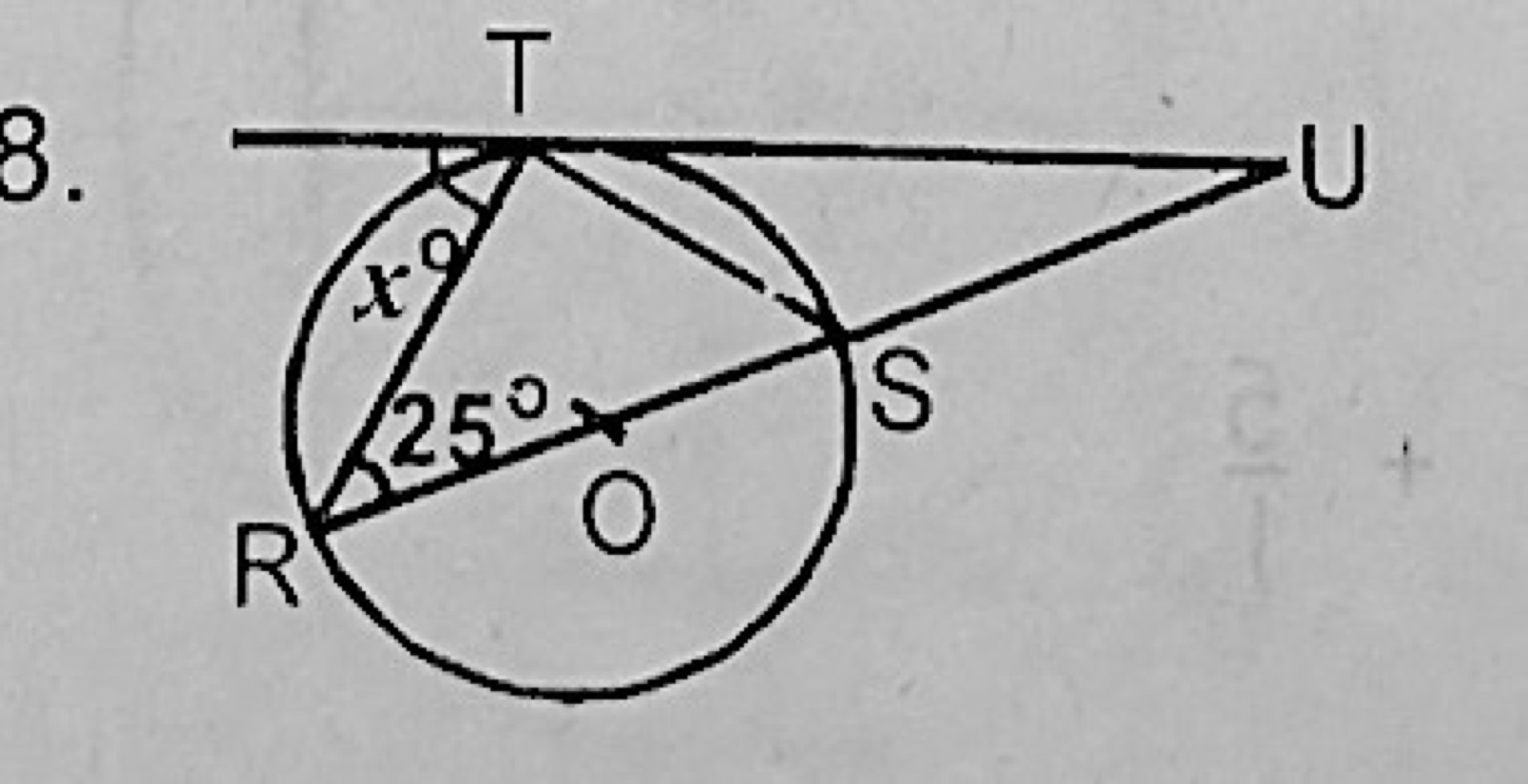
Answer: A (65°)
RS is a diameter, so ∠RTS = 90° and ∠RST = 180° − 90° − 25° = 65°. By the alternate segment theorem, the angle x between the tangent and chord TR equals ∠RST = 65°.
The interior angles of a quadrilateral are (x + 15)°, (2x − 45)°, (x − 30)° and (x + 10)°. Find the value of the least interior angle.
Answer: B (52°)
The angles add to 360°: 5x − 50 = 360, so x = 82. The angles are 97°, 119°, 52° and 92°; the least is 52°.
From the cyclic quadrilateral TUVW above, find the value of x.
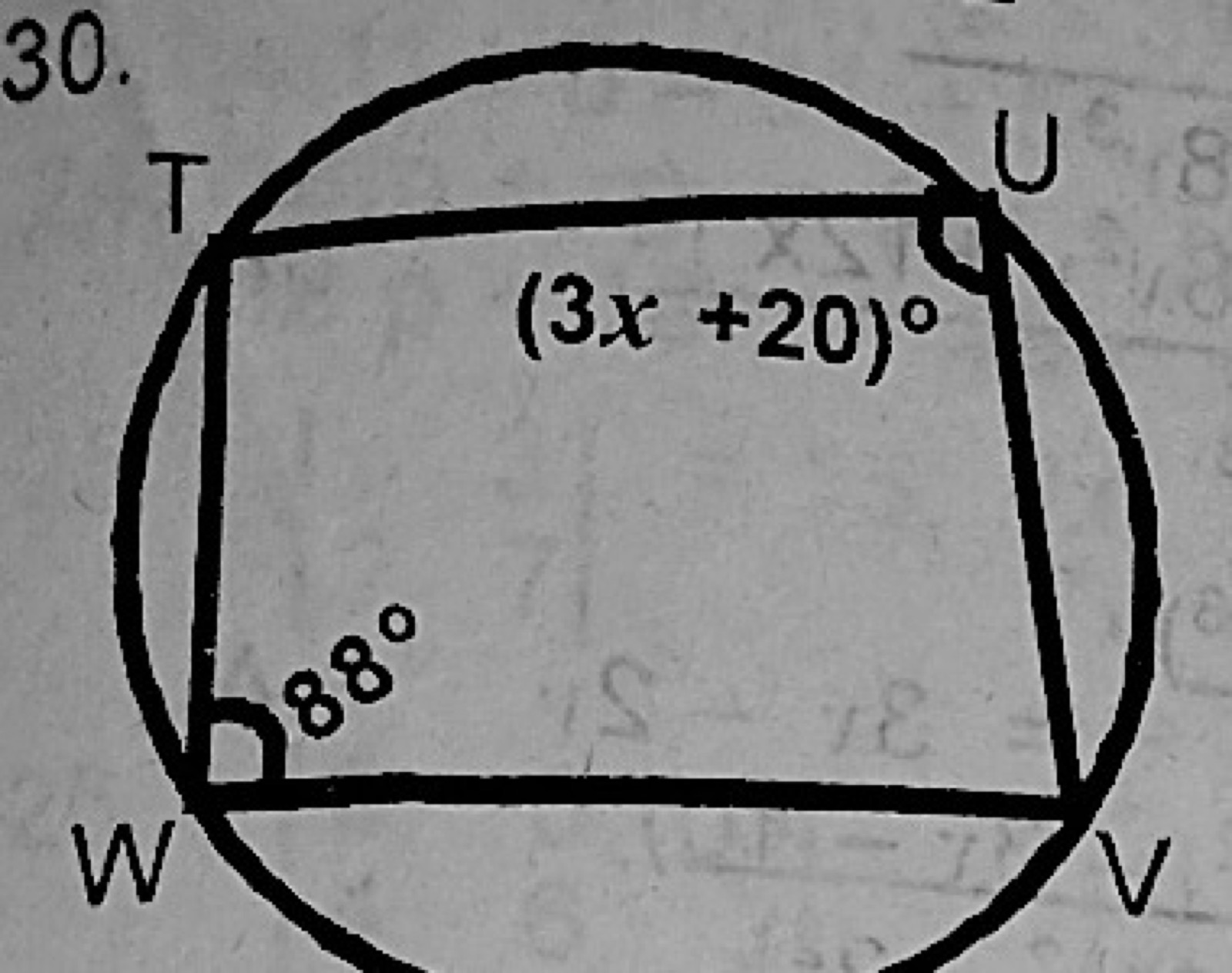
Answer: C (24°)
Opposite angles of a cyclic quadrilateral add to 180°: 3x + 20 + 88 = 180, so 3x = 72 and x = 24°.
If the two smaller sides of a right angled triangle are 4 cm and 5 cm, find its area.
Answer: A (10 cm2)
The two shorter sides are the base and height, so area = ½ × 4 × 5 = 10 cm2.
An arc subtends an angle of 50° at the centre of circle of radius 6 cm. Calculate the area of the sector formed. (π = 22/7)
Answer: B (110/7 cm2)
Area = 50/360 × 22/7 × 36 = 110/7 cm2.
A cylindrical pipe 50 m long with radius 7 m has one end open. What is the total surface area of the pipe?
Answer: D (749π m2)
Curved surface = 2πrh = 2π × 7 × 50 = 700π. One closed end adds πr2 = 49π. Total = 749π m2.
What is the locus of points that is equidistant from points P(1, 3) and Q (3, 5)?
Answer: A (y = −x + 6)
The locus is the perpendicular bisector of PQ. The midpoint is (2, 4) and PQ has gradient 1, so the bisector has gradient −1: y − 4 = −(x − 2), i.e. y = −x + 6.
Find the distance between the points (½, ½) and (−½, −½).
Answer: A (√2)
d = √((½ + ½)2 + (½ + ½)2) = √(1 + 1) = √2.
Find the equation of a line parallel to y = −4x + 2 passing through (2,3).
Answer: D (y + 4x − 11 = 0)
A parallel line has gradient −4: y − 3 = −4(x − 2), so y = −4x + 11, i.e. y + 4x − 11 = 0.
If cot θ = 8/15, where θ is acute, find sin θ.
Answer: B (15/17)
tan θ = 15/8, so the opposite side is 15, the adjacent 8 and the hypotenuse √(225 + 64) = 17. sin θ = 15/17.
If the area of ΔPQR above is 12√3 cm2, find the value of q?
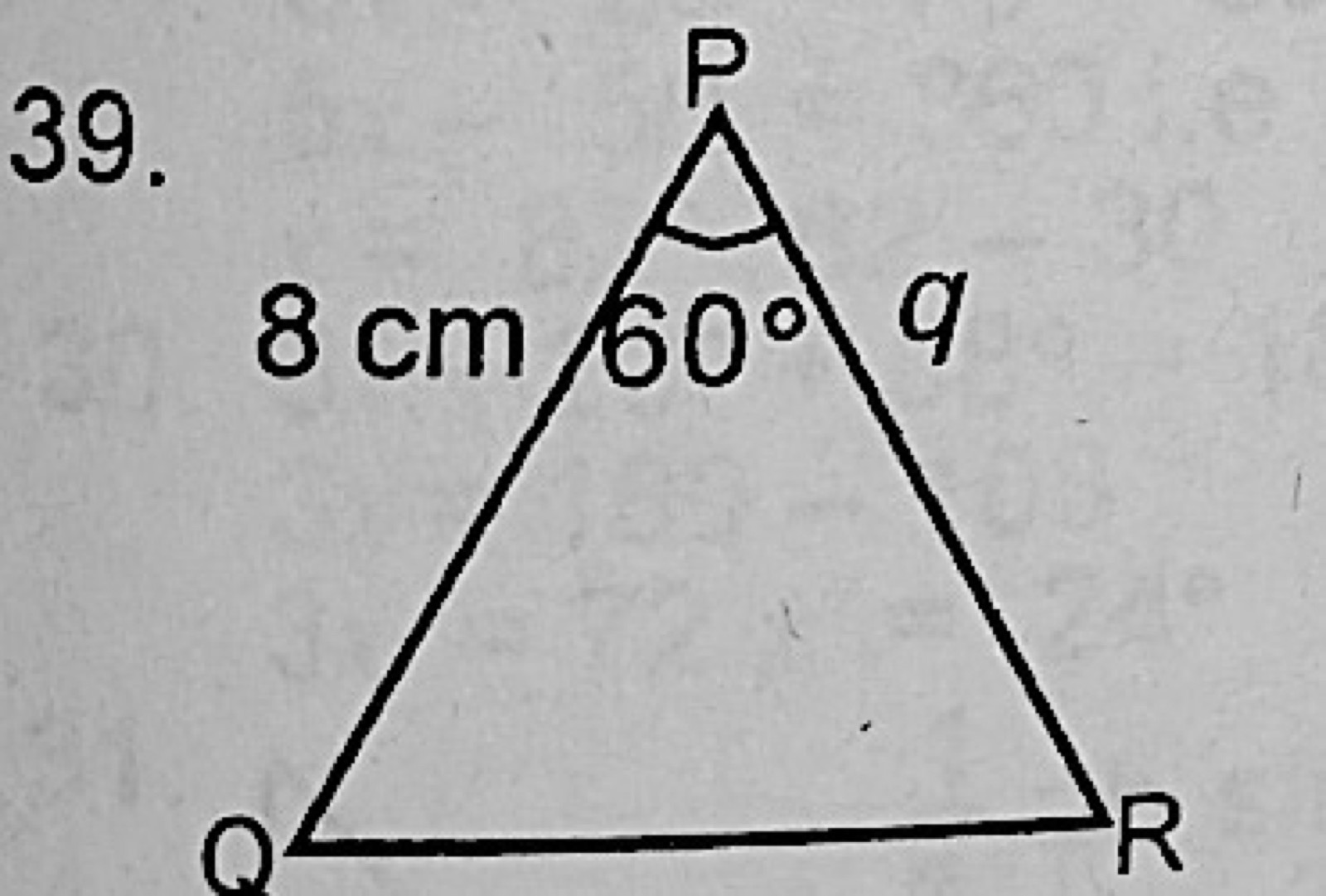
Answer: A (6 cm)
Area = ½ × 8 × q × sin 60° = 2√3 q. Setting 2√3 q = 12√3 gives q = 6 cm.
If y = (2x + 1)3, find dy/dx.
Answer: D (6(2x + 1)2)
By the chain rule, dy/dx = 3(2x + 1)2 × 2 = 6(2x + 1)2.
At what value of x does the function y = −3 − 2x + x2 attain a minimum value?
Answer: A (1)
dy/dx = −2 + 2x = 0 at x = 1, and the second derivative 2 is positive, so the minimum is at x = 1.
Evaluate ∫02 (x3 + x2) dx.
Answer: B (6 2/3)
[x4/4 + x3/3] from 0 to 2 = 4 + 8/3 = 6 2/3.
Find ∫(sin x + 2)dx.
Answer: C (−cos x + 2x + k)
∫sin x dx = −cos x and ∫2 dx = 2x, so the answer is −cos x + 2x + k.
Marks: 2, 3, 4, 5, 6, 7, 8
No. of Students: 3, 1, 5, 2, 4, 2, 3
From the table above, if the pass mark is 5, how many students failed the test?
Answer: D (9)
Students who scored below 5 failed: 3 + 1 + 5 = 9.
Marks: 1, 2, 3, 4, 5
Frequencies: 2, 2, 8, 4, 4
The table above shows the marks obtained in a given test. How many students took the test?
Answer: B (20)
Add the frequencies: 2 + 2 + 8 + 4 + 4 = 20.
Marks: 1, 2, 3, 4, 5
Frequencies: 2, 2, 8, 4, 4
The table above shows the marks obtained in a given test. Find the mean mark.
Answer: D (3.3)
Σfx = 2 + 4 + 24 + 16 + 20 = 66 and Σf = 20, so the mean is 66/20 = 3.3.
Find the standard deviation of 2, 3, 5 and 6.
Answer: A (√(5/2))
The mean is 4. The squared deviations are 4, 1, 1, 4, total 10, so the variance is 10/4 = 5/2 and the SD is √(5/2).
In how many ways can a committee of 2 women and 3 men be chosen from 6 men and 5 women?
Answer: B (200)
5C2 × 6C3 = 10 × 20 = 200.
If three unbiased coins are tossed, find the probability that they are all heads.
Answer: A (1/8)
Each coin is heads with probability ½, so all three is (½)3 = 1/8.