Question 1
Number BasesAdd 11012, 101112 and 1112
- A.1110112
- B.1101102
- C.1010112
- D.1010102
Show the answer and explanation
Answer: C (1010112)
Explanation
In base ten the numbers are 13, 23 and 7, which add to 43 = 32 + 8 + 2 + 1 = 1010112.
47 questions. Try each one, then open the answer to check yourself and read the explanation.
Add 11012, 101112 and 1112
Answer: C (1010112)
In base ten the numbers are 13, 23 and 7, which add to 43 = 32 + 8 + 2 + 1 = 1010112.
If 125x = 2010, find x.
Answer: B (3)
x2 + 2x + 5 = 20, so x2 + 2x − 15 = 0, (x + 5)(x − 3) = 0 and x = 3 (a base must be positive).
Evaluate (3/8 ÷ 1/2 − 1/3)/(1/8 × 2/3 + 1/3)
Answer: D (1)
Top: 3/4 − 1/3 = 5/12. Bottom: 1/12 + 1/3 = 5/12. So the value is 1.
Express 123456 to 3 significant figures
Answer: A (123 000)
Keep the first three digits 123; the next digit 4 is less than 5, so round down: 123 000.
Calculate the simple interest on N7 500 for 8 years at 5% per annum
Answer: A (N3 000)
I = PRT/100 = 7500 × 5 × 8/100 = N3 000.
The cost of kerosene per litre increases from N60 to N85. What is the percentage rate of increase?
Answer: A (42%)
The increase is N25, and 25/60 × 100% ≈ 41.7%, which is 42% to the nearest whole number.
Simplify 16−½ × 4−½ × 271/3
Answer: A (3/8)
16−½ = 1/4, 4−½ = 1/2 and 271/3 = 3, so the product is 3/8.
If logx½ 64 = 3, find the value of x.
Answer: B (16)
(x½)3 = 64, so x3/2 = 64 and x = 642/3 = 16.
If (1 + √2)/(1 − √2) is expressed in the form x + y√2, find the values of x and y.
Answer: A ((−3, −2))
Multiply top and bottom by 1 + √2: (1 + √2)2/(1 − 2) = −(3 + 2√2) = −3 − 2√2, so x = −3, y = −2.
If X = {n2 + 1 : n = 0, 2, 3} and Y = {n + 1 : n = 2, 3, 5}, find X∩Y.
Answer: C (Φ)
X = {1, 5, 10} and Y = {3, 4, 6}. They have no common element, so X ∩ Y is empty.
A bookseller sells Mathematics and English books. If 30 customers buy Mathematics books, 20 customers buy English books and 10 customers buy the two books, how many customers has he altogether?
Answer: B (40)
Total = 30 + 20 − 10 = 40 (the 10 who bought both were counted twice).
Make Q the subject of the formula when L = (4/3)M√(PQ)
Answer: A (9L2/16M2P)
√(PQ) = 3L/(4M). Squaring, PQ = 9L2/(16M2), so Q = 9L2/(16M2P).
If 2x2 − kx − 12 is divisible by x − 4, find the value of k.
Answer: B (5)
By the factor theorem, x = 4 gives zero: 32 − 4k − 12 = 0, so k = 5.
Factorize completely (4x + 3y)2 − (3x − 2y)2
Answer: A ((x + 5y)(7x + y))
Difference of two squares: (4x + 3y − 3x + 2y)(4x + 3y + 3x − 2y) = (x + 5y)(7x + y).
If x − 3 is directly proportional to the square of y and x = 5 when y = 2, find x when y = 6.
Answer: B (21)
x − 3 = ky2: 2 = 4k, so k = ½. When y = 6, x − 3 = 18 and x = 21.
If p varies inversely as the square of q and p = 8 when q = 4, find q when p = 32.
Answer: D (±2)
p = k/q2: k = 8 × 16 = 128. Then q2 = 128/32 = 4, so q = ±2.
Find the range of values of x which satisfy the inequalities 4x − 7 ≤ 3x and 3x − 4 ≤ 4x.
Answer: A (−4 ≤ x ≤ 7)
4x − 7 ≤ 3x gives x ≤ 7, and 3x − 4 ≤ 4x gives x ≥ −4. Together −4 ≤ x ≤ 7.
Solve the quadratic inequality x2 − 5x + 6 ≥ 0
Answer: A (x ≤ 2, x ≥ 3)
x2 − 5x + 6 = (x − 2)(x − 3), which is zero at 2 and 3 and positive outside them: x ≤ 2 or x ≥ 3.
The shaded area that gives the solution set for the inequalities x + y ≤ 3, x − y ≤ 3, is
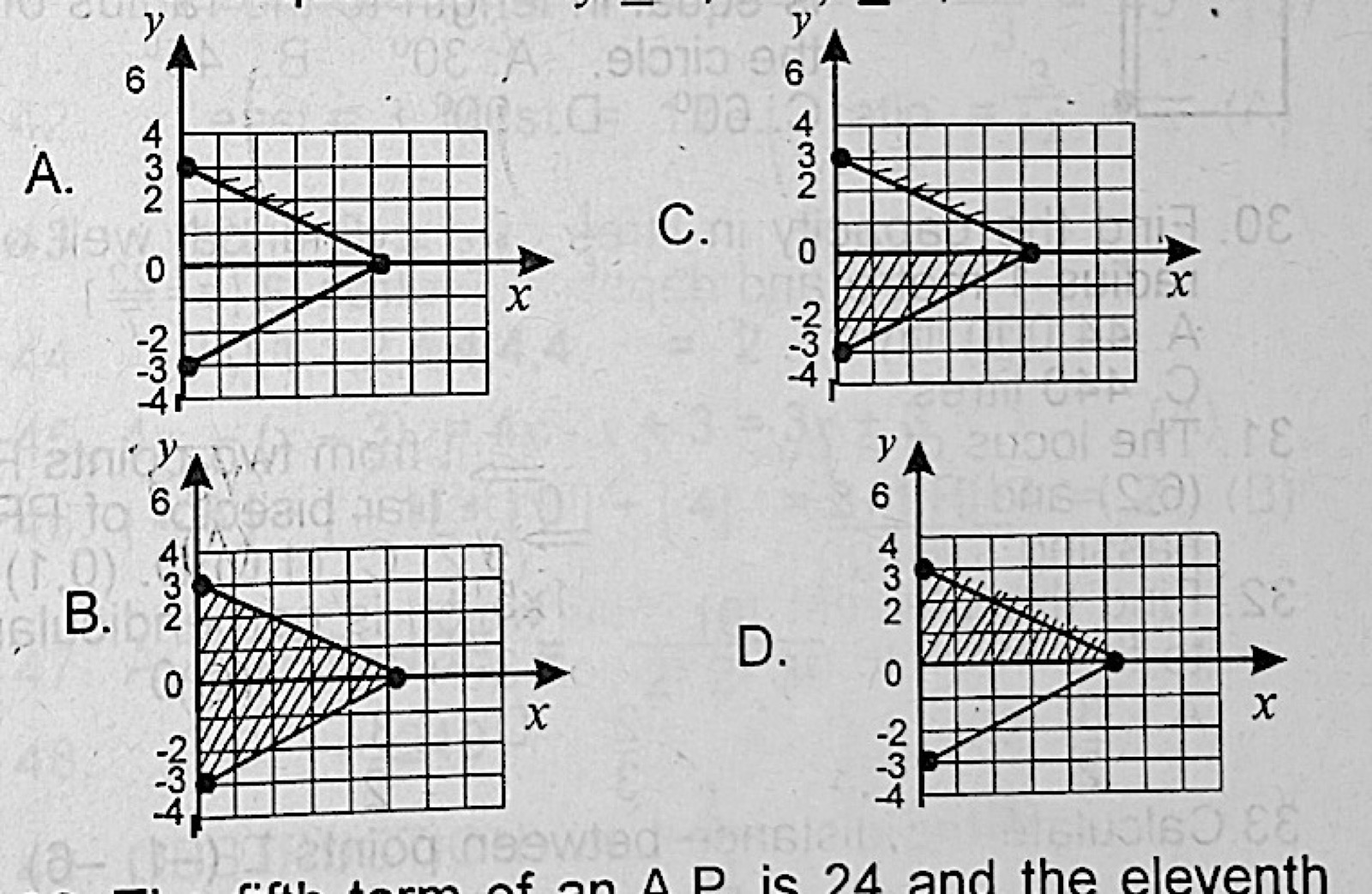
Answer: B (Graph B)
x + y ≤ 3 is on or below the line through (0, 3) and (3, 0); x − y ≤ 3 is on or above the line through (3, 0) and (0, −3). The region between both lines, left of (3, 0), is the one shaded in B.
The fifth term of an A.P. is 24 and the eleventh term is 96. Find the first term.
Answer: D (−24)
a + 4d = 24 and a + 10d = 96, so 6d = 72, d = 12 and a = 24 − 48 = −24.
A binary operation * defined on the set of positive integers is such that x * y = 2x − 3y + 2 for all positive integers x and y. The binary operation is
Answer: B (neither commutative nor closed on the set of positive integers)
y * x = 2y − 3x + 2 is different from x * y, so it is not commutative. 1 * 2 = 2 − 6 + 2 = −2 is not a positive integer, so it is not closed.
A binary operation on the set of real numbers excluding −1 is such that for all m, n ∈ R, m Δ n = m + n + mn. Find the identity element of the operation.
Answer: B (0)
m Δ e = m gives m + e + me = m, so e(1 + m) = 0 and e = 0.
Find the values of x and y respectively if (1 0; −1 −1; 2 2) + (x 1; −1 0; y −2) = (−2 1; −2 −1; −3 0) (matrices written row by row)
Answer: D (−3, −5)
Top-left: 1 + x = −2, so x = −3. Bottom-left: 2 + y = −3, so y = −5.
If (−2 1; 2 3)(p q; r s) = (1 0; 0 1), what is the value of r? (Matrices written row by row.)
Answer: D (1/4)
(p q; r s) is the inverse of (−2 1; 2 3). The determinant is −6 − 2 = −8, so r = −2/(−8) = 1/4.
In the diagram above, PQ//RS. The size of the angle marked x is
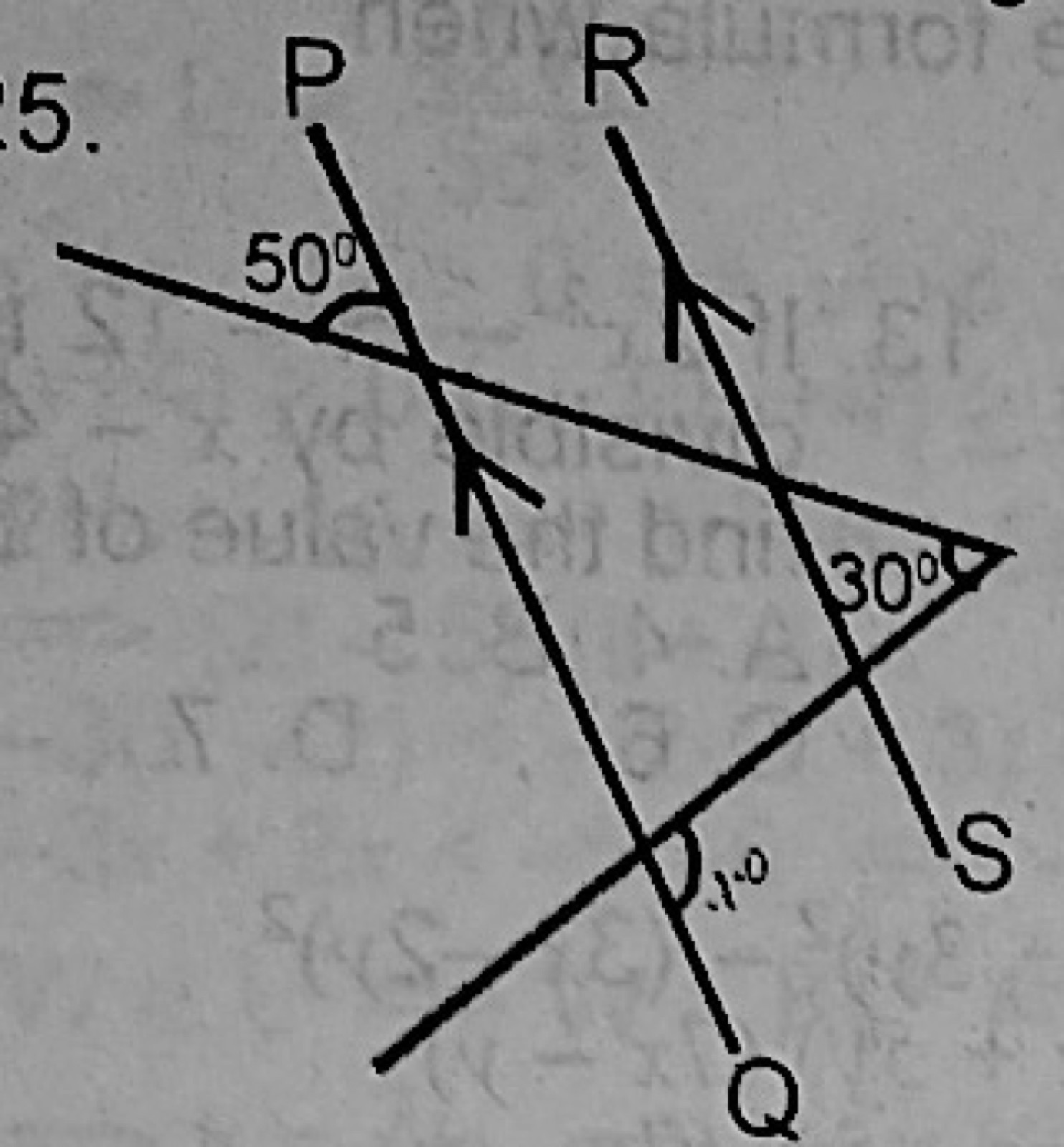
Answer: B (80°)
The two slanting lines and PQ form a triangle with interior angles 50° and 30°. x is the exterior angle at the third corner, so x = 50° + 30° = 80°.
Find the exterior angle of a 12 sided regular polygon.
Answer: D (30°)
Each exterior angle = 360° ÷ 12 = 30°.
In the diagram above, ∠OPQ is
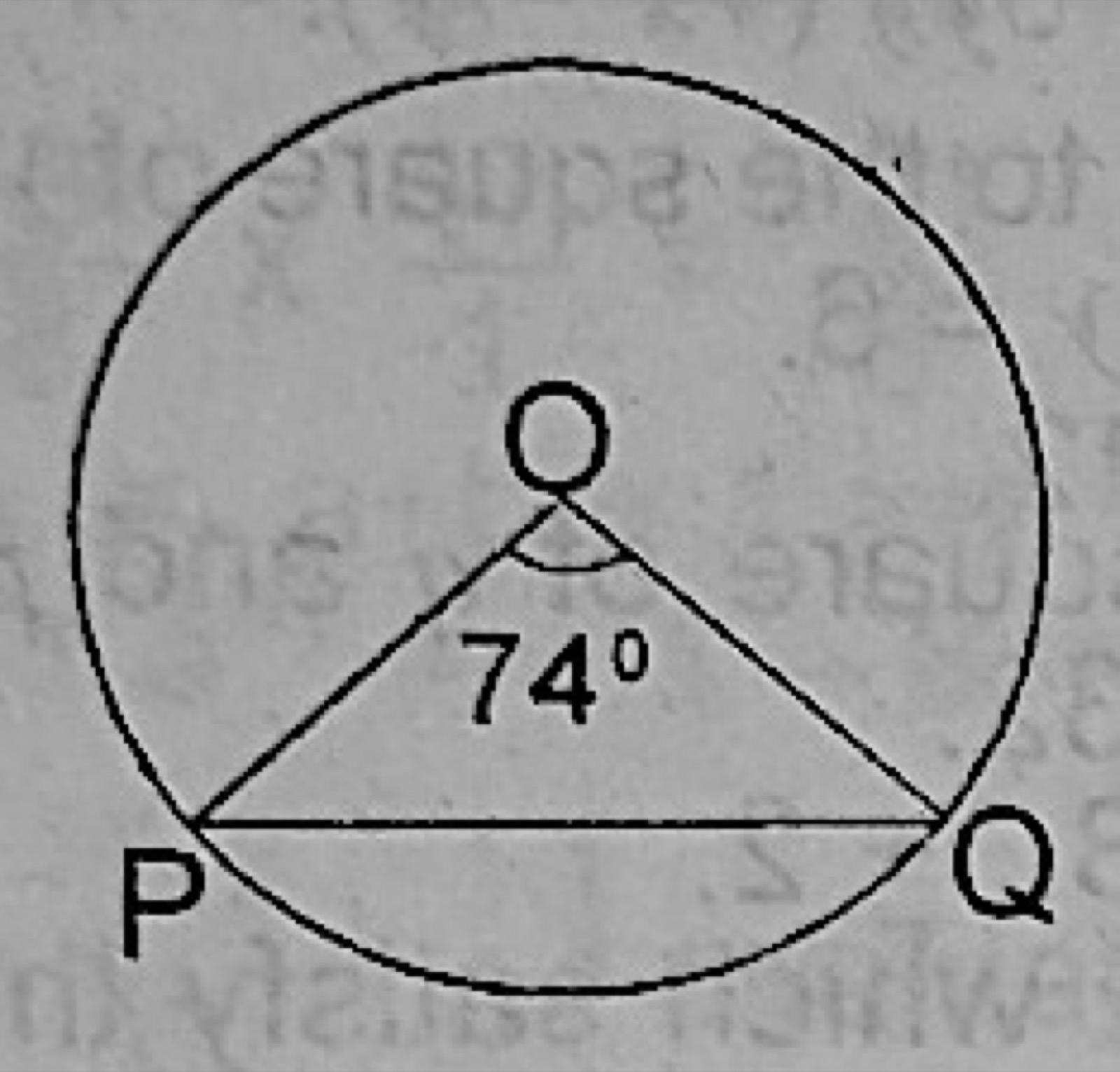
Answer: B (53°)
OP = OQ (radii), so the base angles are equal: ∠OPQ = (180° − 74°)/2 = 53°.
Find the area of the figure above. [π = 22/7]
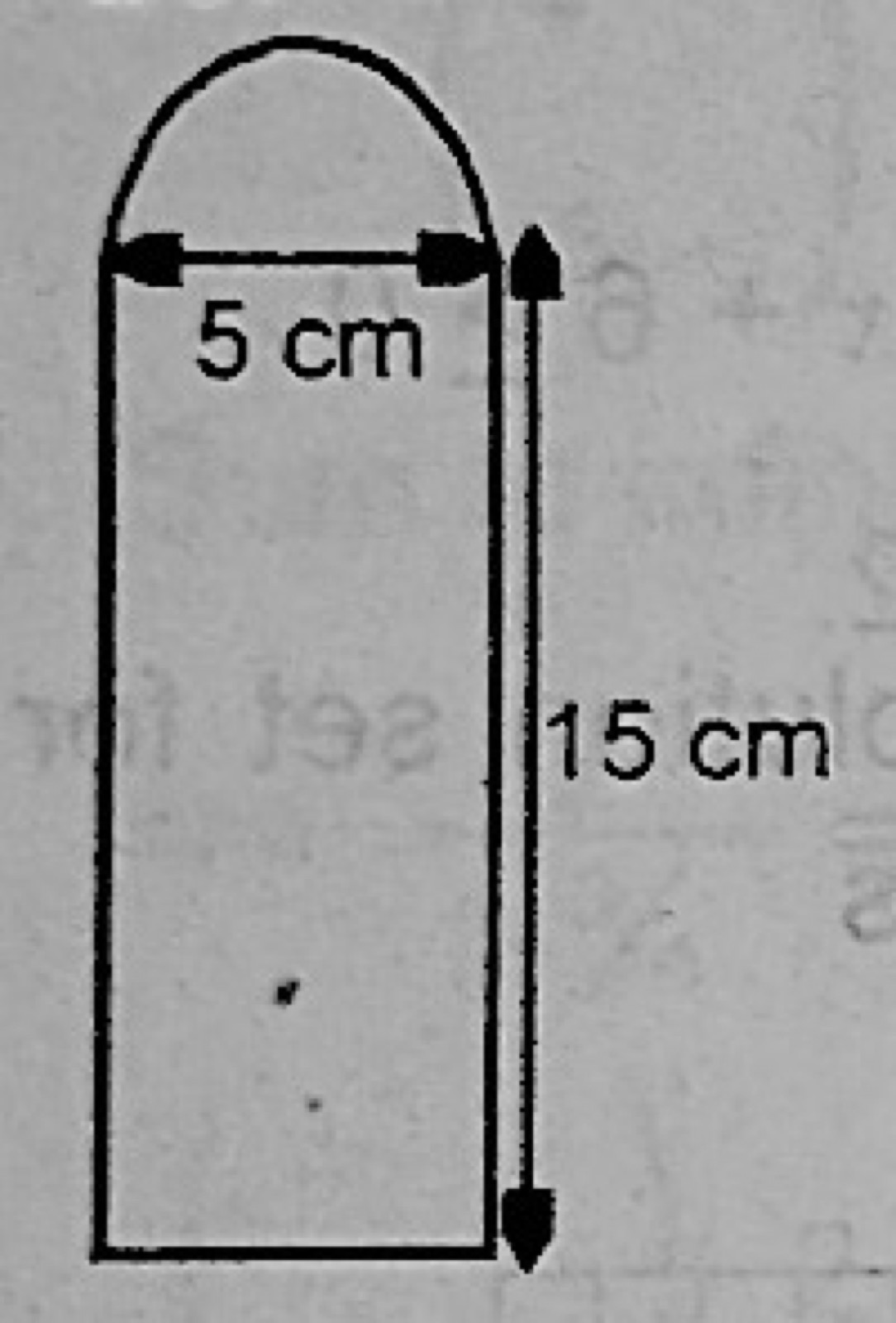
Answer: D (84.8cm2)
Rectangle = 5 × 15 = 75cm2. Semicircle of radius 2.5cm = ½ × 22/7 × 6.25 ≈ 9.8cm2. Total ≈ 84.8cm2.
Find the angle subtended at the centre of a circle by a chord which is equal in length to the radius of the circle.
Answer: C (60°)
The chord and the two radii form an equilateral triangle, so the angle at the centre is 60°.
Find the gradient of the line which is perpendicular to the line with the equation 3x + 2y + 1 = 0
Answer: B (2/3)
2y = −3x − 1, so the line has gradient −3/2. The perpendicular gradient is the negative reciprocal, 2/3.
Calculate the distance between points L(−1, −6) and M(−3, −5)
Answer: A (√5)
d = √((−3 + 1)2 + (−5 + 6)2) = √(4 + 1) = √5.
If sin θ = 3/5, find tan θ.
Answer: A (3/4)
With opposite 3 and hypotenuse 5, the adjacent side is 4, so tan θ = 3/4.
A student sitting on a tower 68 metres high observes his principal's car at an angle of depression of 20°. How far is the car from the bottom of the tower to the nearest metre?
Answer: D (187m)
Distance = 68/tan 20° = 68/0.364 ≈ 186.8m, which is 187m to the nearest metre.
Find the derivative of y = (x7 − x5)/x4.
Answer: C (3x2 − 1)
Simplify first: y = x3 − x, so dy/dx = 3x2 − 1.
Differentiate sin x − x cos x.
Answer: B (x sin x)
d/dx(sin x) = cos x and d/dx(x cos x) = cos x − x sin x. So the derivative is cos x − cos x + x sin x = x sin x.
Find the minimum value of the function y = x(1 + x)
Answer: A (−1/4)
dy/dx = 1 + 2x = 0 at x = −½. The minimum value is y = −½ × ½ = −¼.
Evaluate ∫12 (6x2 − 2x) dx.
Answer: D (11)
[2x3 − x2] from 1 to 2 = (16 − 4) − (2 − 1) = 11.
Evaluate ∫−π/2π/2 cos x dx.
Answer: C (2)
[sin x] from −π/2 to π/2 = 1 − (−1) = 2.
On a pie chart, there are six sectors of which four angles are 30°, 45°, 60°, 90° and the remaining two angles are in the ratio 2:1. Find the smaller angles of the remaining two angles.
Answer: C (45°)
The remaining angles total 360° − 225° = 135°, split 2 : 1 as 90° and 45°. The smaller is 45°.
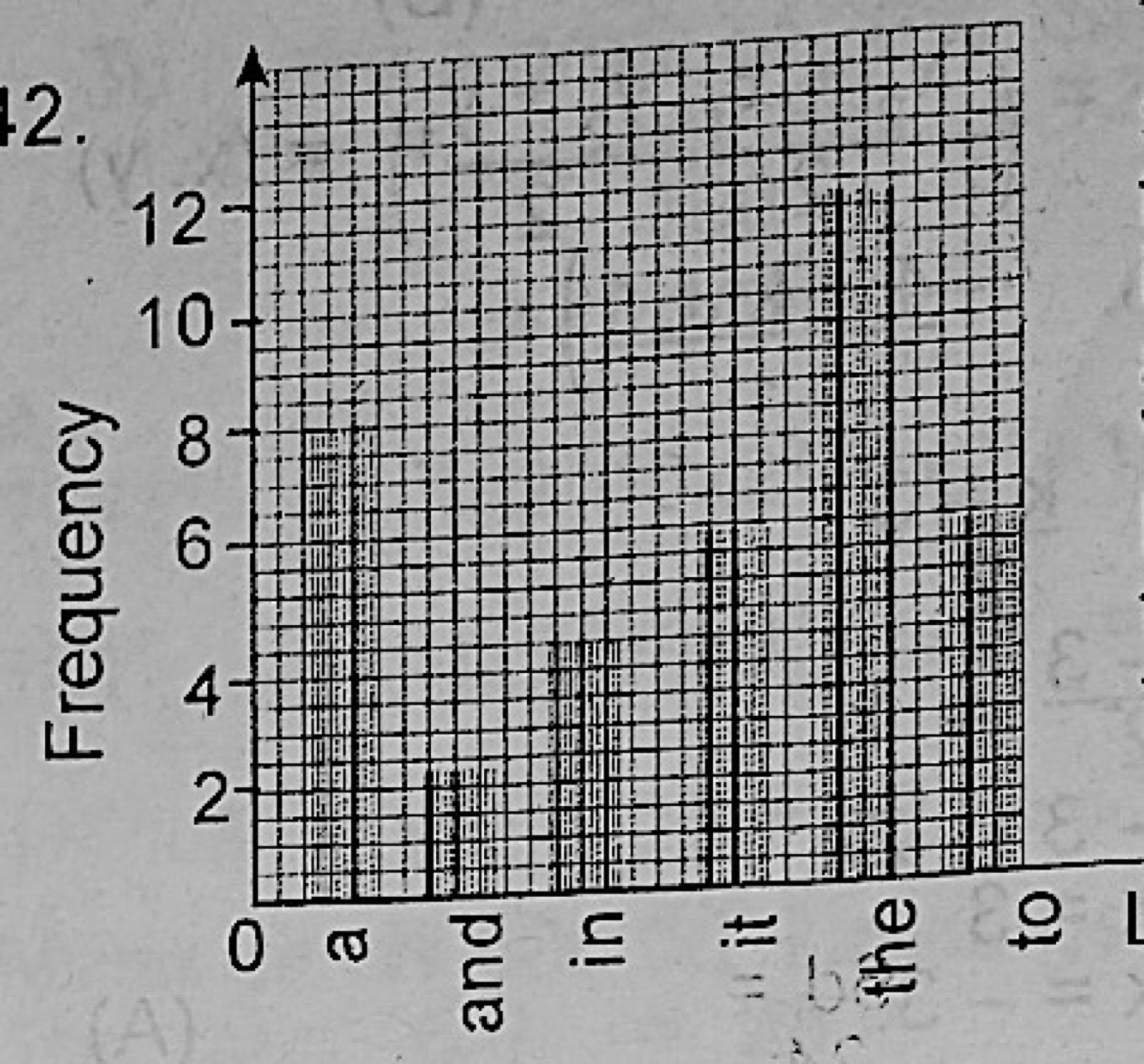
The bar chart above shows the number of times the words a, and, in, it, the, to appear in a paragraph in a book. What is the ratio of the least frequent word to that of the most frequent word?
Answer: A (1/4)
The shortest bar ("and") is about 3 and the tallest ("the") is about 12, giving 3 : 12 = 1/4.
What is the mean of the data t, 2t − 1, t − 2, 2t − 1, 4t and 2t + 2?
Answer: D (2t − 1/3)
The sum is 12t − 2 and there are 6 values, so the mean is (12t − 2)/6 = 2t − 1/3.
Find the median of 4, 1, 4, 1, 0, 4, 4, 2 and 0.
Answer: C (2)
In order: 0, 0, 1, 1, 2, 4, 4, 4, 4. The middle (5th) value is 2.
If x > 0, find the range of the numbers x − 3, 3x + 2, x − 1, 4x, 2x − 1, x − 2, 2x − 2, 3x and 3x + 1.
Answer: A (3x + 3)
For x > 0 the largest is 4x and the smallest is x − 3, so the range is 4x − (x − 3) = 3x + 3.
In how many ways can the letters of the word ACCEPTANCE be arranged?
Answer: A (10!/(2! 2! 3!))
There are 10 letters with A twice, C three times and E twice, so the number of arrangements is 10!/(2! 3! 2!).
Find the number of ways of selecting 6 out of 10 subjects for an examination.
Answer: D (210)
10C6 = 10C4 = 210.
The probability of picking a letter T from the word OBSTRUCTION is
Answer: B (2/11)
OBSTRUCTION has 11 letters, and 2 of them are T, so the probability is 2/11.
The result of rolling a fair die 150 times is summarized in the table below.
Number: 1, 2, 3, 4, 5, 6
Frequency: 12, 18, x, 30, 2x, 45
What is the probability of obtaining a 5?
Answer: B (1/5)
12 + 18 + x + 30 + 2x + 45 = 150 gives 3x = 45 and x = 15. A 5 came up 2x = 30 times, so P = 30/150 = 1/5.