Home › Past questions › JAMB › Mathematics › 2007 44 questions. Try each one, then open the answer to check yourself and read the explanation.
Sign up free to answer these questions on a CBT screen with a timer, then see your score and every answer explained.
Start practising free
Question 1 Measures of Central Tendency If 5, 8, 6 and 2 occur with frequencies 3, 2, 4 and 1 respectively, find the product of the modal and the median number.
A. 36 B. 48 C. 30 D. 40 Show the answer and explanation Answer: A (36 )
Explanation The mode is 6 (frequency 4). In order the 10 numbers are 2, 5, 5, 5, 6, 6, 6, 6, 8, 8, so the median is 6. Product = 36.
Open this question
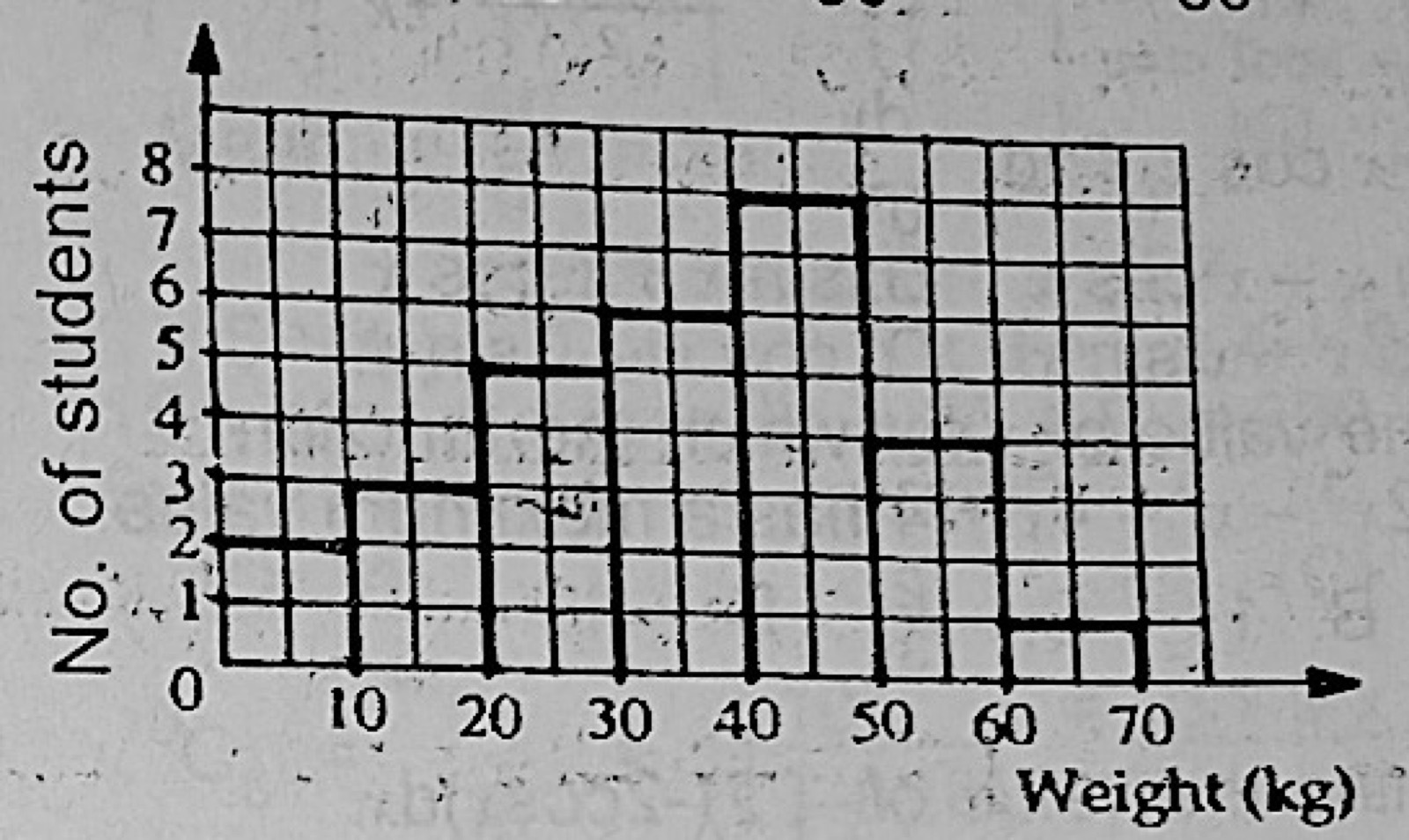
Question 3 Data Presentation The histogram above represents the weights of students who travelled out of their school for an examination. How many people made the trip?
A. 78 B. 38 C. 29 D. 69 Show the answer and explanation Answer: C (29 )
Explanation Add the bar heights: 2 + 3 + 5 + 6 + 8 + 4 + 1 = 29.
Open this question
Question 4 Permutation and Combination A senatorial candidate had planned to visit seven cities prior to a primary election. However, he could only visit four of the cities. How many different itineraries could be considered?
A. 640 B. 840 C. 520 D. 720 Show the answer and explanation Answer: B (840 )
Explanation Order matters for an itinerary, so it is 7 P4 = 7 × 6 × 5 × 4 = 840.
Open this question
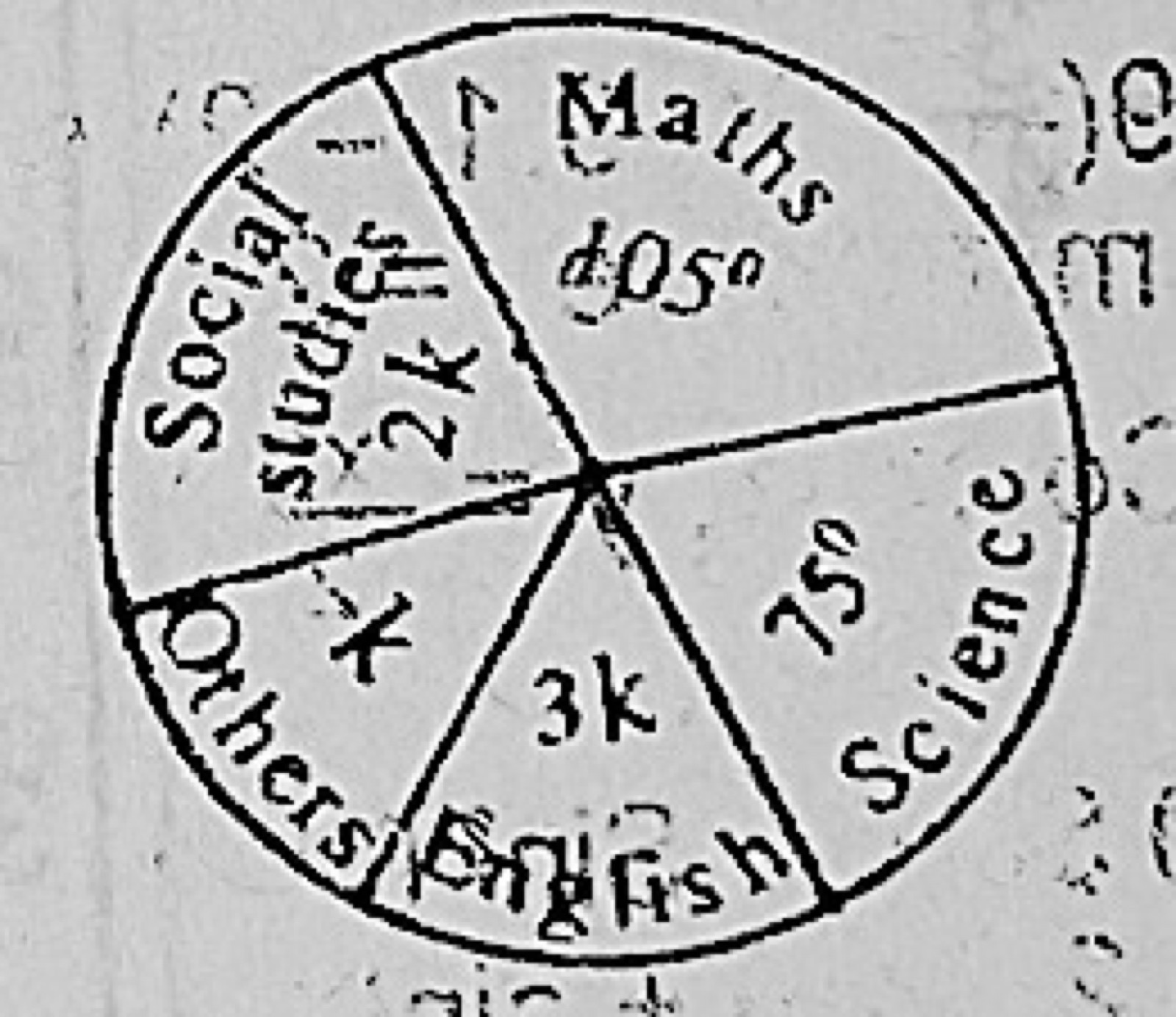
Question 5 Data Presentation The pie chart above illustrates the amount of private time a student spends in a week studying various subjects. Find the value of k.
A. 90° B. 60° C. 30° D. 15° Show the answer and explanation Answer: C (30° )
Explanation 105° + 75° + 2k + k + 3k = 360°, so 6k = 180° and k = 30°.
Open this question
Question 7 Measures of Dispersion What is the mean deviation of 3, 5, 8, 11, 12 and 21?
A. 4.7 B. 60 C. 3.7 D. 10 Show the answer and explanation Answer: A (4.7 )
Explanation The mean is 60/6 = 10. The absolute deviations are 7, 5, 2, 1, 2, 11, which total 28, so the mean deviation = 28/6 ≈ 4.7.
Open this question
Question 8 Measures of Central Tendency Marks: 3, 4, 5, 6, 7, 8
A. 15 B. 13 C. 11 D. 9 Show the answer and explanation Answer: C (11 )
Explanation 15 + 4(y − 1) + 5y + 54 + 28 + 8 = 200 gives 9y + 101 = 200, so y = 11.
Open this question
Question 9 Permutation and Combination In how many ways can 6 subjects be selected from 10 subjects for an examination?
A. 218 B. 216 C. 215 D. 210 Show the answer and explanation Answer: D (210 )
Explanation 10 C6 = 10 C4 = (10 × 9 × 8 × 7)/(4 × 3 × 2 × 1) = 210.
Open this question
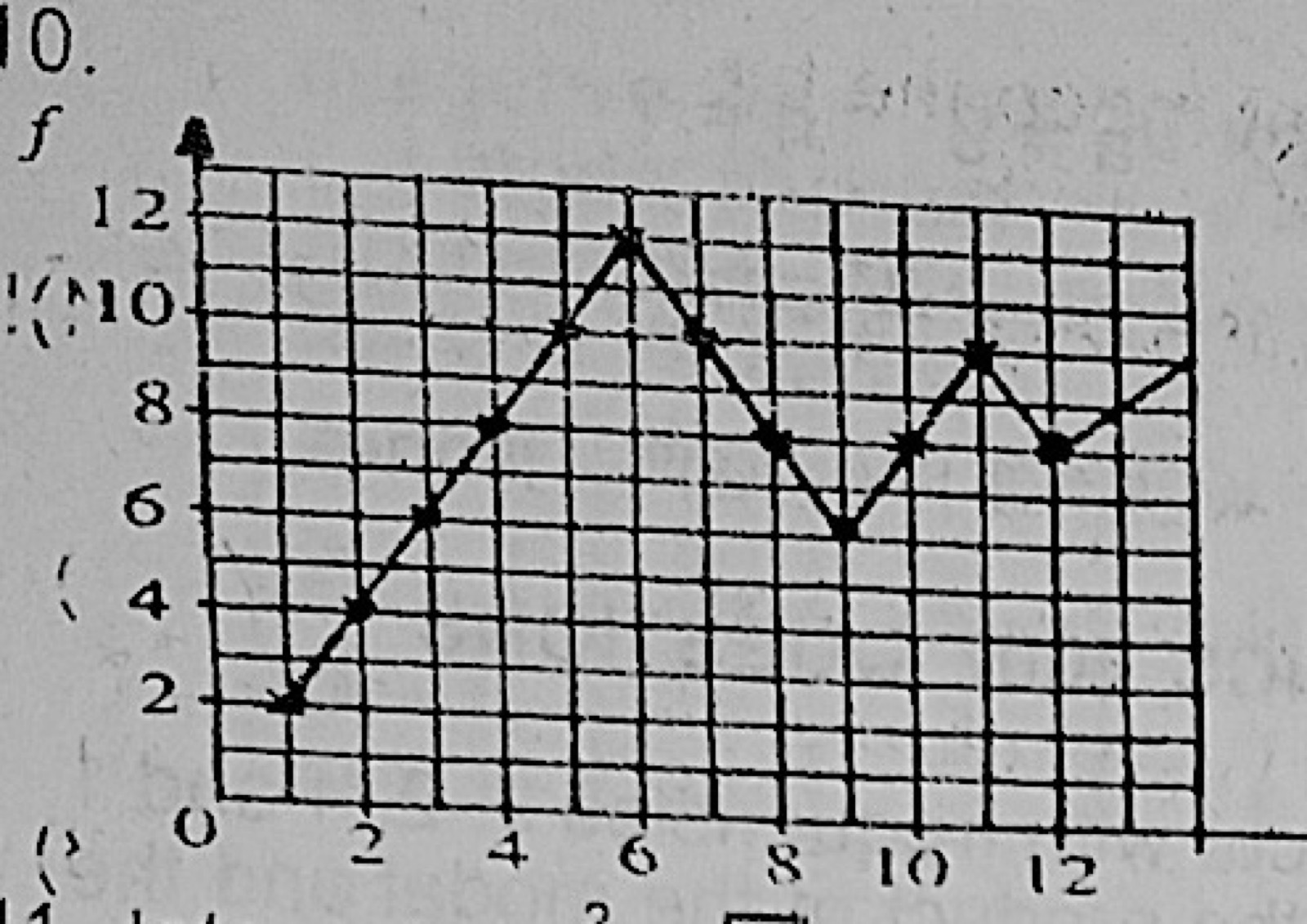
Question 10 Data Presentation The cumulative frequency for 5 ≤ x ≤ 12 from the distribution above is
A. 40 B. 72 C. 22 D. 46 Show the answer and explanation Answer: B (72 )
Explanation Read f at x = 5, 6, ..., 12 from the graph: 10 + 12 + 10 + 8 + 6 + 8 + 10 + 8 = 72.
Open this question
Question 11 Integration Integrate (x2 − √x)/x with respect to x
A. x2 /2 − 2√x + k B. 2(x2 − x)/3x + k C. x2 /2 − √x + k D. (x2 − √x)/x2 + k Show the answer and explanation Answer: A (x2 /2 − 2√x + k )
Explanation Divide first: x − x−½ . Integrating gives x2 /2 − 2x½ + k.
Open this question
Question 13 Differentiation Find the value of x for which the function f(x) = 2x3 − x2 − 4x + 4 has a maximum value.
A. 2/3 B. 1 C. −2/3 D. −1 Show the answer and explanation Answer: C (−2/3 )
Explanation f'(x) = 6x2 − 2x − 4 = 2(3x + 2)(x − 1) = 0 at x = −2/3 or 1. f''(x) = 12x − 2 is negative at x = −2/3, so that is the maximum.
Open this question
Question 14 Integration Determine the value of ∫0 π/2 (−2cos x)dx.
A. −2 B. −½ C. −3 D. −3/2 Show the answer and explanation Answer: A (−2 )
Explanation ∫(−2 cos x)dx = −2 sin x. From 0 to π/2: −2(1 − 0) = −2.
Open this question
Question 16 Binary Operations A binary operation ⊕ on real numbers is defined by x⊕y = xy + x + y for any two real numbers x and y. The value of (−3/4)⊕6 is
A. 3/4 B. −9/2 C. 45/4 D. −3/4 Show the answer and explanation Answer: A (3/4 )
Explanation (−3/4)(6) + (−3/4) + 6 = −18/4 − 3/4 + 24/4 = 3/4.
Open this question
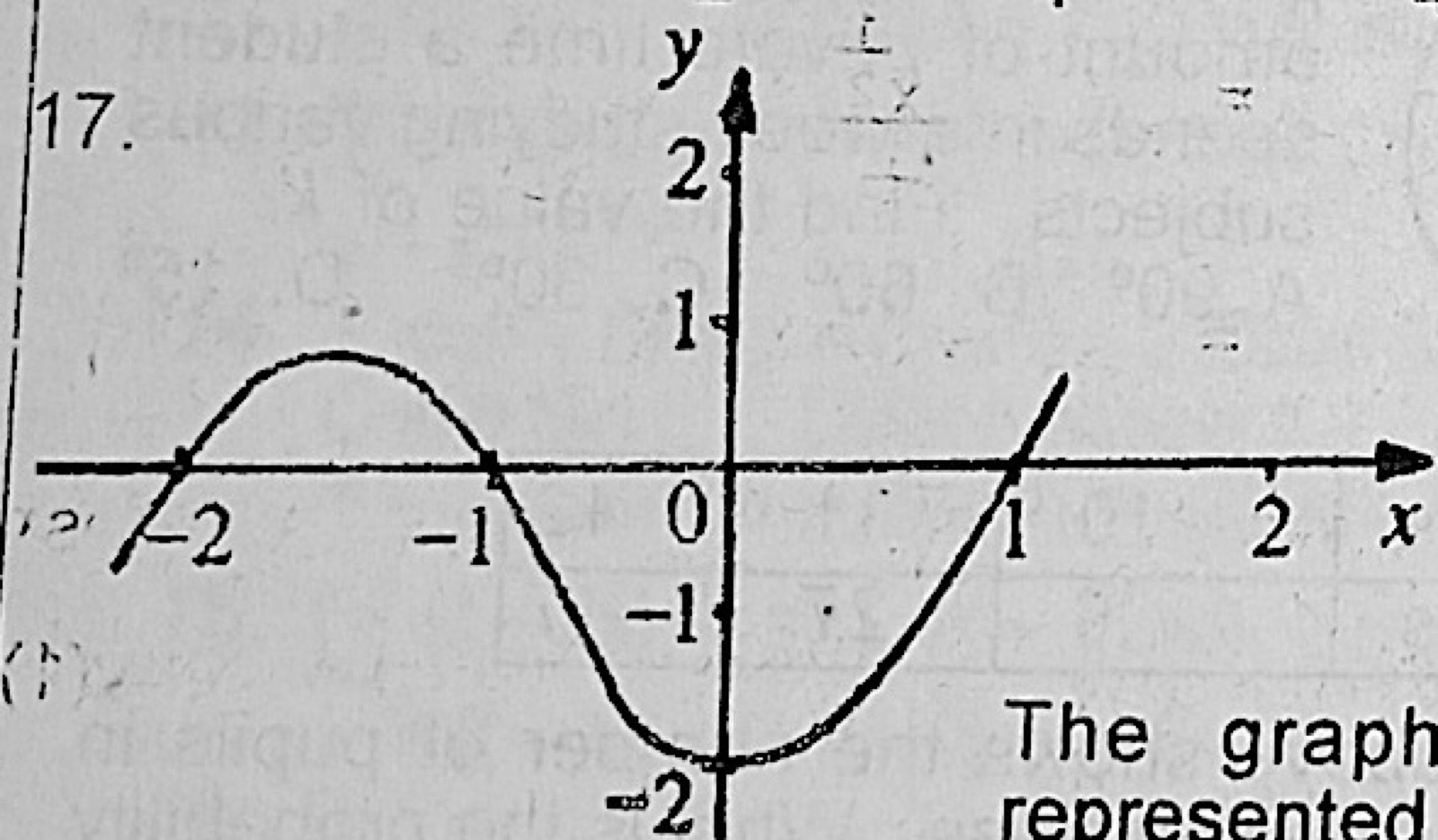
Question 17 Graphs of Functions The graph above is represented by
A. y = x3 − 3x − 2 B. y = x3 + 2x2 − x − 2 C. y = x3 − 4x2 + 5x − 2 D. y = x3 − 4x + 2 Show the answer and explanation Answer: B (y = x3 + 2x2 − x − 2 )
Explanation The curve cuts the x-axis at −2, −1 and 1, so y = (x + 2)(x + 1)(x − 1) = x3 + 2x2 − x − 2, which also gives y = −2 at x = 0 as on the graph.
Open this question
Question 18 Algebraic Expressions Make L the subject of the formula if d = √(42W/5L)
A. √(42W/5d) B. 42W/5d2 C. 42/5dW D. (1/d)√(42W/5) Show the answer and explanation Answer: B (42W/5d2 )
Explanation Square both sides: d2 = 42W/(5L), so 5Ld2 = 42W and L = 42W/(5d2 ).
Open this question
Question 19 Inequalities The solution of the quadratic inequality (x2 + x − 12) ≥ 0 is
A. x ≥ −3 or x ≤ 4 B. x ≥ 3 or x ≥ −4 C. x ≤ 3 or x ≤ −4 D. x ≥ 3 or x ≤ −4 Show the answer and explanation Answer: D (x ≥ 3 or x ≤ −4 )
Explanation x2 + x − 12 = (x + 4)(x − 3), which is zero at −4 and 3 and positive outside them: x ≥ 3 or x ≤ −4.
Open this question
Question 20 Algebraic Expressions Factorize 2t2 + t − 15
A. (2t − 3)(t + 5) B. (t + 3)(2t − 5) C. (t + 3)(t − 5) D. (2t + 3)(t − 5) Show the answer and explanation Answer: B ((t + 3)(2t − 5) )
Explanation Find two numbers with product 2 × (−15) = −30 and sum 1: 6 and −5. 2t2 + 6t − 5t − 15 = 2t(t + 3) − 5(t + 3) = (t + 3)(2t − 5).
Open this question
Question 22 Variation W ∝ L2 and W = 6 when L = 4. If L = √17, find W.
A. 6 7/8 B. 6 5/8 C. 6 3/8 D. 6 1/8 Show the answer and explanation Answer: C (6 3/8 )
Explanation W = kL2 : 6 = 16k, so k = 3/8. Then W = 3/8 × 17 = 51/8 = 6 3/8.
Open this question
Question 23 Binary Operations A binary operation Δ is defined by aΔb = a + b + 1 for any real numbers a and b. Find the inverse of the real number 7 under the operation Δ, if the identity element is −1.
A. −7 B. −9 C. 5 D. 9 Show the answer and explanation Answer: B (−9 )
Explanation 7 Δ a−1 must equal the identity: 7 + a−1 + 1 = −1, so a−1 = −9.
Open this question
Question 24 Progressions The nth term of the sequence ___, 3, 7, 16, 35, 74, ... is
A. 5.2n−2 − n B. 5.2n−2 − (n + 1)/2 C. 3.2n−2 D. 3n/2 Show the answer and explanation Answer: A (5.2n−2 − n )
Explanation Check 5 × 2n−2 − n: n = 2 gives 3, n = 3 gives 7, n = 4 gives 16, n = 5 gives 35 and n = 6 gives 74.
Open this question
Question 25 Matrices and Determinants If f(x) = 3x − 2, P = (2 1; −1 0) and I is 2 × 2 identity matrix, evaluate f(P). (Matrices written row by row.)
A. (6 3; −3 0) B. (2 0; 0 2) C. (8 3; −3 2) D. (4 3; −3 −2) Show the answer and explanation Answer: D ((4 3; −3 −2) )
Explanation f(P) = 3P − 2I = (6 3; −3 0) − (2 0; 0 2) = (4 3; −3 −2).
Open this question
Question 26 Progressions Find the sum to infinity of the series 2 + 3/2 + 9/8 + 27/32 + ...
A. 1 B. 2 C. 8 D. 4 Show the answer and explanation Answer: C (8 )
Explanation a = 2 and r = 3/4, so S = 2/(1 − 3/4) = 8.
Open this question
Question 27 Matrices and Determinants Evaluate (3 −2; −7 5) + 2(−2 4; 3 −1) (matrices written row by row)
A. (3 4; −2 6) B. (−1 6; −1 3) C. (−1 6; 1 3) D. (3 4; 2 6) Show the answer and explanation Answer: B ((−1 6; −1 3) )
Explanation 2(−2 4; 3 −1) = (−4 8; 6 −2). Adding: (3 − 4, −2 + 8; −7 + 6, 5 − 2) = (−1 6; −1 3).
Open this question
Question 28 Surds Find y, if √12 − √147 + y√3 = 0.
A. 5 B. 1 C. 7 D. 3 Show the answer and explanation Answer: A (5 )
Explanation √12 = 2√3 and √147 = 7√3, so 2√3 − 7√3 + y√3 = 0 and y = 5.
Open this question
Question 29 Number Bases If x10 = 12145 find x.
A. 124 B. 121 C. 184 D. 180 Show the answer and explanation Answer: C (184 )
Explanation 12145 = 1 × 125 + 2 × 25 + 1 × 5 + 4 = 184.
Open this question
Question 30 Fractions, Decimals and Approximation Evaluate ((0.5625)2 − (0.4375)2 )/0.04 correct to 3 significant figures.
A. 3.11 B. 3.13 C. 0.313 D. 3.12 Show the answer and explanation Answer: B (3.13 )
Explanation Difference of two squares: (0.5625 + 0.4375)(0.5625 − 0.4375) = 1 × 0.125 = 0.125. 0.125/0.04 = 3.125 ≈ 3.13.
Open this question
Question 31 Indices Find the value of x for which 2(32x−1 ) = 162.
A. 5/2 B. 3/2 C. 2/5 D. 1/2 Show the answer and explanation Answer: A (5/2 )
Explanation 32x−1 = 81 = 34 , so 2x − 1 = 4 and x = 5/2.
Open this question
Question 33 Logarithms If log10 2 = x, express log10 12.5 in terms of x.
A. 2(1 + x) B. 2 + 3x C. 2(1 − x) D. 2 − 3x Show the answer and explanation Answer: D (2 − 3x )
Explanation 12.5 = 100/8, so log 12.5 = log 100 − 3 log 2 = 2 − 3x.
Open this question
Question 34 Commercial Arithmetic A man made a profit of 5% when he sold an article for N60 000.00. How much would he have to sell the article to make a profit of 26%?
A. N68 000 B. N72 000 C. N65 000 D. N70 000 Show the answer and explanation Answer: B (N72 000 )
Explanation Cost price = 60,000 ÷ 1.05. To make 26% profit: 60,000 × 1.26/1.05 = 60,000 × 1.2 = N72,000.
Open this question
Question 35 Sets Given: P = {1, 3, 5, 7, 9, 11} and Q = {2, 4, 6, 8, 10, 12}. Determine the relationship between P and Q.
A. P∩Q = ∅ B. P ⊂ Q C. Q ⊂ P D. P = Q Show the answer and explanation Answer: A (P∩Q = ∅ )
Explanation P holds only odd numbers and Q only even numbers, so they have no common element.
Open this question
Question 36 Number Bases Evaluate 10112 2 − 1012 2 .
A. 1100002 B. 1102 C. 11000002 D. 110002 Show the answer and explanation Answer: C (11000002 )
Explanation 10112 = 11 and 1012 = 5. 121 − 25 = 96 = 64 + 32 = 11000002 .
Open this question
Question 37 Ratio, Percentages and Rates The sum of the ages of Musa and Lawal is 28 years. After sharing a certain sum of money in the ratio of their ages, Musa gets N600 and Lawal N800. How old is Lawal?
A. 20 years B. 16 years C. 14 years D. 12 years Show the answer and explanation Answer: B (16 years )
Explanation Their ages are in the ratio 600 : 800 = 3 : 4, so Lawal is 4/7 × 28 = 16 years.
Open this question
Question 38 Sets If X = {all perfect squares less than 40} and Y = {all odd numbers from 1 to 15}, find X∩Y.
A. {3, 9} B. {9} C. {9, 25} D. {1, 9} Show the answer and explanation Answer: D ({1, 9} )
Explanation X = {1, 4, 9, 16, 25, 36} and Y = {1, 3, 5, ..., 15}. The common elements are 1 and 9.
Open this question
Question 39 Mensuration of Plane Shapes Calculate the length of an arc of a circle of diameter 14 cm, which subtends an angle of 90° at the centre of the circle.
A. 7π/2 cm B. 7π cm C. 14π cm D. 7π/4 cm Show the answer and explanation Answer: A (7π/2 cm )
Explanation r = 7, so the arc = 90/360 × 2π × 7 = 7π/2 cm.
Open this question
Question 40 Coordinate Geometry If the lines 3y = 4x − 1 and qy = x + 3 are parallel to each other, the value of q is
A. −4/3 B. −3/4 C. 4/3 D. 3/4 Show the answer and explanation Answer: D (3/4 )
Explanation The gradients are 4/3 and 1/q. Parallel lines have equal gradients, so 1/q = 4/3 and q = 3/4.
Open this question
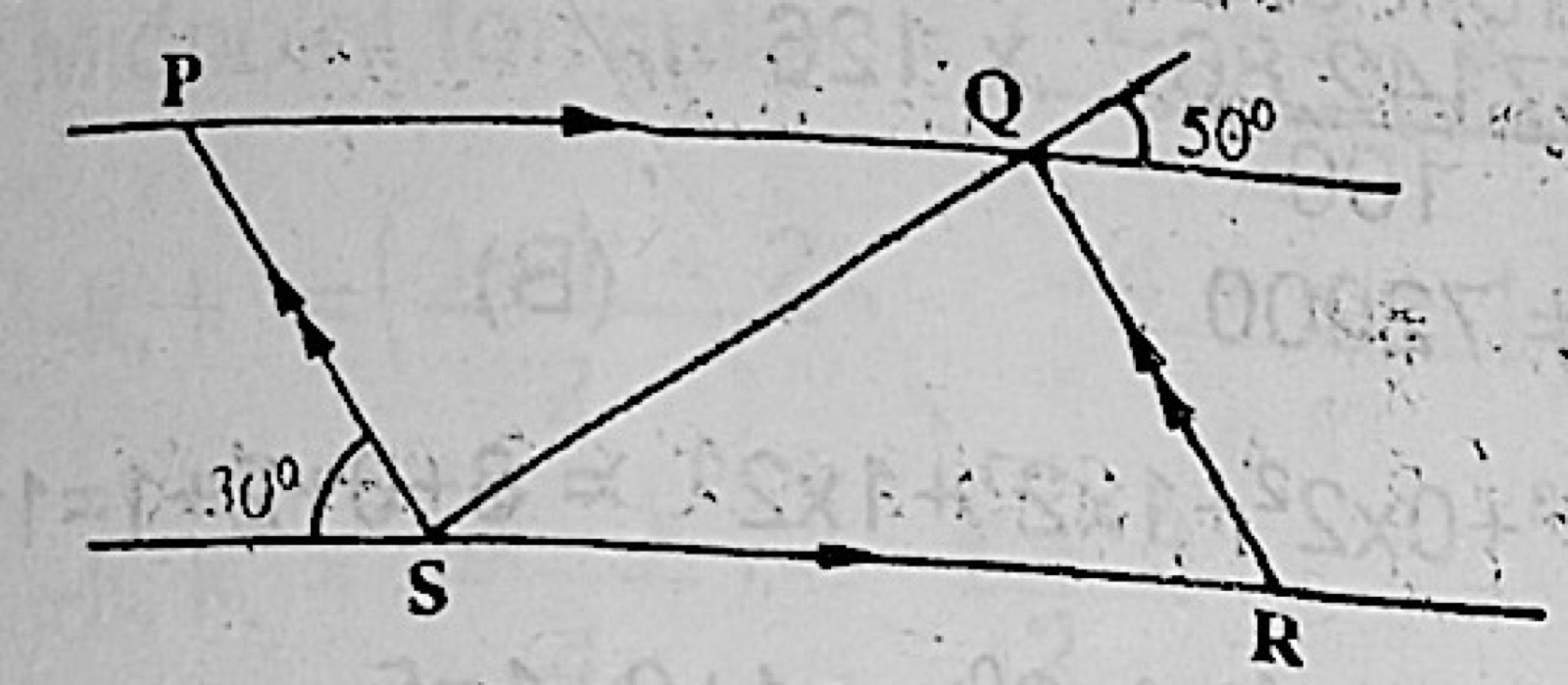
Question 41 Angles and Polygons In the parallelogram PQRS above, find angle SQR.
A. 100° B. 80° C. 50° D. 30° Show the answer and explanation Answer: A (100° )
Explanation ∠QSR = 50° (alternate to the 50° at Q). ∠PSR = 180° − 30° = 150°, so ∠SRQ = 30° (co-interior angles). Then ∠SQR = 180° − 50° − 30° = 100°.
Open this question
Question 42 Mensuration of Solids The volume of a hemispherical bowl is 718⅔ cm3 . Find its radius. [π = 22/7]
A. 4.0 cm B. 5.6 cm C. 7.0 cm D. 3.8 cm Show the answer and explanation Answer: C (7.0 cm )
Explanation (2/3) × 22/7 × r3 = 2156/3, so r3 = 2156/3 × 3/2 × 7/22 = 343 and r = 7cm.
Open this question
Question 43 Loci A particle P moves between points S and T such that angle SPT is always constant. Find the locus of P.
A. It is a semi-circle with ST as diameter. B. It is a perpendicular bisector of ST. C. It is a quadrant of a circle with ST as diameter. D. It is a straight line perpendicular to ST. Show the answer and explanation Answer: A (It is a semi-circle with ST as diameter. )
Explanation Points that see ST at a fixed angle lie on a circular arc through S and T; of the choices, the semicircle on ST as diameter is the arc (the case where the angle is 90°).
Open this question
Question 44 Coordinate Geometry If the lines 2y − kx + 2 = 0 and y + x − k/2 = 0 intersect at (1, −2), find the value of k.
A. −4 B. −3 C. −2 D. −1 Show the answer and explanation Answer: C (−2 )
Explanation Put (1, −2) into the first line: −4 − k + 2 = 0, so k = −2. It also fits the second line: −2 + 1 + 1 = 0.
Open this question
Question 45 Trigonometry A man 40 m from the foot of a tower observes the angle of elevation of the tower to be 30°. Determine the height of the tower.
A. 40√3/3 m B. 20 m C. 40√3 m D. 40 m Show the answer and explanation Answer: A (40√3/3 m )
Explanation height = 40 tan 30° = 40/√3 = 40√3/3 m.
Open this question
Question 46 Loci Find the locus of points equidistant from two straight lines y − 5 = 0 and y − 3 = 0.
A. y − 2 = 0 B. y − 4 = 0 C. x − 1 = 0 D. y − 3 = 0 Show the answer and explanation Answer: B (y − 4 = 0 )
Explanation The lines y = 5 and y = 3 are parallel; points halfway between them lie on y = 4, i.e. y − 4 = 0.
Open this question
Question 47 Coordinate Geometry What is the value of k if the mid-point of the line joining (1 − k, −4) and (2, k + 1) is (−k, k)?
A. −3 B. −1 C. −4 D. −2 Show the answer and explanation Answer: A (−3 )
Explanation x: (3 − k)/2 = −k gives k = −3. y: (k − 3)/2 = k also gives k = −3.
Open this question
Question 48 Angles and Polygons Find the size of each exterior angle of a regular octagon.
A. 51° B. 45° C. 40° D. 36° Show the answer and explanation Answer: B (45° )
Explanation Exterior angles add to 360°, so each is 360° ÷ 8 = 45°.
Open this question
Question 49 Trigonometry Find the value of (tan 60° − tan 30°)/(tan 60° + tan 30°)
A. 4/√3 B. 2/√3 C. 1 D. 1/2 Show the answer and explanation Answer: D (1/2 )
Explanation tan 60° = √3 and tan 30° = 1/√3: (√3 − 1/√3)/(√3 + 1/√3) = (2/√3)/(4/√3) = 1/2.
Open this question
Question 50 Mensuration of Plane Shapes The area of a square is 144 sq cm. Find the length of the diagonal.
A. 13 cm B. 12√2 cm C. 12 cm D. 11√3 cm Show the answer and explanation Answer: B (12√2 cm )
Explanation The side is √144 = 12cm, and the diagonal of a square is side × √2 = 12√2 cm.
Open this question Sign up free for every JAMB Mathematics year, practice by topic and timed mocks.
Start practising free