Question 1
IndicesWithout using tables, evaluate (343)1/3 × (0.14)−1 × (25)−1/2
- A.10
- B.12
- C.8
- D.7
Show the answer and explanation
Answer: A (10)
Explanation
(343)1/3 = 7, (0.14)−1 = 100/14 and (25)−1/2 = 1/5. So 7 × 100/14 × 1/5 = 50/5 = 10.
49 questions. Try each one, then open the answer to check yourself and read the explanation.
Without using tables, evaluate (343)1/3 × (0.14)−1 × (25)−1/2
Answer: A (10)
(343)1/3 = 7, (0.14)−1 = 100/14 and (25)−1/2 = 1/5. So 7 × 100/14 × 1/5 = 50/5 = 10.
In a school, 220 students offer Biology or Mathematics or both. 125 offer Biology and 110 Mathematics. How many offer Biology but not Mathematics?
Answer: D (110)
Both = 125 + 110 − 220 = 15. Biology but not Mathematics = 125 − 15 = 110.
Simplify 52.4 − 5.7 − 3.45 − 1.75
Answer: B (41.5)
Add the amounts being subtracted: 5.7 + 3.45 + 1.75 = 10.9. Then 52.4 − 10.9 = 41.5.
Simplify (√0.7 + √70)2
Answer: A (84.7)
Expand: 0.7 + 70 + 2√(0.7 × 70) = 70.7 + 2√49 = 70.7 + 14 = 84.7.
Evaluate (0.21 × 0.072 × 0.00054)/(0.006 × 1.68 × 0.063), correct to four significant figures.
Answer: A (0.01286)
The numerator is 0.0000081648 and the denominator 0.00063504. Their quotient is 0.012857…, which is 0.01286 to 4 significant figures.
A trader bought goats for N4000 each. He sold them for N180,000 at a loss of 25%. How many goats did he buy?
Answer: A (60)
Selling at a 25% loss means N180 000 is 75% of the cost, so the cost was N240 000. At N4000 each, that is 60 goats.
If dy/dx = 2x − 3 and y = 3 when x = 0, find y in terms of x.
Answer: D (x2 − 3x + 3)
Integrating gives y = x2 − 3x + k. Since y = 3 when x = 0, k = 3.
Find the derivative of y = sin2(5x) with respect to x.
Answer: A (10 sin 5x cos 5x)
By the chain rule: 2 sin 5x × cos 5x × 5 = 10 sin 5x cos 5x.
The slope of the tangent to the curve y = 3x2 − 2x + 5 at the point (1, 6) is
Answer: A (4)
dy/dx = 6x − 2, which is 6 − 2 = 4 at x = 1.
Evaluate ∫sin 3x dx
Answer: C (−(1/3)cos 3x + c)
The integral of sin ax is −(1/a)cos ax. With a = 3 this is −(1/3)cos 3x + c.
A circle with a radius 5cm has its radius increasing at the rate of 0.2cms−1. What will be the corresponding increase in the area?
Answer: A (2π)
A = πr2, so dA/dt = 2πr × dr/dt = 2π × 5 × 0.2 = 2π cm2 per second.
If y = x2 − 1/x, find dy/dx
Answer: D (2x + 1/x2)
−1/x = −x−1, whose derivative is +x−2. So dy/dx = 2x + 1/x2.
Use the graph above to find the values of p and q if px + qy ≤ 4.
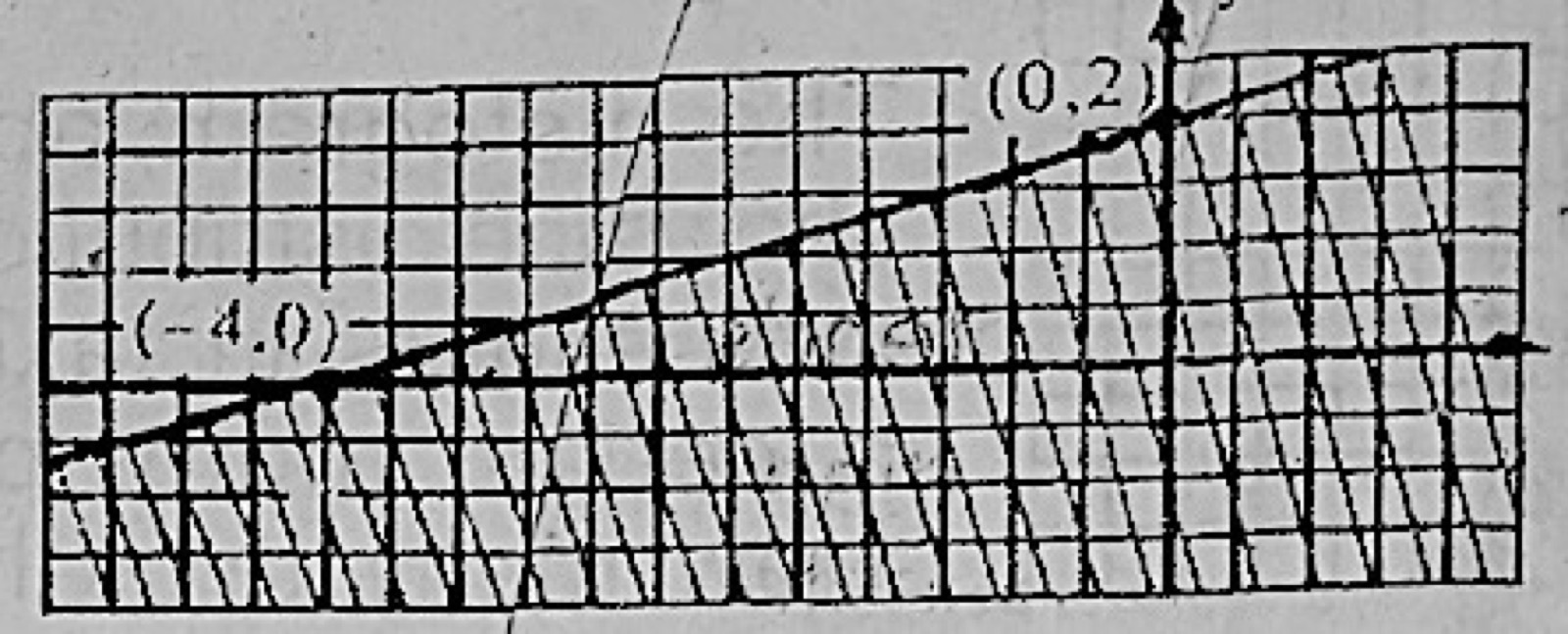
Answer: D (p = −1, q = 2)
The boundary passes through (−4, 0) and (0, 2), so it is y = x/2 + 2, i.e. −x + 2y = 4. The shaded side is below the line, so −x + 2y ≤ 4, giving p = −1, q = 2.
Solve for x in the equation x3 − 5x2 − x + 5 = 0
Answer: A (1, −1 or 5)
Group the terms: x2(x − 5) − 1(x − 5) = (x − 5)(x − 1)(x + 1) = 0. So x = 1, −1 or 5.
The time taken to do a piece of work is inversely proportional to the number of men employed. If it takes 45 men to do a piece of work in 5 days, how long will it take 25 men?
Answer: D (9 days)
The work needs 45 × 5 = 225 man-days. With 25 men it takes 225 ÷ 25 = 9 days.
If P = [2, 1; −3, 0] and I is a 2 × 2 unit matrix, evaluate P2 − 2P + 4I
Answer: C ([1, 0; 0, 1])
P2 = [1, 2; −6, −3] and 2P = [4, 2; −6, 0]. So P2 − 2P + 4I = [1 − 4 + 4, 0; 0, −3 + 4] = [1, 0; 0, 1].
Find the range of values of x for which (x + 2)/4 − (2x − 3)/3 < 4
Answer: A (x > −6)
Multiply by 12: 3x + 6 − 8x + 12 < 48, so −5x < 30. Dividing by −5 reverses the sign: x > −6.
Find the maximum value of y in the equation y = 1 − 2x − 3x2
Answer: D (4/3)
dy/dx = −2 − 6x = 0 gives x = −1/3. Then y = 1 + 2/3 − 1/3 = 4/3.
If the 9th term of an A.P. is five times the 5th term, find the relationship between a and d.
Answer: C (a + 3d = 0)
a + 8d = 5(a + 4d) gives a + 8d = 5a + 20d, so 4a + 12d = 0, i.e. a + 3d = 0.
The inverse of the function f(x) = 3x + 4 is
Answer: A ((1/3)(x − 4))
Put y = 3x + 4 and solve for x: x = (y − 4)/3. So f−1(x) = (1/3)(x − 4).
If −2 is the solution of the equation 2x + 1 − 3c = 2c + 3x − 7, find the value of c.
Answer: C (2)
Put x = −2: −4 + 1 − 3c = 2c − 6 − 7, so −3 − 3c = 2c − 13. Then 10 = 5c and c = 2.
An operation * is defined on the set of integers p and q by p * q = pq + p + q. Find 2 * (3 * 4).
Answer: A (59)
First 3 * 4 = 12 + 3 + 4 = 19. Then 2 * 19 = 38 + 2 + 19 = 59.
If N = [3, 5, −4; 6, −3, −5; −2, 2, 1], find |N|
Answer: A (17)
Expanding along the first row: 3(−3 + 10) − 5(6 − 10) + (−4)(12 − 6) = 21 + 20 − 24 = 17.
The sum to infinity of the series 1 + 1/3 + 1/9 + 1/27 + … is
Answer: D (3/2)
This is a G.P. with a = 1 and r = 1/3. Its sum to infinity is a/(1 − r) = 1 ÷ (2/3) = 3/2.
If x varies directly as √n and x = 9 when n = 9, find x when n = 17/9
Answer: D (√17)
x = k√n with 9 = 3k, so k = 3. When n = 17/9, x = 3 × √17/3 = √17.
In the diagram above, PST is a straight line, PQ = QS = RS. If ∠RST = 72°, find x.
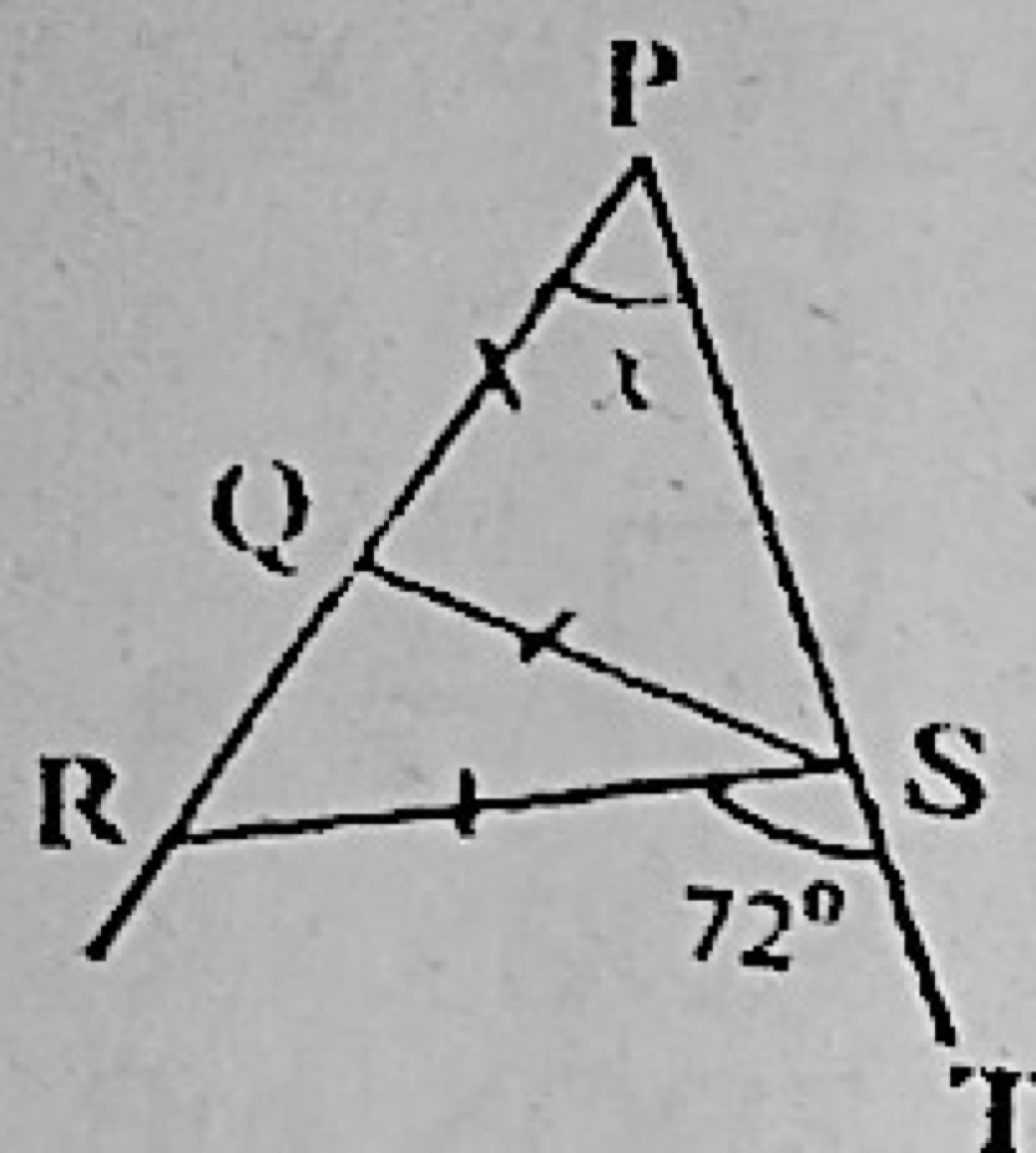
Answer: D (24°)
Triangle PQS is isosceles, so ∠QSP = x and the exterior angle ∠SQR = 2x. Triangle QSR is isosceles, so ∠SRQ = 2x. ∠RST is exterior to triangle PRS, so 3x = 72° and x = 24°.
A chord of a circle subtends an angle of 120° at the centre of a circle of diameter 4√3cm. Calculate the area of the major sector.
Answer: D (8πcm2)
The radius is 2√3 cm, so r2 = 12. The major sector has angle 360° − 120° = 240°, giving area (240/360) × π × 12 = 8π cm2.
Find the equation of the set of points which are equidistant from the parallel lines x = 1 and x = 7
Answer: C (x = 4)
Points halfway between the vertical lines x = 1 and x = 7 lie on the vertical line x = (1 + 7)/2 = 4.
In the diagram above, XZ is the diameter of the circle XYZW, with centre O and radius 15/2cm. If XY = 12cm, find the area of the triangle XYZ.
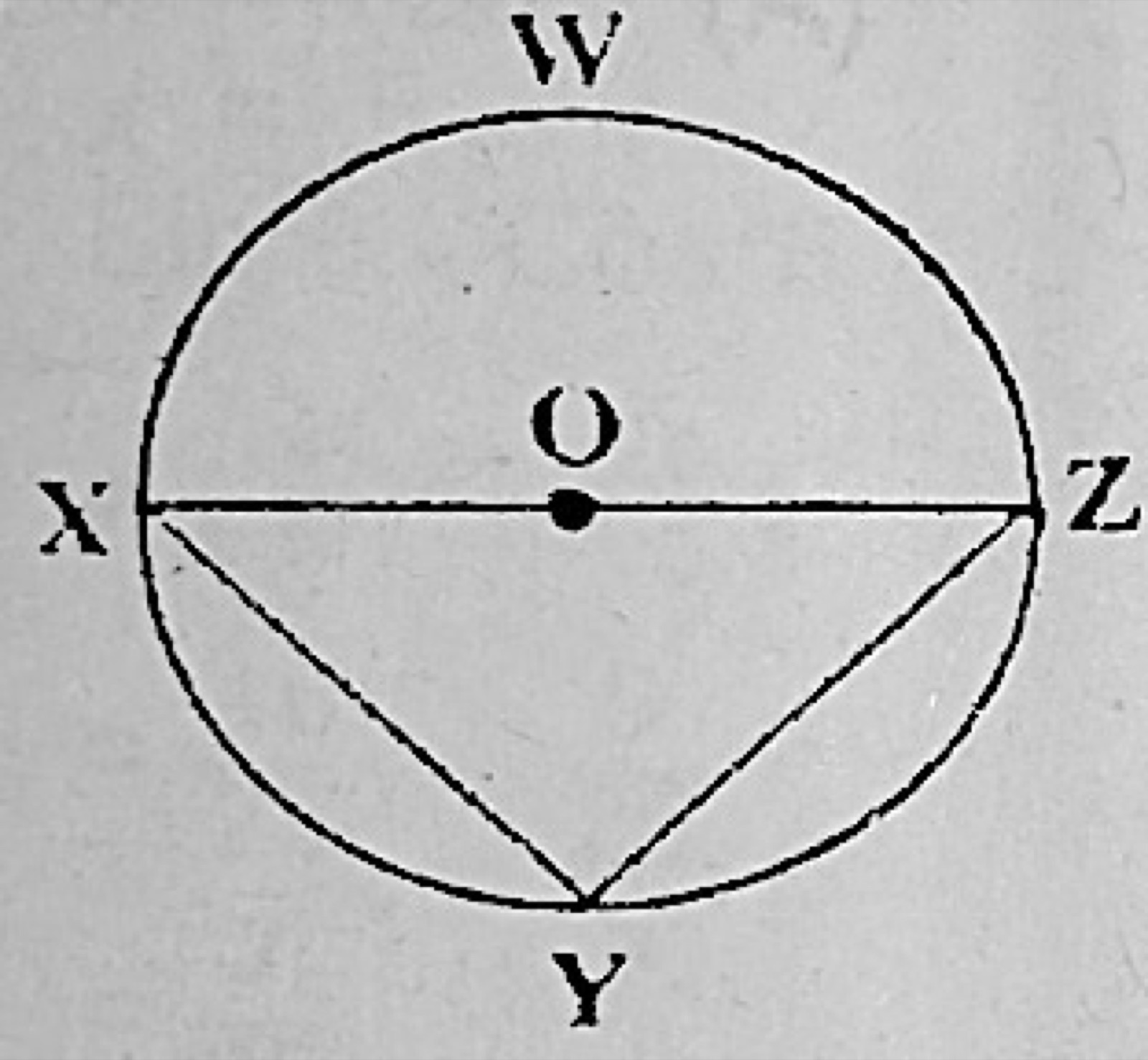
Answer: A (54cm2)
The angle in a semicircle is 90°, so ∠XYZ = 90° and XZ = 15 cm. Then YZ = √(225 − 144) = 9 cm, and the area is ½ × 12 × 9 = 54 cm2.
If tan θ = 4/3, calculate sin2θ − cos2θ.
Answer: C (7/25)
A 3-4-5 triangle gives sin θ = 4/5 and cos θ = 3/5. So sin2θ − cos2θ = 16/25 − 9/25 = 7/25.
In the diagram above are two concentric circles of radii r and R respectively with centre O. If r = (2/5)R, express the area of the shaded portion in terms of π and R.
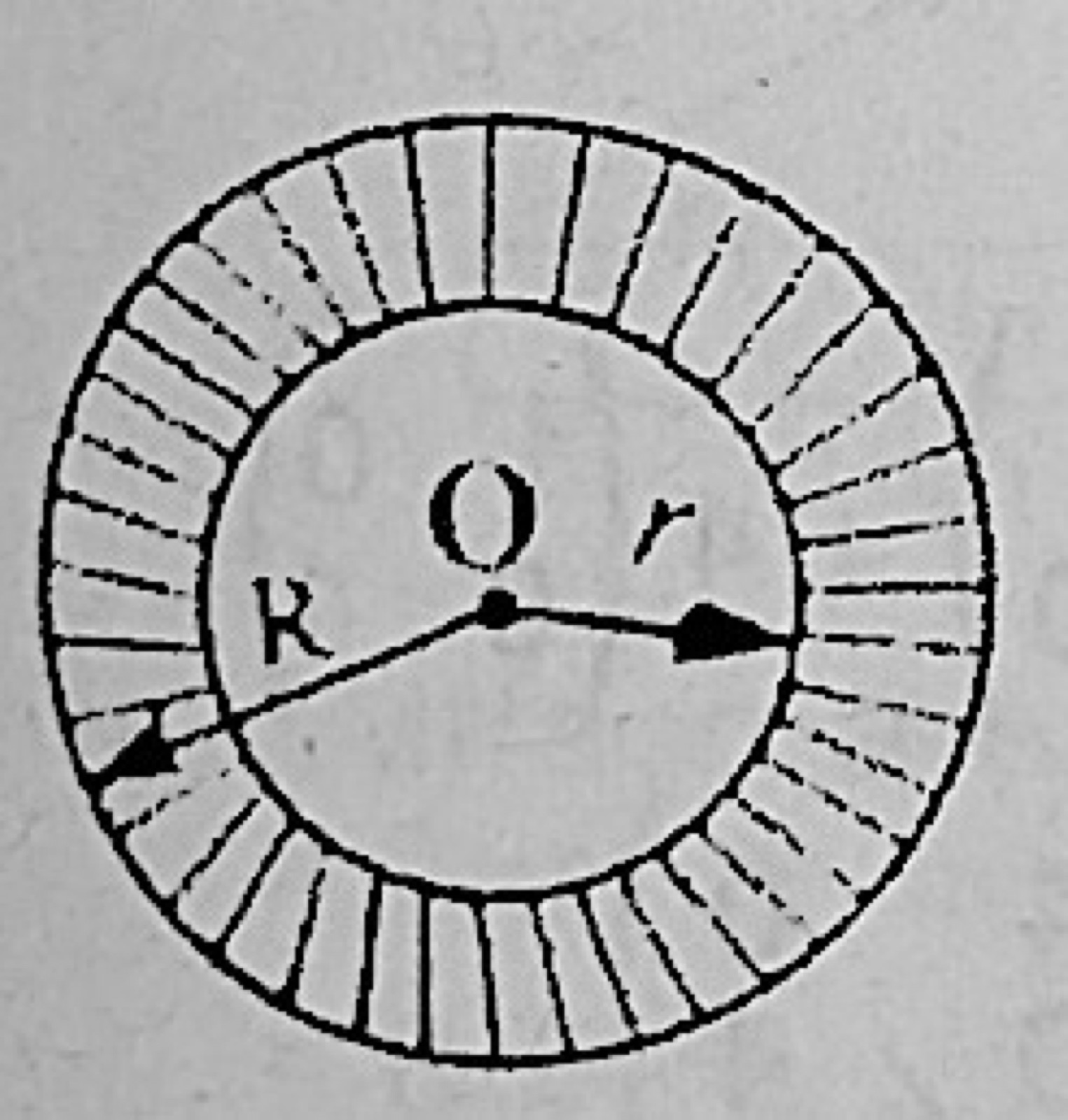
Answer: A ((21/25)πR2)
The shaded ring has area πR2 − πr2 = πR2 − (4/25)πR2 = (21/25)πR2.
A bucket is 12cm in diameter at the top, 8cm in diameter at the bottom and 4cm deep. Calculate its volume.
Answer: A ((304/3)πcm3)
The bucket is a frustum with radii 6 and 4 and height 4. V = (πh/3)(R2 + Rr + r2) = (4π/3)(36 + 24 + 16) = 304π/3 cm3.
In the diagram above, a cylinder is surmounted by a hemispherical bowl. Calculate the volume of the solid.
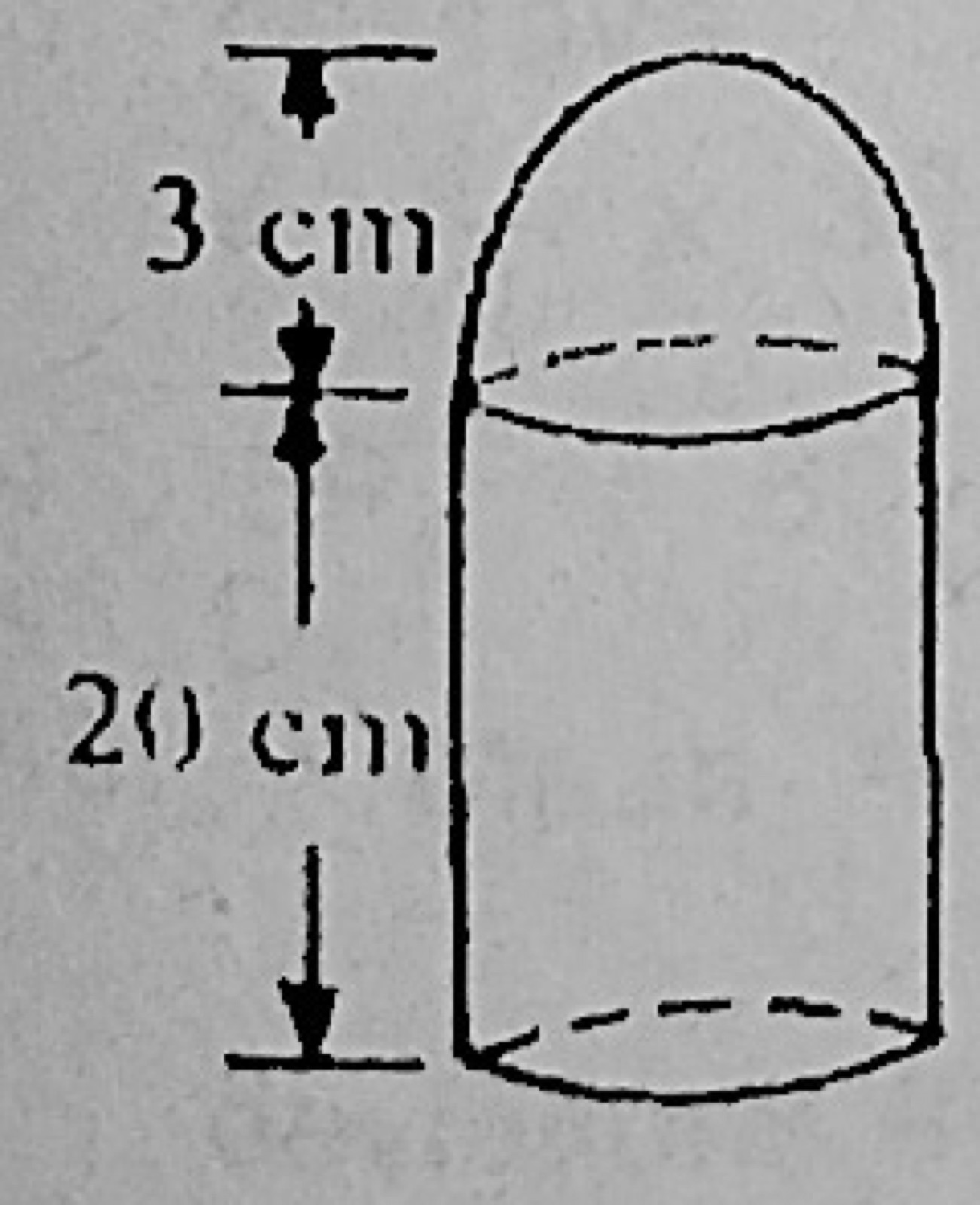
Answer: D (198πcm3)
The radius is 3 cm and the cylinder is 20 cm high. Cylinder: π × 9 × 20 = 180π; hemisphere: (2/3)π × 27 = 18π. Total 198π cm3.
The sum of the interior angles of a polygon is 20 right angles. How many sides does the polygon have?
Answer: A (12)
20 right angles = 1800°. Setting (n − 2) × 180° = 1800° gives n − 2 = 10, so n = 12.
Find the coordinate of the midpoint of x and y intercepts of the line 2y = 4x − 8.
Answer: B ((1,−2))
The line meets the x-axis at (2, 0) and the y-axis at (0, −4). The midpoint is (1, −2).
A hunter 1.6m tall, views a bird on top of a tree at an angle 45°. If the distance between the hunter and the tree is 10.4m, find the height of the tree.
Answer: B (12.0m)
Above eye level the height is 10.4 × tan 45° = 10.4 m. Adding the hunter's eye height of 1.6 m gives 12.0 m.
A solid hemisphere has radius 7cm. Find the total surface area. [π = 22/7]
Answer: B (462cm2)
The total surface is the curved part 2πr2 plus the flat circle πr2, i.e. 3πr2 = 3 × 22/7 × 49 = 462 cm2.
Find the value of α if the line 2y − αx + 4 = 0 is perpendicular to the line y + (1/4)x − 7 = 0
Answer: C (8)
The gradients are α/2 and −1/4. For perpendicular lines (α/2)(−1/4) = −1, so α = 8.
The triangle PQR above is
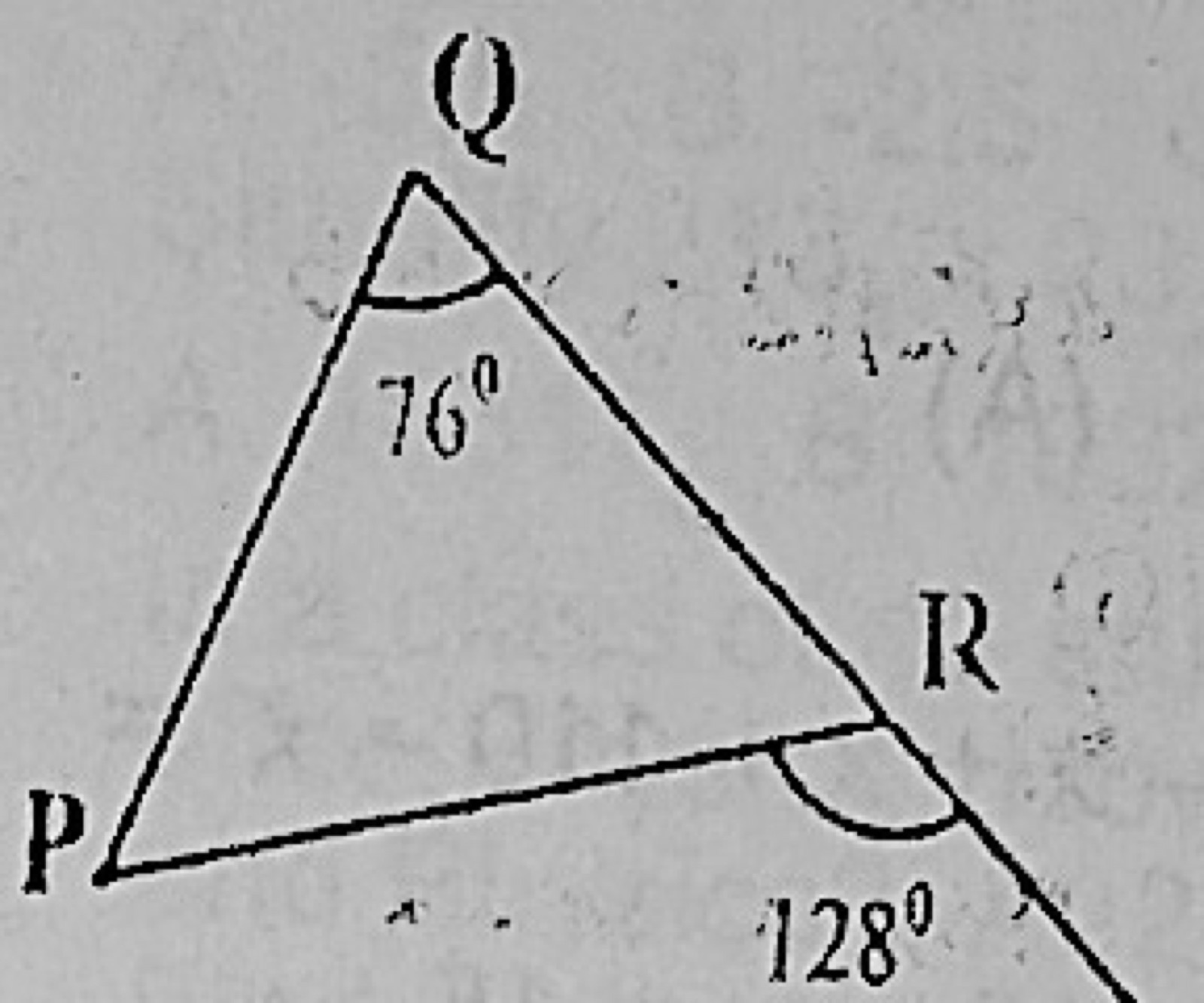
Answer: C (an isosceles triangle)
The exterior angle at R is 128°, so ∠PRQ = 52°. Then ∠P = 180° − 76° − 52° = 52°. Two equal angles make the triangle isosceles.
The locus of a point P which is equidistant from two given points S and T is
Answer: A (the perpendicular bisector of ST)
All points the same distance from S and T lie on the perpendicular bisector of the line segment ST.
Find the mean of the data: 7, −3, 4, −2, 5, −9, 4, 8, −6, 12
Answer: D (2)
The ten numbers add up to 20, so the mean is 20 ÷ 10 = 2.
The venn diagram above shows the number of students offering Music and History in a class of 80 students. If a student is picked at random from the class, what is the probability that he offers Music only?
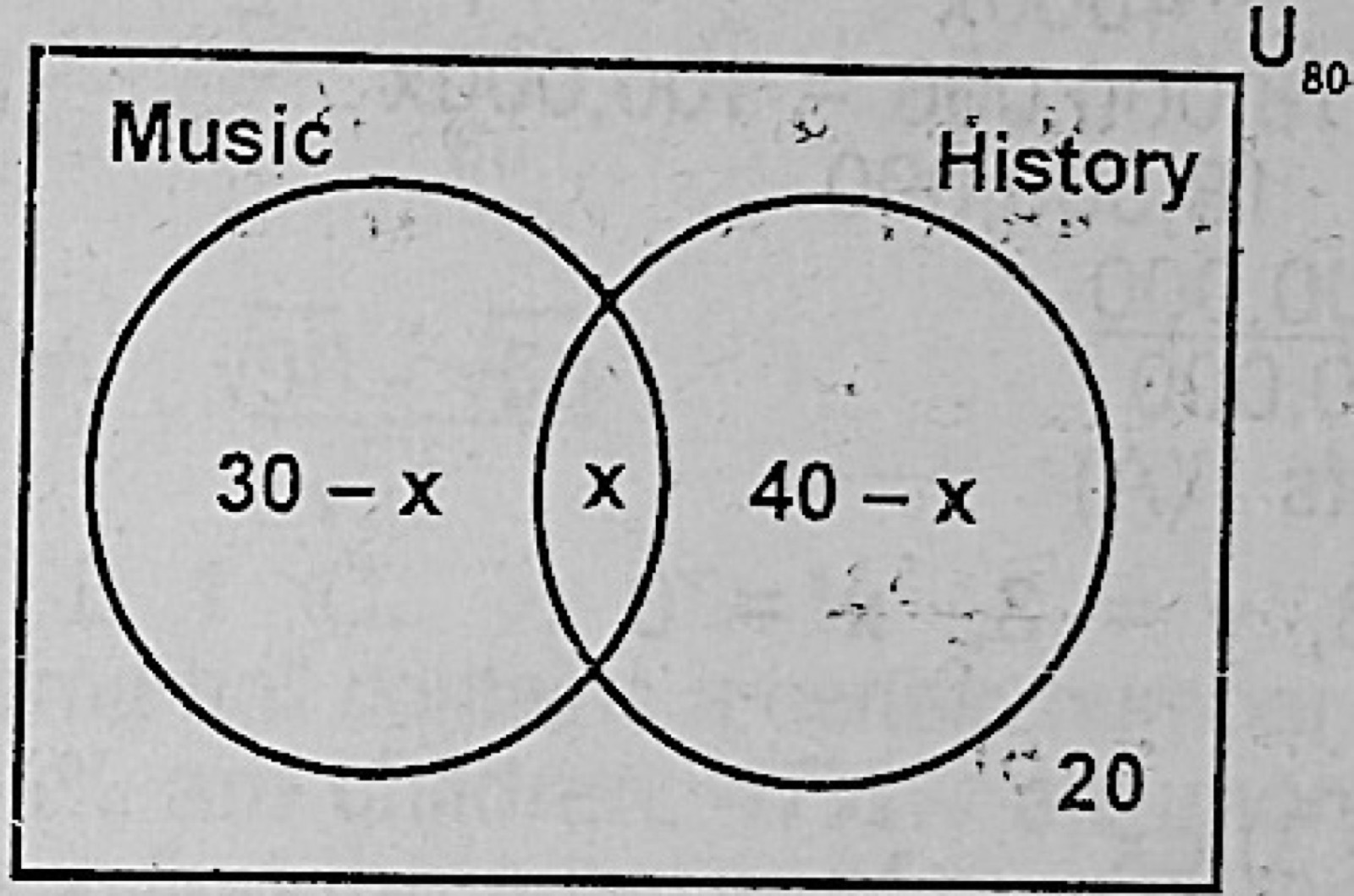
Answer: D (0.25)
(30 − x) + x + (40 − x) + 20 = 80 gives x = 10. Music only is 30 − 10 = 20 students, so the probability is 20/80 = 0.25.
The range of the data k+2, k−3, k+4, k−2, k, k−5, k+3, k−1 and k+6 is
Answer: B (11)
The largest value is k + 6 and the smallest is k − 5. The range is (k + 6) − (k − 5) = 11.
The probability of a student passing any examination is 2/3. If the student takes three examinations, what is the probability that he will not pass any of them?
Answer: D (1/27)
The chance of failing one examination is 1 − 2/3 = 1/3. Failing all three: (1/3)3 = 1/27.
The acres for rice, pineapples, cassava, cocoa and palm oil in a certain district are given respectively as 2, 5, 3, 11 and 9. What is the angle of the sector for cassava in a pie chart?
Answer: C (36°)
The total is 30 acres and cassava has 3. Its angle is 3/30 × 360° = 36°.
How many three-digit numbers can be formed from 32564 without any digit being repeated?
Answer: D (60)
There are 5 different digits. Arranging 3 of them in order: 5 × 4 × 3 = 60.
The mean of a set of six numbers is 60. If the mean of the first five is 50, find the sixth number in the set
Answer: D (110)
The six numbers total 6 × 60 = 360 and the first five total 5 × 50 = 250. The sixth is 360 − 250 = 110.
Calculate the mean deviation of the set of numbers 7, 3, 14, 9, 7 and 8
Answer: D (2⅓)
The mean is 48 ÷ 6 = 8. The distances from 8 are 1, 5, 6, 1, 1, 0, which add to 14. Mean deviation = 14 ÷ 6 = 2⅓.
No. of days: 1, 2, 3, 4, 5, 6
No. of students: 20, x, 50, 40, 2x, 60
The distribution above shows the number of days a group of 260 students were absent from school in a particular term. How many students were absent for at least four days in the term?
Answer: D (160)
20 + x + 50 + 40 + 2x + 60 = 260 gives 3x = 90, so x = 30. At least four days: 40 + 60 + 60 = 160 students.