JAMB Mathematics 1999 past questions and answers

47 questions. Try each one, then open the answer to check yourself and read the explanation.

Question 1

Sets

If U = {1, 2, 3, 4, 5, 6}, P = {3, 4, 5}, Q = {2, 4, 6} and R = {1, 2, 3, 4}, list the elements of (P ∪ Q)′ ∩ R.

  1. A.{1, 2, 3, 4, 5, 6}
  2. B.{1, 2, 3, 4}
  3. C.{1}
  4. D.φ
Show the answer and explanation

Answer: C ({1})

Explanation

P ∪ Q = {2, 3, 4, 5, 6}, so its complement is {1}. {1} ∩ R = {1}.

Open this question

Question 2

Sets

A group of market women sell at least one of yam, plantain and maize. 12 of them sell maize, 10 sell yam and 14 sell plantain, 5 sell plantain and maize, 4 sell yam and maize, 2 sell yam and plantain only while 3 sell all the three items. How many women are in the group?

  1. A.25
  2. B.19
  3. C.18
  4. D.17
Show the answer and explanation

Answer: A (25)

Explanation

Fill a Venn diagram from the centre: all three 3; plantain and maize only 2; yam and maize only 1; yam and plantain only 2. Then yam only 4, plantain only 7, maize only 6. Total = 3 + 2 + 1 + 2 + 4 + 7 + 6 = 25.

Open this question

Question 3

Logarithms

If log810 = x, evaluate log85 in terms of x.

  1. A.½x
  2. B.x − ¼
  3. C.x − ⅓
  4. D.x − ½
Show the answer and explanation

Answer: C (x − ⅓)

Explanation

log₈5 = log₈(10/2) = log₈10 − log₈2. Since 8^(1/3) = 2, log₈2 = 1/3, so log₈5 = x − 1/3.

Open this question

Question 4

Surds

Find the value of x if √2/(x + √2) = 1/(x − √2)

  1. A.3√2 + 4
  2. B.3√2 − 4
  3. C.3 − 2√2
  4. D.4 + 2√2
Show the answer and explanation

Answer: A (3√2 + 4)

Explanation

Cross-multiply: √2x − 2 = x + √2, so x(√2 − 1) = 2 + √2. Multiply top and bottom by √2 + 1: x = (2 + √2)(√2 + 1) = 4 + 3√2.

Open this question

Question 6

Commercial Arithmetic

A trader bought 100 oranges at 5 for N1.20, 20 oranges got spoilt and the remaining were sold at 4 for N1.50. Find the percentage gain or loss.

  1. A.30% gain
  2. B.25% gain
  3. C.30% loss
  4. D.25% loss
Show the answer and explanation

Answer: B (25% gain)

Explanation

Cost = 20 × N1.20 = N24. He sells 80 oranges: 20 × N1.50 = N30. Gain = N6, and 6/24 × 100 = 25% gain.

Open this question

Question 7

Number Bases

Divide 24346 by 426.

  1. A.236
  2. B.356
  3. C.526
  4. D.556
Show the answer and explanation

Answer: B (356)

Explanation

2434₆ = 2×216 + 4×36 + 3×6 + 4 = 598 and 42₆ = 26. 598 ÷ 26 = 23, and 23 = 3×6 + 5 = 35₆.

Open this question

Question 8

Number Bases

If 29 × (Y3)9 = 35 × (Y3)5, find the value of Y.

  1. A.4
  2. B.3
  3. C.2
  4. D.1
Show the answer and explanation

Answer: D (1)

Explanation

In base ten: 2(9Y + 3) = 3(5Y + 3), so 18Y + 6 = 15Y + 9 and Y = 1.

Open this question

Question 9

Fractions, Decimals and Approximation

Simplify √((0.0023 × 750)/(0.00345 × 1.25))

  1. A.15
  2. B.20
  3. C.40
  4. D.75
Show the answer and explanation

Answer: B (20)

Explanation

0.0023 × 750 = 1.725 and 0.00345 × 1.25 = 0.0043125. Their quotient is 400, and √400 = 20.

Open this question

Question 10

Binary Operations

If m∗n = m/n − n/m for m, n ∈ ℜ, evaluate −3 ∗ 4

  1. A.−25/12
  2. B.−7/12
  3. C.7/12
  4. D.25/12
Show the answer and explanation

Answer: C (7/12)

Explanation

−3 ∗ 4 = −3/4 − 4/(−3) = −3/4 + 4/3 = (−9 + 16)/12 = 7/12.

Open this question

Question 11

Linear and Simultaneous Equations

The sum of two numbers is twice their difference. If the difference of the numbers is P, find the larger of the two numbers.

  1. A.P/2
  2. B.3P/2
  3. C.5P/2
  4. D.3P
Show the answer and explanation

Answer: B (3P/2)

Explanation

Let the numbers be x > y. x + y = 2(x − y) gives x = 3y. With x − y = P, 2y = P so y = P/2 and x = 3P/2.

Open this question

Question 12

Matrices and Determinants

Find the matrix T if ST = I where S = (−1 1 / 1 −2) and I is the identity matrix. (Rows are separated by /.)

  1. A.(−2 1 / −1 1)
  2. B.(−2 −1 / −1 −1)
  3. C.(−1 −1 / 0 −1)
  4. D.(−1 1 / 0 1)
Show the answer and explanation

Answer: B ((−2 −1 / −1 −1))

Explanation

T is the inverse of S. det S = 2 − 1 = 1, so S⁻¹ = (−2 −1 / −1 −1): swap the diagonal entries and change the signs of the others.

Open this question

Question 13

Inequalities

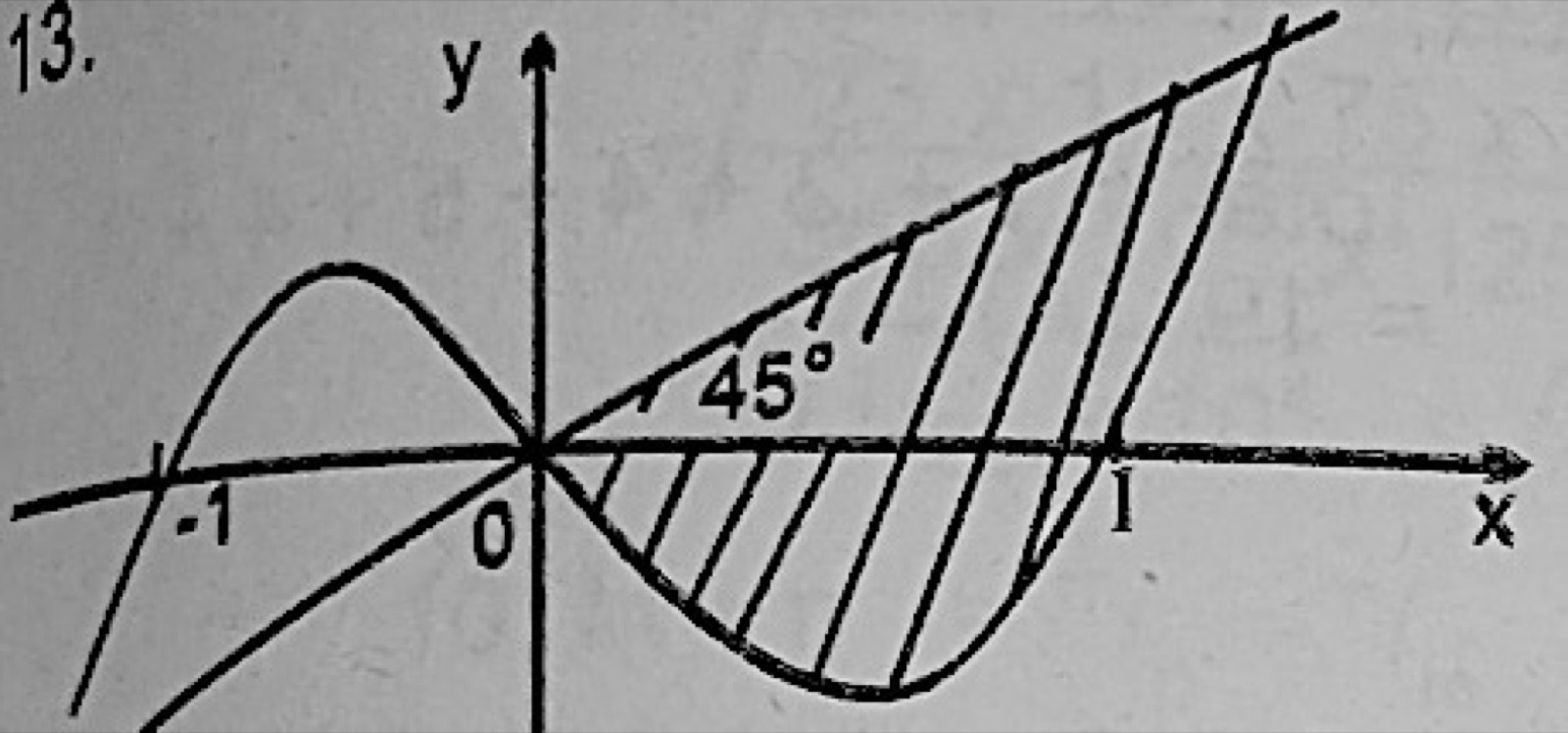
The shaded portion in the graph above is represented by

Diagram for this question
  1. A.y + x − x3 ≥ 0, y − x ≤ 0
  2. B.y − x + x3 ≥ 0, y − x ≤ 0
  3. C.y + x − x3 ≤ 0, y + x ≥ 0
  4. D.y − x + x3 ≤ 0, y + x ≥ 0
Show the answer and explanation

Answer: A (y + x − x3 ≥ 0, y − x ≤ 0)

Explanation

The curve is y = x³ − x and the line is y = x (45°). The shaded part is above the curve (y + x − x³ ≥ 0) and below the line (y − x ≤ 0).

Open this question

Question 14

Binary Operations

A binary operation ∗ is defined by a∗b = ab + a + b for any real number a and b. If the identity element is zero, find the inverse of 2 under this operation.

  1. A.2/3
  2. B.1/2
  3. C.−1/2
  4. D.−2/3
Show the answer and explanation

Answer: D (−2/3)

Explanation

The inverse b satisfies 2∗b = 0: 2b + 2 + b = 0, so 3b = −2 and b = −2/3.

Open this question

Question 15

Matrices and Determinants

Given that Q = (6 0 / 4 5) and Q + P = (7 −2 / 6 8), evaluate |Q + 2P|. (Rows are separated by /.)

  1. A.90
  2. B.96
  3. C.102
  4. D.120
Show the answer and explanation

Answer: D (120)

Explanation

P = (1 −2 / 2 3), so Q + 2P = (8 −4 / 8 11). Its determinant is 8 × 11 − (−4)(8) = 88 + 32 = 120.

Open this question

Question 16

Algebraic Expressions

Factorize completely x2 + 2xy + y2 + 3x + 3y − 18

  1. A.(x + y + 6)(x + y − 3)
  2. B.(x − y − 6)(x − y + 3)
  3. C.(x − y + 6)(x − y − 3)
  4. D.(x − y − 6)(x + y + 3)
Show the answer and explanation

Answer: A ((x + y + 6)(x + y − 3))

Explanation

Let u = x + y: the expression is u² + 3u − 18 = (u + 6)(u − 3) = (x + y + 6)(x + y − 3).

Open this question

Question 17

Inequalities

Tope bought x oranges at N5.00 each and some mangoes at N4.00 each. If she bought twice as many mangoes as oranges and spent at least N65.00 and at most N130.00, find the range of the values of x.

  1. A.4 ≤ x ≤ 5
  2. B.5 ≤ x ≤ 8
  3. C.5 ≤ x ≤ 10
  4. D.8 ≤ x ≤ 10
Show the answer and explanation

Answer: C (5 ≤ x ≤ 10)

Explanation

She spends 5x + 4(2x) = 13x naira. 65 ≤ 13x ≤ 130 gives 5 ≤ x ≤ 10.

Open this question

Question 18

Quadratic Equations

Three consecutive positive integers k, l and m are such that l2 = 3(k + m). Find the value of m.

  1. A.4
  2. B.5
  3. C.6
  4. D.7
Show the answer and explanation

Answer: D (7)

Explanation

Write l = k + 1 and m = k + 2: (k + 1)² = 3(2k + 2), so k² − 4k − 5 = 0 and k = 5 (positive). Then m = 7.

Open this question

Question 19

Polynomials

Express 1/(x3 − 1) in partial fractions.

  1. A.⅓(1/(x − 1) − (x − 2)/(x2 − x + 1))
  2. B.⅓(1/(x − 1) − (x + 2)/(x2 + x + 1))
  3. C.⅓(1/(x − 1) − (x − 2)/(x2 + x + 1))
  4. D.⅓(1/(x − 1) − (x + 2)/(x2 − x − 1))
Show the answer and explanation

Answer: B (⅓(1/(x − 1) − (x + 2)/(x2 + x + 1)))

Explanation

x³ − 1 = (x − 1)(x² + x + 1). Write 1 = A(x² + x + 1) + (Bx + C)(x − 1): x = 1 gives A = 1/3, then B = −1/3 and C = −2/3.

Open this question

Question 20

Progressions

The first term of a geometrical progression is twice its common ratio. Find the sum of the first two terms of the progression if its sum to infinity is 8.

  1. A.8/5
  2. B.8/3
  3. C.72/25
  4. D.56/9
Show the answer and explanation

Answer: C (72/25)

Explanation

a = 2r and a/(1 − r) = 8 give 2r = 8 − 8r, so r = 4/5 and a = 8/5. The first two terms add to 8/5 + 32/25 = 72/25.

Open this question

Question 21

Polynomials

Divide 4x3 − 3x + 1 by 2x − 1

  1. A.2x2 − x + 1
  2. B.2x2 − x − 1
  3. C.2x2 + x + 1
  4. D.2x2 + x − 1
Show the answer and explanation

Answer: D (2x2 + x − 1)

Explanation

Check by multiplying: (2x − 1)(2x² + x − 1) = 4x³ + 2x² − 2x − 2x² − x + 1 = 4x³ − 3x + 1.

Open this question

Question 22

Triangles and Quadrilaterals

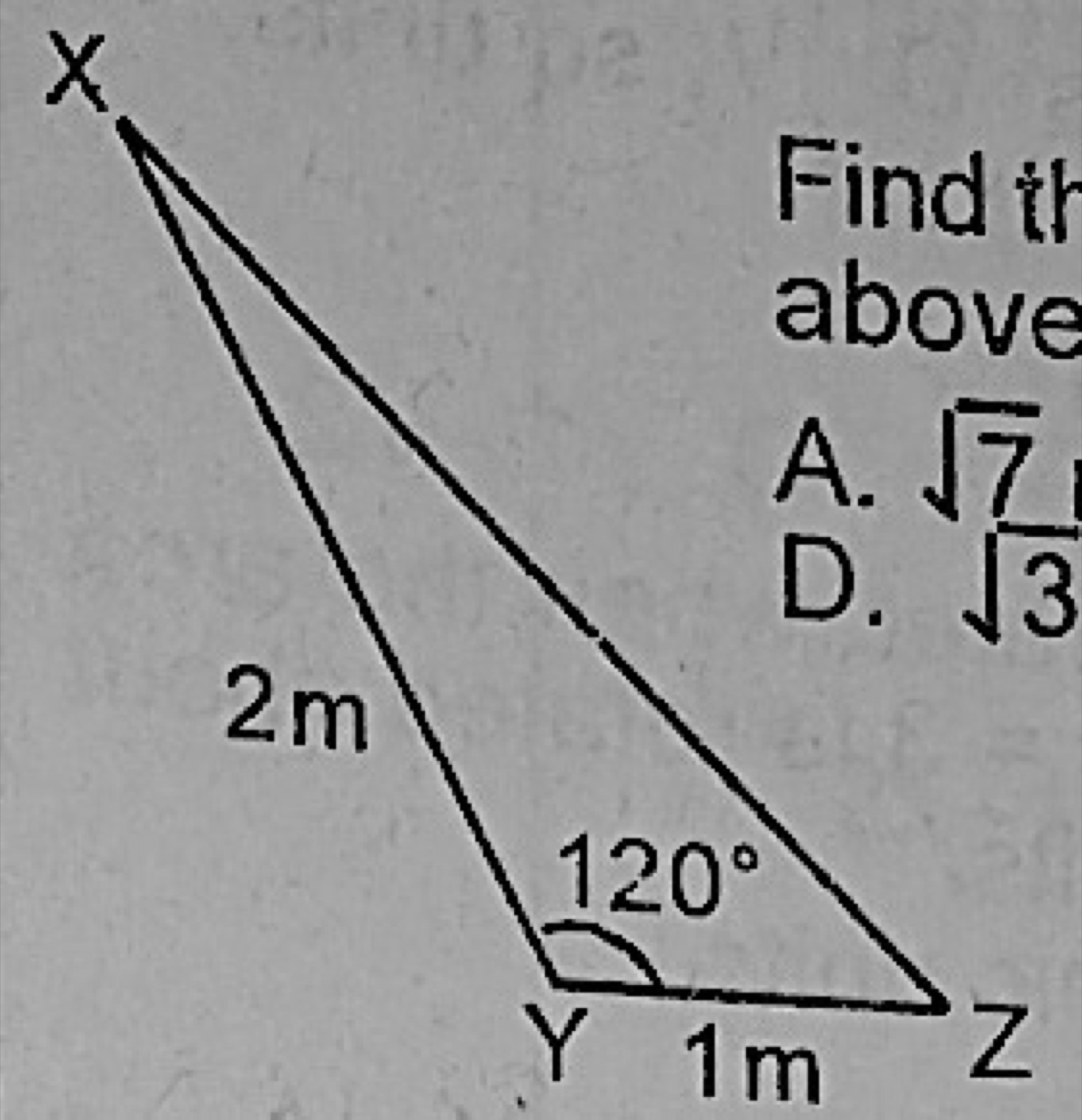
Find the length XZ in the triangle above.

Diagram for this question
  1. A.√7 m
  2. B.√6 m
  3. C.√5 m
  4. D.√3 m
Show the answer and explanation

Answer: A (√7 m)

Explanation

By the cosine rule with XY = 2 m, YZ = 1 m and ∠Y = 120°: XZ² = 4 + 1 − 2(2)(1)cos 120° = 5 + 2 = 7, so XZ = √7 m.

Open this question

Question 23

Coordinate Geometry

Find a positive value of α if the coordinate of the centre of a circle x2 + y2 − 2αx + 4y − α = 0 is (α, −2) and the radius is 4 units.

  1. A.1
  2. B.2
  3. C.3
  4. D.4
Show the answer and explanation

Answer: C (3)

Explanation

For this circle r² = α² + 2² + α = 16, so α² + α − 12 = 0, i.e. (α + 4)(α − 3) = 0. The positive value is 3.

Open this question

Question 24

Trigonometry

A man 1.7m tall observes a bird on top of a tree at an angle of 30°. If the distance between the man's head and the bird is 25m, what is the height of the tree?

  1. A.26.7 m
  2. B.14.2m
  3. C.1.7 + 25√3/3 m
  4. D.1.7 + 25√2/2 m
Show the answer and explanation

Answer: B (14.2m)

Explanation

The 25 m line of sight is the hypotenuse, so the height above the man's eye is 25 sin 30° = 12.5 m. Adding his height: 12.5 + 1.7 = 14.2 m.

Open this question

Question 25

Triangles and Quadrilaterals

In ΔMNO, MN = 6 units, MO = 4 units and NO = 12 units. If the bisector of angle M meets NO at P, calculate NP.

  1. A.4.8 units
  2. B.7.2 units
  3. C.8.0 units
  4. D.18.0 units
Show the answer and explanation

Answer: B (7.2 units)

Explanation

The angle bisector divides NO in the ratio of the other two sides: NP : PO = 6 : 4. So NP = 6/10 × 12 = 7.2 units.

Open this question

Question 26

Coordinate Geometry

Find the tangent of the acute angle between the lines 2x + y = 3 and 3x − 2y = 5.

  1. A.−7/4
  2. B.7/8
  3. C.7/4
  4. D.7/2
Show the answer and explanation

Answer: C (7/4)

Explanation

The gradients are −2 and 3/2. tan θ = |(−2 − 3/2)/(1 + (−2)(3/2))| = (7/2)/2 = 7/4, positive because the angle is acute.

Open this question

Question 27

Circle Theorems

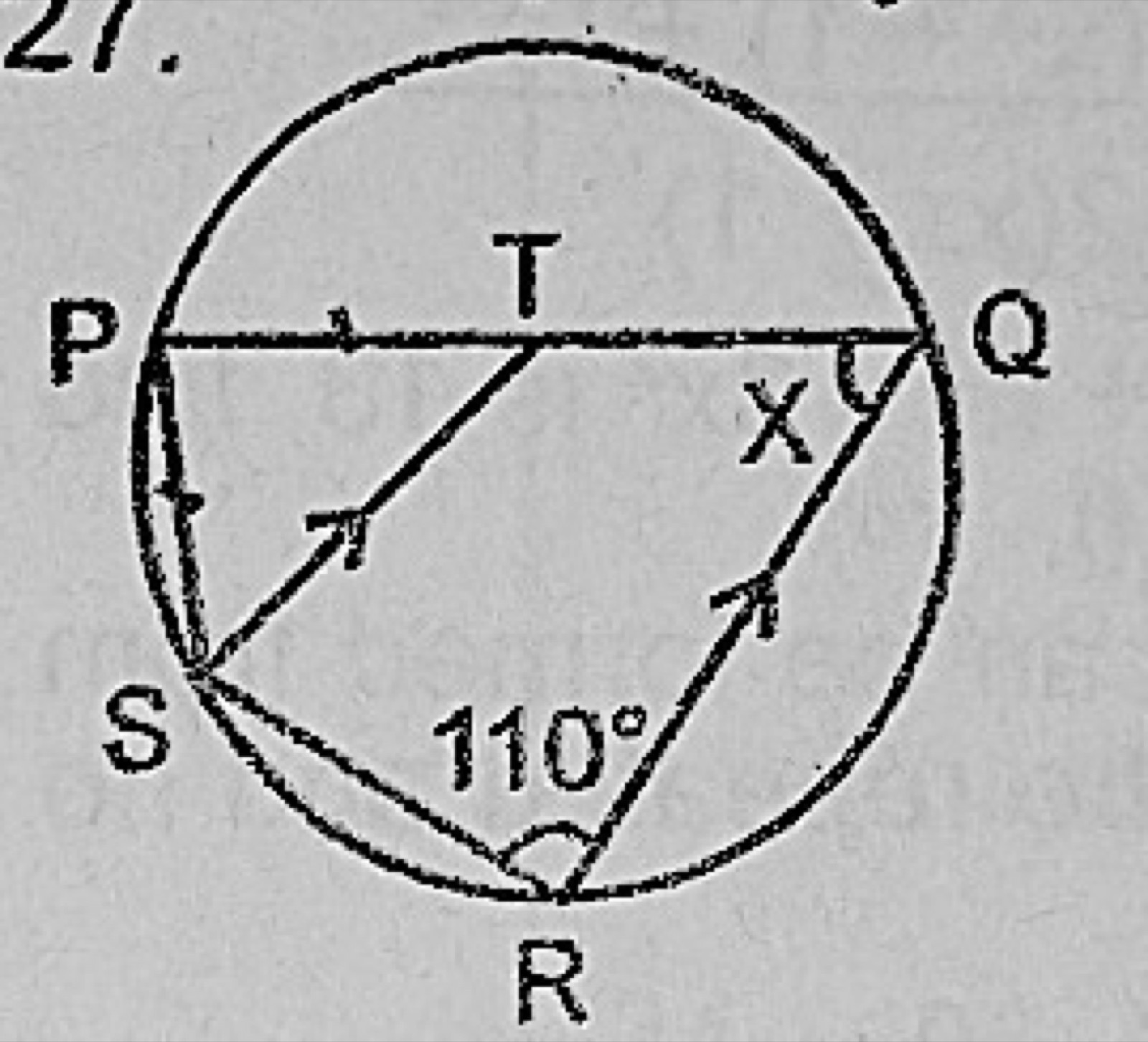
In the figure above, PQRS is a circle with ST||RQ. Find the value of x if PT = PS.

Diagram for this question
  1. A.70°
  2. B.55°
  3. C.40°
  4. D.35°
Show the answer and explanation

Answer: B (55°)

Explanation

Opposite angles of cyclic quadrilateral PQRS add to 180°, so ∠SPT = 180° − 110° = 70°. Triangle PST is isosceles, so ∠PTS = (180° − 70°)/2 = 55°. Since ST ∥ RQ, x = ∠PTS = 55° (corresponding angles).

Open this question

Question 28

Circle Theorems

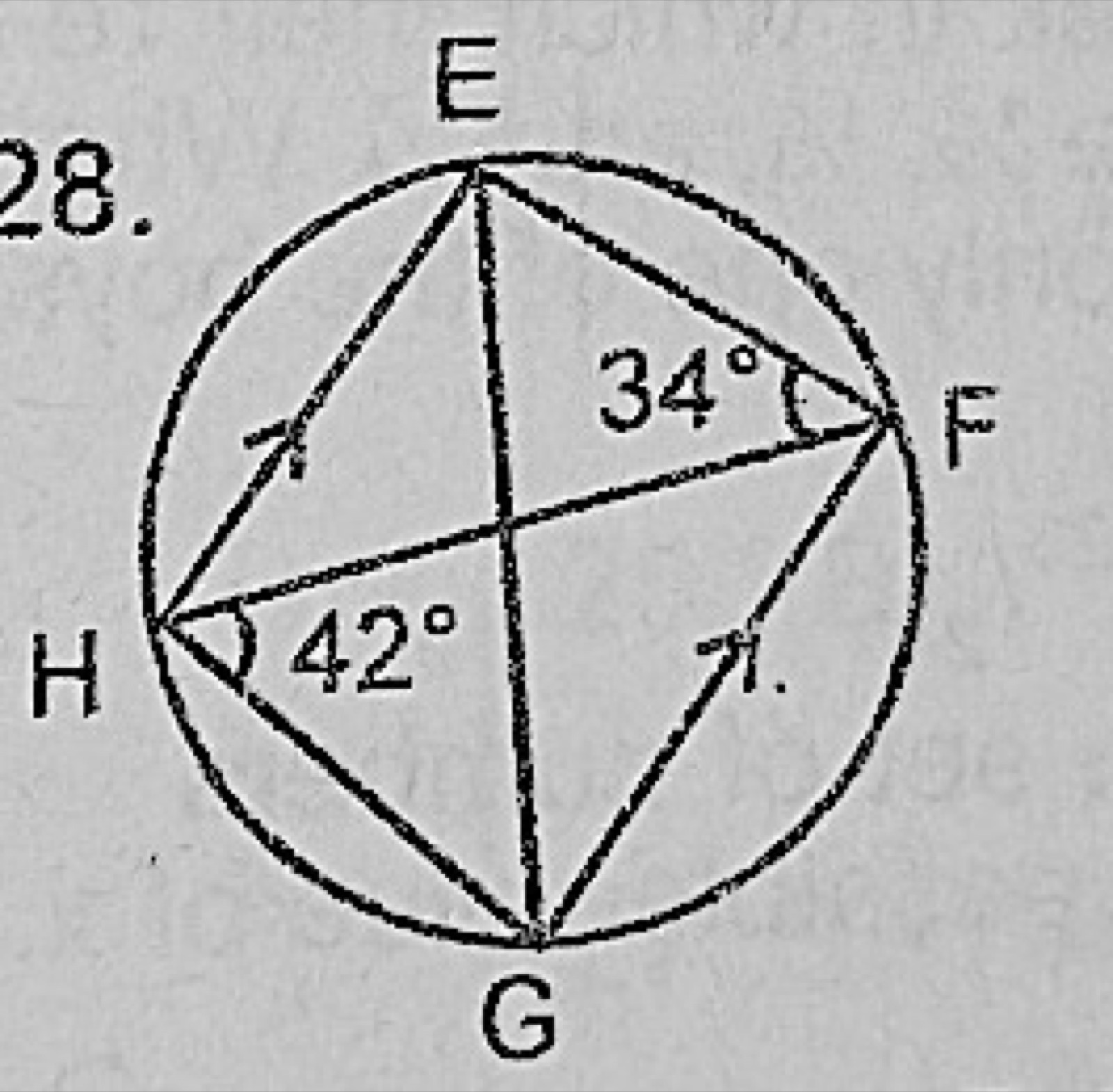
In the diagram above, EFGH is a cyclic quadrilateral in which EH||FG, EG and FH are chords. If ∠FHG = 42° and ∠EFH = 34°, calculate ∠HEG.

Diagram for this question
  1. A.34°
  2. B.42°
  3. C.52°
  4. D.76°
Show the answer and explanation

Answer: C (52°)

Explanation

∠EGH = ∠EFH = 34° (same segment). Let ∠HEG = y; then ∠HFG = y (same segment) and ∠EHF = y (alternate angles, EH ∥ FG). In triangle EHG: y + (y + 42°) + 34° = 180°, so y = 52°.

Open this question

Question 29

Bearings

From a point P, the bearings of two points Q and R are N67°W and N23°E respectively. If the bearing of R from Q is N68°E and PQ = 150m, calculate PR.

  1. A.120m
  2. B.140m
  3. C.150m
  4. D.160m
Show the answer and explanation

Answer: C (150m)

Explanation

∠QPR = 67° + 23° = 90°. At Q the direction to P is S67°E and to R is N68°E, so ∠PQR = 180° − 67° − 68° = 45°. The right-angled triangle is isosceles, so PR = PQ = 150 m.

Open this question

Question 30

Loci

Find the equation of the locus of a point P(x, y) such that PV = PW, when V = (1, 1) and W = (3, 5).

  1. A.2x + 2y = 9
  2. B.2x + 3y = 8
  3. C.2x + y = 9
  4. D.x + 2y = 8
Show the answer and explanation

Answer: D (x + 2y = 8)

Explanation

P lies on the perpendicular bisector of VW. The midpoint is (2, 3) and VW has gradient 2, so the bisector has gradient −1/2: y − 3 = −½(x − 2), i.e. x + 2y = 8.

Open this question

Question 31

Circle Theorems

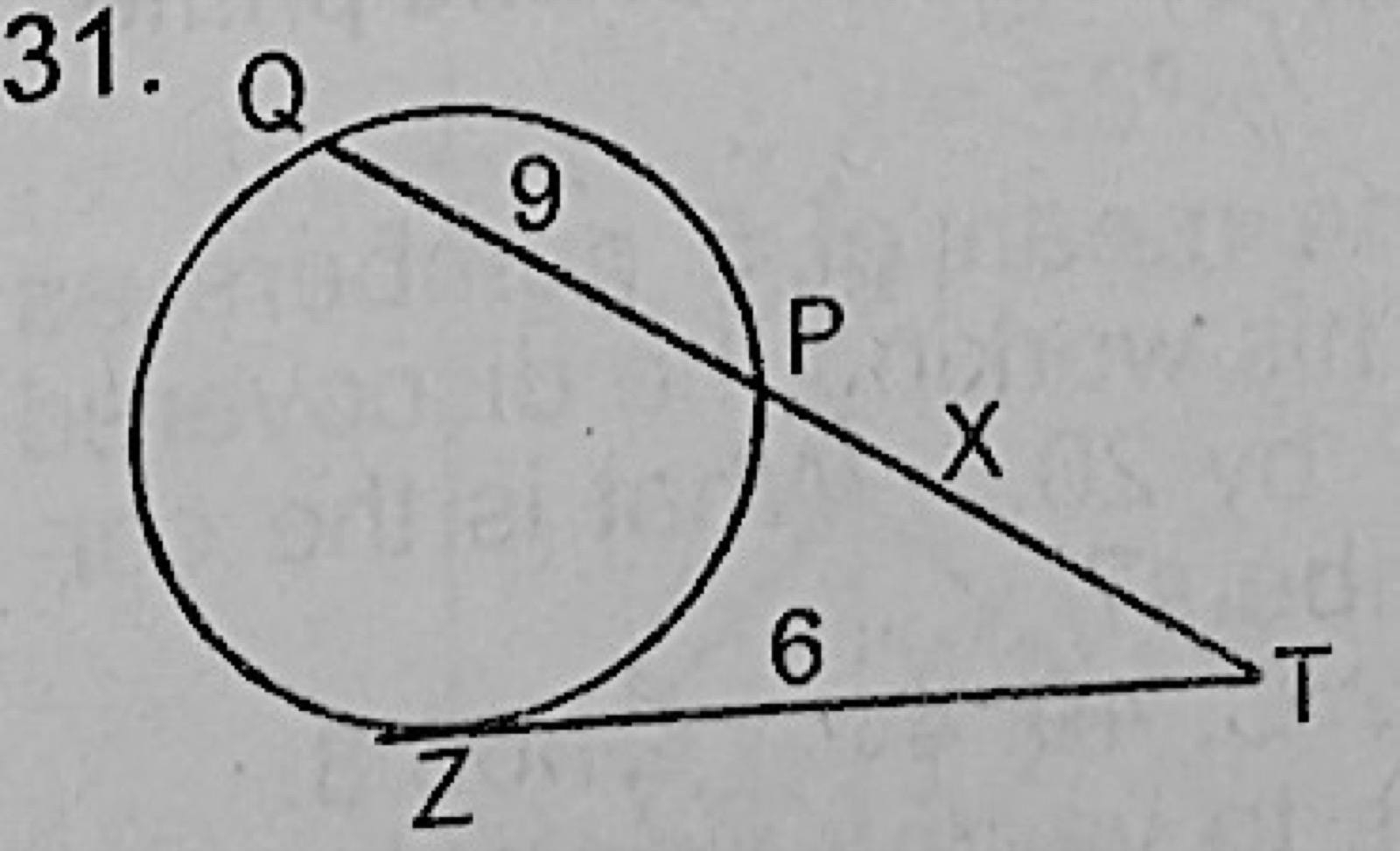
In the figure above, TZ is tangent of the circle QPZ. Find x if TZ = 6 units and PQ = 9 units.

Diagram for this question
  1. A.3
  2. B.4
  3. C.5
  4. D.6
Show the answer and explanation

Answer: A (3)

Explanation

Tangent–secant rule: TZ² = TP × TQ, so 36 = x(x + 9). Then x² + 9x − 36 = 0, (x + 12)(x − 3) = 0 and x = 3.

Open this question

Question 32

Mensuration of Solids

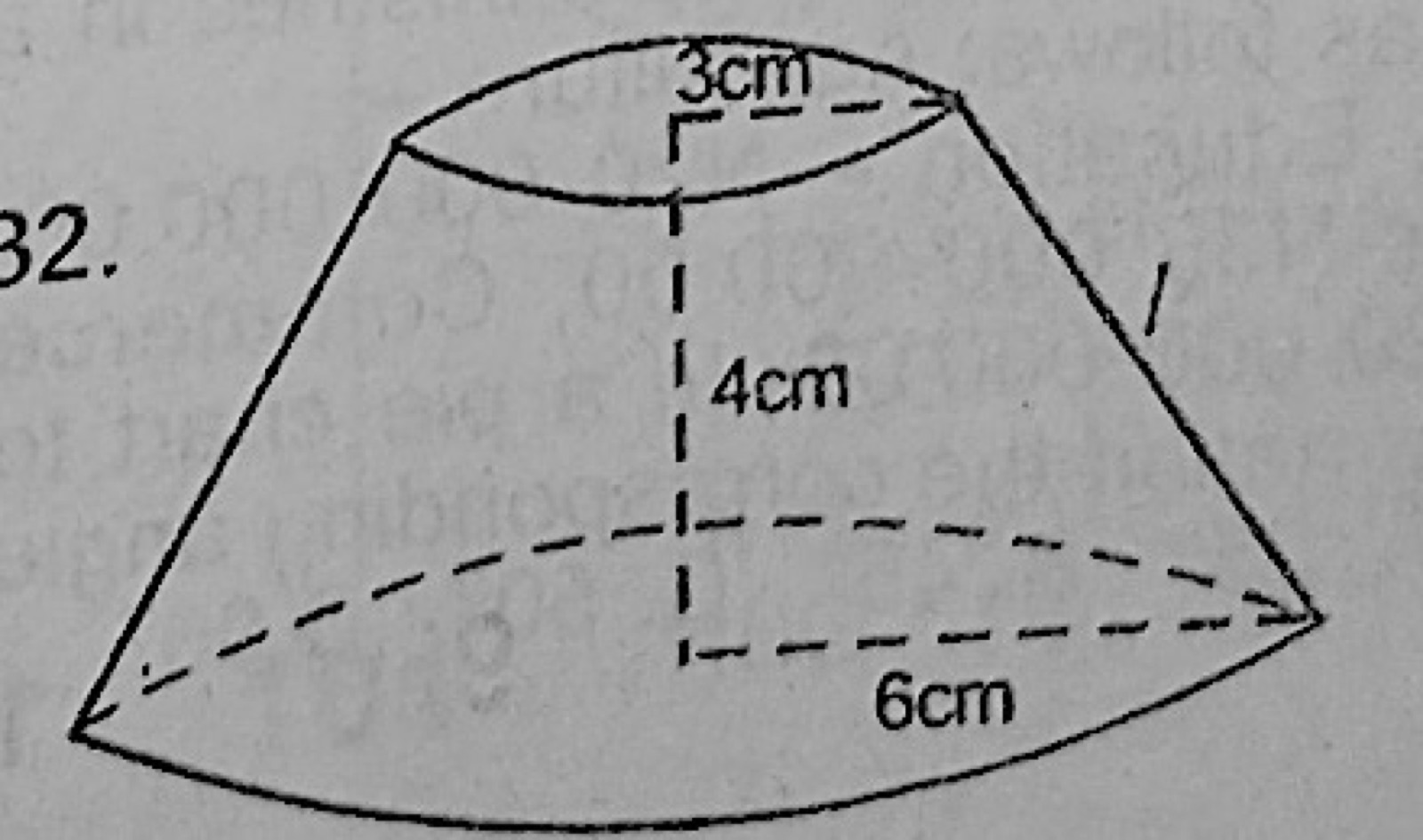
Find the value of l in the frustrum above.

Diagram for this question
  1. A.5 cm
  2. B.6 cm
  3. C.7 cm
  4. D.8 cm
Show the answer and explanation

Answer: A (5 cm)

Explanation

The radii differ by 6 − 3 = 3 cm and the height is 4 cm, so the slant height l = √(4² + 3²) = 5 cm.

Open this question

Question 33

Integration

Find the area bounded by the curve y = x(2 − x), the x-axis, x = 0 and x = 2.

  1. A.4 sq units
  2. B.2 sq units
  3. C.1⅓ sq units
  4. D.⅓ sq units
Show the answer and explanation

Answer: C (1⅓ sq units)

Explanation

Area = ∫₀² (2x − x²) dx = [x² − x³/3]₀² = 4 − 8/3 = 4/3 = 1⅓ square units.

Open this question

Question 34

Integration

Evaluate ∫0π/4 (sin x − cos x) dx.

  1. A.√2 + 1
  2. B.√2 − 1
  3. C.−√2 − 1
  4. D.1 − √2
Show the answer and explanation

Answer: D (1 − √2)

Explanation

The integral is [−cos x − sin x] from 0 to π/4 = (−√2/2 − √2/2) − (−1) = 1 − √2.

Open this question

Question 35

Integration

Find the volume of solid generated when the area enclosed by y = 0, y = 2x and x = 3 is rotated about the x-axis.

  1. A.81π cubic units
  2. B.36π cubic units
  3. C.18π cubic units
  4. D.9π cubic units
Show the answer and explanation

Answer: B (36π cubic units)

Explanation

V = π∫₀³ y² dx = π∫₀³ 4x² dx = π × 4 × 27/3 = 36π cubic units (a cone of radius 6 and height 3).

Open this question

Question 36

Differentiation

What is the derivation of t2 sin(3t − 5) with respect to the variable t?

  1. A.6t cos (3t − 5)
  2. B.2t sin (3t − 5) − 3t2 cos (3t − 5)
  3. C.2t sin (3t − 5) + 3t2 cos (3t − 5)
  4. D.2t sin (3t − 5) + t2 cos 3t
Show the answer and explanation

Answer: C (2t sin (3t − 5) + 3t2 cos (3t − 5))

Explanation

Product rule: 2t × sin(3t − 5) + t² × 3cos(3t − 5).

Open this question

Question 37

Integration

Evaluate ∫−21 (x − 1)2dx

  1. A.−3⅓
  2. B.7
  3. C.9
  4. D.11
Show the answer and explanation

Answer: C (9)

Explanation

∫(x − 1)² dx = (x − 1)³/3. From −2 to 1: 0 − (−27/3) = 9.

Open this question

Question 38

Differentiation

Find the value of x for which the function y = x3 − x has a minimum value.

  1. A.−√3
  2. B.−√3/3
  3. C.√3/3
  4. D.√3
Show the answer and explanation

Answer: C (√3/3)

Explanation

dy/dx = 3x² − 1 = 0 gives x = ±1/√3. d²y/dx² = 6x is positive at x = 1/√3 = √3/3, so that is the minimum.

Open this question

Question 40

Differentiation

If the maximum value of y = 1 + hx − 3x2 is 13, find h.

  1. A.13
  2. B.12
  3. C.11
  4. D.10
Show the answer and explanation

Answer: B (12)

Explanation

dy/dx = h − 6x = 0 at x = h/6. Then y = 1 + h²/6 − h²/12 = 1 + h²/12 = 13, so h² = 144 and h = 12 (taking the positive value offered).

Open this question

Question 41

Permutation and Combination

How many two-digit numbers can be formed from the digits 0, 1, 2, 3 if a digit can be repeated and no number may begin with 0?

  1. A.4
  2. B.12
  3. C.16
  4. D.20
Show the answer and explanation

Answer: B (12)

Explanation

The first digit can be 1, 2 or 3 (3 ways) and the second any of the 4 digits, so 3 × 4 = 12.

Open this question

Question 42

Probability

Three boys play a game of luck in which their respective chances of winning are ½, ⅓ and ¼. What is the probability that one and only one of the boys wins the game?

  1. A.1/24
  2. B.1/12
  3. C.11/24
  4. D.23/24
Show the answer and explanation

Answer: C (11/24)

Explanation

P(exactly one) = ½·⅔·¾ + ½·⅓·¾ + ½·⅔·¼ = 6/24 + 3/24 + 2/24 = 11/24.

Open this question

Question 44

Data Presentation

The grades of 36 students in a class test are as shown in the pie chart above. How many students had Excellent?

Diagram for this question
  1. A.7
  2. B.8
  3. C.9
  4. D.12
Show the answer and explanation

Answer: A (7)

Explanation

Very Good is a right angle (90°), so Excellent = 360° − 120° − 80° − 90° = 70°. 70/360 × 36 = 7 students.

Open this question

Question 45

Probability

A number is selected at random from 0 to 20. What is the probability that the numbers is an odd prime?

  1. A.8/21
  2. B.1/3
  3. C.2/7
  4. D.5/21
Show the answer and explanation

Answer: B (1/3)

Explanation

0 to 20 is 21 numbers. The odd primes are 3, 5, 7, 11, 13, 17 and 19, which is 7 numbers. 7/21 = 1/3.

Open this question

Question 46

Measures of Central Tendency

A student calculated the mean of 5 numbers as 45.3. While rechecking his working, he discovered that his total was short by 20.5. What is the correct mean of the 5 numbers?

  1. A.24.8
  2. B.41.2
  3. C.49.4
  4. D.65.8
Show the answer and explanation

Answer: C (49.4)

Explanation

His total was 5 × 45.3 = 226.5. The correct total is 226.5 + 20.5 = 247, so the correct mean is 247 ÷ 5 = 49.4.

Open this question

Question 47

Data Presentation

The sectorial allocations to various ministries in a state budget are as follows: Agriculture − N25 000 000.00, Education − N20 000 000.00, Women Affairs − N35 000 000.00, Commerce and Industries − N20 000 000.00. In a pie chart to represent this information the corresponding angle to Agriculture is

  1. A.25°
  2. B.45°
  3. C.50°
  4. D.90°
Show the answer and explanation

Answer: D (90°)

Explanation

Total budget = 25 + 20 + 35 + 20 = 100 million naira. Agriculture's angle = 25/100 × 360° = 90°.

Open this question

Question 48

Measures of Dispersion

The mean of four numbers is 5 and the mean deviation is 3. Find the fourth number if the mean deviation of the first three numbers is 2.

  1. A.6
  2. B.10
  3. C.11
  4. D.12
Show the answer and explanation

Answer: C (11)

Explanation

The four deviations from 5 add to 4 × 3 = 12 and the first three add to 3 × 2 = 6, so the fourth number is 6 away from 5. So it is 11 (the other possibility, −1, is not an option).

Open this question

Question 49

Measures of Central Tendency

Marks: 0, 1, 2, 3, 4, 5, 6, 7, 8, 9, 10
No. of Students: 2, 2, 11, 10, 16, 51, 40, 10, 25, 15, 20
The marks scored by students in a test are given in the table above. Find the median.

  1. A.7
  2. B.6
  3. C.5
  4. D.4
Show the answer and explanation

Answer: B (6)

Explanation

There are 202 students, so the median lies between the 101st and 102nd. The cumulative frequency is 92 up to mark 5 and 132 up to mark 6, so the median mark is 6.
Open this question

Question 50

Permutation and Combination

If 6Cr/6Pr = 1/6, find the value of r

  1. A.1
  2. B.3
  3. C.5
  4. D.6
Show the answer and explanation

Answer: B (3)

Explanation

ⁿCᵣ = ⁿPᵣ/r!, so the ratio is 1/r! = 1/6. Since 3! = 6, r = 3.

Open this question