Question 1
Fractions, Decimals and ApproximationSimplify
1½/(2 ÷ 1/4 of 32)
- A.3/256
- B.3/32
- C.6
- D.85
Show the answer and explanation
Answer: C (6)
Explanation
"Of" comes first: 1/4 of 32 = 8. Then 2 ÷ 8 = 1/4, and 1½ ÷ 1/4 = 3/2 × 4 = 6.
49 questions. Try each one, then open the answer to check yourself and read the explanation.
Simplify
1½/(2 ÷ 1/4 of 32)
Answer: C (6)
"Of" comes first: 1/4 of 32 = 8. Then 2 ÷ 8 = 1/4, and 1½ ÷ 1/4 = 3/2 × 4 = 6.
If x is the addition of prime numbers between 1 and 6; and y the H.C.F. of 6, 9, 15, find the product of x and y.
Answer: B (30)
The primes between 1 and 6 are 2, 3 and 5, so x = 10. The HCF of 6, 9 and 15 is 3. So xy = 30.
A 5.0g of salt was weighed by Tunde as 5.1g. What is the percentage error?
Answer: B (2)
The error is 5.1 − 5.0 = 0.1g. Percentage error = 0.1/5.0 × 100 = 2%.
Find correct to one dec. place, 0.24633 ÷ 0.0306
Answer: D (8.1)
0.24633 ÷ 0.0306 = 24633 ÷ 3060 = 8.05, which is 8.1 to one decimal place.
Two sisters, Taiwo and Kehinde, own a store. The ratio of Taiwo's share to Kehinde's is 11:9. Later Kehinde sells 2/3 of her share to Taiwo for N720.00 find the value of the store.
Answer: B (N2,400.00)
Kehinde owns 9/20 of the store, and 2/3 of that is 6/20 = 3/10 of the store. So 3/10 of the value is N720, and the store is worth 720 × 10/3 = N2,400.
A basket contains green, black and blue balls in the ratio 5:2:1. If there are 10 blue balls, find the corresponding new ratio when 10 green and 10 black balls are removed from the basket.
Answer: D (4:1:1)
With 10 blue balls there are 50 green and 20 black. Removing 10 green and 10 black leaves 40 : 10 : 10 = 4 : 1 : 1.
A tax payer is allowed 1/8th of his income tax-free and pays 20% on the remainder. If he pays N490.00 tax, what is his income?
Answer: C (N2,800.00)
20% of the taxable part is N490, so the taxable part is N2,450. That is 7/8 of his income, so the income is 2,450 × 8/7 = N2,800.
Evaluate (81/3 × 52/3)/102/3
Answer: D (∛2)
81/3 = 2 and 102/3 = 22/3 × 52/3. The 52/3 cancels, leaving 2 ÷ 22/3 = 21/3 = ∛2.
If log102 = 0.3010 and log103 = 0.4771, evaluate without using logarithm tables, log104.5.
Answer: C (0.6532)
4.5 = 9/2 = 3 × 3 ÷ 2. So log 4.5 = 2 × 0.4771 − 0.3010 = 0.6532.
Find m such that (m + √3)(1 − √3)2 = 6 − 2√3.
Answer: C (3)
(1 − √3)² = 4 − 2√3. Expanding (m + √3)(4 − 2√3) = 4m − 6 + (4 − 2m)√3. Matching with 6 − 2√3 gives 4m − 6 = 6, so m = 3 (and 4 − 2m = −2 checks).
The thickness of an 800-page book is 18mm. Calculate the thickness of one leaf of the book giving your answers in metres and in standard form.
Answer: D (4.50 × 10⁻⁵m)
18mm = 0.018m. Each leaf carries two pages, so the book has 400 leaves. One leaf = 0.018 ÷ 400 = 0.000045 = 4.50 × 10⁻⁵m.
Simplify
(x + 2)/(x + 1) − (x − 2)/(x + 2)
Answer: C ((5x + 6)/((x + 1)(x + 2)))
Over the common denominator (x + 1)(x + 2), the top is (x + 2)² − (x − 2)(x + 1) = x² + 4x + 4 − (x² − x − 2) = 5x + 6.
If 1/p = (a2 + 2ab + b2)/(a − b) and 1/q = (a + b)/(a2 − 2ab + b2) find p/q
Answer: B (1/(a2 − b2))
p = (a − b)/(a + b)² and q = (a − b)²/(a + b). Dividing, p/q = (a − b)/(a + b)² × (a + b)/(a − b)² = 1/((a + b)(a − b)) = 1/(a² − b²).
If x varies inversely as the cube root of y and x = 1 when y = 8, find y when x = 3.
Answer: C (8/27)
x = k/∛y. With x = 1, y = 8: k = 2. When x = 3, ∛y = 2/3, so y = (2/3)³ = 8/27.
If a = −3, b = 2, c = 4, evaluate
(a3 − b3 − c1/2)/(b − a − c)
Answer: D (−37)
Top: −27 − 8 − 2 = −37. Bottom: 2 + 3 − 4 = 1. So the value is −37.
If g(y) = (y − 3)/11 + 11/(y2 − 9) what is g(y + 3)?
Answer: A (y/11 + 11/(y(y + 6)))
Replace y by y + 3: (y + 3 − 3)/11 + 11/((y + 3)² − 9) = y/11 + 11/(y² + 6y) = y/11 + 11/(y(y + 6)).
Factorize completely (x2 + x)2 − (2x + 2)2
Answer: D ((x + 1)2(x + 2)(x − 2))
Use difference of two squares: (x² + 3x + 2)(x² − x − 2) = (x + 1)(x + 2)(x − 2)(x + 1) = (x + 1)²(x + 2)(x − 2).
Simplify (x − y)/(x1/3 − y1/3)
Answer: B (x2/3 + x1/3y1/3 + y2/3)
Let a = x1/3, b = y1/3. Then x − y = a³ − b³ = (a − b)(a² + ab + b²), so the fraction is a² + ab + b² = x2/3 + x1/3y1/3 + y2/3.
Solve the following equation for x.
x2 + (2/r2)x + 1/r4 = 0
Answer: C (−1/r2)
The left side is a perfect square: (x + 1/r²)² = 0. So x = −1/r².
List the integral values of x which satisfy the inequality −1 < 5 − 2x ≤ 7
Answer: A (−1, 0, 1, 2)
Subtract 5: −6 < −2x ≤ 2. Divide by −2 and reverse the signs: 3 > x ≥ −1. The integers are −1, 0, 1, 2.
Given that 3x − 5y − 3 = 0
2y − 6x + 5 = 0
the value of (x, y) is
Answer: D ((19/24, −1/8))
Doubling the first equation gives 6x = 10y + 6. Put this into the second: 2y − 10y − 6 + 5 = 0, so y = −1/8. Then 3x = 5(−1/8) + 3 = 19/8, so x = 19/24.
The solution of the quadratic equation px2 + qx + b = 0 is
Answer: C ((−q ± √(q2 − 4bp))/2p)
In the formula x = (−B ± √(B² − 4AC))/2A, here A = p, B = q and C = b. So x = (−q ± √(q² − 4bp))/2p.
Simplify
1/(x2 + 5x + 6) + 1/(x2 + 3x + 2)
Answer: C (2/((x + 1)(x + 3)))
The denominators are (x + 2)(x + 3) and (x + 1)(x + 2). The sum is (x + 1 + x + 3)/((x + 1)(x + 2)(x + 3)) = 2(x + 2)/(…) = 2/((x + 1)(x + 3)).
Simplify (4a2 − 49b2)/(2a2 + 5ab − 7b2)
Answer: D ((2a − 7b)/(a − b))
The top is (2a − 7b)(2a + 7b) and the bottom is (2a + 7b)(a − b). Cancelling (2a + 7b) leaves (2a − 7b)/(a − b).
Use the graph of y = (x2 + 3)/(x + 4) and y = 1 to answer this question. What is the solution of the equation x2 − x − 1 = 0?
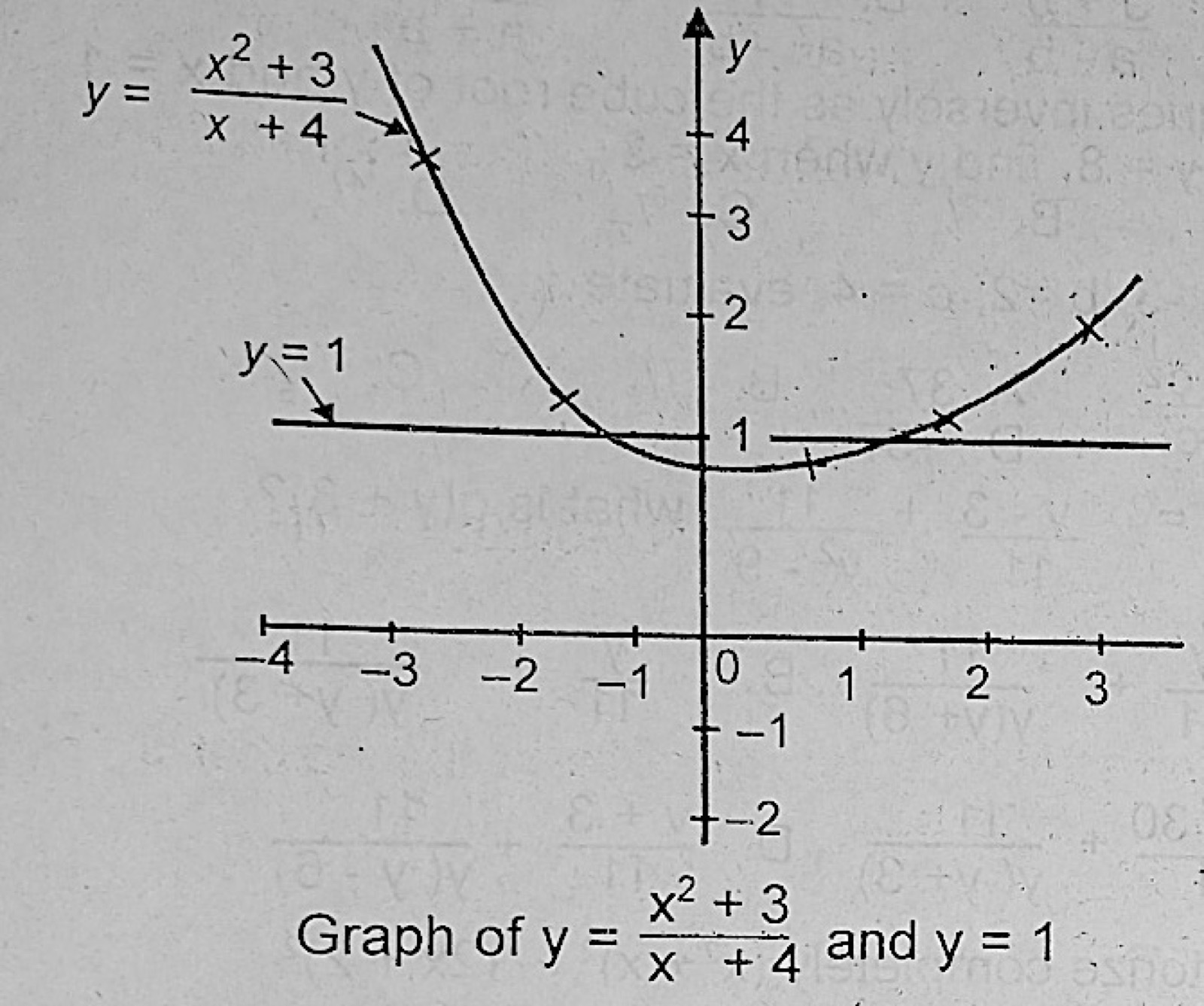
Answer: A (x = 1.6 and x = −0.6)
Setting (x² + 3)/(x + 4) = 1 gives x² + 3 = x + 4, i.e. x² − x − 1 = 0. So the roots are where the curve meets the line y = 1, at about x = 1.6 and x = −0.6.
The solution of x2 − 2x − 1 = 0 are the points of intersection of two graphs. If one of the graphs is y = 2 + x − x2, find the second graph.
Answer: A (y = 1 − x)
We need 2 + x − x² = g(x) to be the same as x² − 2x − 1 = 0. So g(x) = 2 + x − x² + (x² − 2x − 1) = 1 − x.
If the sum of the 8th and 9th terms of an arithmetic progression is 72 and the 4th term is −6, find the common difference
Answer: D (9⅓)
(a + 7d) + (a + 8d) = 72 gives 2a + 15d = 72, and a + 3d = −6 gives 2a + 6d = −12. Subtracting, 9d = 84, so d = 9⅓.
If 7 and 189 are the first and fourth terms of a geometric progression respectively, find the sum of the first three terms of the progression.
Answer: B (91)
7r³ = 189, so r³ = 27 and r = 3. The first three terms are 7, 21 and 63, which add up to 91.
In the figure above, PQRS is a circle. If chords QR and RS are equal, calculate the value of x
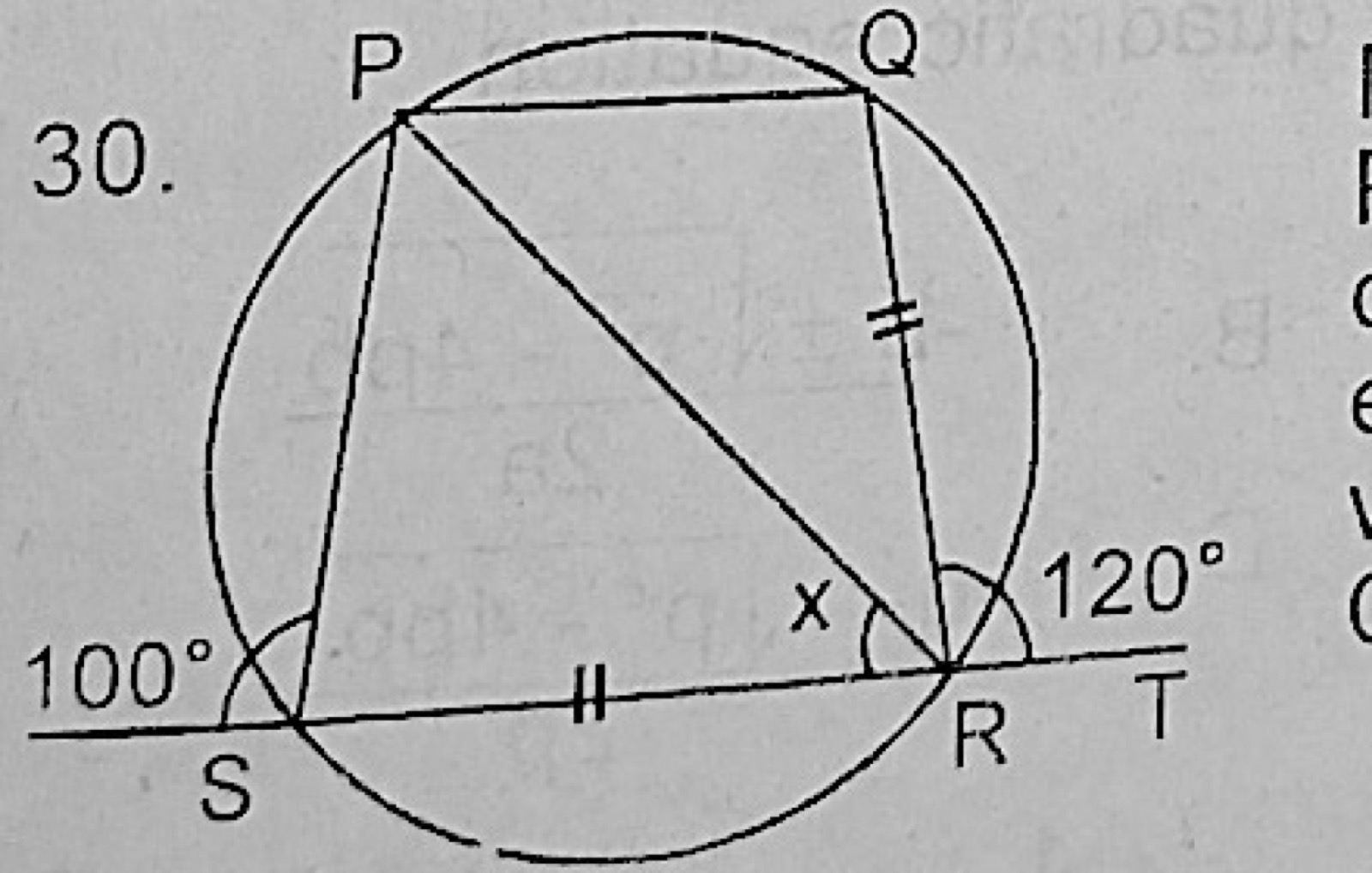
Answer: D (40°)
Angle QRS = 180° − 120° = 60°, and since QR = RS, triangle QRS is equilateral, so angle QSR = angle QPR = 60°. Angle PSR = 180° − 100° = 80° and angle QPS = 180° − 60° = 120°, so angle SPR = 60°. In triangle PSR, x = 180° − 80° − 60° = 40°.
In the figure above, PQ is parallel to ST and QR̂S = 40°. Find the value of x
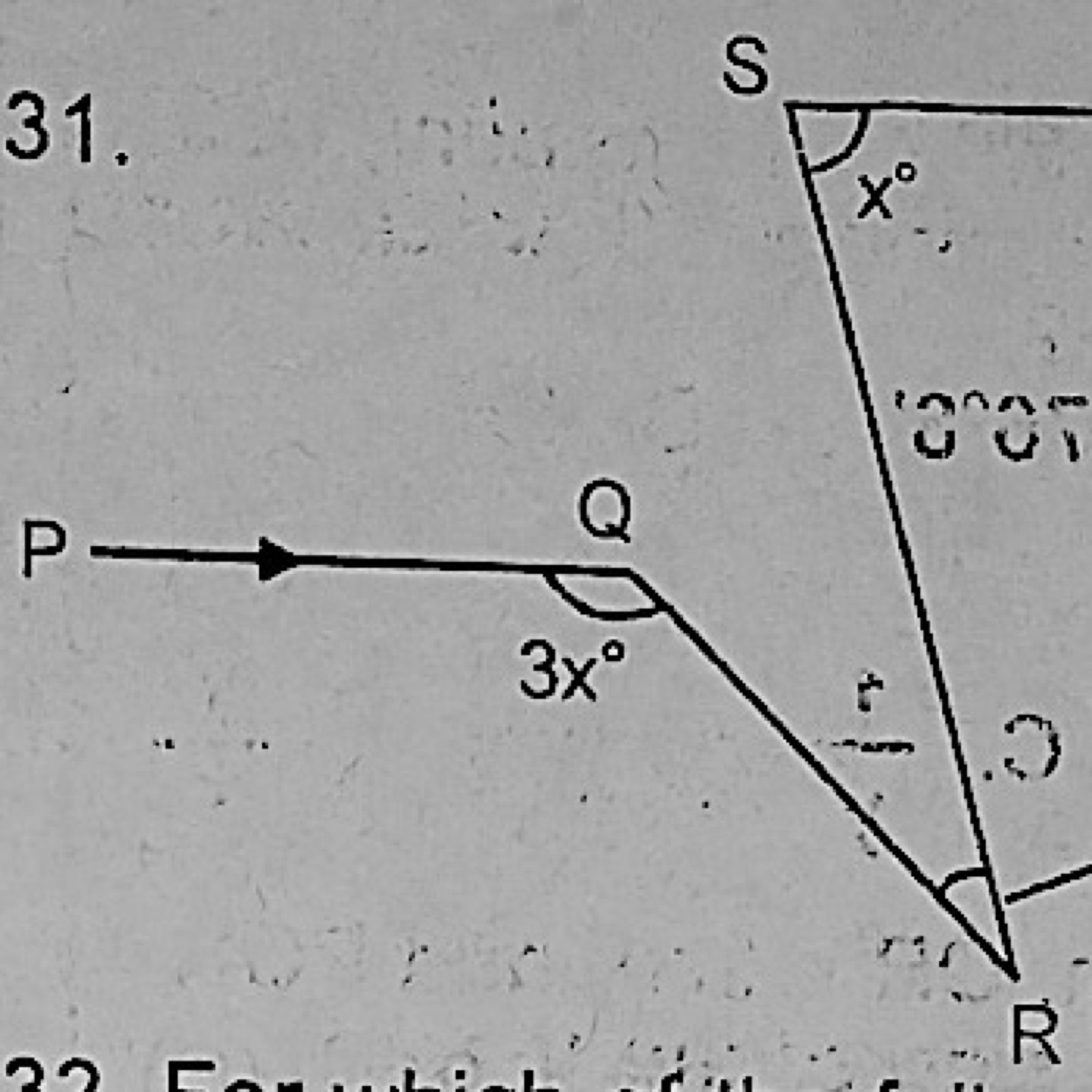
Answer: A (55)
Following the turns of the path P–Q–R–S–T between the parallel lines gives 3x + x − 40° = 180°. So 4x = 220° and x = 55°.
For which of the following exterior angles is a regular polygon possible? i. 35° ii. 18° iii. 15°
Answer: C (ii and iii)
A regular polygon has 360° ÷ (exterior angle) sides, which must be a whole number. 360 ÷ 18 = 20 and 360 ÷ 15 = 24 work, but 360 ÷ 35 is not whole.
In the figure above, PS = 7cm and RY = 9cm. If the area of parallelogram PQRS is 56cm2, find the area of trapezium PQTS.
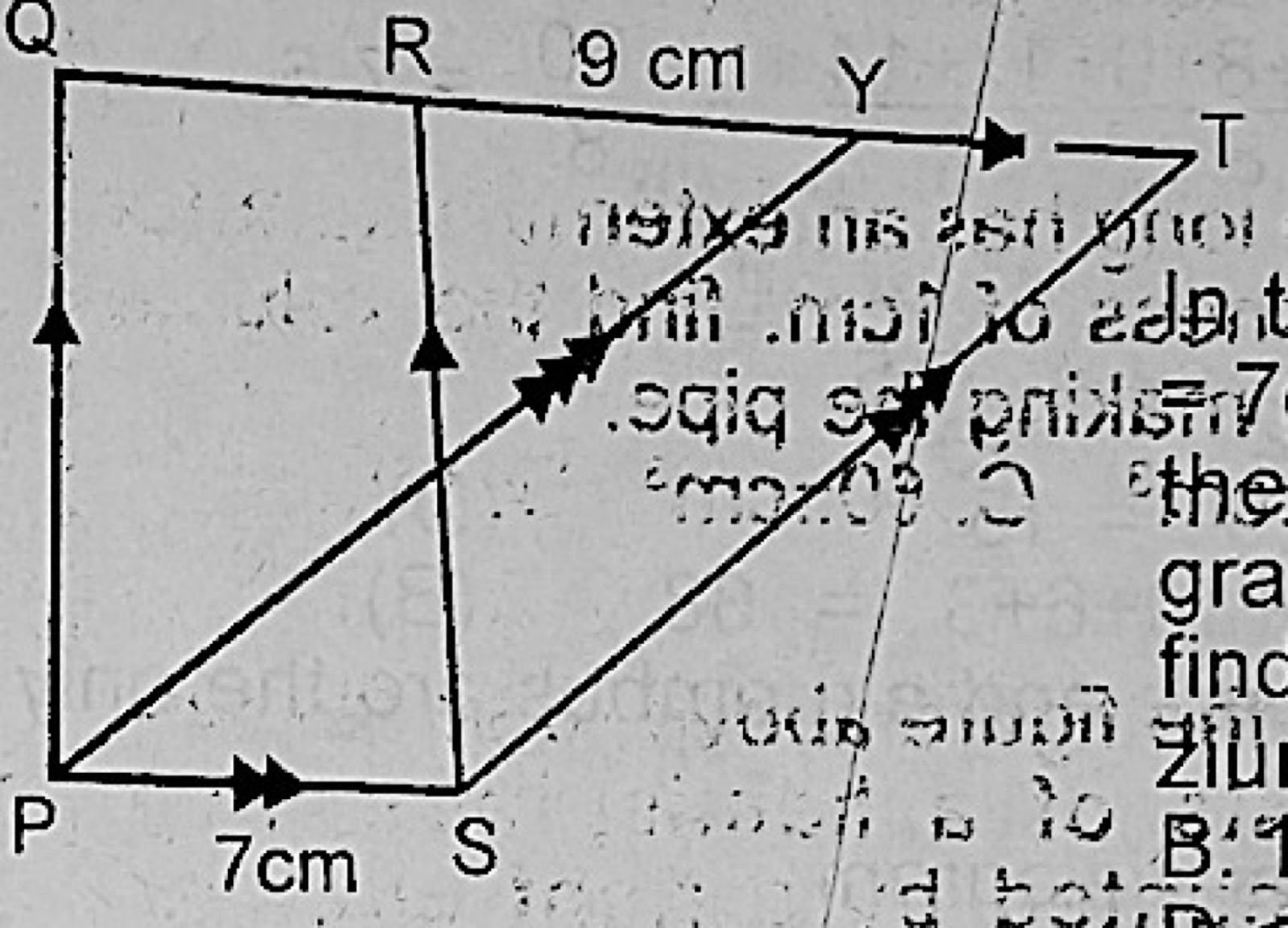
Answer: C (120cm2)
The height is 56 ÷ 7 = 8cm. QT = QR + RY + YT = 7 + 9 + 7 = 23cm. Area of the trapezium = ½(23 + 7) × 8 = 120cm².
A quadrant of a circle of radius 6cm is cut away from each corner of rectangle 25cm long and 18cm wide. Find the perimeter of the remaining figure.
Answer: B ((38 + 12π)cm)
The rectangle's perimeter is 86cm. Each corner loses 6 + 6 = 12cm of straight edge (48cm in all) and gains a quarter arc of 2π × 6 ÷ 4 = 3π. Perimeter = 86 − 48 + 12π = (38 + 12π)cm.
In the figure above, ST̂Q = SR̂P, PT = TQ = 6cm and QS = 5cm. Find SR.
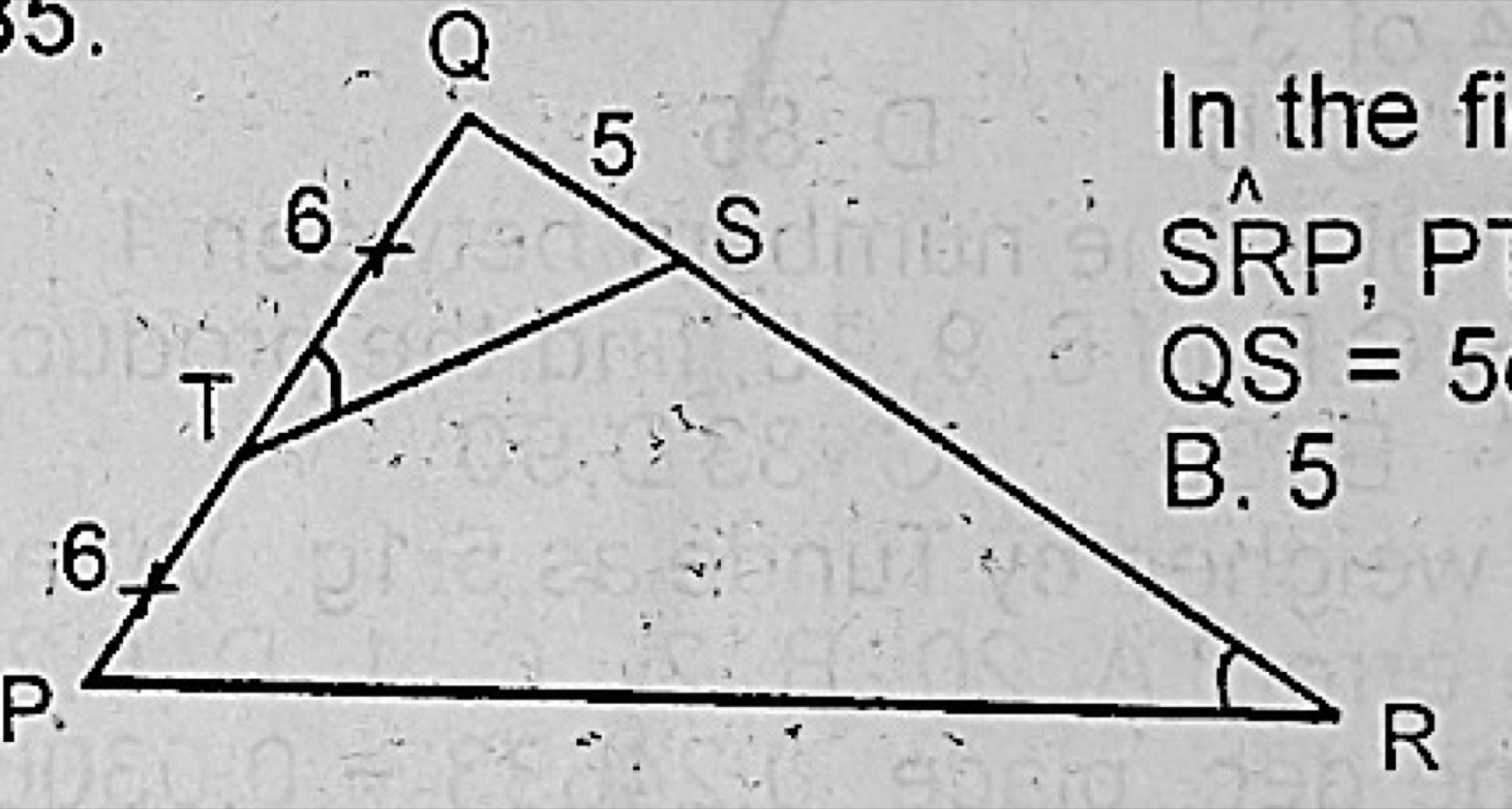
Answer: A (47/5)
Triangles QST and QPR are similar (common angle Q and equal angles at T and R). So QS/QP = QT/QR: 5/12 = 6/QR, giving QR = 72/5. SR = 72/5 − 5 = 47/5.
Four interior angles of a pentagon are 90° − x°, 90° + x°, 110° − 2x°, 110° + 2x°, Find the fifth interior angle.
Answer: D (140°.)
A pentagon's angles add up to 540°. The four given angles add up to 400° (the x terms cancel), so the fifth is 140°.
In the figure above, PS = RS = QS and QŜR = 50°. Find QP̂R.

Answer: A (25°)
S is equally far from P, Q and R, so it is the centre of a circle through them. Angle QPR stands on the same arc QR as the angle at the centre QSR, so it is half of 50°, i.e. 25°.
In the figure above, XR and YQ are tangents to the circle YZXP. If ZX̂R = 45° and YẐX = 55°, find ZŶQ
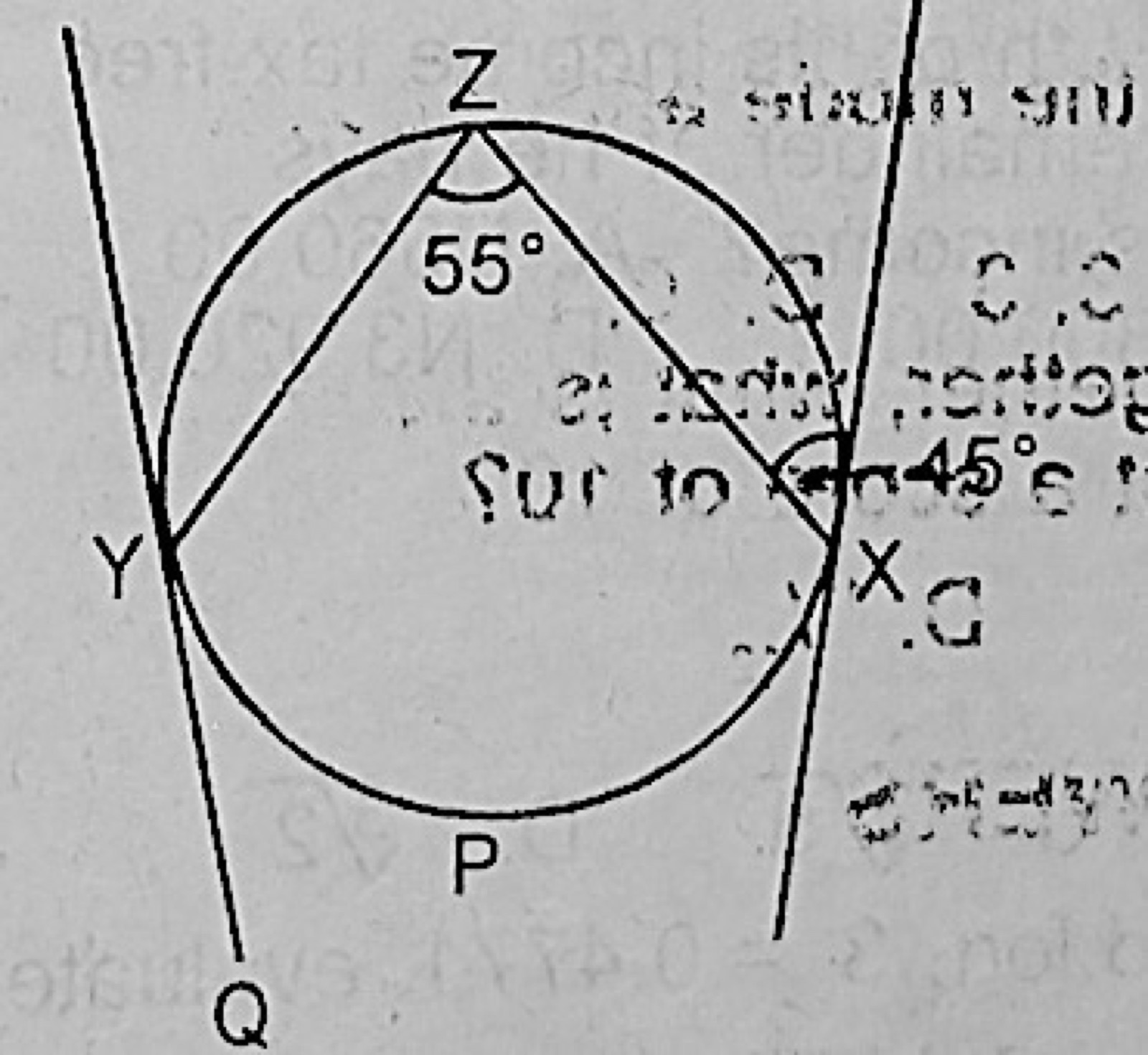
Answer: C (100°)
The angle between a tangent and a chord equals the angle in the alternate segment. So angle ZYX = angle ZXR = 45°, and in triangle XYZ angle YXZ = 180° − 45° − 55° = 80°. The angle between YZ and the tangent on the other side of Y is 80°, so angle ZYQ = 180° − 80° = 100°.
From a point 14√3 metres away from a tree, a man discovers that the angle of elevation of the tree is 30°. If the man measures this angle of elevation from a point 2 metres above the ground, how high is the tree?
Answer: D (16m)
Above eye level the tree rises 14√3 × tan 30° = 14√3 × 1/√3 = 14m. Adding the 2m eye height gives 16m.
Alero starts a 3km walk from P on a bearing 023°. She then walks 4km on a bearing 113° to Q. What is the bearing of Q from P?
Answer: C (76°8')
The two legs are at right angles (113° − 23° = 90°). At P the angle between the first leg and PQ is tan⁻¹(4/3) = 53°8'. The bearing of Q is 23° + 53°8' = 76°8'.
If cot θ = x/y, find cosec θ
Answer: C ((1/y)√(x2 + y2))
Take adjacent side x and opposite side y, so the hypotenuse is √(x² + y²). cosec θ = hypotenuse/opposite = √(x² + y²)/y.
In triangle PQR, PQ = 1cm, QR = 2cm and PQ̂R = 120°. Find the longest side of the triangle.
Answer: B (√7cm)
The longest side is PR, opposite the 120° angle. By the cosine rule PR² = 1² + 2² − 2(1)(2)cos 120° = 5 + 2 = 7, so PR = √7cm.
If cos2θ + 1/8 = sin2θ, find tan θ.
Answer: B (3√7/7)
Replace sin²θ by 1 − cos²θ: 2cos²θ = 7/8, so cos²θ = 7/16 and sin²θ = 9/16. tan θ = 3/√7 = 3√7/7.
If a metal pipe 10cm long has an external diameter of 12cm and a thickness of 1cm, find the volume of the metal used in making the pipe.
Answer: B (110πcm3)
Outer radius 6cm, inner radius 5cm. Volume = π(6² − 5²) × 10 = 110π cm³.
In the figure above, a solid consists of a hemisphere surmounted by a right circular cone, with radius 3.0cm and height 6.0cm. Find the volume of the solid.
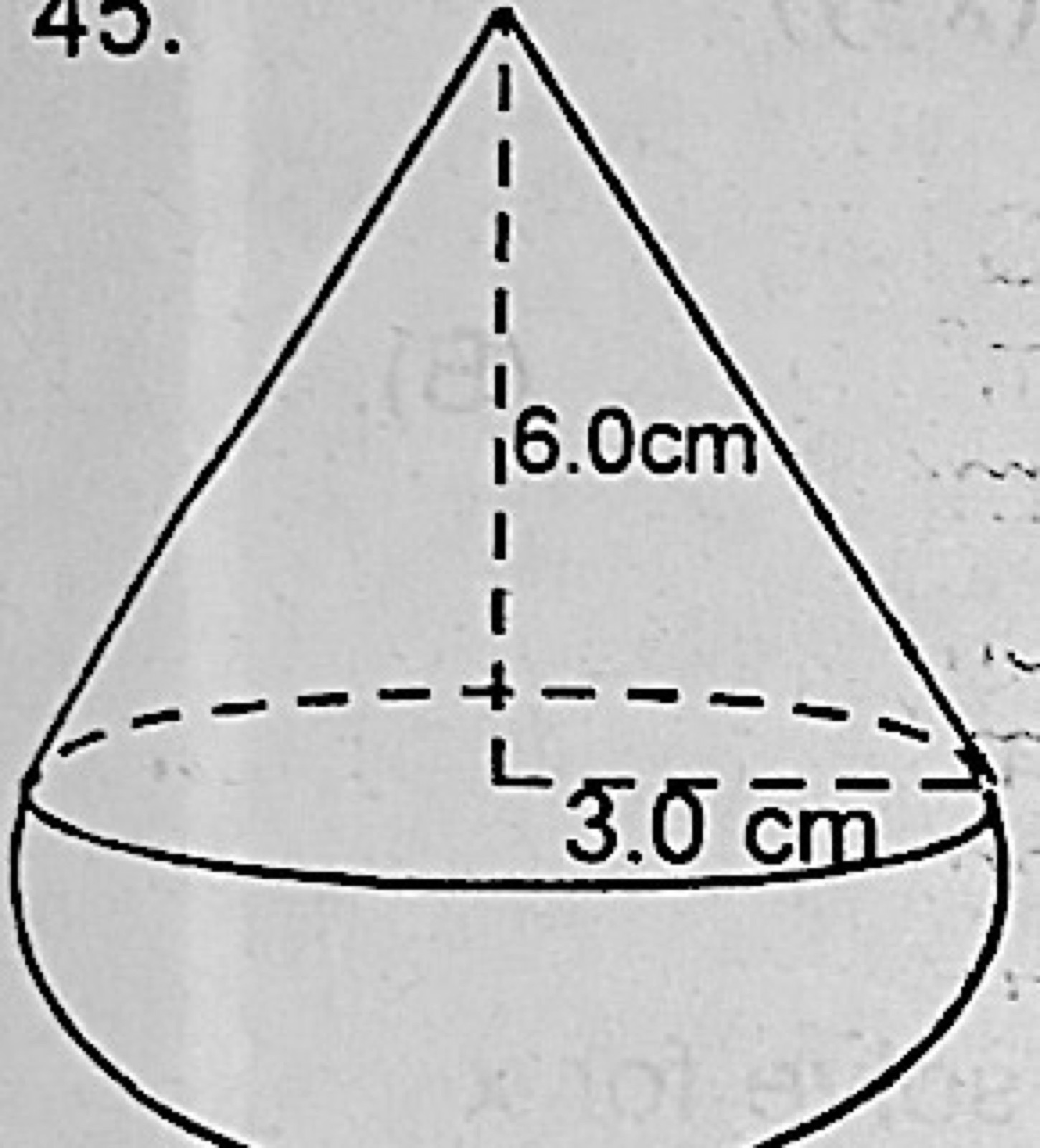
Answer: B (36πcm3)
Cone: ⅓π × 3² × 6 = 18π. Hemisphere: ⅔π × 3³ = 18π. Total = 36π cm³.
PQR is a triangle in which PQ = 10cm and QP̂R = 60°. S is a point equidistant from P and Q. Also, S is a point equidistant from PQ and PR. If U is the foot of the perpendicular from S on PR, find the length SU in cm to one decimal place.
Answer: B (2.9)
S is on the perpendicular bisector of PQ, so it is above the midpoint, 5cm from P. S is also on the bisector of angle P, which makes 30° with PQ. Its distance from PQ (equal to SU) is 5 tan 30° = 2.89 ≈ 2.9cm.
In a class of 150 students, the sector in a pie chart representing the students offering Physics has angle 12°. How many students are offering Physics?
Answer: D (5)
Number = 12/360 × 150 = 5.
If x and y represent the mean and the median respectively of the following set of numbers; 11, 12, 13, 14, 15, 16, 17, 18, 19, 21. Find x/y correct to one decimal place.
Answer: D (1.0.)
The sum is 156, so the mean is 15.6. The median is (15 + 16)/2 = 15.5. x/y = 15.6/15.5 = 1.006 ≈ 1.0.
Score (x): 0, 1, 2, 3, 4, 5, 6
Frequency (f): 7, 11, 6, 7, 7, 5, 3
In the distribution above, the mode and median respectively are
Answer: B (1, 2)
The highest frequency (11) is at score 1, so the mode is 1. There are 46 scores; the 23rd and 24th fall in score 2 (cumulative 7, 18, 24), so the median is 2.
If two dice are thrown together, what is the probability of obtaining at least a score of 10?
Answer: A (1/6)
Totals of 10 or more come from (4,6), (6,4), (5,5), (5,6), (6,5) and (6,6): 6 of the 36 outcomes. Probability = 6/36 = 1/6.