Home › Past questions › JAMB › Mathematics › 1980 44 questions. Try each one, then open the answer to check yourself and read the explanation.
Sign up free to answer these questions on a CBT screen with a timer, then see your score and every answer explained.
Start practising free
Question 1 Fractions, Decimals and Approximation Find correct to three significant figures, the value of √(41830)
A. 205 B. 647 C. 2050 D. 6470 E. 64.7 Show the answer and explanation Answer: A (205 )
Explanation 200² = 40000 and 205² = 42025, so √41830 ≈ 204.5, which is 205 to three significant figures.
Open this question
Question 2 Indices Evaluate (20 + 4-½ )2
A. 1 /4 B. 5 /4 C. 9 /4 D. 4 E. 9 Show the answer and explanation Answer: C (9 /4
Explanation 2⁰ = 1 and 4^(−½) = 1/√4 = ½, so the value is (1½)² = 9/4.
Open this question
Question 3 Fractions, Decimals and Approximation Which of the following is NOT a factor of 124 − 54 ?
A. 7 B. 13 C. 17 D. 49 E. 169. Show the answer and explanation Answer: D (49 )
Explanation 12⁴ − 5⁴ = (144 + 25)(144 − 25) = 169 × 119 = 13² × 7 × 17. It contains only one 7, so 49 is not a factor.
Open this question
Question 4 Surds Rationalize the denominator of the given expression (√(1 + a) − √a)/(√(1 + a) + √a)
A. 1 + 2a − 2√(a(1 + a)) B. √(a(1 + a)) C. 2a − 2√(a(1 + a)) D. 1 − 2a − 2√(a(1 + a)) E. 2a − 2√(a(1 + a)) − 1. Show the answer and explanation Answer: A (1 + 2a − 2√(a(1 + a)) )
Explanation Multiply top and bottom by √(1 + a) − √a. The bottom becomes (1 + a) − a = 1 and the top (√(1 + a) − √a)² = 1 + 2a − 2√(a(1 + a)).
Open this question
Question 5 Commercial Arithmetic When a dealer sells a bicycle for ₦81 he makes a profit of 8%. What did he pay for the bicycle?
A. ₦73 B. ₦74.52 C. ₦75 D. ₦75.52 E. ₦87.48. Show the answer and explanation Answer: C (₦75 )
Explanation ₦81 is 108% of the cost price, so the cost is 81 × 100/108 = ₦75.
Open this question
Question 6 Measures of Central Tendency The median of the set of numbers 4, 9, 4, 13, 7, 14, 10, 17 is
A. 13 B. 7 C. 19 /2 D. 10 E. 39 /4 Show the answer and explanation Answer: C (19 /2
Explanation In order: 4, 4, 7, 9, 10, 13, 14, 17. With eight numbers the median is the average of the 4th and 5th: (9 + 10)/2 = 19/2.
Open this question
Question 7 Inequalities List all integer values of x satisfying the inequality −1 < 2x − 5 ≤ 5
A. 2, 3, 4, 5 B. 2, 5 C. 3, 4, 5 D. 2, 3, 4 E. 3.1. Show the answer and explanation Answer: C (3, 4, 5 )
Explanation Add 5: 4 < 2x ≤ 10, so 2 < x ≤ 5. The integers are 3, 4 and 5.
Open this question
Question 8 Quadratic Equations Find the roots of the equation 10x2 − 13x − 3 = 0
A. x = 3 /5 or −1 /3 B. x = 3 /10 or −1 C. x = −3 /10 or 1 D. x = 1 /5 or −3 /2 E. x = −1 /5 or 3 /2 Show the answer and explanation Answer: E (x = −1 /5 or 3 /2 )
Explanation 10x² − 13x − 3 = (5x + 1)(2x − 3) = 0, so x = −1/5 or 3/2.
Open this question
Question 9 Mensuration of Solids A solid cylinder of radius 3cm has a total surface area of 36πcm2 . Find its height
A. 2cm B. 3cm C. 4cm D. 5cm E. 6cm. Show the answer and explanation Answer: B (3cm )
Explanation Total surface area = 2πr² + 2πrh = 18π + 6πh = 36π, so 6πh = 18π and h = 3cm.
Open this question
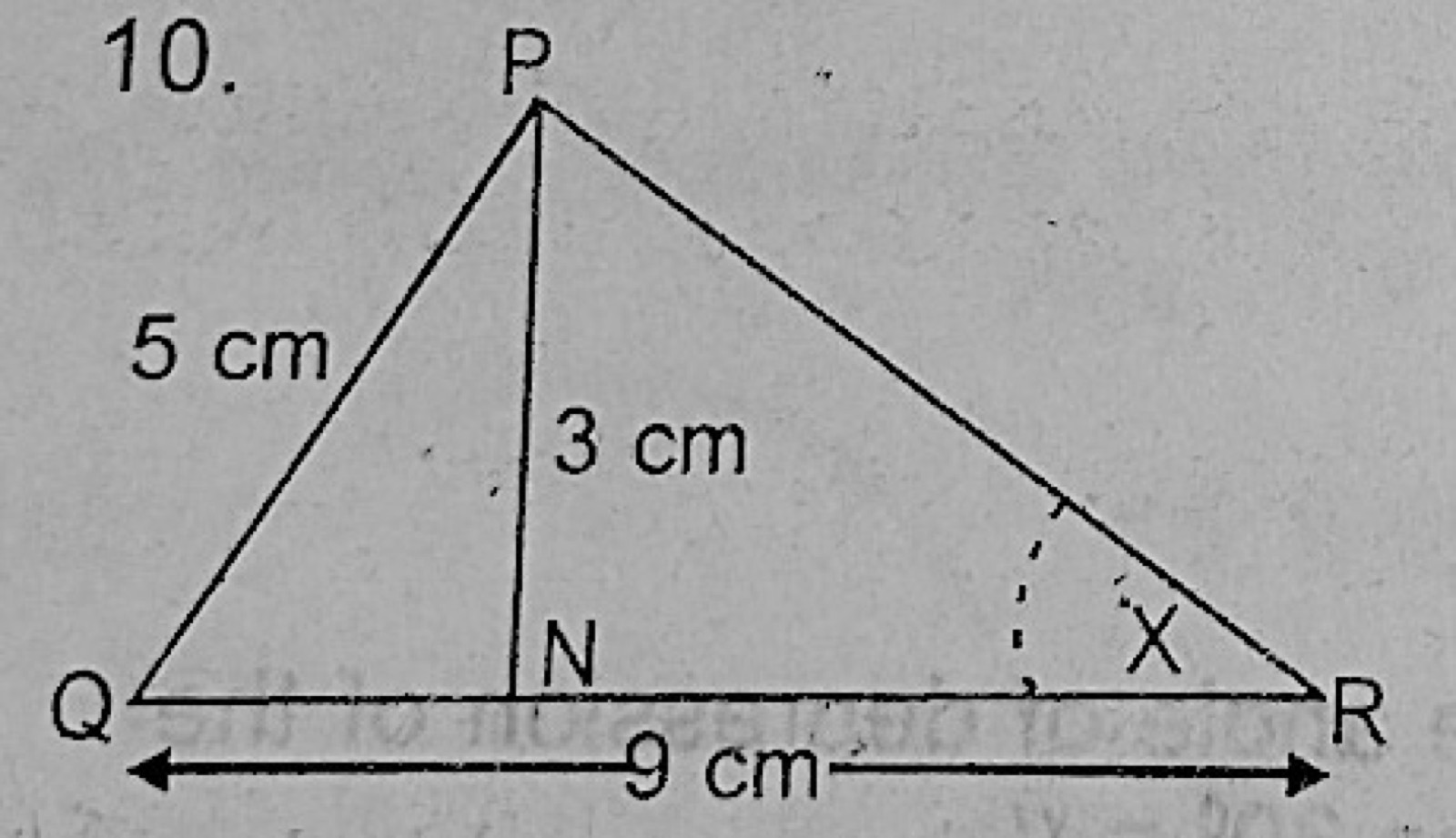
Question 10 Trigonometry If PN is perpendicular to QR, find the value of tan x
A. 5 /9 B. 3 /5 C. 3 /4 D. 4 /3 E. 5 /3 .Show the answer and explanation Answer: B (3 /5
Explanation In triangle PQN, QN = √(5² − 3²) = 4cm, so NR = 9 − 4 = 5cm. tan x = PN/NR = 3/5.
Open this question
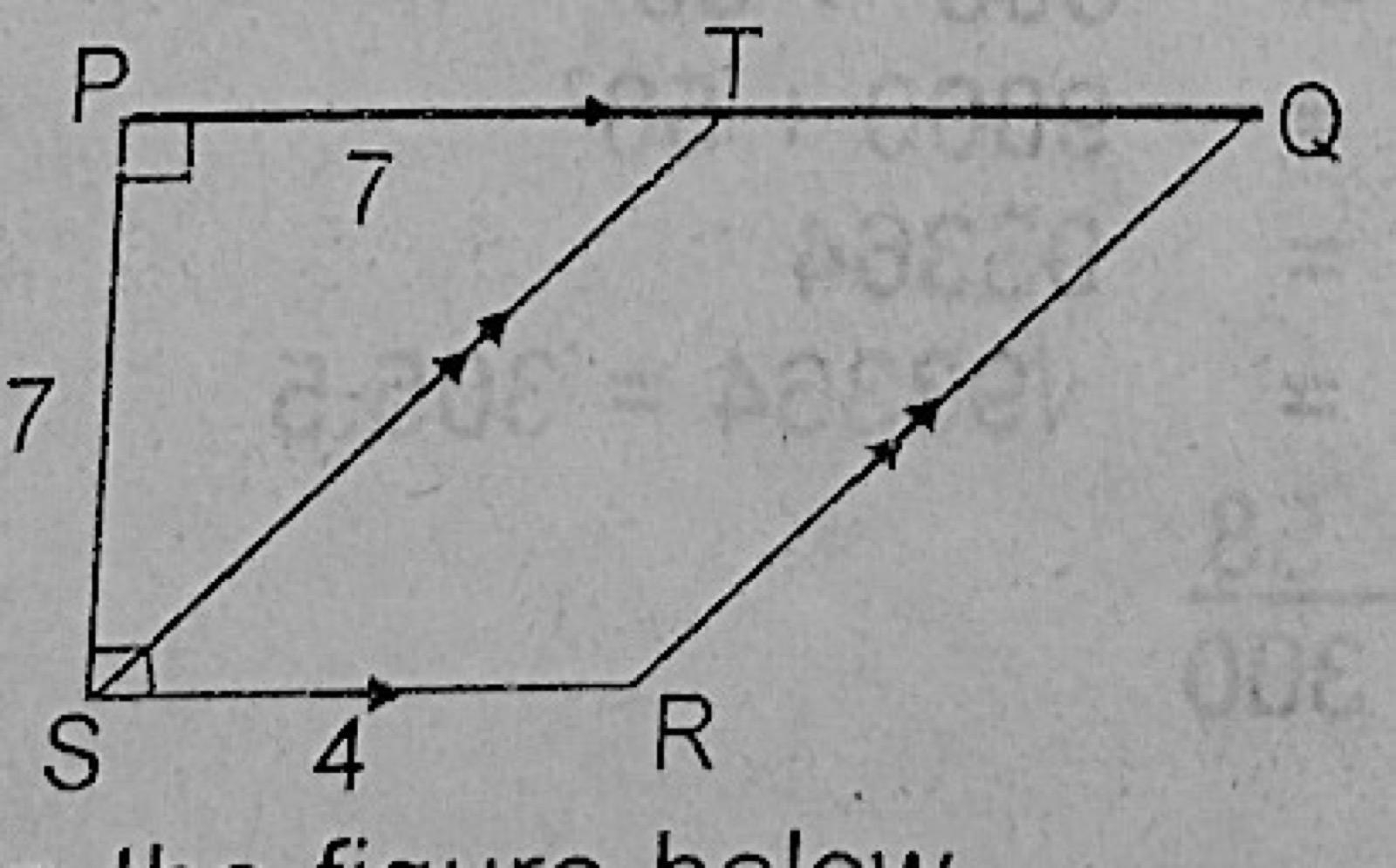
Question 11 Triangles and Quadrilaterals In the figure below, PQ∥SR, ST∥RQ, PS = 7cm, PT = 7cm, SR = 4cm. Find the ratio of the area of QRST to the area of PQRS.
A. 56:77 B. 56:105 C. 28:105 D. 28:49 E. 56:49 Show the answer and explanation Answer: B (56:105 )
Explanation QRST is a parallelogram with base 4cm and height 7cm: area 28cm². PQ = 7 + 4 = 11cm, so trapezium PQRS = ½(11 + 4) × 7 = 52.5cm². 28 : 52.5 = 56 : 105.
Open this question
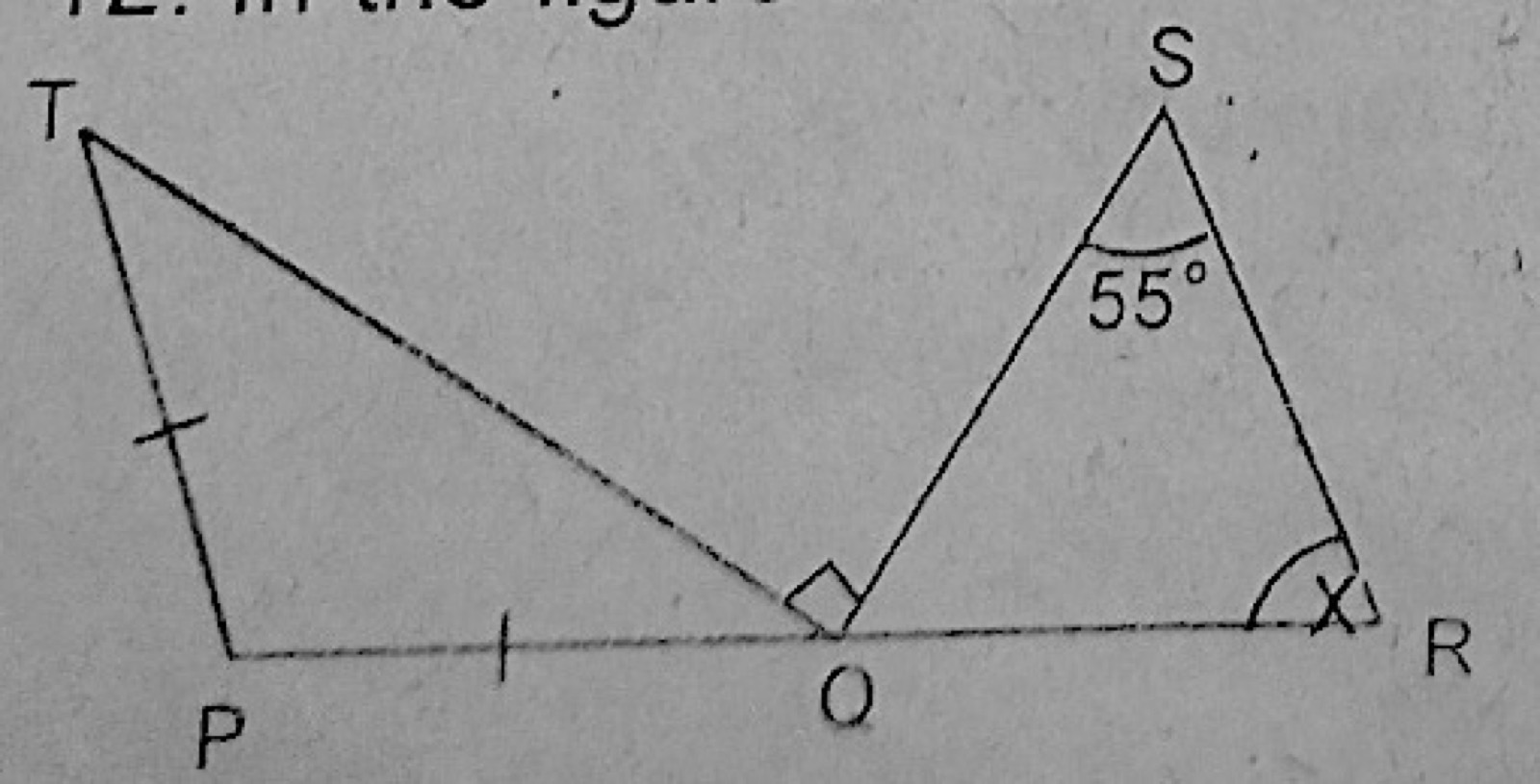
Question 12 Angles and Polygons In the figure below, if PT is parallel to RS, PQ = PT and angle SQT = 90°, find x
A. 35° B. 50° C. 55° D. 70° E. 80°. Show the answer and explanation Answer: D (70° )
Explanation Let <PQT = <PTQ = y (isosceles). PT ∥ RS makes <P + x = 180°, so x = 2y. On the line at Q, <SQR = 90° − y, and in triangle QSR, 55° + x + 90° − y = 180°. So y = 35° and x = 70°.
Open this question
Question 13 Fractions, Decimals and Approximation Write down the number 0.0052048 correct to three significant figures.
A. 0.005 B. 0.0052 C. 0.00520 D. 5.2048 E. 5204. Show the answer and explanation Answer: C (0.00520 )
Explanation The first significant figure is 5; keeping three (5, 2, 0) and rounding the next digit 4 down gives 0.00520.
Open this question
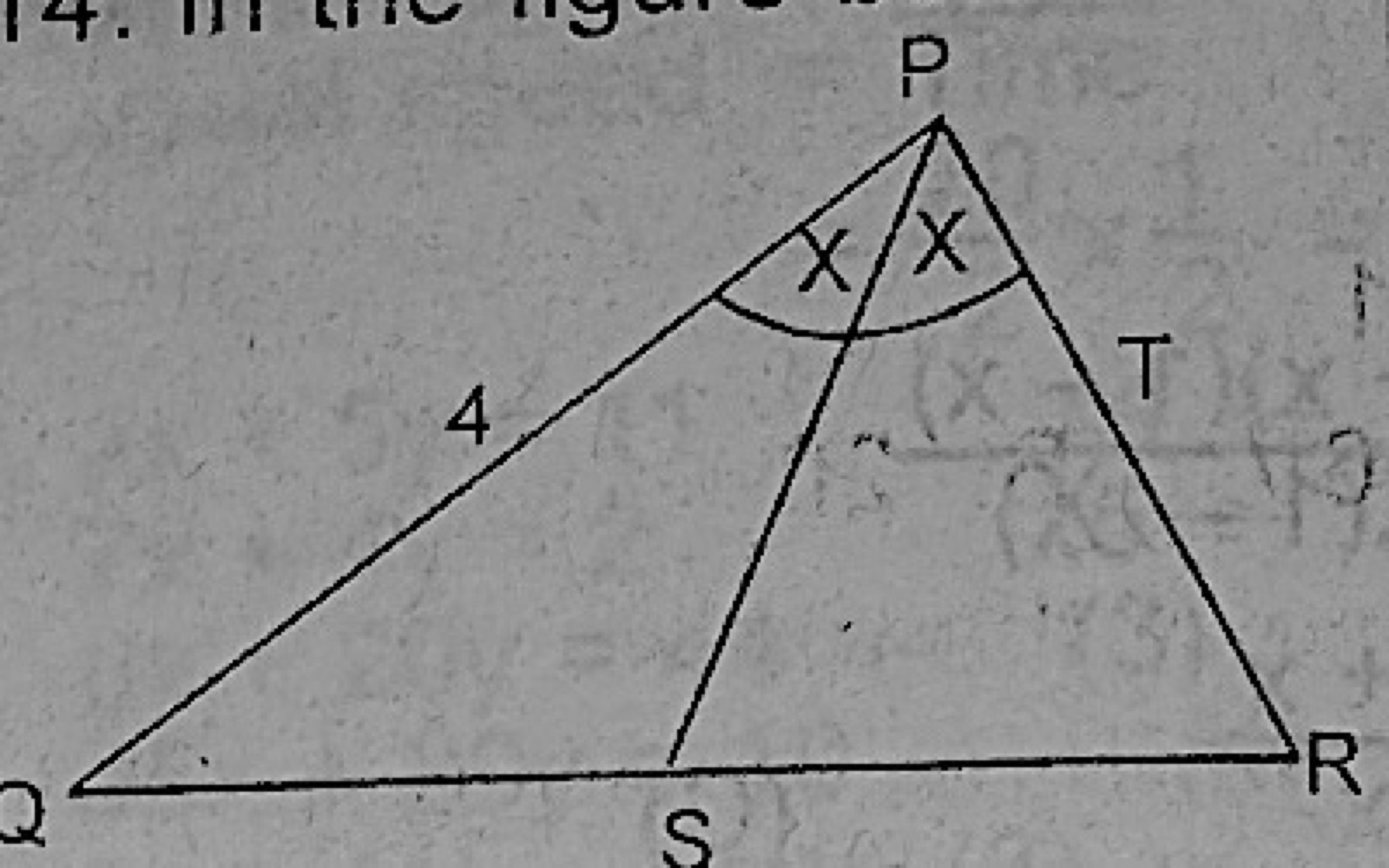
Question 14 Triangles and Quadrilaterals In the figure below PS bisects angle QPR. Find the ratio SR:QR
A. 1:2 B. 1:3 C. 1:4 D. 1:5 E. 1:6 Show the answer and explanation Answer: D (1:5 )
Explanation The angle bisector divides the opposite side in the ratio of the other two sides: QS : SR = PQ : PR = 4 : 1. So SR is 1 part out of 5 and SR : QR = 1 : 5.
Open this question
Question 15 Triangles and Quadrilaterals The ratio of the areas of similar triangles is necessarily equal to
A. the ratio of the corresponding sides B. the ratio of the squares on corresponding sides C. the ratio of the corresponding heights of the triangles D. half the ratio of the corresponding heights of the triangles E. the ratio of the corresponding bases to the heights of the triangles. Show the answer and explanation Answer: B (the ratio of the squares on corresponding sides )
Explanation If the sides are in the ratio k, every length scales by k and areas scale by k², the ratio of the squares on corresponding sides.
Open this question
Question 16 Loci P and Q are fixed points and X is a variable point which moves so that angle PXQ = 45°. What is the locus of X?
A. A pair of straight lines parallel to PQ B. The perpendicular bisector of PQ C. An arc of a circle passing through P and Q D. A circle with diameter PQ. E. The bisector of angle PXQ. Show the answer and explanation Answer: C (An arc of a circle passing through P and Q )
Explanation Angles in the same segment of a circle are equal, so all points where PQ subtends 45° lie on an arc of a circle through P and Q.
Open this question
Question 17 Commercial Arithmetic A man and wife went to buy an article costing ₦400. The woman had 10% of the cost and the man 40% of the remainder. How much did they have altogether?
A. ₦216 B. ₦200 C. ₦184 D. ₦144. E. ₦100. Show the answer and explanation Answer: C (₦184 )
Explanation The woman had 10% of 400 = ₦40. The remainder is ₦360 and the man had 40% of it = ₦144. Together ₦184.
Open this question
Question 18 Logarithms Simplify log10 8/log10 4
A. log10 2 B. log10 4 C. 3 /2 D. 2 E. None of the above. Show the answer and explanation Answer: C (3 /2
Explanation log 8 = 3 log 2 and log 4 = 2 log 2, so the quotient is 3/2.
Open this question
Question 19 Algebraic Expressions Make c the subject of the formula v = 1 − (a/5)(b + 3 /7 c)
A. c = −[7b/3 + (5/a)(v − 1)] B. c = −(7/3)[b + (5/a)(v − 1)] C. c = (7/3)[b + (5/a)(v − 1)] D. c = −(7/3)[b + (5v − 1)/a] E. c = (7/3)[b − (5/a)(v − 1)] Show the answer and explanation Answer: B (c = −(7/3)[b + (5/a)(v − 1)] )
Explanation v − 1 = −(a/5)(b + 3c/7), so b + 3c/7 = −5(v − 1)/a. Then 3c/7 = −[b + (5/a)(v − 1)] and c = −(7/3)[b + (5/a)(v − 1)].
Open this question
Question 20 Algebraic Expressions What factor is common to all the expressions x2 − x, 2x2 + x − 1 and x2 − 1?
A. x B. x − 1 C. x + 1 D. No common factor E. (2x − 1). Show the answer and explanation Answer: D (No common factor )
Explanation x² − x = x(x − 1), 2x² + x − 1 = (2x − 1)(x + 1) and x² − 1 = (x + 1)(x − 1). No single factor appears in all three.
Open this question
Question 21 Progressions Which of the formulae below represents the general terms of the following set of numbers {−1, 2 /3 , −1 /2 , 2 /5 , …} for n = 1, 2, 3, 4, …?
A. 2/(n + 1) B. (−1)n + 1 × 2/(n + 1) C. (−1)n × 2/(n + 1) D. n/(2n − 1) E. (−1)n × n/(2n + 1) Show the answer and explanation Answer: C ((−1)n × 2/(n + 1) )
Explanation The terms are 2/2, 2/3, 2/4, 2/5 with signs −, +, −, +. The sign is (−1)ⁿ, so the nth term is (−1)ⁿ × 2/(n + 1).
Open this question
Question 22 Linear and Simultaneous Equations Three numbers, x, y and z, are connected by the relationships y = 4 /9 x + 1 and z = 4 /9 y + 1. If x = 99 find z
A. 6⅓ B. 20 C. 21 D. 1764 /9 E. None of the above. Show the answer and explanation Answer: C (21 )
Explanation y = 4/9 × 99 + 1 = 45, then z = 4/9 × 45 + 1 = 21.
Open this question
Question 23 Measures of Central Tendency In a school there are 35 students in Class 2A and 40 in Class 2B. The mean score for Class 2A in an English Literature examination is 60.0 and that for 2B in the same paper is 52.5. Find, to one place of decimal, the mean for the combined classes.
A. 1.5 B. 56.0 C. 56.2 D. 56.3 E. 56.5. Show the answer and explanation Answer: B (56.0 )
Explanation Total marks = 35 × 60 + 40 × 52.5 = 2100 + 2100 = 4200 for 75 students, so the mean is 4200 ÷ 75 = 56.0.
Open this question
Question 24 Data Presentation A set of data contains a total of 130 items which are divided into six groups for display on a pie chart. If one group contains 26 items then the sector representing this group on the pie chart contains an angle x° at the centre of the circle where x is
A. 36 B. 60 C. 70 D. 72 E. 75. Show the answer and explanation Answer: D (72 )
Explanation The sector angle is 26/130 × 360° = 72°.
Open this question
Question 25 Triangles and Quadrilaterals In triangle FGH, <G = 90°, <H = 60°, while in triangle XYZ, <X = 60° and <Y = 30°. From ΔXYZ write down the ratio equal to FG/FH
A. YZ/ZX B. YX/YZ C. ZX/YZ D. YX/ZX E. YZ/YX Show the answer and explanation Answer: E (YZ/YX )
Explanation <F = 30° and <Z = 90°, so F matches Y, G matches Z and H matches X. FG corresponds to YZ and FH to YX, so FG/FH = YZ/YX.
Open this question
Question 26 Angles and Polygons A pentagon has four of its angles equal. If the size of the fifth angle is 60°, find the size of each of the four equal angles.
A. 60° B. 108° C. 120° D. 150° E. None of the above. Show the answer and explanation Answer: C (120° )
Explanation The angles of a pentagon add up to (5 − 2) × 180° = 540°. 540° − 60° = 480°, shared by four angles: 120° each.
Open this question
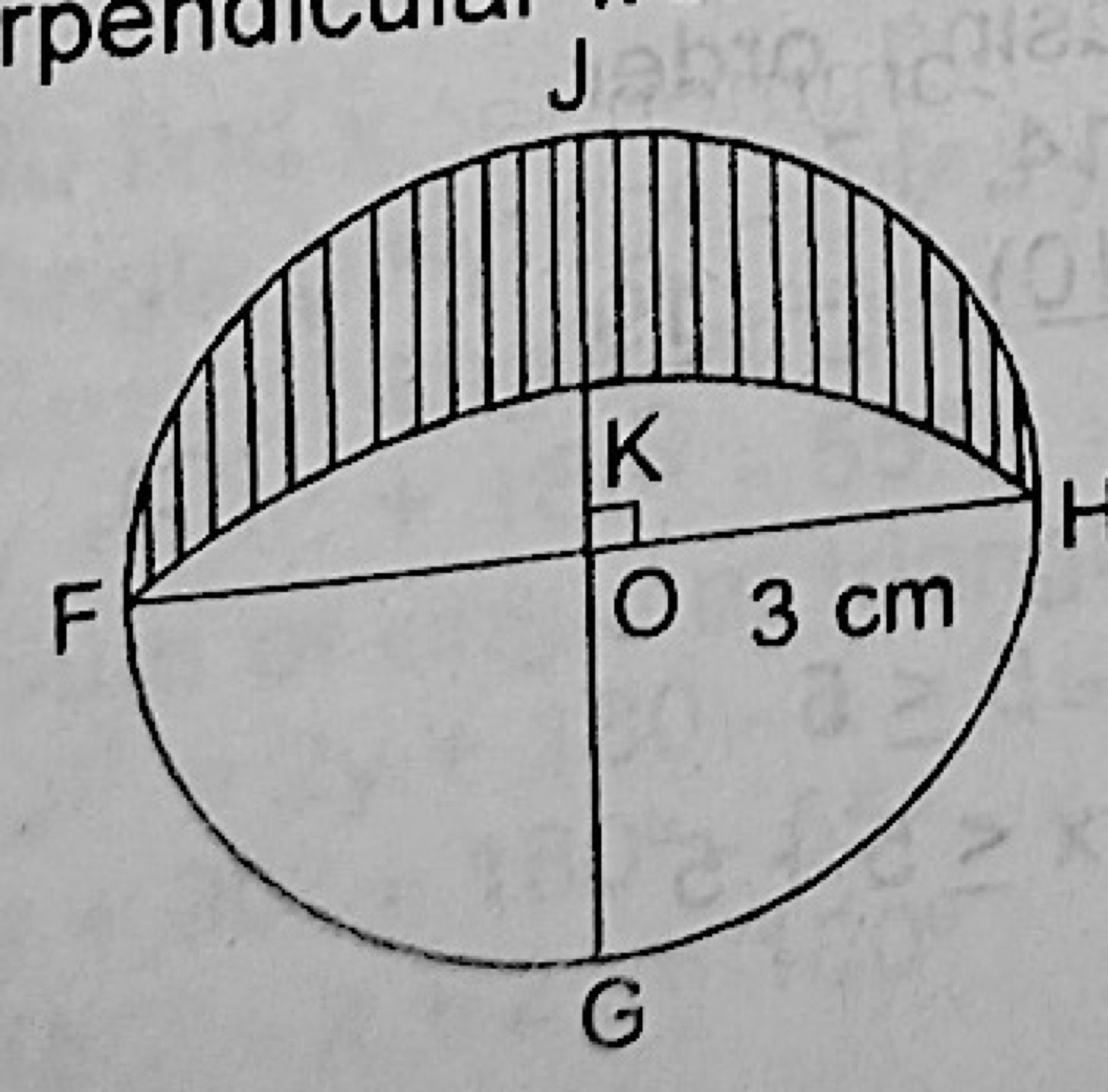
Question 28 Mensuration of Plane Shapes In the figure above, FGHJ is a circle of radius 3cm centre O. FOH, GOJ are perpendicular diameters. With G as centre, an arc of a circle is drawn to pass through F and H. Find the length of the perimeter of the lunar portion shaded.
A. 3π(√2 − 1)cm B. 3π(1 + √2/2) cm C. 3π(1 + √2)cm D. 9 /2 πcmE. 9πcm. Show the answer and explanation Answer: B (3π(1 + √2/2) cm )
Explanation The outer edge is half the small circle: π × 3 = 3π. The inner edge is an arc of radius GF = 3√2 subtending 90° at G: ¼ × 2π × 3√2 = 3√2π/2. Total 3π(1 + √2/2)cm.
Open this question
Question 29 Surds Find the product of (2√y − 3y) and (3y + 2√y)
A. 4y + y2 B. 4y + 9y2 C. 4y − 9y2 D. −4y − 9y2 E. 2y + y2 . Show the answer and explanation Answer: C (4y − 9y2 )
Explanation This is (2√y − 3y)(2√y + 3y), a difference of two squares: (2√y)² − (3y)² = 4y − 9y².
Open this question
Question 31 Quadratic Equations What will be the value of k so that the quadratic equation kx2 − 4x + 1 = 0 has two equal roots?
A. 2 B. 3 C. 4 D. 8 E. ¼ Show the answer and explanation Answer: C (4 )
Explanation Equal roots need b² = 4ac: 16 = 4k, so k = 4.
Open this question
Question 33 Indices If it is given that 5x + 1 + 5x = 150 then the value of x is equal to
A. 3 B. 4 C. 1 D. 2 E. ½. Show the answer and explanation Answer: D (2 )
Explanation 5ˣ⁺¹ + 5ˣ = 5 × 5ˣ + 5ˣ = 6 × 5ˣ = 150, so 5ˣ = 25 = 5² and x = 2.
Open this question
Question 34 Linear and Simultaneous Equations Solve the system of equationx + y = 323y − x = 27
A. (3, 2) B. (−3, 2) C. (3, −2) D. (−3, −2) E. (2, 2). Show the answer and explanation Answer: A ((3, 2) )
Explanation 32 = 2⁵ and 27 = 3³, so x + y = 5 and 3y − x = 3. Adding: 4y = 8, y = 2 and x = 3.
Open this question
Question 36 Mensuration of Solids Find the area of the curved surface of a cone whose base radius is 6cm and whose height is 8cm. (Take π = 22 /7 )
A. 188.57cm2 B. 1320cm2 C. 188cm2 D. 188.08cm2 E. 100cm2 Show the answer and explanation Answer: A (188.57cm2 )
Explanation The slant height is √(6² + 8²) = 10cm. Curved surface = πrl = 22/7 × 6 × 10 ≈ 188.57cm².
Open this question
Question 37 Trigonometry Solve the equation for all positive values of θ less than 360°, 3 tan θ + 2 = −1
A. 135° or 315° B. 45 or 135° C. 315 or 45 D. 315 or 180 E. 360 or 315. Show the answer and explanation Answer: A (135° or 315° )
Explanation 3 tan θ = −3, so tan θ = −1. Tangent is negative in the 2nd and 4th quadrants: θ = 180° − 45° = 135° or 360° − 45° = 315°.
Open this question
Question 38 Logarithms Given log 2 = 0.69, log 3 = 1.10 and log 7 = 1.90 all to a fixed base, find log 10.5 to the same base, without using tables.
A. 1.03 B. 2.31 C. 3.69 D. 10.5 E. 1.69. Show the answer and explanation Answer: B (2.31 )
Explanation 10.5 = 3 × 7 ÷ 2, so log 10.5 = 1.10 + 1.90 − 0.69 = 2.31.
Open this question
Question 39 Logarithms Simplify 102 + log10 5
A. 500 B. 2log10 5 C. 10 D. 25 E. log10 7. Show the answer and explanation Answer: A (500 )
Explanation 10^(2 + log₁₀5) = 10² × 10^(log₁₀5) = 100 × 5 = 500.
Open this question
Question 40 Algebraic Expressions Simplify, as much as possible 1 + 2/(1 − 5/(5 + 2/x))
A. 2/x + 2 B. x + 1 C. 10x + 6 D. 5x + 3 E. (5x + 3)/(5x + 2) Show the answer and explanation Answer: D (5x + 3 )
Explanation 5 + 2/x = (5x + 2)/x, so 5 divided by it is 5x/(5x + 2). Then 1 − 5x/(5x + 2) = 2/(5x + 2), and 2 divided by that is 5x + 2. Adding 1 gives 5x + 3.
Open this question
Question 41 Algebraic Expressions Find the missing numerator: 5/(x + 1) − 3/(1 − x) − (7x − 1)/(x2 − 1) = ______/(x + 1)
A. −1 B. x − 1 C. 3(1 − 5x)/(x + 1) D. 3(1 − 5x) E. 1. Show the answer and explanation Answer: E (1. )
Explanation −3/(1 − x) = 3/(x − 1). Over x² − 1 the top is 5(x − 1) + 3(x + 1) − (7x − 1) = x − 1, so the whole is (x − 1)/(x² − 1) = 1/(x + 1).
Open this question
Question 42 Polynomials The expression x3 − 4x2 + cx + d is such that x + 1 is its factor, and its value is 1 when x is −2. Find c and d.
A. c = 4 and d = −9 B. c = −4 and d = 9 C. c = −20 and d = −15 D. c = 20 and d = −15 E. c = −20 and d = 15. Show the answer and explanation Answer: C (c = −20 and d = −15 )
Explanation f(−1) = −1 − 4 − c + d = 0 gives d − c = 5. f(−2) = −8 − 16 − 2c + d = 1 gives d − 2c = 25. Subtracting: c = −20, so d = −15.
Open this question
Question 43 Algebraic Expressions If a function is defined by f(x + 1) = 3x2 − x + 4 find f(0)
A. 4 B. 6 C. 0 D. 8 E. 2. Show the answer and explanation Answer: D (8 )
Explanation f(0) means x + 1 = 0, i.e. x = −1: 3(1) + 1 + 4 = 8.
Open this question
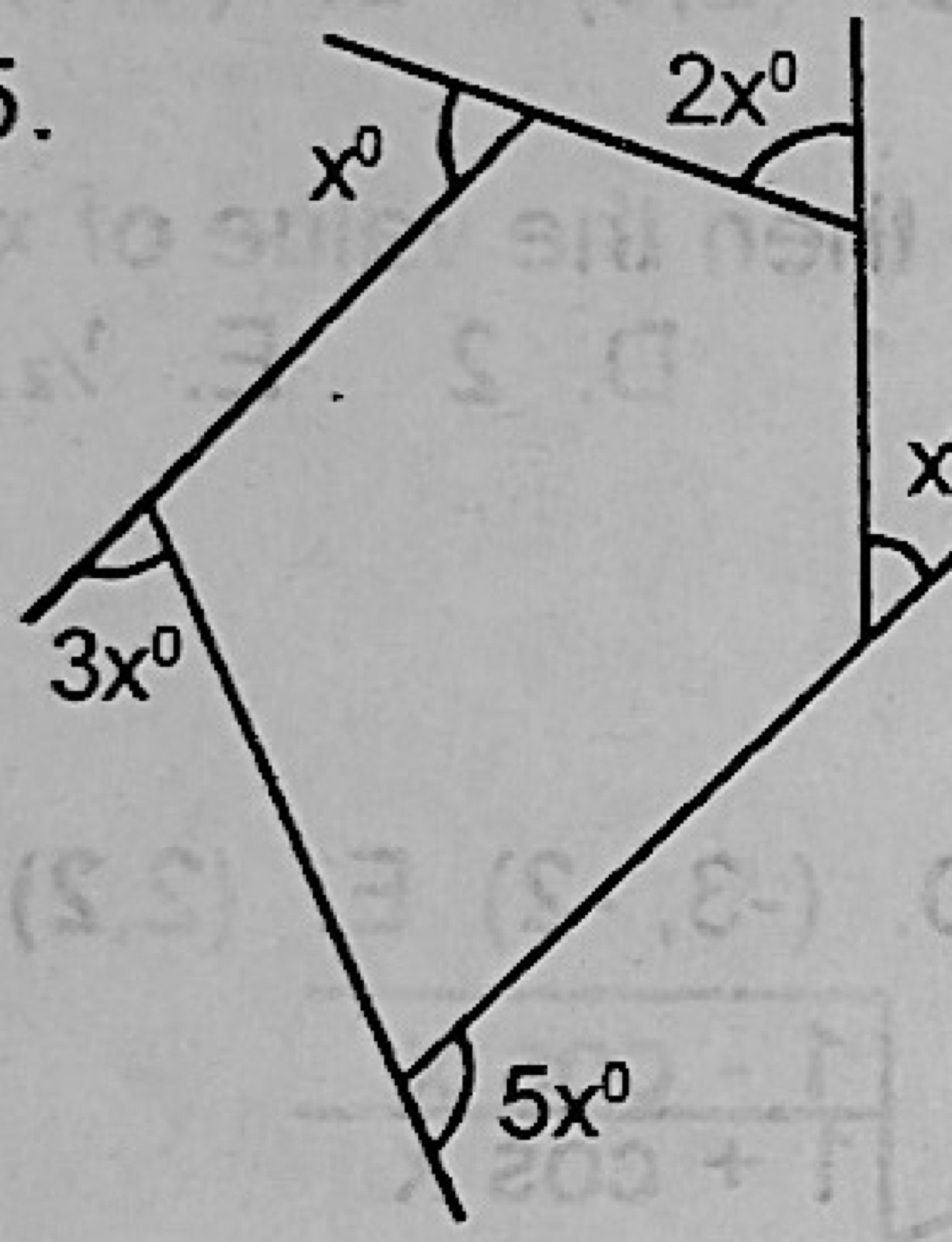
Question 45 Triangles and Quadrilaterals The angles marked in the figure above are measured in degrees. Find x
A. 45° B. 90° C. 60° D. 15° E. 30°. Show the answer and explanation Answer: E (30°. )
Explanation The marked angles are the exterior angles of the pentagon, which add up to 360°: x + 2x + x + 5x + 3x = 12x = 360°, so x = 30°.
Open this question
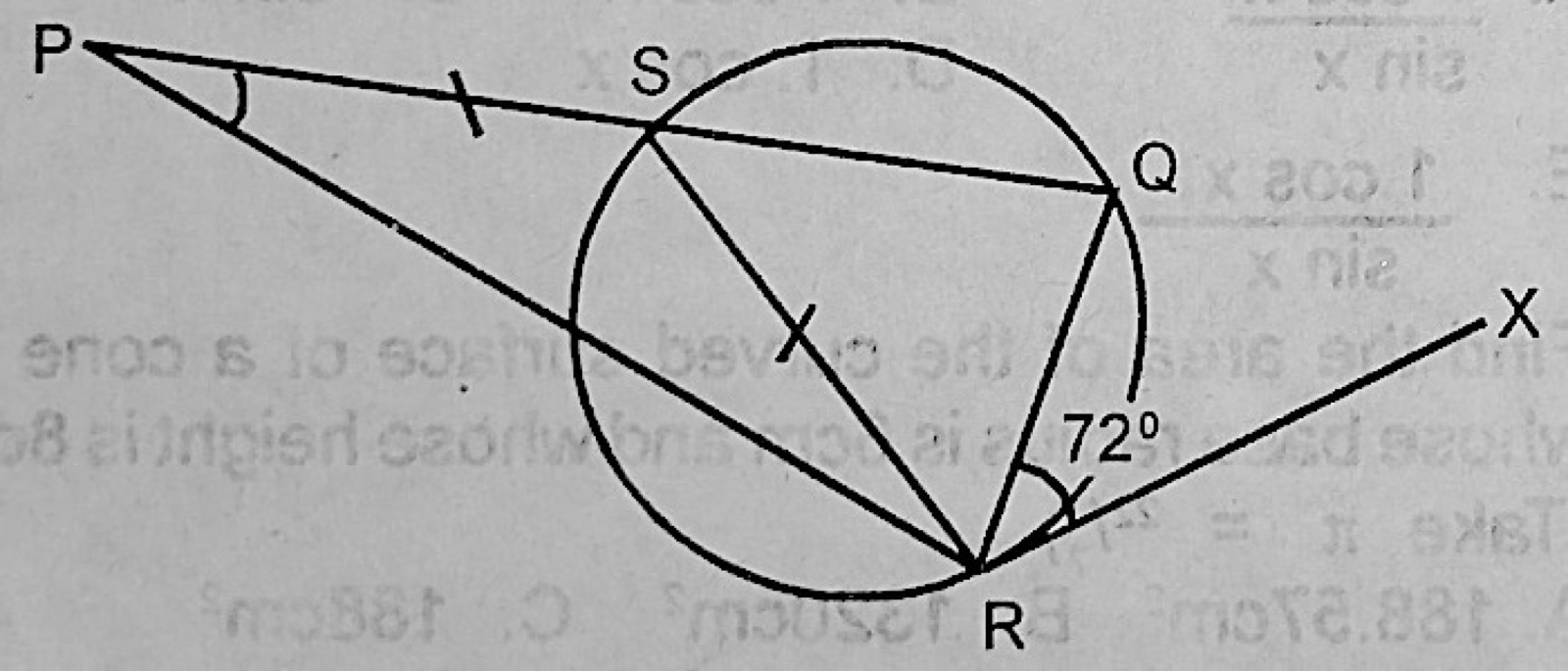
Question 46 Circle Theorems In the figure above, PS = SR and RX is a tangent to the circle at R, <QRX is equal to 72°. Find <SPR
A. 20° B. 36° C. 72° D. 30° E. 15°. Show the answer and explanation Answer: B (36° )
Explanation By the alternate segment theorem <RSQ = <QRX = 72°. This is the exterior angle of isosceles triangle PSR, so 2 × <SPR = 72° and <SPR = 36°.
Open this question
Question 48 Variation If x varies inversely as y, and y varies directly as the square root of z, and z varies directly as 1/w2 , write down in words how x varies with w.
A. x varies inversely as w2 B. x varies directly as w2 C. x varies directly as w D. x varies inversely as w E. x varies directly as square root of w. Show the answer and explanation Answer: C (x varies directly as w )
Explanation √z ∝ 1/w, so y ∝ 1/w. Since x ∝ 1/y, x ∝ w.
Open this question
Question 49 Number Bases Write the decimal number 39 to base 2
A. 100111 B. 110111 C. 111001 D. 100101 E. 19.5. Show the answer and explanation Answer: A (100111 )
Explanation 39 = 32 + 4 + 2 + 1, so in base 2 it is 100111.
Open this question
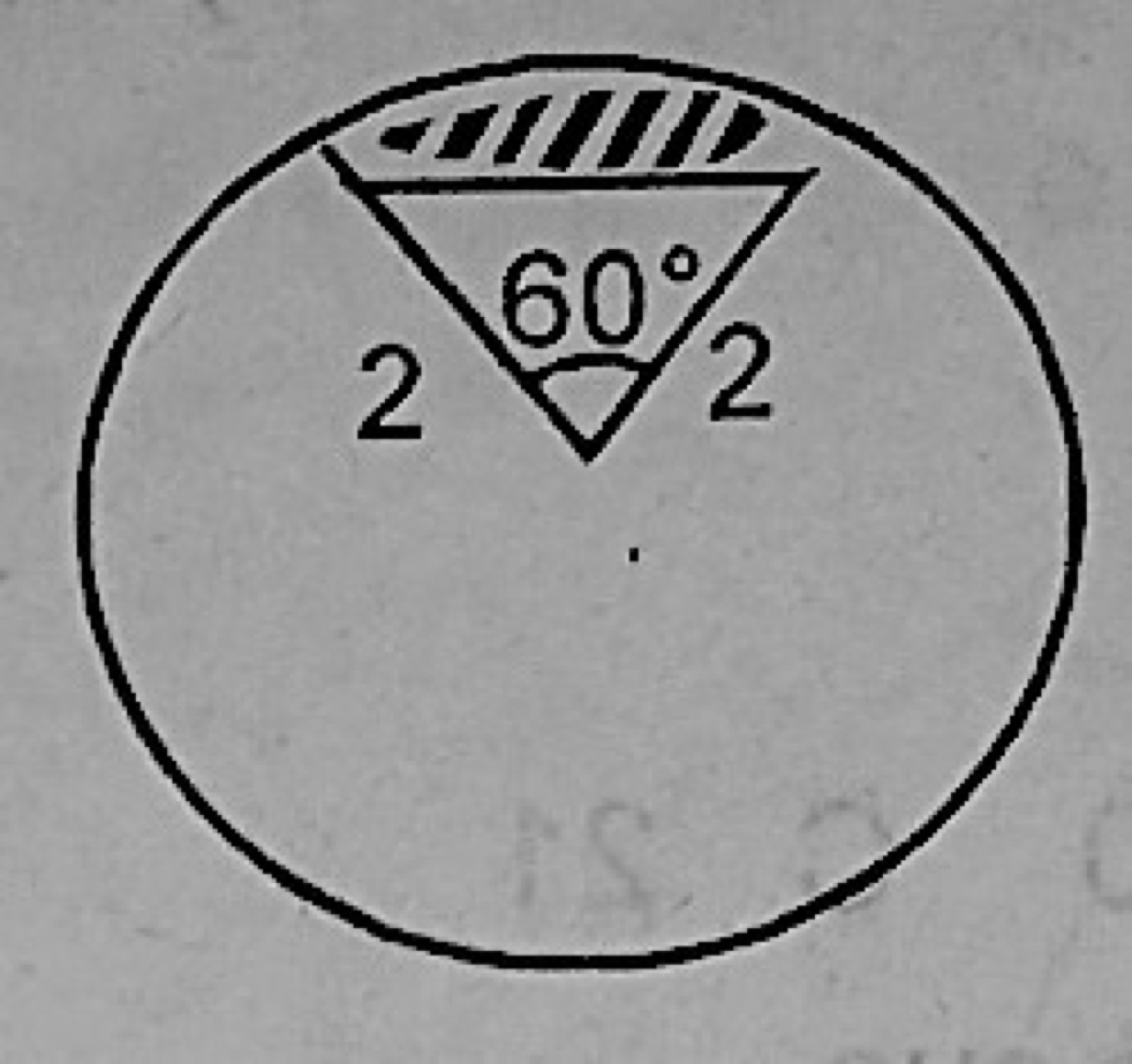
Question 50 Mensuration of Plane Shapes Find the area of the shaded segment in the figure shown above
A. √3 B. 4π − √3 C. 2 /3 πD. 2π/3 − √3 E. 2π/3 − 2√3 Show the answer and explanation Answer: D (2π/3 − √3 )
Explanation Sector = 60/360 × π × 2² = 2π/3. Triangle = ½ × 2 × 2 × sin 60° = √3. Segment = 2π/3 − √3.
Open this question Sign up free for every JAMB Mathematics year, practice by topic and timed mocks.
Start practising free