Question 1
Measures of Central TendencyThe mean of the numbers 1.2, 1.0, 0.9, 1.4, 0.8, 0.8, 1.2 and 1.1 is.
- A.1.5
- B.0.8
- C.1.0
- D.1.02
- E.1.05.
Show the answer and explanation
Answer: E (1.05.)
The eight numbers add up to 8.4, and 8.4 ÷ 8 = 1.05.
47 questions. Try each one, then open the answer to check yourself and read the explanation.
The mean of the numbers 1.2, 1.0, 0.9, 1.4, 0.8, 0.8, 1.2 and 1.1 is.
Answer: E (1.05.)
The eight numbers add up to 8.4, and 8.4 ÷ 8 = 1.05.
(1.28 × 10⁴) ÷ (6.4 × 10²) equals
Answer: D (2 × 101)
1.28 ÷ 6.4 = 0.2 and 10⁴ ÷ 10² = 10², so the answer is 0.2 × 10² = 20 = 2 × 10¹.
If the value of π is taken to be 22/7, the area of a semicircle of diameter 42m is
Answer: E (693m2.)
The radius is 21m. Area = ½ × 22/7 × 21 × 21 = 693m².
(3.2)2 − (1.8)2 equals
Answer: A (7.0)
Use the difference of two squares: (3.2 + 1.8)(3.2 − 1.8) = 5 × 1.4 = 7.0.
In PQR. PQ = 10cm, QR = 8cm and RP = 6cm, the perpendicular RS is drawn from R to PQ. Find the length of RS.
Answer: E (4.8cm)
6² + 8² = 10², so the triangle is right-angled at R and its area is ½ × 6 × 8 = 24. Then ½ × 10 × RS = 24 gives RS = 4.8cm.
After getting a rise of 15%, a man's new monthly salary is ₦345. How much per month did he earn before the increase?
Answer: C (₦300)
The new salary is 115% of the old one, so the old salary is 345 × 100/115 = ₦300.
In base ten, the number 1 0 1 1 0 1 (base 2) equals
Answer: C (45)
101101₂ = 32 + 8 + 4 + 1 = 45.
The annual profit of a transport business were divided between the two partners A and B in the ratio 3:5. If B received ₦3000 more than A, the total profit was
Answer: C (₦12000)
B's share exceeds A's by 5 − 3 = 2 parts out of 8. 2 parts = ₦3000, so 8 parts = ₦12000.
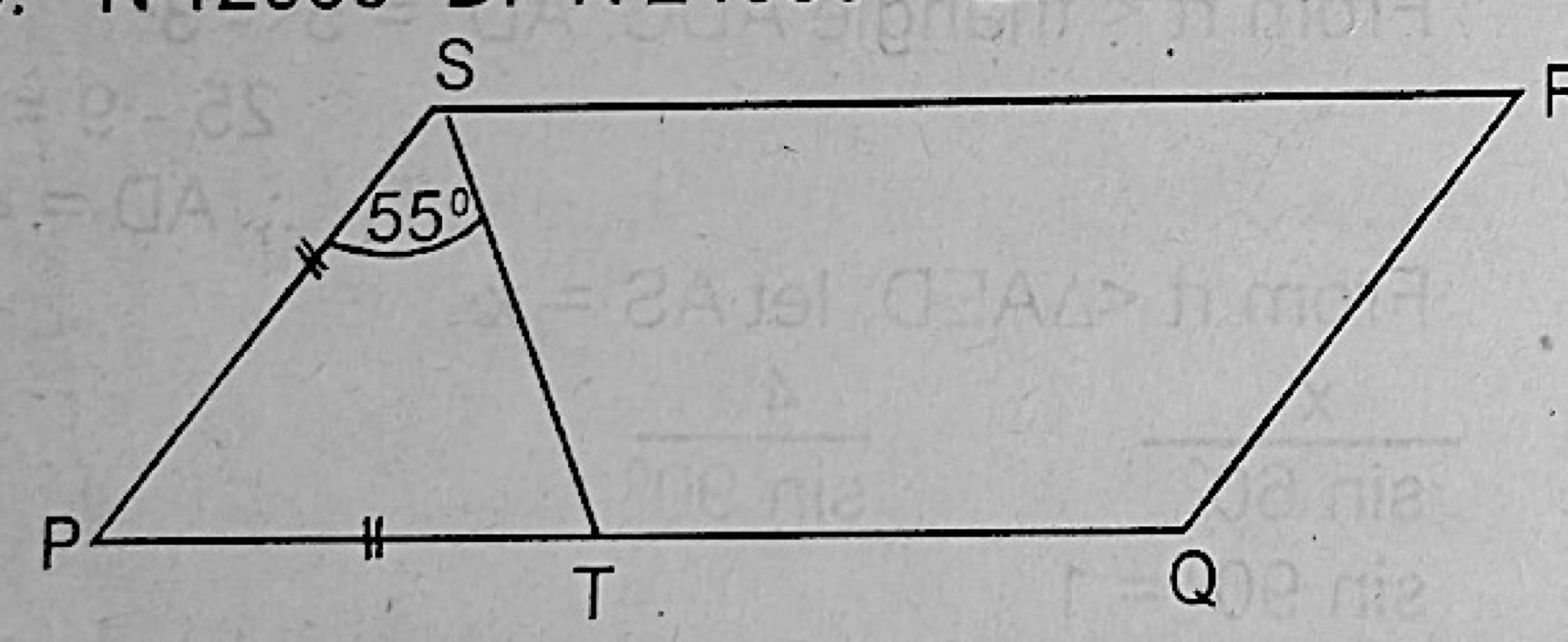
In this figure, PQRS is a parallelogram, PS = PT and <PST = 55°. The size of <PQR is

Answer: D (110°)
Triangle PST is isosceles, so <PTS = 55° and <SPT = 180° − 110° = 70°. Adjacent angles of a parallelogram add to 180°, so <PQR = 110°.
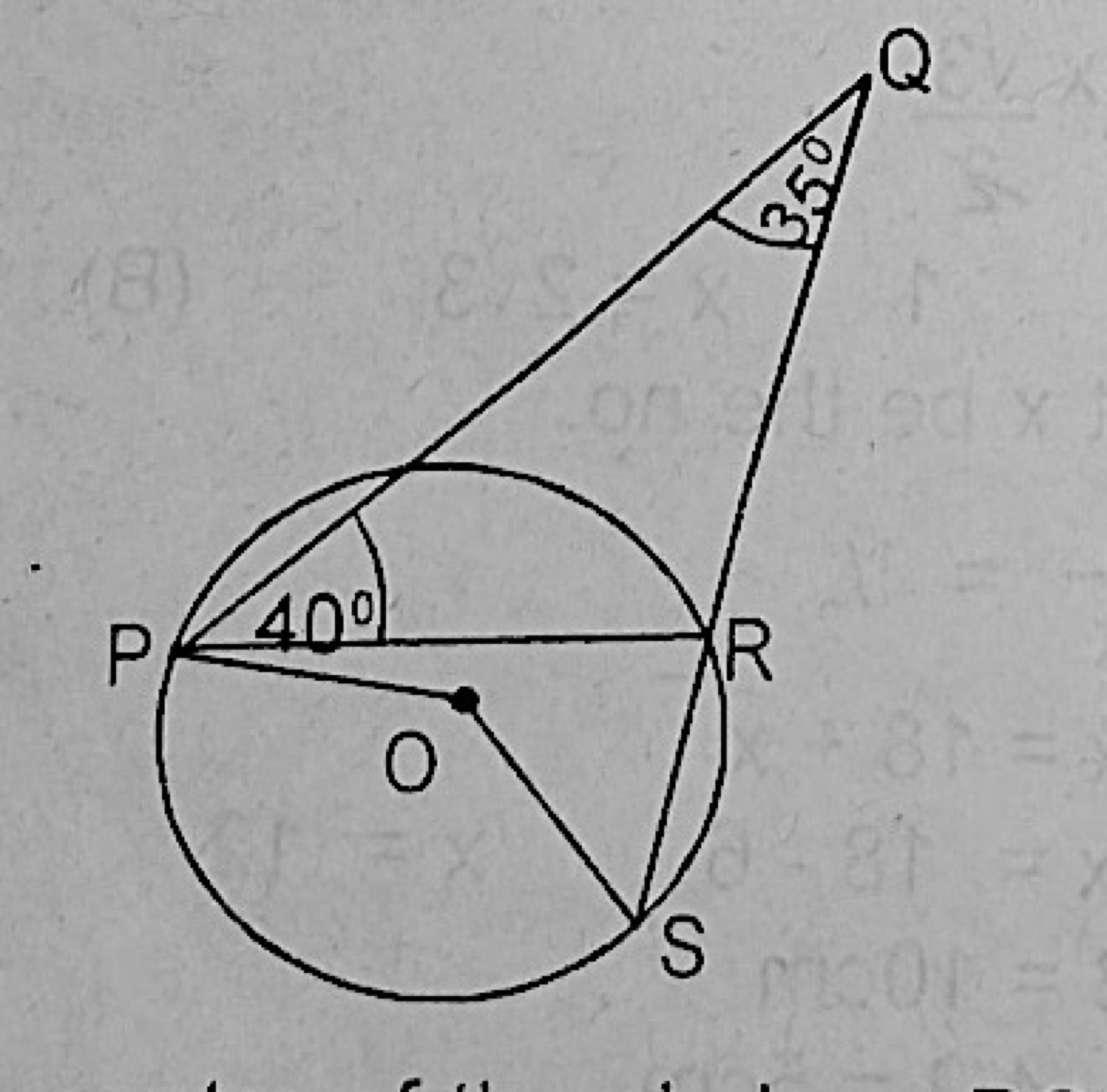
If O is the centre of the circle, <POS equals

Answer: E (150°)
In triangle PQR, <PRQ = 180° − 40° − 35° = 105°, so <PRS = 75° (angles on a straight line). The angle at the centre is twice the angle at the circumference: <POS = 150°.
x is directly proportional to y and inversely proportional to z. If x = 9 when y = 24 and z = 8, what is the value of x when y = 5 and z = 6?
Answer: D (2½)
x = ky/z. 9 = 24k/8 gives k = 3, so x = 3 × 5/6 = 2½.
The solution of the equation x2 − 2x = 8 is
Answer: B (x = −2 or 4)
x² − 2x − 8 = 0 factorises as (x + 2)(x − 4) = 0, so x = −2 or 4.
A trader goes to Ghana for y days with Y cedis. For the first x days, he spends X cedis per day. The amount he has to spend per day for the rest of his stay is
Answer: E ((Y − Xx)/(y − x) cedis)
After x days he has spent Xx cedis, leaving Y − Xx for the remaining y − x days, i.e. (Y − Xx)/(y − x) cedis a day.
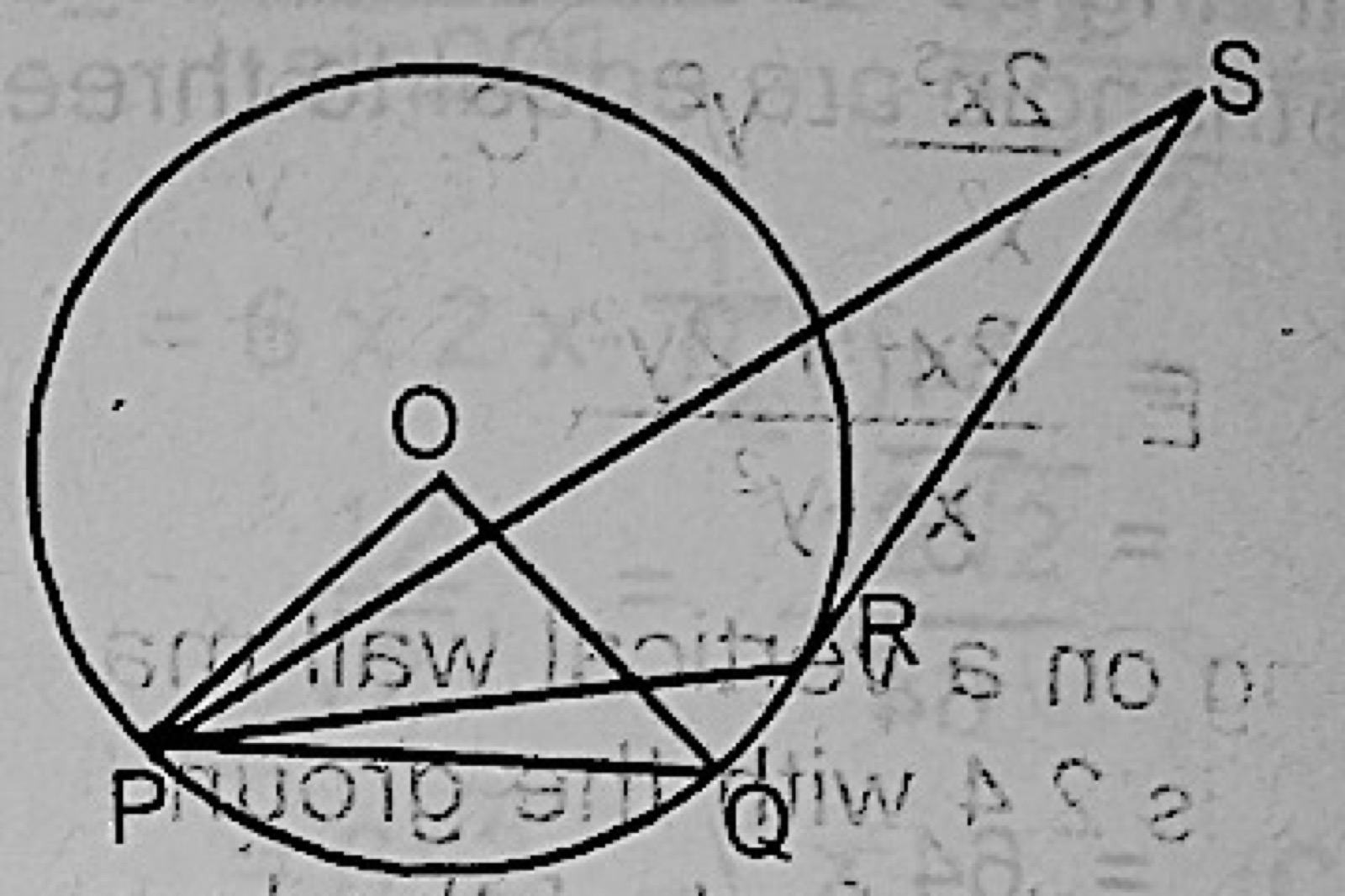
In the figure below PQ and QR are chords of the circle PQR. QRS is a straight line and PR equals to RS. <PSR is 20°. What is the size of <POQ?

Answer: C (80°)
PR = RS, so <RPS = <RSP = 20° and the exterior angle <PRQ = 40°. The angle at the centre is twice this: <POQ = 80°.
Multiply (3x + 5y + 4z) by (2x − 3y + z)
Answer: A (6x2 + xy − 15y2 + 4z2 + 11xz − 7yz)
Expanding: 6x² − 9xy + 3xz + 10xy − 15y² + 5yz + 8xz − 12yz + 4z². Collecting gives 6x² + xy − 15y² + 4z² + 11xz − 7yz.
A square of cardboard is taped at the perimeter by a piece of ribbon 20cm long. What is the area of the board?
Answer: B (25sq.cm)
The perimeter is 20cm, so each side is 5cm and the area is 5 × 5 = 25sq.cm.
Rationalize the denominator of the expression (6 + 2√5)/(4 − 3√6)
Answer: E (−(12 + 4√5 + 9√6 + 3√30)/19)
Multiply top and bottom by 4 + 3√6. The bottom becomes 16 − 54 = −38 and the top 24 + 18√6 + 8√5 + 6√30. Dividing by −38 gives −(12 + 4√5 + 9√6 + 3√30)/19.
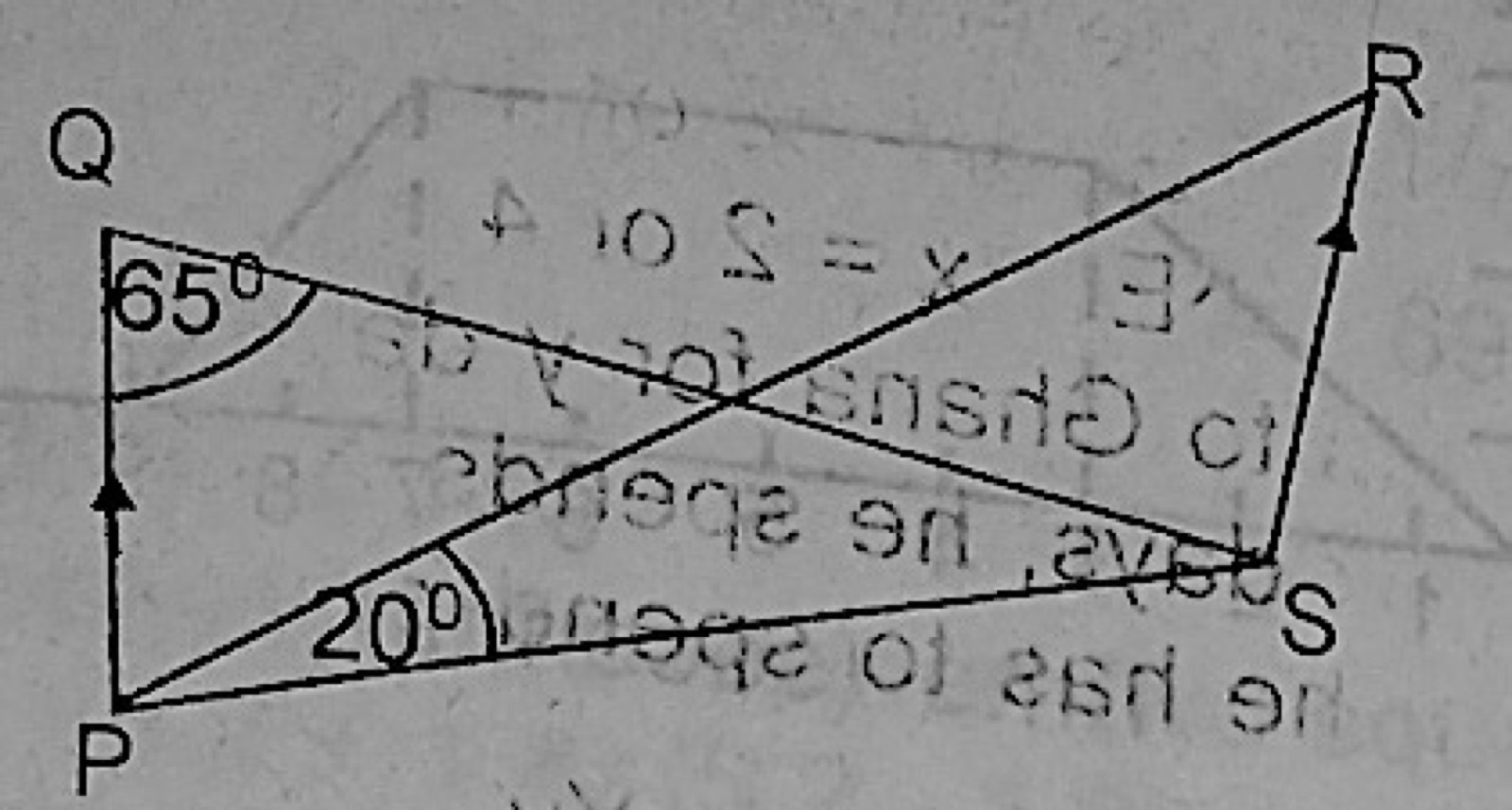
In the figure below PQ is parallel to SR QS bisects <PSR, <PQS is 65° and <RPS is 20°. What is the size of <PRS?

Answer: D (30°)
PQ ∥ SR, so <QSR = <PQS = 65° (alternate angles), and since QS bisects <PSR, <PSR = 130°. In triangle PRS, <PRS = 180° − 130° − 20° = 30°.
Simplify (5x × 25x−1)/125x+1
Answer: C (5-5)
Write everything as powers of 5: 5ˣ × 5^(2x − 2) ÷ 5^(3x + 3) = 5^(3x − 2 − 3x − 3) = 5⁻⁵.
A steel ball of radius 1cm is dropped into a cylinder of radius 2cm and height 4cm. If the cylinder is now filled with water, what is the volume of the water in the cylinder?
Answer: A (44/3πcm3)
The cylinder holds π × 2² × 4 = 16π cm³. The ball takes up (4/3)π × 1³, leaving 16π − 4π/3 = 44π/3 cm³ for water.
Simplify (x2 + y2 + xy)/(x + y) − (x2 + y2 − xy)/(x − y)
Answer: C (2y3/(y2 − x2))
Over the common denominator x² − y², the top is (x − y)(x² + xy + y²) − (x + y)(x² − xy + y²) = (x³ − y³) − (x³ + y³) = −2y³. So the result is −2y³/(x² − y²) = 2y³/(y² − x²).
A ladder resting on a vertical wall makes an angle whose tangent is 2.4 with the ground. If the distance between the foot of the ladder and the wall is 50cm, what is the length of the ladder?
Answer: E (1.3m.)
tan θ = 2.4 = 12/5 means a 5-12-13 triangle, so cos θ = 5/13. Ladder = 50 ÷ (5/13) = 130cm = 1.3m.
Simplify 25/12 − 17/8 × 6/5
Answer: A (1/6)
Multiply first: 15/8 × 6/5 = 9/4 = 27/12. Then 29/12 − 27/12 = 2/12 = 1/6.
One of the following statements is wrong. Which is it?
Answer: D (If two triangles are similar then they are also congruent)
Similar triangles have the same shape but can be different sizes, so they need not be congruent.
PQRS is a cyclic quadrilateral with PQ as diameter of the circle. If <PQS = 15° find <QRS
Answer: D (105°)
The angle in a semicircle is 90°, so <PSQ = 90° and <SPQ = 75°. Opposite angles of a cyclic quadrilateral add to 180°, so <QRS = 105°.
Make c the subject of the equation a(b + c) + 5/d − 2 = 0
Answer: D (c = (2d − 5 − abd)/ad)
Multiply by d: abd + acd + 5 − 2d = 0, so acd = 2d − 5 − abd and c = (2d − 5 − abd)/ad.
Which of the values of the variable x, (a) x = 0, (b) x = −3, (c) x = 9, satisfy the inequalities 0 < (x + 3)/(x − 1) ≤ 2?
Answer: C ((c) only)
x = 0 gives −3 (not positive), x = −3 gives 0 (not greater than 0) and x = 9 gives 12/8 = 1.5, which lies in the range. So only (c).
On each market day Mrs. Bassey walks to the market from her home at a steady speed. This journey normally takes her 2 hours to complete. She finds, however, that by increasing her usual speed by 1km/hr she can save 20 minutes. Find her usual speed in km/hr.
Answer: C (5)
The distance is the same: 2v = (5/3)(v + 1), since the faster trip takes 1 h 40 min. So 6v = 5v + 5 and v = 5km/hr.
Solve the simultaneous linear equations:
2x + 5y = 11
7x + 4y = 2
Answer: D (x = −34/27, y = 73/27)
Multiply the first by 4 and the second by 5 and subtract: 27x = −34, so x = −34/27. Then 5y = 11 + 68/27 = 365/27, so y = 73/27.
If x3 − 12x − 16 = 0 has x = −2 as a solution, then the equation has
Answer: C (3 roots with two equal and the third different)
Dividing by (x + 2) gives x² − 2x − 8 = (x + 2)(x − 4), so x³ − 12x − 16 = (x + 2)²(x − 4). The roots are −2, −2 and 4.
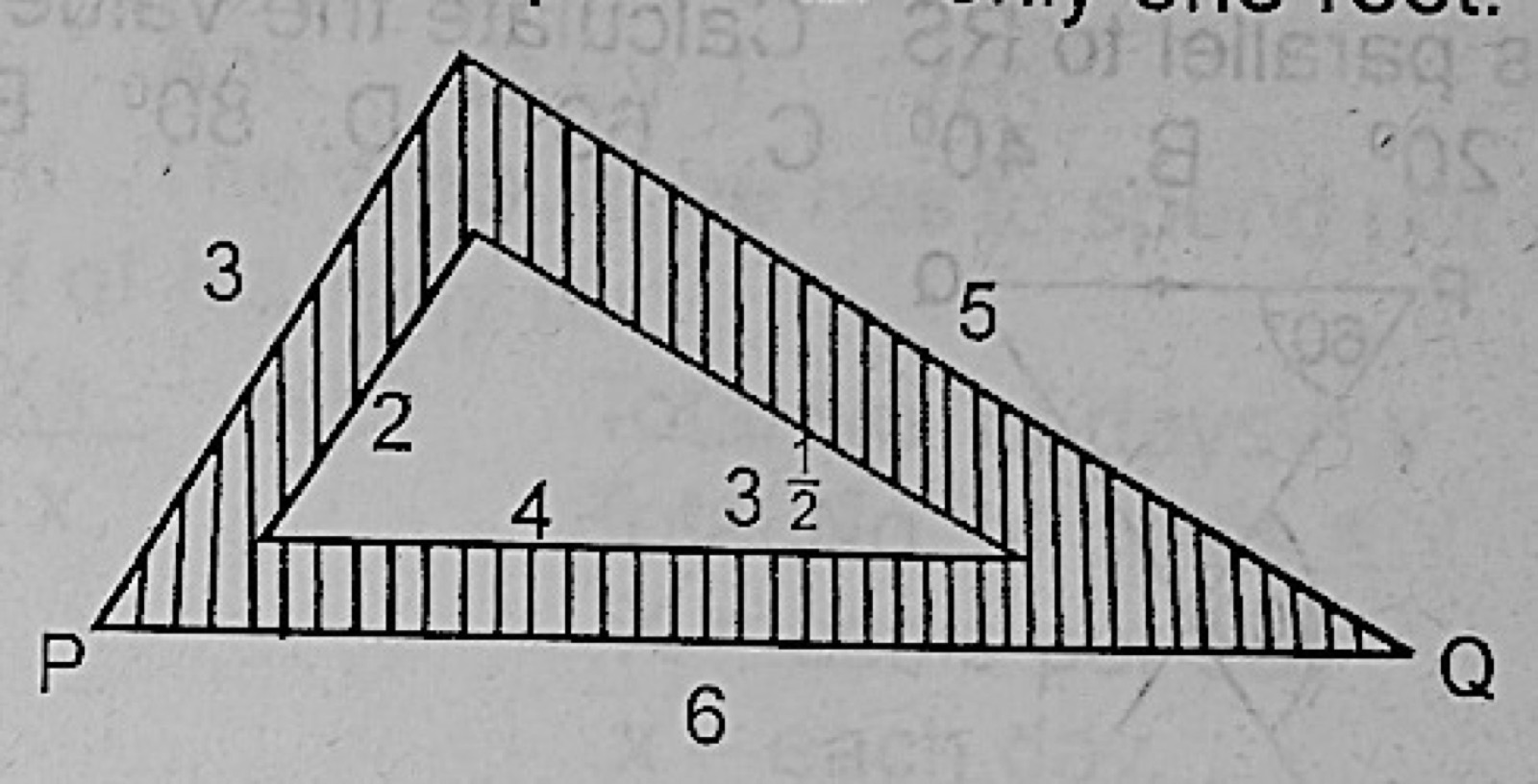
(Numbers indicate the lengths of the sides of the triangles). If the area of Δ PQR is k2 sq. units, what is the area of the shaded portion?

Answer: A (5/9 k2sq.units)
The inner triangle is similar to the outer one with scale factor 2/3 (sides 2, 3⅓, 4 against 3, 5, 6), so its area is (2/3)² = 4/9 of k². The shaded part is k² − 4/9 k² = 5/9 k².
Find the value of (4¼)6
Answer: E (8.)
(4^¼)⁶ = 4^(6/4) = 4^(3/2) = (√4)³ = 2³ = 8.
Find the value of log10 (1/40), given that log10 4 = 0.6021
Answer: B (2̄.3979)
log(1/40) = −(log 4 + log 10) = −1.6021, which in bar notation is 2̄.3979 (−2 + 0.3979).
12 men complete a job in 9 days. How many men working at the same rate, would be required to complete the job in 6 days?
Answer: B (18)
The job takes 12 × 9 = 108 man-days. Done in 6 days it needs 108 ÷ 6 = 18 men.
For the set of numbers 2, 3, 5, 6, 7, 7, 8
Answer: E (the mean is less than the median.)
Mean = 38/7 ≈ 5.4, median = 6 and mode = 7. So the mean is less than the median.
A cylinder of height h and radius r is open at one end. Its surface area is
Answer: E (2πrh + πr2.)
The curved surface is 2πrh and only one circular end is closed, adding πr².
An arc of a circle of radius 2cm subtends an angle of 60° at the centre. Find the area of the sector
Answer: A (2π/3cm2)
Area = (60/360) × π × 2² = 4π/6 = 2π/3 cm².
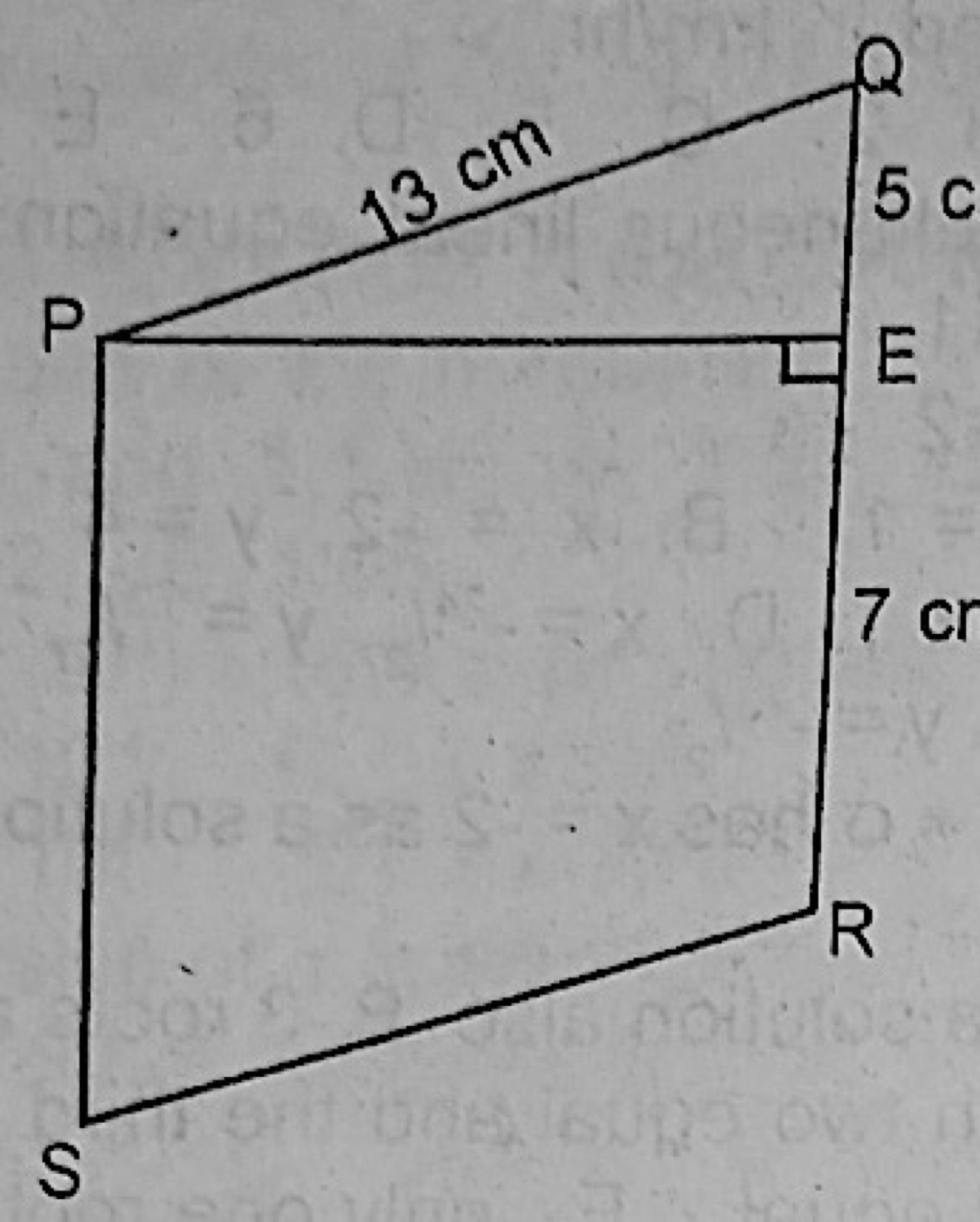
In the parallelogram PQRS, PE is perpendicular to QR. Find the area of the parallelogram

Answer: D (144cm2)
In right triangle PEQ, PE = √(13² − 5²) = 12cm. The base QR = 5 + 7 = 12cm, so the area is 12 × 12 = 144cm².
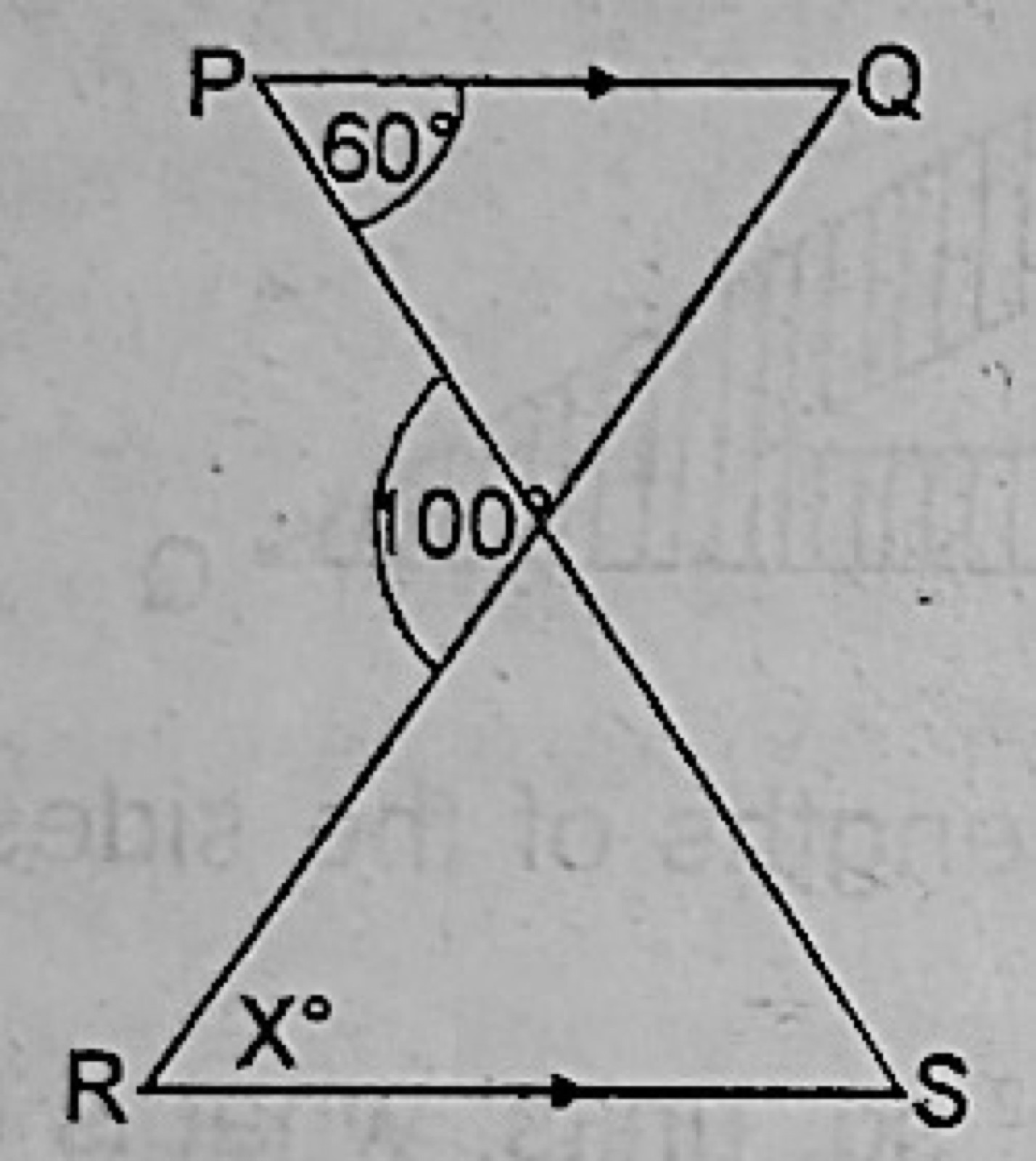
PQ is parallel to RS. Calculate the value of x

Answer: B (40°)
The angles where the lines cross are 100° and 80°. <S = <P = 60° (alternate angles), so in the lower triangle x = 180° − 80° − 60° = 40°.
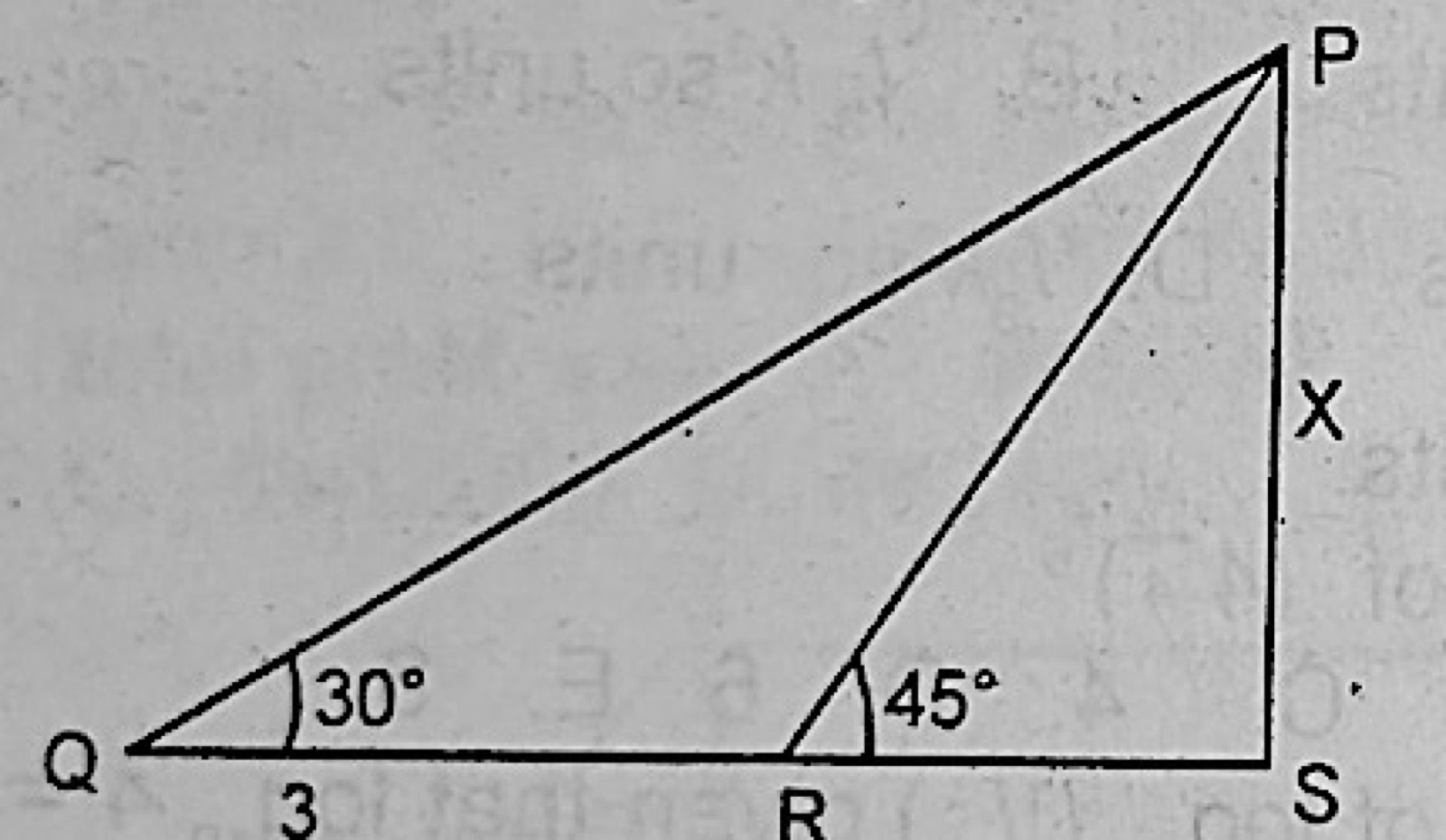
Find x in the diagram below: QR = 3, PS = x, <PQS = 30°, <PRS = 45°, <PSR = 90°

Answer: E (3(√3 + 1)/2)
With <PRS = 45°, RS = PS = x. In triangle PQS, tan 30° = x/(3 + x), so x√3 = 3 + x and x = 3/(√3 − 1) = 3(√3 + 1)/2.
What is log7 (49a) − log10 (0.01)?
Answer: D (2a + 2)
log₇ 49ᵃ = log₇ 7²ᵃ = 2a and log₁₀ 0.01 = −2, so the result is 2a + 2.
What is the greatest straight line distance between two vertices (corners) of a cube whose sides are 2239cm long?
Answer: D (√3 × 2239cm)
The longest distance is the space diagonal, √(a² + a² + a²) = √3 × a = √3 × 2239cm.
The size of a quantity first doubles and then increases by a further 16%. After a short time its size decreases by 16%. What is the net increase in size of the quantity?
Answer: A (59300/625 %)
Multiply the factors: 2 × 1.16 × 0.84 = 1.9488. The increase is 0.9488 = 94.88%, and 59300 ÷ 625 = 94.88.
The following table relates the number of objects f corresponding to a certain size x. What is the average size of an object?
f: 1, 2, 3, 4, 5
x: 1, 2, 4, 8, 16
Answer: D (43/5)
Σfx = 1 + 4 + 12 + 32 + 80 = 129 and Σf = 15, so the mean is 129/15 = 43/5.
If y = x2 − 2x − 3, find the least value of y and the corresponding value of x
Answer: D (x = 1, y = −4)
y = (x − 1)² − 4, which is smallest when x = 1, giving y = −4.
A father is now three times as old as his son. Twelve years ago he was six times as old as his son. How old are the son and the father?
Answer: E (20 and 60.)
Let the son be y, so the father is 3y. Then 3y − 12 = 6(y − 12), giving 3y = 60 and y = 20. The father is 60.
A man is standing on the corridor of a 10 storey building and looking down at a tall tree in front of the building. He sees the top of the tree at an angle of depression of 30°. If the tree is 200m tall and the man's eyes are 300m above the ground, calculate the angle of depression of the foot of the tree as seen by the man.
Answer: B (60°)
The top of the tree is 100m below his eyes, so the horizontal distance is 100/tan 30° = 100√3m. For the foot, tan θ = 300/(100√3) = √3, so θ = 60°.