JAMB Mathematics 1978 past questions and answers

45 questions. Try each one, then open the answer to check yourself and read the explanation.

Question 1

Mensuration of Plane Shapes

A rectangular picture 6cm by 8cm is enclosed by a frame ½cm wide, calculate the area of the frame.

  1. A.15sq.cm
  2. B.20sq.cm
  3. C.13sq.cm
  4. D.16sq.cm
  5. E.17sq.cm
Show the answer and explanation

Answer: A (15sq.cm)

Explanation

With the frame the outer rectangle is 7cm by 9cm = 63sq.cm. The picture is 6 × 8 = 48sq.cm, so the frame is 63 − 48 = 15sq.cm.

Open this question

Question 3

Algebraic Expressions

Multiply (x + 3y + 5) by (2x2 + 5y + 2)

  1. A.2x3+3yx2+10xy+15y2+13y+10x2+2x+10
  2. B.2x3+6yx2+5xy+15y2+31y+10x2+2x+10
  3. C.2x3+3yx2+5xy+10y2+13y+5x2+2x+10
  4. D.2x3+6yx2+5xy+15y2+13y+10x2+2x+10
  5. E.2x3+2yx2+10xy+10y2+31y+5x2+2x+10
Show the answer and explanation

Answer: B (2x3+6yx2+5xy+15y2+31y+10x2+2x+10)

Explanation

Multiply each term of the first bracket by each term of the second: x gives 2x³ + 5xy + 2x, 3y gives 6x²y + 15y² + 6y, and 5 gives 10x² + 25y + 10. Collecting the y terms gives 31y.

Open this question

Question 4

Triangles and Quadrilaterals

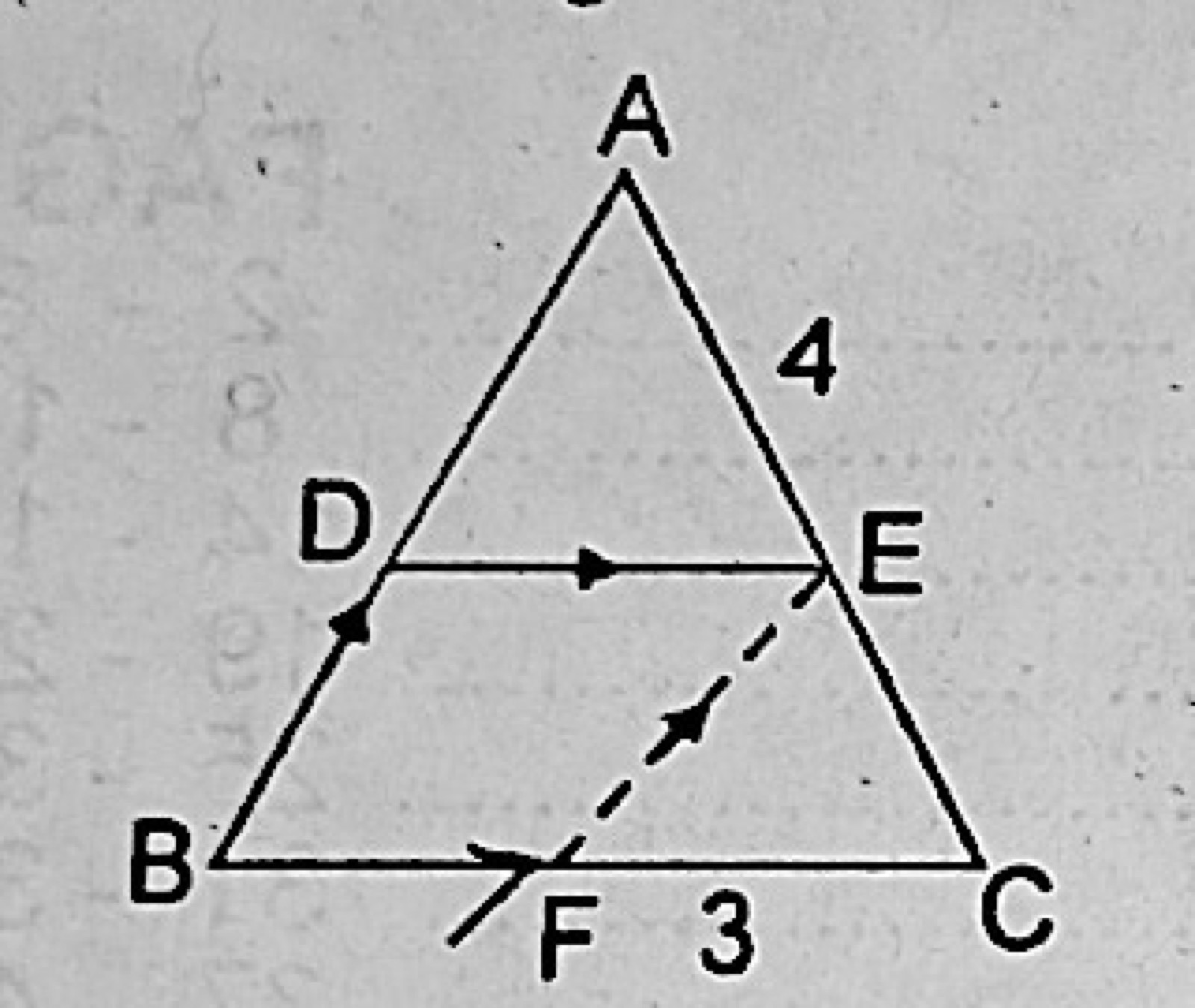
In the figure below, DE//BC, DB//FE, DE = 2cm, FC = 3cm, AE = 4cm. Determine the length of EC

Diagram for this question
  1. A.4cm
  2. B.6cm
  3. C.3cm
  4. D.2cm
  5. E.1cm
Show the answer and explanation

Answer: B (6cm)

Explanation

DBFE is a parallelogram, so BF = DE = 2cm and BC = 5cm. Triangles ADE and ABC are similar, so AE/AC = DE/BC: 4/(4 + EC) = 2/5, giving 4 + EC = 10 and EC = 6cm.

Open this question

Question 5

Angles and Polygons

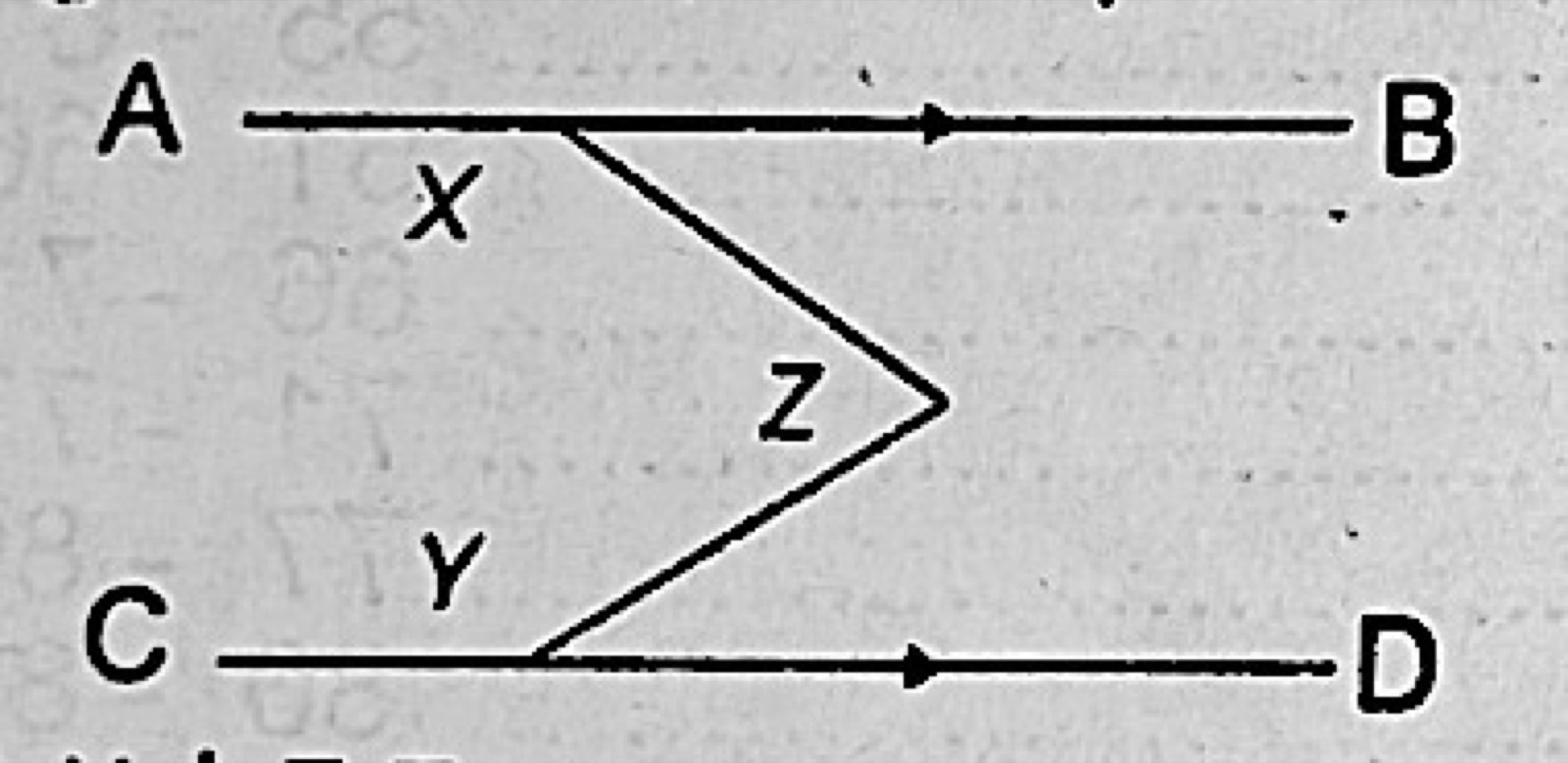
In the figure below, AB is parallel to CD then x + y + z =

Diagram for this question
  1. A.195°
  2. B.200°
  3. C.180°
  4. D.270°
  5. E.360°
Show the answer and explanation

Answer: E (360°)

Explanation

Draw a line through the vertex z parallel to AB and CD. The co-interior angles on each side add to 180°, so x + y + z = 180° + 180° = 360°.

Open this question

Question 6

Fractions, Decimals and Approximation

Arrange 3/5, 9/16, 34/59 and 71/97 in ascending order of magnitude.

  1. A.3/5, 9/16, 34/59, 71/97
  2. B.9/16, 3/5, 71/97, 34/59
  3. C.9/16, 34/59, 3/5, 71/97
  4. D.34/59, 71/97, 3/5, 9/16
  5. E.3/5, 9/16, 71/97, 34/59
Show the answer and explanation

Answer: C (9/16, 34/59, 3/5, 71/97)

Explanation

As decimals: 9/16 = 0.5625, 34/59 ≈ 0.576, 3/5 = 0.6 and 71/97 ≈ 0.732. Smallest to largest gives option C.

Open this question

Question 7

Progressions

The sum of the progression is 1 + x + x2 + x3 + . . . =

  1. A.1/(1 − x)
  2. B.1/(1 + x)
  3. C.1/(x − 1)
  4. D.1/x
  5. E.none of these.
Show the answer and explanation

Answer: A (1/(1 − x))

Explanation

This is a geometric progression with first term 1 and ratio x. For |x| < 1 the sum to infinity is a/(1 − r) = 1/(1 − x).

Open this question

Question 8

Variation

The number of telephone calls N between two cities A and B varies directly as the population PA, PB in A and B respectively and inversely as the square of the distance D between A and B. Which of the following equations represents this relation?

  1. A.N = KPA/D2 + CPB/D2
  2. B.N = KPAPB/D2
  3. C.N = KDPAPB
  4. D.N = KDPA + CDPB
  5. E.N = KD2PAPB
Show the answer and explanation

Answer: B (N = KPAPB/D2)

Explanation

Varying directly as both populations puts PAPB on top, and inversely as the square of the distance puts D² underneath, with one constant K.

Open this question

Question 9

Surds

Find a square root of 170 − 20√30

  1. A.2√10 − 5
  2. B.3√5 − 8√6
  3. C.2√5 − 5√6
  4. D.5√5 − 2√6
  5. E.5√10 − 2√3
Show the answer and explanation

Answer: C (2√5 − 5√6)

Explanation

(2√5 − 5√6)² = 20 + 150 − 2(2√5)(5√6) = 170 − 20√30, so 2√5 − 5√6 is a square root (the other one is 5√6 − 2√5).

Open this question

Question 10

Quadratic Equations

If x2 + 4 = 0, then x =

  1. A.4
  2. B.−4
  3. C.2
  4. D.−2
  5. E.none of these.
Show the answer and explanation

Answer: E (none of these.)

Explanation

x² = −4, and no real number has a negative square, so none of the given values works.

Open this question

Question 11

Triangles and Quadrilaterals

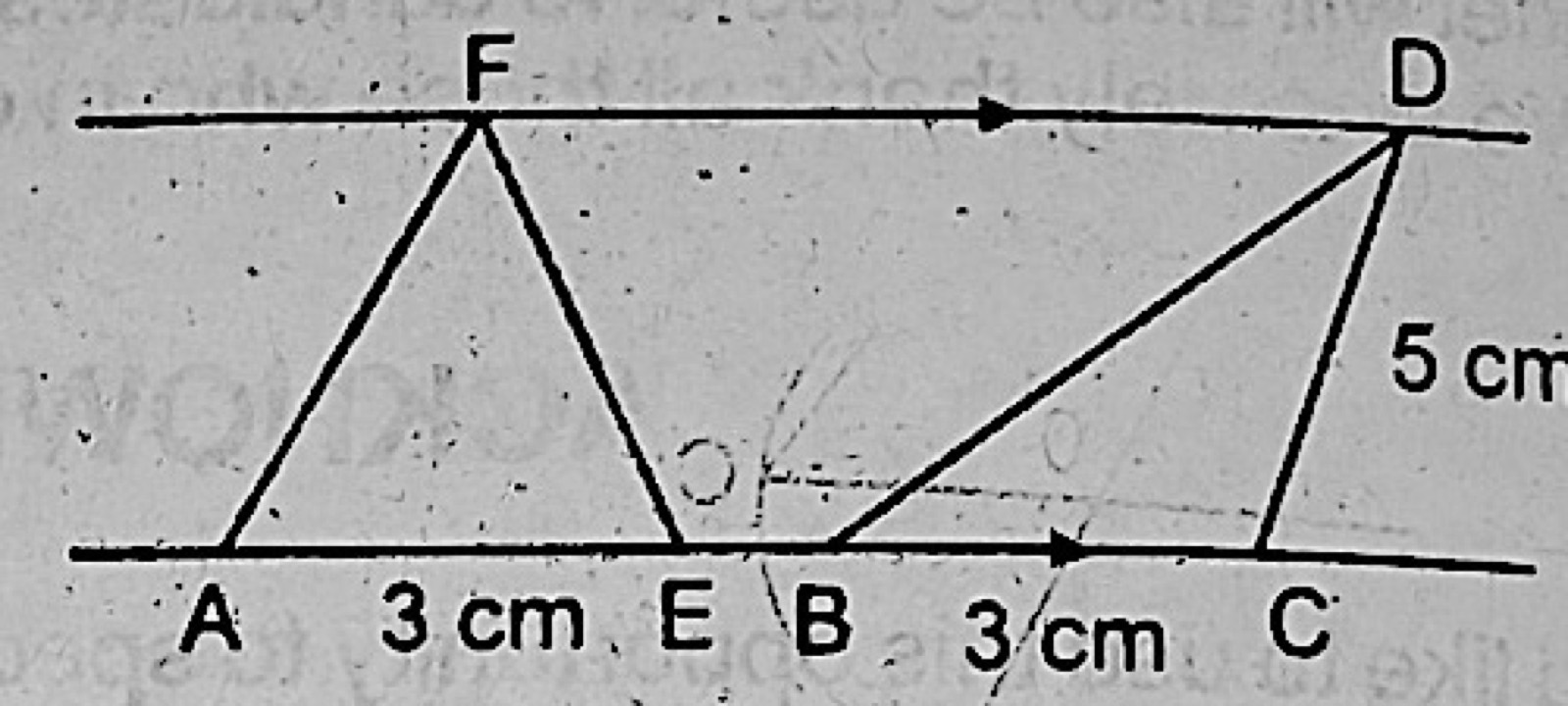
In the figure below, FD//AC. The area of AEF = 6sq.cm, AE = 3cm, BC = 3cm, CD = 5cm, <BCD is an obtuse angle. Find the length of BD.

Diagram for this question
  1. A.√33
  2. B.6
  3. C.4
  4. D.2√13
  5. E.4√5
Show the answer and explanation

Answer: D (2√13)

Explanation

½ × 3 × h = 6 gives the distance between the parallel lines h = 4cm. From CD = 5cm, D is 3cm beyond C along the line, so BD is the hypotenuse of a right triangle with sides 4 and 3 + 3 = 6: BD = √52 = 2√13.

Open this question

Question 12

Logarithms

What is the number whose logarithm to base 10 is 2̄.3482?

  1. A.223.6
  2. B.0.2228
  3. C.2.235
  4. D.22.37
  5. E.0.02229.
Show the answer and explanation

Answer: E (0.02229.)

Explanation

The mantissa .3482 gives the digits 2229 from antilog tables. A characteristic of bar 2 (−2) puts the decimal point to give 0.02229.

Open this question

Question 14

Inequalities

If y = 2x2 + 9x − 35, find the range of values for which y < 0.

  1. A.−7 < x < 5/2
  2. B.−7 ≤ x < 5
  3. C.−5 ≤ x < 7
  4. D.−7/2 < x ≤ 5.
  5. E.None of the above.
Show the answer and explanation

Answer: A (−7 < x < 5/2)

Explanation

2x² + 9x − 35 = (2x − 5)(x + 7), which is zero at x = −7 and x = 5/2. The parabola opens upwards, so it is negative between the roots.

Open this question

Question 15

Commercial Arithmetic

Father reduced the quantity of food bought for the family by 10% when he found that the cost of living had increased by 15%. Thus the fractional increase in the family food bill is now

  1. A.1/12
  2. B.6/35
  3. C.19/300
  4. D.7/200
  5. E.5/100
Show the answer and explanation

Answer: D (7/200)

Explanation

New bill = 90% of the quantity at 115% of the price = 0.9 × 1.15 = 1.035 of the old bill. The increase is 0.035 = 7/200.

Open this question

Question 16

Binary Operations

Given that a*b = ab + a + b and that a°b = a + b + 1, find an expression (not involving * or °) for (a*b)°(a*c) if a, b, c, are real numbers and the operations on the right are ordinary addition and multiplication of numbers.

  1. A.ac + ab + bc + b + c + 1
  2. B.ac + ab + a + c + 2
  3. C.ab + ac + a + b + 1
  4. D.ac + bc + ab + b + c + 2
  5. E.ab + ac + 2a + b + c + 1
Show the answer and explanation

Answer: E (ab + ac + 2a + b + c + 1)

Explanation

a*b = ab + a + b and a*c = ac + a + c. Joining them with ° adds them and adds 1: ab + ac + 2a + b + c + 1.

Open this question

Question 17

Mensuration of Plane Shapes

If a circular paper disc is trimmed in such a way that its circumference is reduced in the ratio 2:5, in what ratio is the surface area reduced?

  1. A.8:125
  2. B.2:5
  3. C.8:25
  4. D.4:25
  5. E.4:10.
Show the answer and explanation

Answer: D (4:25)

Explanation

Circumference is proportional to the radius and area to the radius squared, so the areas are in the ratio 2² : 5² = 4 : 25.

Open this question

Question 18

Angles and Polygons

If the four interior angles of a quadrilateral are (P + 10)°, (P − 30)°, (2P − 45)°, and (P + 15)°, then P is

  1. A.125°
  2. B.82°
  3. C.135°
  4. D.105°
  5. E.60°.
Show the answer and explanation

Answer: B (82°)

Explanation

The angles of a quadrilateral add up to 360°: 5P − 50 = 360, so 5P = 410 and P = 82°.

Open this question

Question 19

Algebraic Expressions

Simplify (a − b)/(a + b) − (a + b)/(a − b)

  1. A.4ab/(a2 − b2)
  2. B.2ab/(a2 − b2)
  3. C.−4ab/(a2 − b2)
  4. D.4ab/(a − b)2
  5. E.2ab/(a + b)2
Show the answer and explanation

Answer: C (−4ab/(a2 − b2))

Explanation

Over the common denominator (a + b)(a − b) = a² − b², the top is (a − b)² − (a + b)² = −4ab.

Open this question

Question 20

Circle Theorems

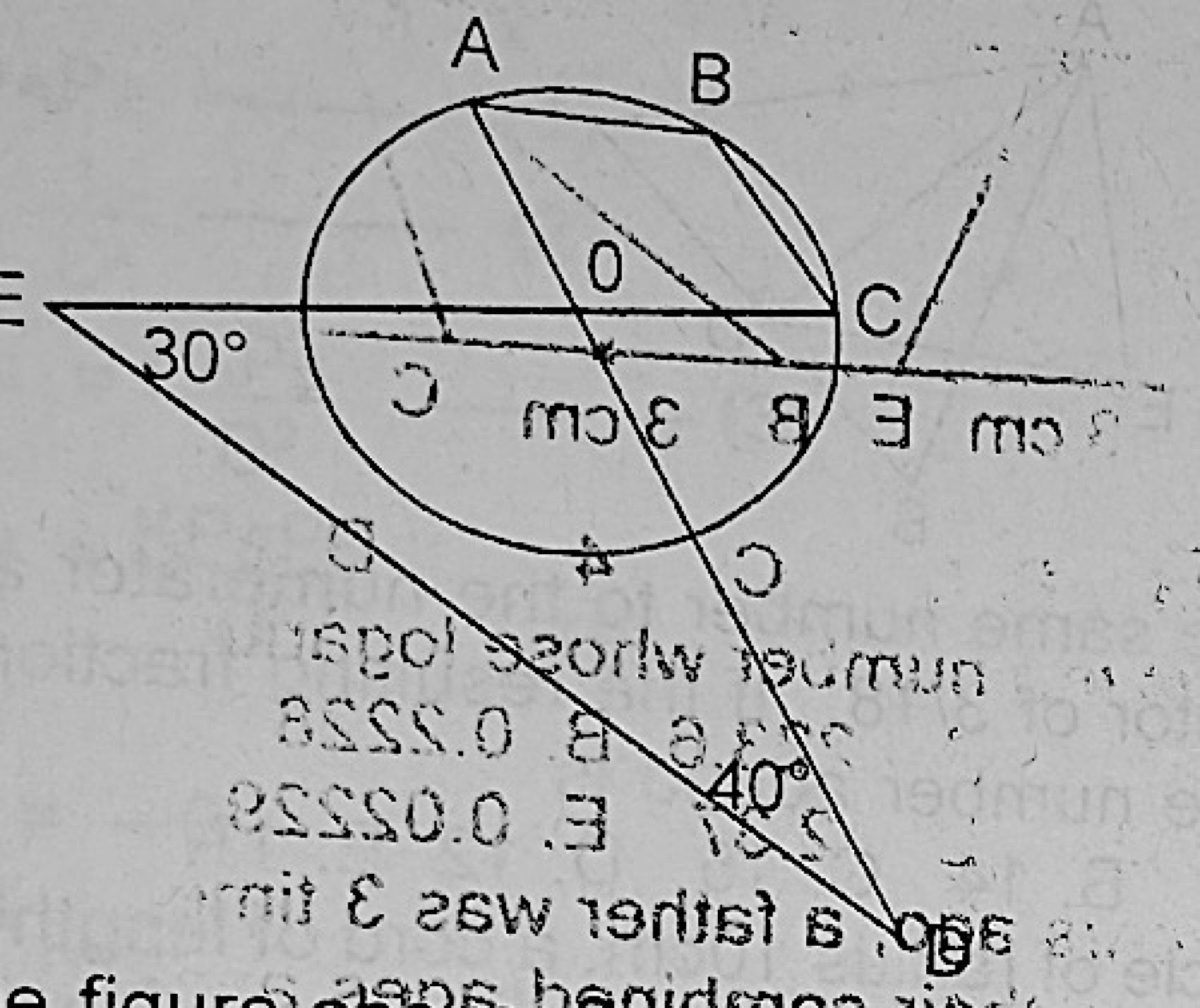
In the figure above, O is the centre of the circle ABC <CED = 30°, <EDA = 40°. What is the size of <ABC?

Diagram for this question
  1. A.70°
  2. B.110°
  3. C.130°
  4. D.125°
  5. E.145°
Show the answer and explanation

Answer: D (125°)

Explanation

The lines EC and DA cross at O, so in triangle EOD the angle at O is 180° − 30° − 40° = 110°, and the vertically opposite angle AOC is 110°. The angle at the circumference on the minor arc is 180° − ½(110°) = 125°.

Open this question

Question 21

Vectors and Transformations

A force of 5 units acts on a particle in the direction to the east and another force of 4 units acts on the particle in the direction north-east. The resultant of the two forces is

  1. A.√3 units
  2. B.3 units
  3. C.√(41 + 20√2) units
  4. D.√(41 − 20√2) units
  5. E.√(41√2 + 20) units.
Show the answer and explanation

Answer: C (√(41 + 20√2) units)

Explanation

The angle between the forces is 45°, so R² = 5² + 4² + 2(5)(4)cos 45° = 41 + 20√2.

Open this question

Question 22

Differentiation

The minimum point on the curve y = x2 − 6x + 5 is at

  1. A.(1,5)
  2. B.(2,3)
  3. C.(−3,−4)
  4. D.(−3,4)
  5. E.(3,−4).
Show the answer and explanation

Answer: E ((3,−4).)

Explanation

dy/dx = 2x − 6 = 0 gives x = 3, and y = 9 − 18 + 5 = −4.

Open this question

Question 24

Mensuration of Solids

A canal has rectangular cross section of width 10cm and breadth 1m. If water of uniform density 1gm cm-3 flows through it at a constant speed of 1000 mm per minute, the adjacent sea is...

  1. A.100 000
  2. B.1000 000
  3. C.120 000
  4. D.30 000
  5. E.350 000.
Show the answer and explanation

Answer: A (100 000)

Explanation

The cross-section is 10cm × 100cm = 1000cm² and the water moves 100cm a minute, so 100 000cm³ (100 000g) of water reaches the sea each minute.

Open this question

Question 25

Linear and Simultaneous Equations

A man runs a distance of 9km at a constant speed for the first 4km and then 2km/h faster for the rest of the distance. The whole run takes him one hour. His average speed for the first 4km is

  1. A.6km/h
  2. B.8km/h
  3. C.9km/h
  4. D.11km/h
  5. E.13km/h.
Show the answer and explanation

Answer: B (8km/h)

Explanation

With speed v: 4/v + 5/(v + 2) = 1, which gives v² − 7v − 8 = 0, so v = 8km/h.

Open this question

Question 26

Mensuration of Solids

A pyramid is constructed on a cuboid. The figure has

  1. A.Twelve faces
  2. B.Thirteen vertices
  3. C.Fourteen edges
  4. D.Fifteen edges
  5. E.Sixteen edges.
Show the answer and explanation

Answer: E (Sixteen edges.)

Explanation

The cuboid has 12 edges and the pyramid on top adds 4 slant edges, giving 16 edges (it has 9 faces and 9 vertices).

Open this question

Question 27

Progressions

In a geometric progression the first term is 153 and the sixth term is 17/27. The sum of the first four terms is

  1. A.860/3
  2. B.680/3
  3. C.608/3
  4. D.806/3
  5. E.680/27
Show the answer and explanation

Answer: B (680/3)

Explanation

153r⁵ = 17/27 gives r⁵ = 1/243, so r = 1/3. S₄ = 153(1 − 1/81)/(1 − 1/3) = 153 × 80/81 × 3/2 = 680/3.

Open this question

Question 28

Progressions

An arithmetic progression has first term 11 and fourth term 32. The sum of the first nine terms is

  1. A.351
  2. B.531
  3. C.135
  4. D.315
  5. E.153.
Show the answer and explanation

Answer: A (351)

Explanation

11 + 3d = 32 gives d = 7. S₉ = 9/2 × (2 × 11 + 8 × 7) = 9/2 × 78 = 351.

Open this question

Question 29

Trigonometry

A triangle has angles 30°, 15° and 135°. The side opposite to the angle 30°, has length 6cm. The side opposite to the angle 135° is equal to

  1. A.12cm
  2. B.6cm
  3. C.6√2cm
  4. D.12√2cm
  5. E.6√3cm.
Show the answer and explanation

Answer: C (6√2cm)

Explanation

By the sine rule, x/sin 135° = 6/sin 30°, so x = 12 × sin 45° = 12 × (√2/2) = 6√2cm.

Open this question

Question 30

Mensuration of Plane Shapes

A regular hexagon is constructed inside a circle of diameter 12cm. The area of the hexagon is

  1. A.36πcm2
  2. B.36/π cm2
  3. C.54√3 cm2
  4. D.54/√3 cm2
  5. E.54√3 πcm2.
Show the answer and explanation

Answer: C (54√3 cm2)

Explanation

The hexagon is six equilateral triangles of side 6cm (the radius). Area = 6 × (√3/4) × 36 = 54√3cm².

Open this question

Question 31

Measures of Central Tendency

In a soccer competition in one season, a club had scored the following goals: 2,0,3,3,2,1,4,0,0,5,1,0,2,2,1,3,1,4,1 and 1. The mean, median and mode are respectively

  1. A.1, 1.8 and 1.5
  2. B.1.8, 1.5 and 1
  3. C.1.8, 1 and 1.5
  4. D.1.5, 1 and 1.8
  5. E.1.5, 1.8 and 1.
Show the answer and explanation

Answer: B (1.8, 1.5 and 1)

Explanation

The 20 scores add up to 36, so the mean is 1.8. In order, the 10th and 11th scores are 1 and 2, so the median is 1.5, and 1 occurs most often (6 times).

Open this question

Question 32

Trigonometry

If sec2 θ + tan2 θ = 3, then the angle θ is equal to

  1. A.30°
  2. B.45°
  3. C.60°
  4. D.90°
  5. E.105°
Show the answer and explanation

Answer: B (45°)

Explanation

sec²θ = 1 + tan²θ, so 1 + 2tan²θ = 3, tan²θ = 1 and θ = 45°.

Open this question

Question 33

Mensuration of Solids

A hollow right prism of equilateral triangular base of side 4cm is filled with water up to a certain height. If a sphere of radius 1/2cm is immersed in the water then the rise of water is

  1. A.1cm
  2. B.√3π/24 cm
  3. C.π/(24√3) cm
  4. D.24π/√3 cm
  5. E.24√3 πcm
Show the answer and explanation

Answer: C (π/(24√3) cm)

Explanation

The sphere's volume is (4/3)π(½)³ = π/6. The base area is (√3/4) × 16 = 4√3, so the rise is (π/6) ÷ 4√3 = π/(24√3)cm.

Open this question

Question 34

Linear and Simultaneous Equations

The set of values of x and y which satisfies the equations x2 − y − 1 = 0 and y − 2x + 2 = 0 is

  1. A.1,0
  2. B.1,1
  3. C.2,2
  4. D.0,2.
  5. E.1,2.
Show the answer and explanation

Answer: A (1,0)

Explanation

From the second equation y = 2x − 2. Substituting: x² − 2x + 1 = 0, so x = 1 and y = 0.

Open this question

Question 35

Mensuration of Solids

A solid sphere of radius 3cm, a solid right cone of radius 3cm and height 12cm and a solid right circular cylinder of radius 3cm and height 4cm. Which of the following statements is true?

  1. A.The volume of the sphere is greater than the volume of the cone.
  2. B.The volume of the cone is less than the volume of the cylinder
  3. C.The total surface area of the cone is greater than that of the sphere
  4. D.The total surface area of the cylinder is less than that of the sphere
  5. E.The total surface area of the cone is equal to that of the cylinder.
Show the answer and explanation

Answer: C (The total surface area of the cone is greater than that of the sphere)

Explanation

All three volumes equal 36π, so A and B are false. Surface areas: sphere 36π, cylinder 2π(3)(4) + 18π = 42π, cone π(3)(√153) + 9π ≈ 46π. Only C is true.

Open this question

Question 36

Algebraic Expressions

The quantity (x + y) is a factor of

  1. A.x2+y2
  2. B.x3−y3
  3. C.2x2−3xy+y2−x+1
  4. D.2x3+2x2y−xy+3x−y2+3y
  5. E.x5−y5.
Show the answer and explanation

Answer: D (2x3+2x2y−xy+3x−y2+3y)

Explanation

(x + y) is a factor when putting x = −y gives 0. For D: −2y³ + 2y³ + y² − 3y − y² + 3y = 0; the others do not give 0.

Open this question

Question 37

Triangles and Quadrilaterals

Two triangles have the same area if

  1. A.Two sides in one triangle are equal to two sides in the other
  2. B.Three sides in one triangle are equal to three sides in the other
  3. C.Two angles in one triangle are equal to two angles in the other.
  4. D.Three angles in one triangle are equal to three angles in the other.
  5. E.One side and the opposite angle in one triangle are equal to one side and the opposite angle in the other.
Show the answer and explanation

Answer: B (Three sides in one triangle are equal to three sides in the other)

Explanation

Three equal sides (SSS) make the triangles congruent, so their areas must be equal. The other conditions allow triangles of different sizes or shapes.

Open this question

Question 38

Indices

If (25)x − 1 = 64 (5/2)6, then x has the value

  1. A.7
  2. B.4
  3. C.32
  4. D.64
  5. E.5.
Show the answer and explanation

Answer: B (4)

Explanation

64 × (5/2)⁶ = 64 × 5⁶/64 = 5⁶. So 5^(2x − 2) = 5⁶, 2x − 2 = 6 and x = 4.

Open this question

Question 39

Logarithms

Assuming loge 4.4 = 1.4816 and loge7.7 = 2.0142 then the value of loge7/4 is

  1. A.0.5326
  2. B.3.4958
  3. C.0.4816
  4. D.0.0142
  5. E.1.3594.
Show the answer and explanation

Answer: A (0.5326)

Explanation

7/4 = 7.7/4.4, so log(7/4) = log 7.7 − log 4.4 = 2.0142 − 1.4816 = 0.5326.

Open this question

Question 40

Loci

The locus of all points having a distance of l units from each of the two fixed points a and b is:

  1. A.a line parallel to the line ab
  2. B.a line perpendicular to the line ab through the mid-point of ab
  3. C.a circle through a and b with centre at the mid-point of ab
  4. D.a circle with centre at a and passes through b
  5. E.a circle in a plane perpendicular to ab and centre at the mid-point of the line ab.
Show the answer and explanation

Answer: E (a circle in a plane perpendicular to ab and centre at the mid-point of the line ab.)

Explanation

Points at distance l from a lie on a sphere of radius l about a, and likewise for b. Two equal spheres meet in a circle centred at the mid-point of ab, in the plane perpendicular to ab.

Open this question

Question 43

Polynomials

If x4 − kx3 + 10x2 + lx − 3 is divisible by (x − 1) and if when it is divided by (x + 2) the remainder is 27, find the constants k and l.

  1. A.k = −7, l = −15
  2. B.k = −15, l = −7
  3. C.k = −21/5, l = −61/5
  4. D.k = −5/3; l = 19/3
  5. E.k = 5/3, l = −19/3
Show the answer and explanation

Answer: A (k = −7, l = −15)

Explanation

f(1) = 0 gives l − k = −8. f(−2) = 27 gives 8k − 2l = −26, i.e. 4k − l = −13. Solving: k = −7 and l = −15.

Open this question

Question 44

Trigonometry

Evaluate without using tables sin(−1290°)

  1. A.√3/2
  2. B.√(2/3)
  3. C.√2/2
  4. D.1
  5. E.½.
Show the answer and explanation

Answer: E (½.)

Explanation

sin(−1290°) = −sin 1290°. 1290° − 3 × 360° = 210°, and sin 210° = −½, so the value is ½.

Open this question

Question 45

Trigonometry

The angle of elevation of the top of a vertical tower from a point A on the ground is 60°. From a point B, 2 units of distance further away from the foot of the tower, the angle of elevation of the top of the tower is 45°. Find the distance of A from the foot of the tower.

  1. A.3 + √3
  2. B.5 + √3
  3. C.3 − √3
  4. D.1 + √3
  5. E.√3 − 1.
Show the answer and explanation

Answer: D (1 + √3)

Explanation

If A is x from the foot, the height is x tan 60° = x√3 and also (x + 2) tan 45° = x + 2. So x(√3 − 1) = 2 and x = 2/(√3 − 1) = √3 + 1.

Open this question

Question 46

Vectors and Transformations

The vectors a and b are given in terms of two perpendicular unit vectors i and j on a plane by a = 2i − 3j, b = −i + 2j. Find the magnitude of the vector a + 3b
  1. A.2
  2. B.4
  3. C.√13
  4. D.2√2
  5. E.√10.
Show the answer and explanation

Answer: E (√10.)

Explanation

a + 3b = (2 − 3)i + (−3 + 6)j = −i + 3j, whose magnitude is √(1 + 9) = √10.

Open this question

Question 47

Triangles and Quadrilaterals

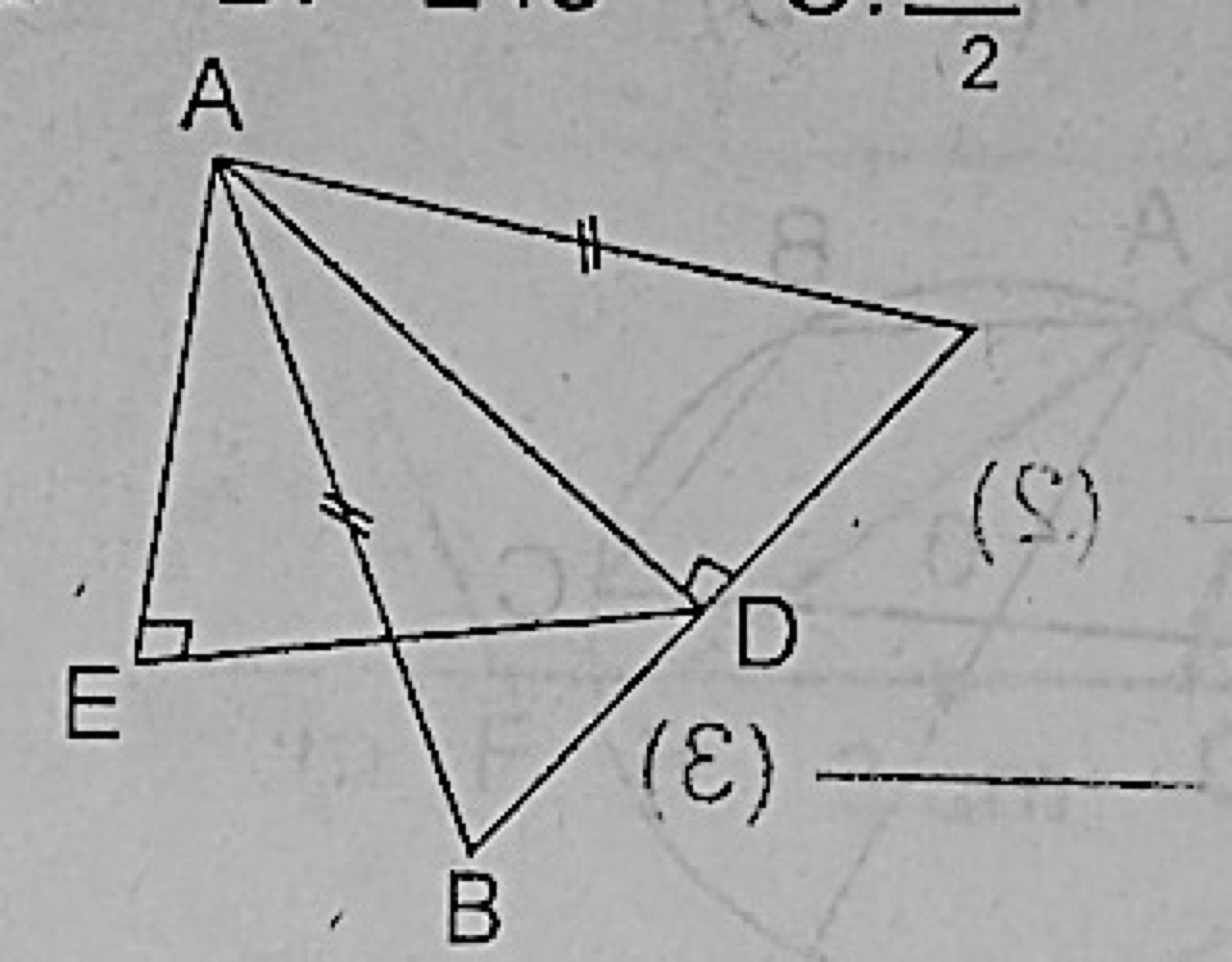
In the figure below ΔABC and ΔAED are in adjacent planes. AB = AC = 5cm, BC = 6cm and <ADE = 60°, then AE is equal to

Diagram for this question
  1. A.3√2
  2. B.2√3
  3. C.√3/2
  4. D.2/√3
  5. E.3/√2
Show the answer and explanation

Answer: B (2√3)

Explanation

D is the mid-point of BC, so AD = √(5² − 3²) = 4cm. Triangle AED is right-angled at E, so AE = AD sin 60° = 4 × √3/2 = 2√3.

Open this question

Question 48

Fractions, Decimals and Approximation

Add the same number to the numerator and denominator of 3/18. If the resulting fraction is 1/2, then the number added is

  1. A.13
  2. B.14
  3. C.15
  4. D.12
  5. E.11.
Show the answer and explanation

Answer: D (12)

Explanation

(3 + x)/(18 + x) = 1/2 gives 6 + 2x = 18 + x, so x = 12.

Open this question

Question 49

Circle Theorems

In a circle of radius 10cm, a cord of length 10cm is xcm from its centre where x is

  1. A.10√2
  2. B.5√3
  3. C.10√3
  4. D.5√2
  5. E.10.
Show the answer and explanation

Answer: B (5√3)

Explanation

The perpendicular from the centre bisects the chord, so x² = 10² − 5² = 75 and x = 5√3cm.

Open this question

Question 50

Fractions, Decimals and Approximation

The smallest number such that when it is divided by 8 has a remainder of 6 and when it is divided by 9, has a remainder of 7 is

  1. A.387
  2. B.493
  3. C.502
  4. D.441
  5. E.634.
Show the answer and explanation

Answer: C (502)

Explanation

Such a number is 2 less than a multiple of 72 (70, 142, …, 502). Checking the options, only 502 = 8 × 62 + 6 = 9 × 55 + 7 works.

Open this question