Home › Past questions › JAMB › Economics › 2012 46 questions. Try each one, then open the answer to check yourself and read the explanation.
Sign up free to answer these questions on a CBT screen with a timer, then see your score and every answer explained.
Start practising free
Question 2 Economic Systems A major disadvantage of a socialist economy is that
A. corruption is rampant B. consumers' sovereignty is lost C. income inequality is entrenched D. there is high level of unemployment. Show the answer and explanation Answer: B (consumers' sovereignty is lost )
Explanation In a socialist economy the state decides what to produce, so consumers lose the power to direct production by their spending.
Open this question
Question 3 Basic Concepts The privatisation of public enterprises will lead to efficient management of resources in the economy. This statement can best be described as
A. normative reasoning B. inductive reasoning C. deductive reasoning D. positive reasoning. Show the answer and explanation Answer: D (positive reasoning. )
Explanation A positive statement says what is, was or will be and can be checked against evidence. 'Privatisation will lead to efficient management' is a prediction that can be tested, so it is positive reasoning; a normative statement would say what ought to be done.
Open this question
Question 4 Tools of Economic Analysis The sign of the slope of a graph in economic analysis is important because it
A. shows whether a good is normal or inferior B. shows the relationship between variables C. reveals the magnitude of the change between variables D. helps to determine the unit of measurement of variables. Show the answer and explanation Answer: B (shows the relationship between variables )
Explanation A positive slope shows the variables move in the same direction; a negative slope shows they move in opposite directions.
Open this question
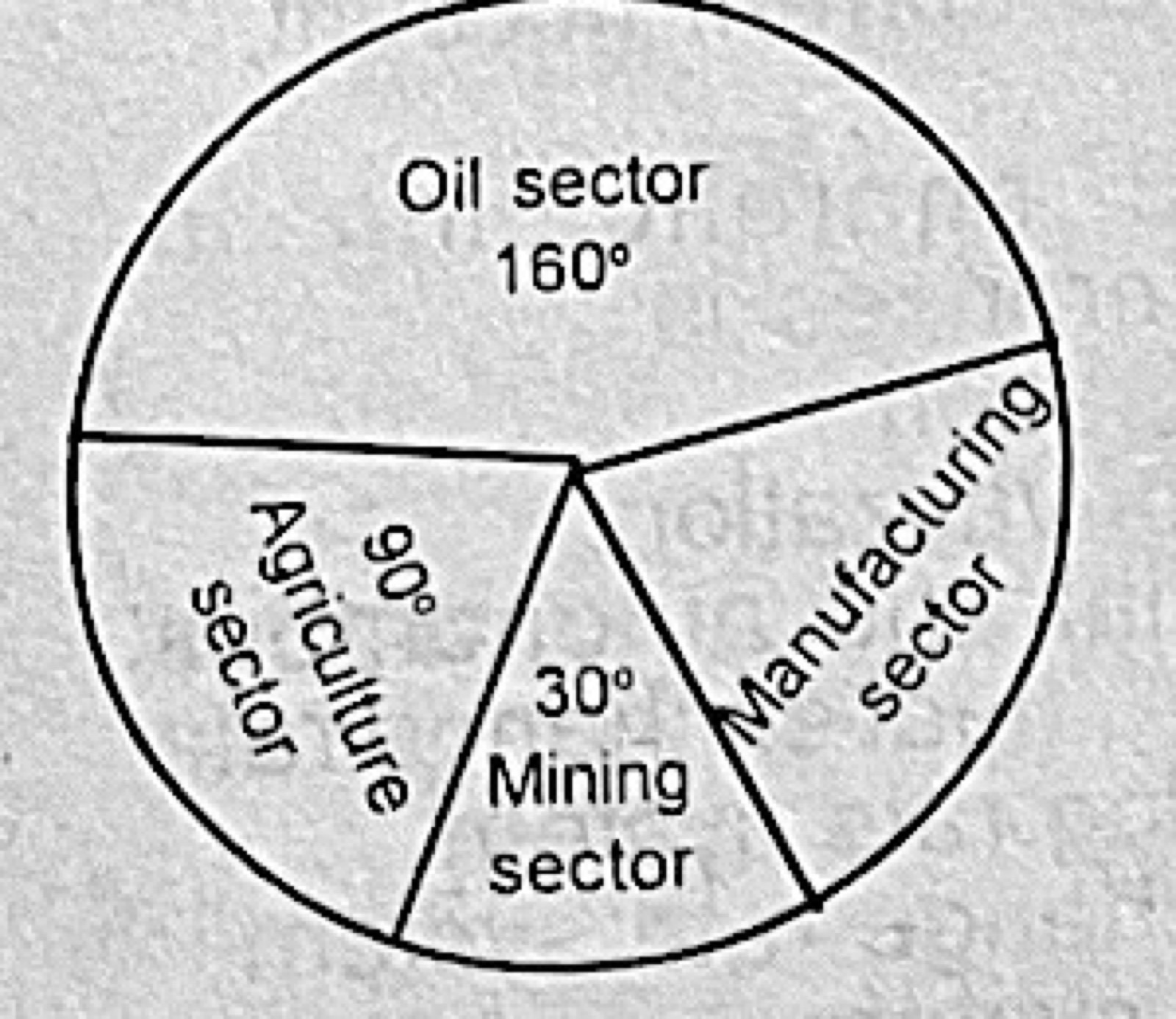
Question 5 Tools of Economic Analysis Use the pie chart below to answer the question.
A. 67.5 B. 40.0 C. 32.4 D. 25.0. Show the answer and explanation Answer: D (25.0. )
Explanation Agriculture has 90° of the 360° circle: 90/360 × 100 = 25%.
Open this question
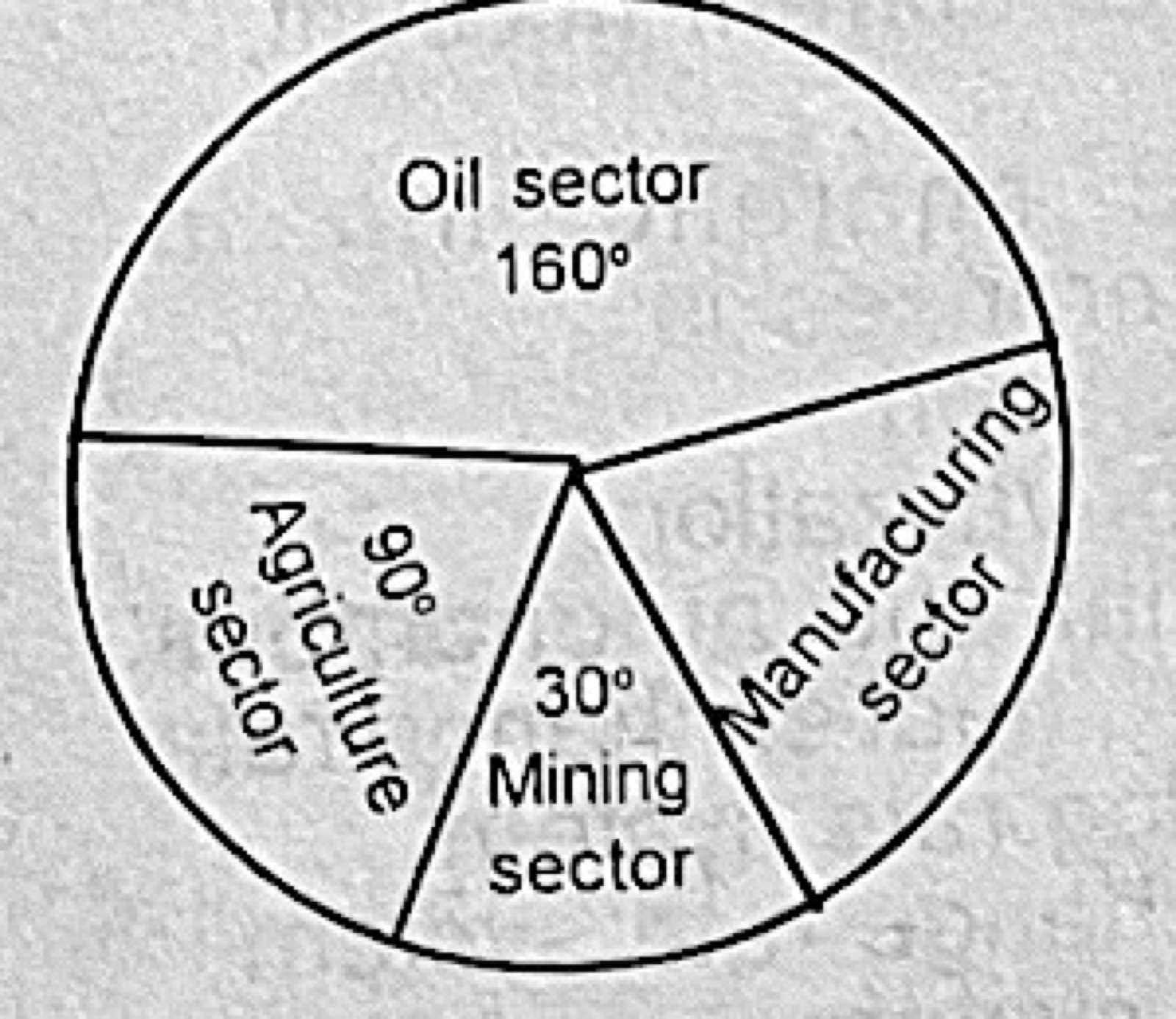
Question 6 Tools of Economic Analysis Use the pie chart below to answer the question.
A. ₦11.7 billion B. ₦13.3 billion C. ₦21.7 billion D. ₦26.6 billion. Show the answer and explanation Answer: B (₦13.3 billion )
Explanation Manufacturing's angle = 360° − (160° + 90° + 30°) = 80°. Difference = (160 − 80)/360 × ₦60bn = ₦13.3 billion.
Open this question
Question 7 Theory of Demand If the quantity of rice bought decreases from 250 tonnes to 200 tonnes owing to a 2% rise in price, it shows that there is a change in
A. consumers' income B. demand C. consumers' tastes D. quantity demanded. Show the answer and explanation Answer: D (quantity demanded. )
Explanation A change in the good's own price causes a movement along the demand curve, called a change in quantity demanded.
Open this question
Question 8 Theory of Demand A rise in income will, ceteris paribus , bring about
A. a movement along the demand curve B. a leftward shift of the demand curve C. a rightward shift of the demand curve D. no effect on the demand curve. Show the answer and explanation Answer: C (a rightward shift of the demand curve )
Explanation With more income, people buy more of a normal good at every price, so the demand curve shifts to the right.
Open this question
Question 9 Elasticity Use the table below to answer the question.
A. 5.0 B. 2.0 C. 1.0 D. 0.5 Show the answer and explanation Answer: D (0.5 )
Explanation % change in quantity = (500 − 400)/500 × 100 = 20%. % change in price = (70 − 50)/50 × 100 = 40%. Elasticity = 20/40 = 0.5.
Open this question
Question 10 Elasticity If the price of an item increases by 8% while the quantity demanded falls from 1500 units to 1492 units, the demand is said to be
A. perfectly elastic B. inelastic C. elastic D. perfectly inelastic. Show the answer and explanation Answer: B (inelastic )
Explanation % change in quantity = 8/1500 × 100 ≈ 0.53%. Elasticity ≈ 0.53/8 ≈ 0.07, which is less than 1 but not zero, so demand is inelastic.
Open this question
Question 11 Theory of Consumer Behaviour Comparison of interpersonal utility is impossible because
A. utility is measured in utiles B. marginal utility is not observable C. utility is subjectively D. individual incomes differ. Show the answer and explanation Answer: C (utility is subjectively )
Explanation Satisfaction is a personal feeling: the same good gives different people different satisfaction, so one person's utility cannot be compared with another's.
Open this question
Question 12 Theory of Consumer Behaviour When the slope of the total utility curve is declining, the marginal utility of a consumer will be increasing if he
A. stops consuming more of the commodity B. reduces the quantity consumed C. increases the quantity consumed D. consumes more of another commodity. Show the answer and explanation Answer: B (reduces the quantity consumed )
Explanation The slope of total utility is marginal utility. It declines as consumption rises, so to raise marginal utility the consumer must reduce the quantity consumed.
Open this question
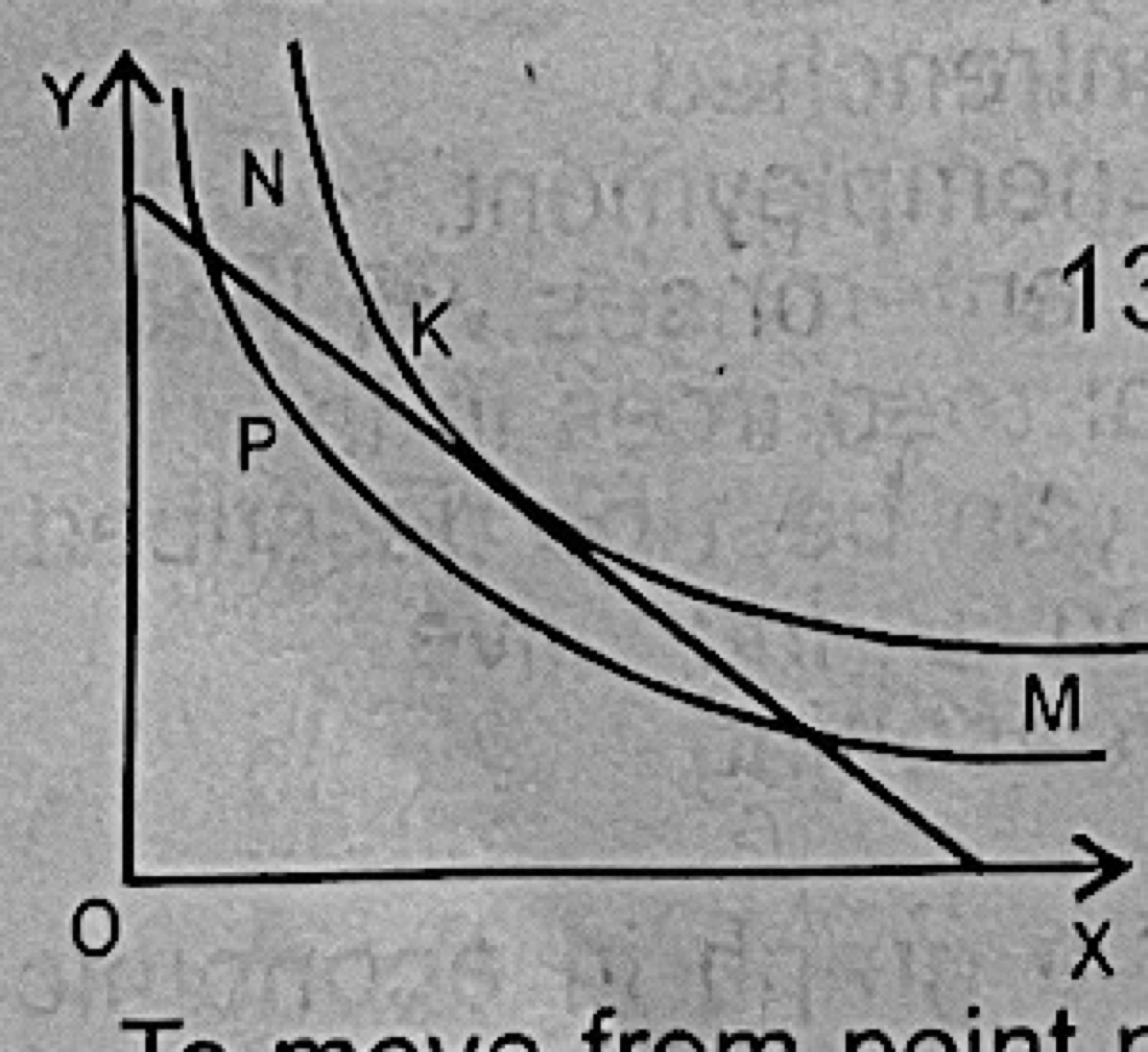
Question 13 Theory of Consumer Behaviour Use the diagram below to answer the question.
A. N B. P C. M D. K Show the answer and explanation Answer: D (K )
Explanation Equilibrium is where the budget line just touches the highest indifference curve the consumer can reach, which is at K.
Open this question
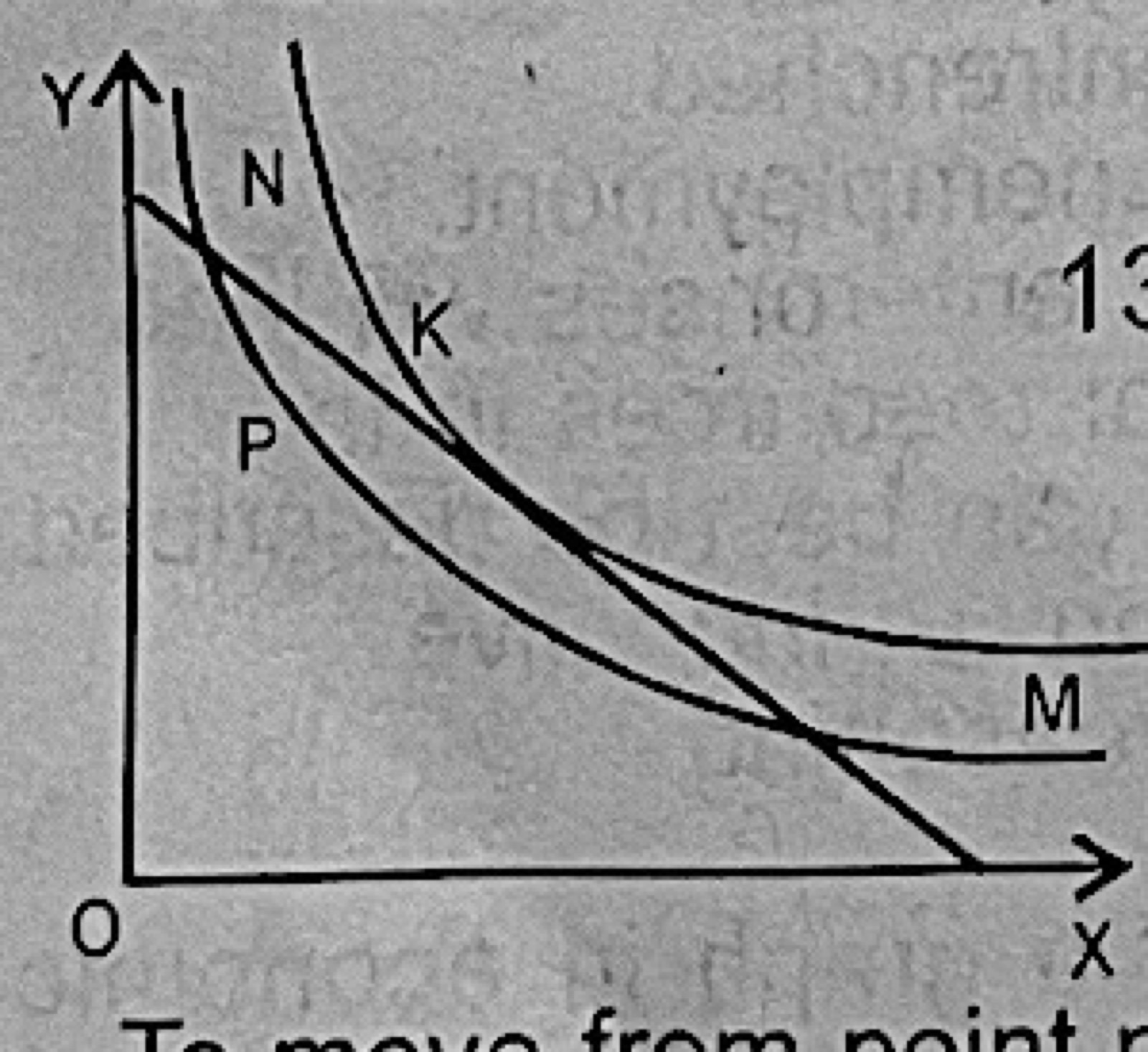
Question 14 Theory of Consumer Behaviour Use the diagram below to answer the question.
A. consumption of X and reduce the consumption of Y B. expenditure on Y C. expenditure on X D. consumption of Y and reduce the consumption of X. Show the answer and explanation Answer: D (consumption of Y and reduce the consumption of X. )
Explanation K lies higher up and to the left of M, so it has more Y and less X.
Open this question
Question 15 Theory of Supply The supply of cocoa is influenced by
A. seasonal conditions B. the efficacy of fertilizer used C. the demand for beverages D. the availability of close substitutes. Show the answer and explanation Answer: A (seasonal conditions )
Explanation Cocoa is a farm crop, so weather and the seasons largely decide how much is harvested and supplied.
Open this question
Question 16 Elasticity If quantity supplied is constant irrespective of price changes, the supply elasticity is
A. unitary B. infinity C. fairly elastic D. perfectly inelastic. Show the answer and explanation Answer: D (perfectly inelastic. )
Explanation If quantity does not change at all when price changes, elasticity is zero: perfectly inelastic supply.
Open this question
Question 18 Economic Systems The invisible hand promotes the interests of
A. consumers B. society C. government D. producers. Show the answer and explanation Answer: B (society )
Explanation Adam Smith argued that when each person pursues his own gain in a free market, the price system guides them, as if by an invisible hand, to benefit society.
Open this question
Question 19 Price Determination Fixing price above equilibrium will cause
A. demand and supply to remain constant B. an increase in quantity supplied C. an increase in supply D. a decrease in quantity supplied. Show the answer and explanation Answer: B (an increase in quantity supplied )
Explanation At a price above equilibrium, producers are willing to sell more, so quantity supplied rises (a movement along the supply curve).
Open this question
Question 20 Economic Systems An important function of the price system is to
A. ensure that producers' profits remain high B. guarantee full employment of resources C. allocate resources to most productive uses D. protect the economic interests of government. Show the answer and explanation Answer: C (allocate resources to most productive uses )
Explanation Prices signal where resources earn the most, so they move resources into their most productive uses.
Open this question
Question 22 Theory of Production The equilibrium point of a firm is attained at the point where the isoquant is
A. greater than the isocost B. less than the isocost C. tangent to the isocost D. greater than the output. Show the answer and explanation Answer: C (tangent to the isocost )
Explanation The least-cost combination of inputs is where an isoquant just touches (is tangent to) the isocost line.
Open this question
Question 23 Theory of Costs and Revenue The long-run average cost curve touches the short-run average cost curves at the
A. minimum points of all short-run average cost curves B. declining points of all short-run average cost curves C. minimum point of only one of the short-run cost curves D. rising points of all short-run average cost curves. Show the answer and explanation Answer: C (minimum point of only one of the short-run cost curves )
Explanation The LRAC curve wraps round all the SRAC curves. Only at the lowest point of LRAC does it touch an SRAC curve at that curve's minimum; elsewhere it touches the falling or rising parts of the SRAC curves.
Open this question
Question 24 Theory of Production If a firm doubles all inputs in the long run and the total output is less than doubled, this results in
A. diminishing returns B. constant returns to scale C. increasing returns to scale D. decreasing returns to scale. Show the answer and explanation Answer: D (decreasing returns to scale. )
Explanation When all inputs are doubled but output less than doubles, output rises less than in proportion: decreasing returns to scale.
Open this question
Question 25 Market Structures Patents and copyrights enable monopolists to
A. determine the quality of their products B. determine the sale of their products C. restrict information from to new firms D. restrict entry of new firms. Show the answer and explanation Answer: D (restrict entry of new firms. )
Explanation Patents and copyrights give the holder the sole legal right to produce, so other firms cannot enter the market.
Open this question
Question 26 Market Structures A discriminatory monopoly is characterized by
A. a common elasticity in different markets B. different elasticities in different markets C. a finite elasticity in all markets D. zero elasticity in all markets. Show the answer and explanation Answer: B (different elasticities in different markets )
Explanation A monopolist can charge different prices only if demand elasticity differs between markets: a higher price where demand is inelastic.
Open this question
Question 27 National Income Net National Product is derived by deducting
A. net exports from GNP B. subsidies from GDP C. taxes from GDP D. depreciation from GNP. Show the answer and explanation Answer: D (depreciation from GNP. )
Explanation NNP = GNP − depreciation (capital consumption allowance).
Open this question
Question 28 National Income The investment expenditure of an economy changes by ₦2 million and MPC is 0.75. What is the change in income?
A. ₦0.5m B. ₦1.5m C. ₦2.6m D. ₦8.0m. Show the answer and explanation Answer: D (₦8.0m. )
Explanation Multiplier = 1/(1 − 0.75) = 4. Change in income = 4 × ₦2m = ₦8m.
Open this question
Question 29 National Income The investment expenditure of an economy changes by ₦2 million and MPC is 0.75. The multiplier is
A. 8 B. 4 C. 3 D. 2 Show the answer and explanation Answer: B (4 )
Explanation Multiplier = 1/(1 − MPC) = 1/0.25 = 4.
Open this question
Question 30 Money and Inflation The money that commands a higher market value than its face value is called
A. paper money B. standard money C. commodity money D. fiat money. Show the answer and explanation Answer: C (commodity money )
Explanation Commodity money is a good that has value in itself, so it can be worth more on the market than its value as money. Paper money is worth almost nothing as paper.
Open this question
Question 31 Money and Inflation If a basket of commodities cost ₦120 in the base year and ₦240 in the current year, calculate the price index.
A. 100 B. 200 C. 240 D. 300 Show the answer and explanation Answer: B (200 )
Explanation Price index = current cost/base cost × 100 = 240/120 × 100 = 200.
Open this question
Question 32 Financial Institutions The minimum amount which banks are required to deposit with the central bank is determined by the
A. liquidity ratio B. cash reserve ratio C. minimum lending rate D. aggregate credit ceiling. Show the answer and explanation Answer: B (cash reserve ratio )
Explanation The cash reserve ratio is the fraction of deposits banks must keep with the central bank.
Open this question
Question 33 Financial Institutions The major function of the money market is to
A. provide funds for long-term financing B. provide funds for short-term financing C. stabilize the value of the local currency D. stabilize domestic prices. Show the answer and explanation Answer: B (provide funds for short-term financing )
Explanation The money market deals in short-term loans and securities; long-term funds come from the capital market.
Open this question
Question 34 Public Finance An ad valorem tax is imposed on
A. special commodities B. exports C. imports D. the value of a commodity. Show the answer and explanation Answer: D (the value of a commodity. )
Explanation Ad valorem means 'according to value': the tax is a percentage of the commodity's value.
Open this question
Question 35 Public Finance A huge national debt is an indication that the gold reserves of a nation has
A. appreciated B. decreased C. depreciated D. stagnated. Show the answer and explanation Answer: B (decreased )
Explanation A country that has piled up a huge debt has usually had to draw on its reserves to pay for imports and debts, so its gold and foreign reserves have decreased.
Open this question
Question 36 Economic Growth and Development Rapid economic development in Nigeria is realizable by
A. continuous dependence on oil B. concentrating more on agriculture C. developing the tourism industry D. diversifying the economy. Show the answer and explanation Answer: D (diversifying the economy. )
Explanation Spreading production across many sectors reduces dependence on oil and gives steadier, faster development.
Open this question
Question 37 Economic Growth and Development The primary reason for desiring economic growth is to
A. control inflation B. reduce poverty C. redistribute income D. raise standard of living. Show the answer and explanation Answer: D (raise standard of living. )
Explanation Growth increases the goods and services available, so people can enjoy a higher standard of living.
Open this question
Question 38 Agriculture An emerging agricultural export crop in Nigeria is
A. cassava B. cotton C. cocoa D. soya beans. Show the answer and explanation Answer: A (cassava )
Explanation Cocoa and cotton are old export crops; cassava (as chips, starch and flour) is a newer export crop being promoted.
Open this question
Question 39 Agriculture A strategy for improving agriculture in Nigeria will involve
A. controlling the prices of agricultural products B. ensuring self-sufficiency in food production C. establishing commodity boards D. reducing agricultural exports. Show the answer and explanation Answer: B (ensuring self-sufficiency in food production )
Explanation Aiming at food self-sufficiency drives more support and investment into farming.
Open this question
Question 40 Industrialisation A sugar industry is best located near the source of
A. labour B. raw materials C. power D. capital. Show the answer and explanation Answer: B (raw materials )
Explanation Sugar cane is bulky and loses weight in processing, so factories are sited near the cane fields.
Open this question
Question 41 Industrialisation An important contribution of small-scale industries to the Nigerian economy is in the area of
A. technological development B. foreign exchange earnings C. raw materials processing D. labour employment. Show the answer and explanation Answer: D (labour employment. )
Explanation Small-scale industries use labour-intensive methods, so they create many jobs.
Open this question
Question 42 Natural Resources and Petroleum A change in the pump price of petrol in Nigeria has a direct effect on the
A. prices of consumer goods B. prices of essential goods C. cost of raw materials D. cost of transportation. Show the answer and explanation Answer: D (cost of transportation. )
Explanation Vehicles run on petrol, so a change in its price immediately changes transport fares and costs; other prices change later as a result.
Open this question
Question 43 Financial Institutions Long-term funds for investment projects are sourced from the
A. money market B. commodity market C. foreign exchange market D. capital market. Show the answer and explanation Answer: D (capital market. )
Explanation The capital market (stock exchange, bonds) provides long-term funds.
Open this question
Question 45 Population The Malthusian theory was concerned about the relationship between
A. population growth rates of the rich and the poor nations B. population density and national income C. population growth rate and natural resources D. age distribution of population. Show the answer and explanation Answer: C (population growth rate and natural resources )
Explanation Malthus compared how fast population grows with how fast food and other resources can grow.
Open this question
Question 46 Population In a village of 50 persons, 10 immigrated, 25 died and 5 emigrated in a year. Determine the total population.
A. 10 B. 20 C. 30 D. 50 Show the answer and explanation Answer: C (30 )
Explanation Population = 50 + 10 (immigrants) − 25 (deaths) − 5 (emigrants) = 30.
Open this question
Question 47 Balance of Payments and Exchange Rates A deficit balance of payments is measured by subtracting the debits from the credits in the
A. current account B. current and capital accounts C. current and escrow accounts D. capital and escrow accounts. Show the answer and explanation Answer: B (current and capital accounts )
Explanation The overall balance is found from both the current and capital accounts; if debits exceed credits there is a deficit.
Open this question
Question 48 International Economic Organisations One of the functions of ECOWAS is to
A. provide funds for infrastructural development B. determine prices of exports C. redistribute income among citizens D. provide employment for citizens of member nations. Show the answer and explanation Answer: A (provide funds for infrastructural development )
Explanation Through its fund and bank, ECOWAS finances roads, power and other infrastructure in member states.
Open this question
Question 49 Theory of Production The reward on machinery and equipment in the process of production is known as
A. profit B. interest C. rent D. wages. Show the answer and explanation Answer: B (interest )
Explanation Machinery and equipment are capital, and the reward for capital is interest.
Open this question
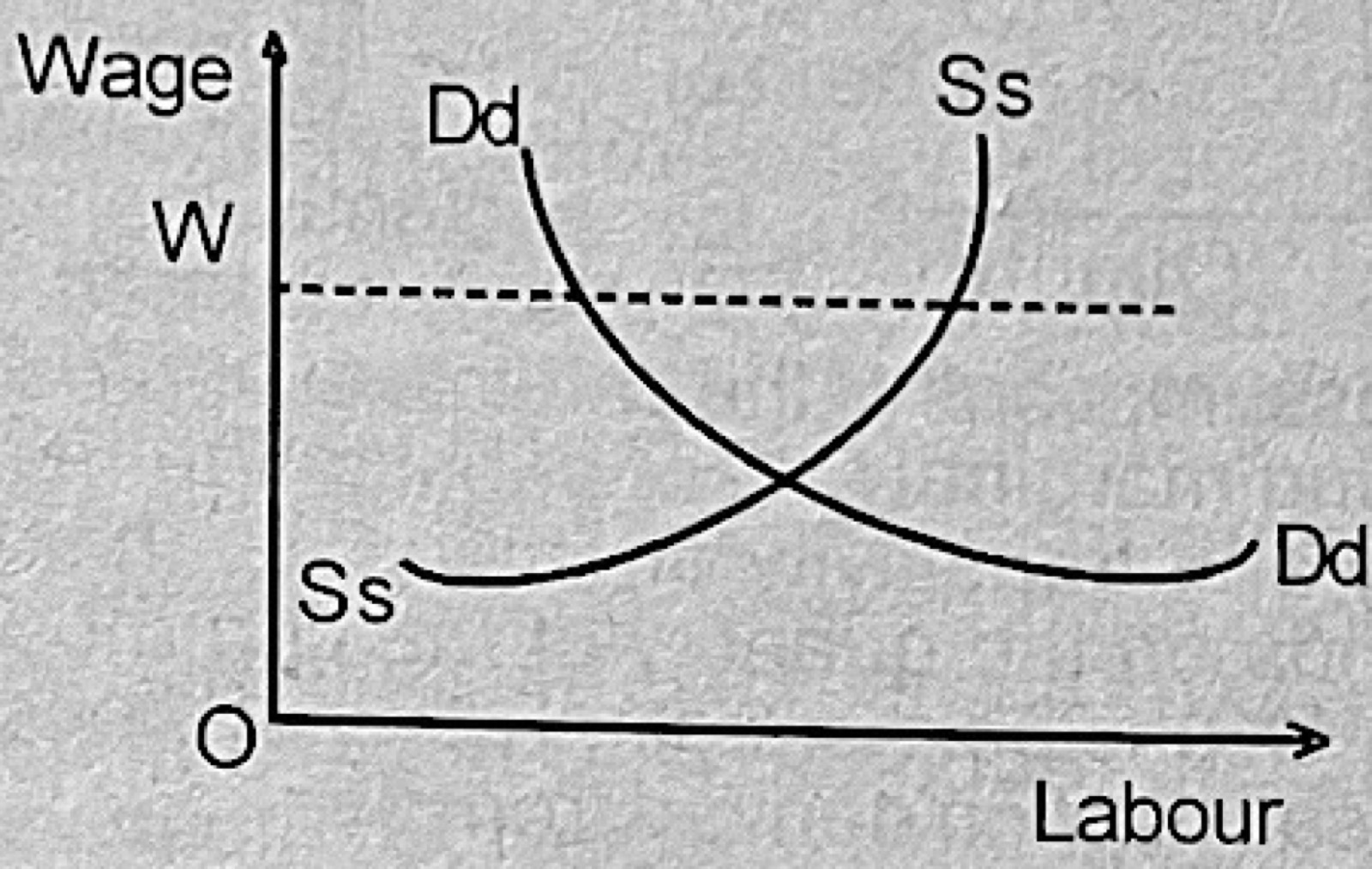
Question 50 Labour Market Use the diagram below to answer the question.
A. full employment of resources B. unemployment C. inflation D. full employment of factors of production. Show the answer and explanation Answer: B (unemployment )
Explanation At wage OW more people want to work than firms want to hire, because the wage is above equilibrium. The excess supply of labour is unemployment.
Open this question Sign up free for every JAMB Economics year, practice by topic and timed mocks.
Start practising free