Home › Past questions › JAMB › Economics › 1999 44 questions. Try each one, then open the answer to check yourself and read the explanation.
Sign up free to answer these questions on a CBT screen with a timer, then see your score and every answer explained.
Start practising free
Question 1 Tools of Economic Analysis In a firm, three employees earn ₦ 5,500 each, four earn ₦ 3, 300 each, two earn ₦ 5 000 each and one earns ₦ 7,000. The mean income of the employees is
A. ₦ 5,200 B. ₦ 4,760 C. ₦ 4,670 D. ₦ 2,080 Show the answer and explanation Answer: C (₦ 4,670 )
Explanation Total = 3 × 5,500 + 4 × 3,300 + 2 × 5,000 + 7,000 = 16,500 + 13,200 + 10,000 + 7,000 = ₦46,700. Mean = 46,700 ÷ 10 = ₦4,670.
Open this question
Question 2 Basic Concepts Abubakar has the choice of buying either a house or a Mercedes Benz car for ₦ 1m plus ₦ 0.5m running cost. If he decides to buy the Mercedes Benz car, his opportunity cost is
A. ₦ 1.5m B. ₦ 2.0m C. the house D. the car. Show the answer and explanation Answer: C (the house )
Explanation Opportunity cost is the best alternative given up, not the money spent. Buying the car means giving up the house.
Open this question
Question 3 Basic Concepts The shape of a production possibility frontier is determined by the
A. increasing relative costs B. returns to scale C. diminishing returns to a fixed factor D. increasing returns to a variable factor. Show the answer and explanation Answer: A (increasing relative costs )
Explanation The frontier bows outward because each extra unit of one good costs more and more of the other good: increasing relative (opportunity) costs.
Open this question
Question 4 Basic Concepts Normative economics deals with
A. what is and not what should be B. facts and not figures C. facts and figures D. value judgements. Show the answer and explanation Answer: D (value judgements. )
Explanation Normative economics deals with opinions about what ought to be, which are value judgements; positive economics deals with facts (what is).
Open this question
Question 6 Elasticity | Period 1 | Period 2
A. 0.5 B. 2.0 C. 2.5 D. 5.0. Show the answer and explanation Answer: B (2.0 )
Explanation Spending on clothing rises from 100 to 200, a 100% rise; income rises from 1,000 to 1,500, a 50% rise. Income elasticity = 100 ÷ 50 = 2.0.
Open this question
Question 7 Economic Systems A capitalist economy is one characterized by the
A. private ownership of factors of production B. ownership of factors of production by rich members of the society C. use of capital and labour in fixed proportions during production D. use of capital intensive methods of production. Show the answer and explanation Answer: A (private ownership of factors of production )
Explanation Under capitalism, land, capital and businesses are owned by private individuals and firms.
Open this question
Question 8 Economic Systems In a planned economy, what shall be produced is determined primarily by
A. what the consumer wants B. government decisions C. price mechanism D. the pattern of consumer spending. Show the answer and explanation Answer: B (government decisions )
Explanation In a planned (command) economy, a central planning authority of the government decides what to produce.
Open this question
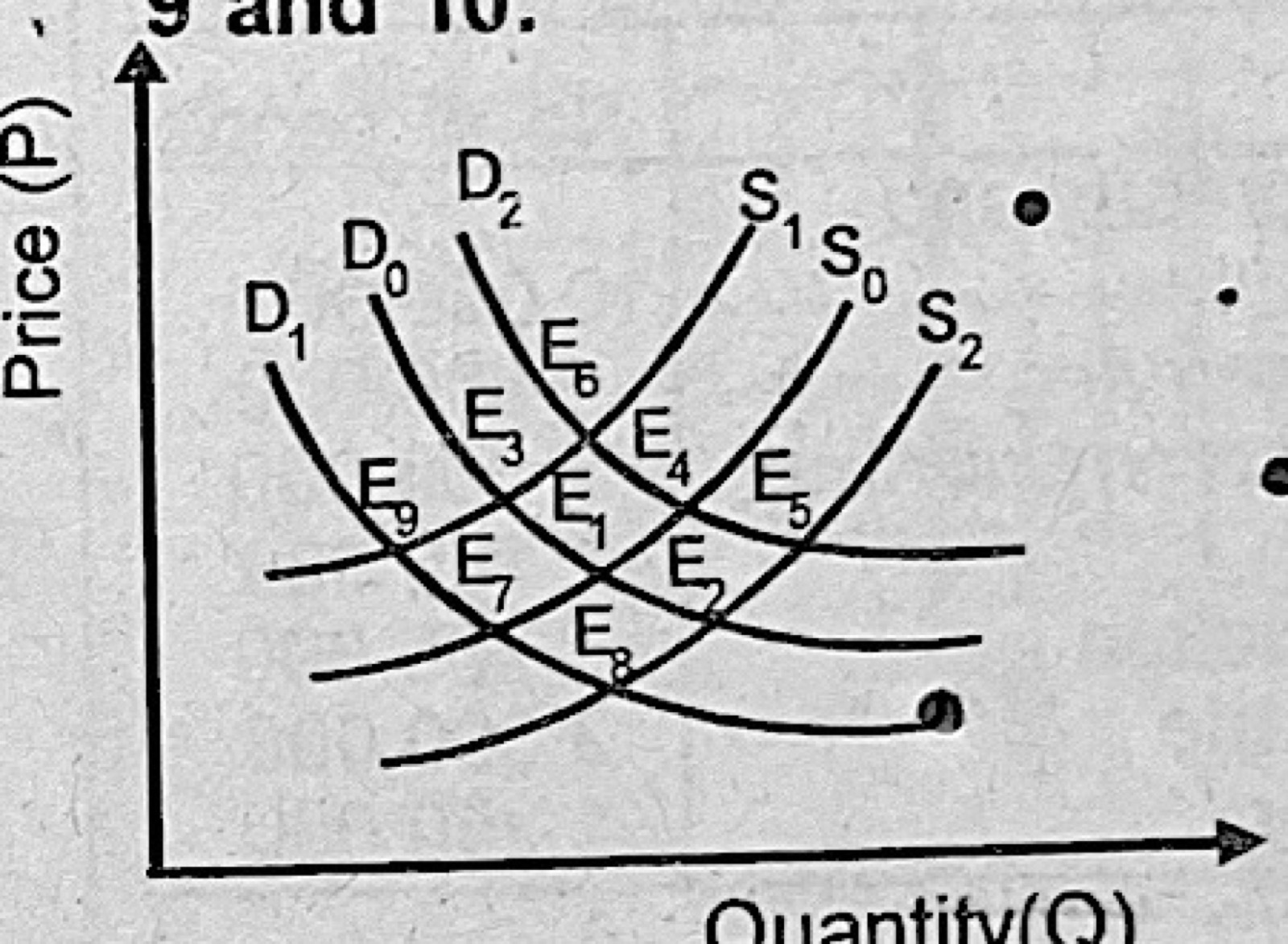
Question 9 Price Determination D0 and S0 are initial demand and supply curves with equilibrium at E1 . Other supply and demand curves with equilibra points are indicated.6 and E5 are respectively equilibra points for
A. D0 and S0 ; D0 and S2 B. D1 and S2 ; D2 and S0 C. D2 and S1 ; D2 and S2 D. D2 and S0 ; D0 and S2 . Show the answer and explanation Answer: C (D2 and S1 ; D2 and S2 )
Explanation E6 is where the highest demand curve D2 crosses the leftmost supply curve S1 . Following D2 to the right, it crosses S2 at E5 .
Open this question
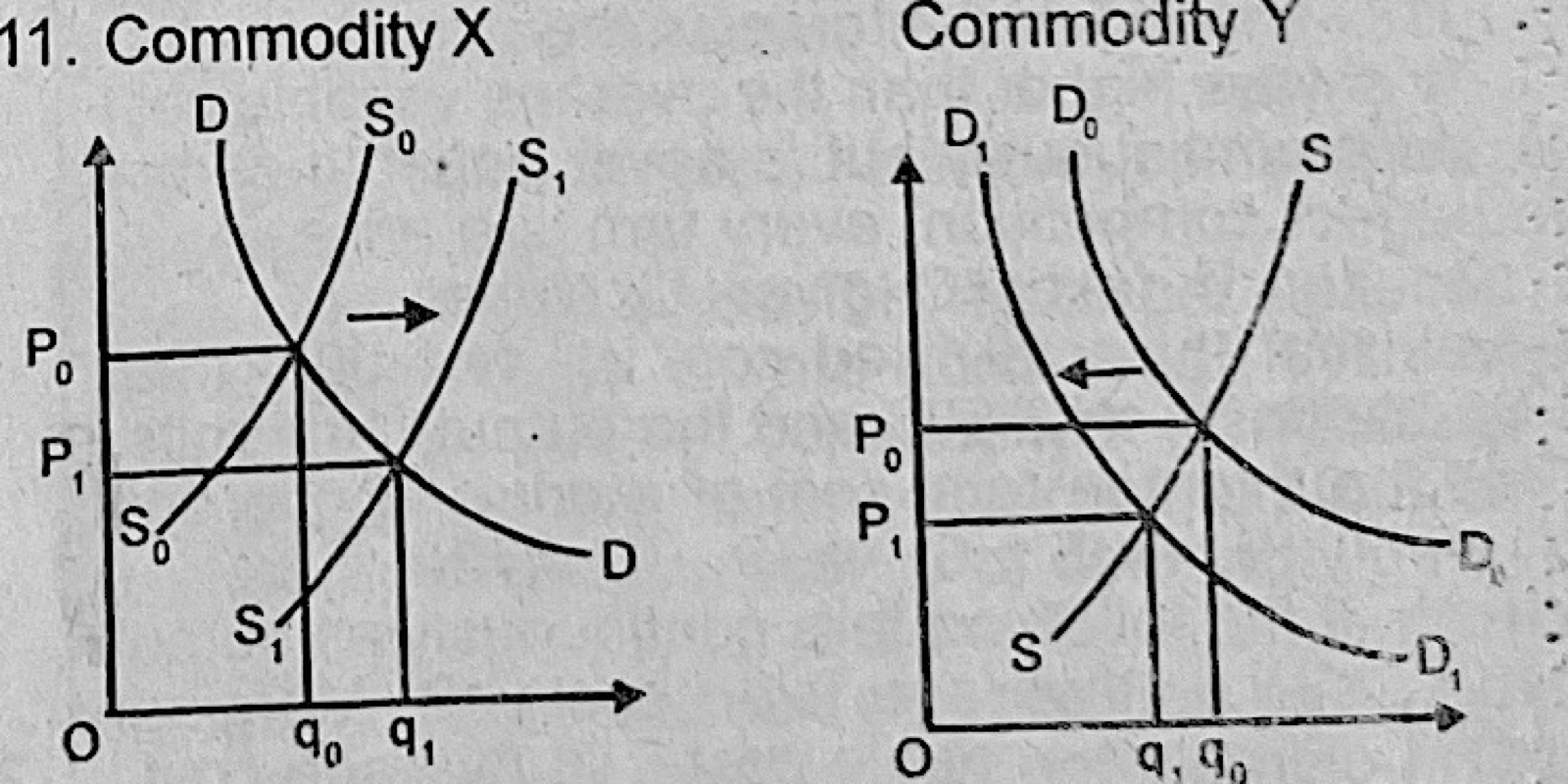
Question 11 Theory of Demand The graphs above illustrate
A. joint demand B. derived demand C. composite demand D. competitive demand Show the answer and explanation Answer: D (competitive demand )
Explanation Supply of X rises and its price falls, and at the same time demand for Y falls. People switch from Y to the cheaper X, so X and Y are substitutes: competitive demand.
Open this question
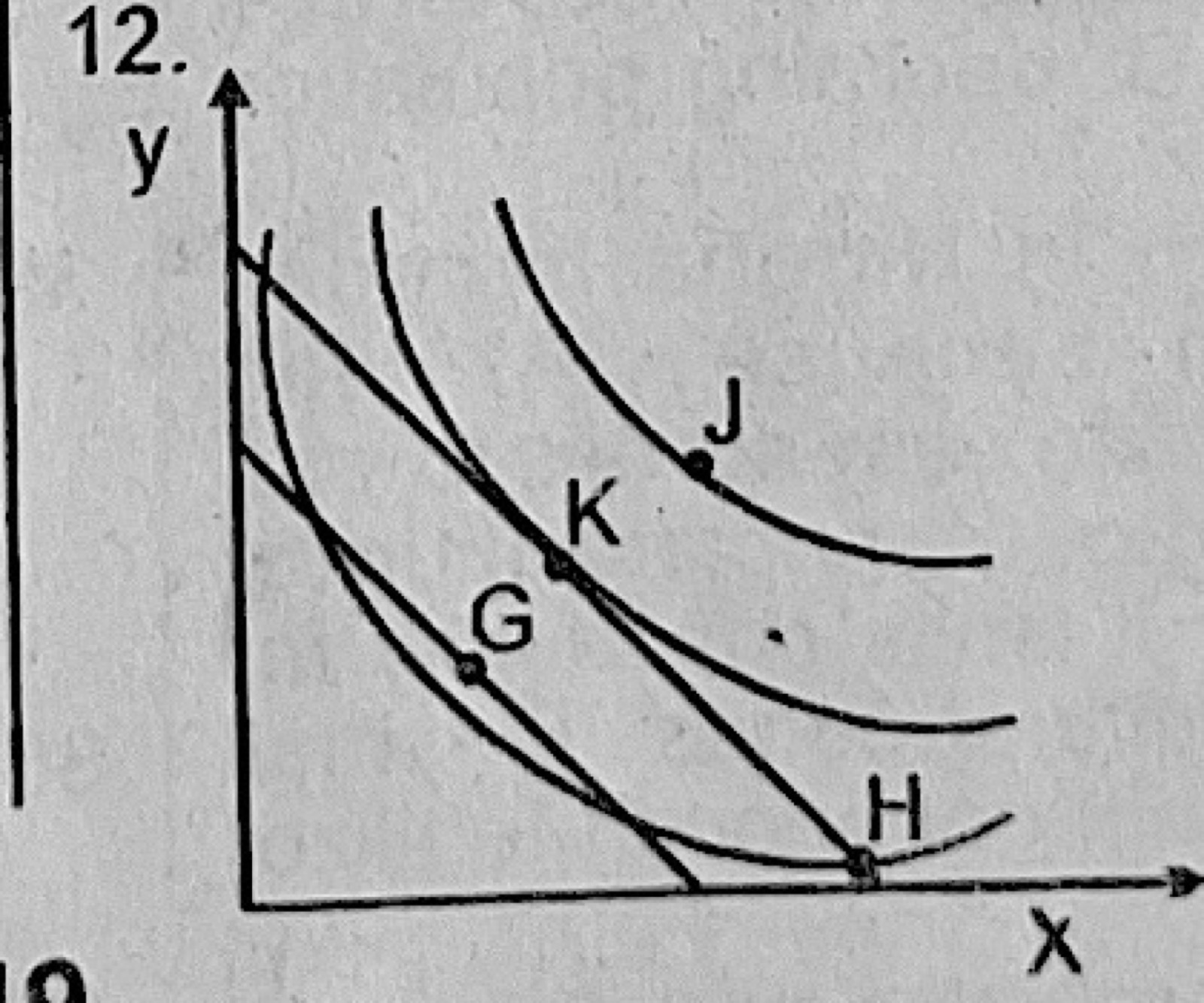
Question 12 Theory of Consumer Behaviour In the diagram above, the consumer attains equilibrium at point
A. G B. H C. J D. K. Show the answer and explanation Answer: D (K. )
Explanation A consumer is in equilibrium where the budget line just touches (is tangent to) the highest indifference curve he can reach; this is point K. J is beyond the budget line and H is where a lower curve crosses it.
Open this question
Question 13 Theory of Consumer Behaviour A utility maximizing household will allocate its expenditure so that
A. more naira is spent on commodities with the highest utility B. less naira is spent on commodities with the lowest utility C. the utility of the last naira spent on each commodity is equal D. the amount spent on each commodity is equal. Show the answer and explanation Answer: C (the utility of the last naira spent on each commodity is equal )
Explanation Satisfaction is greatest when the marginal utility of the last naira spent is the same for every good (equi-marginal principle).
Open this question
Question 14 Theory of Costs and Revenue The downward sloping part of the long-run average cost curve of a firm may be attributable to
A. diminishing returns B. the law of variable proportions C. diseconomies of scale D. increasing returns to scale. Show the answer and explanation Answer: D (increasing returns to scale. )
Explanation In the long run all inputs can change. LRAC falls when doubling inputs more than doubles output (increasing returns to scale).
Open this question
Question 15 Economic Systems The main function of price in the economic system is to
A. allocate scarce resources among competing uses B. ensure equitable distribution of income and wealth C. determine the demand for and the supply of goods and services D. remove all the constraints on production of goods and services. Show the answer and explanation Answer: A (allocate scarce resources among competing uses )
Explanation Prices signal where resources are most wanted, so they share out scarce resources among their competing uses.
Open this question
Question 16 National Income S/No. | Sector | No. of people
A. 5 000 000 B. 6 250 000 C. 11 750 000 D. 12 250 000 Show the answer and explanation Answer: B (6 250 000 )
Explanation Tertiary production is services: transport and communication (2 000 000) + distributive trade (3 000 000) + administration (1 250 000) = 6 250 000.
Open this question
Question 18 Theory of Costs and Revenue A characteristic of the average fixed cost is that, it
A. rises and falls faster than the marginal cost B. is U-shaped and intersects the price axis C. is always higher than the average variable cost D. falls continuously but is never equal to zero. Show the answer and explanation Answer: D (falls continuously but is never equal to zero. )
Explanation AFC = fixed cost ÷ output. It keeps falling as output grows, but since fixed cost is never zero, it never reaches zero.
Open this question
Question 19 Market Structures In perfect competition, every firm is a price
A. maker B. taker C. giver D. bidder. Show the answer and explanation Answer: B (taker )
Explanation Each firm is too small to affect the market price, so it must accept (take) the price set by the industry.
Open this question
Question 20 Theory of Costs and Revenue Given that the total fixed cost is ₦1 000, total variable cost ₦2 500 and the output, 100 units. Find the average total cost of producing one unit
A. ₦60 B. ₦45 C. ₦35 D. ₦30 Show the answer and explanation Answer: C (₦35 )
Explanation Total cost = 1,000 + 2,500 = ₦3,500. Average total cost = 3,500 ÷ 100 = ₦35.
Open this question
Question 21 Theory of Costs and Revenue Which of the following falls continuously as output expands?
A. Average fixed cost B. Marginal cost C. Average variable cost D. Average cost. Show the answer and explanation Answer: A (Average fixed cost )
Explanation Fixed cost is shared over more and more units, so AFC keeps falling. MC, AVC and AC are U-shaped and eventually rise.
Open this question
Question 22 Agriculture A major obstacle to rapid agricultural development in Nigeria is the
A. ineffective use of crude implements B. inability of farmers to adopt modern technology C. introduction of the Green Revolution programme D. declining population growth rate. Show the answer and explanation Answer: B (inability of farmers to adopt modern technology )
Explanation Most Nigerian farmers still use hoes and cutlasses because they cannot afford or are not trained in modern methods, which keeps yields low.
Open this question
Question 23 Agriculture The land tenure system in Nigeria impedes agricultural production because
A. land fragmentation makes possible easy access to land ownership B. it discourages specialization of factors of production C. it limits opportunity for mass production of agricultural goods D. small land holders generally do not get enough fertilizer to use. Show the answer and explanation Answer: C (it limits opportunity for mass production of agricultural goods )
Explanation Inheritance shares land into small scattered plots, so farmers cannot farm on a large scale or use machines.
Open this question
Question 24 Business Organisations The major problem of cooperative societies in Nigeria is that
A. they often lack cohesion and continuity B. their liability is unlimited to members C. voting is by proxy D. their management style is poor. Show the answer and explanation Answer: D (their management style is poor. )
Explanation Co-operatives are often run by ordinary members without business training, so poor management is their main weakness.
Open this question
Question 25 International Trade The primary objective of establishing the Export Processing Zone is to
A. facilitate agricultural production B. encourage the production and processing of export commodities C. erect structures that will facilitate the processing of imported raw materials D. erect economic structures near the port. Show the answer and explanation Answer: B (encourage the production and processing of export commodities )
Explanation An Export Processing Zone gives firms special facilities and tax breaks so they will produce and process goods for export.
Open this question
Question 26 Natural Resources and Petroleum The first petroleum exploring company to discover crude petroleum in Nigeria was
A. Mobil B. Texaco C. Agip D. Shell-BP. Show the answer and explanation Answer: D (Shell-BP. )
Explanation Shell-BP found oil in commercial quantity at Oloibiri in 1956.
Open this question
Question 27 Industrialisation Concentrating industries in one place is advantageous because there are gains in terms of
A. external economies B. internal economies C. economies of scale D. cost economies. Show the answer and explanation Answer: A (external economies )
Explanation Firms in the same area share skilled labour, services and infrastructure, which are external economies.
Open this question
Question 28 Industrialisation Import substitution industrialization refers to
A. the concentration of industries for even development B. setting up of industries for regional development C. a situation in which local industries are set up to produce goods formerly imported D. the banning of imports which are substitutes for domestically produced goods. Show the answer and explanation Answer: C (a situation in which local industries are set up to produce goods formerly imported )
Explanation Import substitution means building local factories to make goods the country used to import.
Open this question
Question 29 Labour Market An entrepreneur will continue to employ labour up to a point where
A. costs are minimized B. maximum efficiency is attained C. wages are equal to marginal product of labour D. marginal product of labour is equal to zero. Show the answer and explanation Answer: C (wages are equal to marginal product of labour )
Explanation Hiring one more worker adds to profit while his extra output is worth more than his wage, so the firm stops where the wage equals the marginal product of labour.
Open this question
Question 30 Population Optimum population is defined as the level of population at which
A. per capita output is maximized B. population is neither increasing nor decreasing C. total national income is maximized D. marginal efficiency of population is maximized. Show the answer and explanation Answer: A (per capita output is maximized )
Explanation Optimum population is the size that, with the available resources and technology, gives the highest output (income) per head.
Open this question
Question 31 Labour Market When a worker earns more than the wage just sufficient to keep him in his job, the excess income is called
A. an opportunity cost B. an economic rent C. transfer earnings D. surplus value. Show the answer and explanation Answer: B (an economic rent )
Explanation The wage just needed to keep a worker in a job is his transfer earnings; anything above it is economic rent.
Open this question
Question 32 National Income No. | Items | Amount (₦m)
A. ₦18,500m B. ₦19,000m C. ₦19,500m D. ₦20,500m. Show the answer and explanation Answer: B (₦19,000m )
Explanation Pensions and unemployment benefits are transfer payments and are left out. National income = 9000 + 7000 + 1500 + 1500 = ₦19,000m.
Open this question
Question 36 Financial Institutions Non-bank financial intermediaries do not
A. provide credit facilities B. accept deposits C. accept demand deposits D. sell shares. Show the answer and explanation Answer: C (accept demand deposits )
Explanation Non-bank financial institutions lend and may take savings or time deposits, but they do not operate current (demand) accounts on which cheques are drawn.
Open this question
Question 37 Money and Inflation Inflation which is caused mainly by increases in the prices of factors of production is described as
A. cost-push inflation B. demand-pull inflation C. crawling inflation D. spiral inflation. Show the answer and explanation Answer: A (cost-push inflation )
Explanation When wages, raw materials and other input costs rise, producers raise their prices: cost-push inflation.
Open this question
Question 38 Money and Inflation The relationship between the value of money and the price level is
A. direct B. unpredictable C. diverse D. inverse. Show the answer and explanation Answer: D (inverse. )
Explanation When prices rise, money buys less, so the value of money and the price level move in opposite directions.
Open this question
Question 39 Money and Inflation People hold money for
A. charity B. safe keeping C. profit making D. speculative purposes. Show the answer and explanation Answer: D (speculative purposes. )
Explanation Keynes gave three motives for holding money: transactions, precaution and speculation.
Open this question
Question 40 Financial Institutions Bills of exchange originate from a
A. central bank B. commercial bank C. community bank D. development bank. Show the answer and explanation Answer: B (commercial bank )
Explanation Of the options, commercial banks are the ones that draw, accept and discount bills of exchange for traders.
Open this question
Question 41 Money and Inflation If high unemployment goes hand in hand with rising prices, the situation created is
A. hyperinflation B. stagflation C. moderate inflation D. galloping inflation. Show the answer and explanation Answer: B (stagflation )
Explanation Stagflation is stagnant output with high unemployment happening at the same time as inflation.
Open this question
Question 42 Money and Inflation One of the functions of money is that, it helps
A. detect frauds in matters of exchange B. postpone payments without loss of count C. store information about the intrinsic benefits of an item. D. record information about the valuation of an item. Show the answer and explanation Answer: B (postpone payments without loss of count )
Explanation Money is a standard of deferred payment: debts can be settled later in money of known value.
Open this question
Question 43 Public Finance Fiscal policy involves changes in
A. open market operations B. revenue and expenditure of government C. money supply to the economy D. imports and exports. Show the answer and explanation Answer: B (revenue and expenditure of government )
Explanation Fiscal policy is the use of government taxes (revenue) and spending to influence the economy; open market operations and money supply are monetary policy.
Open this question
Question 44 Economic Growth and Development Economic development may be defined as economic growth
A. in a given country B. over a long period C. and improved health facilities D. and improved distribution of wealth Show the answer and explanation Answer: D (and improved distribution of wealth )
Explanation Development is more than growth in output: it also needs the benefits to be shared more fairly and living standards to improve.
Open this question
Question 45 Public Finance The price of a good will not be affected by the imposition of a sales tax on it if the
A. supply is inelastic B. demand is inelastic C. supply is perfectly elastic D. demand is perfectly elastic. Show the answer and explanation Answer: D (demand is perfectly elastic. )
Explanation If demand is perfectly elastic, buyers would buy nothing at a higher price, so the seller cannot raise the price and must bear the whole tax.
Open this question
Question 46 International Trade A free trade area emerges when
A. traders from one part of the country can move freely to other parts B. customs regulations are harmonized among countries C. a group of countries decide to remove restrictions on imports from one another D. the UNCTAD is in force. Show the answer and explanation Answer: C (a group of countries decide to remove restrictions on imports from one another )
Explanation In a free trade area, member countries remove tariffs and quotas on trade among themselves.
Open this question
Question 47 Balance of Payments and Exchange Rates Devaluation helps in checking adverse balance of payments if the
A. demand for imports is elastic B. demand for imports is inelastic C. supply of exports is elastic D. demand for exports is inelastic. Show the answer and explanation Answer: A (demand for imports is elastic )
Explanation Devaluation makes imports dearer. If demand for imports is elastic, people cut imports a lot, so the import bill falls and the deficit improves.
Open this question
Question 48 International Trade Gains from trade depends on
A. comparative advantage B. absolute advantage C. distributive cost advantage D. absolute cost advantage. Show the answer and explanation Answer: A (comparative advantage )
Explanation Countries gain from trade by specializing in what they produce at a lower opportunity cost (comparative advantage).
Open this question
Question 49 International Trade Favourable terms of trade is important to a country because it facilities
A. economic prosperity for importers and exporters B. export of hard currency by the government C. economic prosperity for the country D. import of hard currency by the government. Show the answer and explanation Answer: C (economic prosperity for the country )
Explanation With favourable terms of trade, each unit of exports buys more imports, so the whole country gains.
Open this question
Question 50 International Trade The most acceptable economic measure for trade protection is to
A. improve standards of living B. protect infant industries C. safeguard strategic industries D. promote foreign trade. Show the answer and explanation Answer: B (protect infant industries )
Explanation The infant industry argument, protecting new industries until they can compete, is the most widely accepted economic case for protection.
Open this question Sign up free for every JAMB Economics year, practice by topic and timed mocks.
Start practising free