Home › Past questions › JAMB › Economics › 1989 50 questions. Try each one, then open the answer to check yourself and read the explanation.
Sign up free to answer these questions on a CBT screen with a timer, then see your score and every answer explained.
Start practising free
Question 1 National Income In its simplified form, the circular flow of income concept refers to the
A. real flow in goods and services between the product and factor markets B. monetary payments for goods and services produced by individual firms C. transactions in goods and services and payments for such transactions between individual firms and households D. money flows associated with transactions between individual firms and households. Show the answer and explanation Answer: C (transactions in goods and services and payments for such transactions between individual firms and households )
Explanation The simple circular flow shows goods, services and factors moving between households and firms, and the money payments flowing the opposite way.
Open this question
Question 2 Basic Concepts The need to construct a scale of preference is necessitated by
A. the need to satisfy wants B. scarcity and the need for choice C. scarcity of resources D. non-availability of factors of production. Show the answer and explanation Answer: B (scarcity and the need for choice )
Explanation Because resources are scarce we must choose, and a scale of preference ranks wants so the most pressing are satisfied first.
Open this question
Question 3 Basic Concepts A shift in the production possibility frontier could result from
A. unemployment B. changes in the combination of goods produced C. inflation D. changes in production techniques. Show the answer and explanation Answer: D (changes in production techniques. )
Explanation Better techniques let the economy produce more of both goods, so the whole frontier shifts outward. Unemployment puts the economy inside the frontier.
Open this question
Question 4 Basic Concepts The primary problem of Economics is
A. to obtain a more equitable distribution of money income B. the scarcity of productive resources relative to material needs C. how to reach prices which correctly depict that products and resources are not in abundance D. to teach people how to save so as to make more money. Show the answer and explanation Answer: B (the scarcity of productive resources relative to material needs )
Explanation The central problem of economics is scarcity: resources are limited compared with people's wants.
Open this question
Question 5 Theory of Production Efficiency in production involves
A. reducing the size of the workforce B. producing a given output with the lowest cost combination of factors of production C. adoption of capital-intensive technology D. increasing the quantity of the fixed factor of production. Show the answer and explanation Answer: B (producing a given output with the lowest cost combination of factors of production )
Explanation A firm is efficient when it produces its output at the lowest possible cost.
Open this question
Question 6 Labour Market If X represents the factors of production and Y represents the factor price, which of the following sets of association is correct?
A. (Land, rent), (capital, wage), (labour, profit) B. (Land, interest), (capital, profit), (labour, wage) C. (Land, wage), (capital, interest), (labour, rent) D. (Land, rent), (capital, interest), (labour, wage). Show the answer and explanation Answer: D ((Land, rent), (capital, interest), (labour, wage). )
Explanation Land earns rent, capital earns interest and labour earns wages (entrepreneurship earns profit).
Open this question
Question 7 Theory of Costs and Revenue If the cost of production for a firm continues to increase as its output rises, the firm is said to be experiencing
A. large-scale production B. profit maximization C. economies of scale D. diseconomies of scale. Show the answer and explanation Answer: D (diseconomies of scale. )
Explanation When a firm's (average) cost keeps rising as it grows larger, it is facing diseconomies of scale.
Open this question
Question 8 Basic Concepts Given perfect competition in the capital market, the opportunity cost of capital is adequately reflected by the
A. interest rate B. returns on capital C. alternative capital foregone D. shadow price of foreign exchange. Show the answer and explanation Answer: A (interest rate )
Explanation In a perfect capital market anyone can lend or borrow at the market interest rate, so using capital means giving up that interest. The interest rate therefore measures its opportunity cost.
Open this question
Question 9 Elasticity If at 10k per kg, 1000kg of yam were purchased and at 5k per kg, 1,500kg were purchased, the resultant point elasticity of demand is
A. 0.33 B. 0.0001 C. 1 D. 10,000. Show the answer and explanation Answer: C (1 )
Explanation Quantity changes by 500/1000 = 50%; price changes by 5/10 = 50%. Elasticity = 50 ÷ 50 = 1.
Open this question
Question 10 Elasticity If, as the price of a commodity rises, the quantity demanded of the commodity remains the same, then the demand for the commodity is
A. static B. infinitely elastic C. externally determined D. perfectly inelastic. Show the answer and explanation Answer: D (perfectly inelastic. )
Explanation If quantity demanded does not change at all when price changes, elasticity is zero: demand is perfectly inelastic.
Open this question
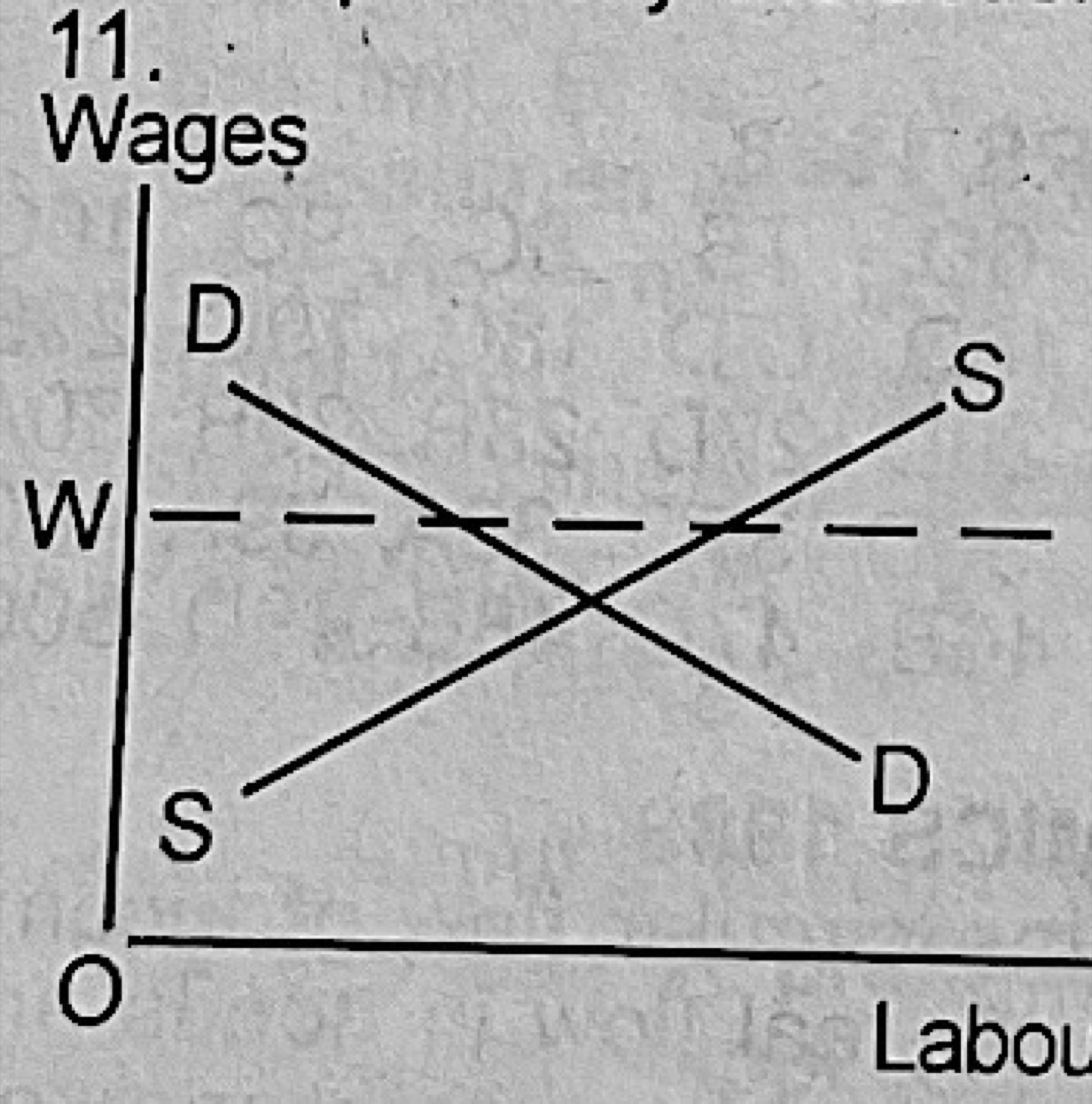
Question 11 Labour Market In the diagram above, what happens when the minimum wage is fixed at OW?
A. Unemployment is reduced B. Unemployment results C. The demand schedule will shift D. The supply schedule will become steeper. Show the answer and explanation Answer: B (Unemployment results )
Explanation OW is above the equilibrium wage, so more people want work than employers want to hire. The surplus labour is unemployment.
Open this question
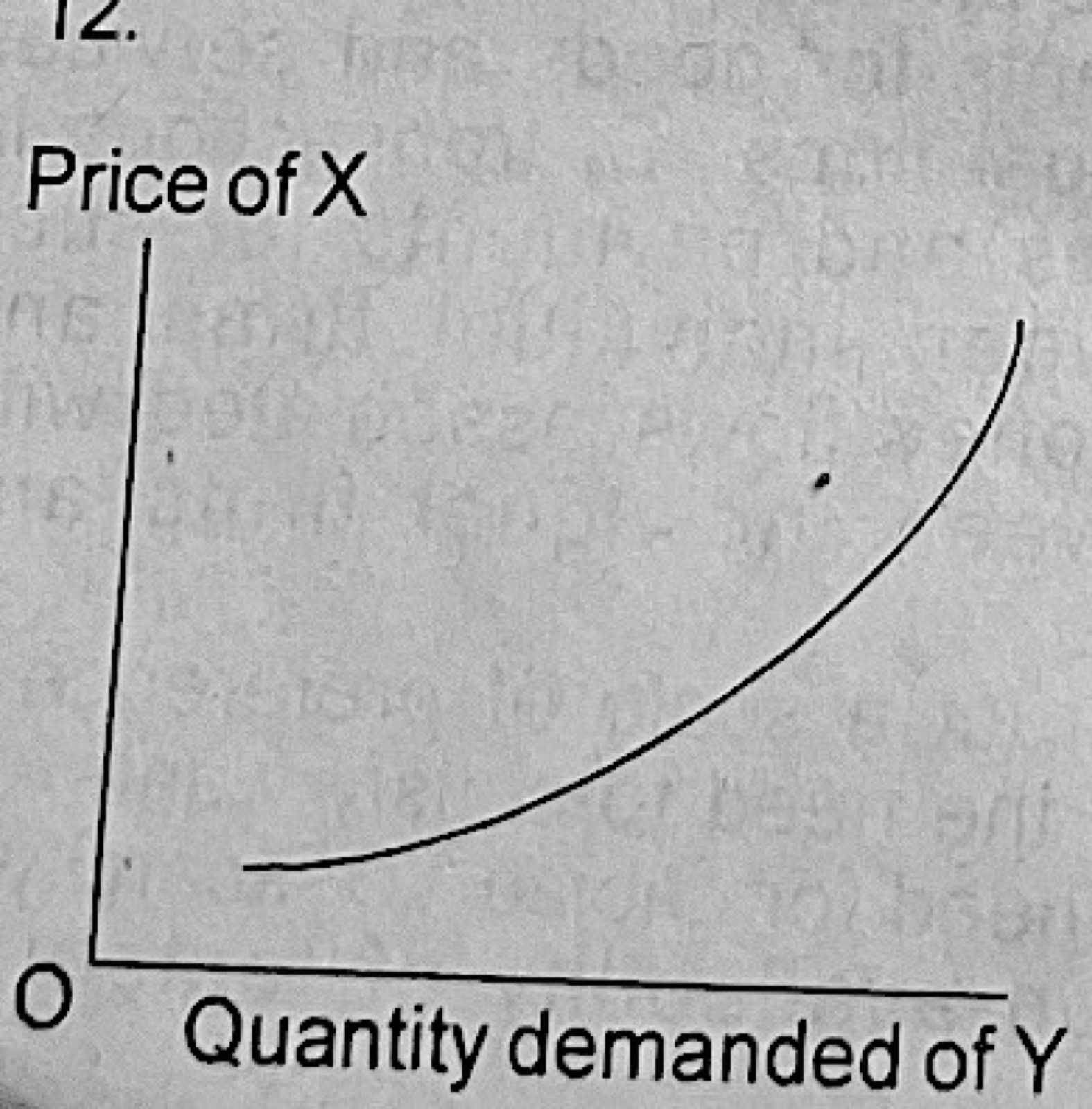
Question 12 Theory of Demand If the curve above shows the relationship between the price of commodity X and the quantity demanded of commodity Y, then X and Y are
A. complementary goods B. substitutes C. inferior goods D. luxury goods. Show the answer and explanation Answer: B (substitutes )
Explanation As the price of X rises, more Y is demanded. People are switching from X to Y, so they are substitutes.
Open this question
Question 13 Elasticity Which of the following factors is an important determinant of the magnitude of price elasticity of demand?
A. The production period B. Cost of storage C. Durability of the product D. Availability of factors of production. Show the answer and explanation Answer: C (Durability of the product )
Explanation Purchases of durable goods can be postponed when their price rises, so durability affects how strongly demand responds to price. The other options affect supply.
Open this question
Question 14 Labour Market The marginal theory of distribution makes an assertion that the price of any factor depends upon its marginal
A. utility B. productivity C. rate of substitution D. revenue. Show the answer and explanation Answer: B (productivity )
Explanation The marginal productivity theory says a factor is paid according to the value of what the last unit of it adds to output.
Open this question
Question 15 Market Structures In order to increase its profit margin, the monopolist can manipulate
A. both price and output B. either price or output C. only its price D. only its output. Show the answer and explanation Answer: B (either price or output )
Explanation A monopolist faces the market demand curve, so it can set the price or the output, but not both: once one is chosen, demand fixes the other.
Open this question
Question 16 Market Structures For a purely competitive industry, a fundamental requirement of the demand curve faced by individual firms is that it should be
A. downward sloping and price inelastic B. perfectly price elastic C. downward sloping but price inelastic D. perfectly price inelastic. Show the answer and explanation Answer: B (perfectly price elastic )
Explanation Each firm is too small to affect price, so it faces a horizontal (perfectly elastic) demand curve at the market price.
Open this question
Question 17 Industrialisation The merging of firms engaged in different stages of production and marketing is called
A. external economies of scale B. vertical integration C. horizontal integration D. economic union. Show the answer and explanation Answer: B (vertical integration )
Explanation Vertical integration joins firms at different stages of the same production chain, e.g. a manufacturer and its retailer.
Open this question
Question 18 Distributive Trade Which of the following is an important function of the retailer?
A. Grants credit to the wholesaler B. Breaks bulk and sells products in small units C. Reduces cost of distribution D. Generates demand for products through advertisement. Show the answer and explanation Answer: B (Breaks bulk and sells products in small units )
Explanation The retailer buys from the wholesaler and sells in small quantities that suit the final consumer.
Open this question
Question 19 Theory of Costs and Revenue Q(ton) | TC(₦) | TR(₦)
A. 400 B. 500 C. 600 D. 700 Show the answer and explanation Answer: B (500 )
Explanation Profit = TR − TC: 4,000 at 400; 4,500 at 500; 4,200 at 600; 3,500 at 700. The largest is at 500 tons.
Open this question
Question 20 Distributive Trade One of the purposes of advertisement in marketing is to
A. change the quality of the product B. raise the quantity of the product demanded as its price falls C. shift the demand curve for the product to the right D. raise production costs. Show the answer and explanation Answer: C (shift the demand curve for the product to the right )
Explanation Advertising aims to make more people want the product at every price, which shifts the demand curve to the right.
Open this question
Question 21 Business Organisations The size of a business unit tends to be small if the activity
A. involves mass production of goods B. requires a large capital C. requires division of labour D. involves the provision of direct services. Show the answer and explanation Answer: D (involves the provision of direct services. )
Explanation Direct personal services, such as hairdressing or tailoring, need close personal attention, so the firms stay small.
Open this question
Question 22 Business Organisations Which type of business organization has the attribute of effectively combining management with control?
A. Sole proprietorship B. Partnership C. Limited liability company D. Co-operatives. Show the answer and explanation Answer: A (Sole proprietorship )
Explanation In a sole proprietorship one person both owns (controls) and manages the business.
Open this question
Question 23 Business Organisations The co-operative as a form of business organization differs from partnership by having
A. several sources of capital for business financing B. ability to issue preferred stocks to members C. entrenched democratic control in the conduct of business D. established rules and regulations governing the activities of its members. Show the answer and explanation Answer: C (entrenched democratic control in the conduct of business )
Explanation Co-operatives are run on 'one member, one vote', however many shares a member holds; this democratic control sets them apart.
Open this question
Question 24 Business Organisations The type of business finance that entitles the holder to a fixed rate of dividend is
A. preferred stock B. common stock C. debenture D. bank loan. Show the answer and explanation Answer: A (preferred stock )
Explanation Preference shares carry a fixed rate of dividend. Debentures earn fixed interest, not dividends.
Open this question
Question 25 Business Organisations Which of the business organizations listed below is characterized by limited authority and liability of the individual owners?
A. Sole proprietorship B. Partnership C. Joint stock company D. Co-operative society. Show the answer and explanation Answer: C (Joint stock company )
Explanation In a joint stock company the shareholders' liability is limited to their shares, and individual shareholders have little say in daily management.
Open this question
Question 26 Business Organisations A company is said to be highly geared if the
A. value of fixed interest loans is high compared with share capital B. value of share capital is high compared with fixed interest loans C. dividend rate is high D. interest rate is high. Show the answer and explanation Answer: A (value of fixed interest loans is high compared with share capital )
Explanation Gearing compares borrowed (fixed-interest) capital with share capital; a highly geared company relies heavily on loans.
Open this question
Question 27 Industrialisation Industries that can be randomly located are characterized by
A. relatively low transport cost for both raw materials and output and factor mobility B. relatively heavy transport cost for raw material or output C. constant returns to scale D. significant economy of scale. Show the answer and explanation Answer: A (relatively low transport cost for both raw materials and output and factor mobility )
Explanation If transport costs are low and factors can move freely, location makes little difference, so such 'footloose' industries can be sited almost anywhere.
Open this question
Question 28 Money and Inflation The term 'double coincidence' of wants is usually associated with a
A. bilateral exchange mechanism B. monetary exchange mechanism C. stock exchange system D. barter exchange mechanism. Show the answer and explanation Answer: D (barter exchange mechanism. )
Explanation In barter each trader must want exactly what the other offers; this need for a double coincidence of wants is barter's main problem.
Open this question
Question 29 Money and Inflation A major factor affecting the value of money is the
A. price level B. banking habit C. transaction motive D. divisible nature of money. Show the answer and explanation Answer: A (price level )
Explanation The value of money is what it can buy, so it falls when the general price level rises and rises when prices fall.
Open this question
Question 30 Money and Inflation Cost-push inflation is caused by
A. growth of government expenditure B. increase in factor prices C. increase in money supply D. hoarding. Show the answer and explanation Answer: B (increase in factor prices )
Explanation Cost-push inflation starts when production costs such as wages and raw-material prices rise, and firms pass them on as higher prices.
Open this question
Question 31 Financial Institutions The stock exchange market is where
A. businessmen borrow some capital B. the federal government trades on treasury bills C. existing bonds and stocks are traded D. new stocks and shares are bought or sold. Show the answer and explanation Answer: C (existing bonds and stocks are traded )
Explanation The stock exchange is mainly a secondary market where existing shares and bonds are bought and sold.
Open this question
Question 32 Financial Institutions Commercial bank reserves at the Central Bank have the effect of
A. controlling credit and money supply B. discouraging banking operations C. advancing trade prospects D. reducing bank frauds. Show the answer and explanation Answer: A (controlling credit and money supply )
Explanation Money kept at the Central Bank cannot be lent out, so required reserves limit bank lending and the money supply.
Open this question
Question 33 Public Finance A tax is defined as regressive if
A. the proportion of income paid as tax increases as the income level increases B. all income groups pay the same percentage of their income as taxes C. the proportion of income taken by the tax falls as income increases D. the proportion of income taken by the tax is a fixed nominal amount of income for all income groups. Show the answer and explanation Answer: C (the proportion of income taken by the tax falls as income increases )
Explanation A regressive tax takes a smaller share of income as income rises, so it weighs more heavily on the poor.
Open this question
Question 34 Economic Systems Government intervention in an economy is often justified on the group that
A. wants are unlimited while resources are scarce B. productivity is higher in the public than in the private sector C. free market may not work or produce desirable results D. opportunity cost of government expenditure is zero. Show the answer and explanation Answer: C (free market may not work or produce desirable results )
Explanation Governments intervene when free markets fail, for example by not providing public goods, creating monopolies or leaving large inequalities.
Open this question
Question 35 Public Finance The three major groups of government revenue are
A. investment income, direct tax and indirect tax B. import duties, excise tax and export duties C. company tax, personal income tax and import duties D. company tax, import duties and excise tax. Show the answer and explanation Answer: A (investment income, direct tax and indirect tax )
Explanation Government revenue comes mainly from direct taxes, indirect taxes and income from its own investments and enterprises.
Open this question
Question 36 Public Finance The main objectives of public expenditure does NOT include
A. stabilization of national economy B. achievement of a more equitable income distribution C. meeting the social needs of the people D. revenue sharing and profit maximization. Show the answer and explanation Answer: D (revenue sharing and profit maximization. )
Explanation Public spending aims at stability, fairness and social welfare; profit maximization is a private-firm goal.
Open this question
Question 37 Public Finance A perfect example of a public good is
A. air B. education C. defence D. transport. Show the answer and explanation Answer: C (defence )
Explanation Defence protects everyone at once and no one can be shut out of it, so it is a pure public good.
Open this question
Question 38 Public Finance A balanced budget is defined as a condition of
A. balance of payments equilibrium B. equality of aggregate demand and aggregate supply C. equality of planned receipts and planned expenditure D. equality of planned exports and planned imports. Show the answer and explanation Answer: C (equality of planned receipts and planned expenditure )
Explanation A budget is balanced when the government's planned revenue equals its planned spending.
Open this question
Question 39 Balance of Payments and Exchange Rates ITEM | AMOUNT (Million Naira)
A. terms of payments B. balance of current accounts C. balance of trade D. terms of trade. Show the answer and explanation Answer: B (balance of current accounts )
Explanation Visible plus invisible items make up the current account: (55.54 + 30.56) − (53.32 + 28.70) = 4.08. The balance of trade would use visible items only (2.22).
Open this question
Question 40 Balance of Payments and Exchange Rates By using exchange controls, a country tries to eliminate a balance of payments deficit by
A. limiting her imports to its currency value of exports B. reducing the nation's domestic price level C. limiting her exports to its currency value of imports D. overvaluing the country's currency. Show the answer and explanation Answer: A (limiting her imports to its currency value of exports )
Explanation Exchange control rations foreign currency, so the country can only spend on imports what it earns from exports.
Open this question
Question 41 International Trade The law of comparative advantage states that a country should specialise in the production of a commodity
A. for which local demand is greatest B. in which its opportunity cost is lower than that of the trade partner C. for which foreign demand is greatest D. for which there is abundant supply of raw materials. Show the answer and explanation Answer: B (in which its opportunity cost is lower than that of the trade partner )
Explanation Comparative advantage means producing the good you can make at a lower opportunity cost than your trading partner.
Open this question
Question 42 International Trade International and inter-regional trade differ primarily because
A. comparative advantage is relevant to the former but not to the latter B. products flow across national boundaries C. there are different resource supplies among countries of the world D. of regulation from GATT. Show the answer and explanation Answer: B (products flow across national boundaries )
Explanation International trade crosses national borders, bringing different currencies, customs duties and laws; trade between regions of one country does not.
Open this question
Question 43 Population Optimum population is the population level at which
A. death rate is at a minimum B. per capita income is at a maximum C. population is at a maximum D. death rate is equal to birth rate. Show the answer and explanation Answer: B (per capita income is at a maximum )
Explanation The optimum population is the size that, with the available resources, gives the highest income per head.
Open this question
Question 44 Theory of Production The group of people engaged in banking or insurance services by occupational distributions are classified as
A. primary producers B. secondary producers C. tertiary producers D. technical producers. Show the answer and explanation Answer: C (tertiary producers )
Explanation Banking and insurance are services, so people working in them are in tertiary production.
Open this question
Question 45 National Income The difference between gross national product and net national product is equal to
A. gross investment B. net investment C. net foreign income D. capital depreciation. Show the answer and explanation Answer: D (capital depreciation. )
Explanation NNP = GNP − depreciation (capital consumption).
Open this question
Question 46 National Income The value of the total output produced within Nigeria by all residents (citizens and non-citizens) is referred to as the
A. gross national product B. disposable income C. national income D. gross domestic product. Show the answer and explanation Answer: D (gross domestic product. )
Explanation GDP is the value of everything produced inside the country, whoever produces it.
Open this question
Question 47 National Income The multiplier is defined as
A. the ratio of the change in income to the change in investment B. the change in investment divided by the change in income C. 1/(MPC) D. 1/(1 − MPS) Show the answer and explanation Answer: A (the ratio of the change in income to the change in investment )
Explanation The investment multiplier k = change in income ÷ change in investment (equal to 1/MPS, not 1/MPC).
Open this question
Question 48 National Income If C stands for consumption expenditure, I for investment, X for exports, and M for imports, then national income is
A. C + I + X + M B. C + I + X − M C. C + I − X + M D. C + I + X. Show the answer and explanation Answer: B (C + I + X − M )
Explanation National income by expenditure = consumption + investment + net exports, i.e. C + I + (X − M).
Open this question
Question 49 Economic Growth and Development A sustained increase in the per capita income of a country over a period of time is called
A. economic growth B. economic development C. structural change D. stagflation. Show the answer and explanation Answer: A (economic growth )
Explanation Economic growth is a lasting rise in a country's real output or income per head.
Open this question
Question 50 Economic Growth and Development The primary goal of development planning in Nigeria is to
A. increase profitability of enterprises B. achieve a rapid increase in the welfare and standard of living of Nigerians C. increase the level of gross domestic product D. make Nigeria a super-power. Show the answer and explanation Answer: B (achieve a rapid increase in the welfare and standard of living of Nigerians )
Explanation Development plans aim mainly to raise the welfare and living standards of the people, not just output or profits.
Open this question Sign up free for every JAMB Economics year, practice by topic and timed mocks.
Start practising free