Home › Past questions › JAMB › Economics › 1985 50 questions. Try each one, then open the answer to check yourself and read the explanation.
Sign up free to answer these questions on a CBT screen with a timer, then see your score and every answer explained.
Start practising free
Question 1 Basic Concepts One main quality of a good is that it
A. is sold in the market B. satisfies wants C. is made in the factory D. is always tangible E. is non-perishable. Show the answer and explanation Answer: B (satisfies wants )
Explanation Something is an economic good because it gives satisfaction (utility) by meeting a want.
Open this question
Question 2 National Income The interdependence between households and business enterprises illustrated in the figure above is known as
A. market interaction B. cash flow C. circular flow of income D. supply and demand for goods and services E. household preference schedule Show the answer and explanation Answer: C (circular flow of income )
Explanation Households sell labour to firms for wages and spend the wages on firms' goods, so money and goods flow round in a circle: the circular flow of income.
Open this question
Question 3 Basic Concepts Bisi needs a book costing N10.00 and a hat costing N10.00. If Bisi buys the book instead of the hat, the opportunity cost of his choice is the
A. cost of the book B. cost of the hat C. book D. hat E. N10.00. Show the answer and explanation Answer: D (hat )
Explanation Opportunity cost is the next best alternative actually given up. Bisi chose the book, so what he gave up is the hat itself.
Open this question
Question 4 Basic Concepts An economic problem exists whenever
A. there is scarcity and choice B. there are no buyers for our goods C. there are too many sellers D. many people are out of work E. all raw materials are imported. Show the answer and explanation Answer: A (there is scarcity and choice )
Explanation The basic economic problem arises because resources are scarce, so people must choose which wants to satisfy.
Open this question
Question 5 Basic Concepts The meaning of scale of preference is
A. preparing a list of goods and services to be purchased in order of priority B. showing the monthly income C. budget preparation without due regard to proper priorities D. consumers' preference for luxury goods E. consumers' preference for foreign goods. Show the answer and explanation Answer: A (preparing a list of goods and services to be purchased in order of priority )
Explanation A scale of preference is a list of wants arranged in order of importance, so the most pressing are satisfied first.
Open this question
Question 6 Population Optimum population is desirable because it enables an economy to attain maximum
A. per capita income B. per capita output C. per capita real income D. per capita revenue E. growth rate. Show the answer and explanation Answer: A (per capita income )
Explanation At the optimum population, the people combined with the available resources give the highest income per head.
Open this question
Question 7 Population The age distribution of a population is NOT influenced by
A. birth rates B. death rates C. patterns of immigration D. patterns of emigration E. school leaving age. Show the answer and explanation Answer: E (school leaving age. )
Explanation Births, deaths and migration change how many people are in each age group; the age at which pupils leave school does not.
Open this question
Question 8 Population One theory of population contends that population tends to increase much faster than the supply of food, and that if the growth in population is not checked, it will be checked by natural forces like misery disasters and food shortages. This theory was propounded by
A. Prof. Paul Samuelson B. Adam Smith C. David Ricardo D. Rev. Thomas Malthus E. Prof. Ojetunji Aboyade. Show the answer and explanation Answer: D (Rev. Thomas Malthus )
Explanation Thomas Malthus (1798) argued that population grows geometrically while food grows arithmetically, so famine, disease and war act as positive checks.
Open this question
Question 9 Theory of Consumer Behaviour Units of Quantity Consumed | Total Utility | Marginal Utility
A. diminishing marginal utility B. diminishing marginal productivity C. diminishing returns D. increasing returns E. increasing total utility. Show the answer and explanation Answer: A (diminishing marginal utility )
Explanation Each extra unit consumed adds less satisfaction than the one before (10, 5, 2, 1, 0): diminishing marginal utility.
Open this question
Question 10 Theory of Supply If in the short-run commodity X and commodity Y are supplied jointly, which of the following is correct?
A. An increase in demand for X will increase the supply of Y B. An increase in demand for X will shift the supply of Y C. An increase in demand for Y will raise the price of X D. An increase in demand for X will cause less of Y to be produced E. A probable tax on Y will cause more of X to be supplied. Show the answer and explanation Answer: A (An increase in demand for X will increase the supply of Y )
Explanation Jointly supplied goods come out of the same process (e.g. beef and hides), so producing more X to meet demand automatically produces more Y.
Open this question
Question 11 Economic Systems In market economies, resources are allocated through the
A. government authorities B. price system C. banking system D. central planning bureau E. revenue allocation formula. Show the answer and explanation Answer: B (price system )
Explanation In a market economy prices, set by demand and supply, guide what is produced and how resources are used.
Open this question
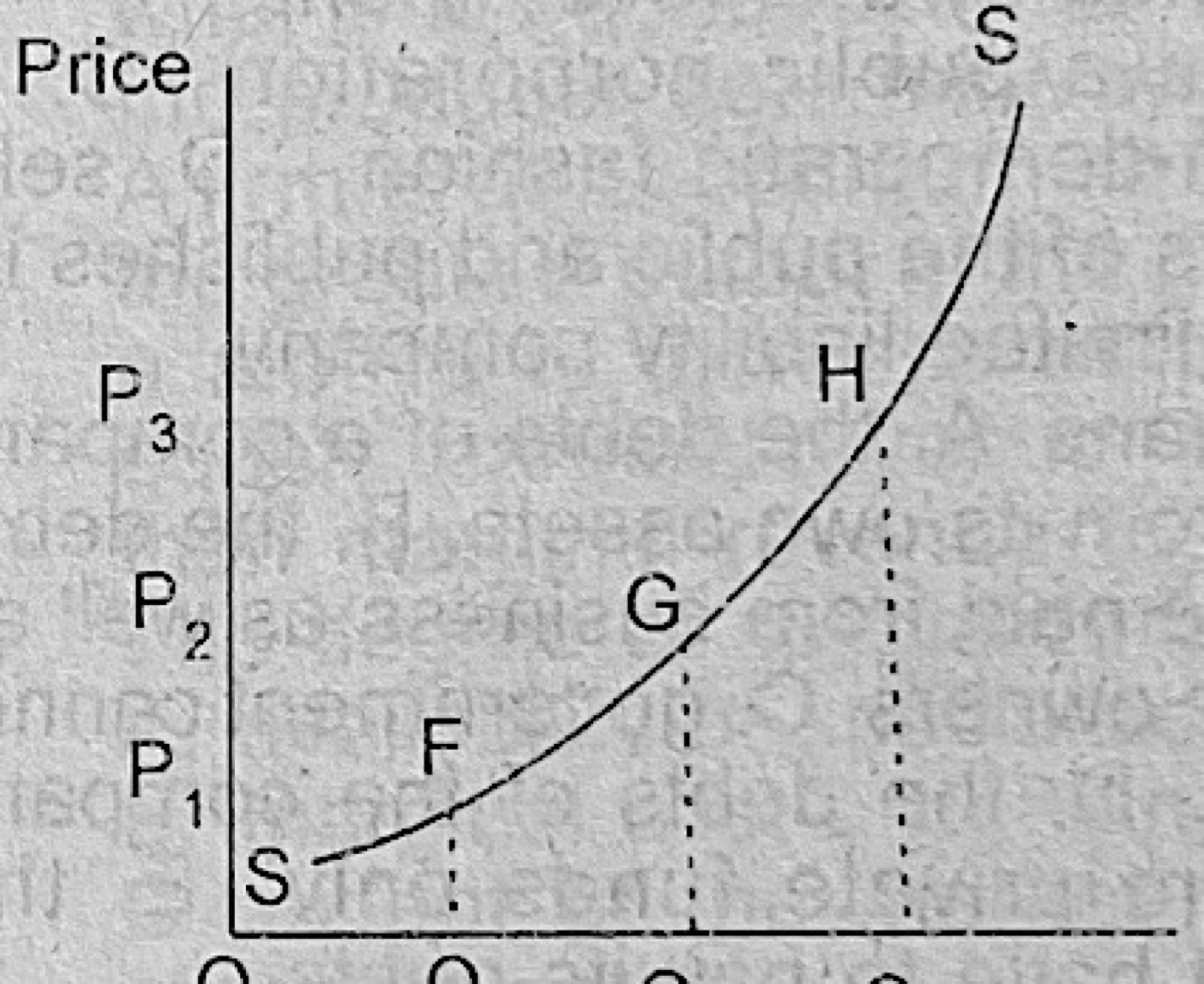
Question 12 Elasticity Study the figure below. At point H, the price elasticity of supply is
A. perfectly inelastic B. inelastic C. unit elastic D. perfectly elastic E. elastic. Show the answer and explanation Answer: B (inelastic )
Explanation For a supply curve, a tangent through the origin means unit elasticity, a tangent cutting the price axis means elastic supply and a tangent cutting the quantity axis means inelastic supply. The curve is steep at H and its tangent there meets the quantity axis, so supply at H is inelastic.
Open this question
Question 13 Theory of Consumer Behaviour At every point on an indifference curve, the
A. total utility is decreasing B. prices of all goods are constant C. consumer is satiated D. level of utility is constant E. level of utility is increasing. Show the answer and explanation Answer: D (level of utility is constant )
Explanation An indifference curve joins combinations of two goods that give the consumer the same satisfaction, so utility is constant along it.
Open this question
Question 14 Market Structures Under perfect competition, the long-run equilibrium requires
A. MR = MC B. MR = AC = AR C. MR > MC D. MR = MC = AR = AC E. AR = AC. Show the answer and explanation Answer: D (MR = MC = AR = AC )
Explanation In the long run the firm maximises profit (MR = MC) and earns only normal profit (AR = AC); since AR = MR, all four are equal.
Open this question
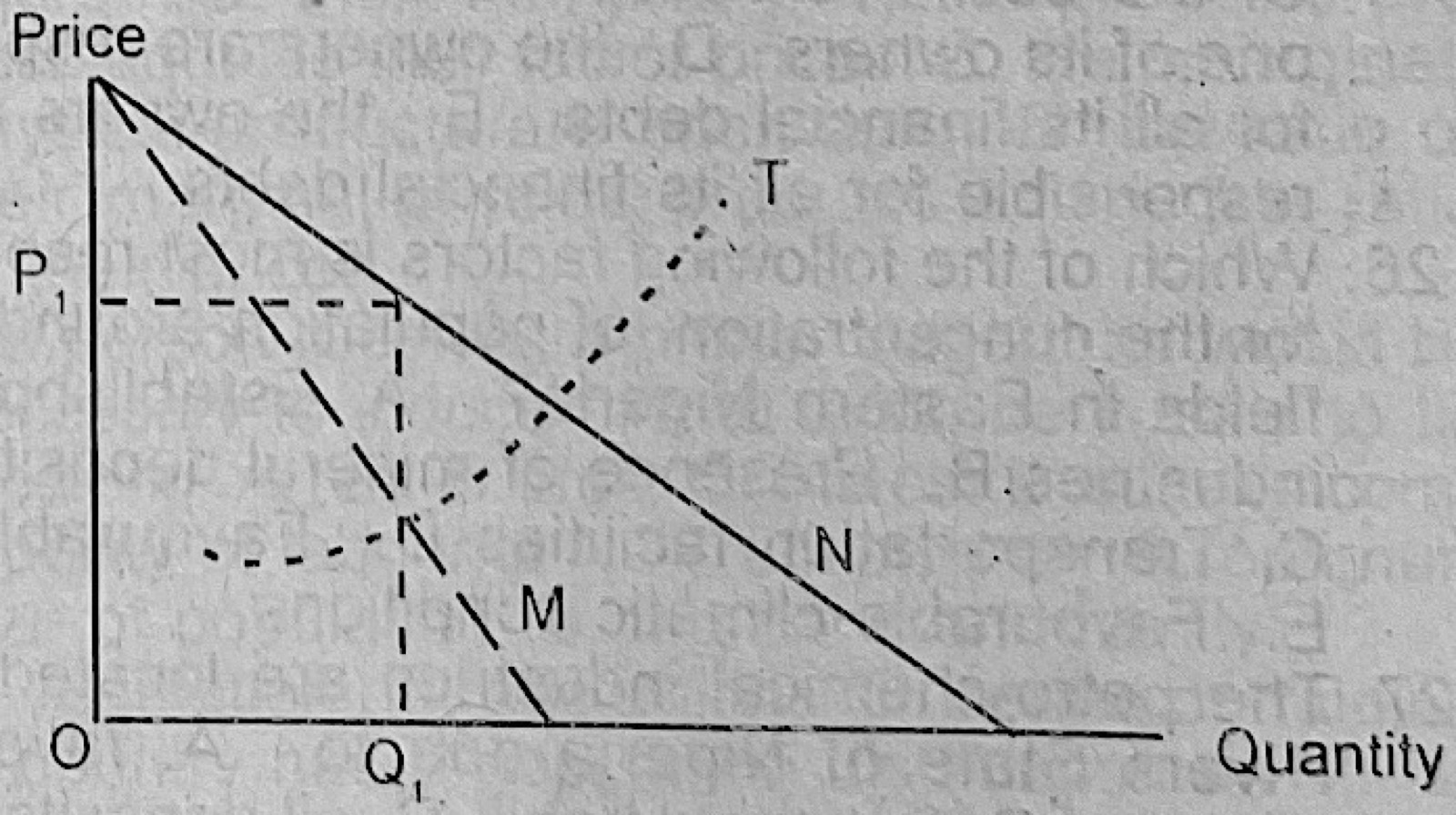
Question 15 Market Structures In the figure above, the broken line labelled M is the Marginal Revenue Curve of a
A. monopoly B. competitive firm C. state corporation D. partnership E. monopsony. Show the answer and explanation Answer: A (monopoly )
Explanation The MR line slopes down and lies below the downward-sloping demand line, which happens only when a firm faces a falling demand curve, as a monopoly does.
Open this question
Question 16 Market Structures If monopoly is attempting to maximize profit which of the following should it attempt to do?
A. Select that output at which ATC is at minimum B. Set price equal to TC C. Maximize profit per unit D. Maximize revenue E. Equate marginal cost to marginal revenue. Show the answer and explanation Answer: E (Equate marginal cost to marginal revenue. )
Explanation Any firm, monopoly included, maximises total profit by producing where marginal cost equals marginal revenue.
Open this question
Question 17 Theory of Production The amount of labour a producer hires relative to other factor inputs depends on the
A. price of labour or its wage B. price of labour, machinery and other inputs C. price of machinery D. price of the other inputs E. type of machinery. Show the answer and explanation Answer: B (price of labour, machinery and other inputs )
Explanation A producer compares the price of labour with the prices of machines and other inputs before choosing the mix of factors.
Open this question
Question 18 Economic Growth and Development Which of the following is NOT a feature of underdevelopment?
A. Low per capita income B. Vicious circle of poverty C. Low level of industrialization D. Greater dependence on primary production E. High per capita income. Show the answer and explanation Answer: E (High per capita income. )
Explanation Underdeveloped countries have low, not high, income per head.
Open this question
Question 19 Distributive Trade The inefficient distribution of scarce commodities in Nigeria is mostly due to the
A. inefficiency of the middlemen B. inefficiency in the production process C. long chain of the distribution system D. sovereignty of the consumers E. ineffectiveness of retailers Show the answer and explanation Answer: C (long chain of the distribution system )
Explanation Goods pass through many middlemen before reaching consumers; each adds cost and delay, and hoarding is easier.
Open this question
Question 20 Distributive Trade Warehousing facilities in the distribution and marketing of products are provided by
A. manufacturers B. wholesalers C. retailers D. consumers E. sellers Show the answer and explanation Answer: B (wholesalers )
Explanation Wholesalers buy in bulk and store goods in warehouses until retailers need them.
Open this question
Question 21 Financial Institutions A corporation can obtain funds by issuing bonds. A bond is a form of debt which falls due to repayment after
A. 6 months B. 9 months C. 2 years D. 5 years E. 10 or more years. Show the answer and explanation Answer: E (10 or more years. )
Explanation Bonds are long-term loans, usually repaid after ten years or more.
Open this question
Question 22 Business Organisations A firm is said to be a public Joint Stock Company when it
A. is owned by the government B. is operated as a public corporation C. is operated in a non-democratic fashion D. sells shares to members of the public and publishes its accounts E. is a limited liability company. Show the answer and explanation Answer: D (sells shares to members of the public and publishes its accounts )
Explanation A public company offers its shares to the general public (on the stock exchange) and must publish its accounts.
Open this question
Question 23 Business Organisations Limited liability means
A. the debts of a company can only be paid from its own assets B. the debts of the company are paid from business as well as private funds of the owners C. government cannot tax the company D. the debts of the company must be paid from private funds only E. the company does not have to pay its debts. Show the answer and explanation Answer: A (the debts of a company can only be paid from its own assets )
Explanation With limited liability, creditors can claim only the company's assets, not the owners' private property.
Open this question
Question 24 Money and Inflation The purchasing power of the naira will fall when
A. the naira is devalued B. government cuts all salaries and wages C. there is inflation D. the colour of the naira is changed E. workers are retrenched. Show the answer and explanation Answer: C (there is inflation )
Explanation Inflation is a general rise in prices, so each naira buys fewer goods.
Open this question
Question 25 Business Organisations When a business has unlimited liability
A. all its profits can be taxed away by the government B. all its assets are owned by the members of its board of directors C. the business ceases to exist at the death of one of its owners D. the owners are responsible for all its financial debts E. the owners are not responsible for all its financial debts. Show the answer and explanation Answer: D (the owners are responsible for all its financial debts )
Explanation Unlimited liability means the owners must pay all the business's debts, even from their private property.
Open this question
Question 26 Population Which of the following factors is most responsible for the concentration of population around the oil fields in Eastern Nigeria?
A. Establishment of industries B. Presence of mineral deposits C. Transportation facilities D. Favourable soils E. Favourable climatic conditions Show the answer and explanation Answer: B (Presence of mineral deposits )
Explanation The oil (a mineral deposit) attracts companies and jobs, and people move to the area to work.
Open this question
Question 27 Industrialisation The petro-chemical industries are located in the Rivers State of Nigeria due to
A. favourable climate B. favourable soil C. oil deposits D. palm oil products E. coal deposits. Show the answer and explanation Answer: C (oil deposits )
Explanation Petrochemicals are made from crude oil and gas, which are found in Rivers State.
Open this question
Question 28 Financial Institutions One of the functions of a commercial bank is that it is
A. responsible for monetary policy B. responsible for issuing currency notes C. the lender of last resort D. the banker of the government E. a banker of demand and time deposits of customers Show the answer and explanation Answer: E (a banker of demand and time deposits of customers )
Explanation Commercial banks accept current (demand) and savings/time deposits from customers; the other functions belong to the Central Bank.
Open this question
Question 29 Money and Inflation Because money serves as a standard for deferred payments
A. it serves as a store of value B. goods can be bought on credit with pre-determined value C. future trade becomes possible D. it serves as a unit of account E. it becomes valuable. Show the answer and explanation Answer: B (goods can be bought on credit with pre-determined value )
Explanation As a standard of deferred payment, money lets people agree today on a sum to be paid later, which makes credit buying possible.
Open this question
Question 30 Money and Inflation Which of the following is a necessary prerequisite for trade by barter?
A. Need for double coincidence of wants B. Multiple exchange rate C. Impossibility of future trade D. Impossibility of large-scale production E. Indivisibility of commodities. Show the answer and explanation Answer: A (Need for double coincidence of wants )
Explanation In barter each party must want what the other has; without this double coincidence of wants no exchange happens.
Open this question
Question 31 Public Finance A state budget is an outline of planned
A. expenditures and revenues expected within a financial year B. expenditures of ministries and parastatals within a given period C. recurrent and capital expenditures within a year D. sources of revenue derivation for a financial year E. use of different kinds of taxation in a given year. Show the answer and explanation Answer: A (expenditures and revenues expected within a financial year )
Explanation A budget sets out both the planned spending and the expected revenue of government for one financial year.
Open this question
Question 32 Public Finance Which of the following is NOT among the canons of taxation as set out by Adam Smith?
A. Equality B. Security C. Certainty D. Convenience E. Economy Show the answer and explanation Answer: B (Security )
Explanation Adam Smith's four canons are equality, certainty, convenience and economy; security is not one of them.
Open this question
Question 33 Public Finance An example of a regressive tax is
A. the personal income tax B. the graduated corporation income tax C. a general sales tax D. the inheritance tax E. the excise tax. Show the answer and explanation Answer: C (a general sales tax )
Explanation Everyone pays the same sales tax on what they buy, so it takes a bigger share of a poor person's income: it is regressive.
Open this question
Question 34 Public Finance Tax which is levied on goods manufactured, sold or used within a country is
A. sales tax B. excise tax C. direct tax D. income tax E. poll tax. Show the answer and explanation Answer: B (excise tax )
Explanation Excise duty is the tax charged on goods produced inside the country.
Open this question
Question 35 International Trade By terms of trade, we mean the
A. ratio of exports to imports B. difference between exports and imports C. difference between current account and capital account D. index of export prices to import prices expressed as a percentage E. ratio of short-term capital movements to long-term capital movements. Show the answer and explanation Answer: D (index of export prices to import prices expressed as a percentage )
Explanation Terms of trade = (index of export prices ÷ index of import prices) × 100; it compares prices, not quantities.
Open this question
Question 36 International Trade The argument of tariff protection in less developed economies is that such a measure would
A. raise the price of goods affected abroad B. make consumers pay a higher price for the domestically produced output C. protect young industries from ruinous competition from abroad D. help reduce excess capacity in domestic industries E. stifle private investment initiatives. Show the answer and explanation Answer: C (protect young industries from ruinous competition from abroad )
Explanation The infant-industry argument says tariffs shield new local industries from strong foreign rivals until they can compete.
Open this question
Question 37 Balance of Payments and Exchange Rates Devaluation of the naira as a condition for the International Monetary Fund 'loan' is considered inadvisable because
A. it would allow for more money to be spent on luxuries B. the interest rate on the loan would increase C. it would decrease the demand for Nigeria's exports D. it would worsen Nigeria's foreign exchange situation E. Nigeria's oil would sell for less in the world market. Show the answer and explanation Answer: D (it would worsen Nigeria's foreign exchange situation )
Explanation Nigeria's main export, oil, is priced in dollars and its demand does not rise when the naira falls, while imports needed by industry become dearer, so devaluation would worsen the foreign exchange position.
Open this question
Question 38 Financial Institutions Foreign exchange control in Nigeria is administered by the
A. United Bank for Africa B. Union Bank of Nigeria C. First Bank of Nigeria D. Central Bank of Nigeria E. National Bank of Nigeria. Show the answer and explanation Answer: D (Central Bank of Nigeria )
Explanation The Central Bank manages the country's foreign reserves and administers exchange control.
Open this question
Question 39 International Economic Organisations Under the ECOWAS agreement, a Nigerian can enter and stay in Ghana without a visa for a period of
A. 14 days B. 30 days C. 60 days D. 90 days E. 100 days. Show the answer and explanation Answer: D (90 days )
Explanation The ECOWAS protocol on free movement allows citizens of member states to stay in another member state for up to 90 days without a visa.
Open this question
Question 40 Economic Growth and Development How many National Development Plans did Nigeria have between 1960 and 1984?
A. One B. Two C. Four D. Five E. Six Show the answer and explanation Answer: C (Four )
Explanation Nigeria had four plans in that period: 1962–68, 1970–74, 1975–80 and 1981–85.
Open this question
Question 41 Economic Growth and Development If an economy grows at an annual rate of 6%, of which 4% is deemed to be due to improvement in the productivity of labour and capital combined, the remaining 2% is generally attributed to
A. technical progress B. size of the population C. amount of natural resources D. the environment E. the quality of human resources Show the answer and explanation Answer: A (technical progress )
Explanation Growth not explained by labour and capital (the 'residual') is credited to technical progress.
Open this question
Question 42 Industrialisation The process by which a country attempts to reduce the import of manufactured goods by encouraging firms to produce these goods at home is described as
A. export-promotion B. import-substitution C. industrialization D. export-diversification E. import-creation. Show the answer and explanation Answer: B (import-substitution )
Explanation Import substitution means producing at home the manufactured goods that used to be imported.
Open this question
Question 43 Public Finance Under normal circumstances a producer will bear the entire burden of taxation on his output if the
A. demand for his product is completely elastic B. supply of his goods is more elastic than the demand C. demand for his product is more elastic than the supply D. production of his commodities is subject to diminishing returns E. production of his commodities is subject to increasing returns to scale. Show the answer and explanation Answer: A (demand for his product is completely elastic )
Explanation With perfectly elastic demand any price rise loses all buyers, so the producer cannot pass any of the tax on and bears all of it.
Open this question
Question 44 Theory of Costs and Revenue Which of the following is NOT a part of the fixed costs of a limited liability company?
A. Interest on loans B. Rent on buildings C. Depreciation reserves D. Management expenditure E. Wages. Show the answer and explanation Answer: E (Wages. )
Explanation Wages of production workers change with output, so they are a variable cost; the others are paid whatever the output.
Open this question
Question 45 Theory of Production The act of combining factor inputs in order to obtain specific output is known as
A. factor procurement B. manufacturing C. investment D. industrialization E. production. Show the answer and explanation Answer: E (production. )
Explanation Production is the combining of factors of production to create goods and services.
Open this question
Question 46 Labour Market Disguised unemployment
A. exists when manpower is not being utilized efficiently B. calls for the implementation of five-year plans C. can be eliminated if the press is free D. can be eliminated if the capital output ratio is increased E. is a statistical artifact with no economic meaning. Show the answer and explanation Answer: A (exists when manpower is not being utilized efficiently )
Explanation In disguised unemployment more people work at a job than are needed, so some add nothing to output: labour is not used efficiently.
Open this question
Question 47 Theory of Costs and Revenue Output | Total Cost (N)
A. N16.00 B. N20.00 C. N36.00 D. N40.00 E. N48.00 Show the answer and explanation Answer: C (N36.00 )
Explanation MC of the 2nd unit = TC(2) − TC(1) = 56 − 20 = N36.
Open this question
Question 48 Theory of Production The table below illustrates the law of diminishing returns on a farm.
A. X = 20, Y = 6 B. X = 38, Y = 9 C. X = 46, Y = 9 D. X = 46, Y = 14 E. X = 10, Y = 10. Show the answer and explanation Answer: C (X = 46, Y = 9 )
Explanation X = 25 + 21 = 46 (also 60 − 14 = 46). Y = 82 − 73 = 9.
Open this question
Question 49 Labour Market The unemployment associated with a recession is called
A. voluntary B. frictional C. cyclical D. structural E. disguise Show the answer and explanation Answer: C (cyclical )
Explanation Unemployment caused by a fall in total demand during the downswing (recession) of the trade cycle is cyclical unemployment.
Open this question
Question 50 Theory of Costs and Revenue When total revenue is at a maximum, marginal revenue is
A. constant B. negative C. zero D. positive E. maximum. Show the answer and explanation Answer: C (zero )
Explanation TR rises while MR is positive and falls once MR is negative, so at its peak MR is zero.
Open this question Sign up free for every JAMB Economics year, practice by topic and timed mocks.
Start practising free