Home › Past questions › JAMB › Chemistry › 2014 46 questions. Try each one, then open the answer to check yourself and read the explanation.
Sign up free to answer these questions on a CBT screen with a timer, then see your score and every answer explained.
Start practising free
Question 2 Separation of Mixtures A mixture is different from a compound because
A. the properties of a compound are those of its individual constituents while those of a mixture differ from its constituents B. a mixture is always homogeneous while a compound is not C. the constituents of a compound are chemically bound together while those of a mixture are not D. a mixture can be represented by a chemical formula while a compound cannot Show the answer and explanation Answer: C (the constituents of a compound are chemically bound together while those of a mixture are not )
Explanation In a compound the elements are chemically combined; in a mixture the parts are only mixed physically and can be separated by physical means.
Open this question
Question 3 Mole Concept and Stoichiometry What is the percentage of sulphur in sulphur(IV) oxide? [S = 32, O = 16]
A. 66% B. 25% C. 40% D. 50% Show the answer and explanation Answer: D (50% )
Explanation SO2 has molar mass 32 + 32 = 64 g. % S = 32/64 × 100 = 50%.
Open this question
Question 4 Gas Laws A gas X diffuses twice as fast as gas Y. If the relative molecular mass of X is 32, calculate the relative molecular mass of Y.
A. 128 B. 8 C. 16 D. 64 Show the answer and explanation Answer: A (128 )
Explanation Graham's law: rate X/rate Y = √(MY /MX ). So 2 = √(MY /32), giving MY = 4 × 32 = 128.
Open this question
Question 5 Gas Laws 200 cm3 of a gas at 25 °C exerts a pressure of 700 mmHg. Calculate its pressure if its volume increases to 350 cm3 at 75 °C.
A. 342.53 mmHg B. 1430.54 mmHg C. 467.11 mmHg D. 400.00 mmHg Show the answer and explanation Answer: C (467.11 mmHg )
Explanation P1 V1 /T1 = P2 V2 /T2 : P2 = (700 × 200 × 348)/(298 × 350) = 467.11 mmHg (temperatures in kelvin).
Open this question
Question 6 Periodic Table An element X has electron configuration 1s2 2s2 2p6 3s2 3p5 . Which of the following statements is correct about the element?
A. It has a completely filled p-orbital. B. It has 5 electrons in its outermost shell. C. It belongs to group II on the periodic table. D. It is a halogen. Show the answer and explanation Answer: D (It is a halogen. )
Explanation X has 7 outer electrons (3s2 3p5 ), so it is in group VII: it is chlorine, a halogen.
Open this question
Question 7 Periodic Table Beryllium and aluminium have similar properties because they
A. are both metals. B. belong to the same group. C. belong to the same period. D. are positioned diagonally to each other. Show the answer and explanation Answer: D (are positioned diagonally to each other. )
Explanation Beryllium (group II, period 2) and aluminium (group III, period 3) sit diagonally across the periodic table, and diagonal neighbours have similar charge density and so similar properties.
Open this question
Question 8 Chemical Bonding If the difference in electronegativity of elements P and Q is 3.0, the bond that will be formed between them is
A. metallic. B. covalent. C. co-ordinate. D. ionic. Show the answer and explanation Answer: D (ionic. )
Explanation A large electronegativity difference (above about 1.7) means one atom takes electrons from the other, so the bond is ionic.
Open this question
Question 9 Atomic Structure How many protons, neutrons and electrons respectively are present in the element 60 27 Co?
A. 27, 33 and 33. B. 33, 27 and 27. C. 27, 33 and 27. D. 60, 33 and 60. Show the answer and explanation Answer: C (27, 33 and 27. )
Explanation Protons = atomic number = 27; neutrons = 60 − 27 = 33; a neutral atom has as many electrons as protons, 27.
Open this question
Question 10 Chemical Bonding The radioactive radiation used in studying the arrangement of particles in giant organic molecules is
A. γ-rays. B. α-particles. C. X-rays. D. β-particles. Show the answer and explanation Answer: C (X-rays. )
Explanation X-ray diffraction (crystallography) is used to work out how the atoms are arranged in large molecules and crystals.
Open this question
Question 11 Atomic Structure A silicon-containing ore has 92% 28 Si, 5% 29 Si and 3% 30 Si. Calculate the relative atomic mass of the silicon.
A. 14.00 B. 29.00 C. 28.11 D. 28.00 Show the answer and explanation Answer: C (28.11 )
Explanation Relative atomic mass = (92 × 28 + 5 × 29 + 3 × 30)/100 = (2576 + 145 + 90)/100 = 28.11.
Open this question
Question 12 Air The nitrogen obtained from air has a density higher than the one from nitrogen-containing compounds because the one from air is contaminated with
A. water vapour. B. oxygen. C. rare gases. D. carbon(IV) oxide. Show the answer and explanation Answer: C (rare gases. )
Explanation Nitrogen from air still contains the rare gases (mainly argon), which are denser than nitrogen, so it is slightly denser than pure nitrogen.
Open this question
Question 13 Water Water is said to be temporarily hard when it contains
A. Ca(HCO3 )2 and Mg(HCO3 )2 salts. B. Ca(HCO3 )2 and CaCO3 salts. C. Mg(HCO3 )2 and CaSO4 salts. D. CaSO4 and Ca(HCO3 )2 salts. Show the answer and explanation Answer: A (Ca(HCO3 )2 and Mg(HCO3 )2 salts. )
Explanation Temporary hardness is caused by dissolved calcium and magnesium hydrogentrioxocarbonates(IV), which boiling removes.
Open this question
Question 14 Water On exposure to the atmosphere, a hydrated salt loses its water of crystallization to become anhydrous. This phenomenon is referred to as
A. efflorescence. B. deliquescence. C. hygroscopy. D. hydrolysis. Show the answer and explanation Answer: A (efflorescence. )
Explanation Efflorescent salts (e.g. washing soda) give up their water of crystallization to the air.
Open this question
Question 15 Solubility and Solutions 16.55 g of lead(II) trioxonitrate(V) was dissolved in 100 g of distilled water at 20 °C, calculate the solubility of the solute in mol dm-3 . [Pb = 207, N = 14, O = 16]
A. 0.05 g B. 2.00 g C. 1.00 g D. 0.50 g Show the answer and explanation Answer: D (0.50 g )
Explanation Molar mass of Pb(NO3 )2 = 207 + 2(14 + 48) = 331 g, so 16.55 g = 0.05 mol in 100 g of water. In 1000 g (about 1 dm3 ) that is 0.50 mol dm-3 .
Open this question
Question 16 Solubility and Solutions The dispersion of a liquid in a liquid medium will give
A. an emulsion. B. a fog. C. a gel. D. an aerosol. Show the answer and explanation Answer: A (an emulsion. )
Explanation An emulsion, such as milk, is one liquid spread as tiny drops through another liquid.
Open this question
Question 19 Acids, Bases and Salts The colour of litmus in a neutral medium is
A. purple B. pink C. yellow D. orange Show the answer and explanation Answer: A (purple )
Explanation Litmus is red in acid and blue in alkali; in a neutral solution it shows the in-between colour, purple.
Open this question
Question 20 Acids, Bases and Salts The mathematical expression of pH is
A. log10 [OH− ] B. log10 1/[H3 O+ ] C. log10 [H3 O+ ] D. log10 1/[OH− ] Show the answer and explanation Answer: B (log10 1/[H3 O+ ] )
Explanation pH = −log10 [H3 O+ ], which is the same as log10 (1/[H3 O+ ]).
Open this question
Question 21 Acids, Bases and Salts Which of the following salts will turn blue litmus red?
A. Sodium tetrahydroxozincate(II). B. Potassium hydrogentetraoxosulphate(VI). C. Sodium trioxocarbonate(IV). D. Zinc chloride hydroxide. Show the answer and explanation Answer: B (Potassium hydrogentetraoxosulphate(VI). )
Explanation KHSO4 is an acid salt: its HSO4 − ion releases H+ in water, so the solution is acidic and turns blue litmus red.
Open this question
Question 22 Redox Reactions Zn(s) + CuSO4(aq) → ZnSO4(aq) + Cu(s)
A. 0 to +4. B. 0 to +2. C. +1 to +2. D. +1 to +3. Show the answer and explanation Answer: B (0 to +2. )
Explanation Zinc is the reducing agent: it goes from the element (0) to Zn2+ in ZnSO4 (+2).
Open this question
Question 23 Redox Reactions H2 O(g) + C(s) → H2(g) + CO(g)
A. CO(g) B. C(s) C. H2 O(g) D. H2(g) Show the answer and explanation Answer: C (H2 O(g) )
Explanation Steam gives its oxygen to carbon (hydrogen goes from +1 to 0), so water is reduced and is the oxidizing agent.
Open this question
Question 24 Electrolysis Calculate the quantity of electricity in coulombs required to liberate 10 g of copper from a copper compound. [Cu = 64, F = 96500 C mol-1 ]
A. 32395.5 B. 30156.3 C. 60784.5 D. 15196.5 Show the answer and explanation Answer: B (30156.3 )
Explanation Cu2+ + 2e− → Cu: 64 g needs 2 × 96500 C, so 10 g needs (10 × 2 × 96500)/64 = 30156.3 C.
Open this question
Question 25 Electrolysis How many faraday of electricity is required to produce 0.25 mole of copper?
A. 1.00 F B. 0.01 F C. 0.05 F D. 0.50 F Show the answer and explanation Answer: D (0.50 F )
Explanation Each mole of Cu2+ needs 2 F, so 0.25 mol needs 0.25 × 2 = 0.50 F.
Open this question
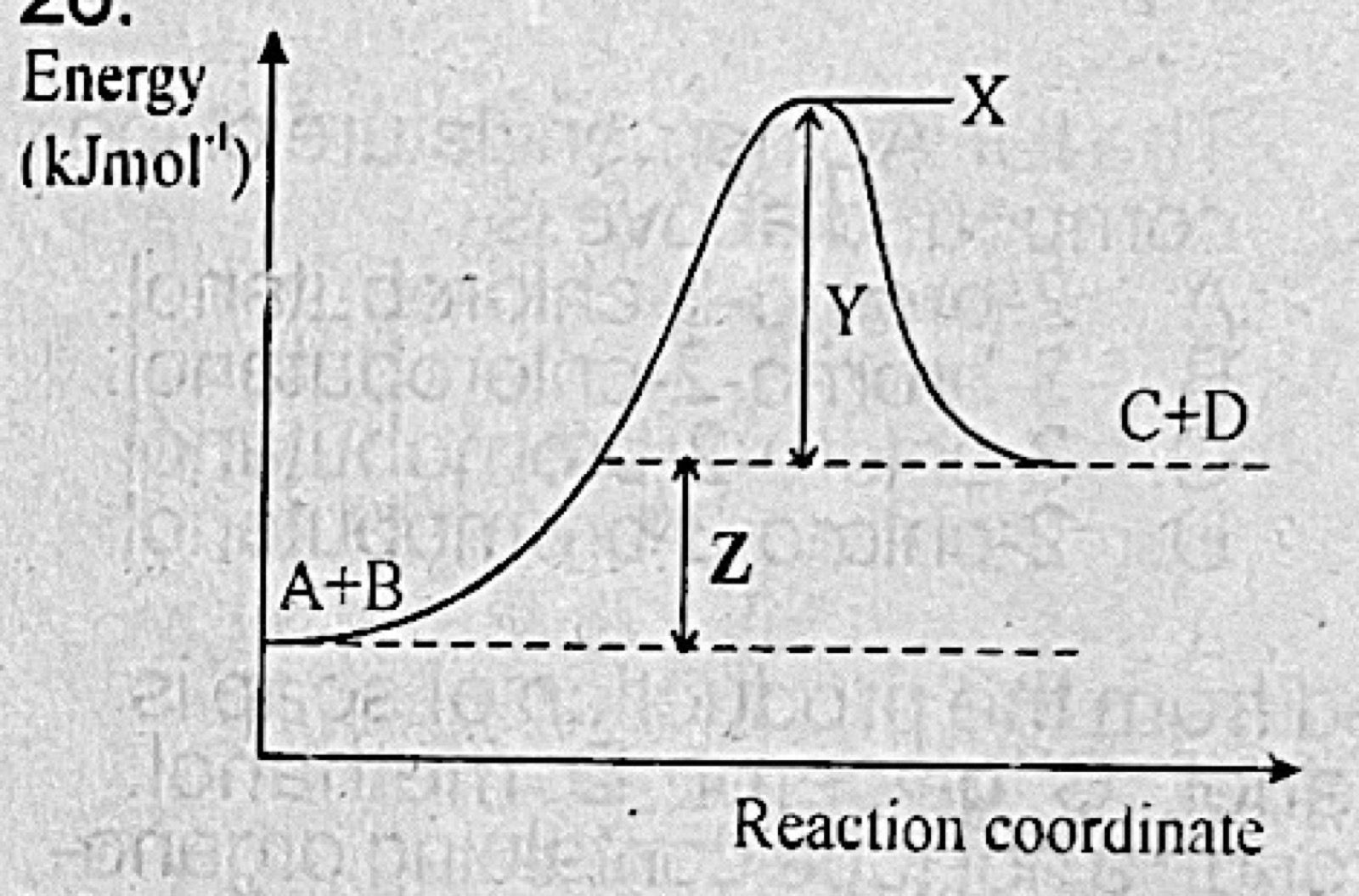
Question 26 Energy Changes Z in the diagram above represents
A. heat of reaction. B. activation energy. C. free energy. D. entropy of reaction. Show the answer and explanation Answer: A (heat of reaction. )
Explanation Z is the energy gap between the reactants (A + B) and the products (C + D), which is the heat of reaction ΔH.
Open this question
Question 27 Energy Changes If the change in free energy of a system is −899 J mol-1 and the entropy change is 10 J mol-1 K-1 at 25 °C, calculate the enthalpy change.
A. +2081 J mol-1 B. −2081 J mol-1 C. −649 J mol-1 D. +649 J mol-1 Show the answer and explanation Answer: A (+2081 J mol-1 )
Explanation ΔG = ΔH − TΔS, so ΔH = ΔG + TΔS = −899 + 298 × 10 = +2081 J mol-1 .
Open this question
Question 28 Chemical Equilibrium In an equilibrium reaction, which of the following conditions indicates that maximum yield of the product will be obtained?
A. Equilibrium constant is very large. B. ΔH − TΔS = 0. C. ΔH > TΔS. D. Equilibrium constant is less than zero. Show the answer and explanation Answer: A (Equilibrium constant is very large. )
Explanation A very large equilibrium constant means the equilibrium mixture is mostly products.
Open this question
Question 29 Rates of Reaction In a chemical reaction, the change in concentration of a reactant with time is
A. entropy of reaction. B. enthalpy of reaction. C. rate of reaction. D. order of reaction. Show the answer and explanation Answer: C (rate of reaction. )
Explanation Rate of reaction is defined as how fast the concentration of a reactant (or product) changes with time.
Open this question
Question 30 Chemical Equilibrium Cr2 O7 2− (aq) + H2 O(l) ⇌ 2CrO4 2− (aq) + 2H+ (aq)
A. More of the products will be formed. B. The reaction will not proceed. C. The equilibrium position will shift to the right. D. The equilibrium position will shift to the left. Show the answer and explanation Answer: D (The equilibrium position will shift to the left. )
Explanation H+ is a product; adding more of it makes the equilibrium shift to the left to use it up (Le Chatelier's principle).
Open this question
Question 31 Metals and their Compounds Which of the following will liberate hydrogen from dilute tetraoxosulphate(VI) acid?
A. Lead. B. Magnesium. C. Copper. D. Gold. Show the answer and explanation Answer: B (Magnesium. )
Explanation Magnesium is above hydrogen in the activity series and reacts readily with dilute acid; copper and gold do not, and lead is stopped by insoluble PbSO4 .
Open this question
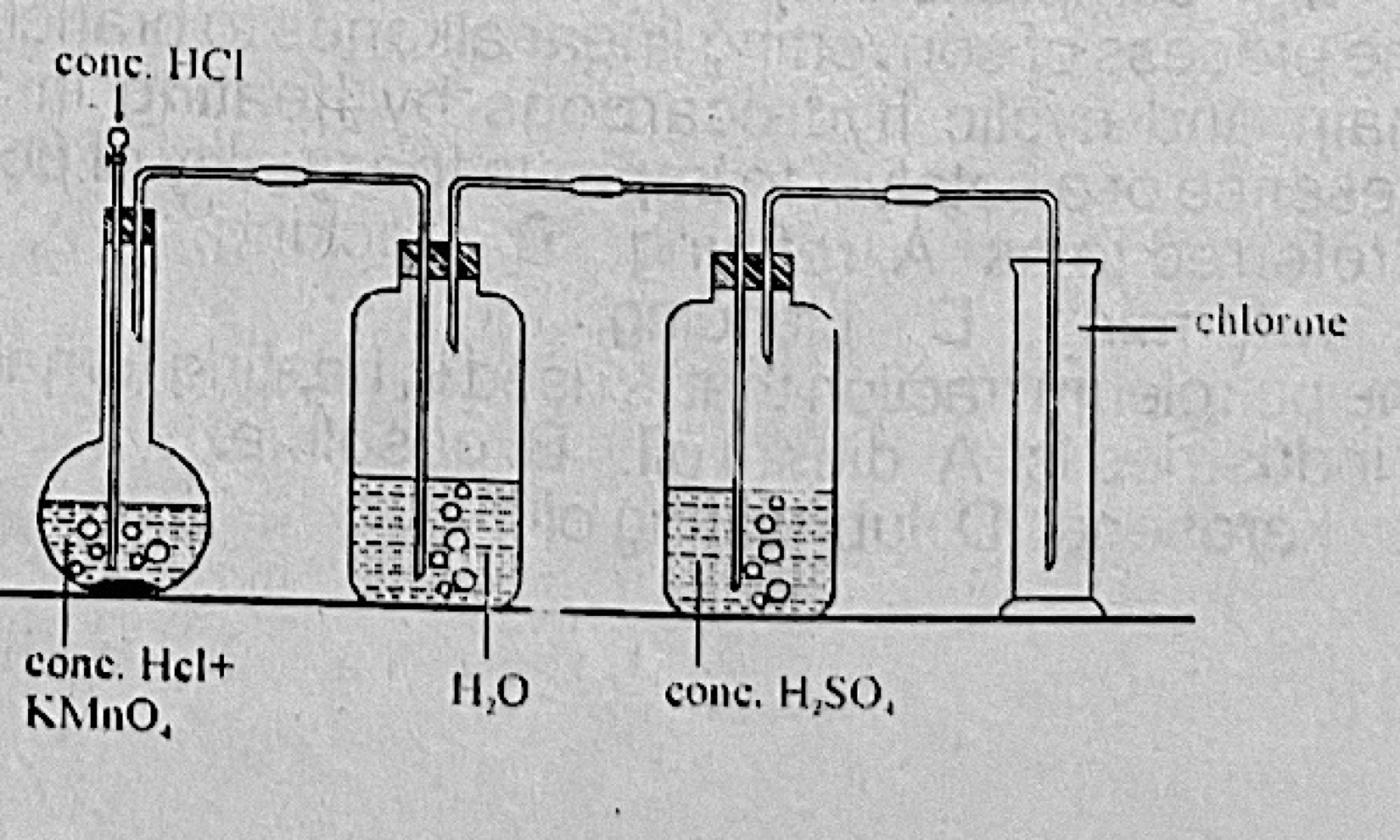
Question 32 Halogens Use the diagram (preparation of chlorine) to answer this question.2 SO4 is to
A. purify the gas. B. dry the gas. C. liquefy the gas. D. remove odour. Show the answer and explanation Answer: B (dry the gas. )
Explanation Concentrated tetraoxosulphate(VI) acid absorbs water, so the last bottle dries the chlorine.
Open this question
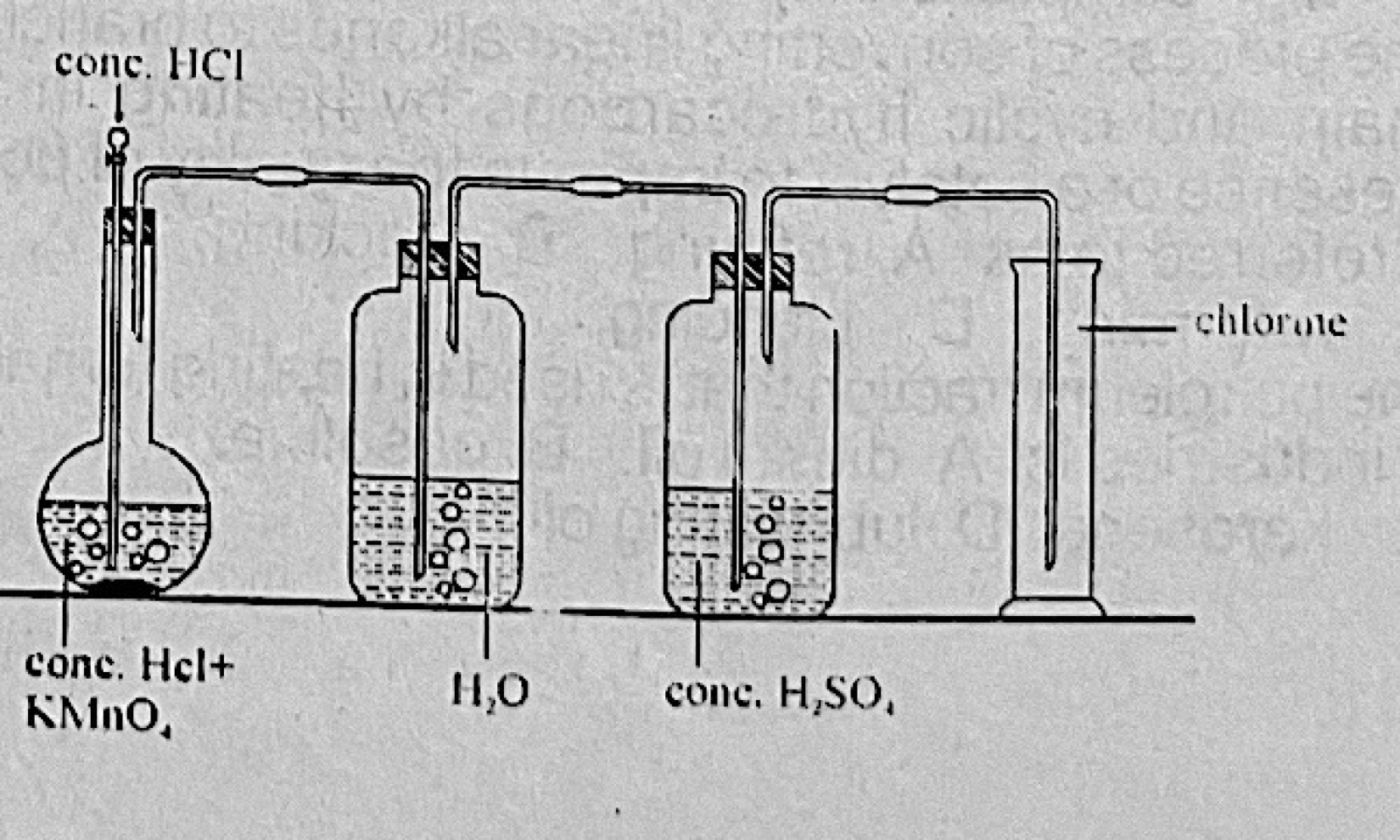
Question 33 Halogens Use the diagram (preparation of chlorine) to answer this question.
A. O2 . B. SO2 . C. HCl. D. H2 . Show the answer and explanation Answer: C (HCl. )
Explanation Hydrogen chloride fumes from the concentrated acid are very soluble in water, so the water bottle removes them from the chlorine.
Open this question
Question 34 Halogens Fluorine does not occur in the free state in nature because
A. it is a poisonous gas. B. it belongs to the halogen family. C. it is inert. D. of its high reactivity. Show the answer and explanation Answer: D (of its high reactivity. )
Explanation Fluorine is the most reactive non-metal, so it is always found combined with other elements.
Open this question
Question 35 Metals and their Compounds In the extraction of sodium from fused sodium chloride, the anode is made of platinum because
A. sodium is formed at the anode. B. chlorine is formed at the anode. C. sodium does not react with platinum. D. chlorine does not react with platinum. Show the answer and explanation Answer: D (chlorine does not react with platinum. )
Explanation Chlorine is released at the anode and attacks most metals, so the anode is made of an inert material that chlorine does not react with.
Open this question
Question 36 Qualitative Analysis A compound that gives a brick-red colour to a non-luminous flame is likely to contain
A. copper ions. B. sodium ions. C. calcium ions. D. aluminium ions. Show the answer and explanation Answer: C (calcium ions. )
Explanation Calcium ions give a brick-red flame; sodium gives yellow and copper gives green-blue.
Open this question
Question 37 Metals and their Compounds In the electrolytic extraction of calcium from calcium chloride, the cathode is
A. zinc. B. graphite. C. platinum. D. iron. Show the answer and explanation Answer: D (iron. )
Explanation In the industrial cell the anode is graphite and the cathode, where calcium collects, is iron.
Open this question
Question 38 Qualitative Analysis A few drops of NaOH solution was added to an unknown salt forming a white precipitate which is insoluble in excess solution. The cation likely present is
A. Zn2+ . B. Pb2+ . C. Ca2+ . D. Al3+ . Show the answer and explanation Answer: C (Ca2+ . )
Explanation Zn2+ , Pb2+ and Al3+ hydroxides are amphoteric and dissolve in excess NaOH; Ca(OH)2 stays as a white precipitate.
Open this question
Question 39 Introduction to Organic Chemistry The general formula of haloalkanes where X represents the halide is
A. Cn H2n−1 X. B. Cn H2n X. C. Cn H2n+2 X. D. Cn H2n+1 X. Show the answer and explanation Answer: D (Cn H2n+1 X. )
Explanation A haloalkane is an alkane (Cn H2n+2 ) with one H replaced by a halogen: Cn H2n+1 X.
Open this question
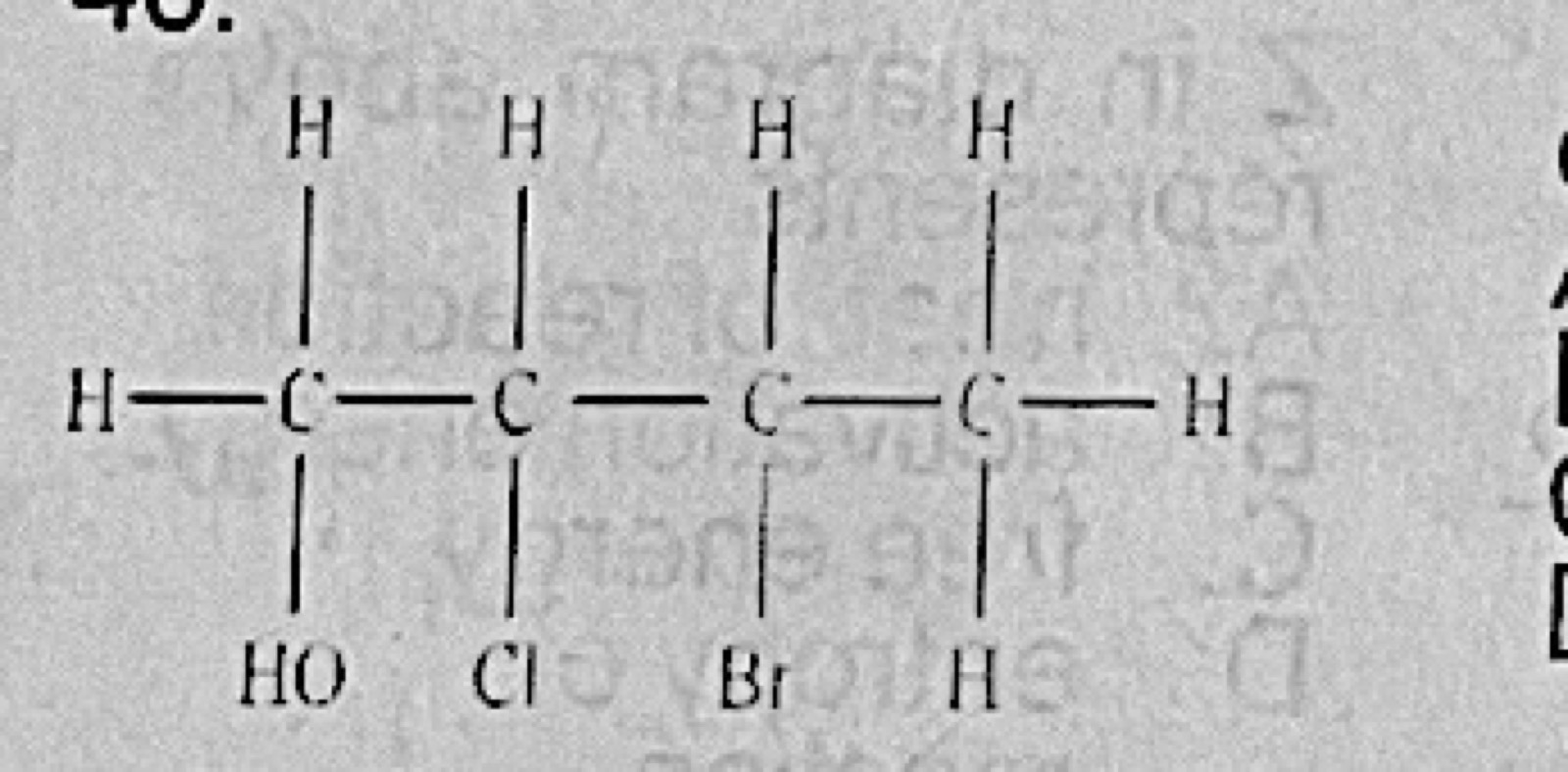
Question 40 Introduction to Organic Chemistry The IUPAC nomenclature of the compound above is
A. 2-bromo-3-chlorobutanol. B. 3-bromo-2-chlorobutanol. C. 3-chloro-2-bromobutanol. D. 2-chloro-3-bromobutanol. Show the answer and explanation Answer: B (3-bromo-2-chlorobutanol. )
Explanation Number from the carbon with –OH (C1): Cl is on C2 and Br on C3. Prefixes go in alphabetical order, so the name is 3-bromo-2-chlorobutanol.
Open this question
Question 42 Hydrocarbons Ethyne is passed through a hot tube containing organo-nickel catalyst to produce
A. isoprene. B. polythene. C. ethanol. D. benzene. Show the answer and explanation Answer: D (benzene. )
Explanation Three ethyne molecules join into a ring (polymerise) over the hot catalyst to form benzene, C6 H6 .
Open this question
Question 43 Hydrocarbons Due to the unstable nature of ethyne, it is stored by dissolving in
A. ethane-1,2-diol. B. propanol. C. ethanoic acid. D. propanone. Show the answer and explanation Answer: D (propanone. )
Explanation Ethyne can explode under pressure, so cylinders hold it dissolved in propanone (acetone).
Open this question
Question 44 Carbohydrates, Proteins and Amines The process of converting starch to ethanol is
A. cracking. B. distillation. C. fermentation. D. oxidation. Show the answer and explanation Answer: C (fermentation. )
Explanation Yeast enzymes break starch down to sugars and then to ethanol and carbon(IV) oxide: fermentation.
Open this question
Question 45 Polymers The polymer used in making car rear lights is
A. perspex. B. bakelite. C. polystyrene. D. polyacrylonitrile. Show the answer and explanation Answer: A (perspex. )
Explanation Perspex is a clear, tough plastic that can be coloured, so it is used for car light covers.
Open this question
Question 46 Alkanoic Acids and Esters CH3 COOC2 H5(l) + H2 O(l) ⇌ CH3 COOH(aq) + C2 H5 OH(aq) + in the reaction above is to
A. increase the yield of products. B. maintain the solution at a constant pH. C. increase the rate of hydrolysis. D. decrease the rate of the reverse reaction. Show the answer and explanation Answer: C (increase the rate of hydrolysis. )
Explanation The acid acts as a catalyst: it speeds up the hydrolysis of the ester but does not shift the equilibrium.
Open this question
Question 47 Introduction to Organic Chemistry A hydrocarbon has an empirical formula CH and a vapour density of 39. Determine its molecular formula. [C = 12, H = 1]
A. C2 H6 B. C3 H8 C. C3 H4 D. C6 H6 Show the answer and explanation Answer: D (C6 H6 )
Explanation Molar mass = 2 × 39 = 78. (CH)n : 13n = 78, so n = 6 and the formula is C6 H6 .
Open this question
Question 48 Polymers Polystyrene is widely used as packaging materials for fragile objects during transportation because of its
A. lightness. B. low density. C. high density. D. high compressibility. Show the answer and explanation Answer: B (low density. )
Explanation Expanded polystyrene is mostly trapped air, so its very low density makes it a light, cushioning packing material.
Open this question
Question 49 Petroleum and Coal The process of converting linear alkanes to branched chain and cyclic hydrocarbons by heating in the presence of a catalyst to improve the quality of petrol is referred to as
A. refining. B. cracking. C. reforming. D. blending. Show the answer and explanation Answer: C (reforming. )
Explanation Reforming rearranges straight-chain alkanes into branched and ring compounds, which raises the octane rating of petrol.
Open this question
Question 50 Petroleum and Coal The petroleum fraction that is used in heating furnaces in industries is
A. diesel oil. B. gasoline. C. kerosene. D. lubricating oil. Show the answer and explanation Answer: A (diesel oil. )
Explanation Diesel (gas) oil and heavier fuel oils are burnt in industrial furnaces and boilers.
Open this question Sign up free for every JAMB Chemistry year, practice by topic and timed mocks.
Start practising free