JAMB Chemistry 2003 past questions and answers

48 questions. Try each one, then open the answer to check yourself and read the explanation.

Question 1

Mole Concept and Stoichiometry

What volume of oxygen is produced from the decomposition of 2 moles of KClO3 at s.t.p? [Molar volume of a gas at s.t.p = 22.4 dm3]

  1. A.22.4 dm3
  2. B.33.6 dm3
  3. C.44.8 dm3
  4. D.67.2 dm3
Show the answer and explanation

Answer: D (67.2 dm3)

Explanation

2KClO3 → 2KCl + 3O2, so 2 moles of KClO3 give 3 moles of O2. 3 × 22.4 = 67.2 dm3.

Open this question

Question 2

Separation of Mixtures

Which of the following is a physical change?

  1. A.Burning kerosine
  2. B.Freezing ice-cream
  3. C.Exposing white phosphorus to air
  4. D.Dissolving calcium in water
Show the answer and explanation

Answer: B (Freezing ice-cream)

Explanation

Freezing only changes the state of the ice-cream; no new substance forms. Burning, phosphorus reacting with air and calcium reacting with water all make new substances.

Open this question

Question 3

Mole Concept and Stoichiometry

What is the percentage by mass of oxygen in Al2(SO4)3.2H2O? [Al = 27, S = 32, H = 1, O = 16]

  1. A.14.29%
  2. B.25.39%
  3. C.50.79%
  4. D.59.25%
Show the answer and explanation

Answer: D (59.25%)

Explanation

Molar mass = 54 + 96 + (14 × 16) + 4 = 378. Oxygen = 224, so % O = 224/378 × 100 ≈ 59.3%.

Open this question

Question 4

Environmental Pollution

The filter in a cigarette reduces the nicotine content by

  1. A.burning
  2. B.adsorption
  3. C.evaporation
  4. D.absorption
Show the answer and explanation

Answer: B (adsorption)

Explanation

The filter material holds nicotine and tar particles on its surface as smoke passes through: that is adsorption.

Open this question

Question 5

Chemical Formulae and Equations

3Cu + pHNO3 → 3Cu(NO3)2 + 4H2O + xNO
In the equation above, the values of p and x respectively are

  1. A.1 and 3
  2. B.2 and 3
  3. C.6 and 2
  4. D.8 and 2
Show the answer and explanation

Answer: D (8 and 2)

Explanation

Hydrogen: 4H2O has 8 H, so p = 8. Nitrogen: 8 = 6 (in 3Cu(NO3)2) + x, so x = 2.

Open this question

Question 6

Atomic Structure

Neutral atoms of neon with atomic number 10 have the same number of electrons as

  1. A.O2+
  2. B.Ca2+
  3. C.K+
  4. D.Mg2+
Show the answer and explanation

Answer: D (Mg2+)

Explanation

Neon has 10 electrons. Mg has 12 electrons and loses 2 to form Mg2+, leaving 10.

Open this question

Question 7

Periodic Table

The noble gases owe their inactivity to

  1. A.octet configuration
  2. B.cyclic shape
  3. C.hexagonal shape
  4. D.obtuse configuration
Show the answer and explanation

Answer: A (octet configuration)

Explanation

Noble gases already have a full outer shell (octet, or duplet for helium), so they have no tendency to gain, lose or share electrons.

Open this question

Question 8

Kinetic Theory and States of Matter

According to the kinetic theory, an increase in temperature causes the kinetic energy of particles to

  1. A.decrease
  2. B.increase
  3. C.remain constant
  4. D.be zero
Show the answer and explanation

Answer: B (increase)

Explanation

Average kinetic energy of particles is proportional to absolute temperature, so heating makes the particles move faster.

Open this question

Question 10

Gas Laws

A gas exerts pressure on its container because

  1. A.some of the its molecules are moving faster than others
  2. B.of the collision of the molecules with each other
  3. C.of the mass of the molecules of gas
  4. D.the molecules of a gas collide with the walls of the container
Show the answer and explanation

Answer: D (the molecules of a gas collide with the walls of the container)

Explanation

Gas pressure is the force from molecules hitting the walls of the container.

Open this question

Question 11

Atomic Structure

When cathode rays are deflected onto the electrode of an electrometer, the instrument becomes

  1. A.negatively charged
  2. B.positively charged
  3. C.neutral
  4. D.bipolar
Show the answer and explanation

Answer: A (negatively charged)

Explanation

Cathode rays are streams of electrons, which carry negative charge to the electrometer.

Open this question

Question 12

Chemical Bonding

The weakest attractive force that can be observed between two molecules is

  1. A.ionic
  2. B.covalent
  3. C.coordinate covalent
  4. D.Van der Waals.
Show the answer and explanation

Answer: D (Van der Waals.)

Explanation

Van der Waals forces are weak intermolecular attractions, far weaker than ionic or covalent bonds.

Open this question

Question 13

Environmental Pollution

A consequence of global warming is

  1. A.air pollution
  2. B.water pollution
  3. C.increased humidity
  4. D.flooding
Show the answer and explanation

Answer: D (flooding)

Explanation

Global warming melts ice and raises sea levels, leading to flooding. Air pollution is a cause, not a consequence.

Open this question

Question 14

Acids, Bases and Salts

Which of the following ions is acidic?

  1. A.K+
  2. B.NO3-
  3. C.S2-
  4. D.H3O+
Show the answer and explanation

Answer: D (H3O+)

Explanation

The hydroxonium ion H3O+ is what makes a solution acidic; it donates a proton.

Open this question

Question 15

Fats, Oils and Soaps

The structural component that makes detergent dissolve more quickly in water than soap is

  1. A.–SO3-Na+
  2. B.–COO-Na+
  3. C.–SO4-Na+
  4. D.–COO-K+
Show the answer and explanation

Answer: A (–SO3-Na+)

Explanation

Soapless detergents are sodium alkylbenzene sulphonates; the –SO3-Na+ head is very soluble and does not form scum with hard water. Soaps have –COO- heads.

Open this question

Question 16

Solubility and Solutions

A liquid that will dissolve fat is

  1. A.hydrochloric acid
  2. B.calcium hydroxide
  3. C.kerosine
  4. D.water
Show the answer and explanation

Answer: C (kerosine)

Explanation

Fats are non-polar, so they dissolve in non-polar organic solvents such as kerosine, not in water or aqueous solutions.

Open this question

Question 17

Mole Concept and Stoichiometry

What mass of K2CrO4 is required to prepare 250cm3 of 0.020 mol dm-3 solution? [K2CrO4 = 194.2g mol-1]

  1. A.0.97 g
  2. B.9.70 g
  3. C.19.42 g
  4. D.97.10 g
Show the answer and explanation

Answer: A (0.97 g)

Explanation

Moles = 0.020 × 0.250 = 0.005 mol. Mass = 0.005 × 194.2 = 0.971 g.

Open this question

Question 18

Environmental Pollution

Farmlands affected by crude-oil spillage can be decontaminated by

  1. A.adding acidic solutions
  2. B.using aerobic bacteria
  3. C.pouring water on the affected area
  4. D.burning off the oil from the area.
Show the answer and explanation

Answer: B (using aerobic bacteria)

Explanation

Aerobic bacteria break down the hydrocarbons in crude oil (bioremediation) without harming the soil further.

Open this question

Question 19

Mole Concept and Stoichiometry

When 10g of sodium hydroxide is dissolved in 1000cm3 of water, the solution formed is approximately [Na = 23, H = 1, O = 16]

  1. A.0.01 mol dm-3
  2. B.0.10 mol dm-3
  3. C.0.25 mol dm-3
  4. D.0.50 mol dm-3
Show the answer and explanation

Answer: C (0.25 mol dm-3)

Explanation

NaOH = 40 g/mol, so 10 g = 0.25 mol in about 1 dm3: 0.25 mol dm-3.

Open this question

Question 20

Solubility and Solutions

A change in the temperature of a saturated solution disturbs the equilibrium between the

  1. A.dissolved solute and the solvent
  2. B.solvent and the undissolved solute
  3. C.dissolved solute and the undissolved solute
  4. D.dissolved solute and the solution.
Show the answer and explanation

Answer: C (dissolved solute and the undissolved solute)

Explanation

In a saturated solution, undissolved solid is in dynamic equilibrium with dissolved solute; changing temperature changes solubility and shifts this balance.

Open this question

Question 21

Chemical Equilibrium

If an equilibrium reaction has ΔH > 0, the reaction will proceed favourably in the forward direction at

  1. A.high temperature
  2. B.any temperature
  3. C.low temperature
  4. D.minimum temperature.
Show the answer and explanation

Answer: A (high temperature)

Explanation

ΔH > 0 means the forward reaction is endothermic, and by Le Chatelier's principle heating favours the endothermic direction.

Open this question

Question 22

Rates of Reaction

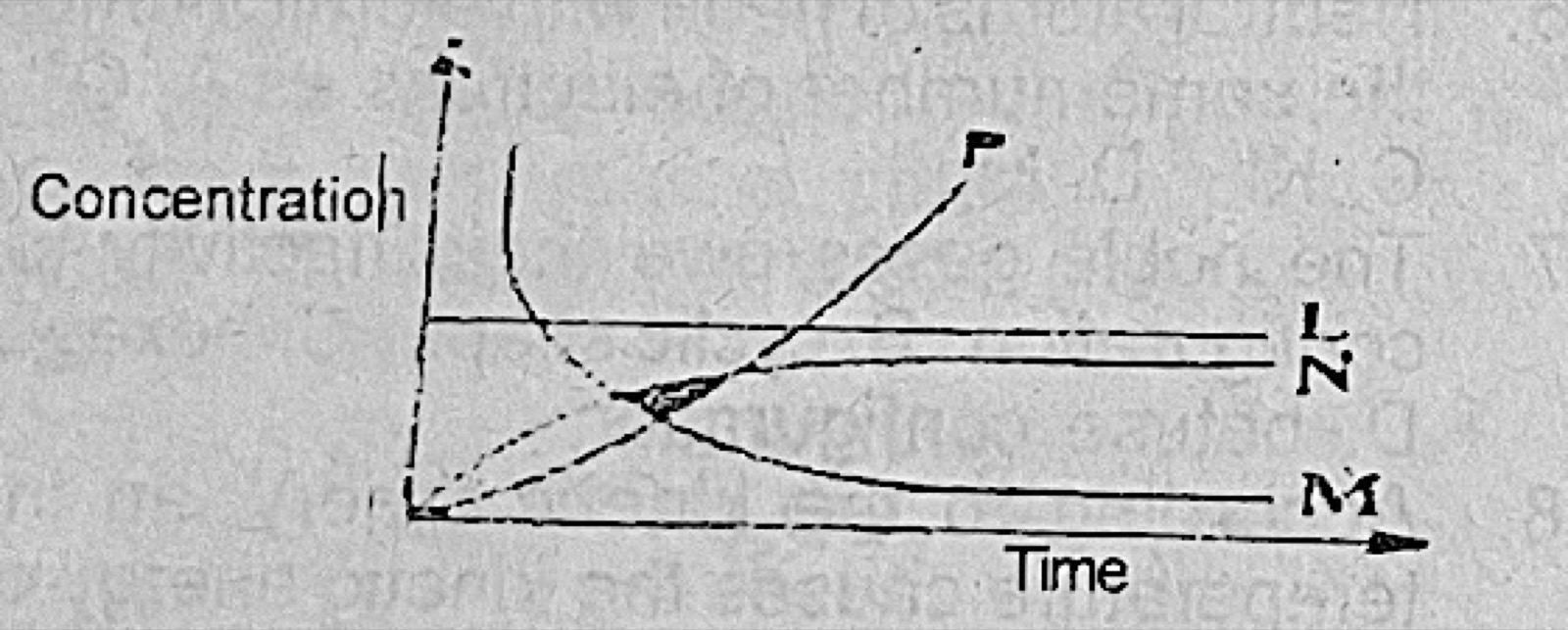
2HCl(aq) + CaCO3(s) → CaCl2(s) + CO2(g) + H2O(l)
From the reaction above, which of the curves in the diagram represents the production of carbon (IV) oxide as dilute HCl is added?

Diagram for this question
  1. A.L
  2. B.M
  3. C.N
  4. D.P
Show the answer and explanation

Answer: C (N)

Explanation

The amount of CO2 produced starts at zero, rises and then levels off when the reaction is complete; curve N has that shape. M falls, so it shows a reactant being used up.

Open this question

Question 23

Electrolysis

The commonest feature of reactions at the anode is that

  1. A.electrons are consumed
  2. B.oxidation is involved
  3. C.ions are reduced
  4. D.electrode dissolves.
Show the answer and explanation

Answer: B (oxidation is involved)

Explanation

At the anode, ions or the electrode lose electrons, which is oxidation.

Open this question

Question 24

Rates of Reaction

Which of the following will change when a catalyst is added to a chemical reaction?

  1. A.The activation energy
  2. B.The potential energy of the reactants.
  3. C.The heat of reaction
  4. D.The potential energy of the products.
Show the answer and explanation

Answer: A (The activation energy)

Explanation

A catalyst provides a different pathway with a lower activation energy; the energies of reactants, products and ΔH stay the same.

Open this question

Question 25

Redox Reactions

If Y is an oxidizing agent that reacts with a reducing agent, Z, which of the following is correct?

  1. A.Y increases in oxidation number
  2. B.Y becomes reduced
  3. C.Z loses protons
  4. D.Z gains protons
Show the answer and explanation

Answer: B (Y becomes reduced)

Explanation

An oxidizing agent accepts electrons, so it is itself reduced and its oxidation number falls.

Open this question

Question 26

Chemical Equilibrium

When at equilibrium, which of the reactions below will shift to the right if the pressure is increased and the temperature is kept constant?

  1. A.2SO3(g) ⇌ 2SO2(g) + O2(g)
  2. B.2CO2(g) ⇌ 2CO(g) + O2(g)
  3. C.2H2(g) + O2(g) ⇌ 2H2O(g)
  4. D.2NO(g) ⇌ N2(g) + O2(g)
Show the answer and explanation

Answer: C (2H2(g) + O2(g) ⇌ 2H2O(g))

Explanation

Higher pressure favours the side with fewer gas molecules. In C, 3 molecules on the left give 2 on the right, so it shifts right.

Open this question

Question 27

Electrolysis

In the electrolysis of a concentrated solution of sodium chloride using inert electrodes, which of the following ions are discharged at the cathode and anode respectively?

  1. A.Na+ and Cl-
  2. B.Na+ and OH-
  3. C.H+ and OH-
  4. D.H+ and Cl-
Show the answer and explanation

Answer: D (H+ and Cl-)

Explanation

H+ is discharged at the cathode in preference to Na+ (hydrogen is given off), and because Cl- is concentrated it is discharged at the anode (chlorine is given off).

Open this question

Question 28

Energy Changes

CO(g) + H2O(g) → CO2(g) + H2(g)
From the reaction above, calculate the standard heat change if the standard enthalpies of formation of CO2(g), H2O(g) and CO(g) in kJ mol-1 are –394, –242 and –110 respectively.

  1. A.–262 kJ mol-1
  2. B.–42 kJ mol-1
  3. C.+42 kJ mol-1
  4. D.+262 kJ mol-1
Show the answer and explanation

Answer: B (–42 kJ mol-1)

Explanation

ΔH = (products) – (reactants) = (–394 + 0) – (–110 + –242) = –394 + 352 = –42 kJ mol-1.

Open this question

Question 29

Energy Changes

When sugar is dissolved in tea, the reaction is always accompanied by

  1. A.positive entropy change
  2. B.negative entropy change
  3. C.no entropy change
  4. D.a minimum entropy change.
Show the answer and explanation

Answer: A (positive entropy change)

Explanation

Sugar molecules spread out from an ordered crystal into the liquid, so disorder (entropy) increases: a positive entropy change.

Open this question

Question 30

Electrolysis

Which of the following is an electrolyte?

  1. A.Alcohol
  2. B.Sodium acetate solution
  3. C.Solid potassium hydroxide
  4. D.Mercury
Show the answer and explanation

Answer: B (Sodium acetate solution)

Explanation

Sodium acetate solution contains free ions that carry current and are decomposed. Solid KOH's ions cannot move, alcohol has no ions, and mercury conducts without decomposing.

Open this question

Question 32

Metals and their Compounds

Metals of the first transition series have special properties which are different from those of groups I and II elements because they have partially filled

  1. A.s orbitals
  2. B.p orbitals
  3. C.d orbitals
  4. D.f orbitals
Show the answer and explanation

Answer: C (d orbitals)

Explanation

Transition metals have partly filled 3d orbitals, which give them variable valency, coloured ions and catalytic activity.

Open this question

Question 33

Metals and their Compounds

Hydrogen can be displaced from a hot alkaline solution by

  1. A.Fe
  2. B.Cu
  3. C.Ca
  4. D.Sn
Show the answer and explanation

Answer: D (Sn)

Explanation

Amphoteric metals such as tin, zinc and aluminium react with hot alkali to give hydrogen and a stannate/zincate/aluminate. Iron and copper do not; calcium is not amphoteric.

Open this question

Question 34

Sulphur and its Compounds

Which of the following statements is true of sulphur (IV) oxide?

  1. A.It forms tetraoxosulphate (VI) acid with water
  2. B.It is an odourless gas
  3. C.It is an acid anhydride
  4. D.It forms white precipitate with acidified barium chloride.
Show the answer and explanation

Answer: C (It is an acid anhydride)

Explanation

SO2 dissolves in water to form trioxosulphate (IV) acid, so it is an acid anhydride. It has a choking smell and gives no precipitate with acidified BaCl2.

Open this question

Question 35

Qualitative Analysis

The salt that will form a precipitate soluble in excess ammonia solution is

  1. A.Ca(NO3)2
  2. B.Cu(NO3)2
  3. C.Mg(NO3)2
  4. D.Al(NO3)3
Show the answer and explanation

Answer: B (Cu(NO3)2)

Explanation

Cu2+ gives a blue Cu(OH)2 precipitate that dissolves in excess ammonia to form a deep blue solution. Al(OH)3 and Mg(OH)2 do not dissolve in excess ammonia.

Open this question

Question 36

Metals and their Compounds

The metal that liberates hydrogen from cold water in bubbles only is

  1. A.Na
  2. B.K
  3. C.Ca
  4. D.Al
Show the answer and explanation

Answer: C (Ca)

Explanation

Calcium sinks and reacts steadily with cold water, giving a stream of hydrogen bubbles. Sodium and potassium react violently, darting about on the surface; aluminium hardly reacts.

Open this question

Question 37

Halogens

Chlorine gas turns a damp starch-iodide paper

  1. A.pink
  2. B.colourless
  3. C.red
  4. D.dark blue
Show the answer and explanation

Answer: D (dark blue)

Explanation

Chlorine displaces iodine from the iodide, and iodine turns starch dark blue.

Open this question

Question 38

Metals and their Compounds

The modern process of manufacturing steel from iron is by

  1. A.treatment with acids
  2. B.oxidation
  3. C.blast reduction
  4. D.treatment with alkalis.
Show the answer and explanation

Answer: B (oxidation)

Explanation

In the basic oxygen process, oxygen is blown through molten pig iron to oxidise away excess carbon and other impurities.

Open this question

Question 39

Nitrogen and its Compounds

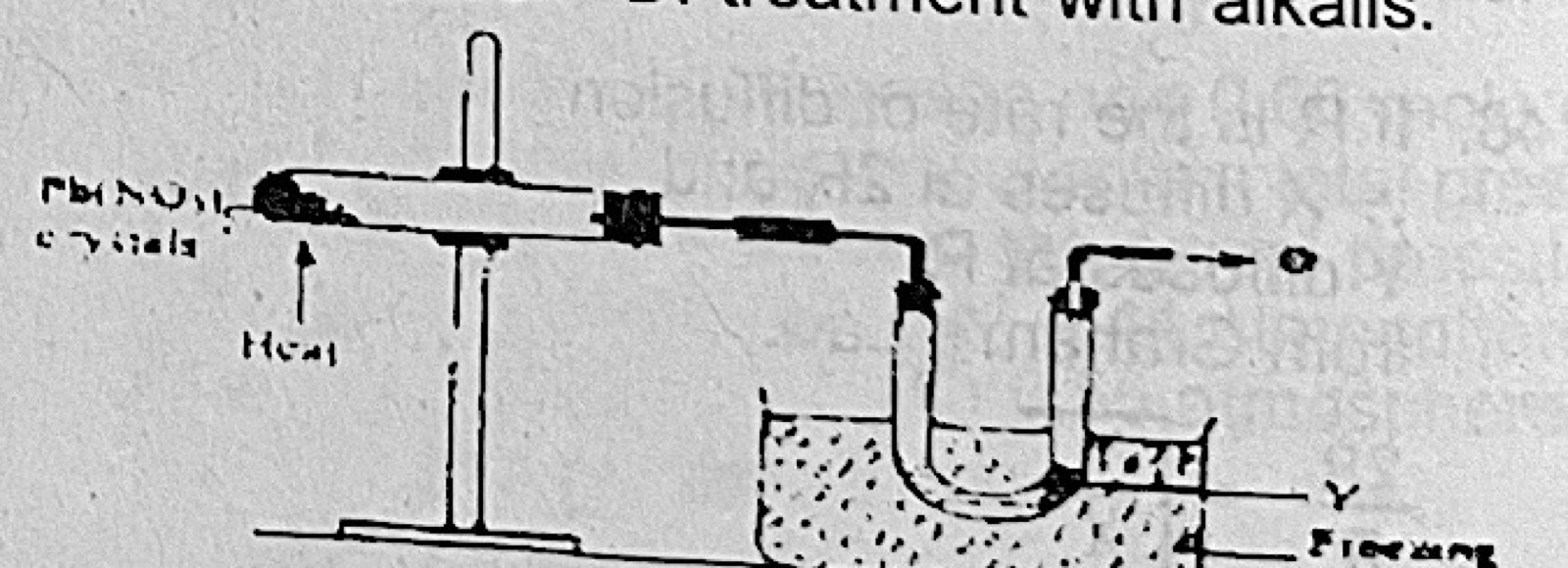
In the diagram above, Y is

Diagram for this question
  1. A.NO
  2. B.NO2
  3. C.N2O5
  4. D.N2O4
Show the answer and explanation

Answer: D (N2O4)

Explanation

Heating lead(II) nitrate gives NO2 and O2. In the U-tube cooled by the freezing mixture the NO2 condenses to liquid dinitrogen tetraoxide, N2O4; oxygen passes on.

Open this question

Question 40

Hydrocarbons

Ethene reacts with hydrogen bromide to give

  1. A.CH2Br2
  2. B.CH3CH2Br
  3. C.C2H2Br2
  4. D.CHBr3
Show the answer and explanation

Answer: B (CH3CH2Br)

Explanation

HBr adds across the double bond: CH2=CH2 + HBr → CH3CH2Br (bromoethane).

Open this question

Question 41

Carbohydrates, Proteins and Amines

Carbohydrates are compounds containing carbon, hydrogen and oxygen in the ratio

  1. A.3 : 1 : 1
  2. B.2 : 1 : 1
  3. C.1 : 2 : 1
  4. D.1 : 1 : 1
Show the answer and explanation

Answer: C (1 : 2 : 1)

Explanation

Carbohydrates have the general formula Cx(H2O)y, e.g. glucose C6H12O6, a C : H : O ratio of 1 : 2 : 1.

Open this question

Question 42

Introduction to Organic Chemistry

How many isomers does pentane have?

  1. A.6
  2. B.5
  3. C.4
  4. D.3
Show the answer and explanation

Answer: D (3)

Explanation

C5H12 has three isomers: pentane, 2-methylbutane and 2,2-dimethylpropane.

Open this question

Question 43

Fats, Oils and Soaps

The leachate of a certain plant ash is used in local soap-making because it contains.

  1. A.sodium chloride and potassium hydroxide
  2. B.sodium hydroxide
  3. C.potassium hydroxide
  4. D.soluble carbonates and hydrogen carbonates.
Show the answer and explanation

Answer: D (soluble carbonates and hydrogen carbonates.)

Explanation

Water run through plant ash dissolves mainly potassium carbonate (potash) and hydrogen carbonates; this alkaline solution saponifies the oil.

Open this question

Question 44

Alkanoic Acids and Esters

The formula for ethyl butanoate is

  1. A.C3H7COOC2H5
  2. B.C2H5COOC3H7
  3. C.C4H9COOC2H5
  4. D.C2H5COOC4H9
Show the answer and explanation

Answer: A (C3H7COOC2H5)

Explanation

Butanoic acid is C3H7COOH; replacing the H with an ethyl group gives C3H7COOC2H5.

Open this question

Question 45

Hydrocarbons

The type of reaction that is peculiar to benzene is

  1. A.addition
  2. B.hydrolysis
  3. C.polymerization
  4. D.substitution.
Show the answer and explanation

Answer: D (substitution.)

Explanation

Benzene's stable ring resists addition, so it typically undergoes substitution reactions (e.g. nitration, halogenation with a catalyst).

Open this question

Question 46

Alkanols

Ethanol reacts with excess acidified K2Cr2O7 to produce

  1. A.ethanedioic acid
  2. B.ethanal
  3. C.ethyl ethanoate
  4. D.ethanoic acid.
Show the answer and explanation

Answer: D (ethanoic acid.)

Explanation

A primary alkanol is oxidised first to ethanal and, with excess oxidising agent, on to ethanoic acid.

Open this question

Question 47

Chemical Formulae and Equations

A compound contains 40.0% carbon, 6.7% hydrogen and 53.3% oxygen. If the molar mass of the compound is 180, find the molecular formula. [H = 1, C = 12, O = 16]

  1. A.CH2O
  2. B.C3H6O3
  3. C.C6H12O6
  4. D.C6H6O3
Show the answer and explanation

Answer: C (C6H12O6)

Explanation

Mole ratio C : H : O = 40/12 : 6.7/1 : 53.3/16 = 3.33 : 6.7 : 3.33 = 1 : 2 : 1, so the empirical formula is CH2O (30). 180/30 = 6, giving C6H12O6.

Open this question

Question 48

Petroleum and Coal

The process by which atoms are rearranged into different molecular structures in the petroleum refining process is referred to as

  1. A.catalytic cracking
  2. B.hydrocracking
  3. C.polymerization
  4. D.reforming.
Show the answer and explanation

Answer: D (reforming.)

Explanation

Reforming rearranges the atoms in straight-chain molecules into branched or ring molecules to improve petrol quality; cracking breaks molecules into smaller ones.
Open this question

Question 49

Carbohydrates, Proteins and Amines

Which of the following is found in cotton.

  1. A.Starch
  2. B.Cellulose
  3. C.Fat
  4. D.Oil
Show the answer and explanation

Answer: B (Cellulose)

Explanation

Cotton fibres are almost pure cellulose.

Open this question

Question 50

Petroleum and Coal

The principal constituent of natural gas is

  1. A.methane
  2. B.ethane
  3. C.propane
  4. D.butane
Show the answer and explanation

Answer: A (methane)

Explanation

Natural gas is mostly methane, CH4.

Open this question