JAMB Chemistry 2002 past questions and answers

46 questions. Try each one, then open the answer to check yourself and read the explanation.

Question 1

Chemical Formulae and Equations

A compound contains 31.91% potassium, 28.93% chlorine and the rest oxygen. What is the chemical formula of the compound? [K = 39, Cl = 35.5, O = 16]

  1. A.KClO4
  2. B.KClO
  3. C.KClO2
  4. D.KClO3
Show the answer and explanation

Answer: D (KClO3)

Explanation

Oxygen = 100 − 31.91 − 28.93 = 39.16%. Moles: K 31.91/39 = 0.818, Cl 28.93/35.5 = 0.815, O 39.16/16 = 2.45, a ratio of 1 : 1 : 3, so KClO3.

Open this question

Question 2

Chemical Formulae and Equations

The formula CH2O for ethanoic acid is regarded as its

  1. A.molecular formula
  2. B.general formula
  3. C.empirical formula
  4. D.structural formula
Show the answer and explanation

Answer: C (empirical formula)

Explanation

Ethanoic acid is C2H4O2; CH2O is its simplest whole-number ratio of atoms, which is the empirical formula.

Open this question

Question 4

Separation of Mixtures

The chromatographic separation of ink is based on the ability of the components to

  1. A.react with the solvent
  2. B.react with each other
  3. C.dissolve in each other in the column
  4. D.move at different speeds in the column.
Show the answer and explanation

Answer: D (move at different speeds in the column.)

Explanation

Each dye in ink is carried by the solvent at its own speed, depending on how well it dissolves and how strongly it sticks to the paper or column, so the dyes separate.

Open this question

Question 5

Mole Concept and Stoichiometry

Which of the following gases contains the least number of atoms at s.t.p.?

  1. A.1 mole of butane
  2. B.3 moles of ozone
  3. C.4 moles of chlorine
  4. D.7 moles of argon
Show the answer and explanation

Answer: D (7 moles of argon)

Explanation

Count moles of atoms: butane C4H10 1 × 14 = 14; ozone O3 3 × 3 = 9; chlorine Cl2 4 × 2 = 8; argon (monatomic) 7 × 1 = 7. Argon has the fewest atoms.

Open this question

Question 6

Chemical Equilibrium

In the reaction E + F ⇌ G + H, the backward reaction is favoured if the concentration of

  1. A.F is increased
  2. B.E is increased
  3. C.E is reduced
  4. D.G is reduced.
Show the answer and explanation

Answer: C (E is reduced)

Explanation

Removing a reactant (E) makes the equilibrium shift to the left to replace it, so the backward reaction is favoured.

Open this question

Question 8

Rates of Reaction

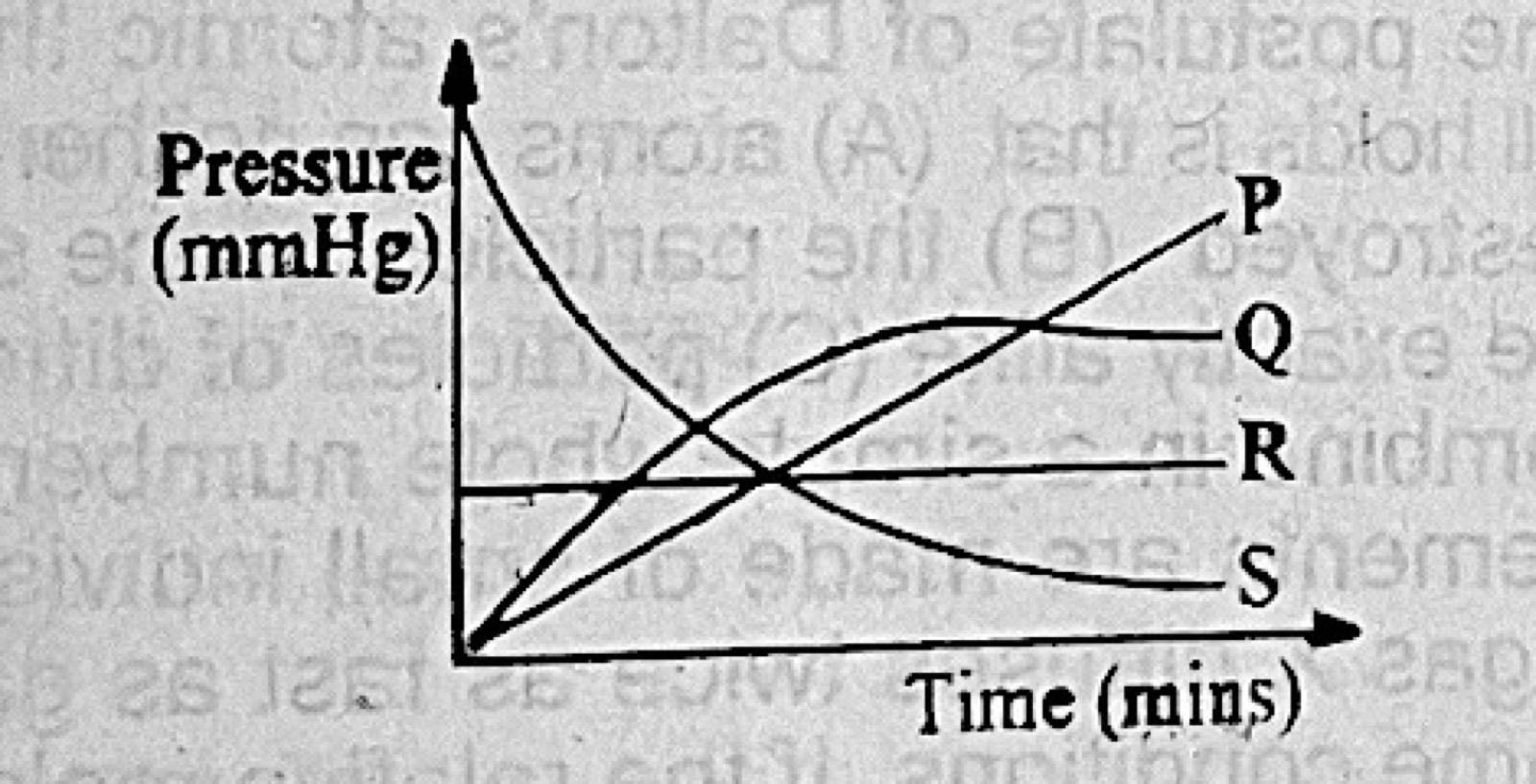
In the diagram above, the curve that represents the production of oxygen gas from the decomposition of KClO3 in the presence of MnO2 catalyst is

Diagram for this question
  1. A.R
  2. B.P
  3. C.S
  4. D.Q
Show the answer and explanation

Answer: D (Q)

Explanation

With MnO2 the KClO3 decomposes quickly at first, so the oxygen pressure rises fast. As the KClO3 runs out, the rate slows and the pressure levels off, which is the shape of curve Q.

Open this question

Question 9

Energy Changes

Which of the following equations shows that a reaction is in equilibrium?

  1. A.ΔG < 0
  2. B.ΔG = ΔH − TΔS
  3. C.ΔG > 0
  4. D.ΔG = 0
Show the answer and explanation

Answer: D (ΔG = 0)

Explanation

At equilibrium there is no driving force in either direction, so the free energy change ΔG is zero.

Open this question

Question 10

Chemical Equilibrium

PCl5(g) ⇌ PCl3(g) + Cl2(g)
In the reaction above, a decrease in pressure will

  1. A.decelerate the reaction
  2. B.increase the yield of PCl3
  3. C.increase the yield of PCl5
  4. D.accelerate the reaction.
Show the answer and explanation

Answer: B (increase the yield of PCl3)

Explanation

The right side has more gas molecules (2) than the left (1). Lowering the pressure shifts the equilibrium towards more molecules, giving more PCl3.

Open this question

Question 11

Redox Reactions

When H2S is passed into a solution of iron (III) chloride, the solution turns

  1. A.pale green
  2. B.pale red
  3. C.brown
  4. D.colourless.
Show the answer and explanation

Answer: A (pale green)

Explanation

H2S is a reducing agent: it reduces yellow-brown Fe3+ to Fe2+, which is pale green (and yellow sulphur is deposited).

Open this question

Question 12

Rates of Reaction

The Arrhenius equation expresses the relationship between the speed of a reaction and its

  1. A.molecular collisions
  2. B.heat of reaction
  3. C.catalyst
  4. D.activation energy
Show the answer and explanation

Answer: D (activation energy)

Explanation

The Arrhenius equation k = Ae−Ea/RT shows that the rate constant gets smaller as the activation energy Ea gets larger.

Open this question

Question 13

Energy Changes

When dissolved in water, NaOH flakes show

  1. A.an endothermic change
  2. B.an exothermic change
  3. C.a slow reaction
  4. D.a rapid reaction.
Show the answer and explanation

Answer: B (an exothermic change)

Explanation

Dissolving sodium hydroxide gives out a lot of heat (the solution gets hot), so it is an exothermic change.

Open this question

Question 14

Redox Reactions

Cu2S(s) + O2(g) → 2Cu(s) + SO2(g)
What is the change in the oxidation number of copper in the reaction above?

  1. A.+1 to 0
  2. B.0 to +2
  3. C.+2 to +1
  4. D.0 to +1
Show the answer and explanation

Answer: A (+1 to 0)

Explanation

In Cu2S sulphur is −2, so each copper is +1. Free copper metal is 0, so copper changes from +1 to 0.

Open this question

Question 15

Electrolysis

The products of the electrolysis of dilute sodium hydroxide using platinum electrodes are

  1. A.hydrogen and oxygen gases
  2. B.water and hydrogen gas
  3. C.water and sodium metal
  4. D.sodium metal and oxygen gas.
Show the answer and explanation

Answer: A (hydrogen and oxygen gases)

Explanation

H+ is discharged instead of Na+ at the cathode, giving hydrogen, and OH− is discharged at the anode, giving oxygen (and water).

Open this question

Question 16

Solubility and Solutions

The solubility of a salt of molar mass 101g at 20°C is 0.34 mol dm−3. If 3.40g of the salt is dissolved completely in 250cm3 of water in a beaker, the resulting solution is

  1. A.a suspension
  2. B.saturated
  3. C.unsaturated
  4. D.supersaturated
Show the answer and explanation

Answer: C (unsaturated)

Explanation

A saturated solution would hold 0.34 × 101 × 0.25 ≈ 8.6 g in 250 cm3. Only 3.40 g is dissolved, so the solution is unsaturated.

Open this question

Question 17

Sulphur and its Compounds

Tetraoxosulphate (VI) acid burns the skin by

  1. A.hydrolysis
  2. B.hydration
  3. C.heating
  4. D.dehydration
Show the answer and explanation

Answer: D (dehydration)

Explanation

Concentrated tetraoxosulphate (VI) acid is a strong dehydrating agent: it removes water from the skin's tissues, charring them.

Open this question

Question 18

Water

When a salt loses its water of crystallization to the atmosphere on exposure, the process is said to be

  1. A.efflorescence
  2. B.deliquescence
  3. C.effervescence
  4. D.fluorescence.
Show the answer and explanation

Answer: A (efflorescence)

Explanation

Efflorescence is the loss of water of crystallization to the air, e.g. washing soda crystals turning to powder.

Open this question

Question 19

Acids, Bases and Salts

Three drops of a 1.0mol dm−3 solution of NaOH are added to 20cm3 of a solution of pH 8.4. The pH of the resulting solution will be

  1. A.close to that of pure water
  2. B.unaltered
  3. C.greater than 8.4
  4. D.less than 8.4
Show the answer and explanation

Answer: C (greater than 8.4)

Explanation

Adding a strong alkali increases the hydroxide ion concentration, so the solution becomes more alkaline and its pH rises above 8.4.

Open this question

Question 20

Volumetric Analysis

25cm3 of a 0.2 mol dm−3 solution of Na2CO3 requires 20cm3 of a solution of HCl for neutralization. The concentration of the HCl solution is

  1. A.0.5 mol dm−3
  2. B.0.6 mol dm−3
  3. C.0.2 mol dm−3
  4. D.0.4 mol dm−3
Show the answer and explanation

Answer: A (0.5 mol dm−3)

Explanation

Na2CO3 + 2HCl → 2NaCl + H2O + CO2. Moles of Na2CO3 = 0.2 × 0.025 = 0.005, so HCl = 0.010 mol in 0.020 dm3 = 0.5 mol dm−3.

Open this question

Question 21

Environmental Pollution

The substance least considered as a source of environmental pollution is

  1. A.lead compounds
  2. B.organophosphorous compounds
  3. C.silicate minerals
  4. D.uranium.
Show the answer and explanation

Answer: C (silicate minerals)

Explanation

Silicate minerals (sand, clay, rock) are natural, insoluble and harmless. Lead compounds, organophosphorus pesticides and radioactive uranium are all serious pollutants.

Open this question

Question 22

Water

The furring of kettles is caused by the presence in water of

  1. A.calcium tetraoxosulphate (VI)
  2. B.calcium hydrogentrioxocarbonate (IV)
  3. C.calcium hydroxide
  4. D.calcium trioxocarbonate (IV).
Show the answer and explanation

Answer: B (calcium hydrogentrioxocarbonate (IV))

Explanation

Temporary hard water contains dissolved Ca(HCO3)2. On boiling it decomposes: Ca(HCO3)2 → CaCO3 + H2O + CO2, and the insoluble CaCO3 forms the fur.

Open this question

Question 23

Acids, Bases and Salts

Which of the following solutions containing only hydroxyl ions will liberate hydrogen gas when reacted with magnesium metal?

  1. A.1.0 × 10−6 mol dm−3
  2. B.1.0 × 10−12 mol dm−3
  3. C.1.0 × 10−2 mol dm−3
  4. D.1.0 × 10−4 mol dm−3
Show the answer and explanation

Answer: B (1.0 × 10⁻¹² mol dm−3)

Explanation

Magnesium liberates hydrogen from acids. [OH−] = 10−12 means pOH = 12 and pH = 2, which is acidic. The other solutions have pH 8, 12 and 10 (alkaline).

Open this question

Question 24

Alkanols

The property which makes alcohol soluble in water is the

  1. A.boiling point
  2. B.hydrogen bonding
  3. C.ionic character
  4. D.covalent nature.
Show the answer and explanation

Answer: B (hydrogen bonding)

Explanation

The —OH group of an alcohol forms hydrogen bonds with water molecules, so the alcohol mixes with water.

Open this question

Question 25

Water

Steam changes the colour of anhydrous cobalt (II) chloride from

  1. A.blue to pink
  2. B.white to red
  3. C.white to green
  4. D.blue to white
Show the answer and explanation

Answer: A (blue to pink)

Explanation

Anhydrous cobalt (II) chloride is blue; it turns pink when it takes up water, which is the standard test for water.

Open this question

Question 26

Nitrogen and its Compounds

The gas that gives brown colouration in brown ring test is

  1. A.NO
  2. B.CO2
  3. C.NO2
  4. D.CO
Show the answer and explanation

Answer: A (NO)

Explanation

In the brown ring test for nitrates, the nitrate is reduced to NO, which combines with iron (II) sulphate to form the brown complex FeSO4·NO.

Open this question

Question 27

Carbohydrates, Proteins and Amines

Ethanol can easily be produced by

  1. A.fermentation of starch
  2. B.distillation of starch solution
  3. C.catalytic oxidation of methane
  4. D.destructive distillation of wood.
Show the answer and explanation

Answer: A (fermentation of starch)

Explanation

Starch is broken down to sugar, and yeast ferments the sugar to ethanol; this is the usual way to make ethanol.

Open this question

Question 28

Qualitative Analysis

Which of the following gives a precipitate when treated with NaOH solution?

  1. A.AlCl3
  2. B.NH4Cl
  3. C.CH3COONa
  4. D.Na2CO3.
Show the answer and explanation

Answer: A (AlCl3)

Explanation

Al3+ + 3OH− → Al(OH)3, a white gelatinous precipitate. Ammonium chloride gives ammonia gas, and the sodium salts give no precipitate.

Open this question

Question 30

Carbon and its Compounds

An example of element that can catenate is

  1. A.bromine
  2. B.nitrogen
  3. C.chlorine
  4. D.carbon
Show the answer and explanation

Answer: D (carbon)

Explanation

Catenation is the joining of atoms of the same element into long chains and rings; carbon does this better than any other element.

Open this question

Question 31

Hydrocarbons

The reaction of an alkene with hydrogen in the presence of a catalyst is

  1. A.a substitution reaction
  2. B.an oxidation reaction
  3. C.a nucleophilic reaction
  4. D.an addition reaction.
Show the answer and explanation

Answer: D (an addition reaction.)

Explanation

Hydrogen adds across the C=C double bond to give an alkane, so it is an addition reaction (hydrogenation).

Open this question

Question 32

Introduction to Organic Chemistry

The number of isomers formed by C6H14 is

  1. A.4
  2. B.5
  3. C.2
  4. D.3
Show the answer and explanation

Answer: B (5)

Explanation

Hexane has five structural isomers: hexane, 2-methylpentane, 3-methylpentane, 2,2-dimethylbutane and 2,3-dimethylbutane.

Open this question

Question 33

Polymers

Which of these pairs are synthetic and natural macromolecules respectively?

  1. A.Haemoglobin and nylon, creatine and polyethylene.
  2. B.Nylon and polyethylene, creatine and haemoglobin
  3. C.Nylon and creatine, polyethylene and haemoglobin
  4. D.Polyethylene and creatine, nylon and haemoglobin.
Show the answer and explanation

Answer: B (Nylon and polyethylene, creatine and haemoglobin)

Explanation

Nylon and polyethylene are man-made polymers; haemoglobin and the protein keratin (printed 'creatine') are made by living things. Only B gives a synthetic pair followed by a natural pair.

Open this question

Question 34

Chemistry and Industry

Ordinary glass is manufactured from silica, CaCO3 and

  1. A.Na2CO3
  2. B.K2CO3
  3. C.K2SO4
  4. D.NaHCO3
Show the answer and explanation

Answer: A (Na2CO3)

Explanation

Ordinary (soda-lime) glass is made by melting sand (silica) with limestone and sodium trioxocarbonate (IV) (soda ash).

Open this question

Question 35

Hydrocarbons

A red precipitate of copper (I) carbide is formed when ammonium solution of copper (I) chloride is introduced into

  1. A.CH3CH2CH2CH3
  2. B.CH2=CH−CH2CH3
  3. C.CH3CH2−C≡CH
  4. D.CH3−C≡C−CH3
Show the answer and explanation

Answer: C (CH3CH2−C≡CH)

Explanation

Only alkynes with a hydrogen on the triple-bonded carbon (terminal alkynes, —C≡CH) form copper (I) carbide. But-1-yne has one; but-2-yne does not.

Open this question

Question 36

Alkanols

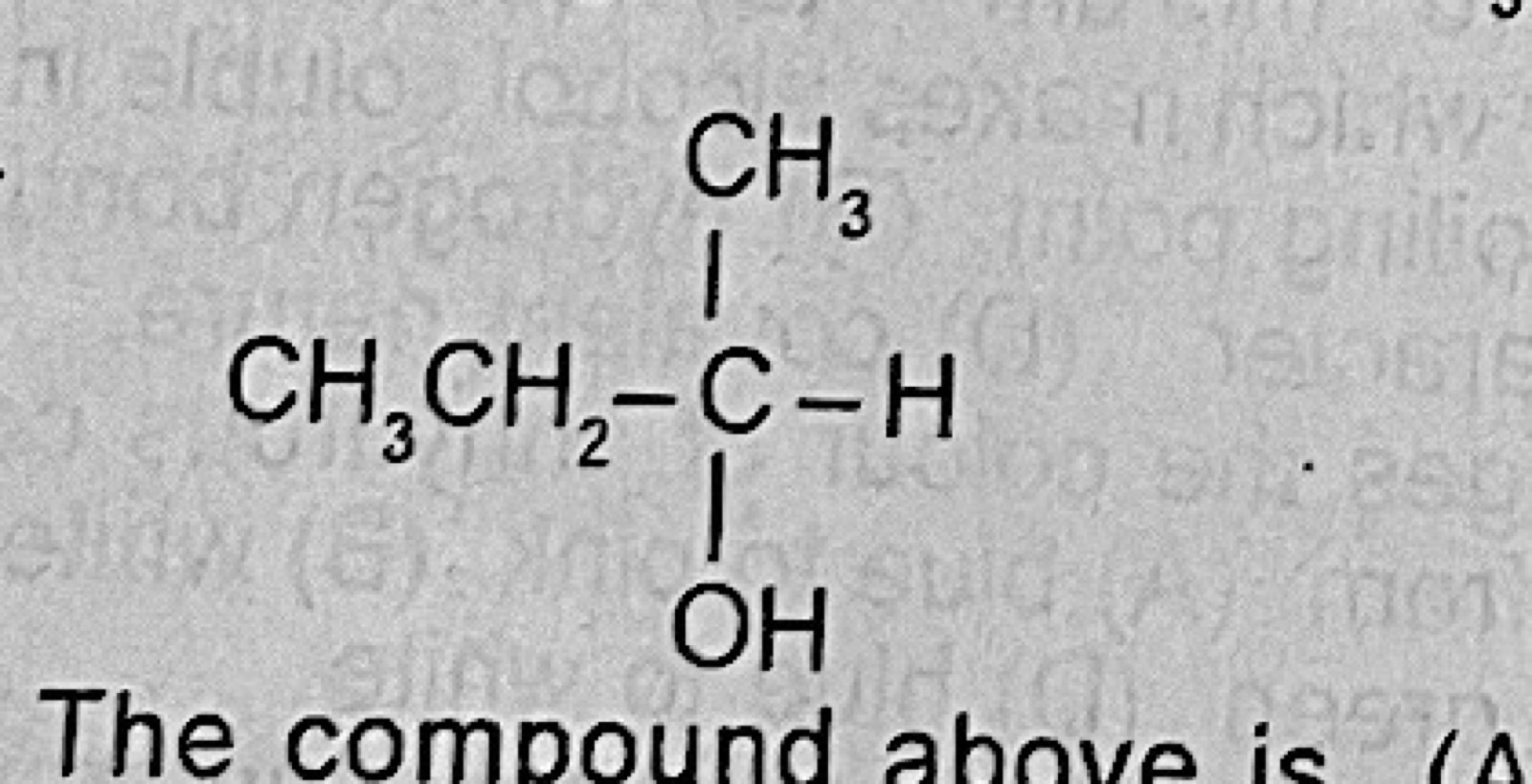
CH3CH2−CH(CH3)−OH
The compound above is

Diagram for this question
  1. A.glycol
  2. B.primary alkanol
  3. C.secondary alkanol
  4. D.tertiary alkanol
Show the answer and explanation

Answer: C (secondary alkanol)

Explanation

The carbon carrying the —OH group is joined to two other carbon atoms (CH3 and CH2CH3), so this butan-2-ol is a secondary alkanol.

Open this question

Question 37

Fats, Oils and Soaps

The boiling of fat and aqueous caustic soda is referred to as

  1. A.hydrolysis
  2. B.esterification
  3. C.acidification
  4. D.saponification
Show the answer and explanation

Answer: D (saponification)

Explanation

Boiling a fat or oil with sodium hydroxide splits it into soap and glycerol; this soap-making reaction is saponification.

Open this question

Question 38

Hydrogen, Oxygen and Oxides

The most important use of hydrogen is in the

  1. A.manufacture of ammonia
  2. B.manufacture of methyl alcohol
  3. C.manufacture of ethyl alcohol
  4. D.hydrogenation of oils.
Show the answer and explanation

Answer: A (manufacture of ammonia)

Explanation

Most hydrogen produced is used in the Haber process, N2 + 3H2 ⇌ 2NH3, to make ammonia for fertilisers.

Open this question

Question 40

Metals and their Compounds

Hydrogen is readily released when dilute hydrochloric acid reacts with

  1. A.Cu
  2. B.Na
  3. C.Au
  4. D.Ag
Show the answer and explanation

Answer: B (Na)

Explanation

Sodium is above hydrogen in the activity series, so it displaces hydrogen from the acid. Copper, gold and silver are below hydrogen and do not.

Open this question

Question 41

Alkanals and Alkanones

The intermediate product formed when ethanol is progressively oxidized to ethanoic acid with potassium heptaoxodichromate (VI) is

  1. A.butanal
  2. B.ethanal
  3. C.methanal
  4. D.propanal
Show the answer and explanation

Answer: B (ethanal)

Explanation

Ethanol is first oxidised to ethanal (CH3CHO), which is then oxidised further to ethanoic acid (CH3COOH).

Open this question

Question 42

Sulphur and its Compounds

A rock sample was added to cold dilute HNO3. The gas evolved was passed into a solution of acidified K2Cr2O7 and the solution turned green. The rock sample contains

  1. A.Cl−
  2. B.NO3−
  3. C.SO32−
  4. D.SO42−
Show the answer and explanation

Answer: C (SO32−)

Explanation

A trioxosulphate (IV) (SO32−) gives SO2 with dilute acid, and SO2 turns orange acidified dichromate green.

Open this question

Question 43

Atomic Structure

Which of the following statements is true of a proton?

  1. A.The mass of a proton is 1840 times the mass of an electron
  2. B.The total mass of the protons in a particular nucleus is always half the nuclear mass.
  3. C.The mass of a proton is one-twelfth the molar mass of carbon
  4. D.The mass of a proton is 1.0008g.
Show the answer and explanation

Answer: A (The mass of a proton is 1840 times the mass of an electron)

Explanation

A proton's mass is about 1836 (roughly 1840) times that of an electron. One proton weighs only about 1.67 × 10⁻²⁴ g; it is a mole of protons that weighs about 1 g.

Open this question

Question 44

Chemical Bonding

Which of the following chlorides would exhibit the least ionic character?

  1. A.MgCl2
  2. B.CaCl2
  3. C.LiCl
  4. D.AlCl3
Show the answer and explanation

Answer: D (AlCl3)

Explanation

The small, highly charged Al3+ ion strongly distorts the chloride ion's electrons, so AlCl3 is largely covalent.

Open this question

Question 45

Gas Laws

A fixed mass of gas has a volume of 92cm3 at 3°C. What will be its volume at 18°C if the pressure remains constant?

  1. A.15.3cm3
  2. B.87.3cm3
  3. C.552.0cm3
  4. D.97.0cm3
Show the answer and explanation

Answer: D (97.0cm3)

Explanation

Charles' law with kelvin temperatures: V2 = 92 × 291 ÷ 276 = 97.0 cm3.

Open this question

Question 46

Carbon and its Compounds

The processes which return carbon (IV) oxide to the atmosphere include

  1. A.respiration,decay and combustion
  2. B.photosynthesis, respiration and transpiration
  3. C.ozone depletion, combustion and decay
  4. D.photosynthesis, decay and respiration.
Show the answer and explanation

Answer: A (respiration,decay and combustion)

Explanation

Respiration, decay of dead matter and burning all release CO2. Photosynthesis removes CO2 from the air.

Open this question

Question 47

Atomic Structure

The postulate of Dalton's atomic theory which still holds is that

  1. A.atoms can neither be created nor destroyed
  2. B.the particles of the same element are exactly alike
  3. C.particles of different elements combine in a simple whole number ratio
  4. D.all elements are made of small indivisible particles.
Show the answer and explanation

Answer: C (particles of different elements combine in a simple whole number ratio)

Explanation

Atoms can be split and changed in nuclear reactions, and isotopes show that atoms of one element are not all alike. Atoms still combine in simple whole-number ratios, as in H2O and CO2.

Open this question

Question 48

Gas Laws

A gas X diffuses twice as fast as gas Y under the same conditions. If the relative molecular mass of X is 28, calculate the relative molecular mass of Y.

  1. A.112
  2. B.120
  3. C.56
  4. D.14
Show the answer and explanation

Answer: A (112)

Explanation

Graham's law: rateX/rateY = √(MY/MX), so 2 = √(MY/28), giving MY = 4 × 28 = 112.

Open this question

Question 49

Radioactivity

146C → X + β
X in the equation above represents

  1. A.126C
  2. B.125B
  3. C.147N
  4. D.136C
Show the answer and explanation

Answer: C (147N)

Explanation

A beta particle is 0−1e. The mass number stays 14 and the atomic number rises from 6 to 7, giving nitrogen-14.

Open this question

Question 50

Gas Laws

If 0.75 mole of cyclopropane and 0.66 mole of oxygen are mixed in a vessel with a total pressure of 0.7 atmosphere, what is the partial pressure of oxygen in the mixture?
  1. A.0.44 atmosphere
  2. B.0.22 atmosphere
  3. C.0.55 atmosphere
  4. D.0.33 atmosphere
Show the answer and explanation

Answer: D (0.33 atmosphere)

Explanation

Mole fraction of oxygen = 0.66 ÷ (0.75 + 0.66) = 0.468. Partial pressure = 0.468 × 0.7 ≈ 0.33 atmosphere.

Open this question