49 questions. Try each one, then open the answer to check yourself and read the explanation.
Question 1
Separation of Mixtures
Chromatography is used to separate components of mixtures which differ in their rates of
A.diffusion
B.migration
C.reaction
D.sedimentation
Show the answer and explanation
Answer: B (migration)
Explanation
In chromatography the solvent carries each component along the paper or column at its own speed. Components separate because they migrate at different rates.
A gas sample with an initial volume of 3.25 dm3 is heated and allowed to expand to 9.75 dm3 at constant pressure. What is the ratio of the final absolute temperature to the initial absolute temperature?
A.3:1
B.5:2
C.5:4
D.8:3
Show the answer and explanation
Answer: A (3:1)
Explanation
By Charles' law, V/T is constant at fixed pressure, so T2/T1 = V2/V1 = 9.75/3.25 = 3, a ratio of 3:1.
Two cylinders A and B each contains 30 cm3 of oxygen and nitrogen respectively at the same temperature and pressure. If there are 5.0 moles of nitrogen, then the mass of oxygen is
A.3.2 g
B.6.4 g
C.80.0 g
D.160.0 g
Show the answer and explanation
Answer: D (160.0 g)
Explanation
Equal volumes at the same temperature and pressure hold equal numbers of moles (Avogadro's law), so there are 5.0 mol of O2. Mass = 5.0 × 32 = 160.0 g.
A.its vapour pressure is equal to the vapour pressure of its solid at the given temperature
B.molecules start escaping from its surface
C.its vapour pressure equals the atmospheric pressure
D.its volume is slightly increased
Show the answer and explanation
Answer: C (its vapour pressure equals the atmospheric pressure)
Explanation
Boiling starts when the vapour pressure of the liquid becomes equal to the pressure of the air above it. Bubbles of vapour can then form throughout the liquid.
The stability of ionic solids is generally due to the
A.negative electron affinity of most atoms
B.crystal lattice forces
C.electron pair sharing
D.positive ionization potentials
Show the answer and explanation
Answer: B (crystal lattice forces)
Explanation
In an ionic solid, each ion is held by strong electrostatic attractions to many oppositely charged neighbours in the crystal lattice. This lattice energy makes ionic solids stable.
Which of the following statements is FALSE about isotopes of the same element? They have the
A.same number of electrons in their outermost shells
B.different atomic masses
C.same atomic number and the same number of electrons
D.same atomic number but different number of electrons
Show the answer and explanation
Answer: D (same atomic number but different number of electrons)
Explanation
Isotopes differ only in the number of neutrons. Neutral isotopes of an element have the same number of protons and therefore the same number of electrons, so D is false.
When plastics and packaging materials made from chloroethene are burnt in the open, the mixture of gases released into the atmosphere is most likely to contain
A.ethane
B.chlorine
C.hydrogen chloride
D.ethene
Show the answer and explanation
Answer: C (hydrogen chloride)
Explanation
PVC (poly(chloroethene)) contains chlorine. When it burns, the chlorine combines with hydrogen to give hydrogen chloride gas.
In general, an increase in temperature increases the solubility of a solute in water because
A.more solute molecules collide with each other
B.most solutes dissolve with the evolution of heat
C.more solute molecules dissociate at higher temperatures
D.most solutes dissolve with absorption of heat
Show the answer and explanation
Answer: D (most solutes dissolve with absorption of heat)
Explanation
For most solids, dissolving absorbs heat (it is endothermic). By Le Chatelier's principle, raising the temperature favours the heat-absorbing process, so more solute dissolves.
Which of the following solutions will have a pH < 7?
A.Na2SO4(aq)
B.NaCl(aq)
C.Na2CO3(aq)
D.NH4Cl(aq)
Show the answer and explanation
Answer: D (NH4Cl(aq))
Explanation
NH4Cl is the salt of a strong acid and a weak base. It hydrolyses in water to give an acidic solution, while Na2CO3 is alkaline and the other two are neutral.
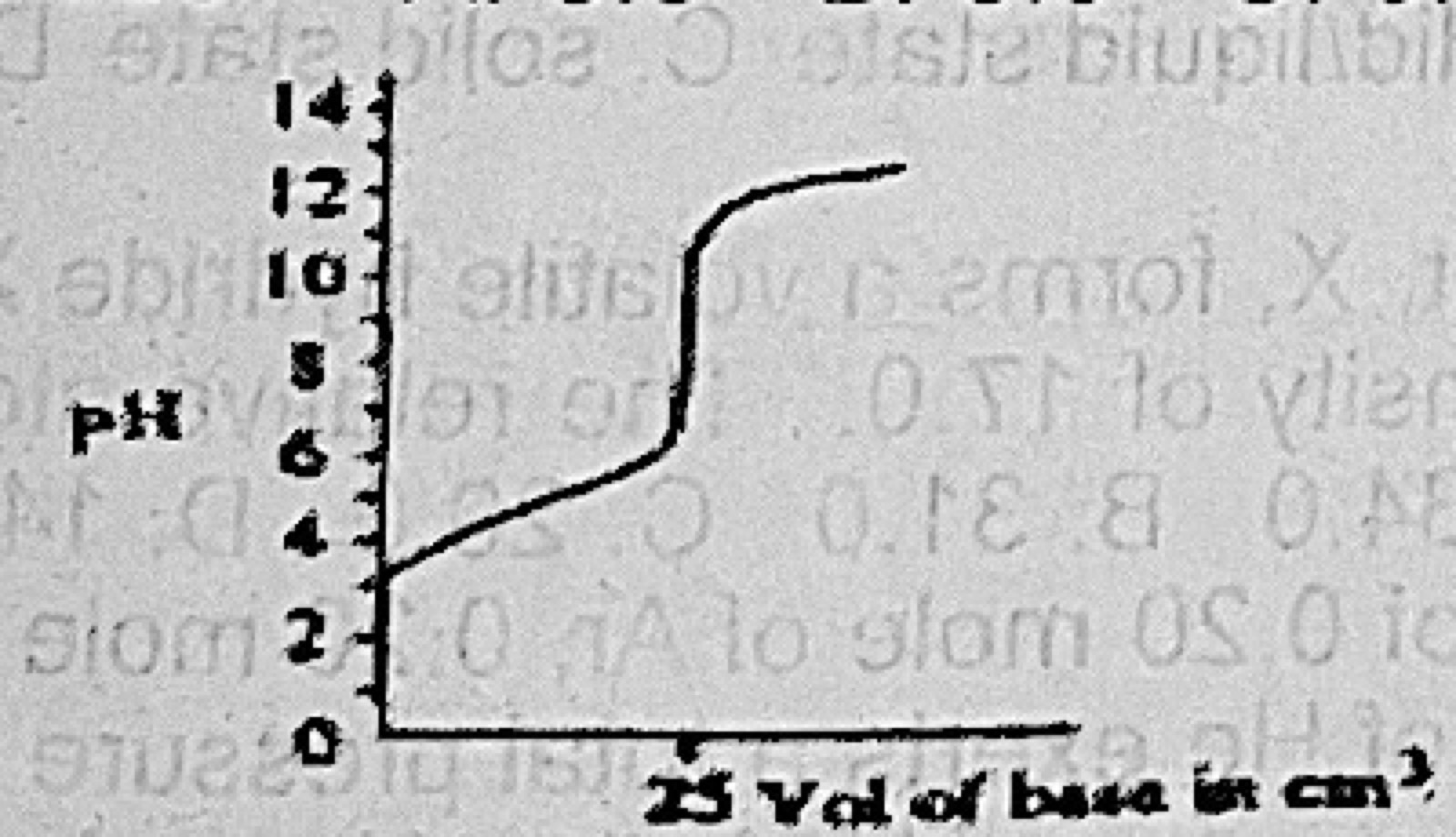
The graph above shows the pH changes for the titration of a
A.strong acid versus strong base
B.weak acid versus strong base
C.strong acid versus weak base
D.weak acid versus weak base
Show the answer and explanation
Answer: B (weak acid versus strong base)
Explanation
The pH starts at about 3 (a weak acid) and the sharp jump runs from about 6 to 11, ending high (a strong base). This shape is typical of a weak acid titrated with a strong base.
In the process of silver-plating a metal M, the metal M is the
A.anode and a direct current is used
B.cathode and an alternating current is used
C.anode and an alternating current is used
D.cathode and a direct current is used
Show the answer and explanation
Answer: D (cathode and a direct current is used)
Explanation
Silver ions are positive, so they are deposited on the negative electrode, the cathode. The current must be direct (one-way) so that M stays the cathode throughout.
If an equilibrium reaction has ΔH < O, the reaction will proceed favourably in the forward reaction at
A.low temperatures
B.high temperatures
C.all temperatures
D.all pressures
Show the answer and explanation
Answer: A (low temperatures)
Explanation
ΔH < 0 means the forward reaction is exothermic. Lowering the temperature favours the heat-releasing direction, so the forward reaction is favoured at low temperatures.
Which of the following processes leads to increase in entropy?
A.Mixing a sample of NaCl and sand
B.Condensation of water vapour
C.Boiling a sample of water
D.Cooling a saturated solution
Show the answer and explanation
Answer: C (Boiling a sample of water)
Explanation
Entropy measures disorder. Boiling turns an ordered liquid into a gas whose molecules move freely, a large increase in disorder. Condensing and cooling reduce disorder.
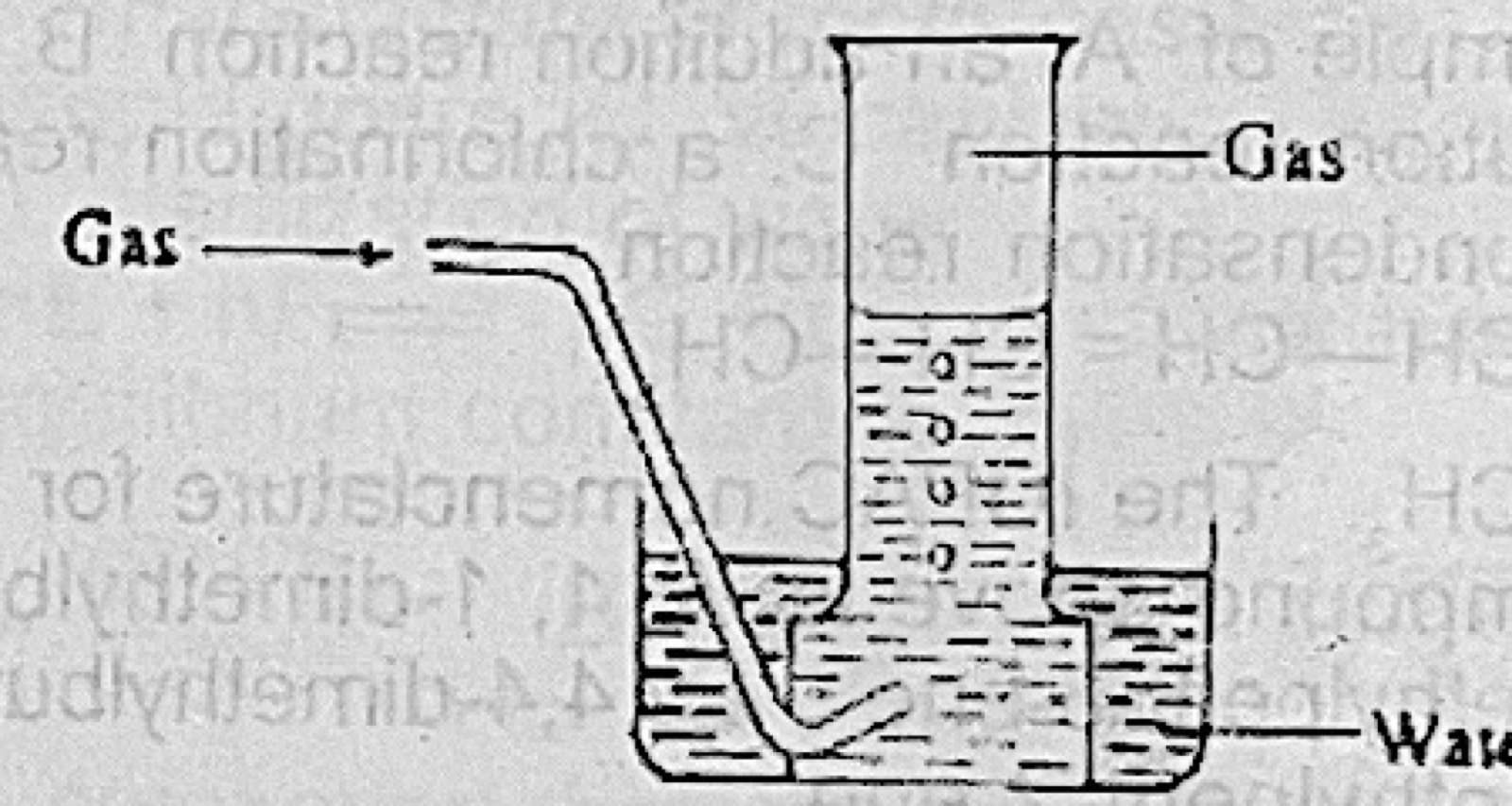
The arrangement above can be used for the collection of
A.sulphur (IV) oxide
B.ammonia
C.nitrogen
D.hydrogen chloride
Show the answer and explanation
Answer: C (nitrogen)
Explanation
The gas is collected over water, which only works for a gas that is nearly insoluble in water. Nitrogen is insoluble, but SO2, NH3 and HCl dissolve readily.
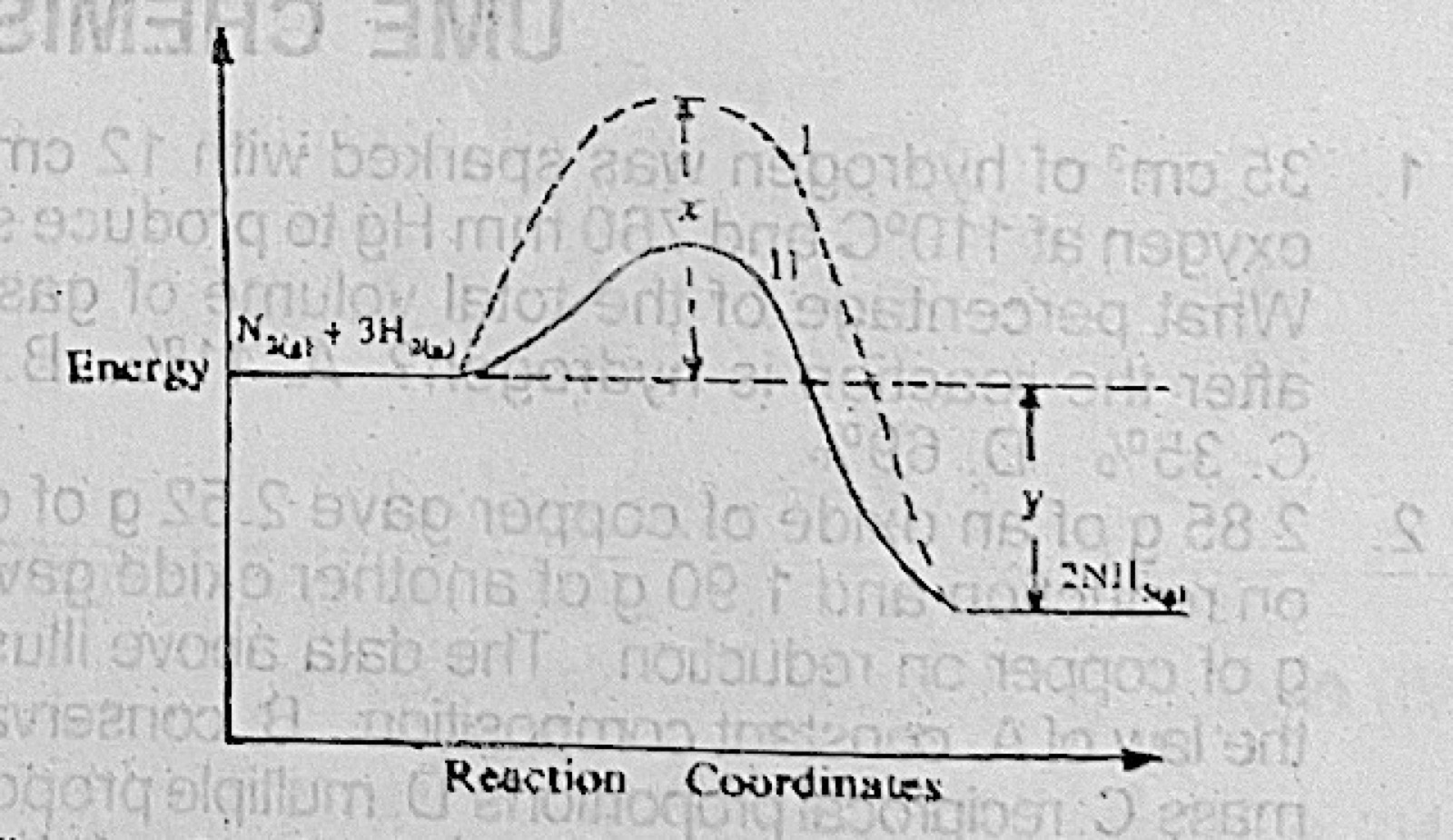
Use the diagram above. The activation energy of the uncatalysed reaction is
A.x
B.x + y
C.x − y
D.y
Show the answer and explanation
Answer: A (x)
Explanation
Activation energy is the height of the energy barrier above the reactants. For the uncatalysed path (I, the higher curve) this is the distance x from the N2 + 3H2 level to the top. y is the enthalpy change.
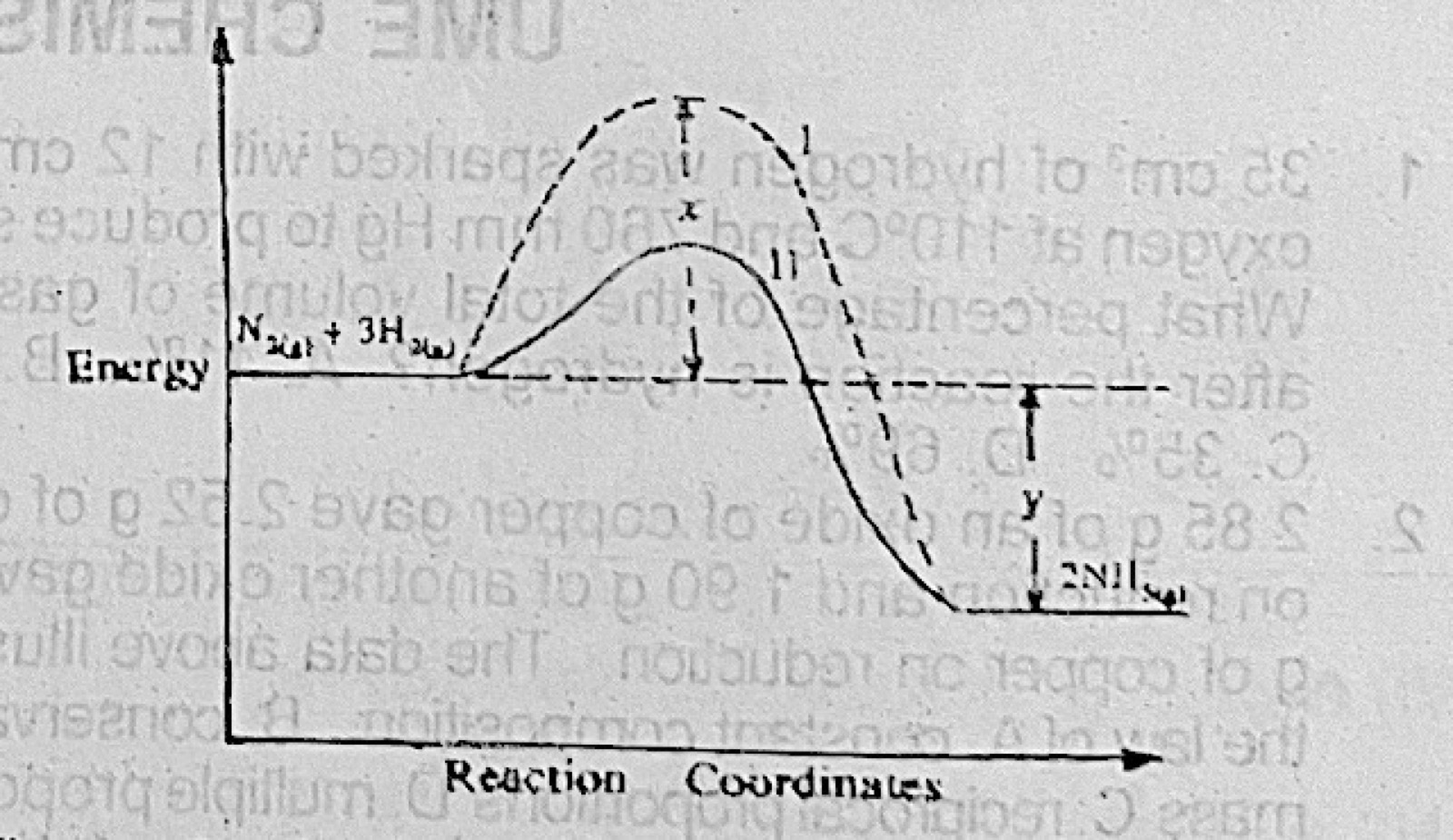
Use the diagram above. It can be deduced that the rate of the reaction
A.for path I is higher than path II
B.for path II is higher than path I
C.is the same for both paths at all temperatures
D.depends on the values of both x and y at all pressures
Show the answer and explanation
Answer: B (for path II is higher than path I)
Explanation
Path II has a lower energy barrier (it is the catalysed path). A lower activation energy means more molecules have enough energy to react, so the reaction is faster.
In the industrial production of hydrogen from natural gas, carbon (IV) oxide produced along with the hydrogen is removed by
A.washing under pressure
B.passing the mixture into lime water
C.using ammoniacal copper (I) chloride
D.drying over phosphorus (V) oxide
Show the answer and explanation
Answer: A (washing under pressure)
Explanation
CO2 is much more soluble in water under pressure than hydrogen is. Washing the gas with water under pressure dissolves the CO2 cheaply on a large scale.
A gas that will turn orange potassium heptaoxodichromate (VI) solution to clear green is
A.sulphur (VI) oxide
B.hydrogen sulphide
C.sulphur (IV) oxide
D.hydrogen chloride
Show the answer and explanation
Answer: C (sulphur (IV) oxide)
Explanation
SO2 reduces orange dichromate(VI) to green chromium(III), giving a clear green solution. H2S also reduces it but leaves a cloudy yellow deposit of sulphur.
CH3—CH(CH3)—CH=CH—CH3 The IUPAC nomenclature for the compound above is
A.1, 1-dimethylbut-2-ene
B.2-methylpent-3-ene
C.4,4-dimethylbut-2-ene
D.4-methylpent-2-ene
Show the answer and explanation
Answer: D (4-methylpent-2-ene)
Explanation
The longest chain has 5 carbons with a double bond. Numbering from the end nearest the double bond puts it at carbon 2 and the methyl group at carbon 4: 4-methylpent-2-ene.
Aromatic and aliphatic hydrocarbons can be distinguished from each other by the
A.action of bromine
B.use of polymerization reaction
C.action of heat
D.use of oxidation reaction
Show the answer and explanation
Answer: C (action of heat)
Explanation
Aromatic hydrocarbons such as benzene have a high carbon content and burn with a very smoky, sooty flame, while aliphatic ones burn more cleanly. Bromine does not help, since neither benzene nor alkanes decolourise it readily.
A secondary amine has two alkyl groups on the nitrogen (R2NH). Dibutylamine has two butyl groups; methylamine is primary and trimethylamine is tertiary.
The relatively high boiling points of alkanols are due to
A.ionic bonding
B.aromatic character
C.covalent bonding
D.hydrogen bonding
Show the answer and explanation
Answer: D (hydrogen bonding)
Explanation
The –OH groups of neighbouring alkanol molecules form hydrogen bonds, which need extra energy to break, so alkanols boil higher than alkanes of similar mass.