20 cm3 of hydrogen gas are sparked with 20 cm3 of oxygen gas in an endiometer at 373 K (100°C) and 1 atmosphere. The resulting mixture is cooled to 298 K (25°C) and passed over calcium chloride. The volume of the residual gas is
A.40 cm3
B.20 cm3
C.30 cm3
D.10 cm3
E.5 cm3
Show the answer and explanation
Answer: D (10 cm3)
Explanation
2H2 + O2 → 2H2O, so 20 cm3 of hydrogen uses only 10 cm3 of oxygen. The water is condensed and absorbed by calcium chloride, leaving 10 cm3 of unused oxygen.
Which among the elements 1. Carbon 2. Oxygen 3. Copper 4. Bromine 5. Zinc, will NOT react with either water or steam?
A.1 and 2
B.2 and 3
C.3 and 4
D.1, 2 and 3
E.2, 3 and 5
Show the answer and explanation
Answer: B (2 and 3)
Explanation
Red-hot carbon reacts with steam (water gas), zinc reacts with steam, and bromine reacts slightly with water. Oxygen and copper do not react with water or steam.
Which combination of the following statements is correct? 1. lowering the activation energy 2. conducting the reaction in a gaseous state 3. increasing the temperature 4. removing the products as soon as they are formed 5. powdering the reactant if solid
A.1, 2 and 3
B.1, 3 and 5
C.2, 3 and 5
D.3 and 4
E.3 and 5
Show the answer and explanation
Answer: B (1, 3 and 5)
Explanation
The rate of a reaction is increased by lowering the activation energy (a catalyst), raising the temperature and increasing the surface area of a solid by powdering it. Removing products changes the yield at equilibrium, not the rate.
Which of the following mixtures would result in a solution of pH greater than 7?
A.25.00 cm3 of 0.05 M H2SO4 and 25.00 cm3 of 0.50 M Na2CO3
B.25.00 cm3 of 0.05 M H2SO4 and 25.00 cm3 of 0.10 M NaHCO3
C.25.00 cm3 of 0.11 M H2SO4 and 25.00 cm3 of 0.10 M NaOH
D.25.00 cm3 of 0.11 M H2SO4 and 50.00 cm3 of 0.05 M NaOH
E.25.00 cm3 of 0.25 M H2SO4 and 50.00 cm3 of 0.20 M NaOH.
Show the answer and explanation
Answer: A (25.00 cm3 of 0.05 M H2SO4 and 25.00 cm3 of 0.50 M Na2CO3)
Explanation
In A there are only 1.25 mmol of H2SO4 but 12.5 mmol of Na2CO3, so excess carbonate makes the solution alkaline. In C, D and E the acid is in excess, and in B the acid and hydrogencarbonate just neutralise each other.
A reducing agent is itself oxidised. In D, H2O2 is oxidised to O2 while PbO2 (lead +4) is reduced to Pb(NO3)2 (lead +2). In the others H2O2 is reduced to water, so it is the oxidising agent.
For the reactions: (I) Melon oil + NaOH ⇌ Soap + Glycerol (II) 3Fe + 4H2O ⇌ Fe3O4 + 4H2 (III) N2O4 ⇌ 2NO2, which of the following satements is true?
A.Each of the three reactions requires a catalyst
B.All the reactions demonstrate Le Chatelier's principle.
C.The presence of a catalyst will increase the yield of the products
D.Increase in pressure will result in higher yields of the products in I and II only
E.Increase in pressure will result in higher yields of the products in III only.
Show the answer and explanation
Answer: B (All the reactions demonstrate Le Chatelier's principle.)
Explanation
All three are reversible reactions at equilibrium, so each responds to changes as Le Chatelier's principle predicts. A catalyst never changes the yield, and higher pressure would lower the yield in III, which makes more gas molecules.
E.is usually stored in the form of sticks in water.
Show the answer and explanation
Answer: C (burns with a blue flame)
Explanation
Sulphur burns in air with a blue flame to form sulphur (IV) oxide. Its oxides are acidic, it does not conduct, and it is white phosphorus, not sulphur, that is kept under water.
An organic compound with a vapour density 56.5 has the following percentage composition: C = 53.1%, N = 12.4%, O = 28.3%, H = 6.2%. The molecular formula of the compound is (Relative atomic masses: N = 14, O = 16, C = 12, H = 1)
A.C3H6O2N
B.C5H6O2N
C.(C5H7O2N)½
D.C5H7O2N
E.(C5H7O2N)2
Show the answer and explanation
Answer: D (C5H7O2N)
Explanation
Moles: C 53.1/12 = 4.43, N 12.4/14 = 0.886, O 28.3/16 = 1.77, H 6.2/1 = 6.2; dividing by 0.886 gives C5H7O2N (mass 113). Relative molecular mass = 2 × 56.5 = 113, so the molecular formula is C5H7O2N.
A.Fractional distillation of crude petroleum will give the following hydrocarbon fuels in order of increasing boiling point: Butane < petrol < kerosene
B.H2C=CH2 will serve as a monomer in the preparation of polythene.
C.Both but-1-ene and but-1-yne will decolorize bromine readily
D.But-2-ene will react with chlorine to form 2, 3-dichlorobutane.
E.Calcium carbide will react with water to form any alkyne
Show the answer and explanation
Answer: E (Calcium carbide will react with water to form any alkyne)
Explanation
Calcium carbide and water give only one alkyne, ethyne (CaC2 + 2H2O → C2H2 + Ca(OH)2). The other statements are true.
Which of the following statements is NOT correct about all four of the acids: HBr, HNO3, H2CO3 and H2SO4? They
A.dissolve marble to liberate CO2
B.have a pH less than 7
C.turn blue litmus red
D.neutralize alkalis to form salt
E.react with magnesium to liberate hydrogen
Show the answer and explanation
Answer: A (dissolve marble to liberate CO2)
Explanation
Carbonic acid is too weak to release CO2 from marble, and H2SO4 soon stops reacting because insoluble CaSO4 coats the marble. So A is not true of all four.
If the cost of electricity required to deposit 1 g of magnesium is N5.00, how much would it cost to deposit 10g of aluminium? (Relative atomic masses: Al = 27, Mg = 24)
A.N10.00
B.N27.00
C.N44.44
D.N66.67
E.N33.33.
Show the answer and explanation
Answer: D (N66.67)
Explanation
1 g of Mg (Mg2+) needs 2/24 = 0.0833 F. 10 g of Al (Al3+) needs 3 × 10/27 = 1.111 F, which is 13.33 times as much, so the cost is 13.33 × N5.00 = N66.67.
31R 199U 2412S 2010T 179Y. Which of the following statements is NOT true of the elements R, U, S, T, Y?
A.R is an isotope of hydrogen
B.U and Y are isotopes
C.R, U, S and T are metals
D.T is a noble gas
E.S will react with oxygen to form SO.
Show the answer and explanation
Answer: C (R, U, S and T are metals)
Explanation
R (atomic number 1) is hydrogen, U and Y (atomic number 9) are fluorine and T (10) is neon, none of which is a metal. Only S (12, magnesium) is a metal, so C is false.
Nitrogen can best be obtained from a mixture of oxygen and nitrogen by passing the mixture over
A.potassium hydroxide
B.heated gold
C.heated magnesium
D.heated phosphorus
E.calcium chloride
Show the answer and explanation
Answer: D (heated phosphorus)
Explanation
Heated phosphorus combines with the oxygen and removes it, leaving nitrogen. Heated magnesium would also react with the nitrogen, and gold, KOH and CaCl2 do not remove oxygen.
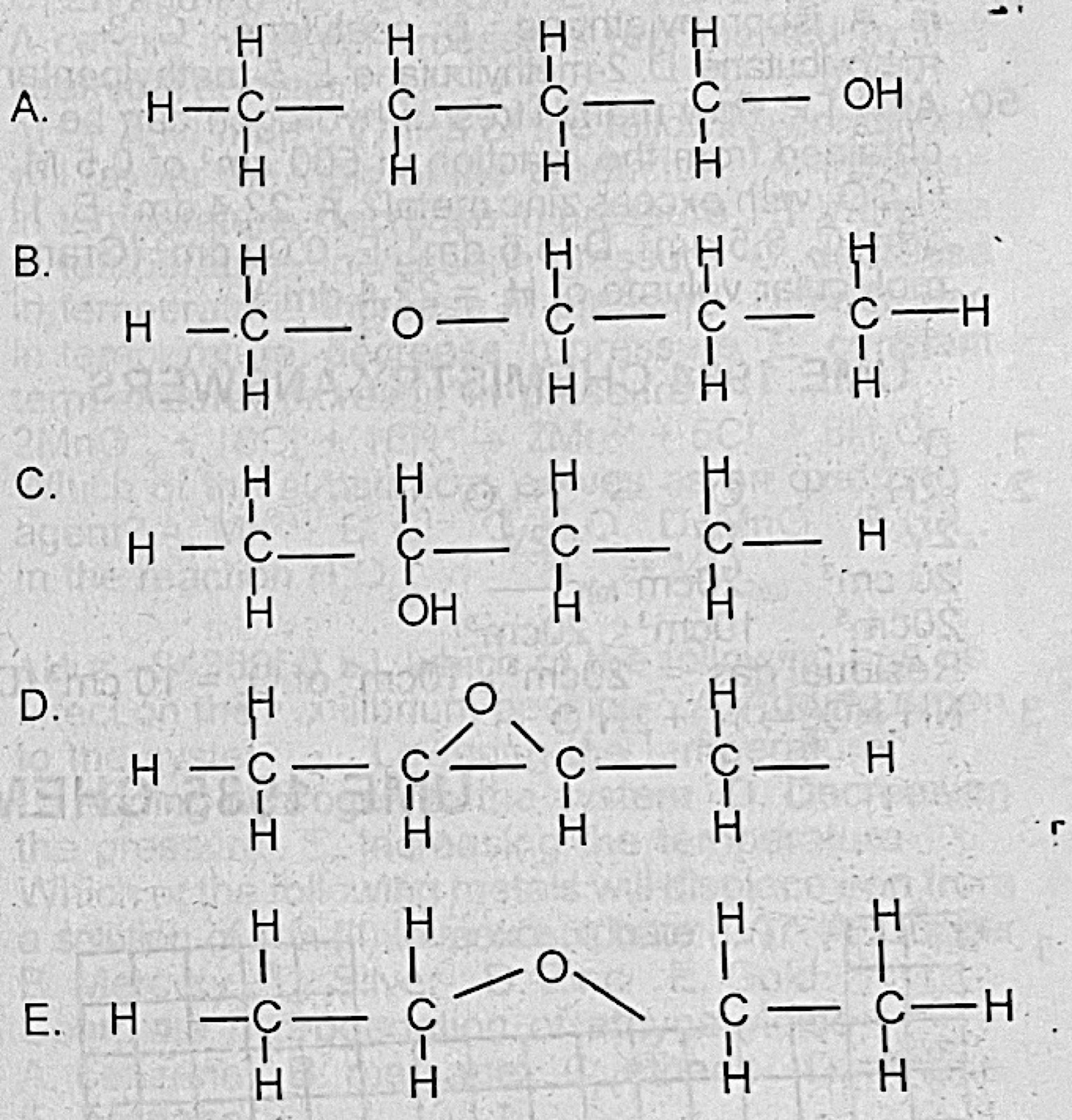
Which of the following structural formulae is NOT isomeric with the others?
A.CH3CH2CH2CH2OH
B.CH3–O–CH2CH2CH3
C.CH3CH(OH)CH2CH3
D.CH3–CH–CH–CH3 with an O bridging the two middle carbons
E.CH3CH2–O–CH2CH3
Show the answer and explanation
Answer: D (CH3–CH–CH–CH3 with an O bridging the two middle carbons)
Explanation
A, B, C and E all have the formula C4H10O. D has the oxygen in a ring between two carbons, so it has only 8 hydrogens (C4H8O) and is not an isomer of the others.
If an excess of a liquid hydrocarbon is poured into a jar of chlorine, and the sealed jar is then exposed for several hours to bright sunlight, all the chlorine gas is consumed. The hydrocarbon is said to have undergone
A.a polymerization reaction
B.an isomerization reaction
C.an addition reaction
D.a substitution reaction
E.a reduction reaction
Show the answer and explanation
Answer: D (a substitution reaction)
Explanation
A saturated hydrocarbon reacts with chlorine only in sunlight, and chlorine atoms replace hydrogen atoms one by one. That is a substitution reaction.
A piece of sea shell, when dropped into a dilute solution of hydrochloric acid, produces a colourless, odourless gas which turns clear limewater milky. The sea shell contains
A.sodium chloride
B.ammonium nitrate
C.calcium carbonate
D.calcium chloride
E.magnesium chloride
Show the answer and explanation
Answer: C (calcium carbonate)
Explanation
The gas that turns limewater milky is CO2, which comes from a carbonate reacting with acid. Sea shells are made of calcium carbonate.
An aqueous solution of a metal salt, M, gives a white precipitate with NaOH which dissolves in excess NaOH. With aqueous ammonia, the solution of M also gives a white precipitate which dissolves in excess ammonia. Therefore the cation in M is
A.Zn2+
B.Ca2+
C.Al3+
D.Pb2+
E.Cu2+
Show the answer and explanation
Answer: A (Zn2+)
Explanation
Zn(OH)2 is white and dissolves in excess of both NaOH and ammonia. Al(OH)3 and Pb(OH)2 do not dissolve in excess ammonia, and copper gives a blue precipitate.
At S.T.P. how many litres of hydrogen can be obtained from the reaction of 500 cm3 of 0.5 M H2SO4 with excess zinc metal? (Gram molecular volume of H2 = 22.4 dm3).