JAMB Chemistry 1981 past questions and answers

50 questions. Try each one, then open the answer to check yourself and read the explanation.

Question 1

Atomic Structure

An element X has 127 neutrons and 82 electrons. Its atomic number is

  1. A.209
  2. B.105
  3. C.45
  4. D.82
  5. E.127
Show the answer and explanation

Answer: D (82)

Explanation

A neutral atom has as many protons as electrons, so X has 82 protons. The atomic number is the number of protons, 82.

Open this question

Question 2

Carbon and its Compounds

When a bottle of Coca-Cola is opened, bubbles of gas evolve. The gas is

  1. A.hydrogen
  2. B.carbon monoxide
  3. C.carbon dioxide
  4. D.sulphur dioxide
  5. E.chlorine
Show the answer and explanation

Answer: C (carbon dioxide)

Explanation

Fizzy drinks are made by dissolving carbon dioxide under pressure. When the bottle is opened the pressure falls and the CO2 comes out as bubbles.

Open this question

Question 3

Atomic Structure

Which of the following is the electronic configuration of sodium? (Atomic number of Na = 11)

  1. A.1s2 2s2 2p6 3s2
  2. B.1s2 2s2 2p6 3s2 3p1
  3. C.1s2 2s2 2p6 3s1
  4. D.1s2 2s2 2p6 3s0
  5. E.1s2 2s2 2p6 3s2 3p6 4s1
Show the answer and explanation

Answer: C (1s2 2s2 2p6 3s1)

Explanation

Sodium has 11 electrons: 2 fill 1s, 2 fill 2s, 6 fill 2p and the last one goes into 3s, giving 1s2 2s2 2p6 3s1.

Open this question

Question 4

Introduction to Organic Chemistry

Methane is a member of the homologous series called

  1. A.alkenes
  2. B.alcohols
  3. C.esters
  4. D.alkanes
  5. E.alkynes
Show the answer and explanation

Answer: D (alkanes)

Explanation

Methane, CH4, is the first member of the alkanes (general formula CnH2n+2).

Open this question

Question 5

Carbon and its Compounds

When a glowing splint is inserted into the mouth of a jar containing a gas, the splint is extinguished. The gas gives a white precipitate when passing into barium hydroxide. The gas is

  1. A.methane
  2. B.hydrogen chloride
  3. C.hydrogen
  4. D.nitrogen
  5. E.carbondioxide
Show the answer and explanation

Answer: E (carbondioxide)

Explanation

Carbon dioxide does not support burning, so it puts out the splint, and it reacts with barium hydroxide to form a white precipitate of barium carbonate.

Open this question

Question 6

Electrolysis

An example of a strong electrolyte is

  1. A.ethyl acetate
  2. B.ethanol
  3. C.glucose
  4. D.sodium formate
  5. E.formic acid
Show the answer and explanation

Answer: D (sodium formate)

Explanation

Sodium formate is a salt, so it is fully ionised in water and is a strong electrolyte. Formic acid is a weak acid, and the other three are non-electrolytes.

Open this question

Question 7

Redox Reactions

The oxidation state of manganese in KMnO4 is

  1. A.+1
  2. B.+3
  3. C.+5
  4. D.+7
  5. E.+2
Show the answer and explanation

Answer: D (+7)

Explanation

K is +1 and four O atoms give −8, so Mn + 1 − 8 = 0 and Mn = +7.

Open this question

Question 8

Metals and their Compounds

For iron to rust, there should be present

  1. A.oxygen
  2. B.moisture
  3. C.carbondioxide
  4. D.oxygen and moisture
  5. E.oxygen, moisture and carbondioxide
Show the answer and explanation

Answer: D (oxygen and moisture)

Explanation

Rusting needs both oxygen (air) and water. Carbon dioxide speeds it up but is not required.

Open this question

Question 9

Atomic Structure

The mass number of an atom is

  1. A.the number of electrons in the atom
  2. B.the number of protons in the nucleus of the atom
  3. C.the number of neutrons in the nucleus of the atom
  4. D.the sum of numbers of electrons and protons in the atom
  5. E.the sum of the numbers of protons and neutrons in the nucleus of the atom
Show the answer and explanation

Answer: E (the sum of the numbers of protons and neutrons in the nucleus of the atom)

Explanation

The mass number counts the particles in the nucleus: protons plus neutrons.

Open this question

Question 10

Atomic Structure

Sodium and potassium belong to the same group of the Periodic Table. This is because

  1. A.both are metals
  2. B.both are soft and lighter than water
  3. C.both form cations by losing electrons
  4. D.both have identical electronic configuration
  5. E.both react with water vigorously
Show the answer and explanation

Answer: D (both have identical electronic configuration)

Explanation

Elements in the same group have the same outer-shell electron arrangement. Sodium (2,8,1) and potassium (2,8,8,1) each have one electron in the outer shell, which is what the option means by 'identical' configuration.

Open this question

Question 11

Mole Concept and Stoichiometry

In the reaction of oxygen with hydrogen to produce water, which of the following statements is true?

  1. A.One atom of hydrogen reacts with two atoms of oxygen to give one molecule of water.
  2. B.Two atoms of hydrogen react with two atoms of oxygen to give two molecules of water
  3. C.One molecule of oxygen reacts with one molecule of hydrogen to give two molecules of water
  4. D.One molecule of hydrogen reacts with two molecules of oxygen to give three molecules of water
  5. E.One molecule of oxygen reacts with two molecules of hydrogen to give two molecules of water.
Show the answer and explanation

Answer: E (One molecule of oxygen reacts with two molecules of hydrogen to give two molecules of water.)

Explanation

The balanced equation is 2H2 + O2 → 2H2O: two molecules of hydrogen and one of oxygen give two molecules of water.

Open this question

Question 12

Redox Reactions

Oxidation is the process of

  1. A.gain of electrons
  2. B.loss of electrons
  3. C.gain of hydrogen
  4. D.loss of oxygen
  5. E.addition of an electropositive element to a substance.
Show the answer and explanation

Answer: B (loss of electrons)

Explanation

In electron terms, oxidation is loss of electrons (OIL RIG). The other options describe reduction.

Open this question

Question 13

Mole Concept and Stoichiometry

The number of atoms in one mole of a substance is equal to

  1. A.the atomic number
  2. B.the Avogadro number
  3. C.the gas constant
  4. D.the number of neutrons
  5. E.the number of electrons.
Show the answer and explanation

Answer: B (the Avogadro number)

Explanation

One mole of an element contains 6.02 × 10²³ atoms, the Avogadro number.

Open this question

Question 14

Chemical Bonding

Which of the following statements is NOT true of electrovalent compounds?

  1. A.They are solids
  2. B.They do not vaporize easily
  3. C.They usually dissolve in water
  4. D.The elements forming the compounds normally have their valency electrons in a shared state
  5. E.They conduct electricity
Show the answer and explanation

Answer: D (The elements forming the compounds normally have their valency electrons in a shared state)

Explanation

In electrovalent (ionic) compounds electrons are transferred, not shared. Sharing electrons describes covalent compounds.

Open this question

Question 15

Sulphur and its Compounds

If concentrated sulphuric acid is added to sugar and warmed gently, the sugar changes from white to brown and finally to a black mass of carbon. In this reaction, concentrated sulphuric acid is acting as

  1. A.a drying agent
  2. B.an oxidizing agent
  3. C.a dehydrating agent
  4. D.a reducing agent
  5. E.a hydrolysing agent.
Show the answer and explanation

Answer: C (a dehydrating agent)

Explanation

The acid removes the elements of water (H and O in a 2:1 ratio) from the sugar, leaving carbon. That is dehydration.

Open this question

Question 16

Redox Reactions

In the reaction C + 2HNO3 → CO2 + NO2 + NO + H2O nitric acid is acting as

  1. A.a reducing agent
  2. B.a nitrating agent
  3. C.an oxidizing agent
  4. D.a catalytic agent
  5. E.a neutralizing agent
Show the answer and explanation

Answer: C (an oxidizing agent)

Explanation

Carbon goes from 0 to +4 (oxidised) while nitrogen goes from +5 to +4 and +2 (reduced), so nitric acid is the oxidizing agent.

Open this question

Question 17

Nitrogen and its Compounds

The brown coloration in the nitric acid prepared in the laboratory can be removed by

  1. A.heating the acid
  2. B.bubbling air through the acid
  3. C.cooling the acid
  4. D.adding a decolorizing agent
  5. E.adding a base
Show the answer and explanation

Answer: B (bubbling air through the acid)

Explanation

The brown colour is dissolved nitrogen(IV) oxide. Blowing air through the acid sweeps it out (and oxidises it back to the acid).

Open this question

Question 18

Electrolysis

Which of the following processes takes place during electrolysis?

  1. A.Positive ions are discharged at the anode by gaining sufficient electrons to become neutral
  2. B.Negative ions are discharged at the anode by gaining sufficient electrons to become neutral
  3. C.Positive ions are discharged at the anode by losing sufficient electrons to become neutral
  4. D.Negative ions are discharged at the anode by losing sufficient electrons to become neutral
  5. E.Nothing happens.
Show the answer and explanation

Answer: D (Negative ions are discharged at the anode by losing sufficient electrons to become neutral)

Explanation

Anions move to the anode and give up their extra electrons there, becoming neutral atoms or molecules.

Open this question

Question 19

Nitrogen and its Compounds

In the preparation of ammonia, which of the following is used as the drying agent?

  1. A.CaO
  2. B.CaCl2
  3. C.Conc. H2SO4
  4. D.P2O5
  5. E.H3PO4
Show the answer and explanation

Answer: A (CaO)

Explanation

Ammonia is basic, so it is dried with quicklime (CaO). Acidic driers react with it and CaCl2 forms a complex with it.

Open this question

Question 20

Introduction to Organic Chemistry

Which of the following can have an isomer?

  1. A.C2H4
  2. B.C4H10
  3. C.C3H8
  4. D.C2H6
  5. E.C6H6
Show the answer and explanation

Answer: B (C4H10)

Explanation

C4H10 can be a straight chain (butane) or branched (2-methylpropane). The smaller alkanes and ethene have only one possible structure.

Open this question

Question 21

Carbon and its Compounds

Allotropes are elements having

  1. A.different physical but the same chemical properties
  2. B.different chemical but the same physical properties
  3. C.the same chemical and physical properties
  4. D.different atomic structures
  5. E.the same position in the periodic table.
Show the answer and explanation

Answer: A (different physical but the same chemical properties)

Explanation

Allotropes are different forms of the same element, e.g. diamond and graphite: their physical properties differ but they react the same way.

Open this question

Question 22

Polymers

A polymerization reaction is one in which

  1. A.small molecules form giant molecules
  2. B.atoms form molecules
  3. C.giant molecules form small molecules
  4. D.molecules form volatile compounds
  5. E.a molecule rearranges itself.
Show the answer and explanation

Answer: A (small molecules form giant molecules)

Explanation

In polymerization many small molecules (monomers) join to make one very large molecule (a polymer).

Open this question

Question 23

Mole Concept and Stoichiometry

Na2CO3 + 2HCl → 2NaCl + H2O + CO2. Using the above equation, what volume of carbondioxide, measured at s.t.p is liberated when 53 g of sodium carbonate is dissolved in hydrochloric acid? (1 mole of gas occupies 22.4 dm3 at s.t.p) (Na = 23, C = 12, O = 16)

  1. A.44.8 dm3
  2. B.11.2 dm3
  3. C.3.0 dm3
  4. D.100.1 dm3
  5. E.22.4 dm3
Show the answer and explanation

Answer: B (11.2 dm3)

Explanation

Molar mass of Na2CO3 = 106 g, so 53 g is 0.5 mol. It gives 0.5 mol CO2 = 0.5 × 22.4 = 11.2 dm3.

Open this question

Question 24

Energy Changes

When sodium nitrite dissolves in water, ΔH is positive. This means that

  1. A.the reaction is catalysed
  2. B.the reaction is complete
  3. C.the reaction is exothermic
  4. D.the reaction is endothermic
  5. E.sodium nitrite is highly soluble in water
Show the answer and explanation

Answer: D (the reaction is endothermic)

Explanation

A positive ΔH means heat is taken in from the surroundings, which is an endothermic change.

Open this question

Question 25

Introduction to Organic Chemistry

If an organic compound decolorizes bromine water then the compound is

  1. A.saturated
  2. B.supersaturated
  3. C.unsaturated
  4. D.a solid
  5. E.protonated
Show the answer and explanation

Answer: C (unsaturated)

Explanation

Bromine adds across C=C or C≡C bonds, removing its colour, so decolorizing bromine water shows the compound is unsaturated.

Open this question

Question 26

Gas Laws

When air is compressed

  1. A.its density decreases
  2. B.it solidifies
  3. C.its temperature decreases
  4. D.its temperature increases
  5. E.its temperature remains unchanged.
Show the answer and explanation

Answer: D (its temperature increases)

Explanation

Work is done on the gas when it is squeezed, so its molecules move faster and its temperature rises (a bicycle pump gets warm). Its density increases, not decreases.

Open this question

Question 27

Fats, Oils and Soaps

Fats and oils are

  1. A.addition products of long-chain fatty acids and alkali
  2. B.addition products of long-chain fatty acids and glycerol
  3. C.condensation products of long-chain fatty acids and glycerol
  4. D.condensation products of formaldehyde and glycerol
  5. E.liquids at 20°C
Show the answer and explanation

Answer: C (condensation products of long-chain fatty acids and glycerol)

Explanation

Fats and oils are esters formed when fatty acids react with glycerol, losing water; reactions that eliminate water are condensation reactions.

Open this question

Question 28

Carbon and its Compounds

Which of the following statements about phosphorus is NOT correct?

  1. A.Phosphorus is a solid mineral
  2. B.Phosphorus is obtained by oxidation of phosphates
  3. C.Phosphorus exists in two allotropic forms
  4. D.Both forms of phosphorus are interconvertible
  5. E.Yellow phosphorus ignites when rubbed on a rough surface.
Show the answer and explanation

Answer: B (Phosphorus is obtained by oxidation of phosphates)

Explanation

Phosphorus is extracted by reducing calcium phosphate with coke (and sand) in an electric furnace, not by oxidation. Yellow phosphorus is very easily ignited, so E is true.

Open this question

Question 29

Electrolysis

If 48,000 coulombs of electricity are required to discharge 0.5 mole of sodium from a molten sodium chloride mass, then the number of coulombs required to discharge 2 moles of lead from molten lead (II) chloride is

  1. A.48,000
  2. B.96,000
  3. C.192,000
  4. D.384,000
  5. E.576,000
Show the answer and explanation

Answer: D (384,000)

Explanation

Na+ needs 1 mol of electrons per mole, so 1 mol of electrons is 96,000 C here. Pb2+ needs 2 mol of electrons per mole, so 2 mol Pb needs 4 × 96,000 = 384,000 C.

Open this question

Question 30

Gas Laws

28.8 cm3 of nitrogen at 15°C is cooled to 0°C at constant pressure, the new volume of nitrogen is

  1. A.17.4 cm3
  2. B.14.7 cm3
  3. C.27.3 cm3
  4. D.31.7 cm3
  5. E.34.7 cm3
Show the answer and explanation

Answer: C (27.3 cm3)

Explanation

Charles' law: V2 = 28.8 × 273/288 = 27.3 cm3 (temperatures in kelvin).

Open this question

Question 31

Chemical Formulae and Equations

In an experiment 5.00 g of a metal gave 10.59 g of its chloride. In another experiment, 1.50 g of the same metal combined with 1.68 g of chlorine. The above data illustrates

  1. A.Law of Conservation of Mass
  2. B.Law of Definite Proportion
  3. C.Law of Multiple Proportion
  4. D.Gay Lussac's Law
  5. E.Avogadro's Law
Show the answer and explanation

Answer: B (Law of Definite Proportion)

Explanation

Chlorine per gram of metal is 5.59/5.00 = 1.12 in the first experiment and 1.68/1.50 = 1.12 in the second. The same fixed ratio shows the law of definite proportions.

Open this question

Question 32

Sulphur and its Compounds

The products of the reaction between dilute sulphuric acid and sodium thiosulphate crystals are

  1. A.Na2SO4 + SO2 + O2 + H2O
  2. B.Na2SO3 + SO3 + O2 + H2O
  3. C.Na2SO4 + SO2 + S + H2O
  4. D.Na2SO4 + SO3 + S + H2O
  5. E.Na2SO4 + SO2 + H2O only
Show the answer and explanation

Answer: C (Na2SO4 + SO2 + S + H2O)

Explanation

Na2S2O3 + H2SO4 → Na2SO4 + SO2 + S + H2O; the yellow sulphur precipitate is the well-known sign of this reaction.

Open this question

Question 33

Kinetic Theory and States of Matter

The following compounds are given with their corresponding boiling points
Compound I: 14°C
Compound II: 24°C
Compound III: 0°C
Compound IV: 120°C
Compound V: −2°C
From the above information, indicate which of the following is correct

  1. A.All the compounds are gaseous at 20°C.
  2. B.One of the compounds is gaseous at 20°C.
  3. C.Two of the compounds are gaseous at 20°C
  4. D.Three of the compounds are gaseous at 20°C
  5. E.None of the compounds is gaseous at 20°C
Show the answer and explanation

Answer: D (Three of the compounds are gaseous at 20°C)

Explanation

A substance is a gas at 20°C if its boiling point is below 20°C. That is true for I (14°C), III (0°C) and V (−2°C): three compounds.

Open this question

Question 34

Gas Laws

Which of the following is NOT a true statement of the Kinetic Theory of Gases?

  1. A.The molecules move at random
  2. B.The size of molecules is negligible as compared with the volume of gas
  3. C.The molecular collisions are perfectly elastic
  4. D.Every molecule has the same kinetic energy at a particular temperature
  5. E.The average kinetic energy is proportional to the absolute temperature of the gas.
Show the answer and explanation

Answer: D (Every molecule has the same kinetic energy at a particular temperature)

Explanation

Molecules in a gas have a spread of speeds and energies; only their average kinetic energy is fixed by the temperature.

Open this question

Question 35

Atomic Structure

The electronic configuration of elements X and Y are X = 2, 8, 6; Y = 2, 8, 7. The bond in the compound formed by X and Y is expected to be

  1. A.ionic
  2. B.covalent
  3. C.dative covalent
  4. D.metallic
  5. E.none of the above.
Show the answer and explanation

Answer: B (covalent)

Explanation

X (sulphur) and Y (chlorine) are both non-metals that need electrons, so they share electrons and form covalent bonds.

Open this question

Question 36

Solubility and Solutions

5 cm3 of a saturated solution of sodium chloride at 30°C gave, on careful evaporation, 1.95 g of solid salt. The solubility of sodium chloride at 30°C is (Na = 23, Cl = 35.5)

  1. A.5.00 mole dm−3
  2. B.5.67 mole dm−3
  3. C.6.00 mole dm−3
  4. D.6.67 mole dm−3
  5. E.7.00 mole dm−3.
Show the answer and explanation

Answer: D (6.67 mole dm−3)

Explanation

1.95 g in 5 cm3 is 390 g per dm3. Dividing by the molar mass 58.5 g gives 6.67 mol dm−3.

Open this question

Question 37

Metals and their Compounds

In the extraction of iron, which of the following reactions does NOT take place in the blast furnace?

  1. A.CO2 + C → 2CO
  2. B.2Fe2O3 + 3C → 4Fe + 3CO2
  3. C.Fe2O3 + 3CO → 2Fe + 3CO2
  4. D.CaCO3 → CaO + CO2
  5. E.CaO + SiO2 → CaSiO3.
Show the answer and explanation

Answer: B (2Fe2O3 + 3C → 4Fe + 3CO2)

Explanation

In the blast furnace the ore is reduced by carbon monoxide, not directly by carbon to CO2. The other reactions make the CO and remove the sand impurity as slag.

Open this question

Question 38

Mole Concept and Stoichiometry

Pure sulphuric acid is a liquid of 1.84 density. What volume of it would be required to prepare 250 cm3 of 0.2 M solution? (H = 1, S = 32, O = 16)

  1. A.2.00
  2. B.2.66
  3. C.3.00
  4. D.3.66
  5. E.4.00
Show the answer and explanation

Answer: B (2.66)

Explanation

Moles needed = 0.250 × 0.2 = 0.05 mol, which is 0.05 × 98 = 4.9 g. Volume = mass/density = 4.9/1.84 = 2.66 cm3.

Open this question

Question 39

Mole Concept and Stoichiometry

What mass of sodium carbonate is in 500 cm3 of 0.1 molar sodium carbonate solution? (Na = 23, C = 12, O = 16)

  1. A.10.6 g
  2. B.5.3 g
  3. C.500 g
  4. D.10 g
  5. E.20 g
Show the answer and explanation

Answer: B (5.3 g)

Explanation

Moles = 0.5 dm3 × 0.1 mol dm−3 = 0.05 mol; mass = 0.05 × 106 = 5.3 g.

Open this question

Question 40

Separation of Mixtures

Which of the following compounds and elements would sublime on exposure to the atmosphere?

  1. A.Ice
  2. B.Sulphur
  3. C.Phosphorus
  4. D.Iodine
  5. E.Potassium iodide
Show the answer and explanation

Answer: D (Iodine)

Explanation

Iodine crystals turn straight into violet vapour without melting, i.e. they sublime.

Open this question

Question 41

Sulphur and its Compounds

When hydrogen sulphide and sulphur dioxide are each passed in turn into a solution of potassium dichromate

  1. A.both gases change the colour of the solution from yellow to colourless
  2. B.both gases cause sulphur to be deposited
  3. C.only hydrogen sulphide decolorizes the solution
  4. D.only sulphur dioxide deposits sulphur
  5. E.only hydrogen sulphide deposits sulphur.
Show the answer and explanation

Answer: E (only hydrogen sulphide deposits sulphur.)

Explanation

Both gases reduce the dichromate (orange to green), but only H2S is oxidised to solid sulphur; SO2 is oxidised to sulphate ions in solution.

Open this question

Question 42

Metals and their Compounds

Which one of the following metals is not normally extracted by chemical reduction because of its position in the electrochemical series?

  1. A.Copper
  2. B.Iron
  3. C.Lead
  4. D.Potassium
  5. E.Zinc
Show the answer and explanation

Answer: D (Potassium)

Explanation

Potassium is very high in the electrochemical series, so carbon cannot reduce its compounds; it is extracted by electrolysis of the molten compound.

Open this question

Question 43

Mole Concept and Stoichiometry

If 1 mole of aluminium contains 6 × 10²³ atoms of aluminium, how many atoms are contained in 0.9 g of aluminium? (Al = 27)

  1. A.1.0 × 1021
  2. B.6.6 × 1021
  3. C.2.0 × 1022
  4. D.6.0 × 1022
  5. E.5.4 × 1023
Show the answer and explanation

Answer: C (2.0 × 10²²)

Explanation

0.9 g ÷ 27 g/mol = 1/30 mol; 1/30 × 6 × 1023 = 2.0 × 10²² atoms.

Open this question

Question 44

Rates of Reaction

4 g each of aluminium foil and aluminium powder were introduced respectively into flasks P and Q. Flask P was treated with warm bench sodium hydroxide and all the aluminium dissolved in one hour. Flask Q was treated with cold sodium hydroxide and all the aluminium dissolved in 10 minutes. What was responsible for Q reacting faster than P?

  1. A.There were more aluminium atoms in Q than P.
  2. B.The heat given off in P retarded the reaction
  3. C.Q generated more pressure than P during the reaction
  4. D.P generated more pressure than Q.
  5. E.Q has a greater surface area for the reaction than P.
Show the answer and explanation

Answer: E (Q has a greater surface area for the reaction than P.)

Explanation

Both flasks held the same mass of aluminium, but powder exposes far more surface to the alkali than foil, so Q reacted faster even though it was cold.

Open this question

Question 45

Introduction to Organic Chemistry

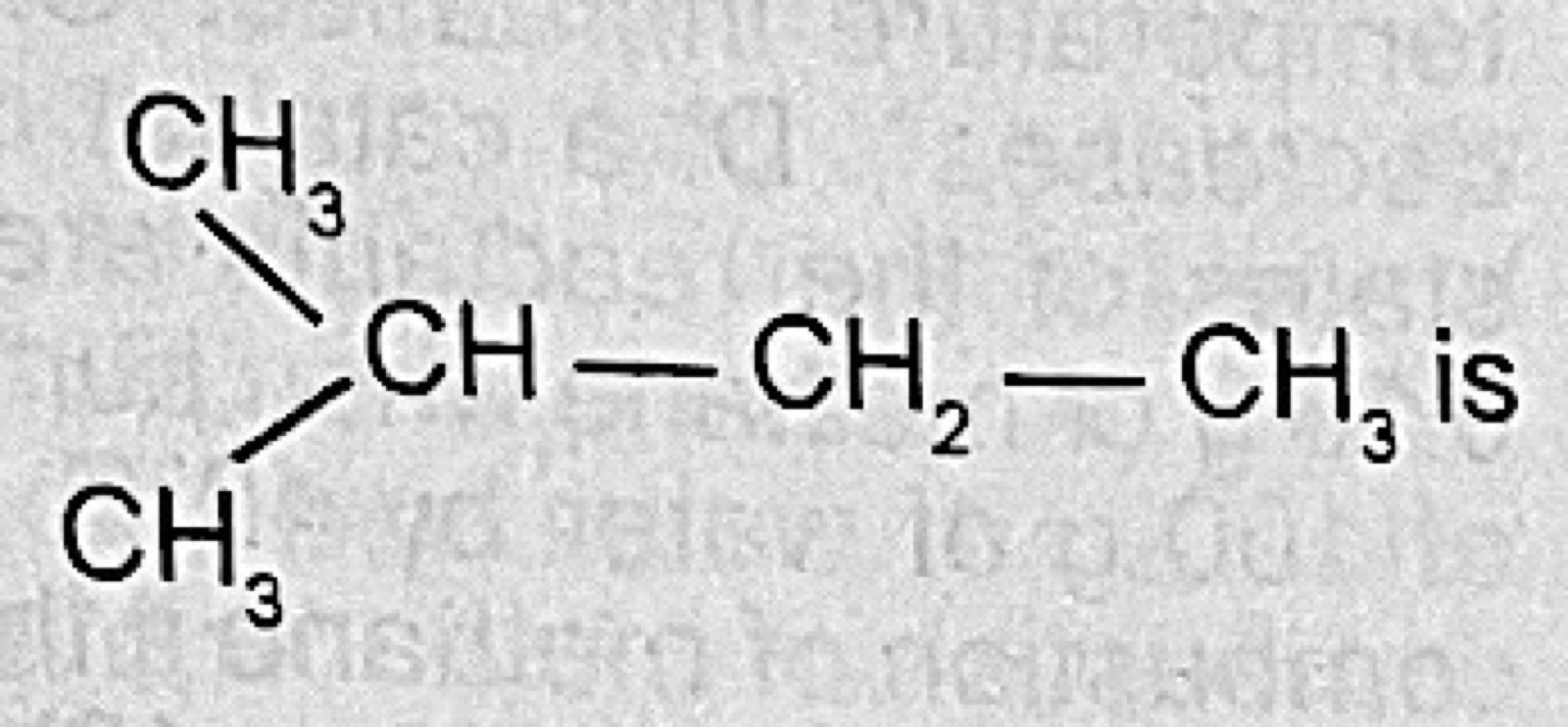
The IUPAC name for (CH3)2CH—CH2—CH3 is

Diagram for this question
  1. A.1-methylpentane
  2. B.3-methylbutane
  3. C.2-methylbutane
  4. D.1-dimethylpropane
  5. E.2-methylpentane
Show the answer and explanation

Answer: C (2-methylbutane)

Explanation

The longest chain has four carbons (butane) and the CH3 branch sits on carbon 2 when numbered from the nearer end, so it is 2-methylbutane.

Open this question

Question 46

Nitrogen and its Compounds

What happens when the nitrates of potassium, calcium, zinc and copper are separately heated?

  1. A.All the nitrates will decompose to their respective metals
  2. B.The nitrates of calcium and potassium will decompose to their nitrites.
  3. C.Only copper nitrate decomposes to the metal
  4. D.Only the nitrates of zinc and copper will decompose to their oxides
  5. E.The nitrates of calcium, zinc and copper decompose to their oxides.
Show the answer and explanation

Answer: E (The nitrates of calcium, zinc and copper decompose to their oxides.)

Explanation

Potassium nitrate (a very reactive metal) gives the nitrite and oxygen; the nitrates of calcium, zinc and copper give the metal oxide, nitrogen(IV) oxide and oxygen.
Open this question

Question 47

Water

The scale formation in a kettle used for boiling water is caused by the presence in water of

  1. A.calcium sulphate
  2. B.calcium carbonate
  3. C.calcium hydrogen carbonate
  4. D.calcium hydroxide
  5. E.magnesium sulphate
Show the answer and explanation

Answer: C (calcium hydrogen carbonate)

Explanation

Dissolved calcium hydrogen carbonate decomposes on boiling to insoluble calcium carbonate, which forms the scale (fur) in kettles.

Open this question

Question 48

Water

An efflorescent compound is a substance that

  1. A.absorbs water from the air without dissolving in it
  2. B.is capable of giving off coloured luminosity
  3. C.gives out water to the atmosphere
  4. D.absorbs water from the air and dissolves in it
  5. E.gives out its water of crystallization on heating
Show the answer and explanation

Answer: C (gives out water to the atmosphere)

Explanation

An efflorescent substance (e.g. washing soda crystals) loses water of crystallization to the atmosphere simply on standing in air, without heating.

Open this question

Question 49

Acids, Bases and Salts

Which of the following represents a precipitation reaction?

  1. A.H2SO4 + NaCl → NaHSO4 + HCl.
  2. B.Fe + H2SO4 → FeSO4 + H2
  3. C.4HCl + MnO2 → MnCl2 + 2H2O + Cl2
  4. D.Na2SO4 + Pb(NO3)2 → PbSO4 + 2NaNO3
  5. E.CuO + 2HCl → CuCl2 + H2O.
Show the answer and explanation

Answer: D (Na2SO4 + Pb(NO3)2 → PbSO4 + 2NaNO3)

Explanation

Lead(II) sulphate is insoluble, so mixing the two soluble salts gives a solid precipitate of PbSO4.

Open this question

Question 50

Introduction to Organic Chemistry

The general formula of an alkyl halide (which X represents the halide) is

  1. A.CnH2n−2X
  2. B.CnH2n+1X
  3. C.CnH2n+2X
  4. D.CnH2nX
  5. E.CnH2n−1
Show the answer and explanation

Answer: B (CnH2n+1X)

Explanation

An alkyl group is an alkane minus one H, CnH2n+1, so an alkyl halide is CnH2n+1X.

Open this question