Which of the following is most advanced in the evolutionary trend of animals?
A.Liverfluke.
B.Earthworm.
C.Snail.
D.Cockroach.
Show the answer and explanation
Answer: D (Cockroach.)
Explanation
Arthropods such as the cockroach have jointed legs, an exoskeleton and a well-developed nervous system, so they are more advanced than flatworms, annelids and molluscs.
Plants that show secondary growth are usually found among the
A.thallophytes
B.pteridophytes
C.monocotyledons
D.dicotyledons.
Show the answer and explanation
Answer: D (dicotyledons.)
Explanation
Dicotyledons have a cambium between xylem and phloem that keeps dividing, so their stems and roots grow thicker (secondary growth). Monocots usually have no cambium.
The fungi are a distinct group of eukaryotes mainly because they have
A.spores
B.no chlorophyll
C.many fruiting bodies
D.sexual and asexual reproduction.
Show the answer and explanation
Answer: B (no chlorophyll)
Explanation
Fungi cannot make their own food because they lack chlorophyll; they feed on dead or living matter. Spores are also made by mosses and ferns, so spores do not set fungi apart.
A function of the hydrochloric acid produced in the human stomach during digestion is to
A.neutralise the effect of bile
B.coagulate milk protein and emulsify fats
C.stop the action of ptyalin
D.break up food into smaller particles.
Show the answer and explanation
Answer: C (stop the action of ptyalin)
Explanation
Ptyalin (salivary amylase) works only in neutral to slightly alkaline conditions; the acid in the stomach stops it working and gives pepsin the acid it needs.
Cellulose is made of many glucose units joined together, so it is a polysaccharide. Glucose is a monosaccharide; sucrose and maltose are disaccharides.
Plant growth can be artificially stimulated by the addition of
A.gibberellin
B.kinin
C.abscisic acid
D.ethylene.
Show the answer and explanation
Answer: A (gibberellin)
Explanation
Gibberellins are growth hormones that make stems lengthen, so farmers spray them to boost growth. Abscisic acid and ethylene slow growth or cause ripening and leaf fall.
Organisms living in an estuarine habitat are adapted to
A.withstand wide fluctuations in temperature
B.survive only in water with low salinity
C.withstand wide fluctuations in salinity
D.feed only on phytoplankton and dead organic matter.
Show the answer and explanation
Answer: C (withstand wide fluctuations in salinity)
Explanation
An estuary is where river (fresh) water meets sea water, so the salt content changes with the tides; its organisms must tolerate large changes in salinity.
Which of the following animals can exist solely on the water they get from food and metabolic reactions?
A.Forest arboreal dwellers.
B.Desert dwellers.
C.Forest ground dwellers.
D.Rainforest dwellers.
Show the answer and explanation
Answer: B (Desert dwellers.)
Explanation
Desert animals such as the kangaroo rat rarely find water to drink, so they survive on water in their food and water made during respiration (metabolic water).
The abiotic factors that control human population include
A.disease and famine
B.space and rainfall
C.flooding and earthquake
D.temperature and disease.
Show the answer and explanation
Answer: C (flooding and earthquake)
Explanation
Abiotic factors are non-living. Floods and earthquakes are physical events that kill people, while disease and famine involve living things (pathogens, food).
The diseases caused by waterborne pathogens include
A.gonorrhoea and poliomyelitis
B.typhoid and syphilis
C.tuberculosis and cholera
D.typhoid and cholera.
Show the answer and explanation
Answer: D (typhoid and cholera.)
Explanation
Typhoid and cholera bacteria spread through contaminated drinking water. Gonorrhoea and syphilis are sexually transmitted and tuberculosis is airborne.
Which of the following is true in blood transfusion?
A.A person of blood group AB can donate blood only to another person of blood group AB.
B.Persons of blood groups A and B can donate or receive blood from each other.
C.A person of blood group AB can receive blood only from persons of blood group A or B.
D.A person of blood group O can donate only to a person of blood group O.
Show the answer and explanation
Answer: A (A person of blood group AB can donate blood only to another person of blood group AB.)
Explanation
Group AB blood carries both A and B antigens, so only an AB recipient (with no anti-A or anti-B antibodies) can safely receive it. Group O is the universal donor and AB the universal recipient.
A yellow maize is planted and all the fruits obtained are of yellow seeds. When they are cross-bred, yellow seeds and white seeds are obtained in a ratio 3: 1. The yellow seed is said to be
A.non-heritable
B.sex-linked
C.a recessive trait
D.a dominant trait.
Show the answer and explanation
Answer: D (a dominant trait.)
Explanation
A 3:1 ratio in the offspring of two hybrids is Mendel's ratio: the trait that shows in 3 out of 4 (yellow) is dominant and white is recessive.
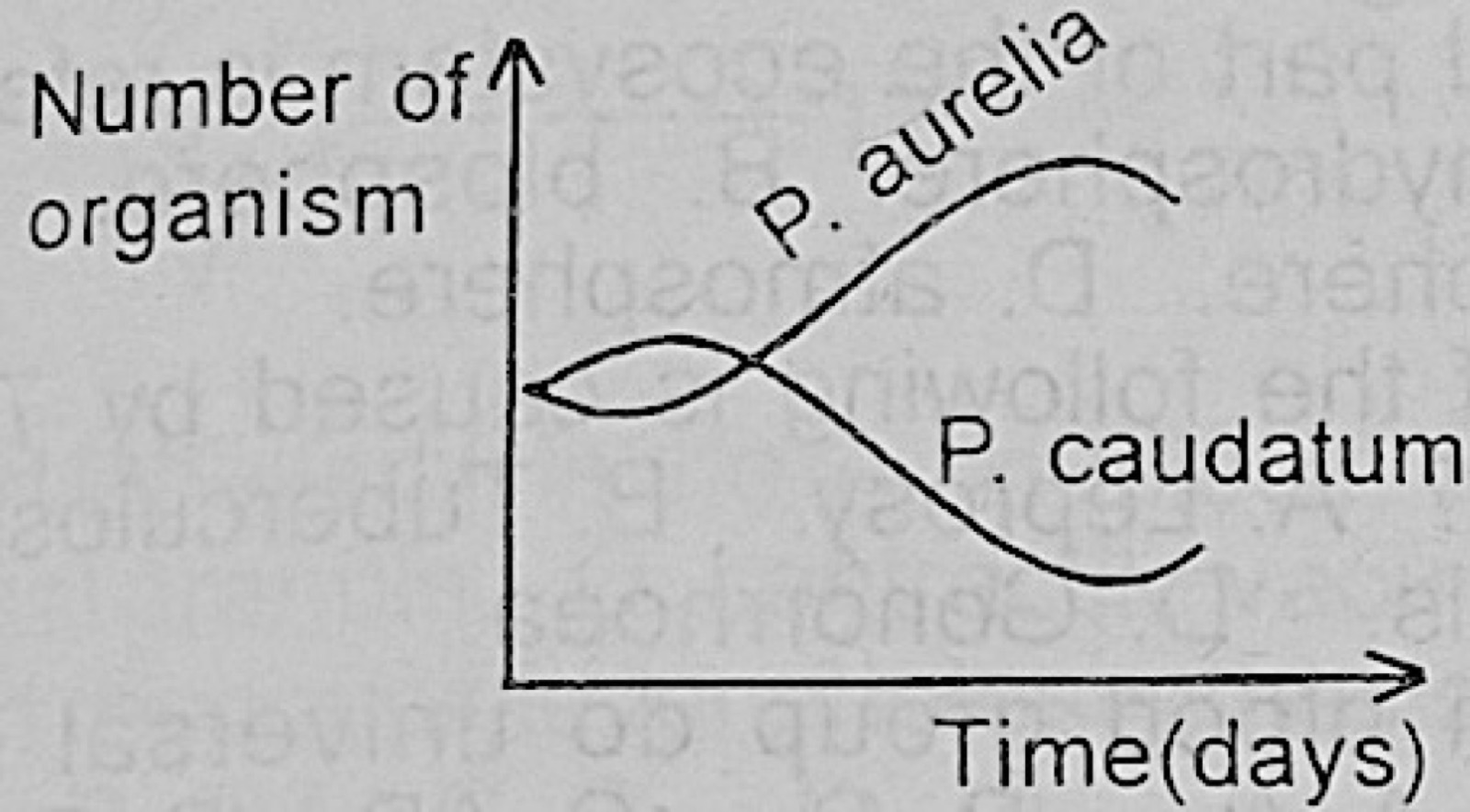
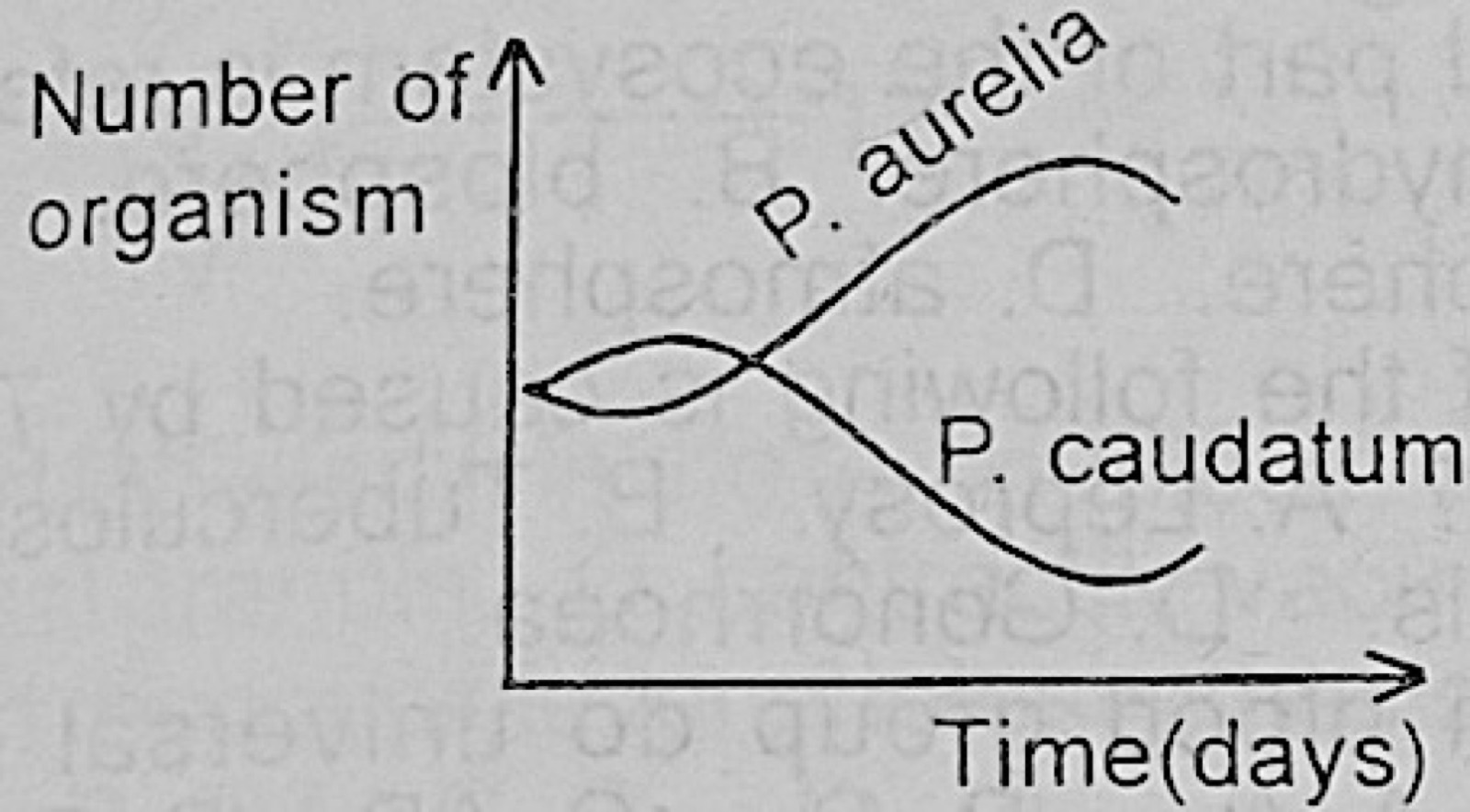
Use the graph of number of organisms of P. aurelia and P. caudatum against time (days) to answer: Which of the following statements is true of the interaction?
A.P. aurelia is better adapted for obtaining food than P. caudatum.
B.P.caudatum is better adapted for obtaining food than P.aurelia.
C.Both organisms cannot coexist.
D.Both organisms cannot reproduce.
Show the answer and explanation
Answer: A (P. aurelia is better adapted for obtaining food than P. caudatum.)
Explanation
The P. aurelia population keeps rising while P. caudatum falls, so P. aurelia wins the competition for food.
Answer: B (raise their body temperature to become active)
Explanation
The Agama lizard is cold-blooded, so its body temperature depends on its surroundings; it lies in the sun to warm up before it can move about actively.
From his study of Galapagos finches, Darwin derived his theory of evolution from
A.comparative anatomy
B.comparative physiology
C.fossil remains
D.comparative embryology.
Show the answer and explanation
Answer: A (comparative anatomy)
Explanation
Darwin compared the different beak shapes and sizes of living finches on the Galapagos islands, each suited to its food; comparing body structures is comparative anatomy.