Which of the following is an example of parasitism?
A.Fungi growing on a dead tree branch.
B.A squirrel living in an abandoned nest of a bird.
C.Mistletoe growing on an orange tree.
D.Cattle egrets taking ticks from the body of cattle.
Show the answer and explanation
Answer: C (Mistletoe growing on an orange tree.)
Explanation
Mistletoe sends haustoria into the orange tree and takes water and minerals from it, harming the host. Fungi on dead wood are saprophytes, and the egret and cattle both gain.
One adaptation shown by hydrophytes in freshwater habitats is the
A.leaves reduced to spines
B.poor development of roots and xylem tissues
C.waxy cuticle on shoot surface
D.well-developed roots and supporting system.
Show the answer and explanation
Answer: B (poor development of roots and xylem tissues)
Explanation
Water plants are surrounded by water and held up by it, so they need little root, xylem or support tissue. Spines and waxy cuticles are features of dry-land plants.
A crucible of 5 gm weighed 10 gm after filling with fresh soil. It is then heated in an oven at 100°C for 1 hour. After cooling in a desiccator, the weight was 8 gm. The percentage of water in the soil is
A.80%
B.60%
C.20%
D.40%.
Show the answer and explanation
Answer: D (40%.)
Explanation
Mass of soil = 10 − 5 = 5 g. Water lost = 10 − 8 = 2 g. Percentage of water = 2/5 × 100 = 40%.
The highest level of ecological organization is the
A.ecosystem
B.population
C.biosphere
D.niche.
Show the answer and explanation
Answer: C (biosphere)
Explanation
The levels go organism → population → community → ecosystem → biosphere. The biosphere is all the parts of the earth where life exists, so it is the highest.
The mangrove swamp in Nigeria is restricted to the
A.Sahel savanna
B.Sudan savanna
C.Guinea savanna
D.Tropical rainforest.
Show the answer and explanation
Answer: D (Tropical rainforest.)
Explanation
Mangrove swamps grow along the salty coastal creeks and lagoons in the south, which lie in the tropical rainforest belt. The savannas are inland and far drier.
Which of the following factors can bring about competition in a population?
A.Dispersion.
B.Emigration.
C.Drought.
D.Mortality.
Show the answer and explanation
Answer: C (Drought.)
Explanation
Drought makes water and food scarce, so members of the population must struggle for the little that is left. Emigration and mortality reduce numbers and so reduce competition.
The theory which supports the view that the large muscles developed by an athlete will be passed on to the offspring was proposed by
A.Lamarck
B.Darwin
C.Mendel
D.Pasteur.
Show the answer and explanation
Answer: A (Lamarck)
Explanation
Lamarck's theory of use and disuse said that characters acquired during life are inherited. We now know acquired characters like trained muscles are not passed on.
Chlorophyll and carotenoids absorb light energy for photosynthesis. Chloroplasts are organelles, not pigments, and melanin and haemoglobin are animal pigments.
Monocot stems differ from dicot stems in that monocots have
A.no cambium
B.no pith
C.fewer vascular bundles
D.phloems with parenchyma.
Show the answer and explanation
Answer: A (no cambium)
Explanation
Monocot vascular bundles are closed: they have no cambium, so monocot stems cannot undergo secondary thickening. They actually have more, scattered bundles.
The pancreas secretes enzymes for the digestion of
A.fats, proteins and carbohydrates
B.fats, vitamins and cellulose
C.fats, carbohydrates and vitamins
D.proteins, cellulose and minerals
Show the answer and explanation
Answer: A (fats, proteins and carbohydrates)
Explanation
Pancreatic juice contains lipase (fats), trypsin (proteins) and amylase (starch). Vitamins and minerals need no digestion and humans make no cellulase.
Urea is filtered from the glomerulus into Bowman's capsule, then passes through the proximal convoluted tubule, the loop of Henle and the distal convoluted tubule before reaching the collecting tubule.
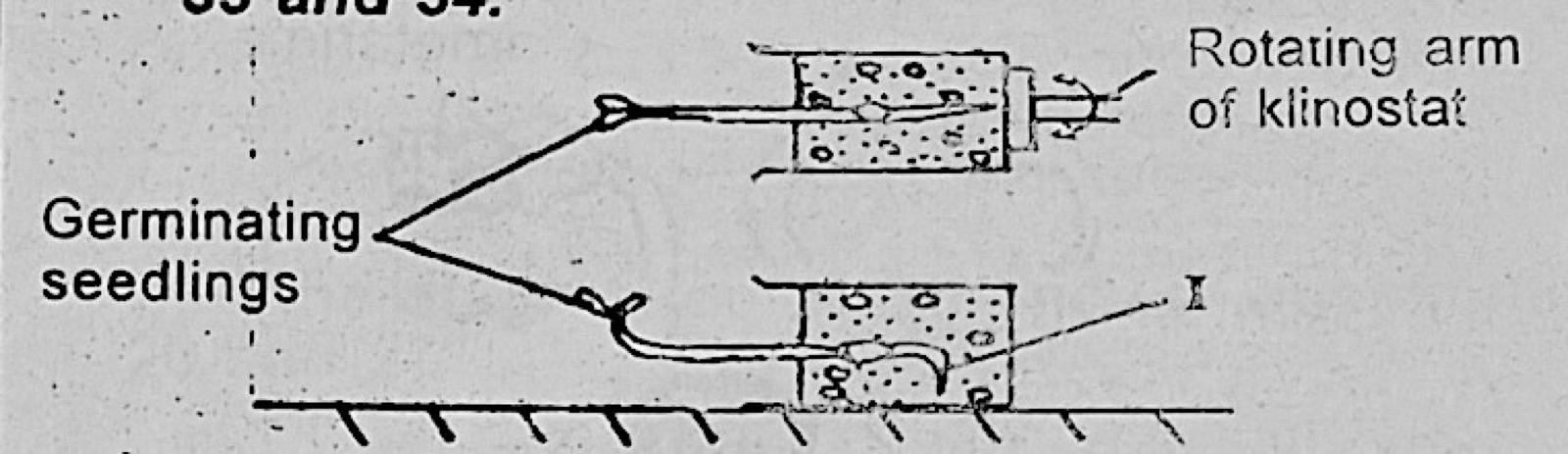
Use the diagram to answer: The experiment demonstrates
A.geotropism
B.thigmotropism
C.phototropism
D.hydrotropism.
Show the answer and explanation
Answer: A (geotropism)
Explanation
On the rotating klinostat gravity acts on all sides equally and the root grows straight, while the still seedling's root bends down. This shows growth response to gravity (geotropism).
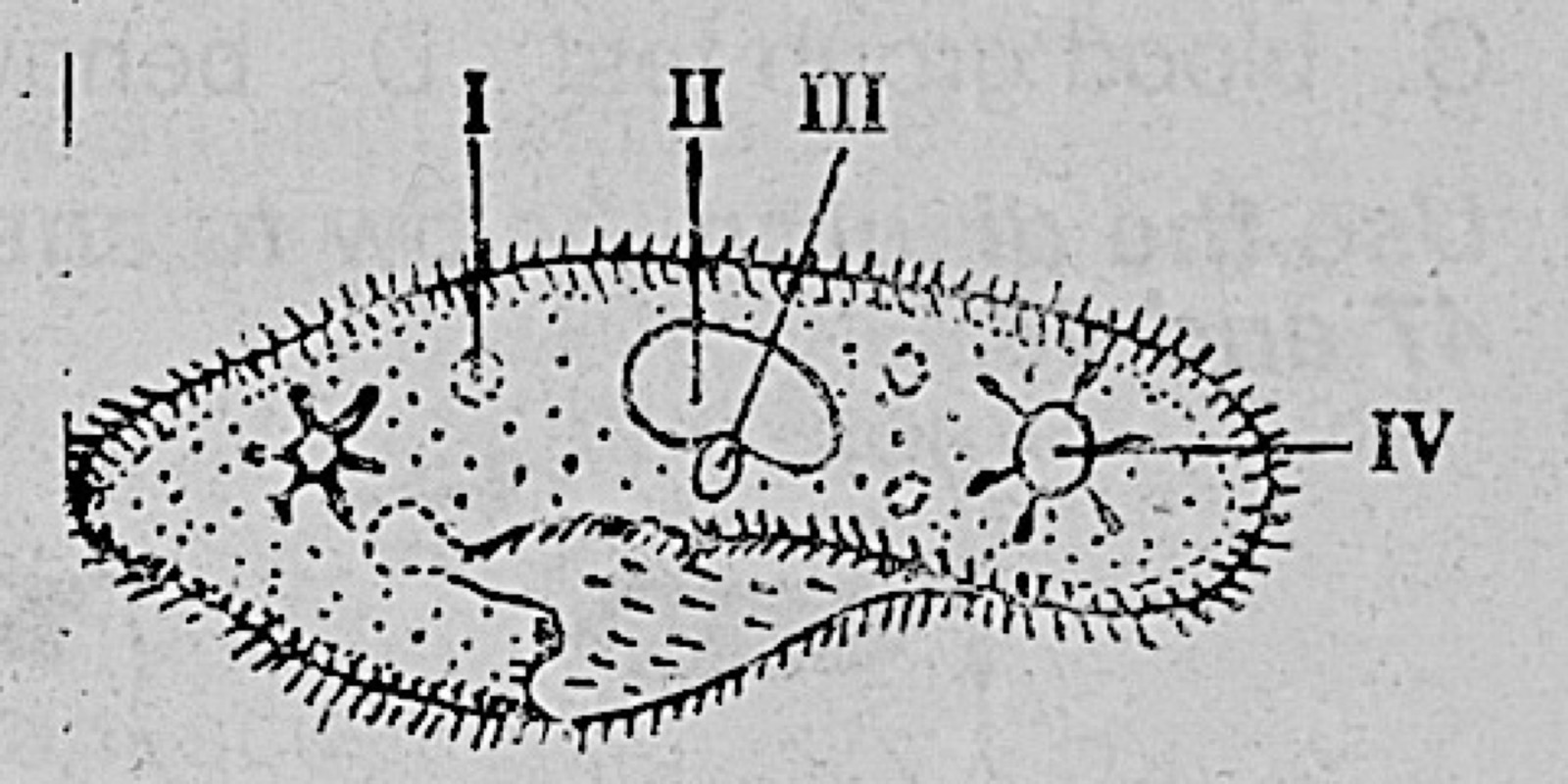
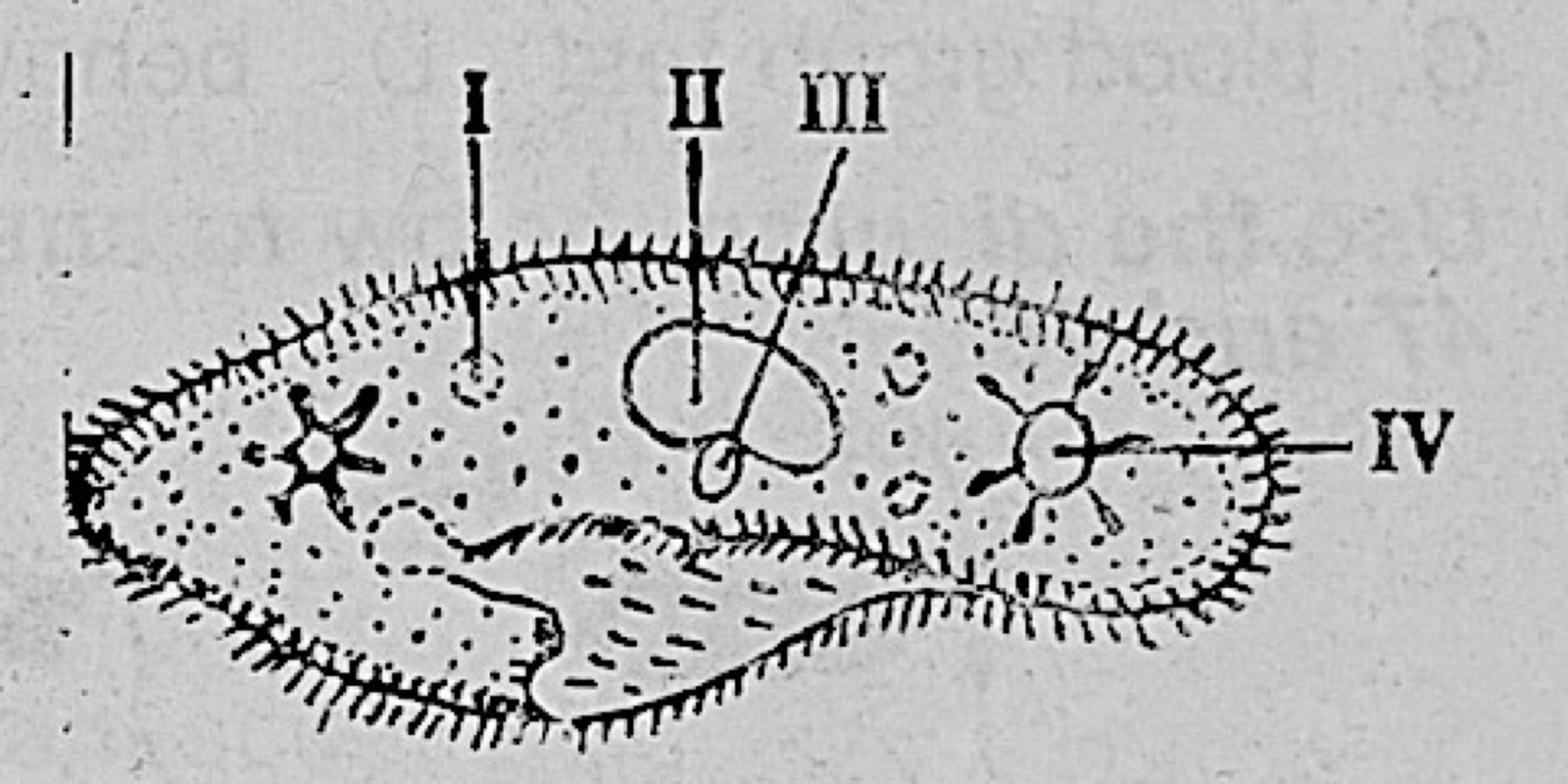
Use the diagram to answer: The organelle responsible for sexual reproduction is
A.II
B.I
C.IV
D.III
Show the answer and explanation
Answer: D (III)
Explanation
III is the small micronucleus. During conjugation (sexual reproduction) Paramecium exchanges micronuclei; the large macronucleus (II) controls everyday activities.
Fern sperms (antherozoids) have flagella and must swim through a film of water to reach the egg. Conifers and flowering plants use pollen tubes instead.
Which of the following is common to the mosquito, housefly and blackfly?
A.They undergo complete metamorphosis.
B.They are parasites of man.
C.Their immature stages are aquatic.
D.Their adults have two pairs of wings.
Show the answer and explanation
Answer: A (They undergo complete metamorphosis.)
Explanation
All three pass through egg, larva, pupa and adult, which is complete metamorphosis. Housefly larvae live in refuse, not water, and all three are true flies with one pair of wings.
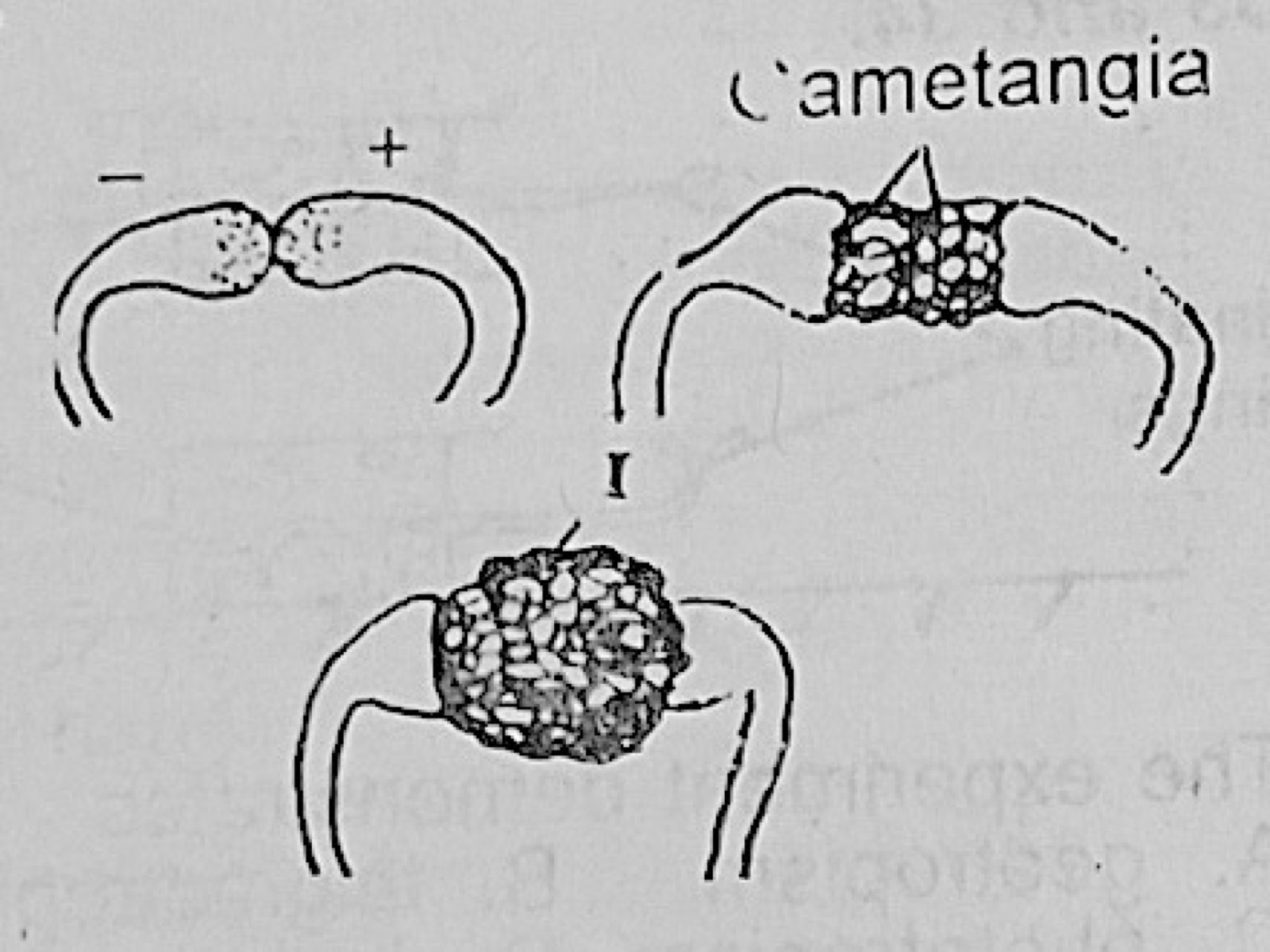
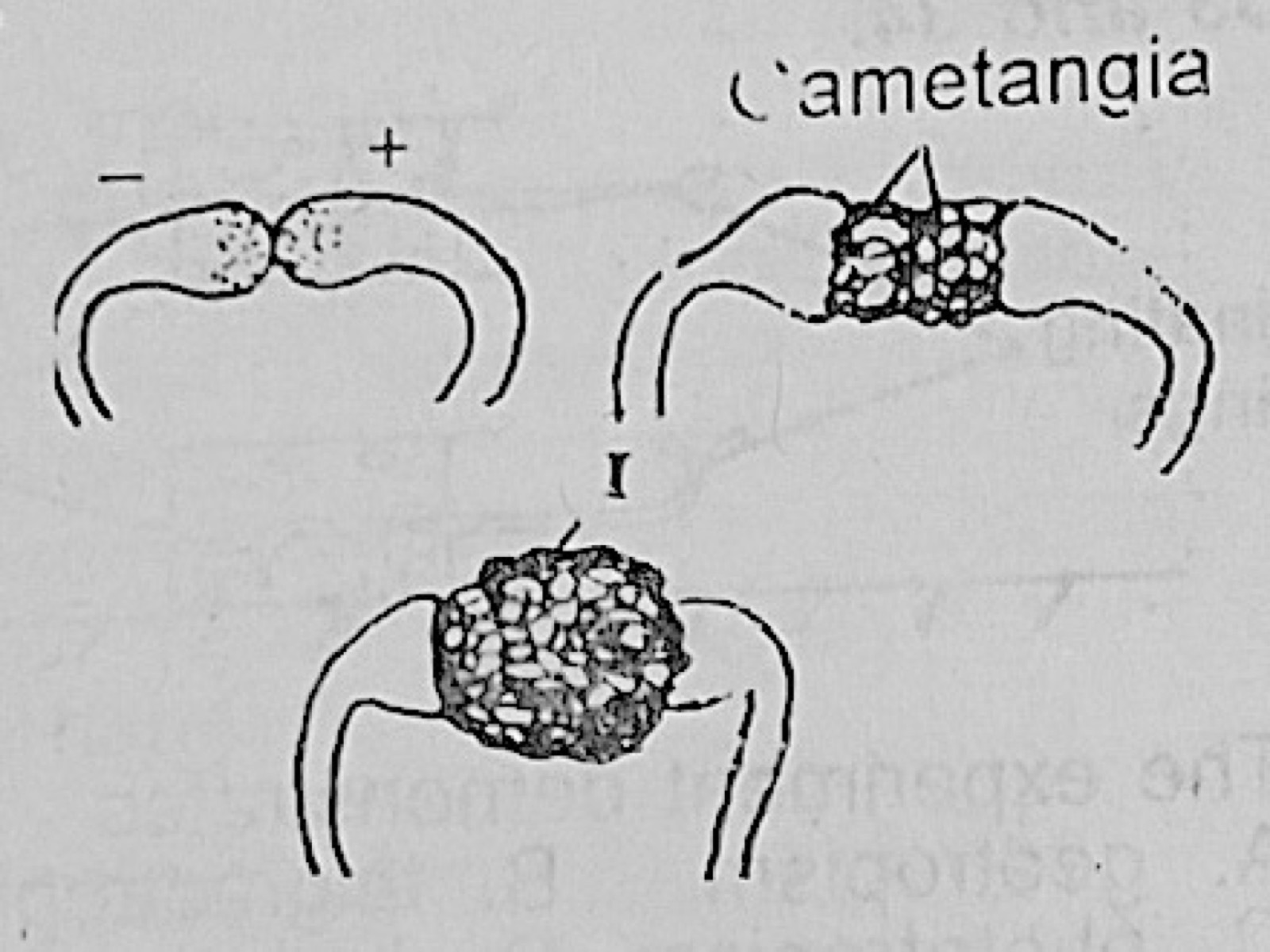
Use the diagram to answer: The process illustrated is
A.gametogenesis
B.sporulation
C.sexual reproduction in Spirogyra
D.sexual reproduction in Rhizopus.
Show the answer and explanation
Answer: D (sexual reproduction in Rhizopus.)
Explanation
Two hyphae of opposite strains (+ and −) meet, their gametangia fuse and form a thick-walled zygospore. This is conjugation, the sexual reproduction of Rhizopus.
An accurate identification of a rapist can be carried out by conducting a
A.RNA analysis
B.DNA analysis
C.blood group test
D.behavioural traits test.
Show the answer and explanation
Answer: B (DNA analysis)
Explanation
Each person's DNA (except identical twins) is unique, so DNA fingerprinting of samples can identify one individual. Many people share the same blood group.
A.It is welcomed as an ethically and morally sound science.
B.Only one cell of the original organism is needed to initiate the process.
C.The clone is similar to but not exactly like the original organism.
D.It involves the asexual multiplication of the tissues of the original organism.
Show the answer and explanation
Answer: D (It involves the asexual multiplication of the tissues of the original organism.)
Explanation
Cloning produces genetically identical copies without the fusion of gametes, so it is a form of asexual multiplication. It is still ethically controversial.