JAMB Biology 2006 past questions and answers

49 questions. Try each one, then open the answer to check yourself and read the explanation.

Question 1

Food Substances and Enzymes

Night-blindness results from a deficiency of

  1. A.vitamin E
  2. B.vitamin A
  3. C.vitamin K
  4. D.vitamin C
Show the answer and explanation

Answer: B (vitamin A)

Explanation

Vitamin A is needed to make the light-sensitive pigment in the rods of the retina. Without it, a person cannot see well in dim light.

Open this question

Question 2

Excretion

The product of excretion common to the mammalian kidney, lung and skin is

  1. A.mineral salt
  2. B.carbon(IV) oxide
  3. C.water
  4. D.urea
Show the answer and explanation

Answer: C (water)

Explanation

The kidneys remove water in urine, the lungs breathe out water vapour and the skin loses water in sweat. Only water is excreted by all three.

Open this question

Question 3

Reproduction in Animals

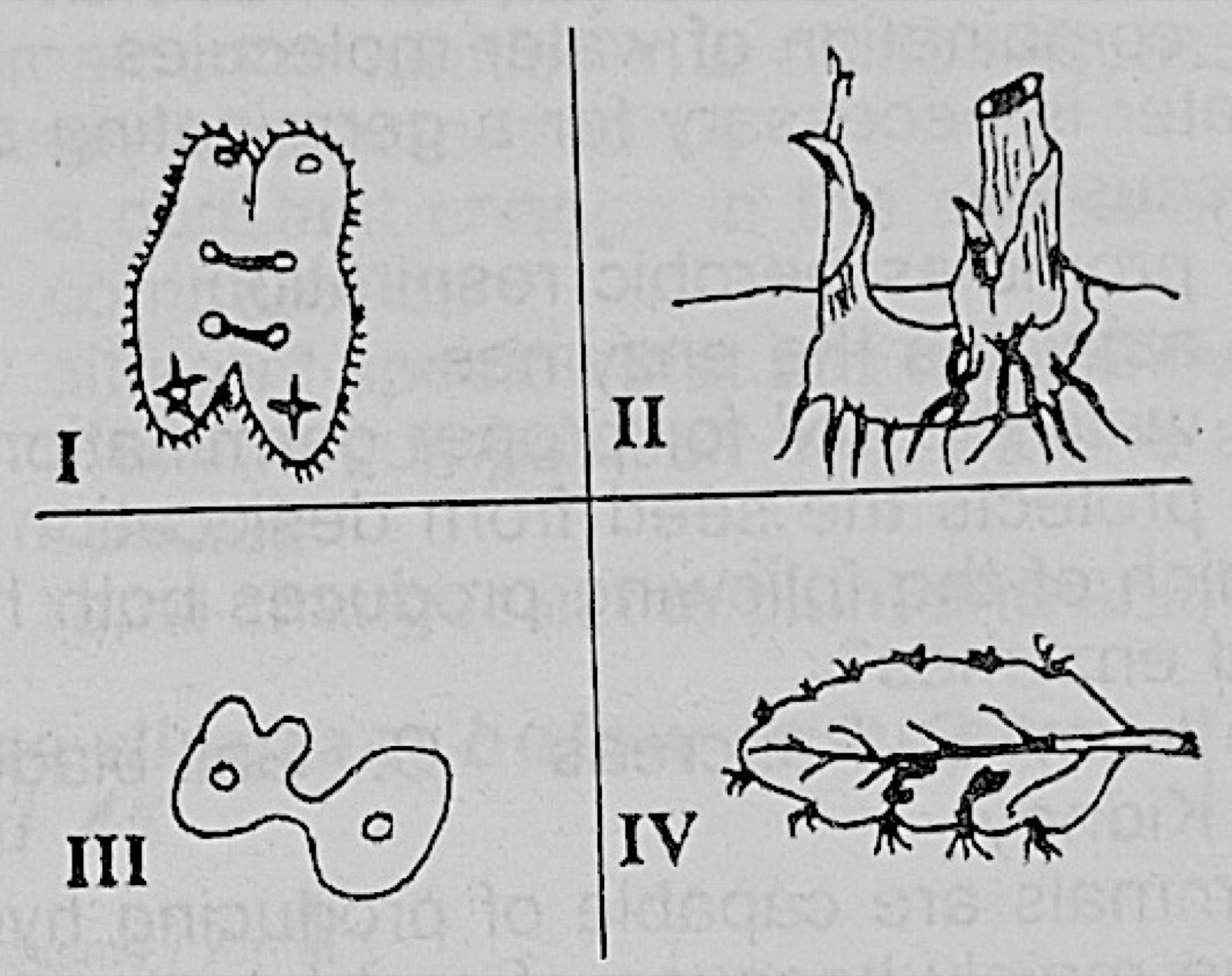
Use the diagram to answer: Sexual reproduction is illustrated in

Diagram for this question
  1. A.II
  2. B.I
  3. C.III
  4. D.IV
Show the answer and explanation

Answer: B (I)

Explanation

I shows two cells joined side by side and exchanging nuclear material (conjugation), which is a sexual process. II, III and IV show asexual methods: sprouting, fission and leaf plantlets.

Open this question

Question 4

Reproduction in Plants

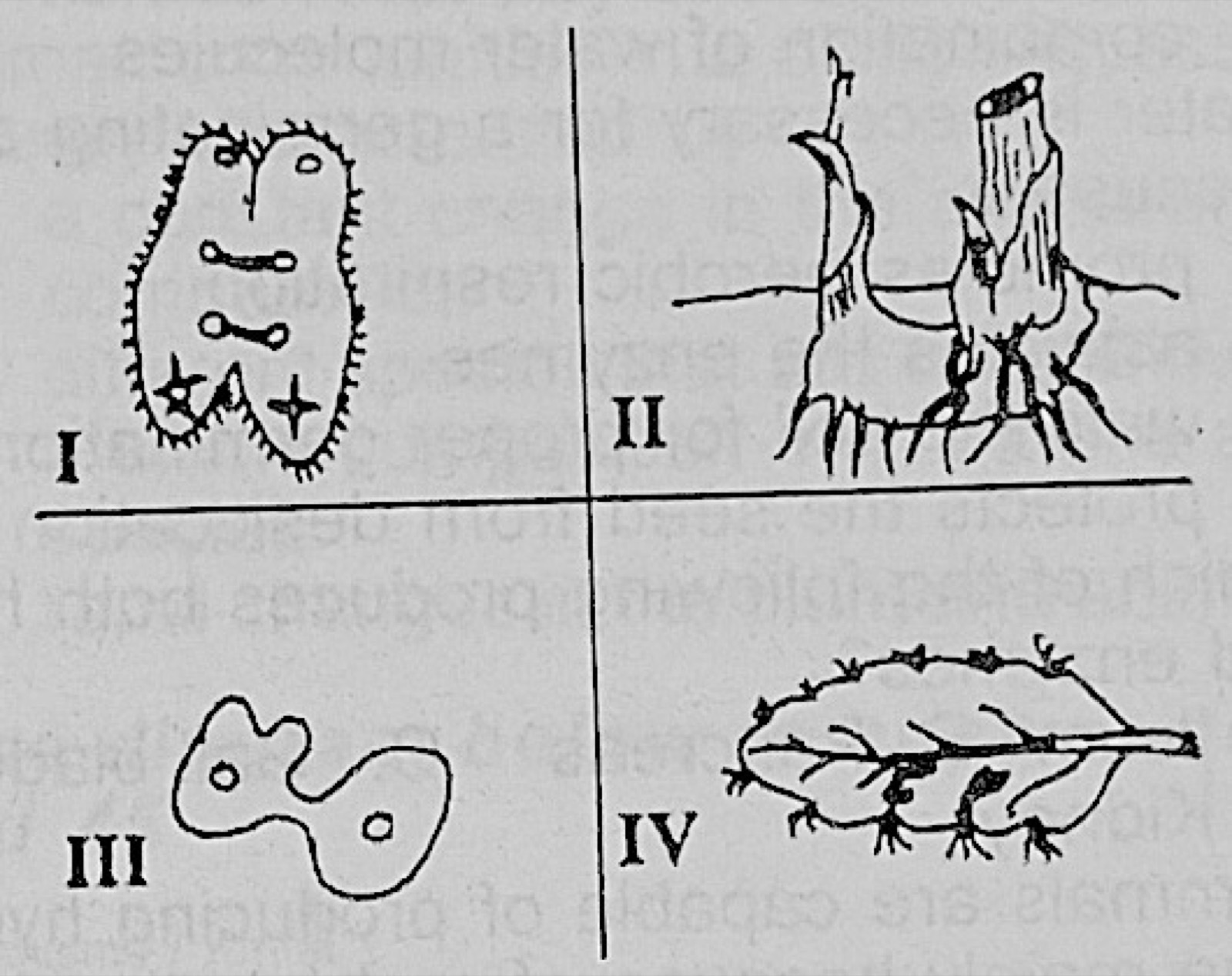
Use the diagram to answer: A plant that exhibits the type of reproduction shown in IV is

Diagram for this question
  1. A.Cola
  2. B.ginger
  3. C.Bryophyllum
  4. D.sugarcane
Show the answer and explanation

Answer: C (Bryophyllum)

Explanation

IV shows small plantlets growing from the notches at the edge of a leaf. This is how Bryophyllum reproduces vegetatively.

Open this question

Question 5

Respiration

An increase in air pressure in the lungs is due to the

  1. A.increase in the volume of the thoracic cavity
  2. B.upward movement of the ribs
  3. C.relaxation of the diaphragm
  4. D.contraction of intercostal muscles
Show the answer and explanation

Answer: C (relaxation of the diaphragm)

Explanation

When the diaphragm relaxes it domes upward and the chest gets smaller. The smaller volume raises the air pressure in the lungs, pushing air out.

Open this question

Question 6

Nervous Coordination

One basic similarity between nervous and endocrine system is that they both

  1. A.produce widespread effects
  2. B.transmit very fast impulses
  3. C.involve the use of chemical substances
  4. D.produce precise and short-lived effects
Show the answer and explanation

Answer: C (involve the use of chemical substances)

Explanation

Nerves pass messages across synapses using chemical transmitters, and the endocrine system uses hormones, which are chemicals. Widespread, slow effects are typical only of hormones.

Open this question

Question 7

Transport in Animals

The organ situated in the pericardial cavity of a mammal is the

  1. A.heart
  2. B.liver
  3. C.stomach
  4. D.spleen
Show the answer and explanation

Answer: A (heart)

Explanation

The pericardium is the bag that encloses the heart. The space inside it is the pericardial cavity.

Open this question

Question 8

Support and Movement

A unique characteristic of the cervical vertebrae is the presence of

  1. A.large centrum
  2. B.long transverse processes
  3. C.zygapophysis
  4. D.vertebrarterial canal
Show the answer and explanation

Answer: D (vertebrarterial canal)

Explanation

Cervical (neck) vertebrae have small holes in their transverse processes, the vertebrarterial canals, through which arteries pass to the head. No other vertebrae have them.

Open this question

Question 9

Transport in Animals

In rabbits, the chamber of the heart that receives oxygenated blood from the lungs is the

  1. A.left ventricle
  2. B.left auricle
  3. C.right ventricle
  4. D.right auricle
Show the answer and explanation

Answer: B (left auricle)

Explanation

The pulmonary veins bring oxygenated blood from the lungs into the left auricle (atrium). It then passes to the left ventricle.

Open this question

Question 10

Reproduction in Animals

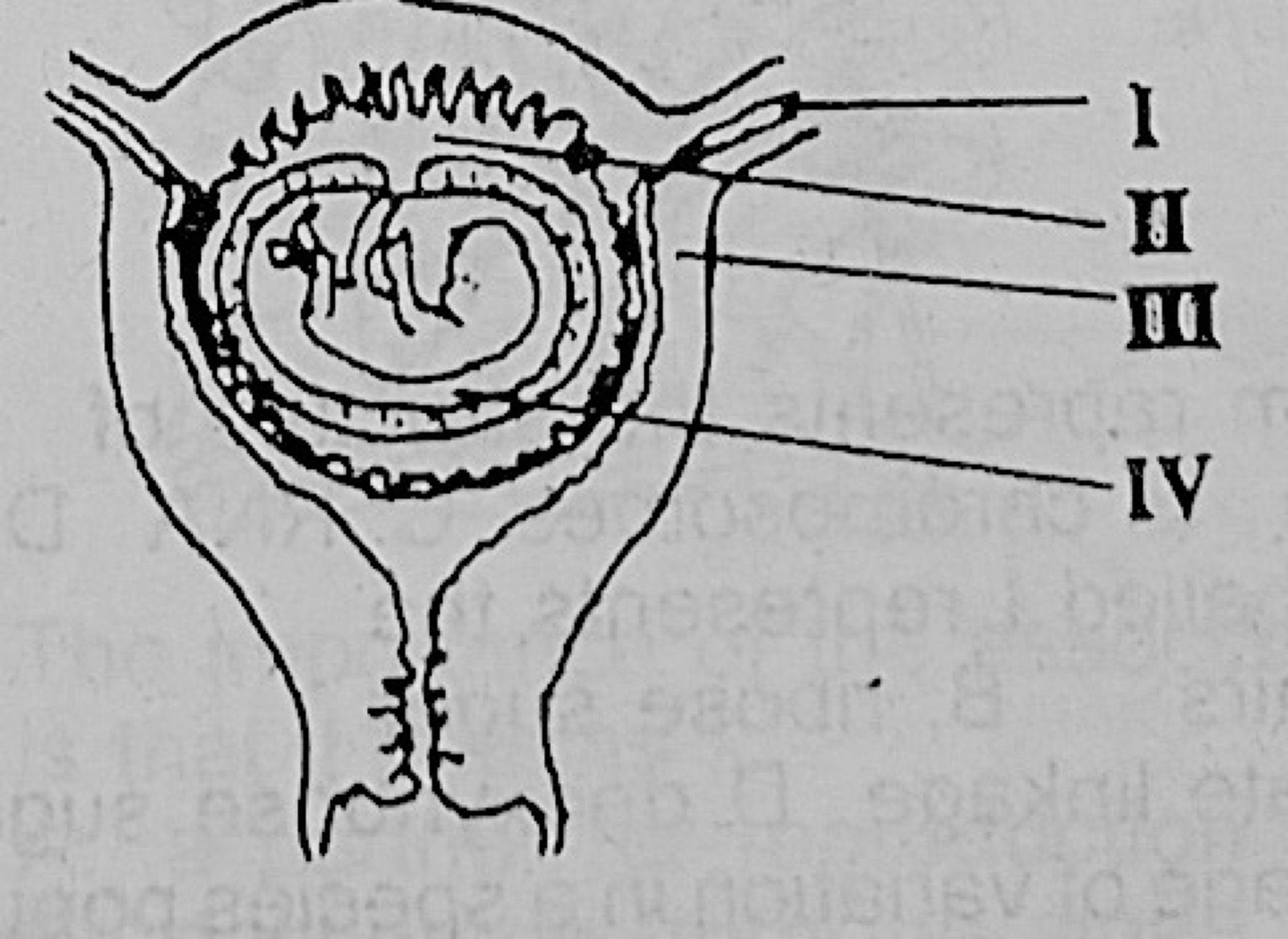
Use the diagram of the pregnant uterus to answer: The part labelled IV is for

Diagram for this question
  1. A.excretion
  2. B.nourishment
  3. C.protection
  4. D.respiration
Show the answer and explanation

Answer: C (protection)

Explanation

IV points to the fluid-filled amniotic sac around the foetus. The amniotic fluid cushions the foetus against shocks and so protects it.

Open this question

Question 11

Reproduction in Animals

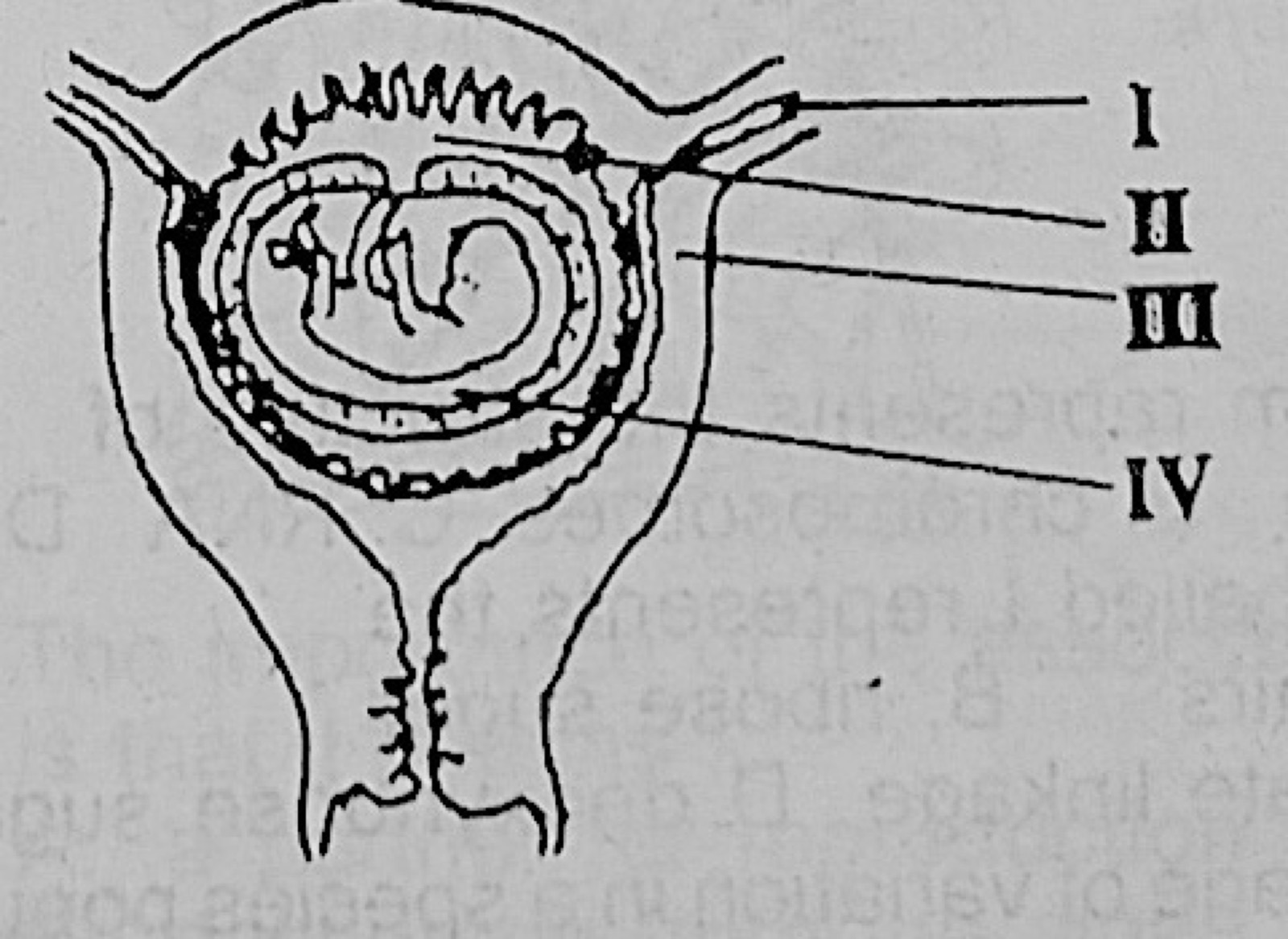
Use the diagram of the pregnant uterus to answer: The organ through which the embryo receives food, water and oxygen is labelled

Diagram for this question
  1. A.III
  2. B.IV
  3. C.II
  4. D.I
Show the answer and explanation

Answer: C (II)

Explanation

II points to the placenta, where the mother's blood and the embryo's blood come very close. Food, water and oxygen pass across it to the embryo.

Open this question

Question 12

Respiration

The formation of water in the tissue respiration results from the

  1. A.breakdown of water molecules
  2. B.reduction of oxygen by hydrogen
  3. C.reduction of carbon(IV) oxide
  4. D.combination of water molecules
Show the answer and explanation

Answer: B (reduction of oxygen by hydrogen)

Explanation

At the end of aerobic respiration, hydrogen removed from food combines with oxygen. This reduces the oxygen to water.

Open this question

Question 13

Growth and Development

Water is necessary for a germinating seed because it

  1. A.promotes aerobic respiration
  2. B.activates the enzymes
  3. C.wets the soil for proper germination
  4. D.protects the seed from desiccation
Show the answer and explanation

Answer: B (activates the enzymes)

Explanation

Water entering the seed switches on its enzymes. They then break down the stored food for the growing embryo.

Open this question

Question 14

Animal Nutrition

Which of the following produces both hormones and enzymes?

  1. A.Ileum
  2. B.Pancreas
  3. C.Gall bladder
  4. D.Kidney
Show the answer and explanation

Answer: B (Pancreas)

Explanation

The pancreas makes digestive enzymes (amylase, lipase, trypsin) for the duodenum, and its islets make the hormones insulin and glucagon.

Open this question

Question 15

Excretion

Mammals are capable of producing hypertonic urine mainly because of reabsorption in the

  1. A.Bowman's capsule
  2. B.urethra
  3. C.ureter
  4. D.loop of Henle
Show the answer and explanation

Answer: D (loop of Henle)

Explanation

The loop of Henle creates a salty region deep in the kidney. Water is drawn back from the urine there, making the urine concentrated (hypertonic).

Open this question

Question 16

Transport in Animals

The mammalian vein which starts with and ends in a capillary network is the

  1. A.pulmonary vein
  2. B.mesenteric vein
  3. C.renal vein
  4. D.hepatic portal vein
Show the answer and explanation

Answer: D (hepatic portal vein)

Explanation

The hepatic portal vein starts in the capillaries of the intestine and ends in the capillaries of the liver. Most veins end at the heart.

Open this question

Question 17

Structure of Flowering Plants

In the transverse section of a dicot stem, the region lying between the endodermis and the vascular bundle is the

  1. A.parenchyma
  2. B.pericycle
  3. C.phloem
  4. D.hypodermis
Show the answer and explanation

Answer: B (pericycle)

Explanation

Just inside the endodermis, before the vascular bundles, is the pericycle. The hypodermis is near the outside of the stem.

Open this question

Question 18

Variation

Hassan and Hussain are identical twins but Hassan grows taller and fatter than Hussain. This is probably because

  1. A.Hassan inherits genes for tallness and fatness from the father
  2. B.they have dissimilar genotypes
  3. C.Hussain is endowed with genes for shortness and thinness
  4. D.they are raised in different environments
Show the answer and explanation

Answer: D (they are raised in different environments)

Explanation

Identical twins have the same genes. Any difference between them must come from their environment, such as food and exercise.

Open this question

Question 19

Chromosomes, DNA and Sex Linkage

The two normal types of sex chromosomes are

  1. A.XXY and XYY
  2. B.XX and XYY
  3. C.XY and XXY
  4. D.XX and XY
Show the answer and explanation

Answer: D (XX and XY)

Explanation

Normal females are XX and normal males are XY. XXY and XYY are abnormal conditions.

Open this question

Question 20

Chromosomes, DNA and Sex Linkage

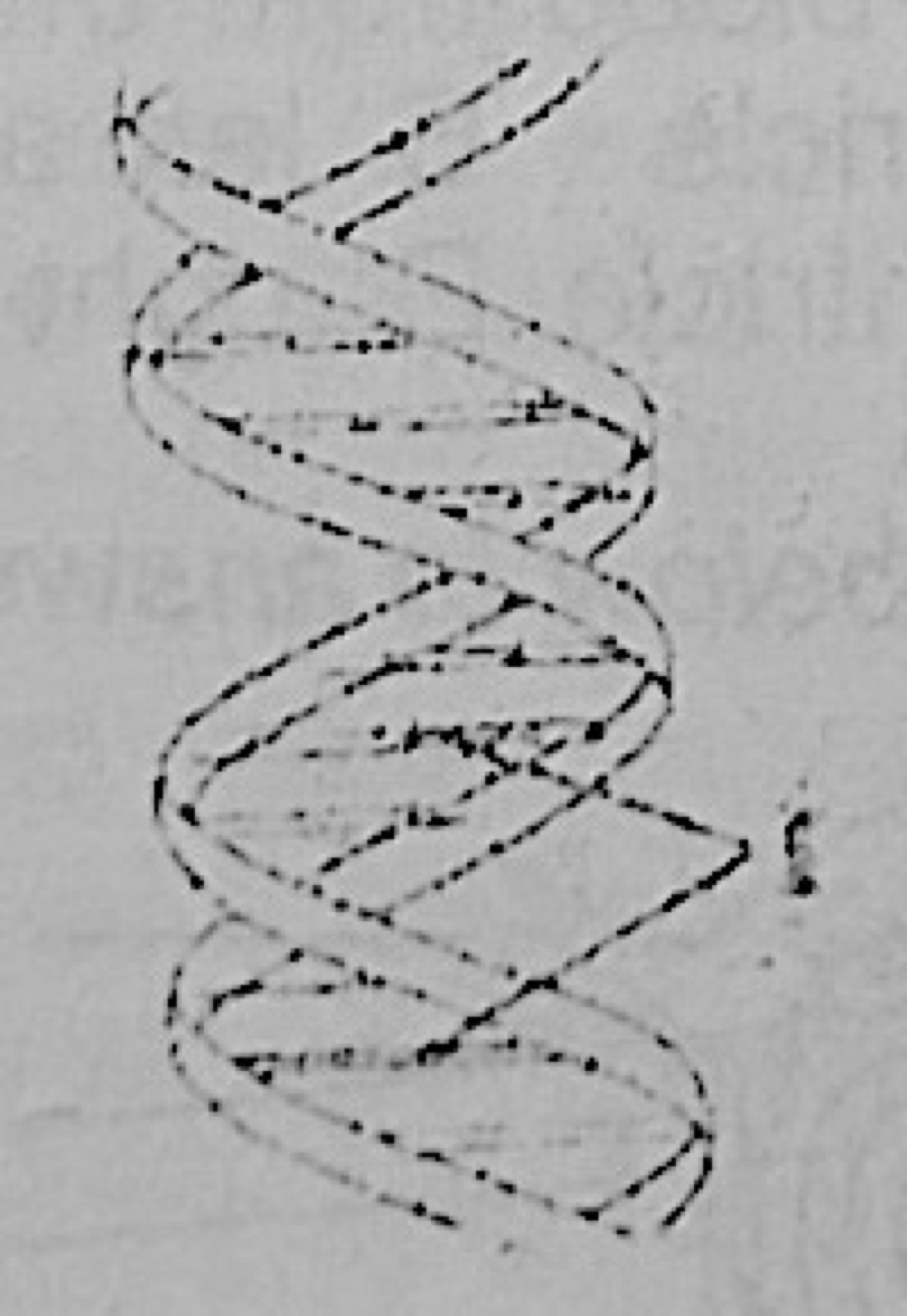
Use the diagram to answer: The diagram represents the structure of

Diagram for this question
  1. A.proteins
  2. B.chromosomes
  3. C.RNA
  4. D.DNA
Show the answer and explanation

Answer: D (DNA)

Explanation

The diagram shows two strands twisted into a double helix joined by rungs. This is the shape of DNA; RNA is single-stranded.

Open this question

Question 21

Chromosomes, DNA and Sex Linkage

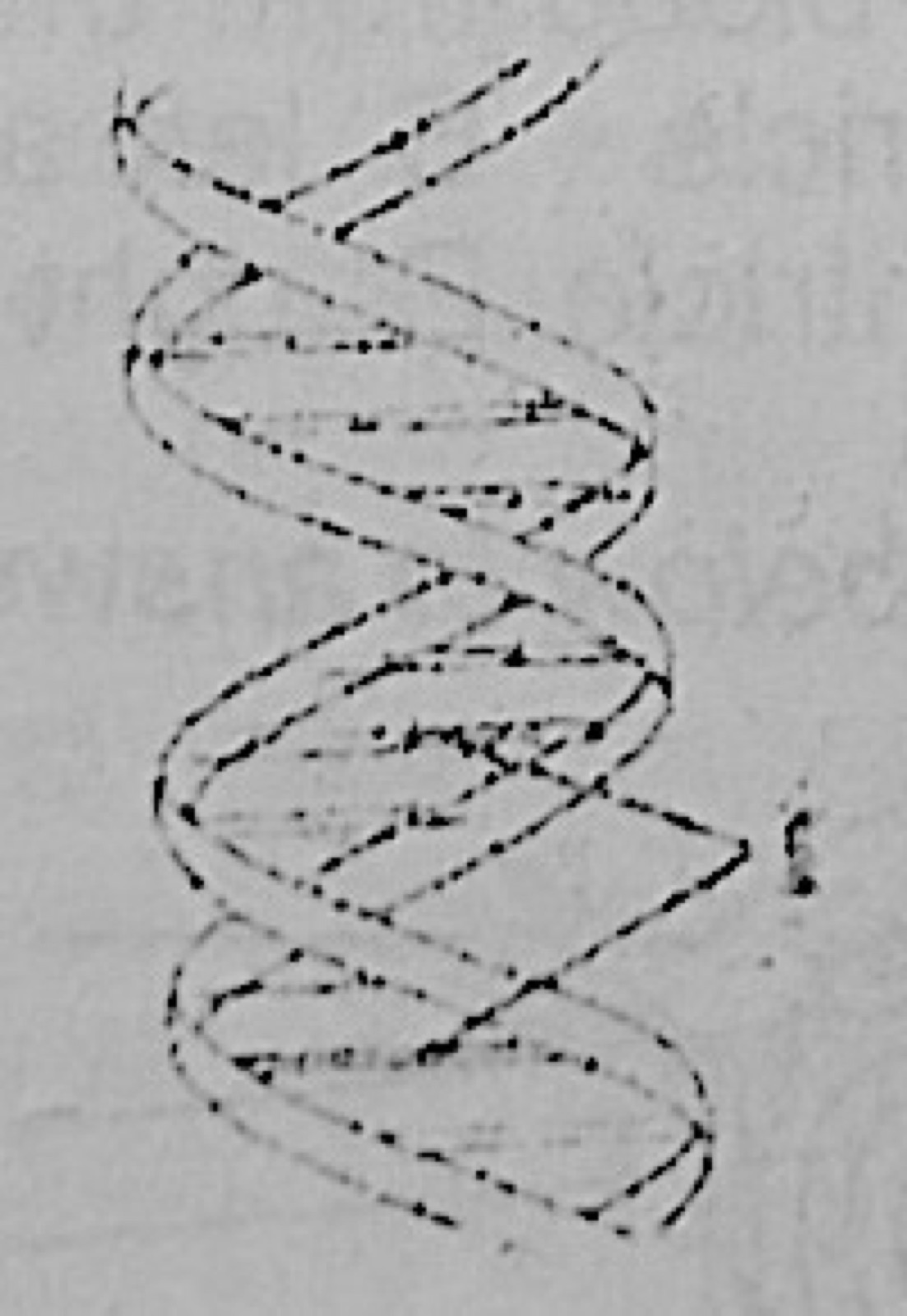
Use the diagram of the double helix to answer: The part labelled I represents the

Diagram for this question
  1. A.base pairs
  2. B.ribose sugar
  3. C.phosphate linkage
  4. D.deoxyribose sugar
Show the answer and explanation

Answer: A (base pairs)

Explanation

I points to a rung across the middle of the helix. The rungs are pairs of bases (A–T and C–G) holding the two strands together.

Open this question

Question 23

Mendelian Inheritance

Mendel's second law of inheritance states that

  1. A.alleles combine randomly
  2. B.alleles segregate independently
  3. C.alleles separate predictably
  4. D.chromosomes segregate independently
Show the answer and explanation

Answer: B (alleles segregate independently)

Explanation

Mendel's second law (independent assortment) says that the alleles of different genes separate into gametes independently of each other.

Open this question

Question 24

Evolution

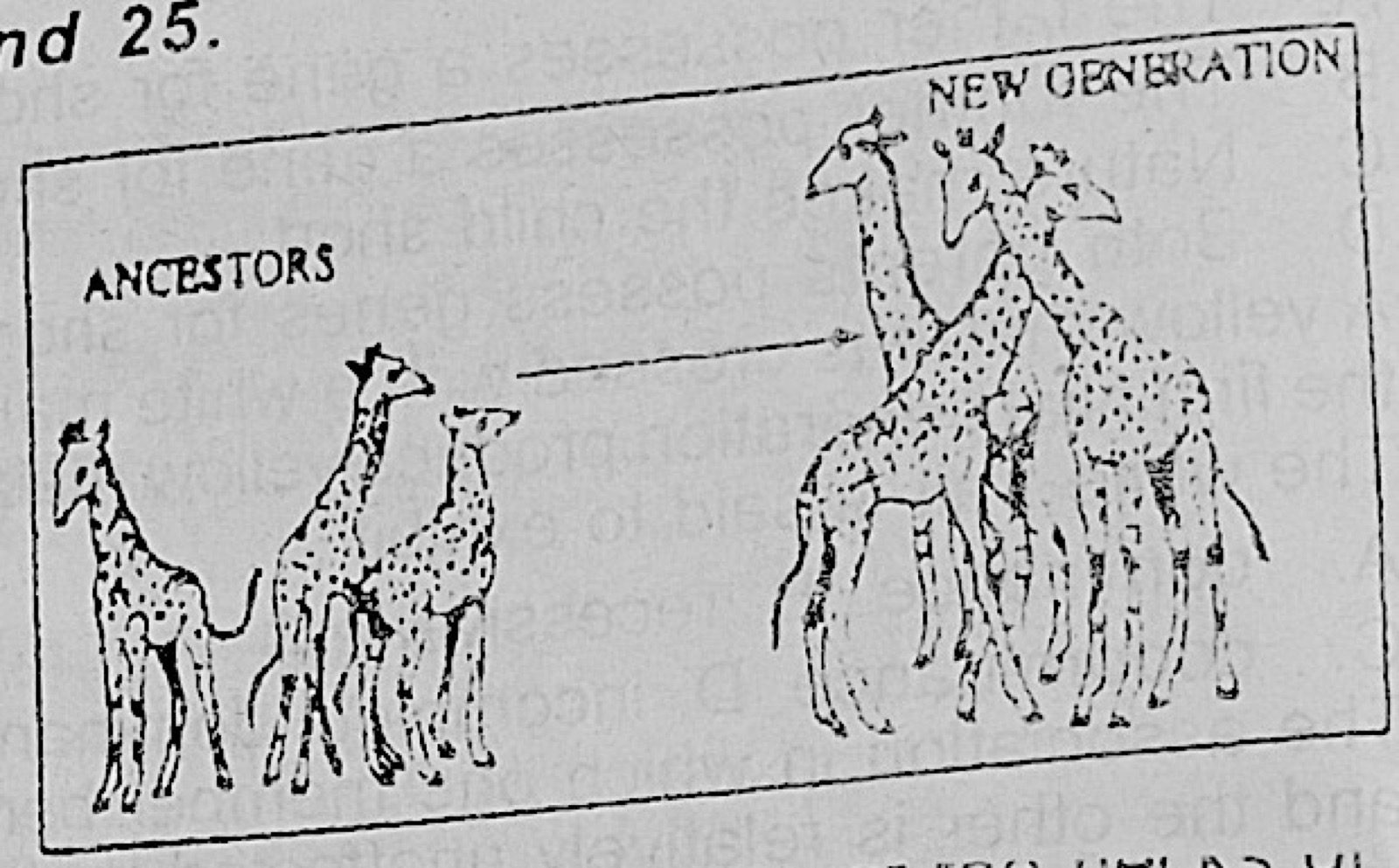
Use the diagram of the giraffes to answer: The change in the length of the necks of the giraffes shown was brought about by

Diagram for this question
  1. A.geographical isolation
  2. B.predation
  3. C.symbiosis
  4. D.natural selection
Show the answer and explanation

Answer: D (natural selection)

Explanation

Giraffes with longer necks could reach more leaves, so they survived and bred more. Over many generations this natural selection made long necks common.

Open this question

Question 25

Variation

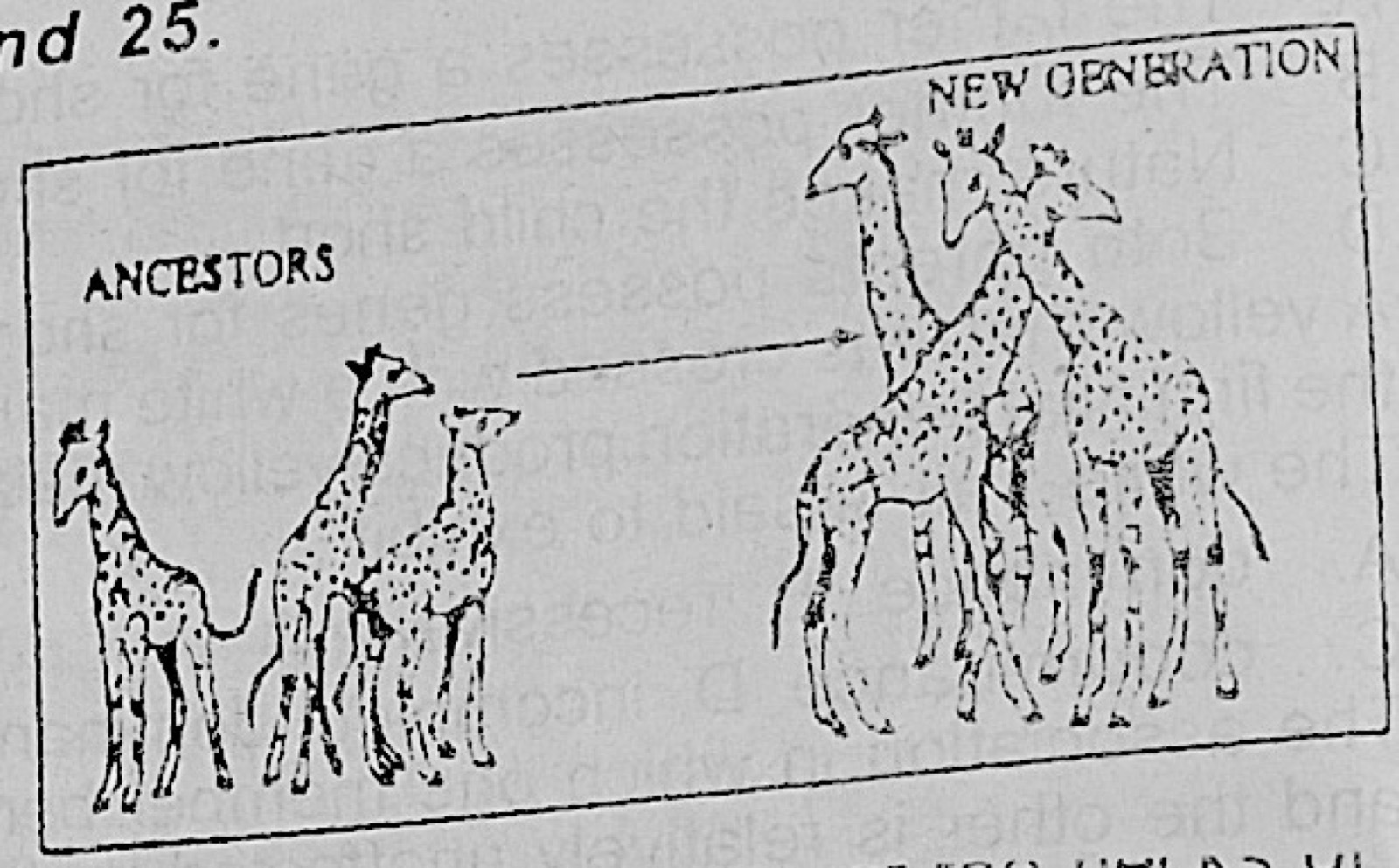
Use the diagram of the giraffes to answer: The variation illustrated is

Diagram for this question
  1. A.discontinuous
  2. B.morphological
  3. C.physiological
  4. D.biochemical
Show the answer and explanation

Answer: B (morphological)

Explanation

Neck length is a difference in body form and structure that can be seen. Such visible differences are morphological variation.

Open this question

Question 26

Population Ecology

The intensity of competition among animals in a given area will increase with

  1. A.an increase in the frequency of disease outbreaks
  2. B.an increase in population size
  3. C.a decrease in the immigration rate
  4. D.an increase in the emigration rate
Show the answer and explanation

Answer: B (an increase in population size)

Explanation

More animals in the same area means more of them need the same food, space and mates. So competition gets stronger as the population grows.

Open this question

Question 27

Animal Kingdom

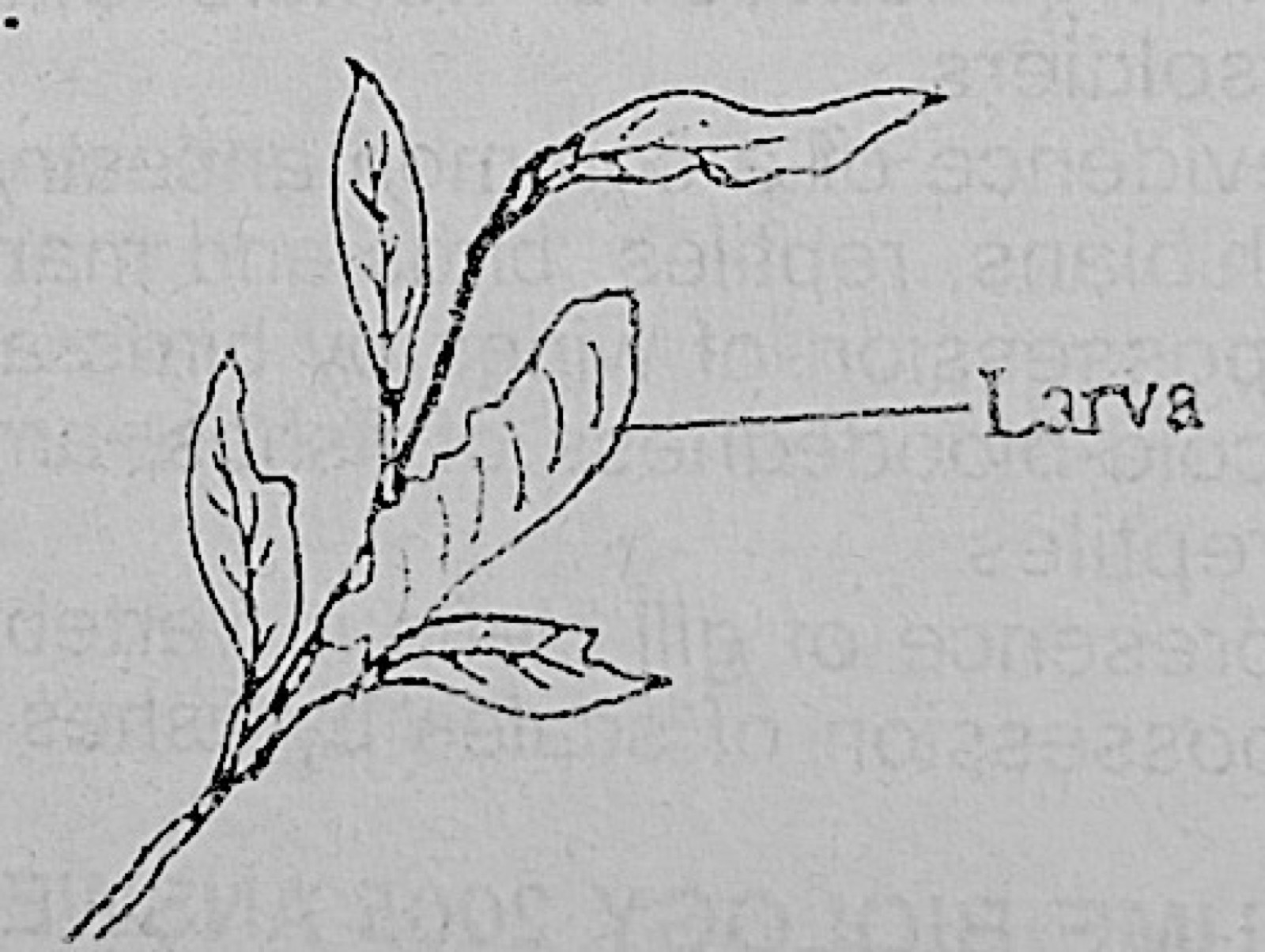
Use the diagram to answer: The economic importance of the larva is that it

Diagram for this question
  1. A.is eaten by birds
  2. B.develops into a moth
  3. C.resembles the plant on which it lives
  4. D.feeds on the leaves of crops
Show the answer and explanation

Answer: D (feeds on the leaves of crops)

Explanation

Economic importance means how it affects people. Caterpillars eat the leaves of crop plants, reducing yields.

Open this question

Question 28

Adaptation

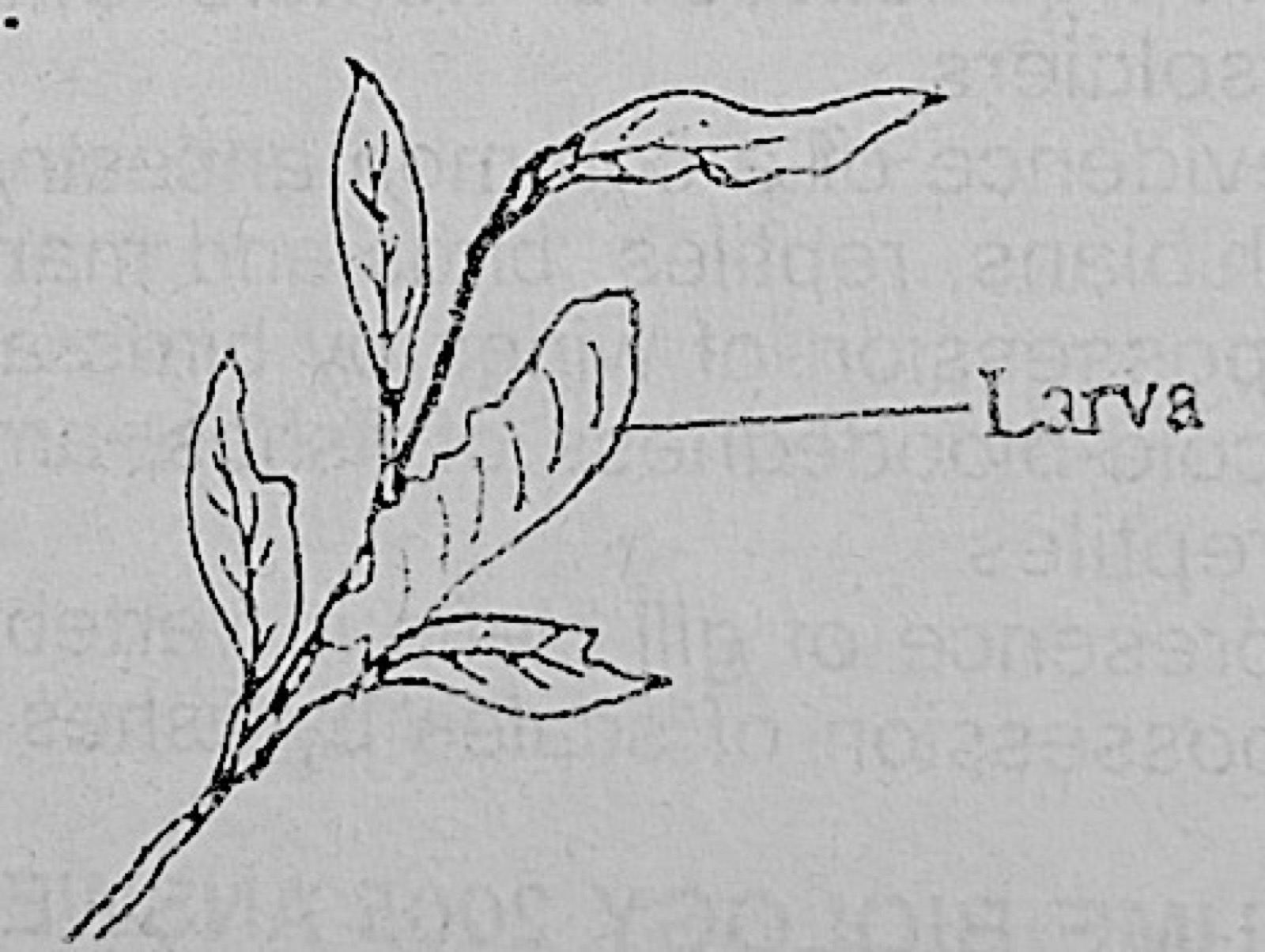
Use the diagram to answer: The type of adaptation shown by the larva is

Diagram for this question
  1. A.mimicry
  2. B.countershading
  3. C.flash coloration
  4. D.disruptive coloration
Show the answer and explanation

Answer: A (mimicry)

Explanation

The larva looks like a leaf or twig of the plant it lives on. Resembling an object this way to fool predators is mimicry.

Open this question

Question 29

Homeostasis

The part of the mammalian skin involved in temperature regulation is the

  1. A.sweat gland
  2. B.hair papilla
  3. C.hair follicle
  4. D.sebaceous gland
Show the answer and explanation

Answer: A (sweat gland)

Explanation

Sweat glands release sweat onto the skin. As the sweat evaporates it takes heat away and cools the body.

Open this question

Question 30

Cell Structure and Organisation

The role of the Golgi complex in a eukaryotic cell is to

  1. A.conduct ions in and out of the cell
  2. B.transport genetic materials out of the cell
  3. C.provide attachment for ribosomal granules
  4. D.transport organic materials in and out of the cell
Show the answer and explanation

Answer: D (transport organic materials in and out of the cell)

Explanation

The Golgi complex packages proteins and other substances into vesicles. These carry the materials to the cell surface for secretion.

Open this question

Question 31

Animal Kingdom

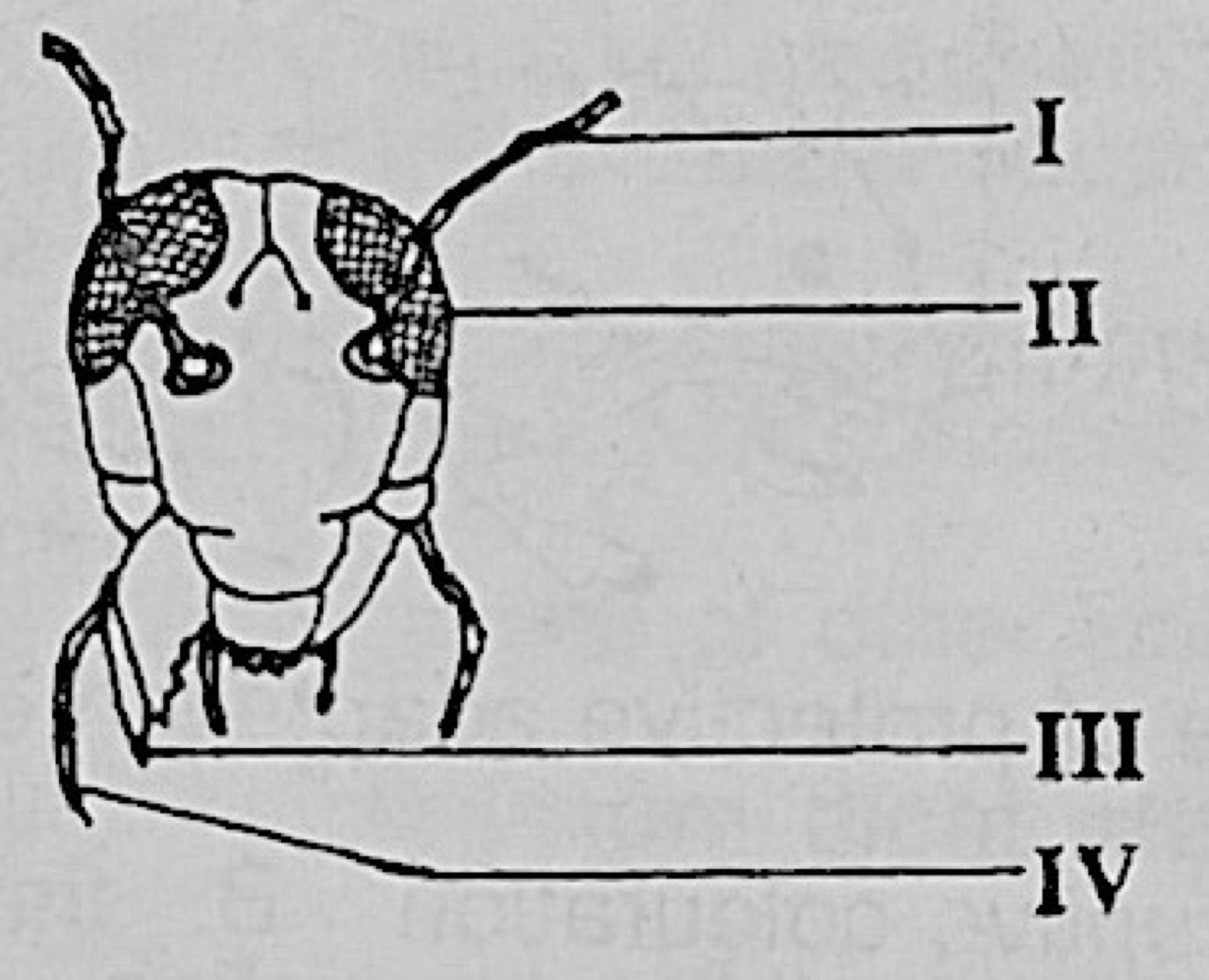
Use the diagram of the insect head to answer: The maxillary palp is labelled

Diagram for this question
  1. A.III
  2. B.IV
  3. C.I
  4. D.II
Show the answer and explanation

Answer: B (IV)

Explanation

The maxillary palps are the long jointed feelers that hang from the mouthparts at the sides of the head. IV points to one of them.

Open this question

Question 32

Sense Organs

Use the diagram of the insect head to answer: The structure labelled I is sensitive to

Diagram for this question
  1. A.light and touch
  2. B.chemicals only
  3. C.light only
  4. D.chemicals and touch
Show the answer and explanation

Answer: D (chemicals and touch)

Explanation

I is an antenna. Antennae detect smells (chemicals) and touch. Light is detected by the compound eyes.

Open this question

Question 33

Plant Kingdom

The dominant phase in the life cycle of a bryophyte is the

  1. A.gametangium
  2. B.sporophyte
  3. C.gametophyte
  4. D.prothallus
Show the answer and explanation

Answer: C (gametophyte)

Explanation

In mosses and liverworts, the green plant you see is the gametophyte. The sporophyte is small and grows on it.

Open this question

Question 34

Evolution

The evidence that supports the advancement of ferns over mosses is derived from

  1. A.comparative anatomy
  2. B.molecular records
  3. C.biochemical similarities
  4. D.physiological records
Show the answer and explanation

Answer: A (comparative anatomy)

Explanation

Comparing their structure shows that ferns have true roots, stems, leaves and vascular tissue, which mosses lack. This comparative anatomy shows ferns are more advanced.

Open this question

Question 35

Transport in Animals

Which of the following vertebrates has the most simple structured heart?

  1. A.Reptile
  2. B.Fish
  3. C.Mammal
  4. D.Amphibian
Show the answer and explanation

Answer: B (Fish)

Explanation

A fish heart has only two chambers (one atrium and one ventricle). Amphibians and reptiles have three and mammals have four.

Open this question

Question 36

Animal Kingdom

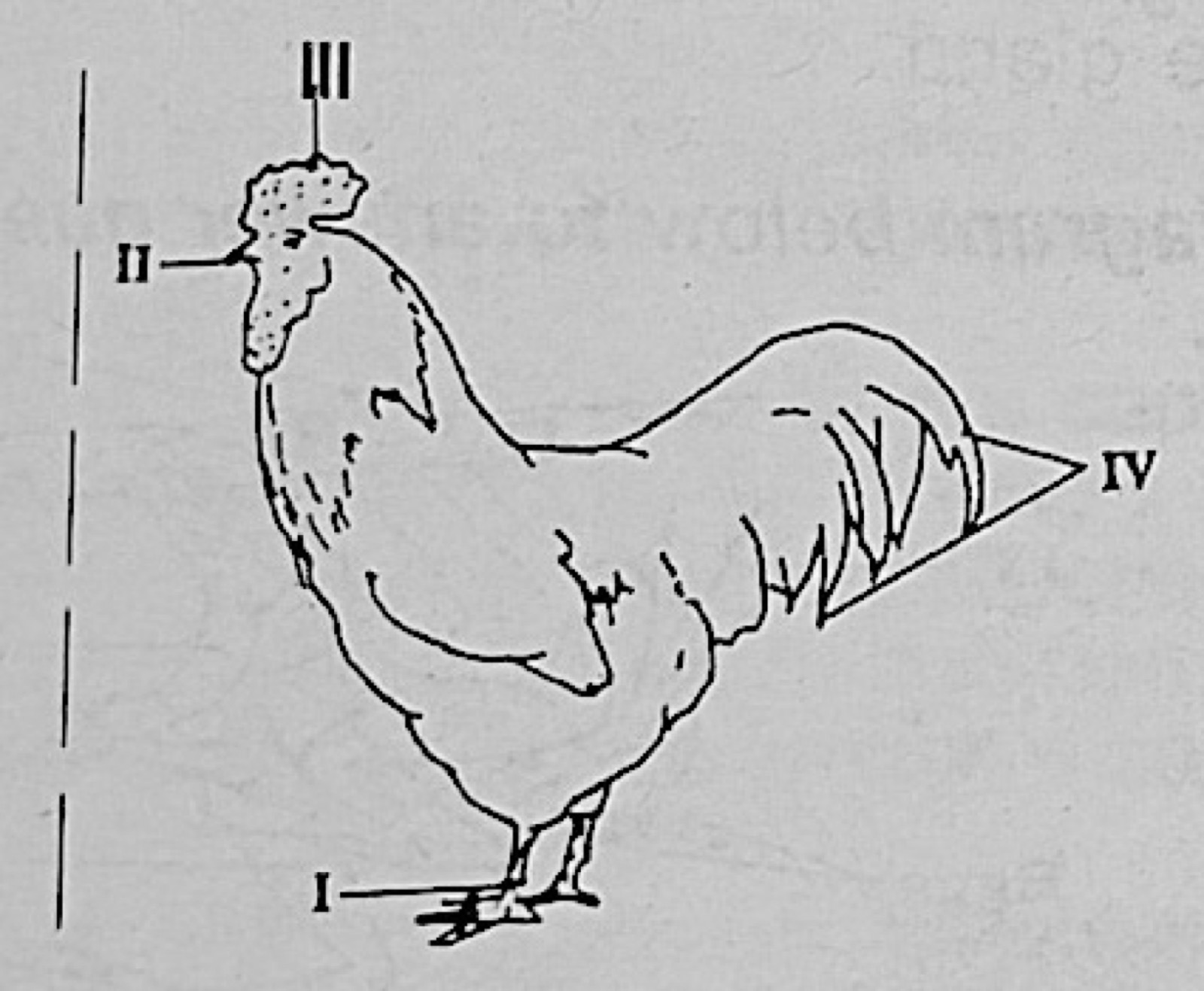
Use the diagram of the cock to answer: A unique characteristic that distinguishes the class of vertebrates represented from other vertebrates is the presence of

Diagram for this question
  1. A.two pairs of limbs
  2. B.scales on the lower legs
  3. C.a pair of wings
  4. D.a covering of feathers
Show the answer and explanation

Answer: D (a covering of feathers)

Explanation

Only birds have feathers. Other animals can have wings (bats), scales (reptiles) or two pairs of limbs.

Open this question

Question 37

Adaptation

Use the diagram of the cock to answer: The structures used for offence and defence are labelled

Diagram for this question
  1. A.I and IV
  2. B.I and II
  3. C.II and III
  4. D.III and IV
Show the answer and explanation

Answer: B (I and II)

Explanation

The cock fights with its claws and spurs on the feet (I) and its beak (II). The comb (III) and tail (IV) are for display.

Open this question

Question 38

Animal Kingdom

One primitive feature of the coelenterates is the possession of

  1. A.a dorsal mouth
  2. B.radial symmetry
  3. C.bilateral symmetry
  4. D.a false foot
Show the answer and explanation

Answer: B (radial symmetry)

Explanation

Coelenterates such as Hydra have radial symmetry, with body parts arranged around a centre. More advanced animals are bilaterally symmetrical.

Open this question

Question 39

Evolution

A characteristic that best exemplifies the evolutionary advancement of mammals over other vertebrates is the

  1. A.viviparous mode of reproduction
  2. B.possession of paired limbs
  3. C.terrestrial mode of life
  4. D.possession of a heart
Show the answer and explanation

Answer: A (viviparous mode of reproduction)

Explanation

Most mammals give birth to live young that develop inside the mother and are fed through a placenta. Other vertebrates mostly lay eggs.

Open this question

Question 40

Animal Nutrition

An organism which exhibits extracellular digestion is

  1. A.Spirogyra
  2. B.Paramecium
  3. C.Amoeba
  4. D.Rhizopus
Show the answer and explanation

Answer: D (Rhizopus)

Explanation

Rhizopus releases digestive enzymes onto its food and absorbs the products, so digestion happens outside its cells. Amoeba and Paramecium digest food inside food vacuoles, and Spirogyra makes its own food.

Open this question

Question 41

Microorganisms and Health

The causative agent of typhoid fever is

  1. A.Salmonella
  2. B.Entamoeba
  3. C.Escherichia
  4. D.Shigella
Show the answer and explanation

Answer: A (Salmonella)

Explanation

Typhoid fever is caused by the bacterium Salmonella typhi, spread through dirty food and water.

Open this question

Question 42

Adaptation

Grasses recover quickly from bush fires in the savanna because of their

  1. A.perennating organs
  2. B.rapid growth rate
  3. C.fibrous roots
  4. D.succulent stems
Show the answer and explanation

Answer: A (perennating organs)

Explanation

Savanna grasses keep underground stems (rhizomes) and buds that the fire does not reach. New shoots grow from these perennating organs soon after the fire.

Open this question

Question 43

Population Ecology

Climax communities in a biotic succession are usually characterized by

  1. A.a constant change in the appearance of the communities
  2. B.different species that are constantly changing
  3. C.a stable composition of plant and animal species
  4. D.rapid changes in the plant and animal species
Show the answer and explanation

Answer: C (a stable composition of plant and animal species)

Explanation

A climax community is the final stage of succession. Its mix of plant and animal species stays stable over time.

Open this question

Question 44

Ecosystem and Ecological Factors

Use the graph to answer: Which of the following can be deduced from the distribution?

Diagram for this question
  1. A.Species II is found only in locations where it rains all year round
  2. B.Species III increases in number as rainfall increases
  3. C.The distribution of species IV is not dependent on rainfall
  4. D.Species I thrives under conditions of moderate to high rainfall
Show the answer and explanation

Answer: D (Species I thrives under conditions of moderate to high rainfall)

Explanation

Species I is scarce at low rainfall but rises above 200 per km² once rainfall is moderate and stays high as rainfall increases. Species III falls as rainfall rises, and species IV is found only within a narrow rainfall range.

Open this question

Question 45

Ecosystem and Ecological Factors

Use the graph to answer: The species whose distribution is not affected by rainfall is

Diagram for this question
  1. A.II
  2. B.IV
  3. C.I
  4. D.III
Show the answer and explanation

Answer: A (II)

Explanation

The line for species II stays flat at 200 per km² at every rainfall level. So rainfall does not affect it.

Open this question

Question 46

Soil

The soil type that contains nutrients which are not readily available for plants is

  1. A.alluvial
  2. B.clayey
  3. C.sandy
  4. D.loamy
Show the answer and explanation

Answer: B (clayey)

Explanation

Clay soil is rich in minerals, but its tiny particles hold them tightly and it is badly aerated and waterlogged. So the nutrients are hard for roots to take up.

Open this question

Question 47

Ecological Associations

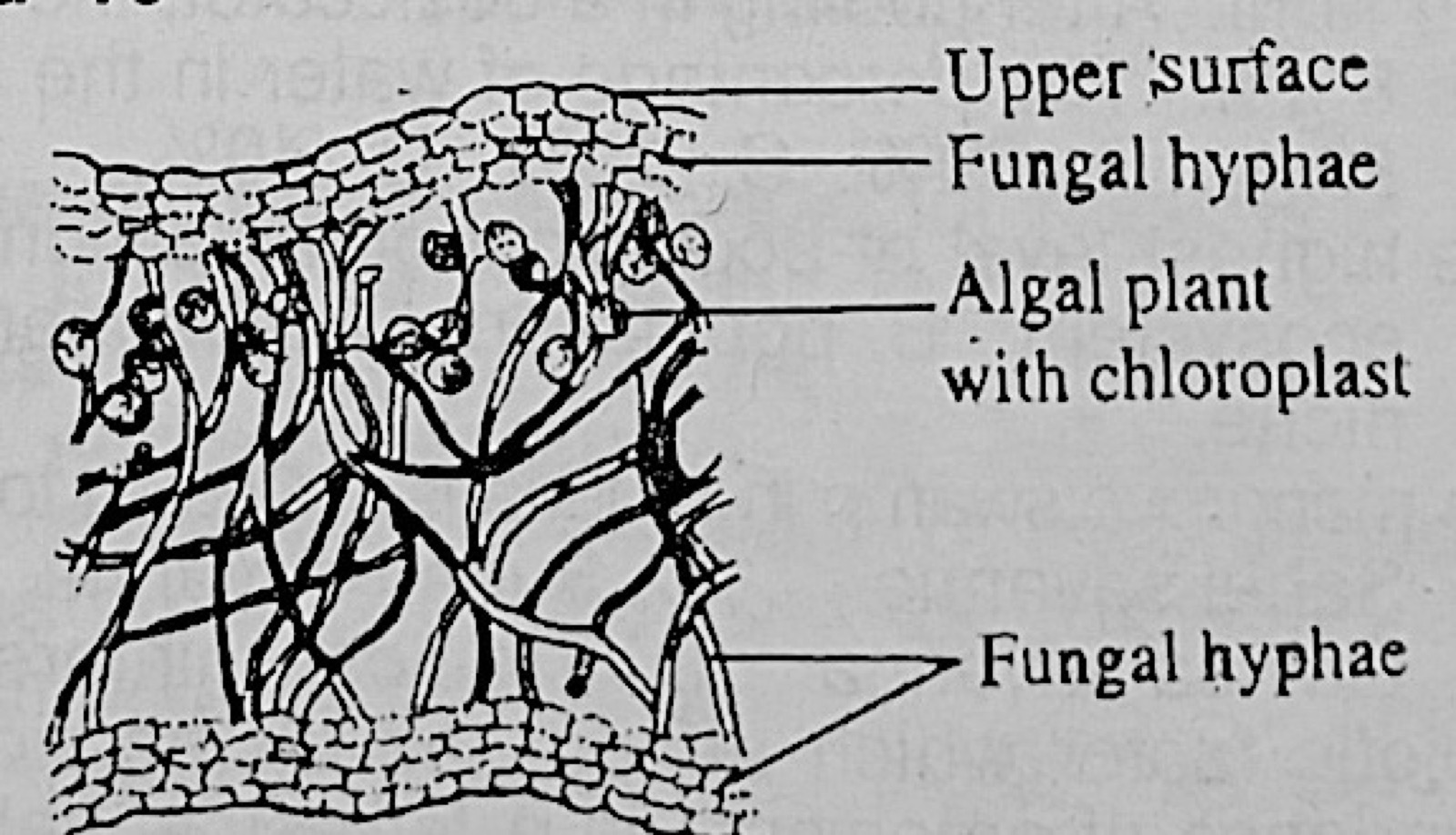
Use the diagram of the lichen to answer: The importance of the association to the fungus is that it obtains

Diagram for this question
  1. A.a partner for reproduction
  2. B.anchorage from the algae
  3. C.oxygen and carbohydrates from the algae
  4. D.water and mineral salts from the algae
Show the answer and explanation

Answer: C (oxygen and carbohydrates from the algae)

Explanation

The alga has chloroplasts and makes carbohydrates by photosynthesis, giving off oxygen. The fungus takes these from the alga, while the fungus gives water and shelter.

Open this question

Question 48

Ecological Associations

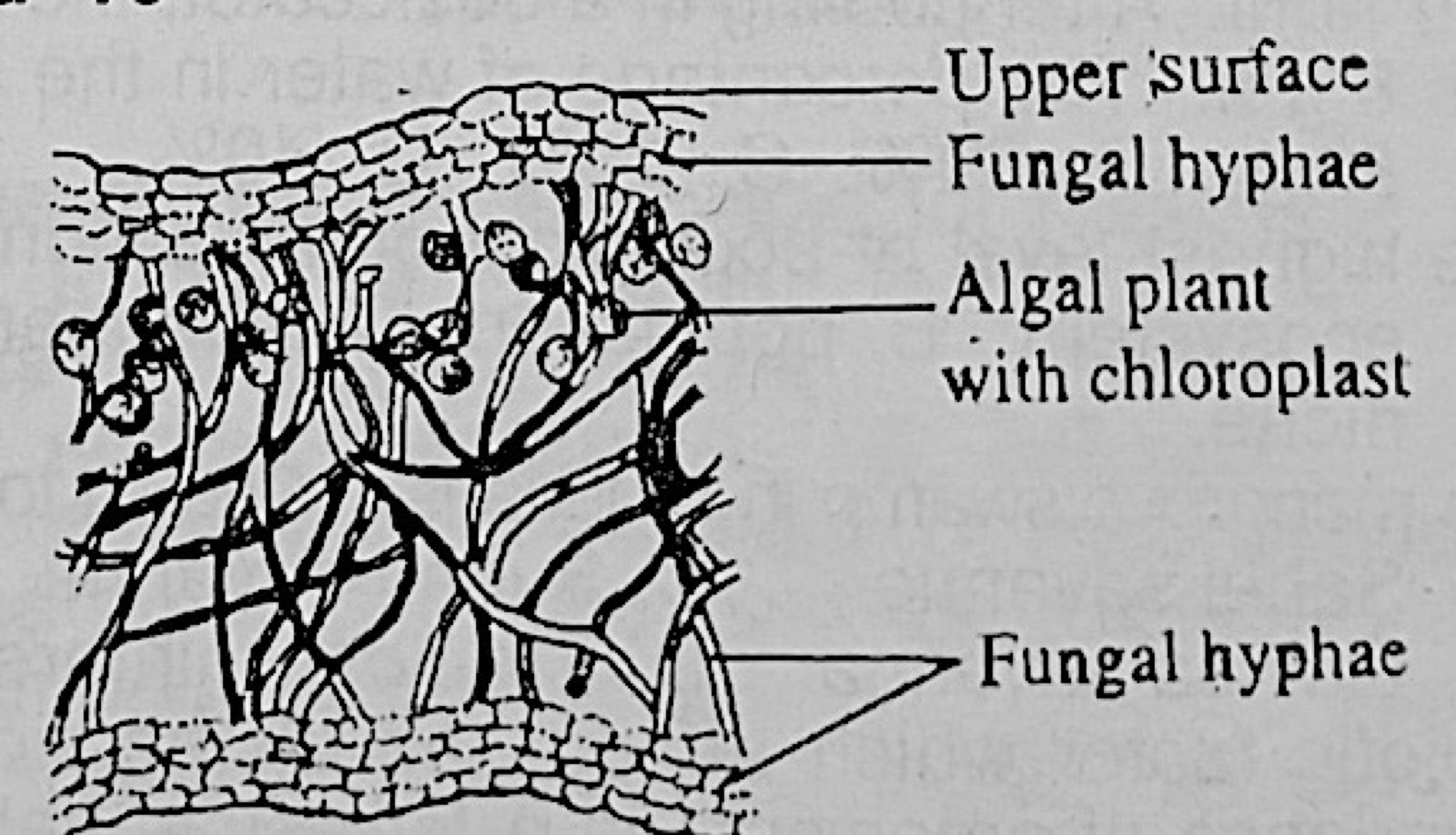
Use the diagram of the lichen to answer: The association illustrated demonstrates

Diagram for this question
  1. A.parasitism
  2. B.commensalism
  3. C.saprophytism
  4. D.mutualism
Show the answer and explanation

Answer: D (mutualism)

Explanation

In a lichen, the alga feeds the fungus and the fungus shelters the alga and keeps it moist. Both benefit, so it is mutualism.

Open this question

Question 49

Population Ecology

A population that doubles in size at constant intervals is an indication of

  1. A.sigmoid growth
  2. B.exponential growth
  3. C.population explosion
  4. D.rapid growth
Show the answer and explanation

Answer: B (exponential growth)

Explanation

Doubling in equal time steps (2, 4, 8, 16…) is exponential growth. Sigmoid growth slows down and levels off.

Open this question

Question 50

Conservation of Natural Resources

The main purpose of establishing shelter belts in the Sahel region is to

  1. A.check desert encroachment
  2. B.provide wood fuel
  3. C.beautify the region
  4. D.break the harmattan wind
Show the answer and explanation

Answer: A (check desert encroachment)

Explanation

Rows of trees planted across the Sahel slow the wind, hold the soil and stop sand from spreading. Their main purpose is to check the advance of the desert.
Open this question