Home › Past questions › JAMB › Biology › 1998 50 questions. Try each one, then open the answer to check yourself and read the explanation.
Sign up free to answer these questions on a CBT screen with a timer, then see your score and every answer explained.
Start practising free
Question 1 Cell Structure and Organisation The nucleus is considered the central organelle of a cell because it
A. contains the genetic material B. contains the nuclear sap C. is bounded by the nuclear membrane D. is located at the centre of the cell. Show the answer and explanation Answer: A (contains the genetic material )
Explanation The nucleus holds the chromosomes (DNA), which control all the activities of the cell.
Open this question
Question 2 Cell Structure and Organisation The procaryotic cell type is characterized by a
A. complex cytoplasm in which different regions are poorly defined B. localization of defferent regions of the cell into tissues C. collection of organelles and macromolecular complexes D. simple cytoplasm with well defined regions. Show the answer and explanation Answer: A (complex cytoplasm in which different regions are poorly defined )
Explanation Prokaryotes such as bacteria have no membrane-bound organelles or nucleus, so the regions of their cytoplasm are not clearly separated.
Open this question
Question 3 Evolution The natural tendency of organisms as they evolve is to
A. decrease in size B. increase in number C. develop specialized structures D. feed indiscriminately. Show the answer and explanation Answer: C (develop specialized structures )
Explanation Evolution generally moves from simple to complex organisms with more specialised structures for particular jobs.
Open this question
Question 4 Animal Kingdom In snails, the hard calcareous shells are secreted by the
A. radula B. ctenidium C. pneumostome D. mantle. Show the answer and explanation Answer: D (mantle. )
Explanation The mantle is the fold of tissue that lines the shell and secretes calcium carbonate to build it.
Open this question
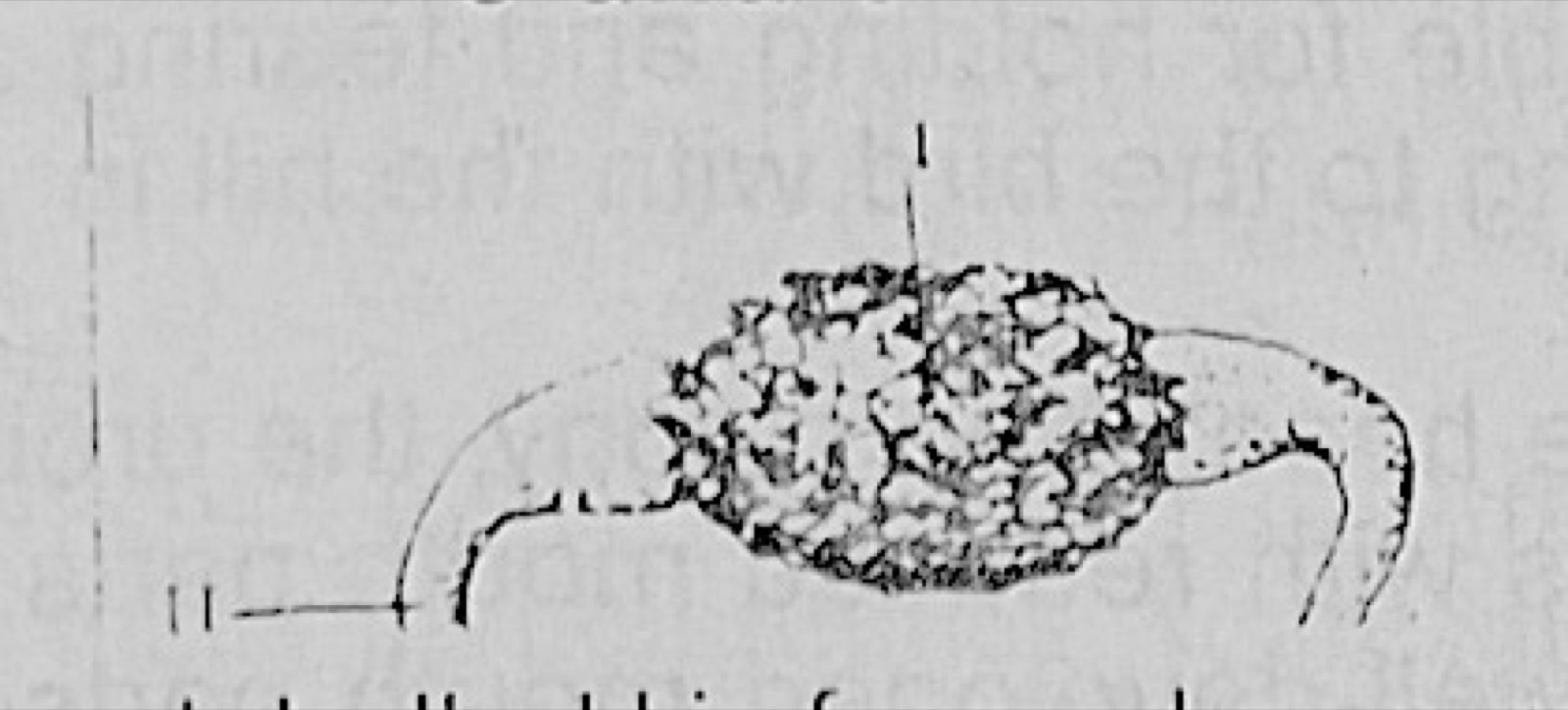
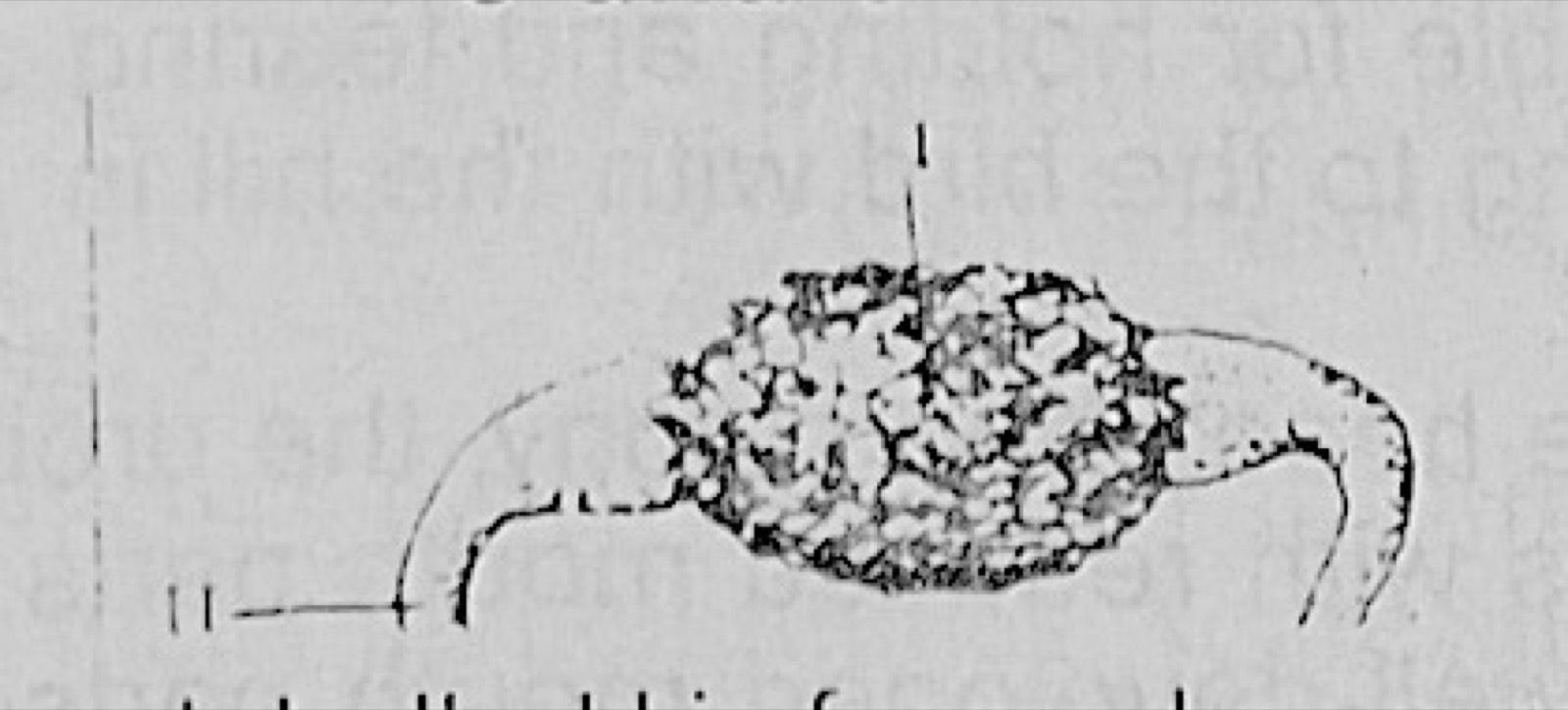
Question 5 Reproduction in Plants Use the diagram to answer questions 5 and 6. The structure labelled I is formed as a result of the fusion of
A. two pairs of nuclei B. several pairs of nuclei C. a pair of nuclei D. two pairs of nucleoli. Show the answer and explanation Answer: B (several pairs of nuclei )
Explanation I is the zygospore of Mucor. It forms when two multinucleate gametangia join and their many nuclei fuse in pairs.
Open this question
Question 6 Viruses, Monera, Protista and Fungi Use the diagram to answer questions 5 and 6. The special name of the part labelled II is
A. gametangium B. hypha C. suspensor D. zygospore. Show the answer and explanation Answer: C (suspensor )
Explanation In Mucor conjugation, the zygospore is held between two curved supporting hyphal branches called suspensors.
Open this question
Question 7 Adaptation The ability of the cockroach to live in cracks and crevices is enhanced by the possession of
A. wings and segmented body B. compound eyes C. claws on the legs D. dorso-ventrally flattened body. Show the answer and explanation Answer: D (dorso-ventrally flattened body. )
Explanation A body flattened from top to bottom lets the cockroach squeeze into narrow cracks.
Open this question
Question 8 Behaviour The caste of termites that lacks pigmentation is the
A. king B. worker C. soldier D. queen. Show the answer and explanation Answer: B (worker )
Explanation Workers live inside the dark mound and are pale and unpigmented; the reproductives are darker.
Open this question
Question 9 Respiration The structures that prevent food particles from escaping through the fish gills are called gill
A. arches B. filaments C. rakers D. lamellae. Show the answer and explanation Answer: C (rakers )
Explanation Gill rakers are comb-like projections on the gill arches that strain food and stop it passing out with the water.
Open this question
Question 10 Animal Kingdom A distinguishing feature of mammals is the possession of
A. skin B. scale C. nail D. hair. Show the answer and explanation Answer: D (hair. )
Explanation Only mammals have hair (fur); other vertebrates have skin, and some have scales or claws.
Open this question
Question 11 Structure of Flowering Plants Which of the following structures is capable of producing more tissues in the stem of a herbaceous flowering plant?
A. Epidermis B. Pericycle C. Xylem D. Cambium. Show the answer and explanation Answer: D (Cambium. )
Explanation Cambium is a layer of dividing (meristematic) cells that produces new xylem and phloem.
Open this question
Question 12 Photosynthesis and Plant Nutrition The manufacture of carbohydrates by plants takes place only in
A. the leaves B. the green stems C. chlorophyllous parts D. flowering plants. Show the answer and explanation Answer: C (chlorophyllous parts )
Explanation Photosynthesis needs chlorophyll, so it happens in any green part of the plant, not only leaves.
Open this question
Question 13 Photosynthesis and Plant Nutrition In a water culture experiment, a plant showed poor growth and yellowing of the leaves. These may be due to deficiency of
A. copper B. iron C. magnesium D. calcium. Show the answer and explanation Answer: C (magnesium )
Explanation Magnesium is part of the chlorophyll molecule; without it leaves cannot make chlorophyll, turn yellow, and the plant grows poorly.
Open this question
Question 14 Food Substances and Enzymes In Millon's test,when the reagent is added to a protein food item, a white precipitate is produced which turns
A. blue on heating B. yellow on heating C. green on heating D. red on heating. Show the answer and explanation Answer: D (red on heating. )
Explanation With Millon's reagent, protein gives a white precipitate that turns brick red when heated.
Open this question
Question 15 Homeostasis Regulation of blood sugar level takes place in the
A. pancreas B. ileum C. liver D. kidney. Show the answer and explanation Answer: C (liver )
Explanation The liver stores excess glucose as glycogen and releases glucose when blood sugar falls, under the control of insulin and glucagon.
Open this question
Question 16 Cell and Its Environment Unicellular organisms transport essential nutrients directly to all parts of their bodies by the process of diffusion because, they have
A. a large volume to surface area ratio B. a large surface area to volume ratio C. their bodies immersed in the nutrients D. their outer membrane made of cellulose. Show the answer and explanation Answer: B (a large surface area to volume ratio )
Explanation Small organisms have a large surface area compared with their volume, so diffusion alone can supply every part.
Open this question
Question 17 Transport in Animals The heart of the adult frog consists of
A. two auricles and two ventricles B. one auricle and one ventricle C. two ventricles and one auricle D. one ventricle and two auricles. Show the answer and explanation Answer: D (one ventricle and two auricles. )
Explanation Amphibians have a three-chambered heart: two auricles (atria) and one ventricle.
Open this question
Question 18 Transport in Animals In adult mammalian blood, the cells which lack nuclei are the
A. erythrocytes B. lymphocytes C. leucocytes D. phagocytes. Show the answer and explanation Answer: A (erythrocytes )
Explanation Mature red blood cells (erythrocytes) lose their nucleus, leaving more room for haemoglobin.
Open this question
Question 19 Respiration Which of the following movements occur during exhalation?
A. The diaphragm and intercostal muscles relax B. The thoracic cavity increases in volume C. The diaphragm and intercostal muscles contract D. The diaphragm contracts and the intercostal muscles relax. Show the answer and explanation Answer: A (The diaphragm and intercostal muscles relax )
Explanation When breathing out, the diaphragm and external intercostal muscles relax, the chest gets smaller and air is pushed out.
Open this question
Question 20 Excretion In which of the following groups of animals is the malpighian tubule found?
A. Lizards, snakes and frogs B. Crickets, houseflies and grasshoppers C. Millipedes, centipedes and scorpions D. earthworms, roundworms and flatworms. Show the answer and explanation Answer: B (Crickets, houseflies and grasshoppers )
Explanation Malpighian tubules are the excretory organs of insects such as crickets, houseflies and grasshoppers.
Open this question
Question 21 Support and Movement Which of the following is not a function of the mammalian skeleton?
A. Protection B. respiration C. Transportation D. Support. Show the answer and explanation Answer: C (Transportation )
Explanation The skeleton protects, supports and helps breathing (rib movements), but it does not transport materials; blood does that.
Open this question
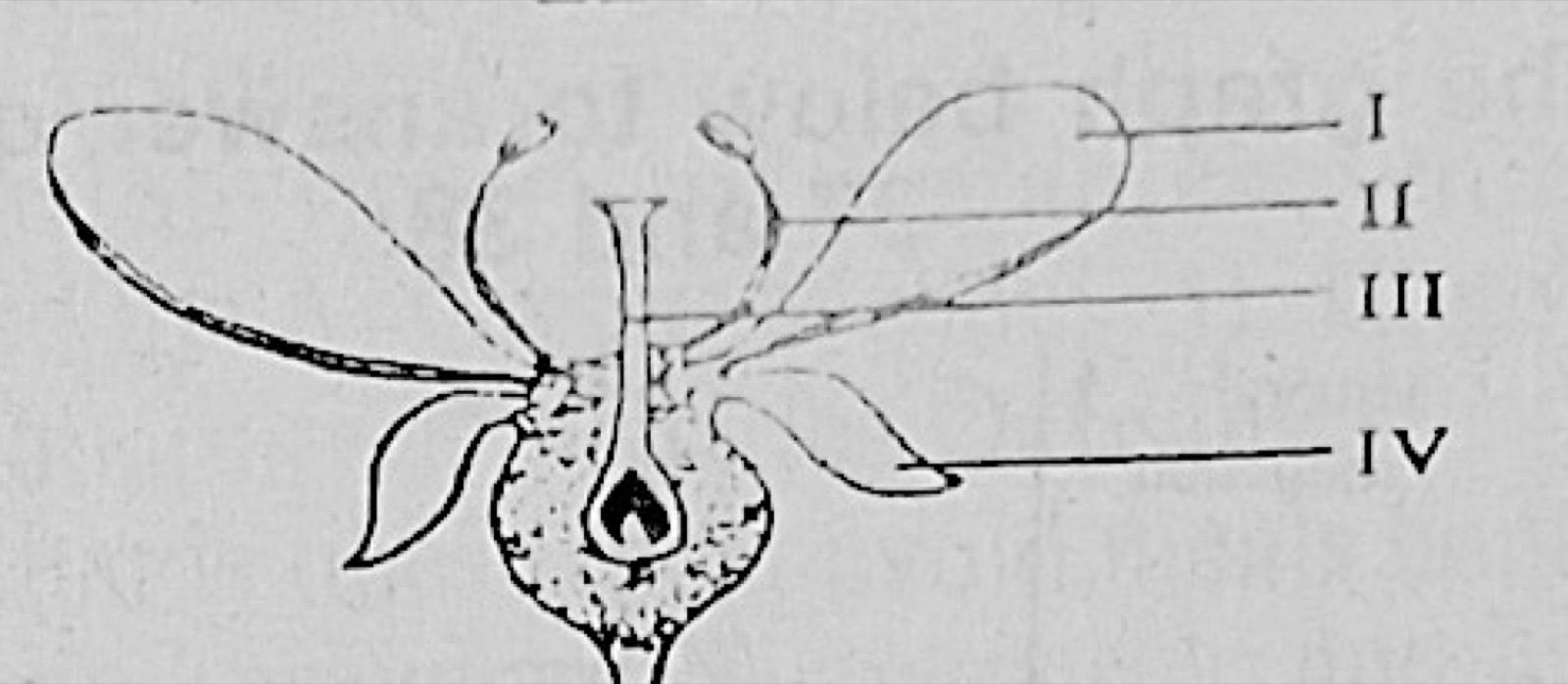
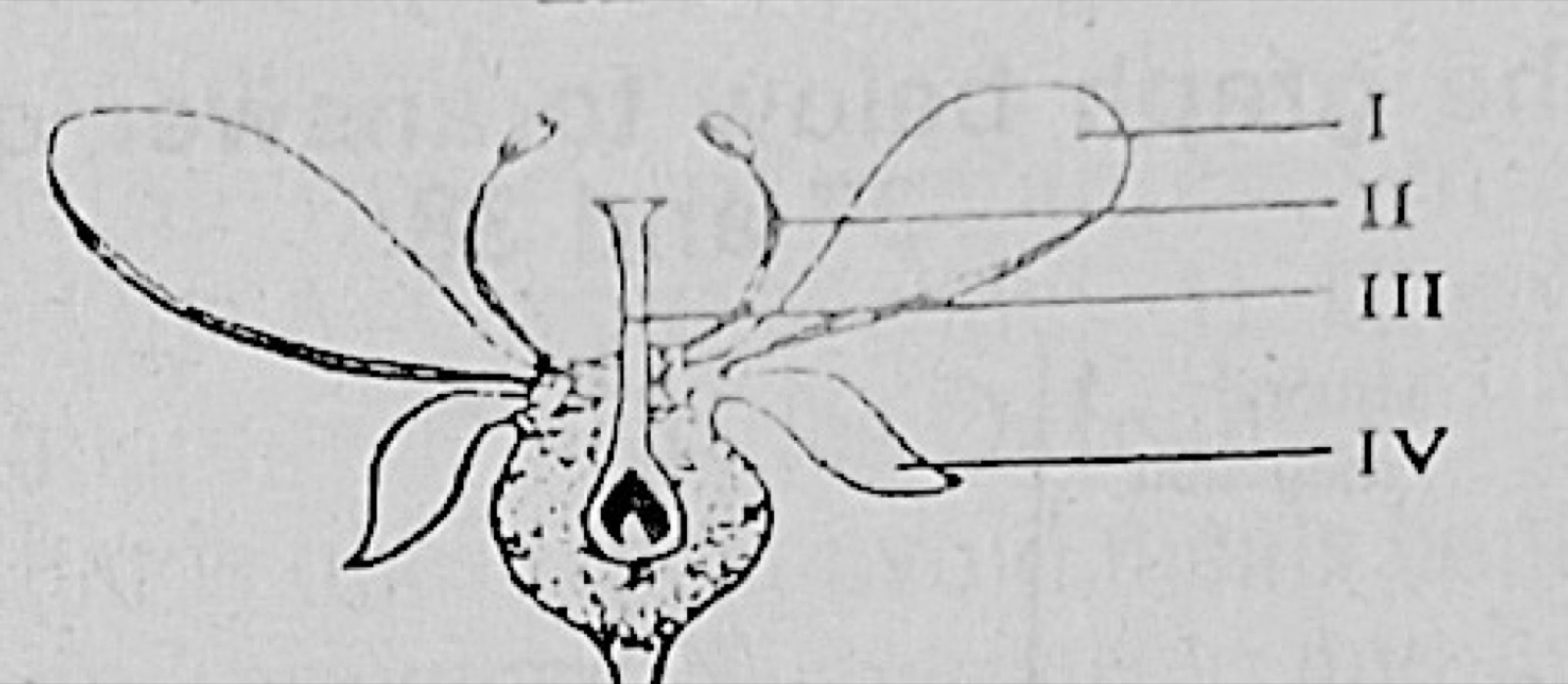
Question 22 Reproduction in Plants Use the diagram to answer questions 22 and 23. The ovary represented is
A. half-superior B. inferior C. superior D. half-inferior. Show the answer and explanation Answer: B (inferior )
Explanation The ovary is sunk below the point where the sepals and petals are attached, so it is inferior.
Open this question
Question 23 Reproduction in Plants Use the diagram to answer questions 22 and 23. The corolla is partly represented by
A. I B. II C. III D. IV Show the answer and explanation Answer: A (I )
Explanation The corolla is made of the petals; label I points to one of the large petals.
Open this question
Question 24 Growth and Development The most reliable estimate of growth is by measuring changes in
A. length B. volume C. surface area D. dry weight. Show the answer and explanation Answer: D (dry weight. )
Explanation Dry weight measures the actual increase in living material, without changes caused by water content.
Open this question
Question 25 Reproduction in Plants A dry fruit formed from two or more carpels containing several seeds is a
A. follicle B. legume C. capsule D. schizocarp. Show the answer and explanation Answer: C (capsule )
Explanation A capsule develops from a compound ovary of two or more carpels and contains many seeds; follicles and legumes come from one carpel.
Open this question
Question 26 Reproduction in Animals The outermost embryonic membrane in the mammal is the
A. amnion B. chorion C. allantois D. yolk sac. Show the answer and explanation Answer: B (chorion )
Explanation The chorion surrounds all the other membranes and joins with the uterine wall to form the placenta.
Open this question
Question 27 Nervous Coordination The small masses of nervous tissue in which many neurones have their nuclei are called
A. dorsal roots B. ventral roots C. ganglia D. synapses. Show the answer and explanation Answer: C (ganglia )
Explanation A ganglion is a cluster of nerve cell bodies (with their nuclei) outside the brain and spinal cord.
Open this question
Question 28 Ecosystem and Ecological Factors A group of organisms of different species living in a particular area is described as a
A. colony B. community C. population D. niche. Show the answer and explanation Answer: B (community )
Explanation A community is all the populations of different species living together in one area.
Open this question
Question 29 Feeding Relationships and Energy Flow Which of the following is the direct consequence of transferring energy from one trophic level to another?
A. An increase in biomass B. A decrease in the efficiency of energy conversion C. An increase in the total numbers of resulting individuals D. A decrease in the resulting biomass. Show the answer and explanation Answer: D (A decrease in the resulting biomass. )
Explanation Most energy is lost as heat at each step, so each higher trophic level can support less biomass.
Open this question
Question 30 Nutrient Cycling The condition that encourages denitrification is
A. low soil oxygen B. high soil nitrogen C. absence of soil bacteria D. lightning and thunderstorm. Show the answer and explanation Answer: A (low soil oxygen )
Explanation Denitrifying bacteria thrive in waterlogged, poorly aerated soils where oxygen is low.
Open this question
Question 31 Adaptation A freshwater plant such as water lily can solve the problem of buoyancy by the possession of
A. aerenchymarous tissues B. dissected leaves C. thin cell walls of the epidermis D. water-repelling epidermis. Show the answer and explanation Answer: A (aerenchymarous tissues )
Explanation Aerenchyma is tissue with large air spaces that keeps the leaves and stems floating.
Open this question
Question 32 Habitats and Biomes The sequence of the biomes in Nigeria from Port Harcourt to Damaturu is
A. estuarine → rain forest → Guinea savannah → Sahel savanah B. rain forest → Guinea savannah → estuarine → desert C. estuarine → Guinea savannah → rain forest → Sahel savannah D. rain forest → estuarine → Guinea savannah → desert. Show the answer and explanation Answer: A (estuarine → rain forest → Guinea savannah → Sahel savanah )
Explanation Moving north from the coast, rainfall falls steadily: mangrove/estuarine swamps, then rain forest, Guinea savanna and finally Sahel savanna in the far north-east.
Open this question
Question 33 Nutrient Cycling Soil micro-organisms are beneficial because of their involvement in
A. photosynthesis B. translocation C. cycling of nutrients D. respiration using soil air. Show the answer and explanation Answer: C (cycling of nutrients )
Explanation Soil microbes decompose dead matter and drive the nitrogen and carbon cycles, returning nutrients to plants.
Open this question
Question 34 Microorganisms and Health Which of the following groups of diseases are associated with water? I Onchocerciasis II Schistosomiasis III Dracunculiasis IV Elephantiasis V. Taeniasis
A. I, II and III B. II, IV and V C. II, III and IV D. I, II and V. Show the answer and explanation Answer: A (I, II and III )
Explanation River blindness (blackflies breed in rivers), bilharzia (snails in water) and guinea worm (drinking water) are all water-related; taeniasis comes from undercooked meat.
Open this question
Question 35 Chromosomes, DNA and Sex Linkage One of the ways in which body cells differ from gamete cells is in the
A. type of centromeres they contain B. number of chromosome pairs they contain C. type of chromatids they contain D. number of chromosomes they contain. Show the answer and explanation Answer: D (number of chromosomes they contain. )
Explanation Body cells are diploid while gametes are haploid, so a body cell has twice as many chromosomes.
Open this question
Question 36 Transport in Animals In blood transfusion, agglutination occurs when
A. white blood cells from two individuals meet B. two different antibodies meet C. two different antigens meet D. contrasting antigens and antibodies meet. Show the answer and explanation Answer: D (contrasting antigens and antibodies meet. )
Explanation Red cells clump when their antigens meet the matching antibodies in the other blood (e.g. antigen A with anti-A).
Open this question
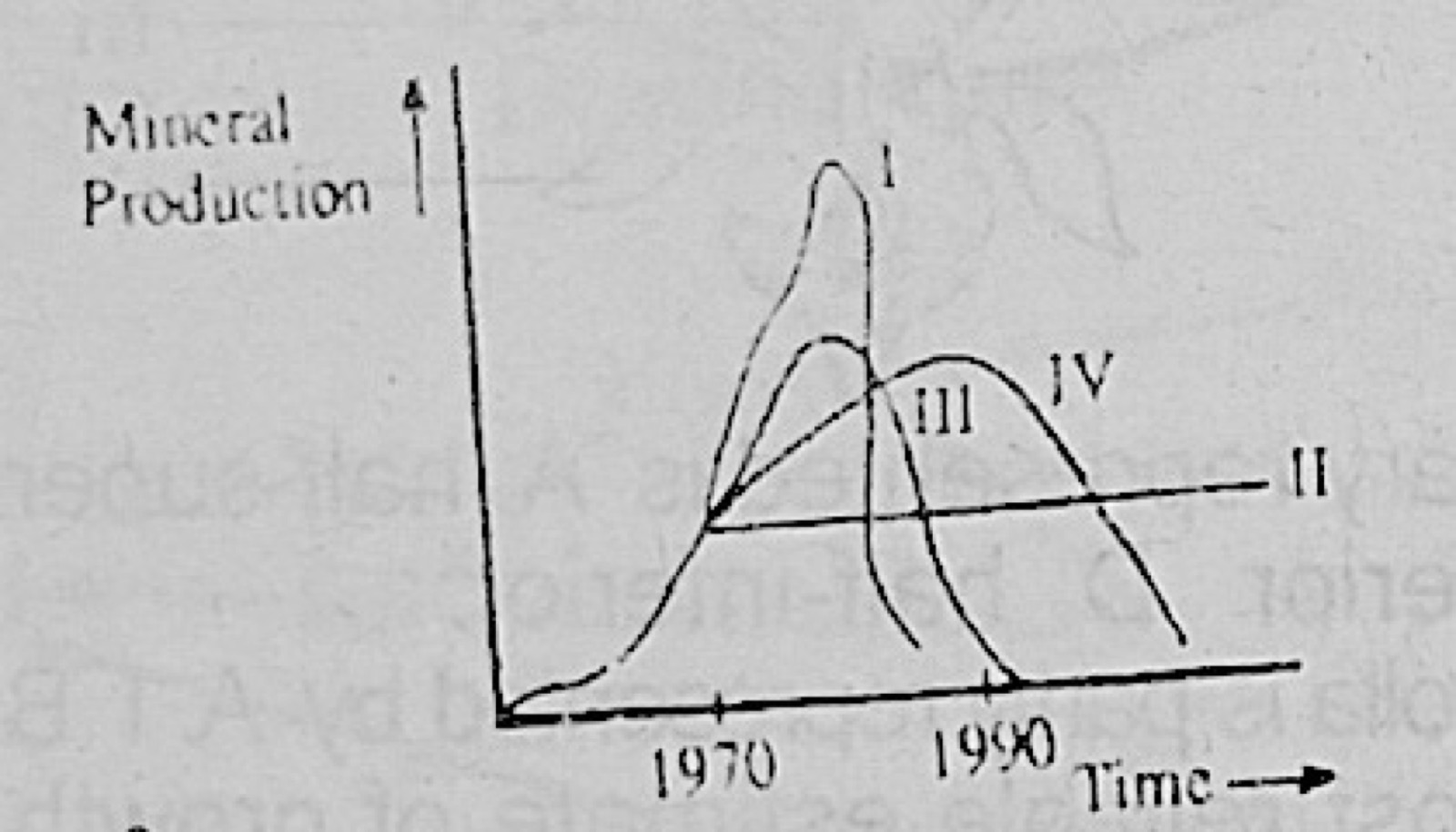
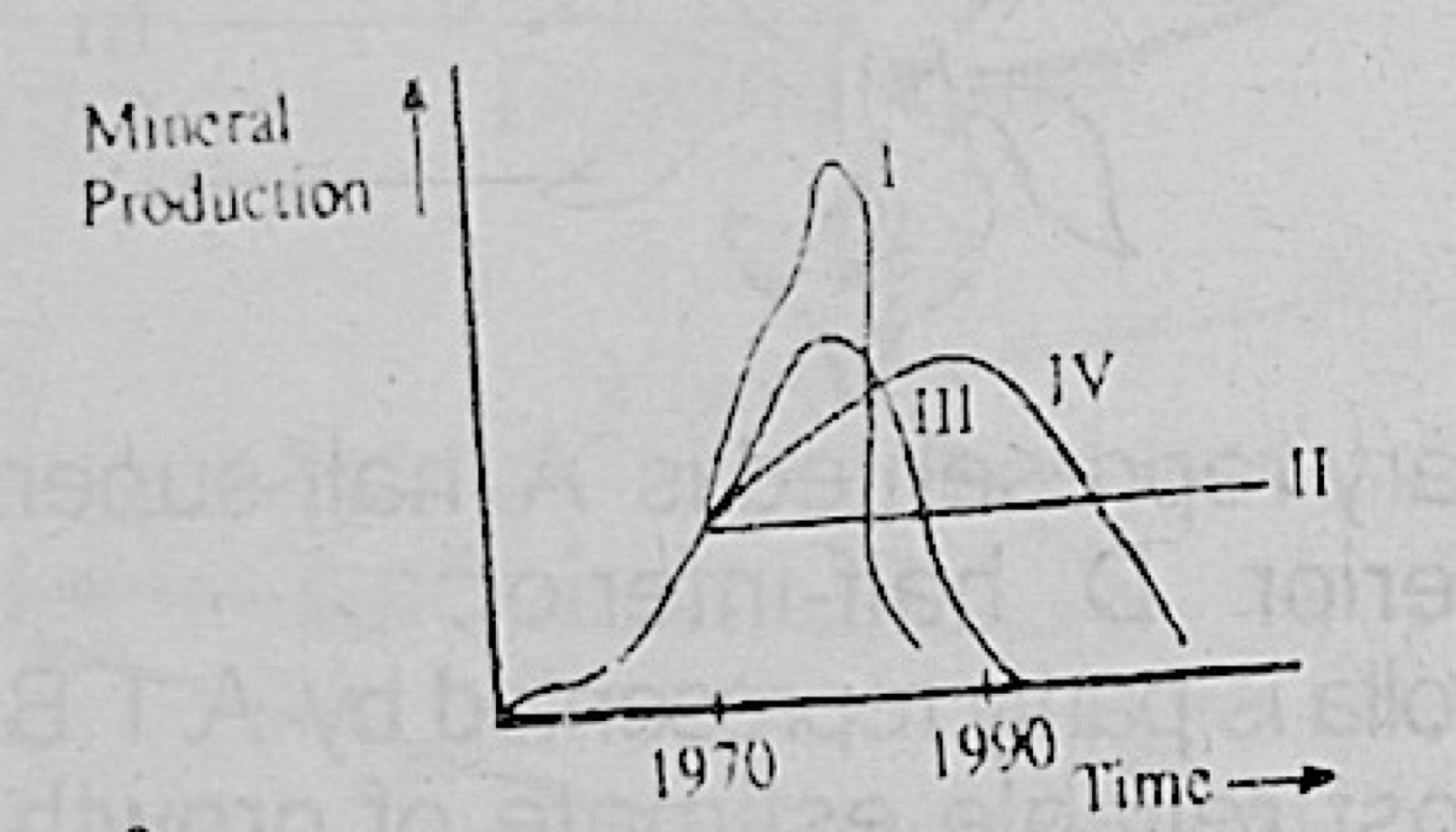
Question 37 Conservation of Natural Resources Use the graph (the alternate depletion patterns of mineral resources over time) to answer questions 37 and 38. The unrestricted pattern is represented by
A. I B. II C. III D. IV. Show the answer and explanation Answer: A (I )
Explanation Without any restriction, production shoots up fast and the resource is used up quickly, giving the tall, narrow peak I.
Open this question
Question 38 Conservation of Natural Resources Use the graph (the alternate depletion patterns of mineral resources over time) to answer questions 37 and 38. The line that represents efficient recycling combined with stringent conservation is
A. IV B. III C. II D. I. Show the answer and explanation Answer: C (II )
Explanation With recycling and strict conservation, only a little new mineral is mined each year, so the line stays flat and the resource lasts longest (line II).
Open this question
Question 39 Variation After one week of life, the weights of five chicks of the same sex hatched simultaneously from the eggs of the same hen and fed on the same diet were 45g, 40g, 35g, 33g, and 30g. This is an example of
A. growth rate B. natural selection C. variation D. mutation. Show the answer and explanation Answer: C (variation )
Explanation Chicks of the same parents, age and diet still differ in weight; these differences are variation.
Open this question
Question 40 Mendelian Inheritance The phenotype of an individual can be summed up as the
A. totality of the expressed traits B. individual's physical appearance C. individual's entire genetical make-up D. physiological traits of the individual. Show the answer and explanation Answer: A (totality of the expressed traits )
Explanation Phenotype is every trait that is actually expressed, physical and physiological; the genetic make-up is the genotype.
Open this question
Question 41 Chromosomes, DNA and Sex Linkage The correct increasing order of size for the cell components responsible for heredity is
A. chromosome → DNA → nucleus → gene B. DNA → gene → chromosome → nucleus C. chromosome → nucleus → DNA → gene. D. DNA → gene → nucleus → chromosome Show the answer and explanation Answer: B (DNA → gene → chromosome → nucleus )
Explanation Genes are made of DNA, genes are carried on chromosomes, and chromosomes are inside the nucleus, so the nucleus is the largest.
Open this question
Question 42 Chromosomes, DNA and Sex Linkage A sex-linked character cannot be passed on directly from
A. father to son B. mother to daughter C. mother to son D. father to daughter. Show the answer and explanation Answer: A (father to son )
Explanation Sex-linked genes are on the X chromosome, and a father gives his son a Y chromosome, not his X.
Open this question
Question 43 Population Ecology The biological association that contributes directly to succession in a community is
A. competition B. predation C. parasitism D. commensalism. Show the answer and explanation Answer: A (competition )
Explanation During succession new species out-compete the earlier ones for light, water and nutrients and replace them.
Open this question
Question 44 Animal Nutrition The group of insects that have mouth parts adapted for both piercing and sucking is
A. cockroaches, aphids and mosquitoes B. aphids, houseflies and moths C. mosquitoes, tse-tse flies and aphids D. aphids, beetles and grasshoppers. Show the answer and explanation Answer: C (mosquitoes, tse-tse flies and aphids )
Explanation Mosquitoes, tsetse flies and aphids pierce skin or plant tissue and suck blood or sap; cockroaches, beetles and grasshoppers chew.
Open this question
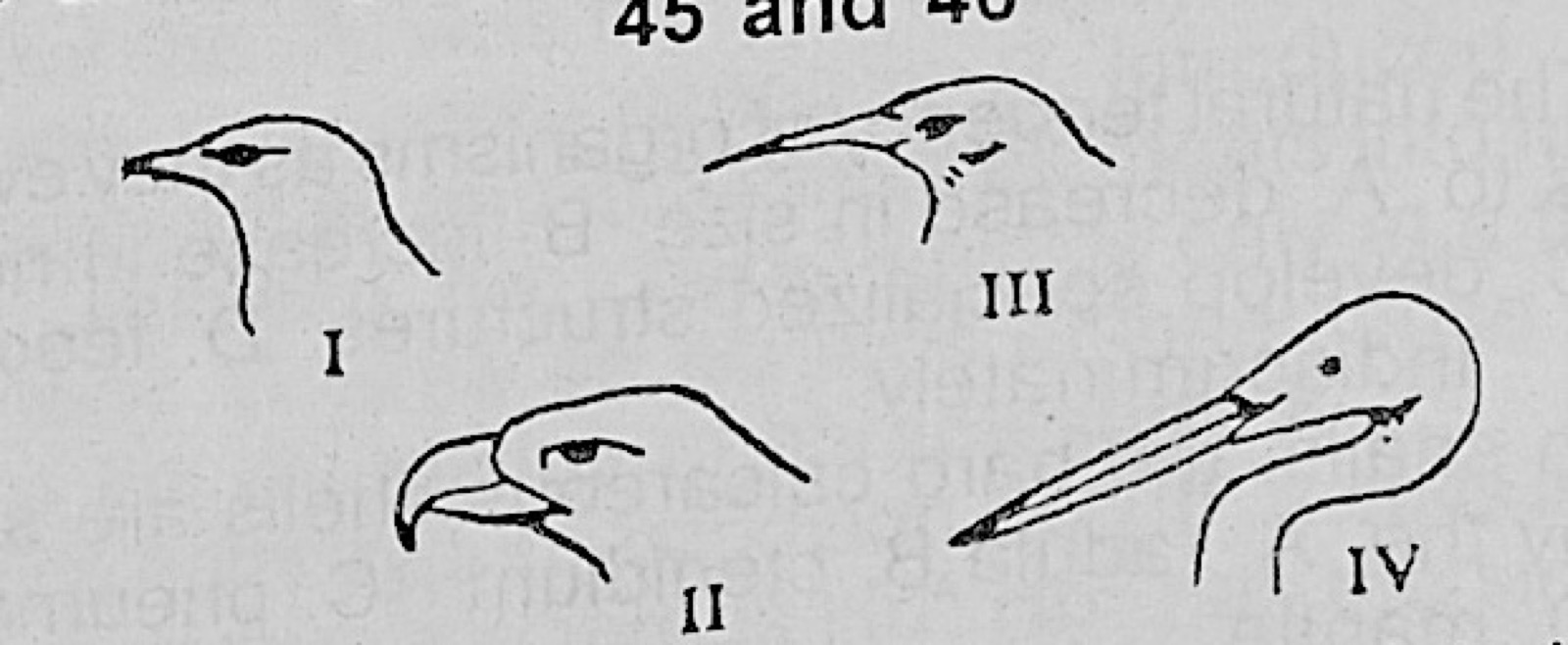
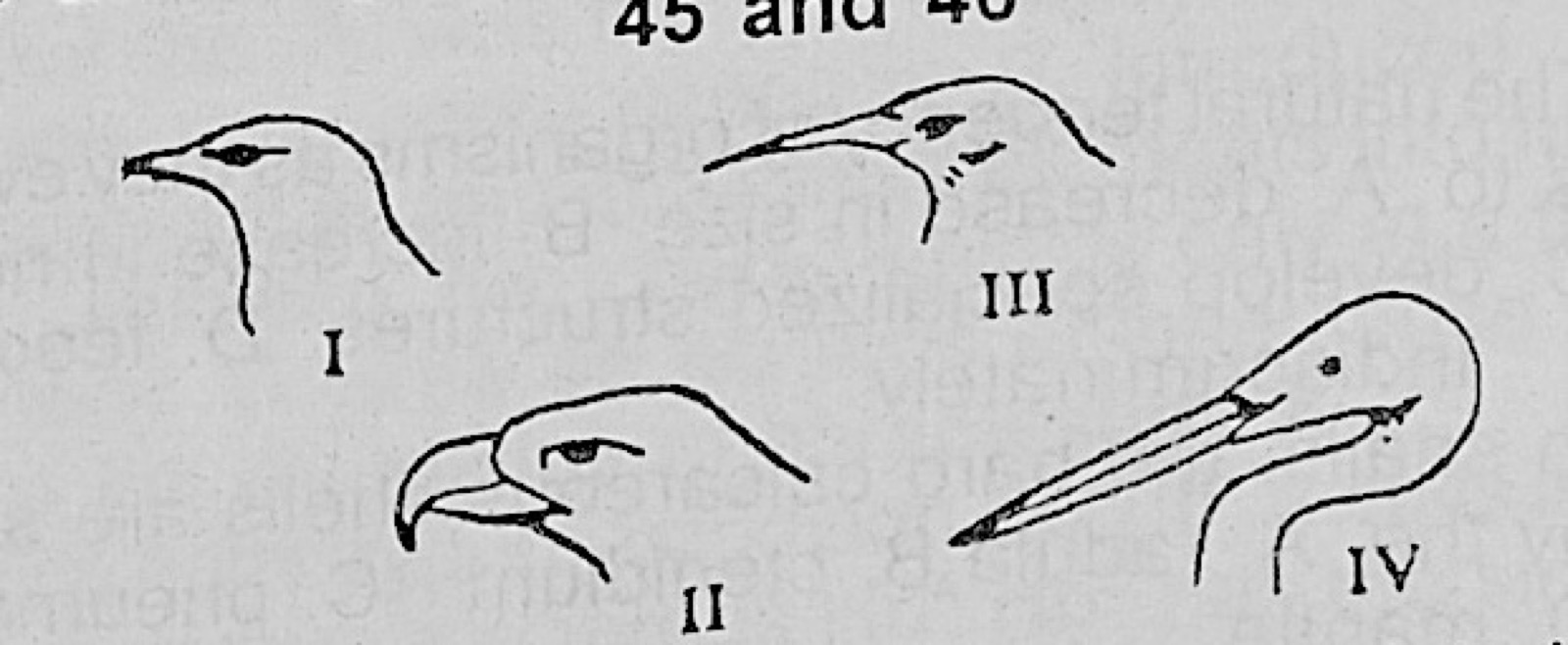
Question 45 Adaptation Use the diagrams to answer questions 45 and 46. The bird's bill adapted for fishing is labelled
A. I B. II C. III D. IV. Show the answer and explanation Answer: D (IV. )
Explanation Bill IV is long, straight and pointed, suited to spearing or catching fish.
Open this question
Question 46 Adaptation Use the diagrams to answer questions 45 and 46. Toes of the feet ending in a sharp, curved hook suitable for holding and tearing are most likely to belong to the bird with the bill in
A. I B. II C. III D. IV. Show the answer and explanation Answer: B (II )
Explanation Bill II is strongly hooked like an eagle's; birds of prey also have hooked talons for gripping and tearing prey.
Open this question
Question 47 Behaviour In the honey bee colony, the drones are
A. sterile males with reduced mouth parts B. sterile males with well-developed mouth parts C. fertile males with reduced mouth parts D. fertile males with well-developed mouth parts. Show the answer and explanation Answer: C (fertile males with reduced mouth parts )
Explanation Drones exist only to mate with the queen; they have short, reduced mouthparts and are fed by the workers.
Open this question
Question 48 Adaptation In the whistling pine, leaves are reduced to brown scales and young stems are green. This is an adaptation for
A. obtaining food B. conserving nutrients C. storing water D. reducing transpiration. Show the answer and explanation Answer: D (reducing transpiration. )
Explanation Tiny scale leaves have very little surface for water loss, so the green stems take over photosynthesis while transpiration is reduced.
Open this question
Question 49 Evolution The best explanation for the theories of natural selection is that
A. all organisms have equal capacity for survival in their habitats B. organisms have varying capacities for survival in their habitats C. organisms compete for resources and better competitors survive and thrive D. habitats allow only organisms that will not have to compete for survival. Show the answer and explanation Answer: C (organisms compete for resources and better competitors survive and thrive )
Explanation Natural selection says organisms compete for limited resources, and those best suited survive and reproduce.
Open this question
Question 50 Chromosomes, DNA and Sex Linkage The basic point of impact by changes which produce mutation is the
A. gametes B. chromosomes C. phenotype D. zygote. Show the answer and explanation Answer: B (chromosomes )
Explanation Mutations are changes in genes or chromosomes, the carriers of hereditary material.
Open this question Sign up free for every JAMB Biology year, practice by topic and timed mocks.
Start practising free