Home › Past questions › JAMB › Biology › 1981 50 questions. Try each one, then open the answer to check yourself and read the explanation.
Sign up free to answer these questions on a CBT screen with a timer, then see your score and every answer explained.
Start practising free
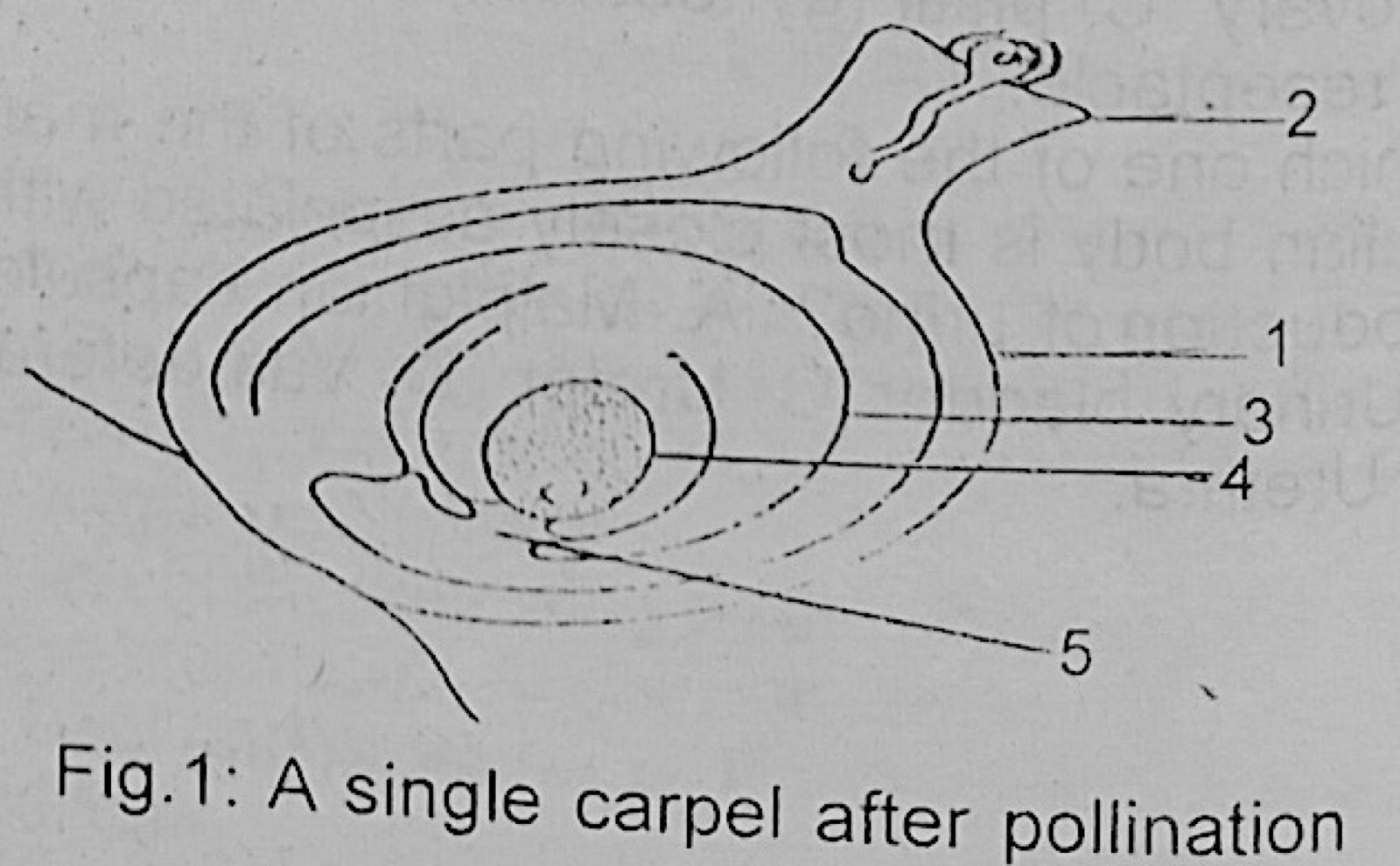
Question 1 Reproduction in Plants Fig.1: A single carpel after pollination
A. 12453 B. 24135 C. 21435 D. 14325 E. 31425. Show the answer and explanation Answer: C (21435 )
Explanation Stigma is 2, ovary wall 1, embryo sac 4 (the dotted sac), integument 3 and micropyle 5, giving 21435.
Open this question
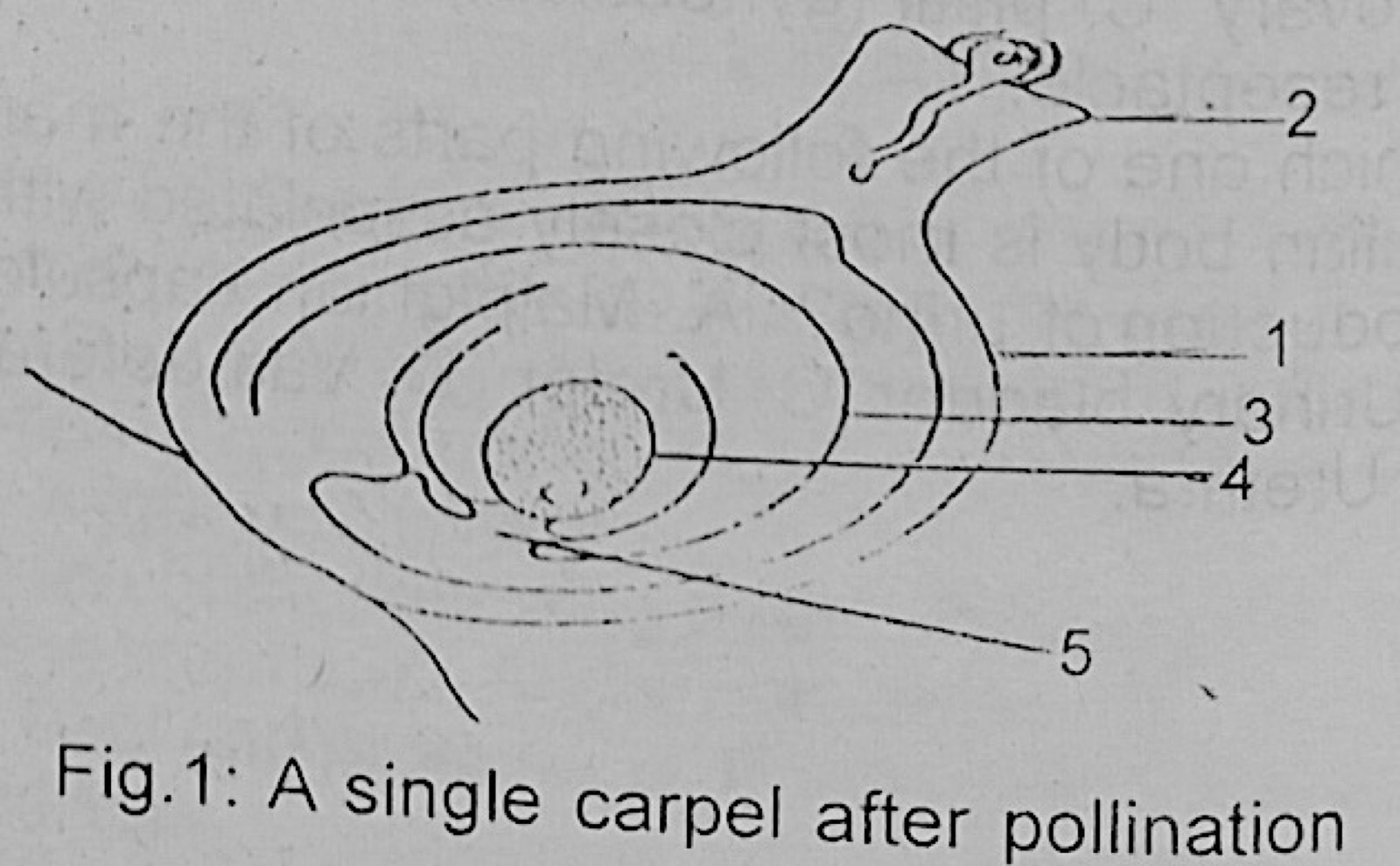
Question 2 Reproduction in Plants Fig.1: A single carpel after pollination
A. 1 B. 2 C. 3 D. 4 E. 5 Show the answer and explanation Answer: C (3 )
Explanation The integument (3) around the ovule hardens into the seed coat (testa).
Open this question
Question 3 Reproduction in Plants Which of the following is NOT true of wind-pollinated flowers?
A. Large amount of pollen produced B. Light smooth pollen grains C. Small inconspicuous flowers D. Scented petals E. Large pendulous anthers. Show the answer and explanation Answer: D (Scented petals )
Explanation Wind-pollinated flowers do not need to attract insects, so they have no scent.
Open this question
Question 4 Animal Kingdom Which of the following animals is cold-blooded?
A. Cat B. Lizard C. Whale D. Bird E. Horse Show the answer and explanation Answer: B (Lizard )
Explanation Reptiles such as lizards are poikilothermic: their body temperature follows that of the surroundings.
Open this question
Question 5 Mendelian Inheritance What is the genetic ratio of a cross between a homozygous tall plant and a homozygous dwarf plant?
A. 0 tall : 4 short B. 3 tall : 1 short C. 2 short : 2 tall D. 1 tall : 1 short E. 4 tall: 0 short Show the answer and explanation Answer: E (4 tall: 0 short )
Explanation TT × tt gives only Tt offspring, so all are tall (4 tall : 0 short).
Open this question
Question 6 Photosynthesis and Plant Nutrition Where is the food stored in a yam plant?
A. Stem B. Bud C. Adventitious root D. Leaves E. Tap root. Show the answer and explanation Answer: A (Stem )
Explanation The yam tuber is a swollen underground stem that stores starch.
Open this question
Question 7 Animal Nutrition Which of the following is the dental formula of man?
A. i 2/2 c 0/1 pm 2/2 m 3/3 B. i 2/2 c 1/1 pm 2/0 m 3/3 C. i 2/2 c 1/1 pm 2/2 m 3/3 D. i 2/2 c 1/1 pm 3/3 m 2/2 E. i 2/2 c 1/1 pm 2/3 m 3/3. Show the answer and explanation Answer: C (i 2/2 c 1/1 pm 2/2 m 3/3 )
Explanation An adult human has 2 incisors, 1 canine, 2 premolars and 3 molars in each half of each jaw (32 teeth).
Open this question
Question 8 Animal Nutrition The kind of teeth used for tearing food materials is the
A. fang B. canine C. premolar D. carnassial E. incisor. Show the answer and explanation Answer: B (canine )
Explanation Canines are pointed teeth used to grip and tear food.
Open this question
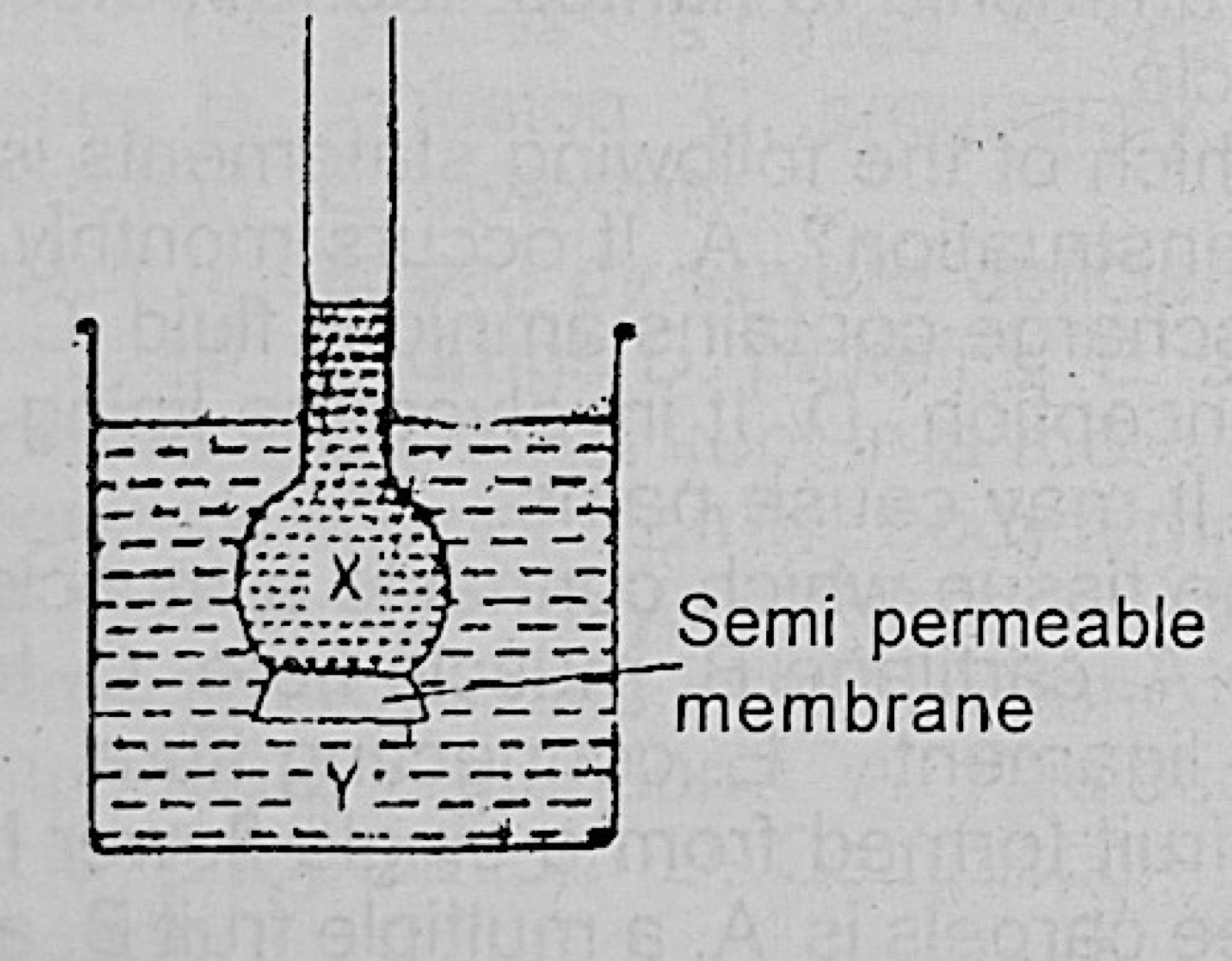
Question 9 Cell and Its Environment Fig. 2: Experiment to demonstrate osmosis
A. The level of X would rise, Y would fall B. The level of X would rise, Y would rise C. The levels of X and Y would stay the same D. The level of Y would rise, X would fall E. The level of Y would fall, X would fall Show the answer and explanation Answer: D (The level of Y would rise, X would fall )
Explanation Water moves by osmosis from the weaker solution X through the membrane into the stronger solution Y, so Y rises and X falls.
Open this question
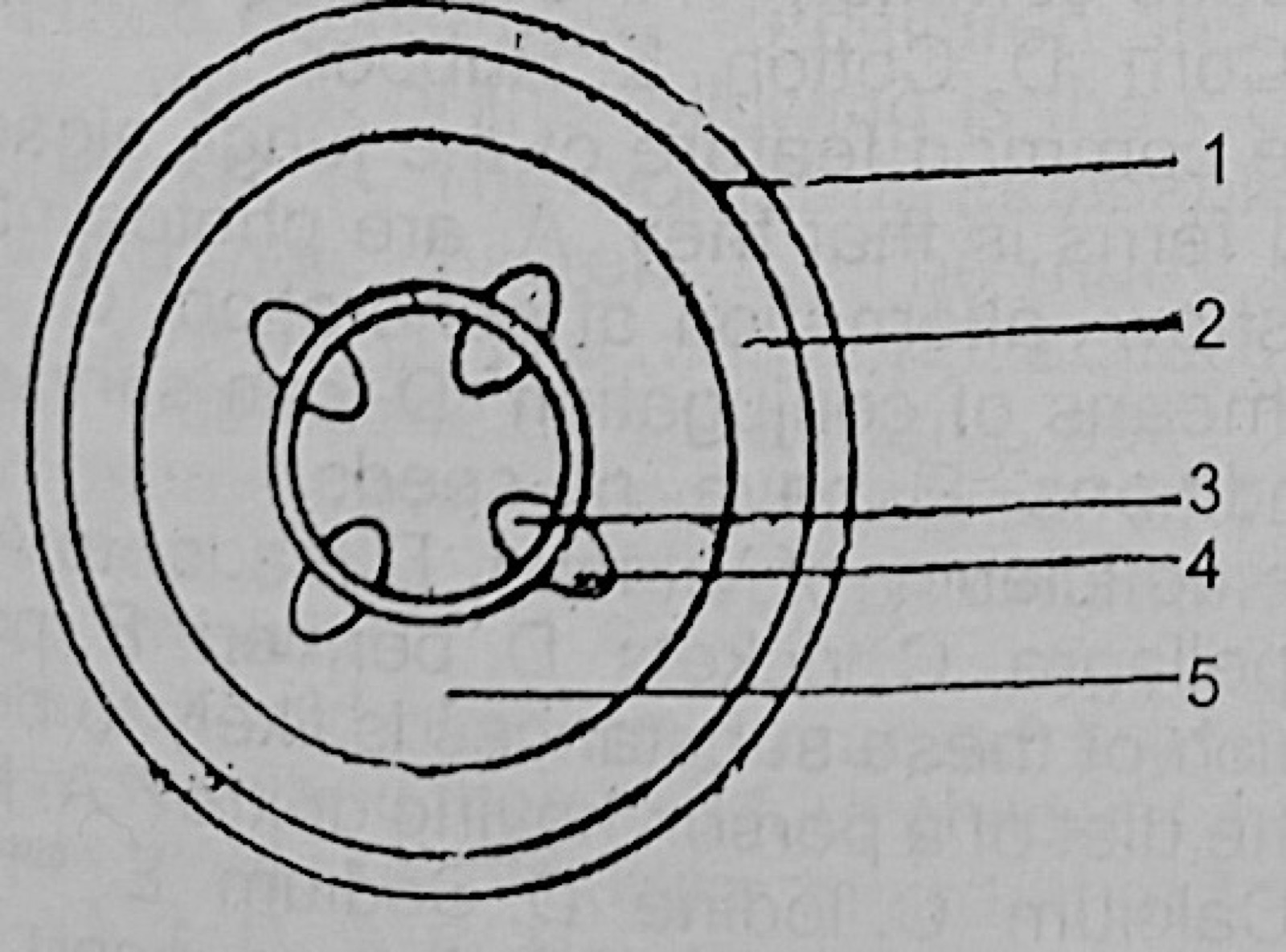
Question 10 Structure of Flowering Plants Fig. 3: T.S. Herbaceous stem
A. 1 B. 2 C. 3 D. 4 E. 5 Show the answer and explanation Answer: C (3 )
Explanation Water and mineral salts travel in the xylem, the inner part of each vascular bundle, labelled 3.
Open this question
Question 11 Animal Kingdom Which of the following insects has an incomplete metamorphosis during its life cycle?
A. Butterfly B. Bee C. Mosquito D. House-fly E. Grasshopper Show the answer and explanation Answer: E (Grasshopper )
Explanation A grasshopper hatches as a nymph that looks like the adult and has no pupa: incomplete metamorphosis.
Open this question
Question 12 Animal Nutrition The mushroom is an organism which feeds
A. parasitically B. saprophytically C. holozoically D. symbiotically E. autotrophically. Show the answer and explanation Answer: B (saprophytically )
Explanation Mushrooms feed on dead organic matter in soil or wood, so they are saprophytes.
Open this question
Question 13 Excretion What is the function of the contractile vacuole in Paramecium?
A. Produces enzymes B. Gets rid of excreta C. Stores and digests food D. Gets rid of excess water E. Controls movement. Show the answer and explanation Answer: D (Gets rid of excess water )
Explanation The contractile vacuole pumps out water that keeps entering by osmosis (osmoregulation).
Open this question
Question 14 Feeding Relationships and Energy Flow Choose the sequence which represents the correct order of organisms in a food chain.
A. Grass, snake, toad, grasshopper, hawk B. Grass, grasshopper, toad, snake, hawk, C. Grass, grasshopper, snake, toad, hawk, D. Grass, snake, grasshopper, toad, hawk, E. Grass, toad, snake, grasshopper, hawk, Show the answer and explanation Answer: B (Grass, grasshopper, toad, snake, hawk, )
Explanation Grasshoppers eat grass, toads eat grasshoppers, snakes eat toads and hawks eat snakes.
Open this question
Question 15 Excretion Which of the following is NOT a function of the liver?
A. Regulation of blood sugar B. Storage of iron C. Formation of bile D. Breakdown of excess amino acids E. Excretion of urea from the blood. Show the answer and explanation Answer: E (Excretion of urea from the blood. )
Explanation The liver makes urea, but it is the kidneys that remove urea from the blood.
Open this question
Question 16 Reproduction in Plants Spirogyra reproduces vegetatively by
A. spore production B. fragmentation C. multiple fission D. budding E. binary fission. Show the answer and explanation Answer: B (fragmentation )
Explanation A Spirogyra filament breaks into pieces, each of which grows into a new filament.
Open this question
Question 17 Plant Responses and Hormones Which of these instruments is used to demonstrate the response of roots and shoots to gravity?
A. Klinostat B. Manometer C. Porometer D. Potometer E. Photometer. Show the answer and explanation Answer: A (Klinostat )
Explanation A klinostat slowly rotates a seedling so gravity acts equally on all sides; comparing it with a still seedling shows geotropism.
Open this question
Question 18 Animal Nutrition Milk protein is hydrolysed by
A. renin B. amylase C. lipase D. lactase E. pepsin. Show the answer and explanation Answer: E (pepsin. )
Explanation Rennin only clots milk protein; pepsin then hydrolyses (digests) it into peptides.
Open this question
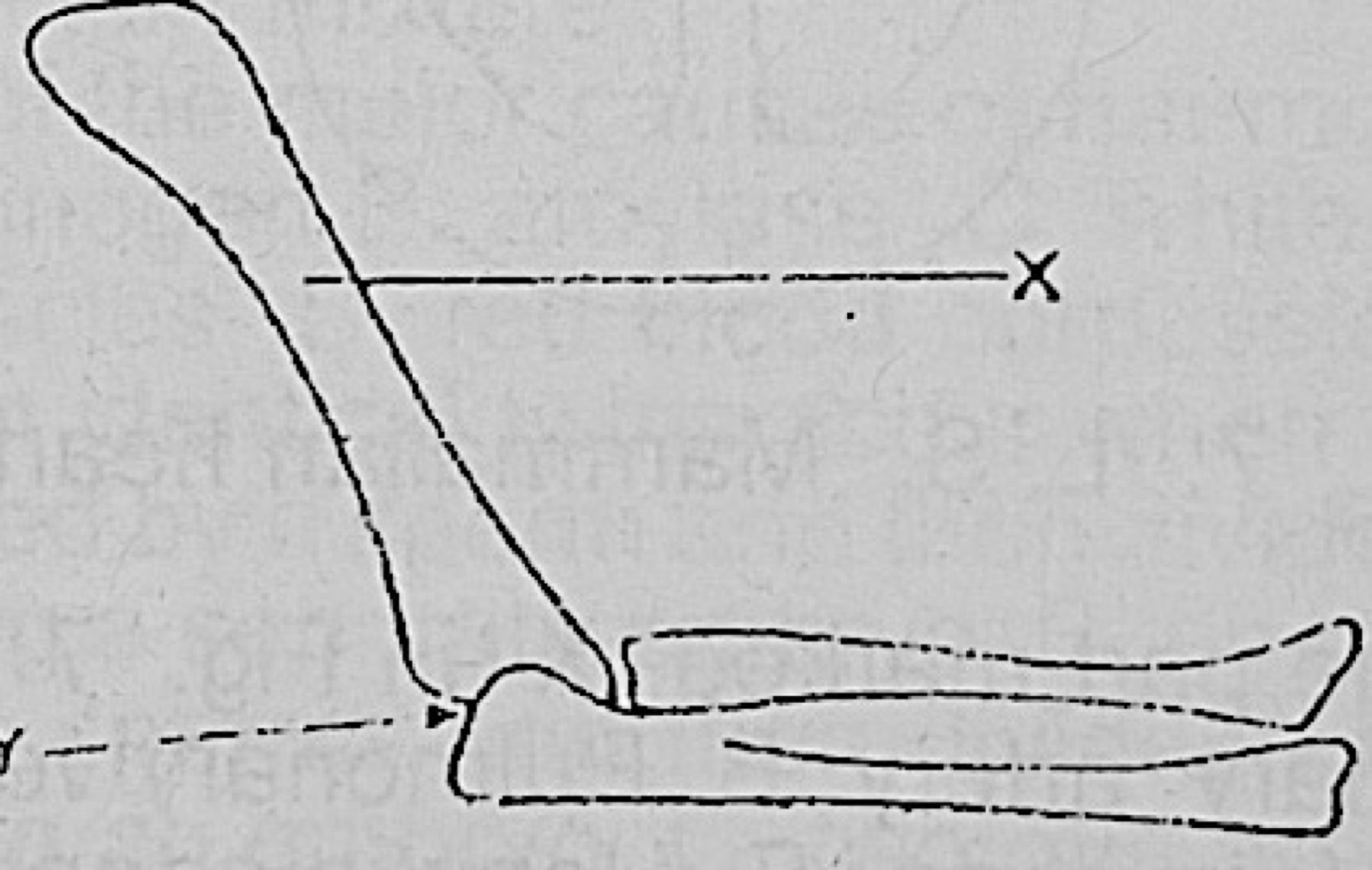
Question 19 Support and Movement Fig. 4: Human arm --- part of skeleton of human arm
A. ulna B. fibula C. radius D. humerus E. tibia Show the answer and explanation Answer: D (humerus )
Explanation X is the single long bone of the upper arm, the humerus.
Open this question
Question 20 Support and Movement Fig. 4: Human arm --- part of skeleton of human arm
A. ball and socket B. hinge C. pivot D. rivet E. none of the above. Show the answer and explanation Answer: B (hinge )
Explanation Y is the elbow, a hinge joint that moves in one plane.
Open this question
Question 21 Transport in Plants The rate of transpiration of a leafy shoot would be highest under
A. damp, cold, still air B. damp, warm, moving air C. dry, warm, moving air D. dry, cold, moving air E. dry, warm, still air Show the answer and explanation Answer: C (dry, warm, moving air )
Explanation Dry air, warmth and wind all speed up evaporation of water from the leaves.
Open this question
Question 22 Respiration What is the name of the respiratory organ of the crab?
A. Tubules B. Trachaea C. Spiracles D. Lungs E. Gills. Show the answer and explanation Answer: E (Gills. )
Explanation Crabs are aquatic crustaceans that breathe with gills.
Open this question
Question 23 Animal Kingdom The two types of human tapeworm can be distinguished by the presence or absence of
A. scolex B. hook C. head D. sucker E. proglottis. Show the answer and explanation Answer: B (hook )
Explanation The pork tapeworm (Taenia solium) has hooks on its scolex; the beef tapeworm (T. saginata) has none.
Open this question
Question 24 Animal Nutrition All of the following are digestive enzymes except
A. bile B. lipase C. maltase D. pepsin E. ptyalin Show the answer and explanation Answer: A (bile )
Explanation Bile emulsifies fats but is not an enzyme.
Open this question
Question 25 Respiration In a bakery, yeast is added to flour to make bread rise. This is possible because yeast produces
A. alcohol B. oxygen C. carbon dioxide D. energy E. ethanol. Show the answer and explanation Answer: C (carbon dioxide )
Explanation Yeast ferments sugar and gives off carbon dioxide gas, whose bubbles make the dough rise.
Open this question
Question 26 Sense Organs Accommodation of the human eye is best described as the
A. ability to see distant objects B. movement of upper and lower eyelids C. focusing of near and distant objects D. changing of lens shape due to varying light intensities E. constant adjustment of the iris. Show the answer and explanation Answer: C (focusing of near and distant objects )
Explanation Accommodation is the eye's ability to focus on both near and distant objects by changing lens shape.
Open this question
Question 27 Chromosomes, DNA and Sex Linkage Normally any character shown by an organism is due to the effects of
A. hormones and chromosomes B. chromosomes C. mutations D. hormones and genes E. genes and environment. Show the answer and explanation Answer: E (genes and environment. )
Explanation An organism's characters result from its genes acting together with the environment it grows in.
Open this question
Question 28 Ecological Associations Which of the following statements is NOT true of symbiosis?
A. Symbionts must be living B. It is an association of 'give and take' C. The association may involve two plants D. Association between two similar species E. Symbionts derive mutual benefit Show the answer and explanation Answer: D (Association between two similar species )
Explanation Symbiosis is a close association between two different species that both benefit.
Open this question
Question 29 Transport in Animals A person whose blood can be donated to all other people, must have the blood group
A. O B. AB C. B D. A E. None of the above. Show the answer and explanation Answer: A (O )
Explanation Group O red cells carry no A or B antigens, so O is the universal donor.
Open this question
Question 30 Food Substances and Enzymes If Benedict's solution gives a positive result in a food test, the food contains
A. sugar B. protein C. oil D. fat E. cellulose. Show the answer and explanation Answer: A (sugar )
Explanation Benedict's solution turns brick-red when heated with a reducing sugar.
Open this question
Question 31 Mendelian Inheritance A surprising fact about sickle cell disease is that it
A. affects only black people B. kills the patient C. is hereditary D. affects blood cells E. weakens the patient. Show the answer and explanation Answer: C (is hereditary )
Explanation Sickle cell disease is not caught from anyone; it is inherited when a child gets the sickle gene from both parents.
Open this question
Question 32 Nutrient Cycling Nitrification means
A. conversion of nitrates to nitrogen B. fixing nitrogen into plants C. conversion of nitrates to nitrites D. changing of ammonia to nitrites, then nitrates E. nitrogen cycle. Show the answer and explanation Answer: D (changing of ammonia to nitrites, then nitrates )
Explanation Nitrifying bacteria oxidise ammonia to nitrites and then to nitrates.
Open this question
Question 33 Reproduction in Animals Which of the following statements is NOT true of menstruation?
A. It occurs monthly B. The discharge contains amniotic fluid C. It signifies no conception D. It involves the lining of uterus E. It may cause pains. Show the answer and explanation Answer: B (The discharge contains amniotic fluid )
Explanation The menstrual flow is blood and broken uterine lining; amniotic fluid surrounds a fetus in pregnancy.
Open this question
Question 34 Support and Movement The tissue which connects a muscle to a bone is a
A. cartilage B. muscle fibre C. tendon D. ligament E. connecting fibre. Show the answer and explanation Answer: C (tendon )
Explanation Tendons join muscles to bones; ligaments join bone to bone.
Open this question
Question 35 Reproduction in Plants A fruit formed from a single flower having several free carpels is
A. a multiple fruit B. a dry dehiscent fruit C. a dry indehiscent fruit D. a simple fruit E. an aggregate fruit Show the answer and explanation Answer: E (an aggregate fruit )
Explanation Each free carpel of one flower forms a fruitlet, and together they make an aggregate fruit.
Open this question
Question 36 Reproduction in Plants If the anthers of a flower mature before the stigma, the condition is termed
A. epigyny B. hypogyny C. protogyny D. protandry E. perigyny. Show the answer and explanation Answer: D (protandry )
Explanation Protandry means the male parts (anthers) ripen first; it helps prevent self-pollination.
Open this question
Question 37 Ecosystem and Ecological Factors An instrument used in measuring the speed of wind is
A. a barometer B. a wind gauge C. a wind vane D. an anemometer E. a hydrometer Show the answer and explanation Answer: D (an anemometer )
Explanation An anemometer's spinning cups measure wind speed; a wind vane shows direction.
Open this question
Question 38 Microorganisms and Health In which of the following plants is swollen shoot disease common?
A. Groundnut B. cocoa C. Corn D. Cotton E. Rubber. Show the answer and explanation Answer: B (cocoa )
Explanation Swollen shoot is a viral disease of cocoa spread by mealybugs.
Open this question
Question 39 Plant Kingdom One common feature of the fungi, algae, mosses and ferns is that they
A. are photosynthetic B. show alternation of generation C. reproduce by means of conjugation D. can survive dry conditions E. have no seeds. Show the answer and explanation Answer: E (have no seeds. )
Explanation All these groups reproduce by spores, not seeds; fungi also lack chlorophyll.
Open this question
Question 40 Food Substances and Enzymes The deficiency of Vitamin D leads to
A. scurvy B. pellagra C. rickets D. beriberi E. polio Show the answer and explanation Answer: C (rickets )
Explanation Vitamin D is needed to absorb calcium for bones; lack of it causes rickets.
Open this question
Question 41 Food Substances and Enzymes Which of these substances is likely to be deficient in the diet of a person having goitre?
A. Potassium B. Calcium C. Iodine D. Sodium E. Phosphorus Show the answer and explanation Answer: C (Iodine )
Explanation Iodine is needed to make thyroxine; without it the thyroid swells into a goitre.
Open this question
Question 42 Plant Responses and Hormones Growing yam tendrils climb for support. This growth response is
A. haptotropism B. geotropism C. phototropism D. hydrotropism E. chemotropism. Show the answer and explanation Answer: A (haptotropism )
Explanation Growth in response to touch or contact is haptotropism (thigmotropism).
Open this question
Question 43 Soil Soil is said to be fertile if
A. it is black B. it can supply usable nutrients to plants C. the oxygen content is very high D. artificial manure is added to it E. it is not waterlogged. Show the answer and explanation Answer: B (it can supply usable nutrients to plants )
Explanation A fertile soil can supply the mineral nutrients plants need for good growth.
Open this question
Question 44 Reproduction in Plants A plant which has a horizontal underground stem is
A. rhizome B. corm C. creeper D. tuber E. bulb. Show the answer and explanation Answer: A (rhizome )
Explanation A rhizome is a stem that grows horizontally under the ground, as in ginger.
Open this question
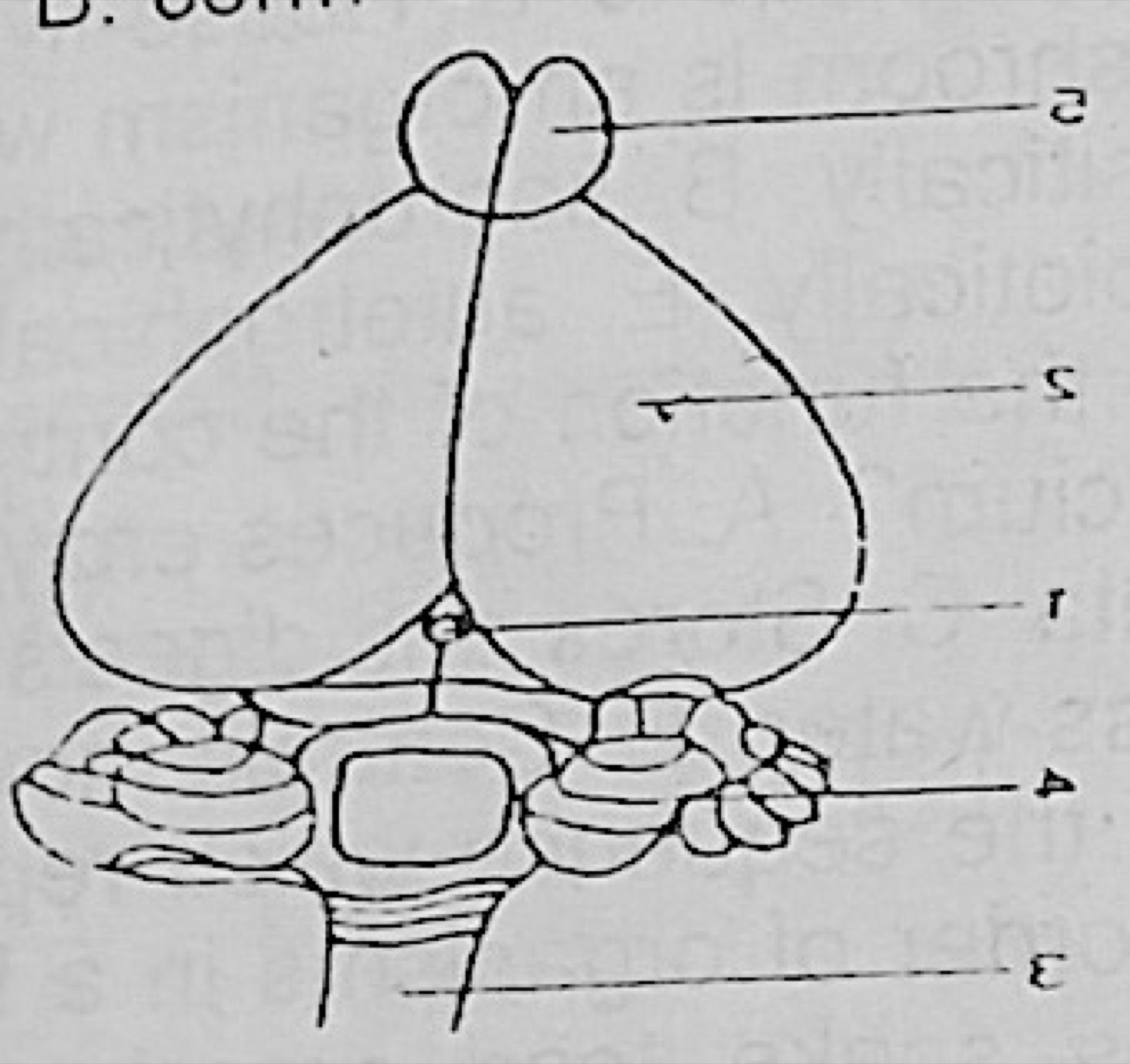
Question 45 Nervous Coordination Fig. 6: A mammalian brain
A. 5. B. 4. C. 3. D. 1. E. 2. Show the answer and explanation Answer: B (4. )
Explanation Balance is controlled by the cerebellum, the folded part behind the cerebrum, labelled 4.
Open this question
Question 46 Transport in Animals The hepatic portal vein is unique because it
A. carries deoxygenated blood B. begins and ends with capillaries C. is the largest vein in mammals D. carries digested food E. is the shortest vein in mammals. Show the answer and explanation Answer: B (begins and ends with capillaries )
Explanation Unlike other veins, it begins in capillaries of the gut and ends in capillaries of the liver.
Open this question
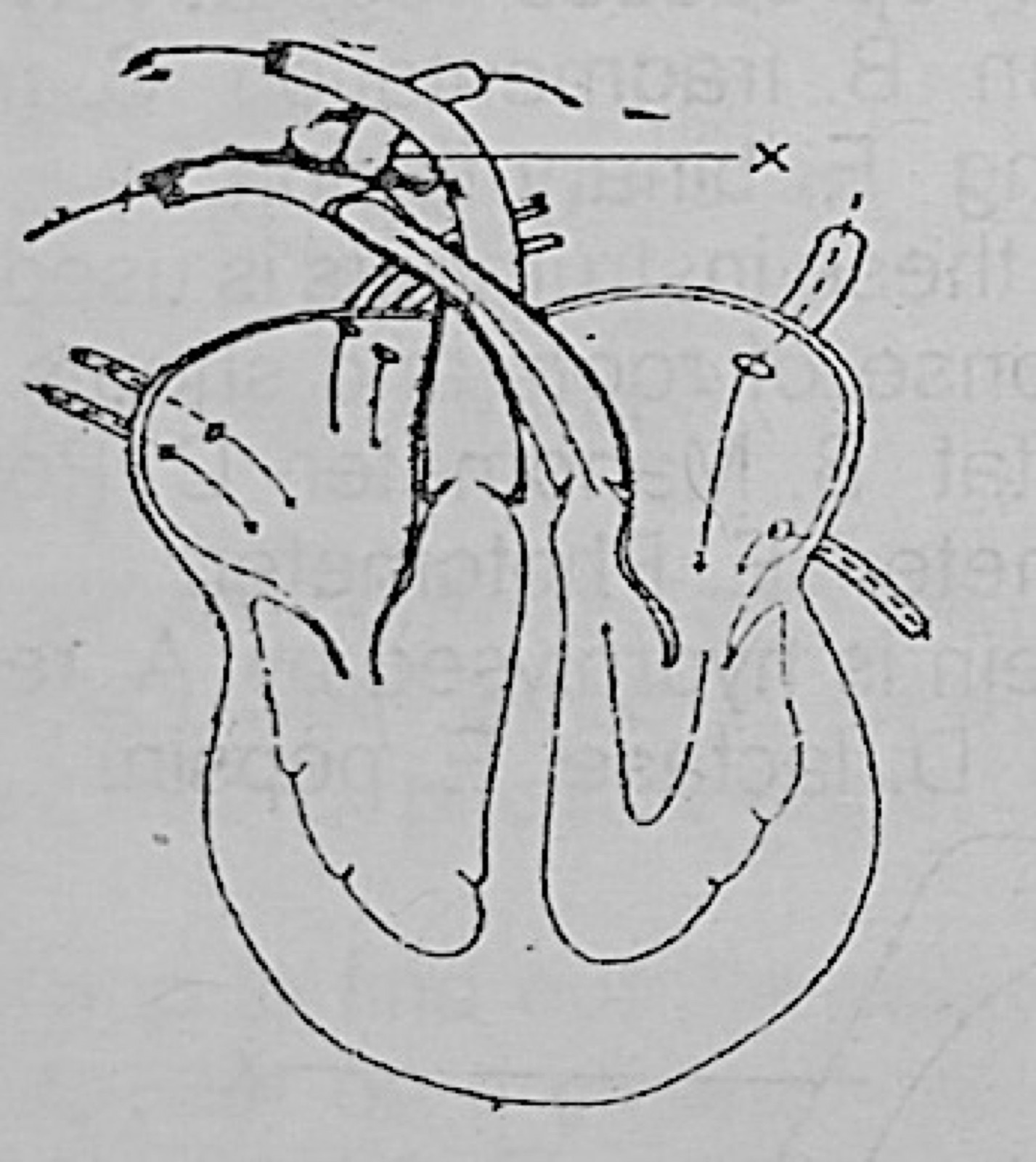
Question 47 Transport in Animals Fig. 7: L. S. Mammalian heart
A. Pulmonary artery B. Pulmonary vein C. Vena cava D. Main aorta E. Hepatic artery Show the answer and explanation Answer: A (Pulmonary artery )
Explanation X is the vessel leaving the heart and branching towards the lungs, the pulmonary artery.
Open this question
Question 48 Excretion The functional unit of a mammalian kidney is the
A. urethra B. malpighian capsule C. glomerulus D. nephron E. ureter Show the answer and explanation Answer: D (nephron )
Explanation Each kidney has about a million nephrons, the units that filter blood and form urine.
Open this question
Question 49 Animal Nutrition The correct route for a piece of bread eaten by a mammal is
A. oral cavity-oesophagus-stomach-ileum-rectum B. oral cavity -stomach-oesophagus-duodenum-ileum-rectum C. oral cavity-oesophagus-duodenum-stomach-ileum-rectum D. oral cavity-oesophagus-ileum - stomach -duodenum-rectum E. oral cavity-oesophagus-stomach-ileum-duodenum-rectum. Show the answer and explanation Answer: A (oral cavity-oesophagus-stomach-ileum-rectum )
Explanation Food passes from the mouth down the oesophagus to the stomach, then the small intestine (ileum) and on to the rectum; only A has this order.
Open this question
Question 50 Support and Movement The thoracic vertebrae of a mammal is characterized by the
A. vertebraterial canal B. prominent neural arch C. prominent transverse process D. prominent neural spine E. prominent centrum. Show the answer and explanation Answer: D (prominent neural spine )
Explanation Thoracic vertebrae have long neural spines for attaching back muscles; vertebrarterial canals belong to cervical vertebrae.
Open this question Sign up free for every JAMB Biology year, practice by topic and timed mocks.
Start practising free