Home › Past questions › GCE › Biology › 1989 61 questions. Try each one, then open the answer to check yourself and read the explanation.
Sign up free to answer these questions on a CBT screen with a timer, then see your score and every answer explained.
Start practising free
Question 1 Structure of Flowering Plants Which of the following constitutes the main internal tissue of a leaf?
A. Cuticle B. Mesophyll C. Vascular tissue D. Lower epidermis E. Upper epidermis Show the answer and explanation Answer: B (Mesophyll )
Explanation Most of the inside of a leaf is mesophyll (palisade and spongy layers) where photosynthesis happens.
Open this question
Question 2 Cell and Its Environment Four cells with osmotic potential equivalent to that of 3% salt solution were immersed respectively in solutions of different concentrations labelled as follows: I = 4% salt solution; II = 6% salt solution III = 1% salt solution; IV = 10% salt solution; V = 5% salt solution. Which of the solutions will cause an increase in osmotic pressure within the cell?
A. I B. II C. III D. IV E. V Show the answer and explanation Answer: C (III )
Explanation Only the 1% solution is weaker than the cell sap, so only there does water enter the cell by osmosis and build up pressure inside it; in all the others the cell loses water.
Open this question
Question 3 Cell and Its Environment Which of the following statements is not true of osmotic process?
A. There must be a selectively permeable membrane B. The two solutions must be of different concentrations initially C. It involves only the movement of water molecules D. Equilibrium is reached when there is equal distribution of water molecules E. The two solutions are of equal concentration at the beginning of experiment Show the answer and explanation Answer: E (The two solutions are of equal concentration at the beginning of experiment )
Explanation Osmosis needs a difference in concentration; if both solutions start equal there is no net movement of water.
Open this question
Question 4 Excretion Which of the following is the correct route for the movement of materials through the kidney?
A. Glomerulus → Bowman's capsule → Loop of Henle → Collecting tubule → Pelvis B. Glomerulus → Loop of Henle → Collecting tubule → Bowman's capsule → Pelvis C. Pelvis → Bowman's capsule → Glomerulus → Loop of Henle → Collecting tubule D. Bowman's capsule → Glomerulus → Loop of Henle → Collecting tubule → Pelvis E. Bowman's capsule → Loop of Henle → Glomerulus → Collecting tubule → Pelvis Show the answer and explanation Answer: A (Glomerulus → Bowman's capsule → Loop of Henle → Collecting tubule → Pelvis )
Explanation Blood is filtered in the glomerulus into Bowman's capsule; the filtrate passes along the tubule and loop of Henle to the collecting tubule and then the pelvis.
Open this question
Question 5 Hormonal Coordination Which of the following is the function of the hormone in the Islets of Langerhans? It
A. is used in protein metabolism B. is involved in sugar synthesis C. aids the rate at which glucose is converted to glycogen D. controls the fluid content of the body E. plays a role in the pH balance of the body fluid Show the answer and explanation Answer: C (aids the rate at which glucose is converted to glycogen )
Explanation Insulin from the islets of Langerhans makes the liver and muscles change glucose into glycogen, lowering blood sugar.
Open this question
Question 6 Transport in Animals Blood in mammals transports oxygen because it contains the pigment called
A. haemoglobin B. chlorocruorin C. melanin D. haemocyanin E. haemoerythrin Show the answer and explanation Answer: A (haemoglobin )
Explanation Mammalian red cells contain haemoglobin, which combines loosely with oxygen.
Open this question
Question 7 Cell Structure and Organisation In which of the following is cilia not associated with movement or transport of materials?
A. Fallopian tube funnel B. Ectoplasm of paramecium C. Lining of the mammalian trachea D. Mammalian alimentary canal E. Oral groove of paramecium Show the answer and explanation Answer: D (Mammalian alimentary canal )
Explanation The mammalian alimentary canal is not lined with cilia (food is moved by peristalsis); in all the other places cilia move something.
Open this question
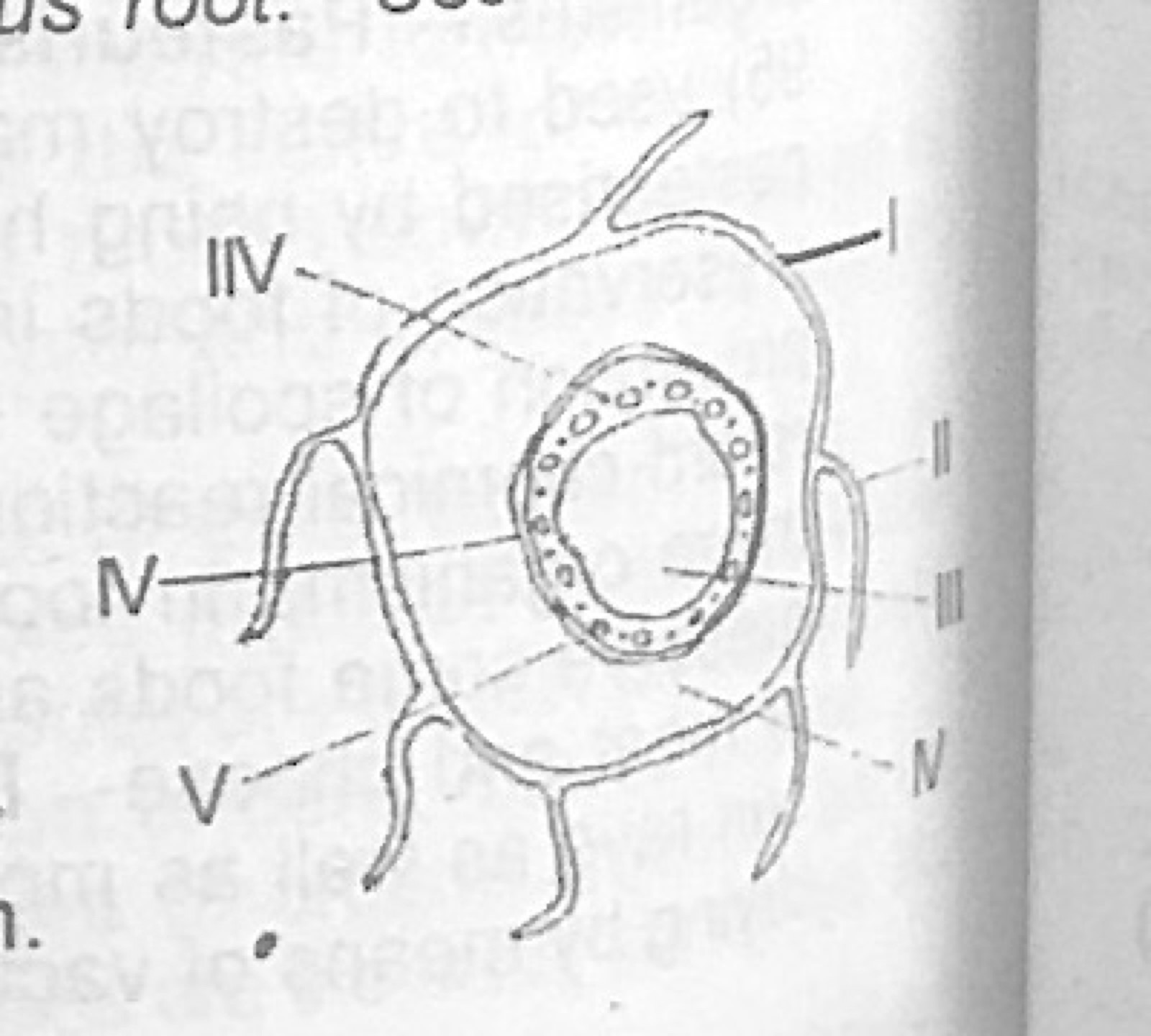
Question 8 Structure of Flowering Plants The diagram below represents a cross-section through a monocotyledonous root.
A. I B. II C. III D. IV E. V Show the answer and explanation Answer: A (I )
Explanation The piliferous layer is the outermost layer of the root, the one that bears root hairs.
Open this question
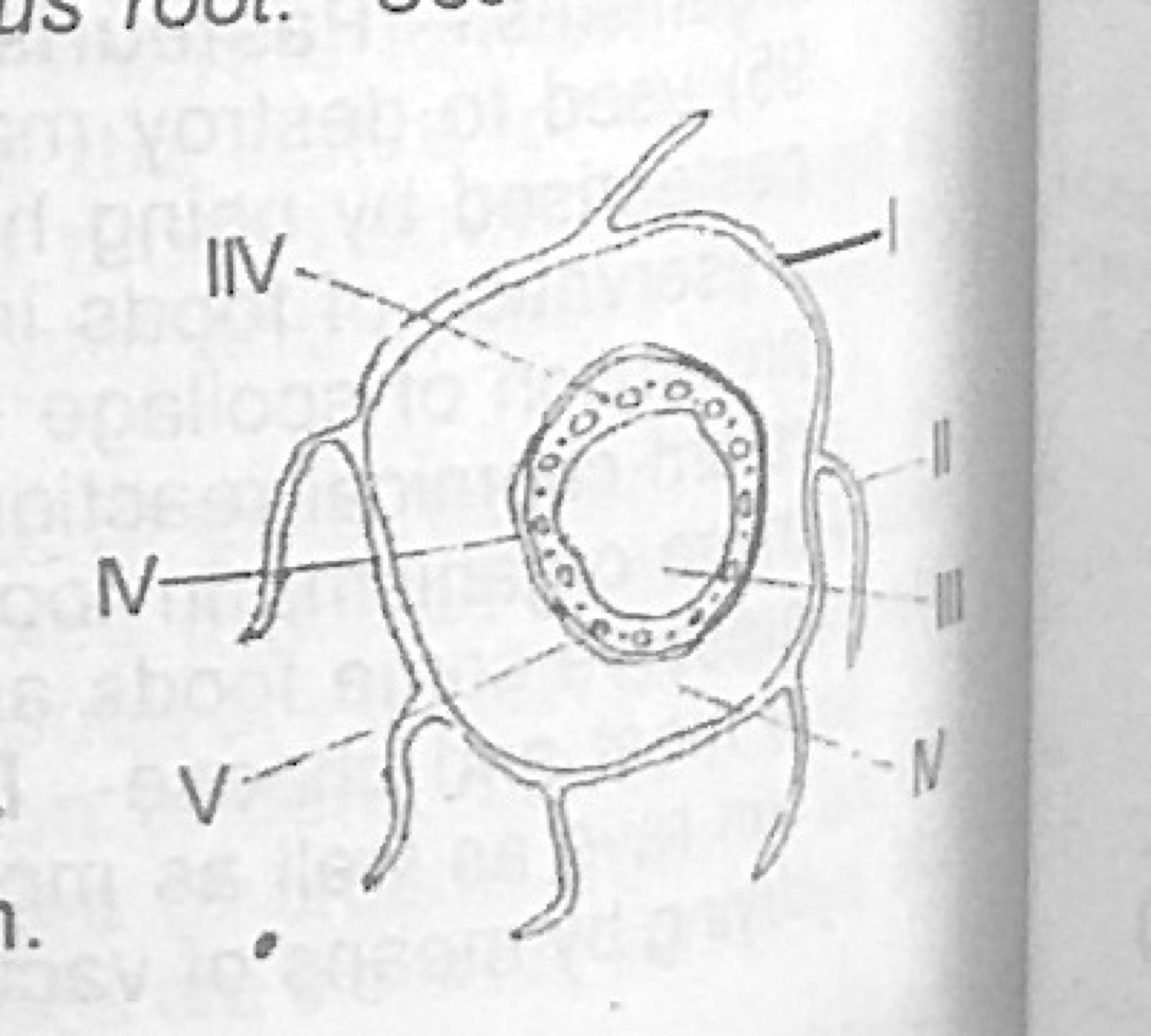
Question 9 Structure of Flowering Plants The diagram below represents a cross-section through a monocotyledonous root.
A. II B. IV C. V D. VI E. VII Show the answer and explanation Answer: C (V )
Explanation In a monocot root the xylem vessels lie in a ring inside the central stele.
Open this question
Question 10 Transport in Plants The diagram below represents a cross-section through a monocotyledonous root.
A. I B. III C. IV D. VII E. VI Show the answer and explanation Answer: D (VII )
Explanation Sugar is carried in the phloem, which alternates with the xylem in the stele of a root.
Open this question
Question 11 Transport in Plants The loss of water vapour through the aerial parts of the plant to the atmosphere is called
A. respiration B. guttation C. osmoregulation D. transpiration E. diffusion Show the answer and explanation Answer: D (transpiration )
Explanation Transpiration is the loss of water vapour from leaves and stems.
Open this question
Question 12 Transport in Plants The upward movement of the sap in the xylem vessel is brought about by
A. transpiration stream B. guttation C. capillarity D. osmosis E. cohesion Show the answer and explanation Answer: A (transpiration stream )
Explanation Water evaporating from the leaves pulls a continuous column of water up the xylem (transpiration pull); this is the main force raising sap.
Open this question
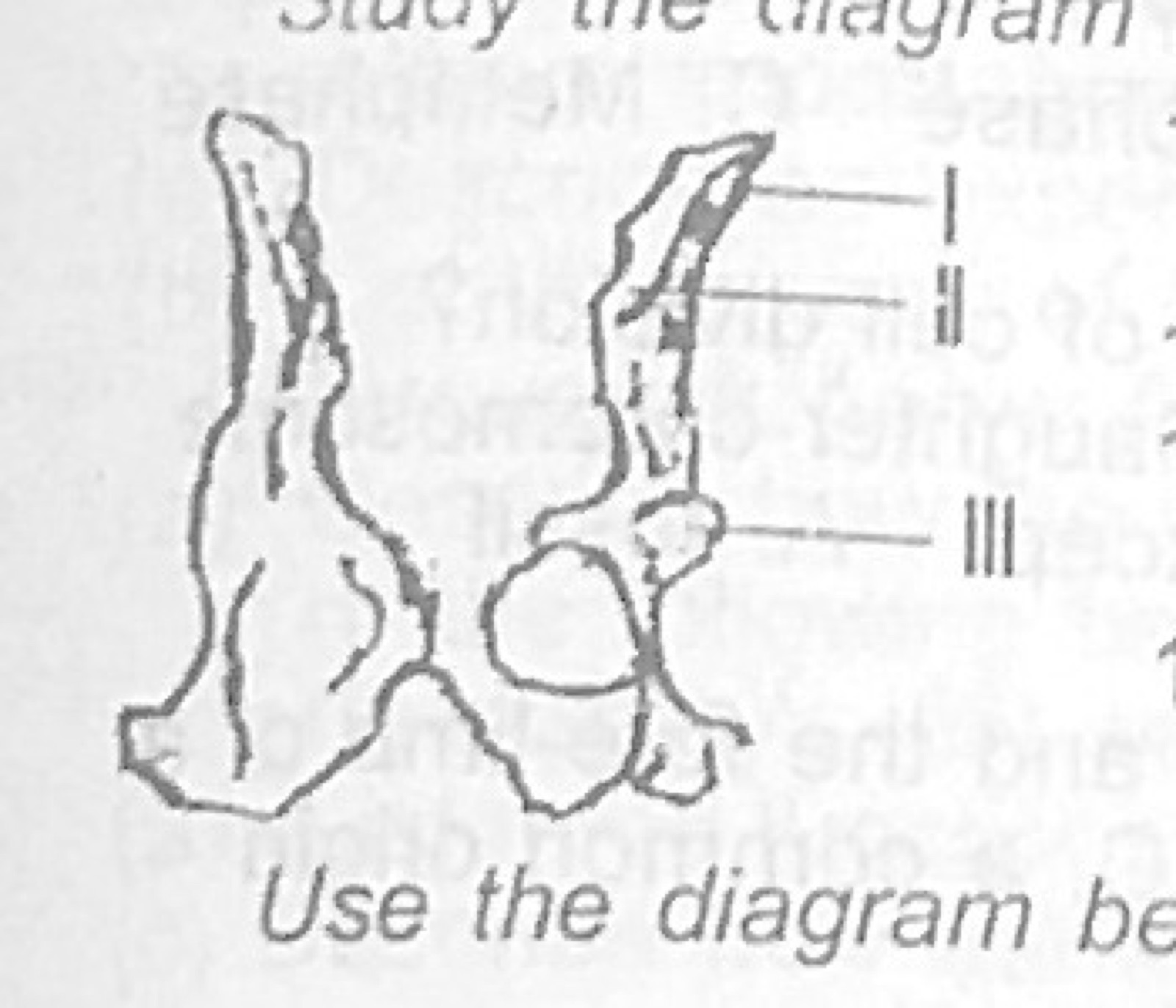
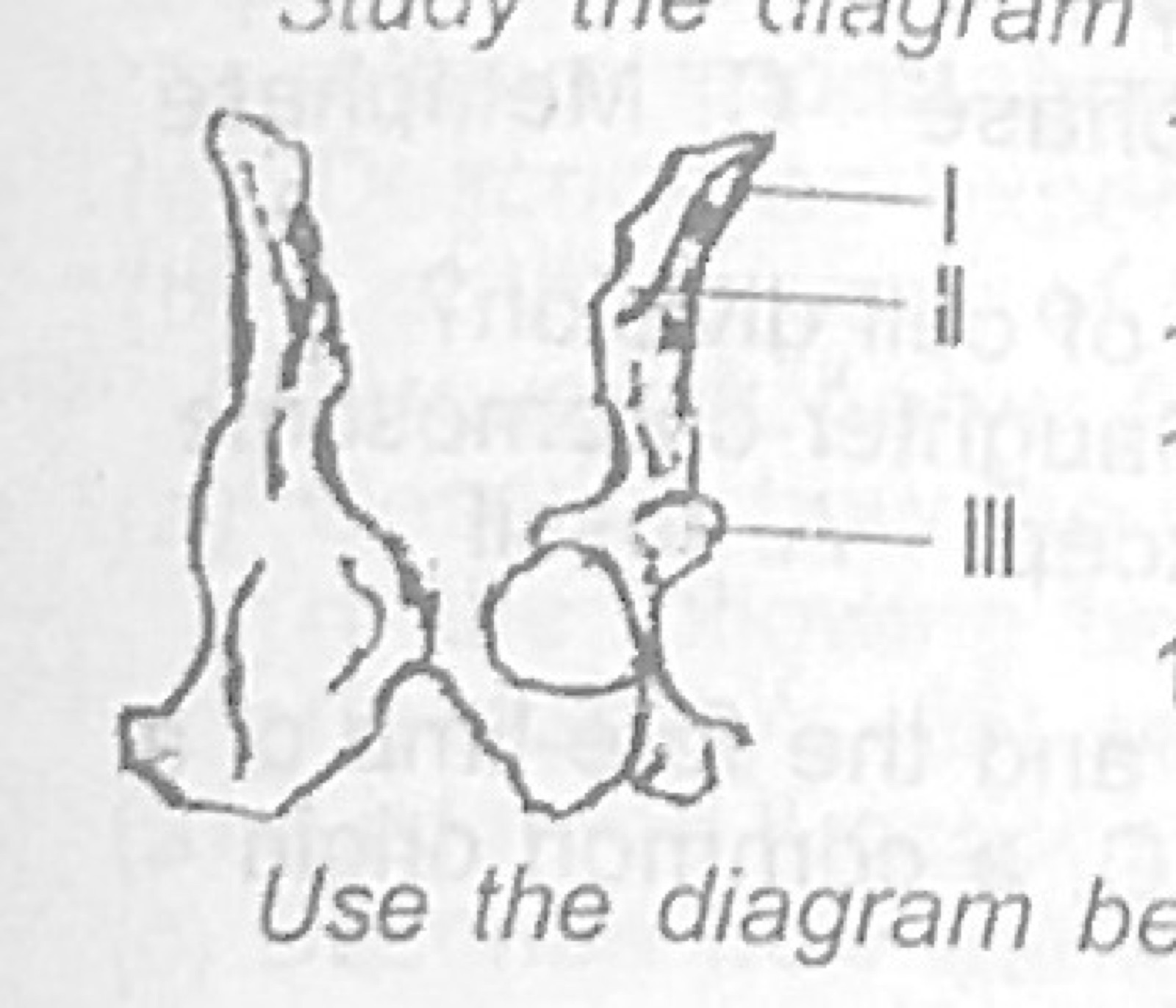
Question 13 Support and Movement Study the diagram below and use it to answer questions 13 to 15
A. pelvic region B. pectoral girdle C. vertebral column D. skull E. thoracic region Show the answer and explanation Answer: A (pelvic region )
Explanation The bone with a broad blade and a socket is the pelvic girdle (hip bone).
Open this question
Question 14 Support and Movement Study the diagram of a bone (parts labelled I to III).
A. lumbar B. sacrum C. ilium D. pubis E. coccyx Show the answer and explanation Answer: C (ilium )
Explanation The broad upper blade of the hip bone is the ilium.
Open this question
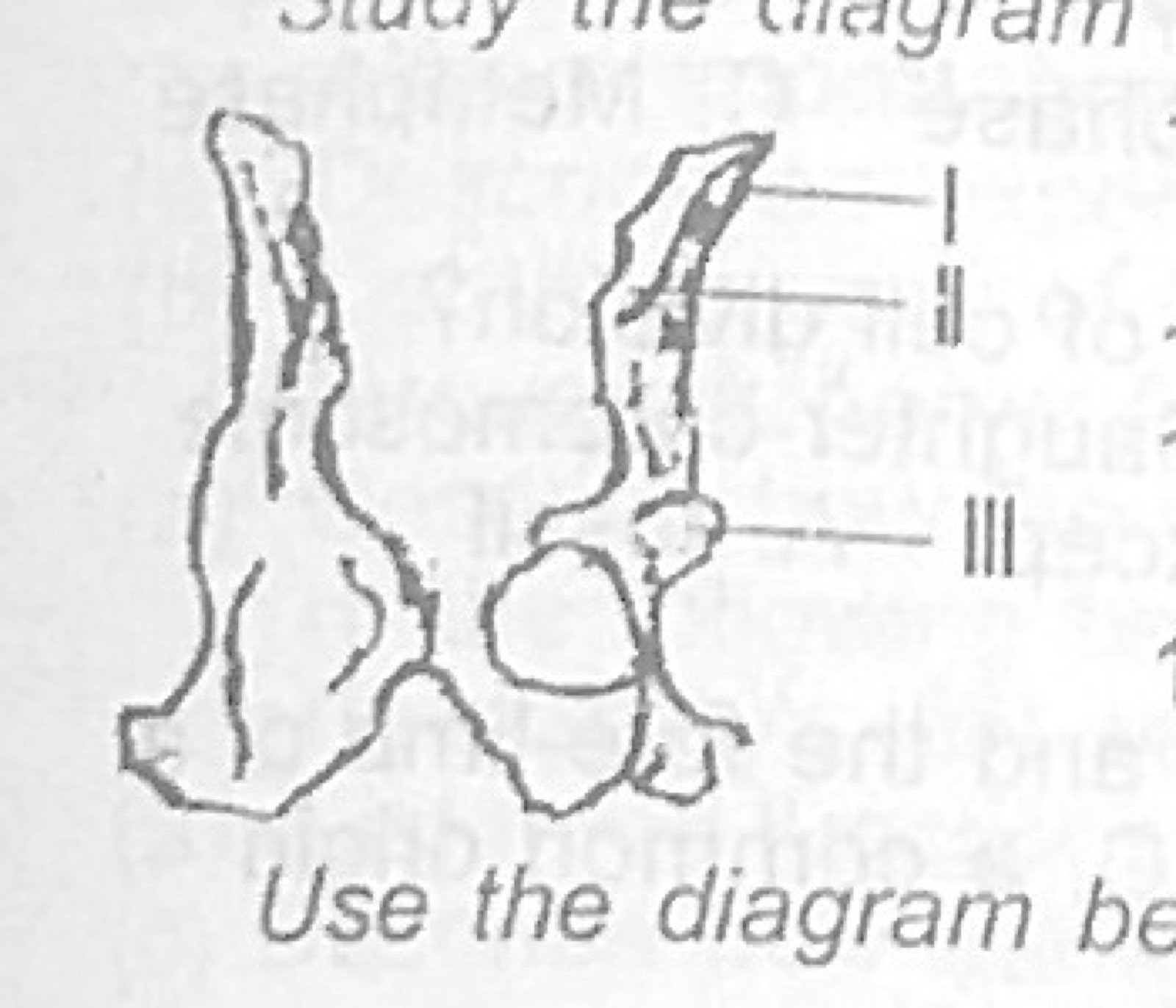
Question 15 Support and Movement Study the diagram of a bone (parts labelled I to III).
A. humerus B. femur C. tibia D. sacrum E. fibula Show the answer and explanation Answer: B (femur )
Explanation Part III is the acetabulum, the socket into which the head of the femur fits.
Open this question
Question 16 Cell Structure and Organisation Which of the following organisms is at the tissue level of organization?
A. Euglena B. Paramecium C. Volvox D. Hydra E. Chlamydomonas Show the answer and explanation Answer: D (Hydra )
Explanation Hydra's body is made of two cell layers that work as tissues; the others are single cells or a colony.
Open this question
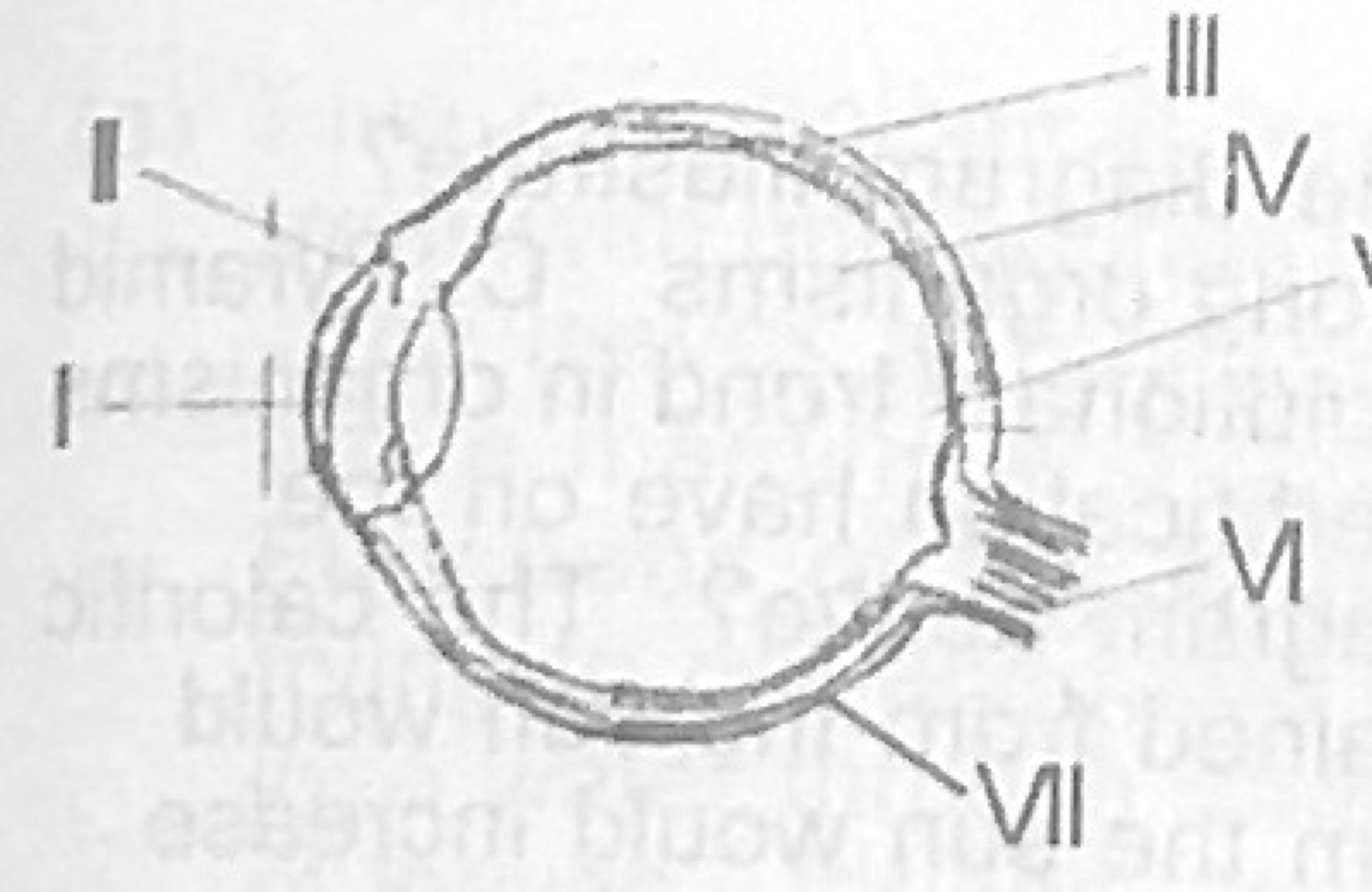
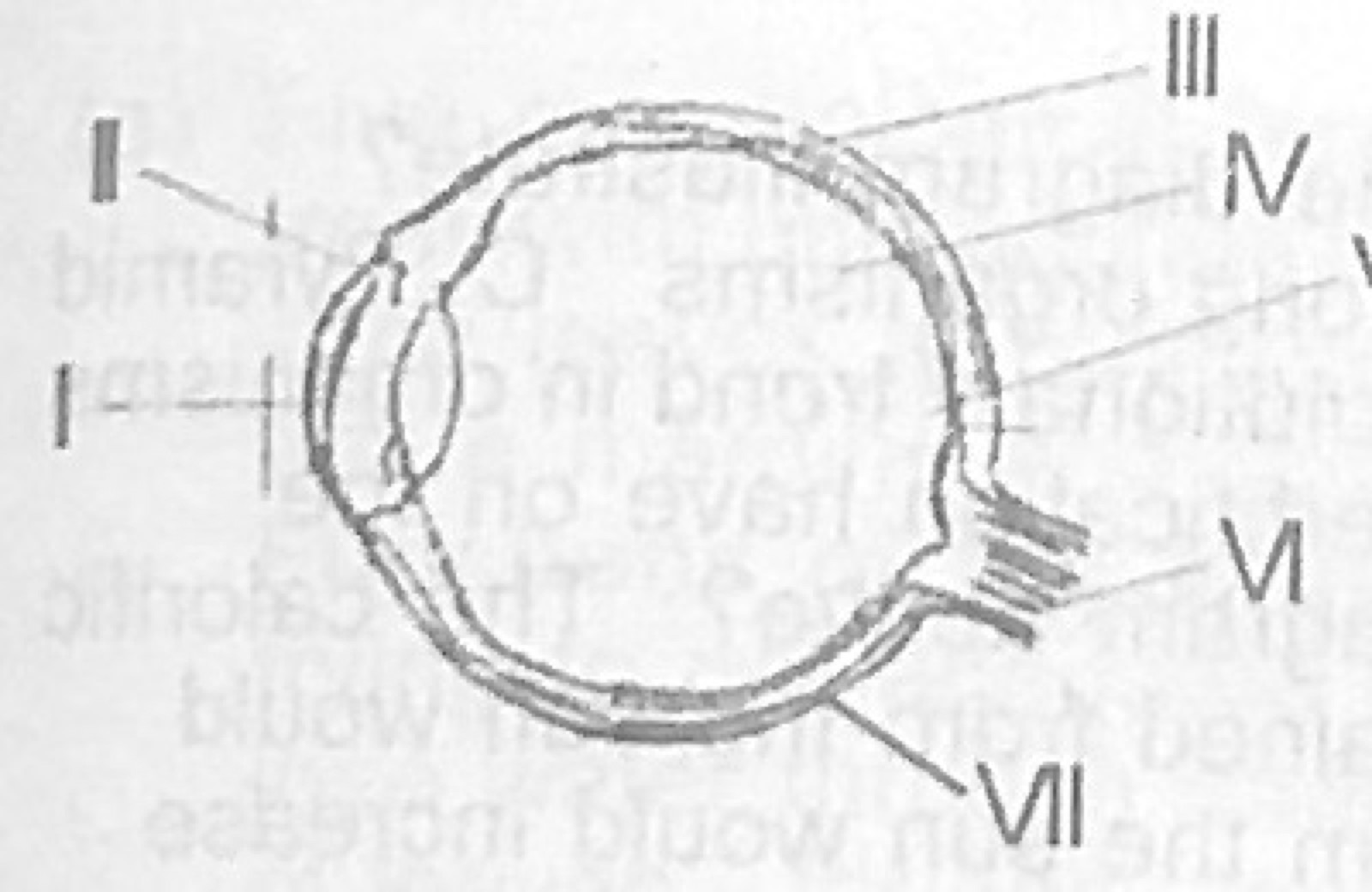
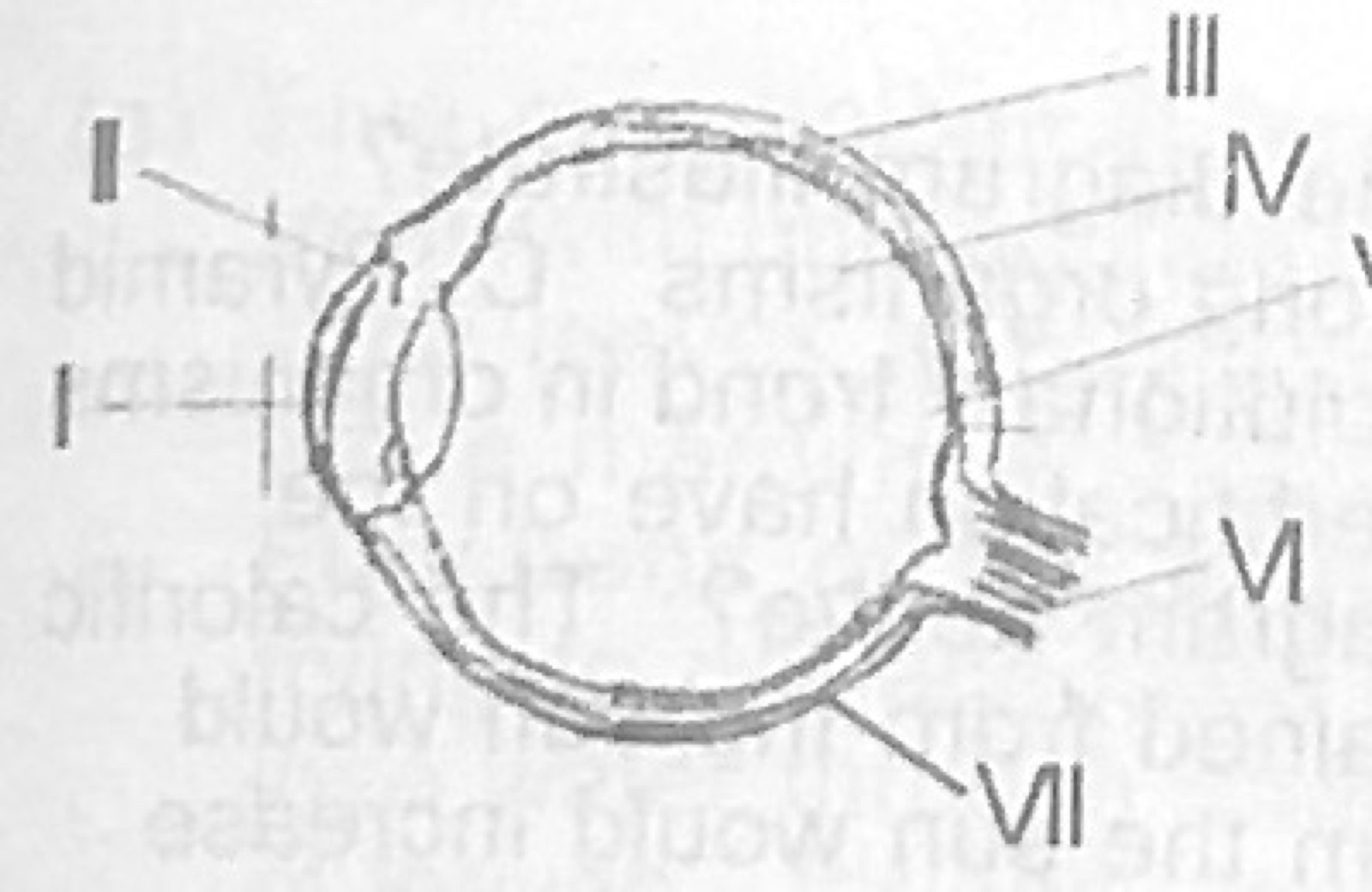
Question 17 Sense Organs Use the diagram below to answer questions 17 to 19.
A. I B. III C. IV D. VI E. VII Show the answer and explanation Answer: E (VII )
Explanation The light-sensitive layer is the retina, the innermost layer at the back of the eye.
Open this question
Question 18 Sense Organs Use the diagram of the eye (parts labelled I to VII) to answer this question.
A. VI B. V C. IV D. III E. I Show the answer and explanation Answer: B (V )
Explanation The yellow spot (fovea) on the retina has the most cones packed together.
Open this question
Question 19 Sense Organs Use the diagram of the eye (parts labelled I to VII) to answer this question.
A. I B. II C. III D. VI E. VII Show the answer and explanation Answer: B (II )
Explanation Aqueous humour is the watery fluid filling the space between the cornea and the lens.
Open this question
Question 20 Feeding Relationships and Energy Flow Autotrophs are also described as
A. consumers B. decomposers C. carnivores D. producers E. herbivores Show the answer and explanation Answer: D (producers )
Explanation Autotrophs make their own food, so they produce the food for the whole ecosystem.
Open this question
Question 21 Photosynthesis and Plant Nutrition In photosynthesis, the following processes are part of the light reaction except
A. transfer of radiant energy which reduces a co-factor B. absorption of radiant energy by chlorophyll C. utilization of the energy in the electron transfer chain to form ATP D. formation of glucose using energy from NADPH E. splitting of water into its component parts Show the answer and explanation Answer: D (formation of glucose using energy from NADPH )
Explanation Glucose is built in the dark (light-independent) stage, using the products of the light stage.
Open this question
Question 22 Animal Nutrition Which of the following is not an adaptation of the small intestine for absorption of digested food? The
A. villi are well supplied with blood and lymph vessels B. villi are numerous and thin-walled C. small intestine has large surface area D. small intestine is long and coiled E. small intestine leads into the large intestine Show the answer and explanation Answer: E (small intestine leads into the large intestine )
Explanation Leading into the large intestine does not help absorption; the other features increase surface or transport.
Open this question
Question 23 Reproduction in Plants A dehiscent fruit formed from several fused carpels with many seeds is classified as
A. an achene B. a capsule C. a follicle D. a legume E. a nut Show the answer and explanation Answer: B (a capsule )
Explanation A capsule (e.g. okra, cotton) comes from several fused carpels, has many seeds and splits open.
Open this question
Question 24 Transport in Plants The translocation of food materials in plants takes place in the
A. xylem B. cambium C. phloem D. parenchyma E. sclerenchyma Show the answer and explanation Answer: C (phloem )
Explanation Manufactured food is carried round the plant in the phloem.
Open this question
Question 25 Ecological Associations An association between living organisms in which one lives on and feeds at the expense of the other organism is known as
A. parasitism B. commensalism C. mutualism D. symbiosis E. predation Show the answer and explanation Answer: A (parasitism )
Explanation A parasite lives on or in its host and feeds on it, harming it.
Open this question
Question 26 Feeding Relationships and Energy Flow Which of the following statements is not correct about food chains?
A. All food chains start with a green plant B. Food chains involve feeding relationships among organisms C. Shorter food chains indicate more effective utilization of energy than longer ones D. There is no energy loss in a food chain E. All food chains have primary consumers Show the answer and explanation Answer: D (There is no energy loss in a food chain )
Explanation Energy is lost at every link (as heat, in respiration and waste), so D is false.
Open this question
Question 27 Ecological Associations Which of the following characteristics is associated with commensalism?
A. Both organisms are harmful to each other B. The association involves many organisms C. The association is beneficial to one of the organisms D. Both species are beneficial to each other E. This relationship is found only among higher plants Show the answer and explanation Answer: C (The association is beneficial to one of the organisms )
Explanation In commensalism one partner benefits and the other is neither helped nor harmed.
Open this question
Question 28 Conservation of Natural Resources Which of the following statements is not correct about the ecological effects of agricultural activities?
A. The use of herbicides and pesticides in farms can cause pollution B. Bush-burning encourages desertification C. Excessive use of fertilizers in farms may have harmful effects D. Tillage of tropical soils with ploughs and harrows may encourage erosion E. Monocropping is one of the cultural methods of controlling pests Show the answer and explanation Answer: E (Monocropping is one of the cultural methods of controlling pests )
Explanation Growing one crop over and over builds up its pests; crop rotation, not monocropping, is the cultural control method.
Open this question
Question 29 Ecological Associations Pests can be controlled without the subsequent danger of polluting the ecosystem by
A. introducing a population of species similar to that of the pest B. increasing the population of the natural enemies of the pest C. eliminating the natural enemies of the pest D. keeping the population of natural enemies of the pest constant E. spraying the ecosystem with pesticide Show the answer and explanation Answer: B (increasing the population of the natural enemies of the pest )
Explanation Biological control uses more natural enemies to reduce the pest, with no chemicals to pollute the environment.
Open this question
Question 30 Ecosystem and Ecological Factors The activities of an organism which affect the survival of another organism in a habitat can be described as
A. biotic factors B. climatic factors C. physiographic factors D. edaphic factors E. abiotic factors Show the answer and explanation Answer: A (biotic factors )
Explanation Effects caused by living things (feeding, competition, disease) are biotic factors.
Open this question
Question 32 Microorganisms and Health Which of the following methods is used in food preservation for a long period?
A. adding oil to food B. Exposing food to fresh air C. keeping the food in a store D. Warming the food daily E. Salting and drying the food Show the answer and explanation Answer: E (Salting and drying the food )
Explanation Salting and drying remove water so microbes cannot grow, keeping food for a long time.
Open this question
Question 33 Microorganisms and Health Maize is best stored against insect attack
A. on raised platforms B. in fumigated silos C. in a sunny area D. while still on the cob E. in humid metal tanks Show the answer and explanation Answer: B (in fumigated silos )
Explanation Fumigation kills weevils and other insects, and a silo keeps new ones out.
Open this question
Question 34 Population Ecology Which of the following is not an effect of overcrowding on a population?
A. Death B. Competition C. Commensalism D. Aggression E. Cannibalism Show the answer and explanation Answer: C (Commensalism )
Explanation Commensalism is a feeding relationship between two species, not a result of overcrowding.
Open this question
Question 35 Conservation of Natural Resources The term used in describing the effective management of national resources by man is
A. preservation B. utilization C. economics D. development E. conservation Show the answer and explanation Answer: E (conservation )
Explanation Conservation is the wise management and use of natural resources so that they last.
Open this question
Question 36 Habitats and Biomes Breathing roots are characteristic structures of plants growing in
A. mangrove swamp B. desert C. shrub biome D. savannah E. tropical rain forest Show the answer and explanation Answer: A (mangrove swamp )
Explanation Mangrove mud is waterlogged and lacks oxygen, so mangroves send up breathing roots (pneumatophores).
Open this question
Question 37 Cell Division At which of the following stages of cell division can the cell be said to be resting
A. Anaphase B. Telophase C. Prophase D. Interphase E. Metaphase Show the answer and explanation Answer: D (Interphase )
Explanation Interphase is the stage between divisions, often called the resting stage.
Open this question
Question 38 Mendelian Inheritance Which of the following represents the phenotypic ratio, when a plant Rr is crossed with another plant Rr, assuming that the gene R for round seed is dominant and wrinkled r is recessive?
A. 1:2:1 B. 2:2:1 C. 3:2 D. 3:1 E. 4:1 Show the answer and explanation Answer: D (3:1 )
Explanation Rr × Rr gives RR, Rr, Rr, rr: three round to one wrinkled.
Open this question
Question 39 Cell Division All hereditary characters in a cell are passed on from parent-cell to daughter-cell through the process of
A. mitosis B. meiosis C. fertilization D. implantation E. gestation Show the answer and explanation Answer: A (mitosis )
Explanation Mitosis gives each daughter cell an exact copy of the parent cell's chromosomes.
Open this question
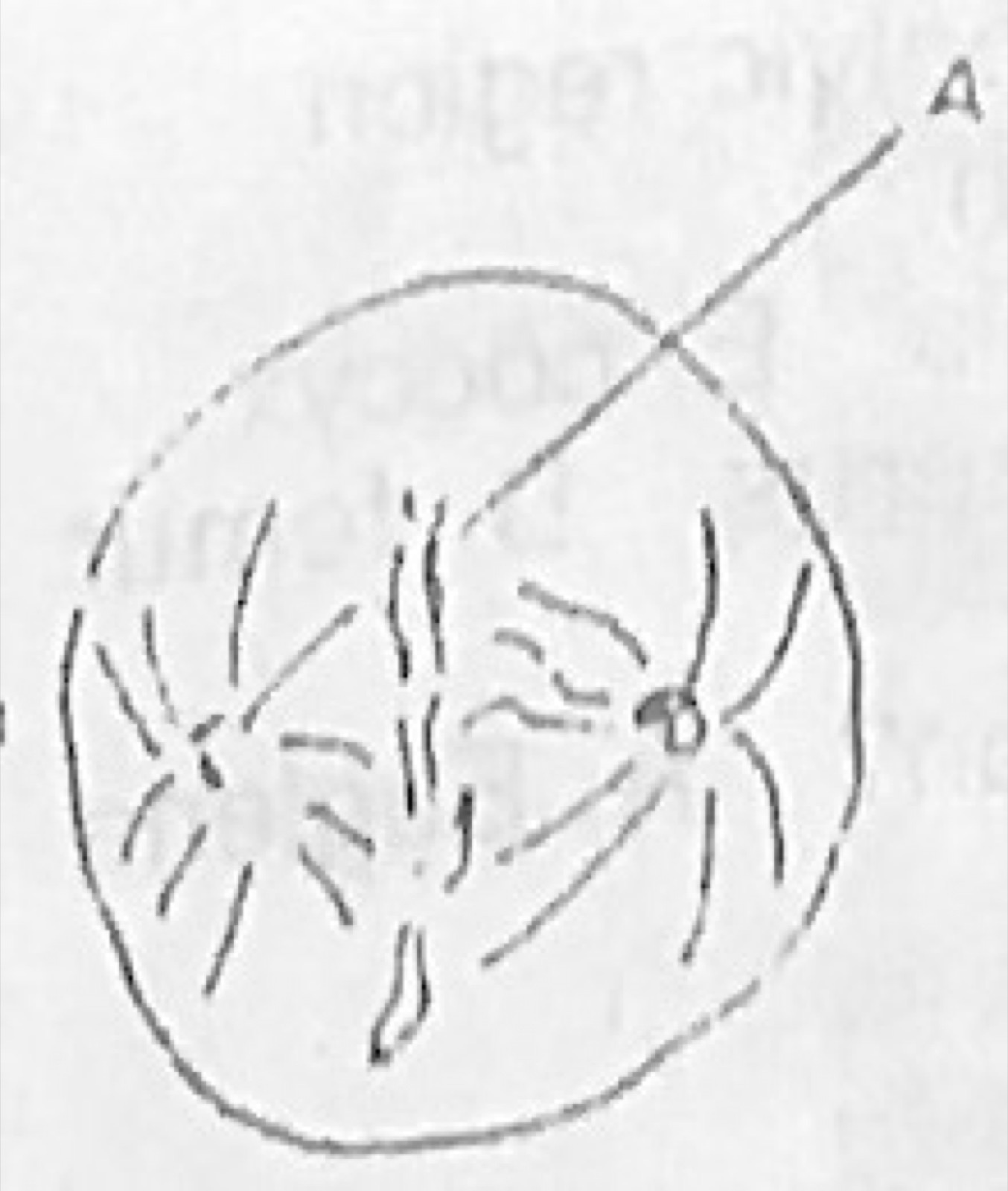
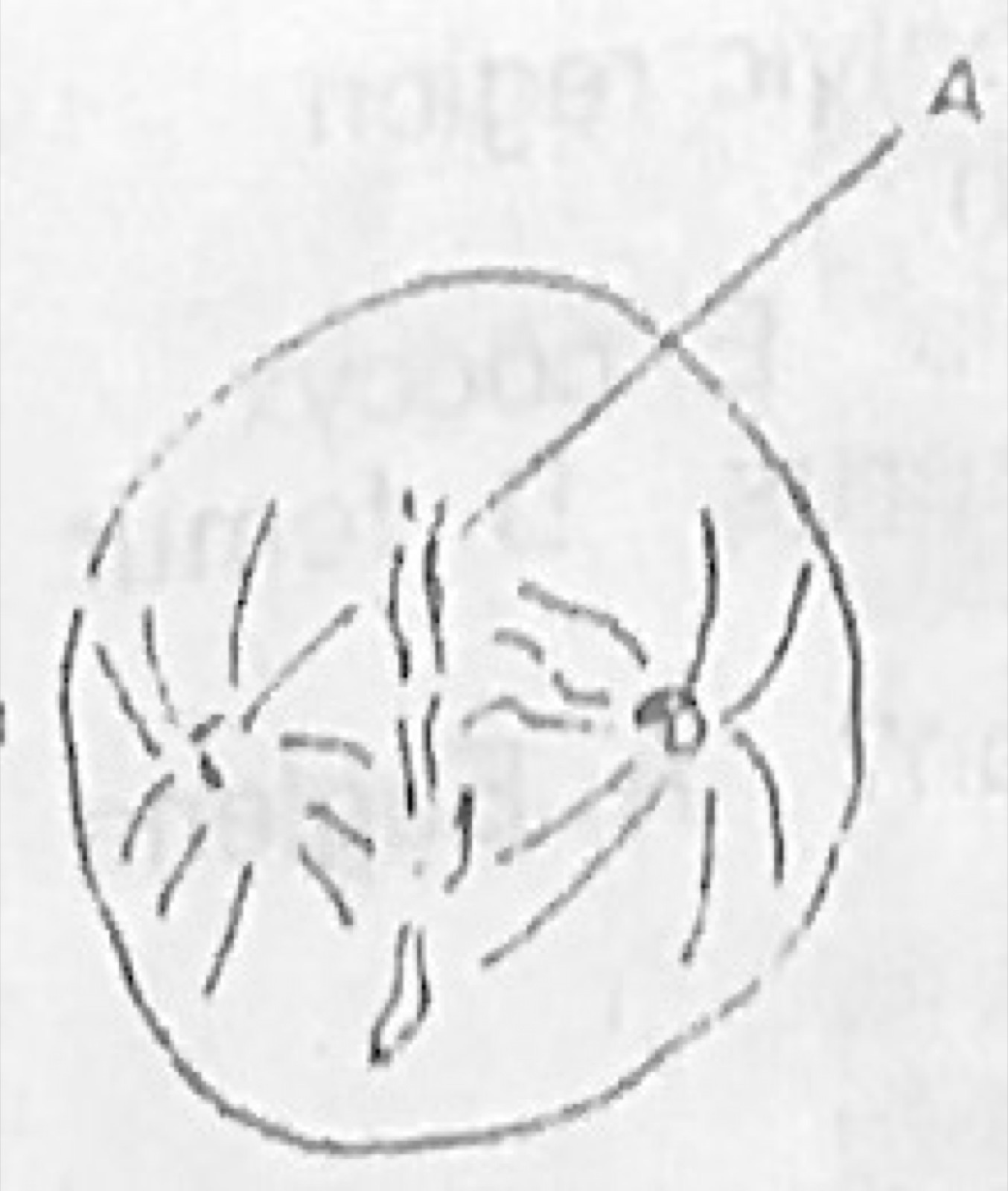
Question 40 Cell Division The diagram below illustrates a stage in mitosis. Use it to answer questions 40 and 41.
A. Interphase B. Prophase C. Metaphase D. Anaphase E. Telophase Show the answer and explanation Answer: C (Metaphase )
Explanation The chromosomes are lined up across the middle (equator) of the spindle: metaphase.
Open this question
Question 41 Cell Division The diagram illustrates a stage in mitosis (questions 40 and 41).
A. Chromatin B. Chromosome C. Chromatid D. Gene E. Dauginter-chromosome Show the answer and explanation Answer: C (Chromatid )
Explanation At metaphase each chromosome is made of two chromatids joined at the centromere; A points to one strand, a chromatid.
Open this question
Question 42 Evolution The evidence for evolution can be obtained from the following except
A. fossil B. anatomy C. history D. embryology E. taxonomy Show the answer and explanation Answer: C (history )
Explanation Fossils, comparative anatomy, embryology and taxonomy (classification) all give evidence of evolution; human history does not.
Open this question
Question 43 Evolution The similarity between the bone structure of the arm of a human and the fore-limb of a rabbit indicates
A. adaptive radiation B. continuous variation C. a common origin D. convergent evolution E. adaptation to the same environment Show the answer and explanation Answer: C (a common origin )
Explanation Limbs with the same basic bones (homologous organs) show that the animals came from a common ancestor.
Open this question
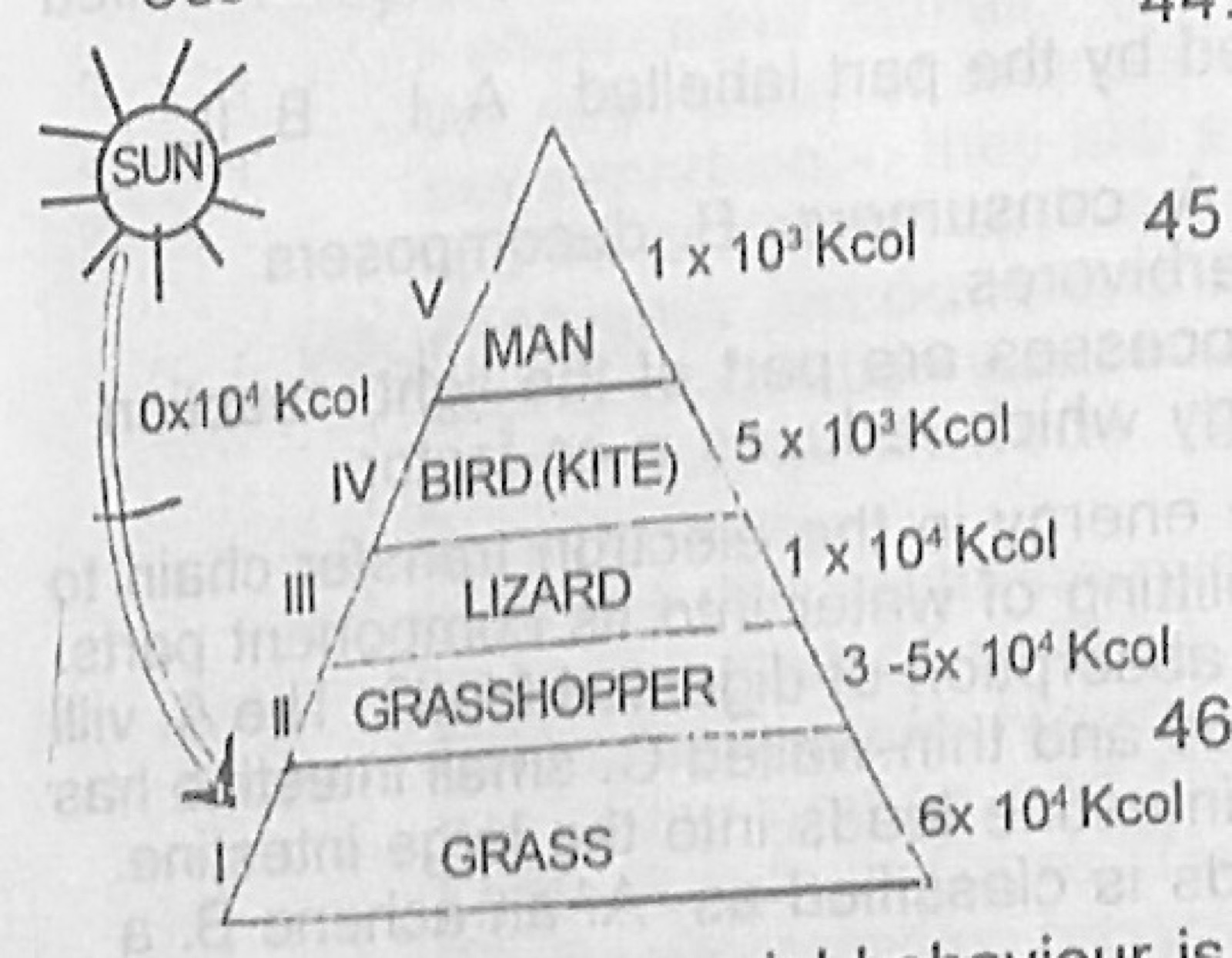
Question 44 Feeding Relationships and Energy Flow Use the diagram to answer questions 44 and 45.
A. Pyramid of numbers B. Food web among organisms C. Pyramid of energy D. Pyramid of biomass E. Evolutionary trend in organisms Show the answer and explanation Answer: C (Pyramid of energy )
Explanation Each level shows the energy (in kcal) it holds, getting smaller up the chain: a pyramid of energy.
Open this question
Question 45 Feeding Relationships and Energy Flow Which of the following effects would desertification have on the ecological balance represented in the diagram above? The calorific value of the energy
A. 10 x 104 k cal obtained from the sun would decrease B. 10 x 104 k cal obtained from the sun would increase C. 6 x 10⁴ k cal obtained at level I would increase D. 1 x 10⁴ k cal obtained at level V would increase E. 3.5x 10⁴ k cal obtained at level II would increase Show the answer and explanation Answer: A (10 x 104 k cal obtained from the sun would decrease )
Explanation Desertification destroys the grass and other producers, so less of the sun's energy is captured by the ecosystem and every level gets less.
Open this question
Question 46 Microorganisms and Health One of the methods of preventing measles is by
A. sleeping under mosquito net B. attacking the vectors C. attacking the secondary host D. vaccinating young children E. providing clean water supply Show the answer and explanation Answer: D (vaccinating young children )
Explanation Measles is a viral disease spread by droplets; vaccination of children prevents it.
Open this question
Question 47 Behaviour Group instinct or social behaviour is not displayed in
A. soldier ants B. bees C. chickens D. weaver birds E. termites Show the answer and explanation Answer: C (chickens )
Explanation Ants, bees, termites and weaver birds live in organised colonies; chickens do not.
Open this question
Question 48 Nutrient Cycling Which of the following fixes atmospheric nitrogen?
A. Rhizobium B. Nitrosomonas C. Nitrobacter D. Putrefying bacteria E. Denitrifying bacteria Show the answer and explanation Answer: A (Rhizobium )
Explanation Rhizobium in legume root nodules turns nitrogen gas into nitrogen compounds.
Open this question
Question 49 Nervous Coordination The spaces between neutrones through which impulses cross by means of chemical reaction are called
A. axons B. ganglia C. synapses D. dendrites E. pia matter Show the answer and explanation Answer: C (synapses )
Explanation A synapse is the gap between two neurones; a chemical transmitter carries the impulse across.
Open this question
Question 50 Variation The inability of some individuals to perceive the taste of some substances is an example of
A. individual adaptation B. physiological variation C. morphological variation D. morphological adaptation E. physical variation Show the answer and explanation Answer: B (physiological variation )
Explanation Tasting ability is a difference in how the body works, not in its shape, so it is physiological variation.
Open this question
Question 51 Conservation of Natural Resources The term afforestation is used in describing
A. harvesting of natural forest resources B. planting trees of value to man C. fallowing of forestland D. felling of trees in the forest E. recycling of waste forest products Show the answer and explanation Answer: B (planting trees of value to man )
Explanation Afforestation means planting useful trees, especially where there was no forest.
Open this question
Question 52 Population Ecology Over-crowding in seedlings of different species is less serious than over-crowding involving one species because different species may
A. have different nutritional needs B. lack the same nutrient C. be active at the same time D. have similar tolerance E. need equal spacing Show the answer and explanation Answer: A (have different nutritional needs )
Explanation Different species need different things, so they compete less than plants of the same species.
Open this question
Question 53 Nervous Coordination The autonomic nervous system comprises
A. sympathetic and parasympathetic systems B. cranial and sacral nerves C. brain and cranial nerves D. spinal cord and spinal nerves E. brain and spinal nerves Show the answer and explanation Answer: A (sympathetic and parasympathetic systems )
Explanation The autonomic nervous system has two parts: sympathetic and parasympathetic.
Open this question
Question 54 Cell Structure and Organisation The scientist who discovered the honey-comb structure of the cell was
A. Robert Hooke B. Felix Dujardin C. Mathias Schleiden D. Theodore Schowann E. Louis Pasteur Show the answer and explanation Answer: A (Robert Hooke )
Explanation Robert Hooke (1665) saw the honeycomb of tiny boxes in cork and called them cells.
Open this question
Question 57 Evolution The theory that new organs or characteristics develop in organisms when there is a need for them was postulated by
A. Charles Darwin B. Jean Lamarck C. Gregor Mendel D. Wallace E. Louis Pasteur Show the answer and explanation Answer: B (Jean Lamarck )
Explanation Lamarck's theory of use and disuse said organs develop when they are needed.
Open this question
Question 58 Adaptation Which of the following is an example of reproductive adaptation?
A. Succulent stems of cactus plant B. Changing colour of chameleon C. Possession of spines by desert plants D. Neck colouration in Agama lizard E. Leaf-shedding in trees Show the answer and explanation Answer: D (Neck colouration in Agama lizard )
Explanation The bright head and neck colour of the male agama attracts females during courtship.
Open this question
Question 59 Adaptation The large intercellular air spaces which penetrate the tissues of most hyrophytes provide a pathway through which
A. carbondioxide absorbed by leaves can diffuse to the roots B. oxygen produced in the leaves can diffuse to the submerged parts C. salts absorbed by roots can reach other parts of the plant D. plant hormones are transported to various parts E. manufactured food is translocated Show the answer and explanation Answer: B (oxygen produced in the leaves can diffuse to the submerged parts )
Explanation Water holds little oxygen, so air spaces let oxygen from the leaves reach the submerged stems and roots.
Open this question
Question 60 Nutrient Cycling Which of the following processes will not introduce carbondioxide into the atmosphere?
A. Breathing B. Photosynthesis C. Respiration D. Putrefaction E. Burning Show the answer and explanation Answer: B (Photosynthesis )
Explanation Photosynthesis removes carbon dioxide from the air; all the others release it.
Open this question
Theory question 101 Habitats and Biomes (a) List five morphological features that are characteristic of plants found in each of the following habitats: (i) tropical rainforest (ii) savanna. In each case, state function of the features listed in "a" to the plant
Show the model answer Model answer (a)(i) Rainforest (any five, each with function): tall straight trunks – reach light above other plants; buttress roots – support tall trees in shallow soil; broad thin leaves – trap light in shade; drip tips – shed rain water quickly; thin smooth bark – no need to resist fire/drought; climbers and epiphytes – reach light
Explanation In (c) every arrow must be labelled with the process, and the answer must be a diagram only.
Open this question
Theory question 102 Plant Responses and Hormones (a) Describe an experiment to demonstrate the influence of auxins on the growth of plant shoot
Show the model answer Model answer (a) Use young coleoptiles/seedlings; cut off the tips; place one tip on a block of agar (or insert a gelatin/jelly strip) and another on mica (impermeable); replace on the cut stumps; a control left intact; keep in the dark/uniform light for a few days
Explanation Always include a control in an experiment and say what it shows.
Open this question
Theory question 103 Reproduction in Plants (a) Describe how the floral parts of a named flower are adapted to wind-pollination
Show the model answer Model answer (a) Named flower e.g. maize or grass: small, dull petals or none; no scent or nectar; long filaments with anthers hanging outside the flower; large amounts of light, dry, smooth pollen; long feathery stigmas hanging out to catch pollen
Explanation Name the flower first, then describe each floral part.
Open this question
Theory question 104 Excretion (a) List three functions of the kidney
Show the model answer Model answer (a) Any three: excretion of nitrogenous waste (urea); osmoregulation (water balance); regulation of salts/ions; regulation of blood pH; removal of drugs/toxins
Explanation Describe ultrafiltration and selective reabsorption as two separate steps.
Open this question Sign up free for every GCE Biology year, practice by topic and timed mocks.
Start practising free