A point Q is 6 km due north of P and R is 8 km due east of P. A bus travels on a straight route from Q to R at an average speed of 40 km/h. How long does it take to travel at that speed?
A.30 minutes
B.15 minutes
C.20 minutes
D.10 minutes
Show the answer and explanation
Answer: B (15 minutes)
Explanation
QR = √(6² + 8²) = 10 km. Time = 10/40 h = ¼ h = 15 minutes.
A right rectangular prism has a height 9 cm. The length of the base is x cm and it is 7 cm more than the width of the base. Write a function of the volume (V) of the prism in terms of the length of the base.
A.V(x) = 9x(x − 7)
B.V(x) = x(x + 9)(x − 7)
C.V(x) = 9x(x + 7)
D.V(x) = x(x + 9)(x + 7)
Show the answer and explanation
Answer: A (V(x) = 9x(x − 7))
Explanation
The width is x − 7, so V = length × width × height = 9x(x − 7).
A bag contains 20 green and a number of red identical balls. The probability of selecting at random a red ball is 3/5. How many balls are there in the bag?
A.50
B.30
C.60
D.12
Show the answer and explanation
Answer: A (50)
Explanation
Green balls make up 2/5 of the bag, so 20 = 2/5 of the total and the total is 50.
The mean height of three groups consisting of 20, 16 and 14 students are 1.67 m, 1.50 m and 1.40 m respectively. Find the mean height of all the students.
A.1.54 m
B.1.53 m
C.1.55 m
D.1.52 m
Show the answer and explanation
Answer: A (1.54 m)
Explanation
Total height = 33.4 + 24 + 19.6 = 77 m for 50 students, so the mean is 1.54 m.
The sum of the ages of 14 learners in a class is 168. A learner was added to the class and the mean age changed to 12.2. Calculate the age of the new learner.
A.16
B.14
C.15
D.13
Show the answer and explanation
Answer: C (15)
Explanation
15 learners with mean 12.2 have total age 183, so the new learner is 183 − 168 = 15.
A cone has a base radius of 12 cm and height of 24 cm. The volume of the cone is equal to the volume of a cylindrical tank with a base radius 6 cm. Calculate the height of the tank. [Take π = 22/7]
A.48 cm
B.16 cm
C.32 cm
D.8 cm
Show the answer and explanation
Answer: C (32 cm)
Explanation
⅓π × 144 × 24 = π × 36 × h, so 1152 = 36h and h = 32 cm.
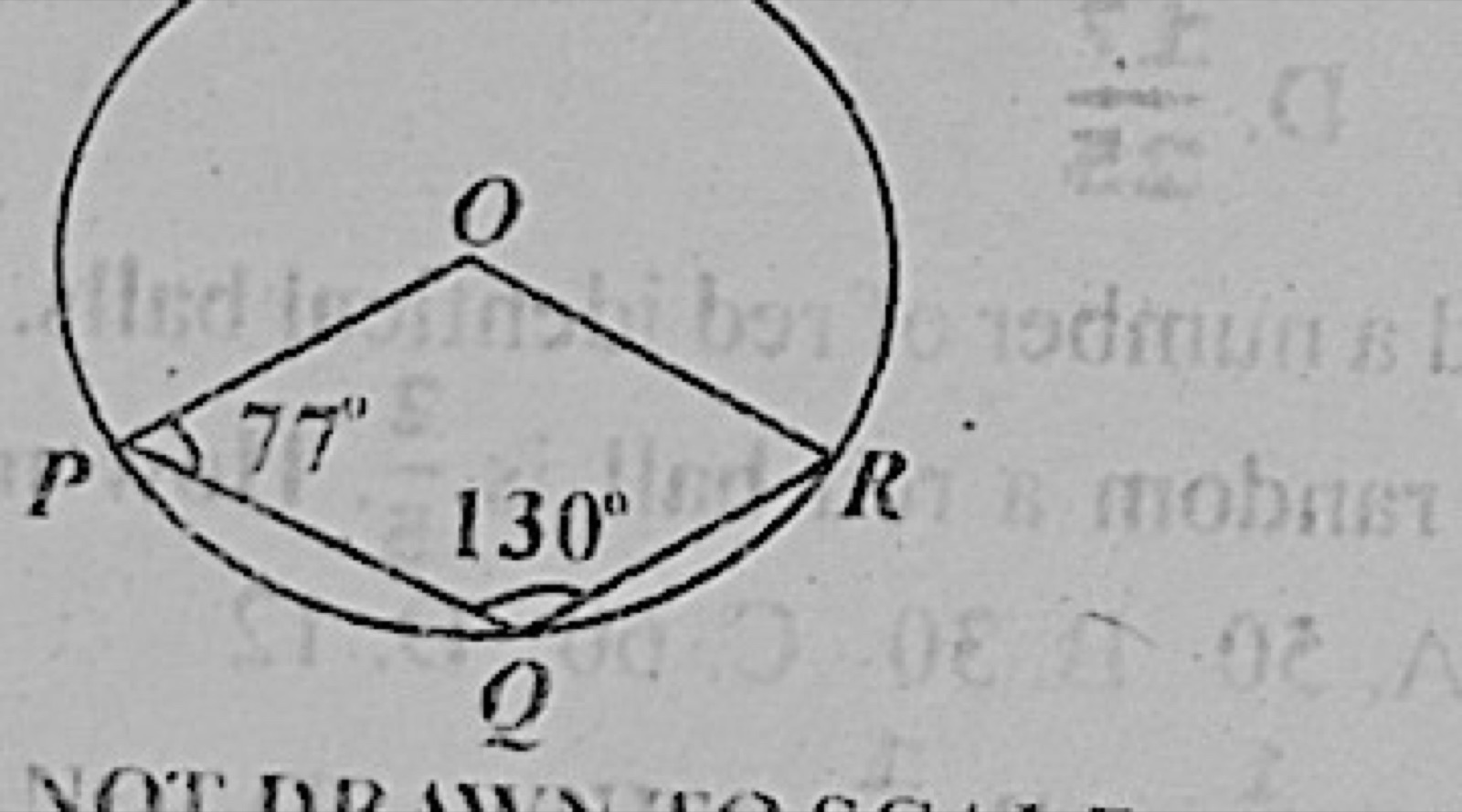
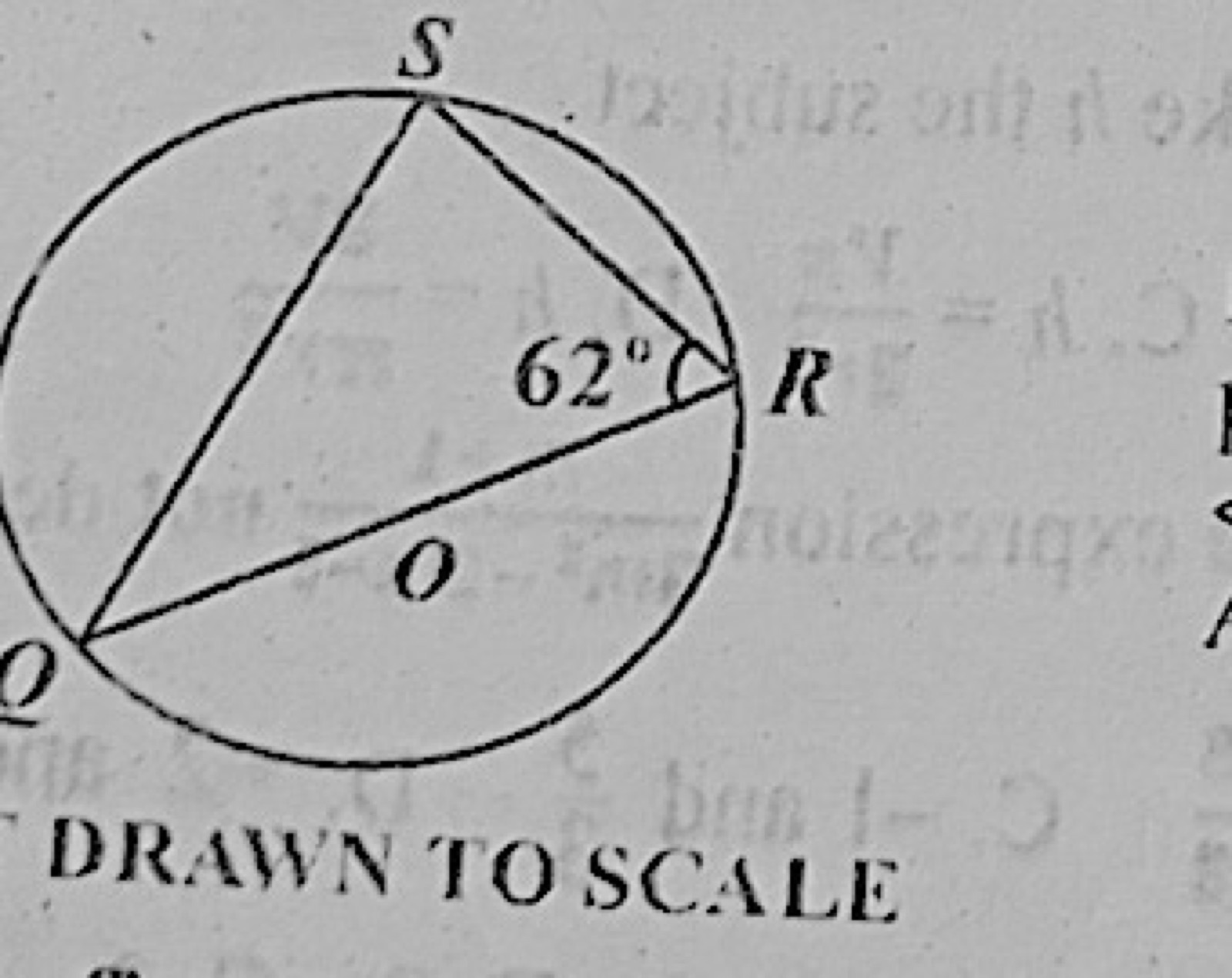
In the diagram, P, Q and R are points on a circle with centre O. ∠OPQ = 77° and ∠PQR = 130°. Find ∠ORQ
A.90°
B.57°
C.33°
D.53°
Show the answer and explanation
Answer: D (53°)
Explanation
∠PQR stands on the major arc PR, so the reflex angle POR = 260° and the angle POR inside OPQR is 100°. The angles of OPQR add to 360°: ∠ORQ = 360° − (77° + 130° + 100°) = 53°.
The point M is on the same horizontal as the foot of a vertical pole. The angle of elevation of the top of the pole from M is 55°. If M is 10 m from the foot of the pole, calculate, correct to the nearest metre, the height of the pole.
A fun club donates to children's home annually. The amount given is increased by 8% of its yearly value. If the donation in 2010 was $7,000.00, find the: (a) donation given in 2012 (b) total amount of money donated from 2010 to 2013
Two cars X and Y, start from a common point and travel in opposite directions. X travels at an average speed of 60 km/h and Y at 80 km/h on the same course. (a) Determine, how far apart X and Y will be after 3 hours (b) If the speed of X is increased by 20 km/h within the 3 hours, what would be the effect on the distance between X and Y? (c) State the importance of considering speed when calculating total distance over the same time frame
Show the model answer
Model answer
(a) X: 60 × 3 = 180 km; Y: 80 × 3 = 240 km; apart = 420 km (b) X: 80 × 3 = 240 km; apart = 240 + 240 = 480 km, an increase of 60 km (c) Distance = speed × time, so for the same time a higher speed gives a greater distance (the separation grows with the combined speed)
Concrete blocks of length 14/25 m were laid end to end along the four sides of a rectangular lawn 28 m long and 21 m wide. (a) How many block were required to complete one layer? (b) If each block costs GH¢ 1.80 and the cost of labor is one-third the cost of a block, find the total cost of laying the blocks.
A bowl contains red, green and black marbles all of the same size. The number of red marbles are 3 more than the number of green marbles and the number of black marbles is 1 less than the number of green marbles. If the probability of drawing at random a black marble is 1/4, find the: (a) Number of each color of marble (b) Probability that a marble drawn at random from the bowl is not black
Show the model answer
Model answer
(a) Green = g, red = g + 3, black = g − 1; total = 3g + 2 (g − 1)/(3g + 2) = ¼ ⇒ 4g − 4 = 3g + 2 ⇒ g = 6 Green 6, red 9, black 5 (total 20) (b) P(not black) = 1 − 5/20 = 15/20 = ¾
Explanation
Express every colour in terms of the number of green marbles.
In a remedial school of 13 teachers, 8 teach Government (G), 7 teach Geography (P) and 7 teach History (H). 2 teach Government and Geography only, 2 teach Government and History only and 3 teach Geography and History only. (a) Represent the information in a Venn diagram (b) Find: (i) n(G ∩ P ∩ H) (ii) n(P ∩ H) (iii) n[(P ∪ H)′ ∩ G]
Show the model answer
Model answer
(a) Three overlapping circles G, P, H in U (13); G∩P only = 2, G∩H only = 2, P∩H only = 3, all three = x; G only = 4 − x, P only = 2 − x, H only = 2 − x (b)(i) (4 − x) + (2 − x) + (2 − x) + 2 + 2 + 3 + x = 13 ⇒ 15 − 2x = 13 ⇒ x = 1 (ii) n(P ∩ H) = 3 + 1 = 4 (iii) n[(P ∪ H)′ ∩ G] = Government only = 4 − 1 = 3
Explanation
Every teacher teaches at least one subject, so all regions add up to 13.
(a) On a certain day, Mabel rode her bicycle for 45 minutes and then walked for 1 hour, covering a total distance of 10.4 km. The average cycling speed is three times the walking speed. (i) Find, correct to two significant figures, the walking speed (ii) If Mabel increases the average cycling speed by 20% but maintains the walking speed for 1 hour, find, in minutes, the new cycling time (b) A line, L passing through K(−3, 5) is parallel to the equation 3x − 2y + 5 = 0. Find the equation of L.
Show the model answer
Model answer
(a)(i) Walking speed w: ¾ × 3w + w = 10.4 ⇒ 3.25w = 10.4 ⇒ w = 3.2 km/h (ii) New cycling speed = 9.6 × 1.2 = 11.52 km/h; walking covers 3.2 km, so cycling distance = 7.2 km Time = 7.2 ÷ 11.52 = 0.625 h = 37.5 minutes (b) 2y = 3x + 5 ⇒ gradient 3/2; y − 5 = 3/2(x + 3) ⇒ 3x − 2y + 19 = 0
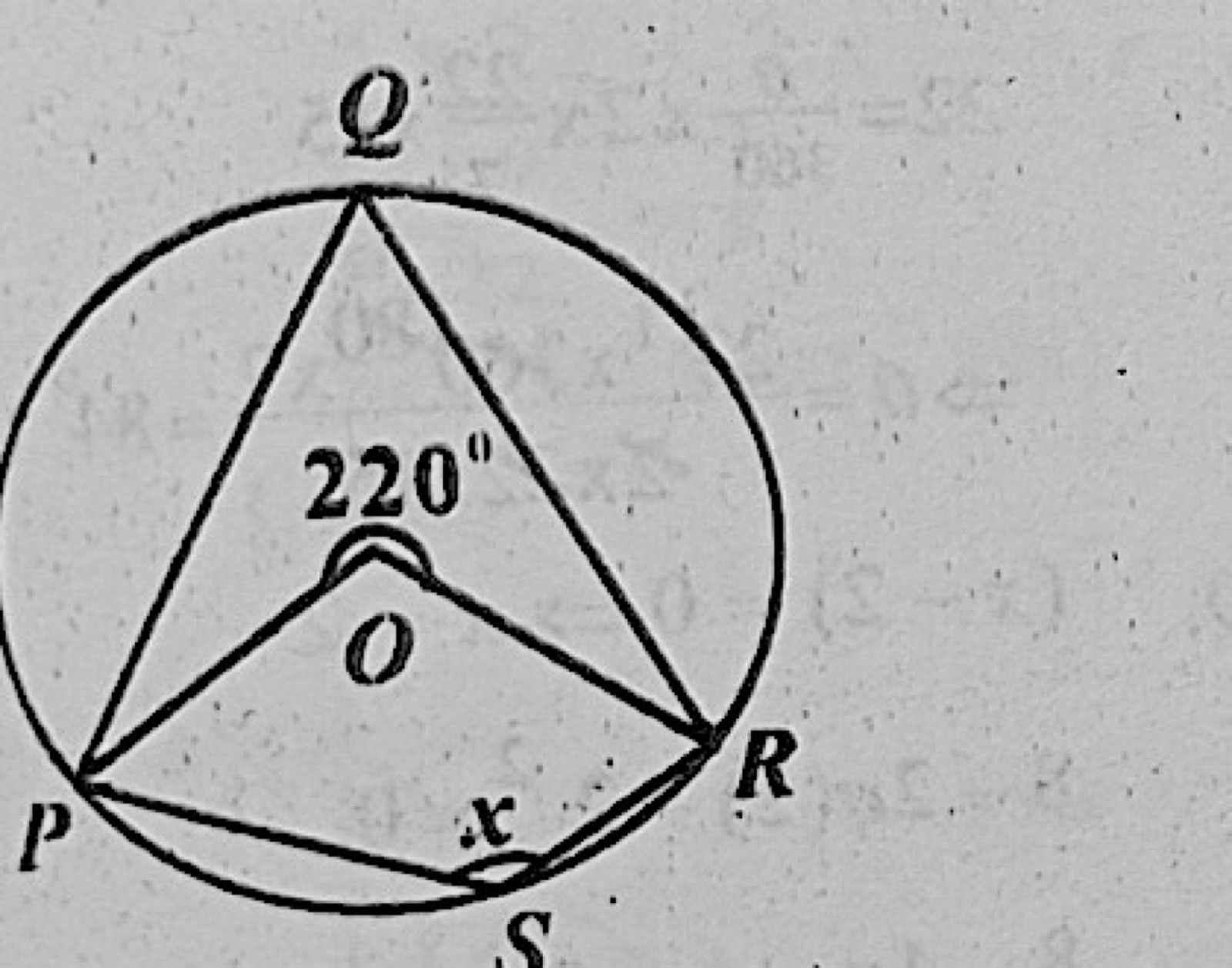
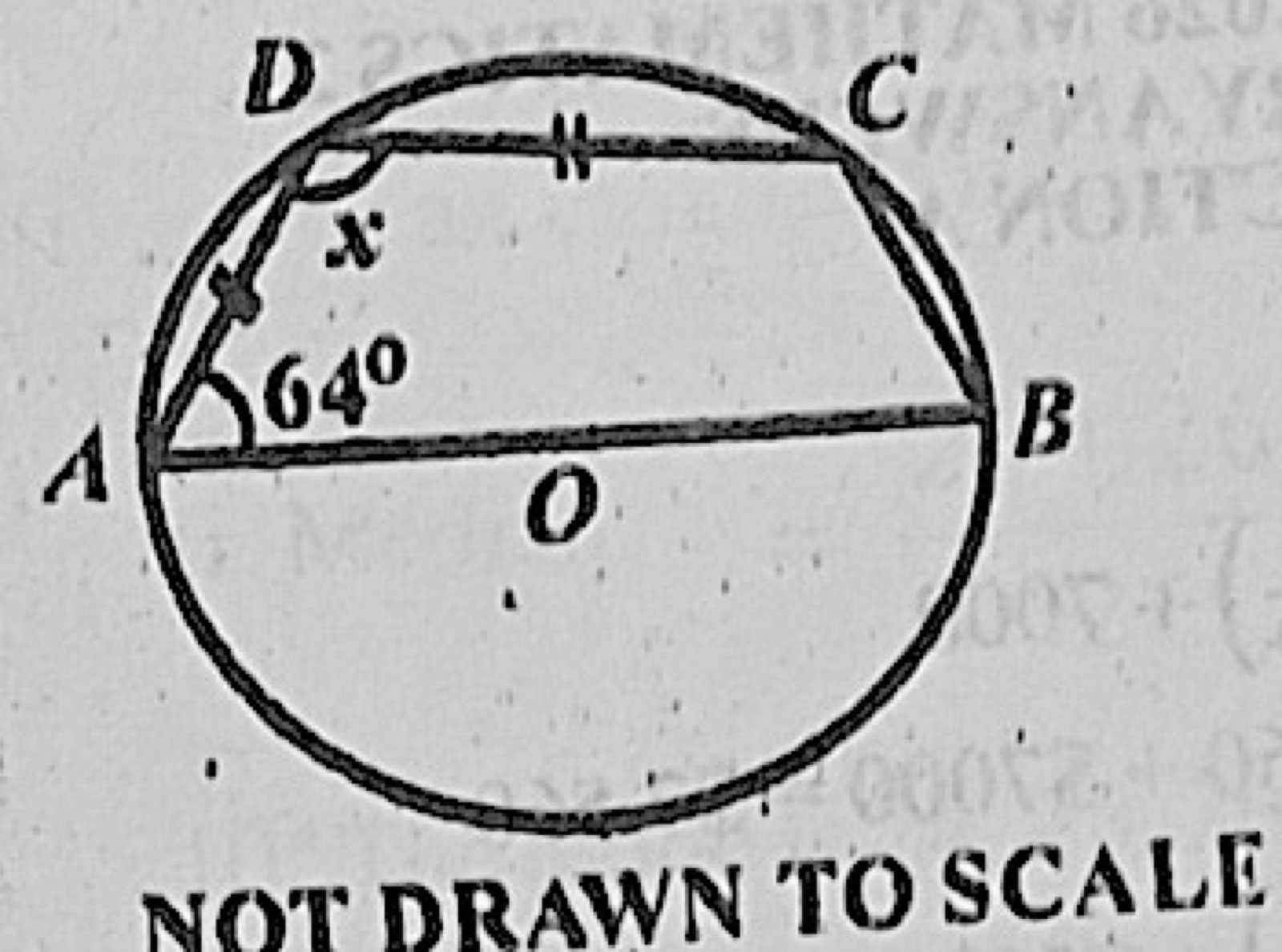
(a) In the diagram, A, B, C and D are points on the circle with centre O. ∠DAB = 64° and |AD| = |DC|. Find the size of the angle marked x. (b) Two consecutive even numbers are such that one-third of the larger exceeds one-fourth of the smaller by 7. Find the numbers.
Show the model answer
Model answer
(a) ∠DCB = 180° − 64° = 116° (cyclic quadrilateral); ∠ACB = 90° (AB is a diameter) ⇒ ∠ACD = 26° AD = DC ⇒ ∠DAC = ∠DCA = 26°; x = ∠ADC = 180° − 52° = 128° (b) Numbers n and n + 2: (n + 2)/3 − n/4 = 7 ⇒ 4n + 8 − 3n = 84 ⇒ n = 76 The numbers are 76 and 78
Explanation
AB passes through O, so the angle in the semicircle is 90°.
(a) The angle of elevation of the top of a 75 m tower from a ship and a boat are 26.4° and 57.4° respectively. Given that, the ship, boat and the foot of the tower are on the same horizontal: (i) Illustrate the information in a diagram (ii) Calculate, correct to three significant figures, the distance between the ship and the boat. (b) A sector of a circle has a radius of 18 cm and subtends an angle of 120° at the centre of the circle. Find, correct to five significant figures, the area of the sector. [Take π = 22/7]
Show the model answer
Model answer
(a)(i) Vertical tower 75 m; ship and boat on the ground line, ship further away (26.4°), boat nearer (57.4°) (ii) Ship to tower = 75 ÷ tan 26.4° ≈ 151.09 m; boat to tower = 75 ÷ tan 57.4° ≈ 47.96 m Same side of the tower: distance ≈ 151.09 − 47.96 ≈ 103 m (if on opposite sides: 151.09 + 47.96 ≈ 199 m) (b) Area = 120/360 × 22/7 × 18² = 339.43 cm²
Explanation
The question does not say which side; the usual reading is that both are on the same side of the tower.
Two equal chords AB and BC are each 15 cm long. They meet at a point B on a circle with centre O, such that ∠ABC = 120°. (a) Illustrate the information in a diagram (b) Calculate, correct to the nearest whole number the: (i) radius of the circle (ii) perimeter of the major segment cut off by the chord AC. [Take π = 22/7]
Show the model answer
Model answer
(a) Circle with B on it, chords BA = BC = 15 cm, ∠ABC = 120°, chord AC drawn (b)(i) AC = 2 × 15 sin 60° ≈ 25.98 cm; sine rule: 2r = AC ÷ sin 120° = 30 ⇒ r = 15 cm (triangles OAB and OBC are equilateral) (ii) The major arc AC (the arc not containing B) subtends 2 × 120° = 240° at the centre Major arc = 240/360 × 2 × 22/7 × 15 ≈ 62.86 cm; perimeter = 62.86 + 25.98 ≈ 89 cm
Explanation
The angle at B on the circumference is half the angle subtended at the centre by the opposite arc.
(a) The profit, P, made by a retailer for selling y number of articles in a day is given by P = (3y2 − 9)/(y − 2) − 18/(y − 2) (i) If $16.00 profit was made in a particular day, determine the number of articles sold. (ii) On a particular day, no profit was made for sales of articles. Find the number of articles sold. (b) Solve (5 + x)/6 + (4x − 1)/3 ≥ (3x + 2)/5
(a) A study on average daily temperature in °C over a period of 12 months are: 24, 25, 23, 27, 26, 28, 29, 30, 27, 26, 25 and 24 (i) Find the: (I) mean (II) median (III) mode of the data (ii) State, with explanation, which of the measures in 12(a)(i) best represents the data? (b) Two towns lie on the same meridian and have latitudes of 15°N and 36°N. (i) Illustrate the information in a diagram (ii) Calculate, correct to three significant figures, the distance between the towns [Take π = 22/7 and R = 6400 km]
Show the model answer
Model answer
(a)(i)(I) Mean = 314 ÷ 12 ≈ 26.17 °C (II) Ordered: 23, 24, 24, 25, 25, 26, 26, 27, 27, 28, 29, 30; median = (26 + 26)/2 = 26 °C (III) Modes: 24, 25, 26 and 27 (each appears twice) (ii) The median (or the mean): the data has no extreme values, both are close to the centre; the mode is not useful because there are four modes (b)(i) Sphere with the equator, one meridian and the two towns at 15°N and 36°N on it (ii) Angle = 36° − 15° = 21°; distance = 21/360 × 2 × 22/7 × 6400 ≈ 2,350 km
(a) Using a ruler and a pair of compasses only, construct ΔMNR in which |MN| = 8.7 cm, |MR| = 10.5 cm and ∠MNR = 75°. (b) Locate by construction, a point S such that RS is parallel to MN and S is equidistant from points M and R. (c) Measure: (i) |NR|; (ii) ∠NRS (d) What shape is SMNR?
Show the model answer
Model answer
(a) Draw MN = 8.7 cm; at N construct 75° (60° + half of 30°); with centre M and radius 10.5 cm cut the arm at R; join MR (b) Construct the line through R parallel to MN and the perpendicular bisector of MR; S is where they meet (c)(i) |NR| ≈ 8.5 cm (ii) ∠NRS ≈ 105° (allow ±1) (d) SMNR is a trapezium (RS ∥ MN)
Explanation
RS ∥ MN, so ∠NRS and ∠MNR are co-interior angles adding to 180°.