WAEC Mathematics 2024 past questions and answers

60 questions. Try each one, then open the answer to check yourself and read the explanation.

Question 1

Fractions, Decimals and Approximation

Multiply 3.4 × 10−5 by 7.1 × 108 and leave the answer in standard form.

  1. A.2.414 × 102
  2. B.2.414 × 103
  3. C.2.414 × 104
  4. D.2414 × 105
Show the answer and explanation

Answer: C (2.414 × 10⁴)

Explanation

3.4 × 7.1 = 24.14 and 10−5 × 108 = 103, so the product is 24.14 × 103 = 2.414 × 10⁴.

Open this question

Question 2

Sets

Given that P = {p: 1 < p < 20}, where p is an integer and R = {r: 0 ≤ r ≤ 25, where r is a multiple of 4}. Find P ∩ R.

  1. A.{4, 8, 10, 16}
  2. B.{4, 8, 12, 16}
  3. C.{4, 8, 12, 16, 20}
  4. D.{4, 8, 12, 16, 20, 24}
Show the answer and explanation

Answer: B ({4, 8, 12, 16})

Explanation

R = {0, 4, 8, 12, 16, 20, 24}. The members that are also between 1 and 20 (not including 20) are 4, 8, 12 and 16.

Open this question

Question 3

Progressions

The first term of an Arithmetic Progression (A.P) is 2 and the last term is 29. If the common difference is 3, how many terms are in the A.P?

  1. A.8
  2. B.9
  3. C.10
  4. D.11
Show the answer and explanation

Answer: C (10)

Explanation

29 = 2 + (n − 1) × 3 gives n − 1 = 9, so n = 10.

Open this question

Question 4

Logarithms

Express in index form: logax + logay = 3.

  1. A.x + y = 3
  2. B.xy = 3
  3. C.x + y = a3
  4. D.xy = a3
Show the answer and explanation

Answer: D (xy = a3)

Explanation

logax + logay = loga(xy) = 3, so xy = a³.

Open this question

Question 6

Surds

If (3 − 4√2)(1 + 3√2) = a + b√2, find the value of b.

  1. A.5
  2. B.−5
  3. C.−21
  4. D.21
Show the answer and explanation

Answer: A (5)

Explanation

Expanding: 3 + 9√2 − 4√2 − 24 = −21 + 5√2, so b = 5.

Open this question

Question 7

Commercial Arithmetic

Find the time for which $1,250.00 will amount to $2,031.25 at 12.5% per annum simple interest.

  1. A.2 years
  2. B.3 years
  3. C.4 years
  4. D.5 years
Show the answer and explanation

Answer: D (5 years)

Explanation

Interest = 2031.25 − 1250 = 781.25. T = (100 × 781.25) ÷ (1250 × 12.5) = 5 years.

Open this question

Question 8

Logarithms

If log3 (2x − 1) = 5, find the value of x.

  1. A.8
  2. B.16
  3. C.64
  4. D.122
Show the answer and explanation

Answer: D (122)

Explanation

2x − 1 = 35 = 243, so 2x = 244 and x = 122.

Open this question

Question 9

Ratio, Percentages and Rates

The population of a town increases by 3% every year. In the year 2000, the population was 3,000. Find the population in the year 2003.

  1. A.3,182
  2. B.3,278
  3. C.6,591
  4. D.7,515
Show the answer and explanation

Answer: B (3,278)

Explanation

Three years of 3% growth: 3000 × 1.03³ = 3278.2, about 3,278.

Open this question

Question 10

Ratio, Percentages and Rates

A trader gave a change of ₦540.00 instead of ₦570.00 to a customer. Calculate the percentage error.

  1. A.55/19%
  2. B.55/9%
  3. C.57/19%
  4. D.57/9%
Show the answer and explanation

Answer: A (55/19%)

Explanation

Error = ₦30. Percentage error = 30/570 × 100% = 100/19 % = 55/19%.

Open this question

Question 12

Linear and Simultaneous Equations

If 3x − 2y = −5 and x + 2y = 9, find the value of (x − y)/(x + y)

  1. A.5/3
  2. B.3/5
  3. C.−3/5
  4. D.−5/3
Show the answer and explanation

Answer: C (−3/5)

Explanation

Adding the equations gives 4x = 4, so x = 1 and y = 4. (x − y)/(x + y) = −3/5.

Open this question

Question 13

Variation

A variable W varies partly as M and partly inversely as P. Which of the following correctly represents the relation with k1 and k2 as constants?

  1. A.W = k1M/(k2P)
  2. B.W = (k1 + k2)M/P
  3. C.W = k1M + k2/P
  4. D.W = (k1 + k2)M + P
Show the answer and explanation

Answer: C (W = k1M + k2/P)

Explanation

'Partly … and partly …' means a sum of two parts: one proportional to M (k1M) and one inversely proportional to P (k2/P).

Open this question

Question 14

Mensuration of Solids

A cylindrical metallic barrel of height 2.5 m and radius 0.245 m is closed at one end. Find, correct to one decimal place, the total surface area of the barrel. [Take π = 22/7]

  1. A.2.1 m2
  2. B.3.5 m2
  3. C.4.0 m2
  4. D.5.1 m2
Show the answer and explanation

Answer: C (4.0 m2)

Explanation

Curved surface + one end = 2πrh + πr² = 22/7 × 0.245 × (5 + 0.245) ≈ 4.04, so 4.0 m².

Open this question

Question 15

Algebraic Expressions

Make R the subject of the relation V = πl(R2 − r2).

  1. A.R = √(V/(πl) + r2)
  2. B.R = √(V/(πl) − r2)
  3. C.R = √(V − πlr2)
  4. D.R = √(V + πlr2)
Show the answer and explanation

Answer: A (R = √(V/(πl) + r2))

Explanation

Divide by πl: R² − r² = V/(πl). Add r² and take the square root: R = √(V/(πl) + r²).

Open this question

Question 16

Logic

Consider the following statements:
m: Edna is respectful
n: Edna is brilliant
If m ⇒ n, which of the following is valid?

  1. A.~m ⇒ ~n
  2. B.n ⇒ ~m
  3. C.~n ⇒ ~m
  4. D.n ⇒ m
Show the answer and explanation

Answer: C (~n ⇒ ~m)

Explanation

The contrapositive of m ⇒ n is ~n ⇒ ~m, and it is always equivalent to the original statement.

Open this question

Question 17

Linear and Simultaneous Equations

A number is added to both the numerator and the denominator of the fraction 1/8. If the result is 1/2, find the number.

  1. A.3
  2. B.4
  3. C.5
  4. D.6
Show the answer and explanation

Answer: D (6)

Explanation

(1 + x)/(8 + x) = ½ gives 2 + 2x = 8 + x, so x = 6.

Open this question

Question 18

Ratio, Percentages and Rates

Gifty, Justina and Frank shared 60 oranges in the ratio 5 : 3 : 7 respectively. How many oranges did Justina receive?

  1. A.12
  2. B.16
  3. C.20
  4. D.28
Show the answer and explanation

Answer: A (12)

Explanation

The ratio has 5 + 3 + 7 = 15 parts. Justina gets 3/15 × 60 = 12.

Open this question

Question 20

Ratio, Percentages and Rates

A piece of rod of length 44 m is cut to form a rectangular shape such that the ratio of the length to the breadth is 7 : 4. Find the breadth.

  1. A.8 m
  2. B.14 m
  3. C.16 m
  4. D.24 m
Show the answer and explanation

Answer: A (8 m)

Explanation

The perimeter is 44 m, so length + breadth = 22 m. Breadth = 4/11 × 22 = 8 m.

Open this question

Question 21

Mensuration of Plane Shapes

In the diagram, MN // KL, ML and KN intersect at X. |MN| = 12 cm, |MX| = 10 cm and |KL| = 9 cm. If the area of ΔMXN is 16 cm2, calculate the area of ΔLXK.

Diagram for this question
  1. A.8 cm2
  2. B.9 cm2
  3. C.10 cm2
  4. D.12 cm2
Show the answer and explanation

Answer: B (9 cm2)

Explanation

Because MN // KL, triangles MXN and LXK are similar with scale factor 9/12 = 3/4. Areas scale by (3/4)² = 9/16, so the area is 16 × 9/16 = 9 cm².

Open this question

Question 22

Trigonometry

A ladder 15 m long leans against a vertical pole, making an angle of 72° with the horizontal. Calculate, correct to one decimal place, the distance between the foot of the ladder and the pole.

  1. A.15.8 m
  2. B.14.3 m
  3. C.4.9 m
  4. D.4.6 m
Show the answer and explanation

Answer: D (4.6 m)

Explanation

The distance along the ground is the adjacent side: 15 cos 72° = 15 × 0.309 ≈ 4.6 m.

Open this question

Question 23

Circle Theorems

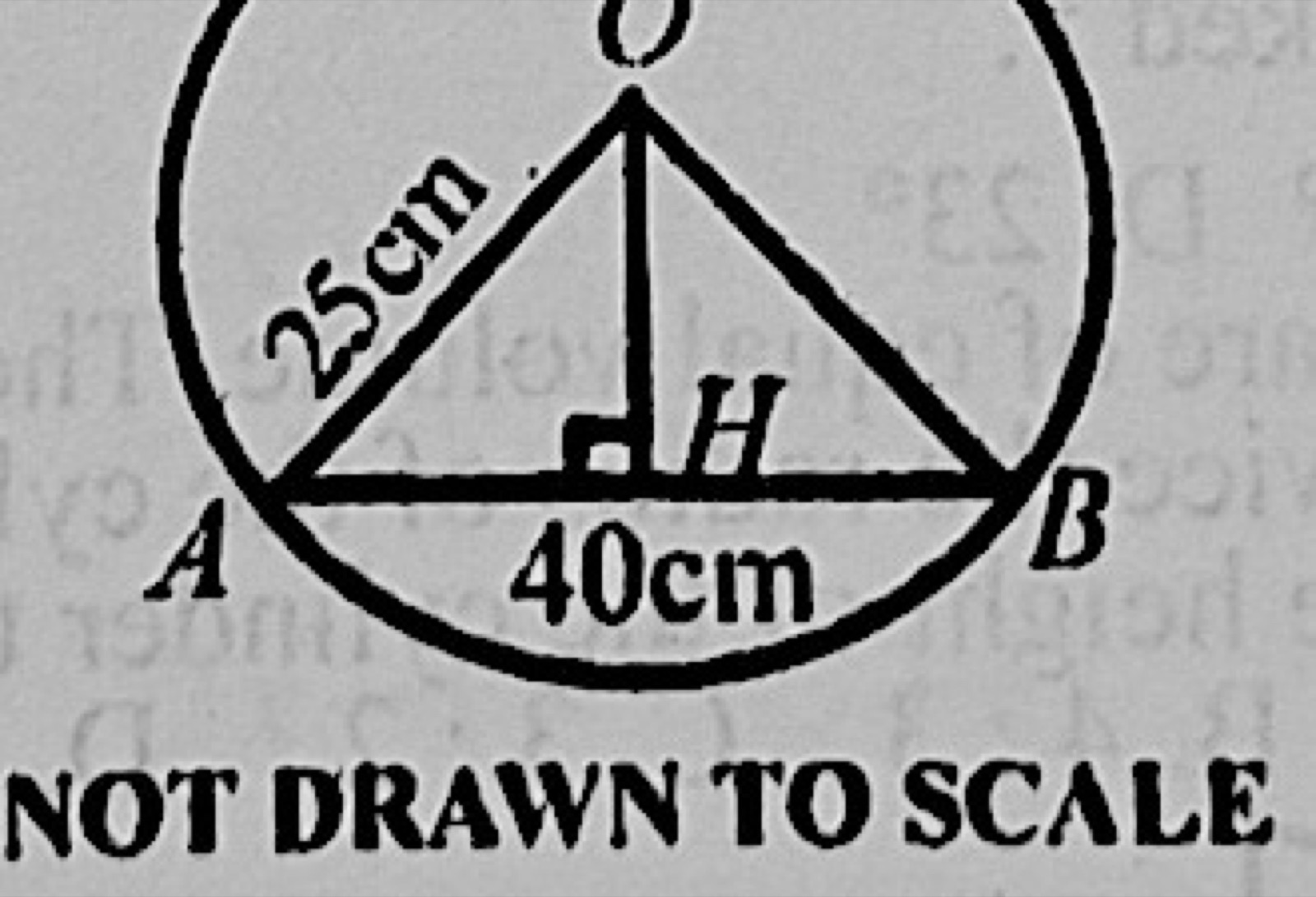
In the diagram, O is the centre of the circle. If |OA| = 25 cm and |AB| = 40 cm, find |OH|.

Diagram for this question
  1. A.15 cm
  2. B.20 cm
  3. C.25 cm
  4. D.30 cm
Show the answer and explanation

Answer: A (15 cm)

Explanation

The perpendicular from the centre bisects the chord, so AH = 20 cm. OH = √(25² − 20²) = √225 = 15 cm.

Open this question

Question 24

Bearings

Given that P is 25 m on a bearing of 330° from Q, how far south of P is Q?

  1. A.25.2 m
  2. B.21.7 m
  3. C.19.8 m
  4. D.18.5 m
Show the answer and explanation

Answer: B (21.7 m)

Explanation

The bearing 330° is 30° west of north, so the north–south distance is 25 cos 30° ≈ 21.7 m.

Open this question

Question 25

Commercial Arithmetic

A car valued at $600,000.00 depreciates by 10% each year. What will be the value of the car at the end of two years?

  1. A.$120,000.00
  2. B.$480,000.00
  3. C.$486,000.00
  4. D.$540,000.00
Show the answer and explanation

Answer: C ($486,000.00)

Explanation

Each year the value is multiplied by 0.9: 600 000 × 0.9 × 0.9 = $486,000.

Open this question

Question 26

Mensuration of Solids

The length and breadth of a cuboid are 15 cm and 8 cm respectively. If the volume of the cuboid is 1,560 cm3, calculate the total surface area.

  1. A.976 cm2
  2. B.838 cm2
  3. C.792 cm2
  4. D.746 cm3
Show the answer and explanation

Answer: B (838 cm2)

Explanation

Height = 1560 ÷ (15 × 8) = 13 cm. Total surface area = 2(15×8 + 15×13 + 8×13) = 2(120 + 195 + 104) = 838 cm².

Open this question

Question 27

Number Bases

The number 1621 was subtracted from 6244 in base x. If the result was 4323, find x.

  1. A.Seven
  2. B.Eight
  3. C.Nine
  4. D.Ten
Show the answer and explanation

Answer: A (Seven)

Explanation

Check by adding 4323 + 1621 = 6244: in the tens column 2 + 2 = 4, but in the hundreds column 3 + 6 = 9 must give 2 carry 1, so x = 9 − 2 = 7.

Open this question

Question 28

Algebraic Expressions

Factorize completely: 27x2 − 48y2

  1. A.3(3x + 4y)(3x + 4y)
  2. B.3(3x + 4y)(3x − 4y)
  3. C.3(9x − 16y)(9x + 16y)
  4. D.3(9x − 16y)(9x − 16y)
Show the answer and explanation

Answer: B (3(3x + 4y)(3x − 4y))

Explanation

Take out 3: 3(9x² − 16y²), then use the difference of two squares: 3(3x + 4y)(3x − 4y).

Open this question

Question 29

Inequalities

For what values of x is (x − 3)/4 + (x + 1)/8 ≥ 2 ?

  1. A.x ≥ 5
  2. B.x ≥ 6
  3. C.x ≥ 7
  4. D.x ≥ 8
Show the answer and explanation

Answer: C (x ≥ 7)

Explanation

Multiply by 8: 2(x − 3) + (x + 1) ≥ 16, so 3x − 5 ≥ 16 and x ≥ 7.

Open this question

Question 30

Triangles and Quadrilaterals

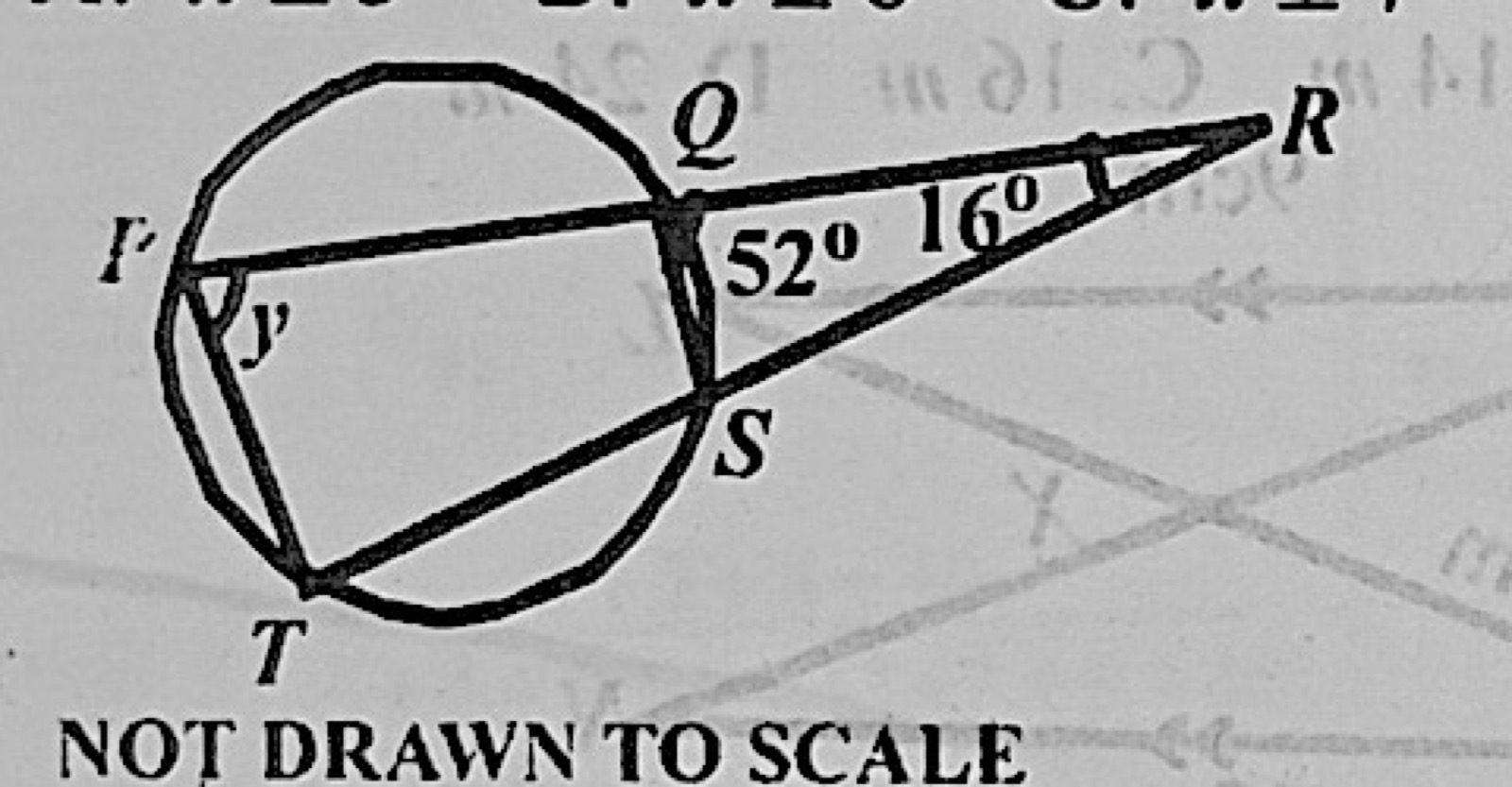
In the diagram, ∠SQR = 52° and ∠PRT = 16°. Find the value of the angle marked y.

Diagram for this question
  1. A.64°
  2. B.68°
  3. C.112°
  4. D.128°
Show the answer and explanation

Answer: C (112°)

Explanation

PQST is cyclic, so the exterior angle SQR equals the interior opposite angle PTS = 52°. In triangle PRT, y = 180° − 52° − 16° = 112°.

Open this question

Question 31

Circle Theorems

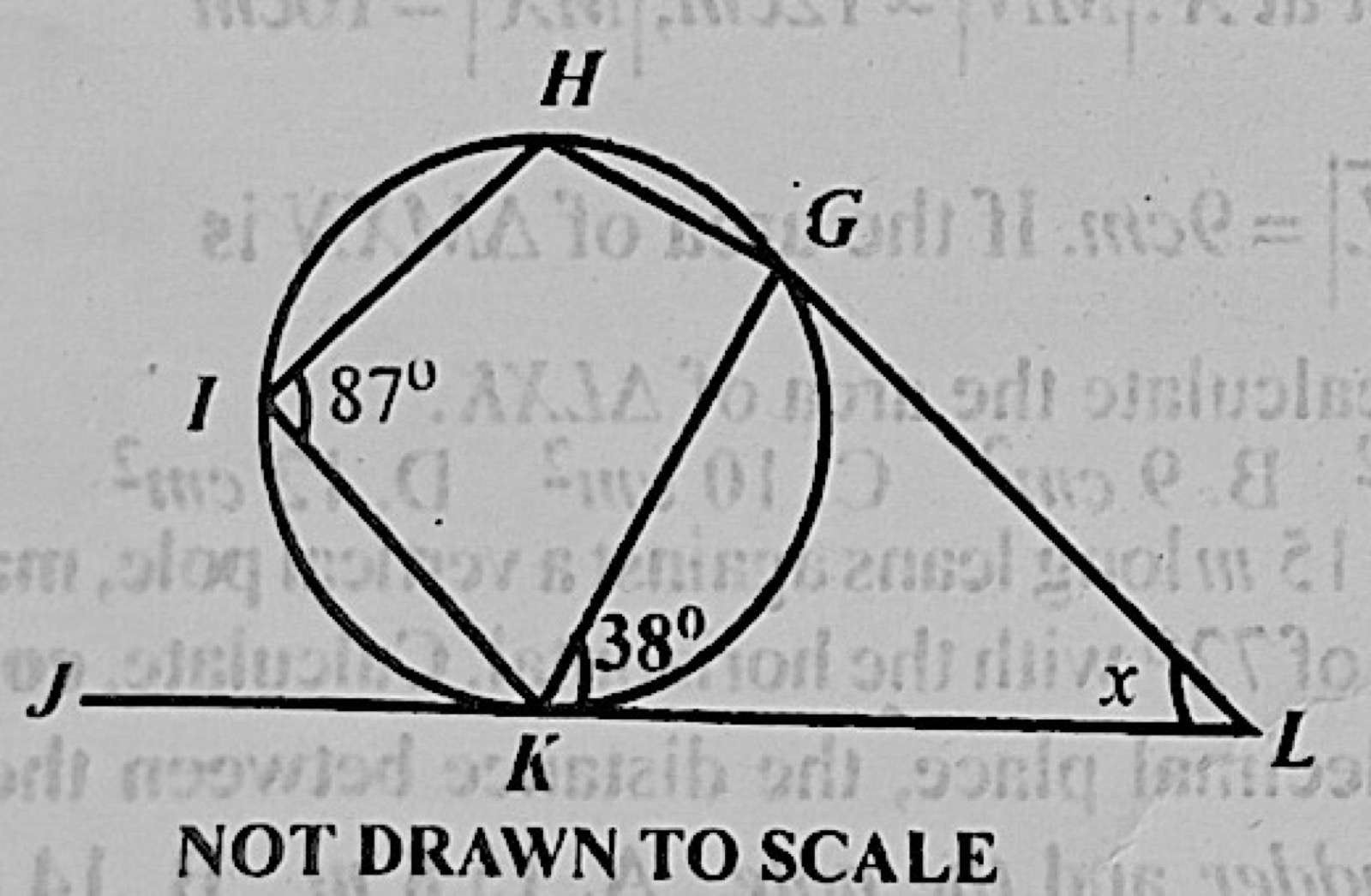
In the diagram, JKL is a tangent to the circle GHIK at K. ∠LKG = 38° and ∠HIK = 87°. Calculate the value of the angle marked x.

Diagram for this question
  1. A.93°
  2. B.55°
  3. C.42°
  4. D.23°
Show the answer and explanation

Answer: B (55°)

Explanation

The exterior angle KGL of the cyclic quadrilateral GHIK equals the opposite interior angle HIK = 87°. In triangle GKL, x = 180° − 87° − 38° = 55°.

Open this question

Question 32

Mensuration of Solids

A cone and a cylinder are of equal volume. The base radius of the cone is twice the radius of the cylinder. What is the ratio of the height of the cylinder to that of the cone?

  1. A.5 : 4
  2. B.4 : 3
  3. C.3 : 2
  4. D.3 : 4
Show the answer and explanation

Answer: B (4 : 3)

Explanation

With cylinder radius r: (1/3)π(2r)²hcone = πr²hcyl, so hcyl = (4/3)hcone and the ratio is 4 : 3.

Open this question

Question 33

Triangles and Quadrilaterals

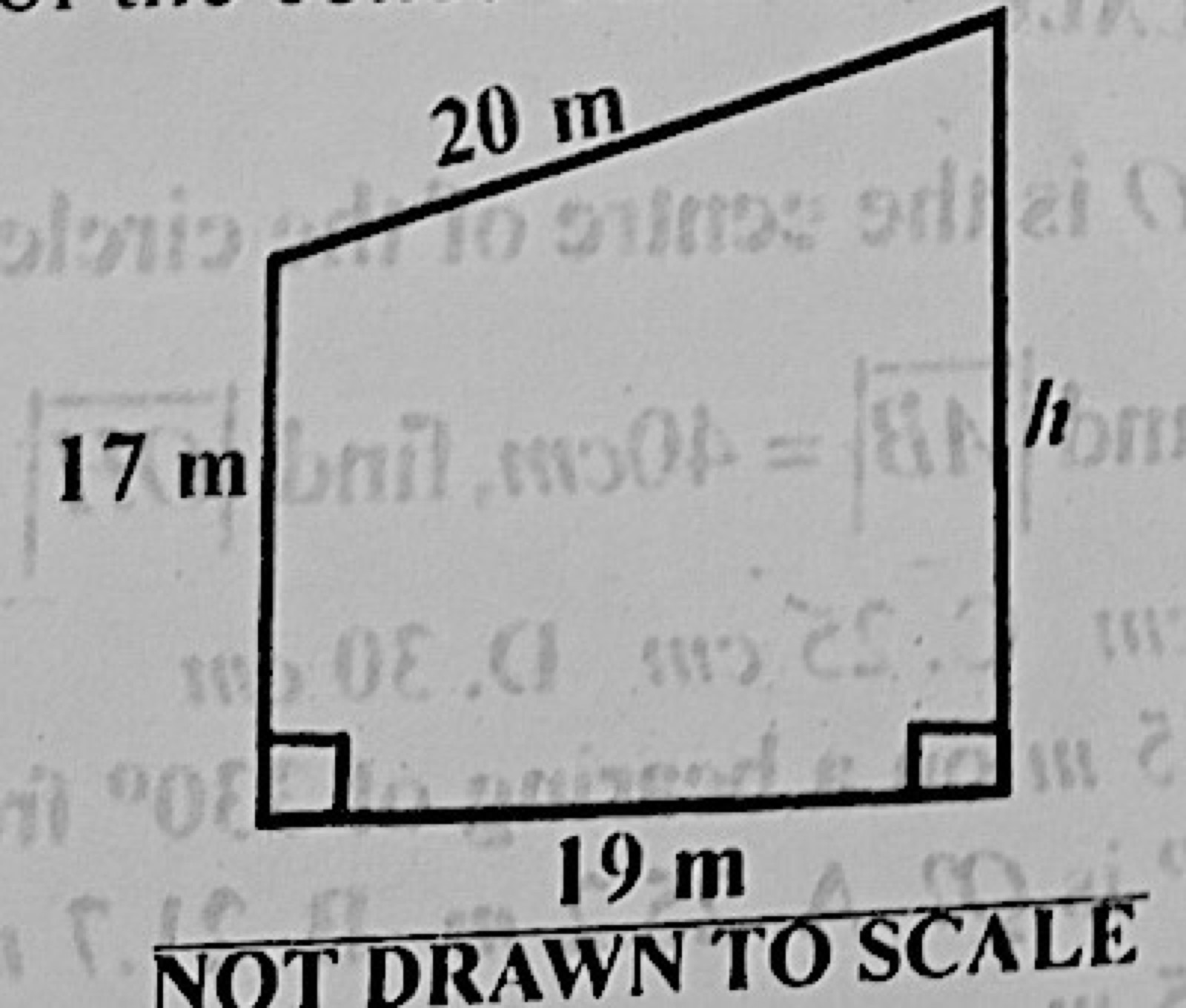
Find, correct to the nearest whole number, the value of h in the diagram.

Diagram for this question
  1. A.16 m
  2. B.22 m
  3. C.23 m
  4. D.18 m
Show the answer and explanation

Answer: C (23 m)

Explanation

The sloping 20 m side spans 19 m horizontally, so it rises √(20² − 19²) = √39 ≈ 6.2 m. h = 17 + 6.2 ≈ 23 m.

Open this question

Question 34

Coordinate Geometry

The gradient of the line joining the points P(2, −8) and Q(1, y) is −4. Find the value of y.

  1. A.2
  2. B.4
  3. C.−4
  4. D.−3
Show the answer and explanation

Answer: C (−4)

Explanation

(y + 8)/(1 − 2) = −4, so y + 8 = 4 and y = −4.

Open this question

Question 35

Angles and Polygons

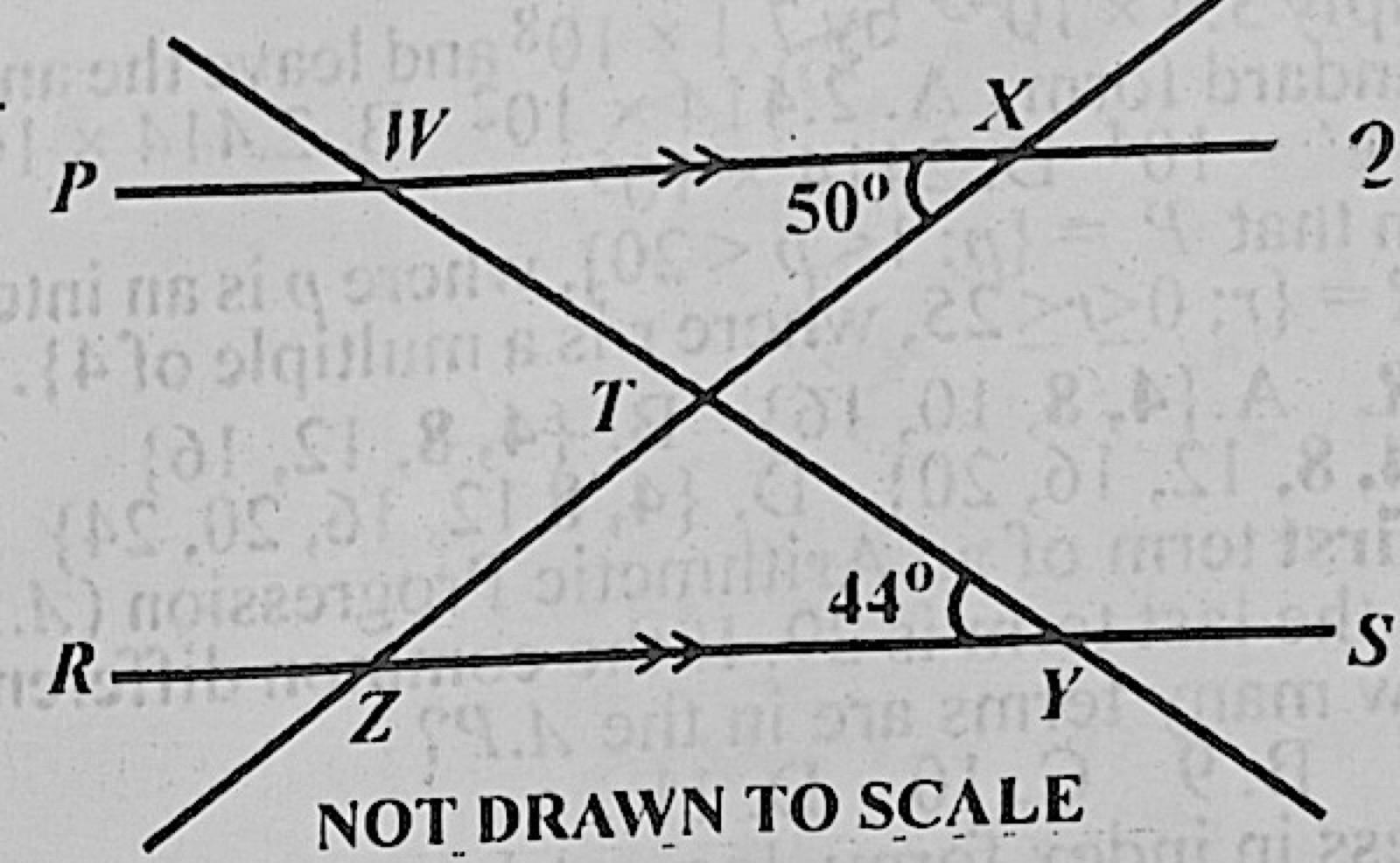
In the diagram, PQ // RS, ∠WYZ = 44° and ∠WXZ = 50°. Find ∠WTX.

Diagram for this question
  1. A.65°
  2. B.68°
  3. C.86°
  4. D.90°
Show the answer and explanation

Answer: C (86°)

Explanation

∠XWY = ∠WYZ = 44° (alternate angles). In triangle WTX, ∠WTX = 180° − 44° − 50° = 86°.

Open this question

Question 36

Mensuration of Plane Shapes

The perimeter of a rectangular garden is 90 m. If the width is 7 m less than the length, find the length of the garden.

  1. A.19 m
  2. B.23 m
  3. C.24 m
  4. D.26 m
Show the answer and explanation

Answer: D (26 m)

Explanation

Length + width = 45 and width = length − 7, so 2 × length − 7 = 45 and length = 26 m.

Open this question

Question 37

Angles and Polygons

Four of the angles of a hexagon sum up to 420°. If the remaining angles are equal, find the value of each of the angles.

  1. A.60°
  2. B.100°
  3. C.120°
  4. D.150°
Show the answer and explanation

Answer: D (150°)

Explanation

A hexagon's angles add to (6 − 2) × 180° = 720°. The other two angles share 720° − 420° = 300°, so each is 150°.

Open this question

Question 38

Triangles and Quadrilaterals

Find the value of x in the diagram.

Diagram for this question
  1. A.60°
  2. B.65°
  3. C.120°
  4. D.125°
Show the answer and explanation

Answer: C (120°)

Explanation

In triangle NMP, ∠M = 180° − 65° − 55° = 60°. QR // MP, so ∠NQR = 60° (corresponding angles), and x = 180° − 60° = 120° (angles on a straight line).

Open this question

Question 39

Measures of Central Tendency

The following are the masses (in kg) of members in a club: 59, 44, 53, 57, 49 40, 48 and 50. Calculate the mean mass.

  1. A.40 kg
  2. B.44 kg
  3. C.50 kg
  4. D.53 kg
Show the answer and explanation

Answer: C (50 kg)

Explanation

The eight masses add up to 400 kg, so the mean is 400 ÷ 8 = 50 kg.

Open this question

Question 40

Measures of Dispersion

The following are the masses (in kg) of members in a club: 59, 44, 53, 57, 49 40, 48 and 50. Calculate the variance of the distribution

  1. A.35
  2. B.36
  3. C.40
  4. D.50
Show the answer and explanation

Answer: A (35)

Explanation

Deviations from 50 are 9, −6, 3, 7, −1, −10, −2, 0; their squares add to 280. Variance = 280 ÷ 8 = 35.

Open this question

Question 41

Mensuration of Plane Shapes

Two opposite sides of a rectangle are (5x + 3) m and (2x + 9) m. If an adjacent side is (6x − 7) m, find in m2, the area of the rectangle.

  1. A.45
  2. B.65
  3. C.125
  4. D.165
Show the answer and explanation

Answer: B (65)

Explanation

Opposite sides are equal: 5x + 3 = 2x + 9 gives x = 2. The sides are 13 m and 6(2) − 7 = 5 m, so the area is 65 m².

Open this question

Question 42

Probability

A die is tossed once. Find the probability of getting a prime number.

  1. A.1/2
  2. B.1/6
  3. C.1/3
  4. D.2/3
Show the answer and explanation

Answer: A (1/2)

Explanation

The primes on a die are 2, 3 and 5: 3 out of 6 outcomes, so ½.

Open this question

Question 43

Mensuration of Plane Shapes

The area of a sector of a circle with radius 7 cm is 51.3 cm2. Calculate, correct to the nearest whole number, the angle of the sector. [Take π = 22/7]

  1. A.60°
  2. B.120°
  3. C.150°
  4. D.180°
Show the answer and explanation

Answer: B (120°)

Explanation

θ/360 × 22/7 × 49 = 51.3, so θ = 51.3 × 360 ÷ 154 ≈ 119.9 ≈ 120°.

Open this question

Question 44

Trigonometry

A cliff on the bank of a river is 87 m high. A boat on the river is 22 m away from the foot of the cliff. Calculate, correct to the nearest degree, the angle of depression of the boat from the top of the cliff.

  1. A.76°
  2. B.64°
  3. C.36°
  4. D.24°
Show the answer and explanation

Answer: A (76°)

Explanation

The angle of depression equals the angle of elevation from the boat: tan α = 87/22 ≈ 3.95, so α ≈ 76°.

Open this question

Question 45

Circle Theorems

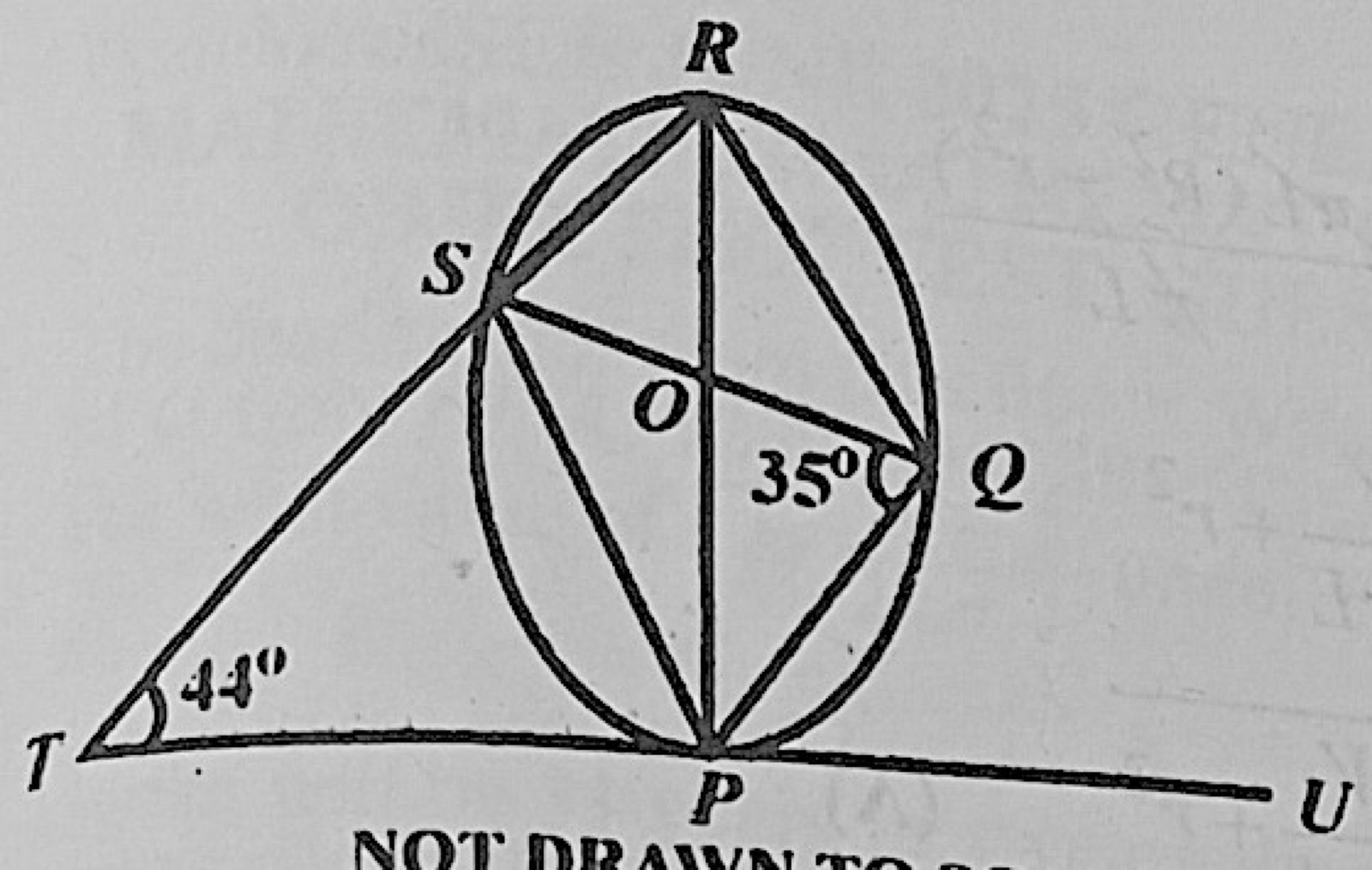
In the diagram TU is a tangent to the circle SPQR at P. If ∠PTS = 44° and ∠SQP = 35°, find ∠PST.

Diagram for this question
  1. A.101°
  2. B.125°
  3. C.130°
  4. D.135°
Show the answer and explanation

Answer: A (101°)

Explanation

By the alternate segment theorem, ∠SPT = ∠SQP = 35°. In triangle PST, ∠PST = 180° − 44° − 35° = 101°.

Open this question

Question 46

Probability

The probability that Amaka will pass an examination is 3/7 and that Bala will pass is 4/9. Find the probability that both will pass the examination.

  1. A.2/21
  2. B.4/21
  3. C.5/21
  4. D.9/21
Show the answer and explanation

Answer: B (4/21)

Explanation

Independent events: 3/7 × 4/9 = 12/63 = 4/21.

Open this question

Question 47

Coordinate Geometry

Which of the following points lies on the line 3x − 8y = 11?

  1. A.(1, 1)
  2. B.(1, −1)
  3. C.(−1, 1)
  4. D.(−1, −1)
Show the answer and explanation

Answer: B ((1, −1))

Explanation

For (1, −1): 3(1) − 8(−1) = 3 + 8 = 11, so it lies on the line.

Open this question

Question 48

Measures of Dispersion

Find the range of the following set of numbers: 28, 29, 39, 38, 37, 26, 20, 15 and 25.

  1. A.22
  2. B.24
  3. C.25
  4. D.27
Show the answer and explanation

Answer: B (24)

Explanation

Range = largest − smallest = 39 − 15 = 24.

Open this question

Question 49

Progressions

The fourth and eighth terms of an Arithmetic Progression are 16 and 40 respectively. Find the common difference.

  1. A.−6
  2. B.6
  3. C.−2
  4. D.2
Show the answer and explanation

Answer: B (6)

Explanation

From the 4th to the 8th term there are 4 steps: 4d = 40 − 16 = 24, so d = 6.

Open this question

Question 50

Algebraic Expressions

For what values of y is (y + 2)/(8y2 − 10y + 3) not defined

  1. A.−3/4, −1/2
  2. B.−3/4, 1/2
  3. C.3/4, −1/2
  4. D.3/4, 1/2
Show the answer and explanation

Answer: D (3/4, 1/2)

Explanation

The fraction is undefined when 8y² − 10y + 3 = (4y − 3)(2y − 1) = 0, i.e. y = 3/4 or 1/2.

Open this question

Theory question 101

Variation

The time (t) taken to buy fuel at a filling station varies directly as the number of vehicles (V) in a queue and varies inversely as the number of pumps (P), available at the station. In a station with 5 pumps, it took 10 minutes to fuel 20 vehicles. Find the: (a) relationship between t, P and V; (b) time it takes to fuel 50 vechicles at a station with 2 pumps; (c) number of pumps required to fuel 40 vehicles in 20 minutes.

Show the model answer
Model answer

(a) t = kV/P; 10 = 20k/5 ⇒ k = 2.5, so t = 2.5V/P (= 5V/2P)
(b) t = 2.5 × 50 ÷ 2 = 62.5 minutes
(c) 20 = 2.5 × 40 ÷ P ⇒ P = 5 pumps

Explanation

Joint variation: V goes on top, P underneath.

Open this question

Theory question 102

Algebraic Expressions

A car travelled a distance of (2x + 13) km at 67.5 km/h and (5x − 20) km at 72 km/h. If the total time for the entire journey was 90 minutes, find the velue of x.

Show the model answer
Model answer

Time = distance ÷ speed, and 90 minutes = 1.5 h
(2x + 13)/67.5 + (5x − 20)/72 = 1.5
Multiply by 1080: 16(2x + 13) + 15(5x − 20) = 1620
107x − 92 = 1620 ⇒ 107x = 1712 ⇒ x = 16

Explanation

Change 90 minutes to hours before forming the equation.

Open this question

Theory question 103

Mensuration of Plane Shapes

A circular floor of a building is to be tiled with ceramic tiles each of side 40 cm × 40 cm. If the perimeter of the floor is 66 m. Calculate, correct to the nearest whole number, the number of tiles required to completely tile the floor. [Take π = 22/7]

Show the model answer
Model answer

2πr = 66 ⇒ r = 66 × 7 ÷ 44 = 10.5 m
Area of floor = 22/7 × 10.5² = 346.5 m²
Area of one tile = 0.4 × 0.4 = 0.16 m²
Number of tiles = 346.5 ÷ 0.16 ≈ 2165.6 ≈ 2166 tiles

Explanation

Work in metres throughout: 40 cm = 0.4 m.

Open this question

Theory question 104

Circle Theorems

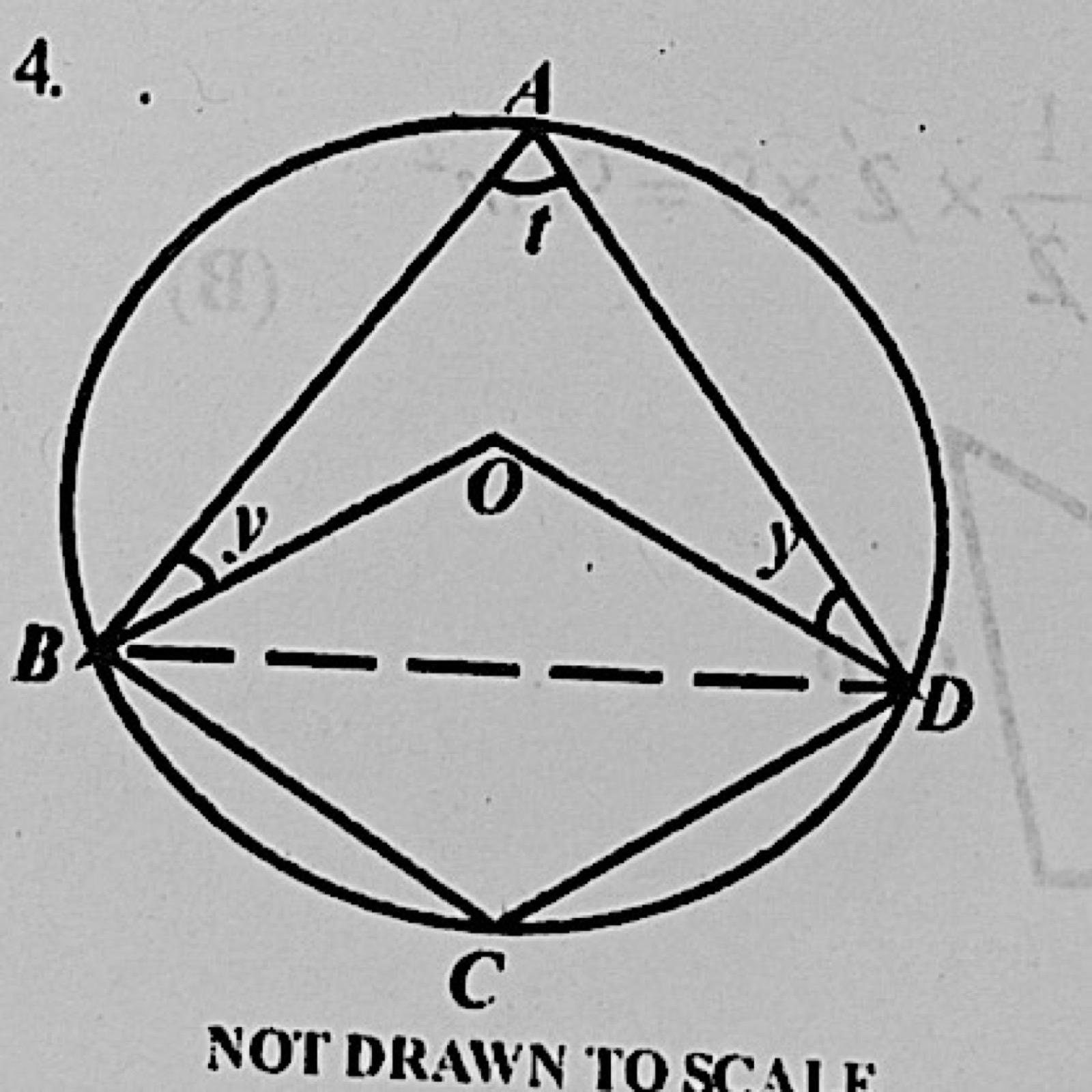
In the diagram, ABCD is a circle O. The quadrilateral OBCD is a rhombus such that ∠ADO = ∠OBA = y and ∠BAD = t. Find (a) the value of t; (b) the value of y; (c) ∠ADC.

Diagram for this question
Show the model answer
Model answer

OB = OC = OD (radii) and OBCD is a rhombus, so OB = BC = CD = DO = OC: triangles OBC and OCD are equilateral
∠BOD (through C) = 60° + 60° = 120°
(a) t = ∠BAD = ½ × 120° = 60° (angle at centre is twice angle at circumference)
(b) OA = OB = OD, so ∠OAB = ∠OBA = y and ∠OAD = ∠ODA = y; t = 2y ⇒ y = 30°
(c) ∠ADC = ∠ADO + ∠ODC = 30° + 60° = 90°

Explanation

Every side of the rhombus equals the radius, so look for equilateral triangles.

Open this question

Theory question 105

Probability

A basket contains 3 gold-plated marbles, 4 diamond marbles and some silver marbles, all of the same size and shape. Two marbles were drawn from the basket at random one after the other without replacement. If the probability that the two marbles were all silver is 1/15, find the number of silver marbles.

Show the model answer
Model answer

Let n = number of silver marbles; total = n + 7
n/(n + 7) × (n − 1)/(n + 6) = 1/15
15n² − 15n = n² + 13n + 42 ⇒ 14n² − 28n − 42 = 0 ⇒ n² − 2n − 3 = 0
(n − 3)(n + 1) = 0 ⇒ n = 3 silver marbles

Explanation

Without replacement, the second fraction has one less on top and bottom.

Open this question

Theory question 106

Progressions

Given that (x + 2), (4x + 3) and (7x + 24) are consecutive terms of a Geometric Progression (G.P.), find the: (a) value of x; (b) common ratio.

Show the model answer
Model answer

(a) (4x + 3)/(x + 2) = (7x + 24)/(4x + 3) ⇒ (4x + 3)² = (x + 2)(7x + 24)
16x² + 24x + 9 = 7x² + 38x + 48 ⇒ 9x² − 14x − 39 = 0 ⇒ (x − 3)(9x + 13) = 0
x = 3 (or x = −13/9)
(b) With x = 3 the terms are 5, 15, 45, so the common ratio = 3 (with x = −13/9 the terms are 5/9, −25/9, 125/9 and the ratio is −5)

Explanation

In a G.P. the middle term squared equals the product of its neighbours.

Open this question

Theory question 107

Measures of Central Tendency

The table shows the ages of 20 children in a household.
Age: 5, 6, 7, 8, 9, 10
Frequency: 2, 2x − 1, y + 2, 4, 2, y − 1
Given that x : y = 1 : 2, find the (a) values of x and y; (b) mean age of the children.

Show the model answer
Model answer

(a) Σf = 8 + 2x + 2y = 20 ⇒ x + y = 6; y = 2x ⇒ 3x = 6 ⇒ x = 2, y = 4
(b) Frequencies 2, 3, 6, 4, 2, 3; Σfx = 10 + 18 + 42 + 32 + 18 + 30 = 150
Mean age = 150/20 = 7.5 years

Explanation

Use the total frequency of 20 to form the first equation.

Open this question

Theory question 108

Trigonometry

Two observers Abu and Badu, 46 m apart, observe a bird on a vertical pole from the same side of the bird. The angles of elevation of the bird from Abu's and Badu's eye are 40° and 48° respectively. If at the foot of the pole, Abu and Badu are on the same horizontal: (a) illustrate the information in a diagram; (b) calculate, correct to one decimal place, the height of the pole.

Show the model answer
Model answer

(a) Vertical pole with the bird on top; Abu and Badu on one horizontal line on the same side, Badu nearer the pole, 46 m apart; elevations 40° at Abu and 48° at Badu
(b) Let Badu be d m from the pole and h the height: h = d tan 48° = (d + 46) tan 40°
d(1.1106 − 0.8391) = 46 × 0.8391 ⇒ d ≈ 142.2 m
h = 142.16 × 1.1106 ≈ 157.9 m

Explanation

The observer with the larger angle is nearer the pole.

Open this question

Theory question 109

Mensuration of Plane Shapes

The diameter of a circle centre O is 26 cm. If a chord PQ is drawn such that it is 5 cm from O to the centre of the chord, calculate, correct to the nearest whole number, the: (a) ∠POQ; (b) area of the minor segment formed by the chord PQ. [Take π = 22/7]

Show the model answer
Model answer

(a) Radius = 13 cm; cos(½∠POQ) = 5/13 ⇒ ½∠POQ ≈ 67.38° ⇒ ∠POQ ≈ 135°
(b) Area of sector = 135/360 × 22/7 × 13² ≈ 199.2 cm²
Area of triangle POQ = ½ × 13² × sin 135° ≈ 59.8 cm² (half-chord = 12 cm gives exactly 60 cm²)
Area of minor segment ≈ 139 cm²

Explanation

The line from the centre to the middle of a chord is perpendicular to it.

Open this question

Theory question 110

Fractions, Decimals and Approximation

(a) In a man's will, he gave 2/5 of the total acres of his cocoa farm to the wife and 1/3 of what is left to the family. The rest of the farm was to be shared amongst his three children in the ratio 3 : 5 : 2. Given that, the child who had the least share received 8 acres, calculate the: (i) total acres the man left; (ii) number of acres the wife received.
(b) The list price of a Television set is $1,600.00. It can be purchased by a deposit of $400.00 and the rest of the amount paid by 12 monthly installment at 25% per annum simple interest. If the Television set is purchased by installment, find the total cost.

Show the model answer
Model answer

(a) Let the farm be x acres. Wife: 2/5 x; left 3/5 x; family: 1/3 × 3/5 x = 1/5 x
Children's part = x − 2/5 x − 1/5 x = 2/5 x
Least share = 2/10 × 2/5 x = 2/25 x = 8 ⇒ (i) x = 100 acres
(ii) Wife = 2/5 × 100 = 40 acres
(b) Balance = 1600 − 400 = $1,200; interest for 1 year at 25% = $300
Total cost = 400 + 1200 + 300 = $1,900

Explanation

The least child's share is a fraction of the children's part, not of the whole farm.

Open this question

Theory question 111

Coordinate Geometry

(a) Find the equation of the line that passes through the origin and the point of intersection of the lines x + 2y = 7 and x − y = 4.
(b) The ratio of an interior angle to an exterior angle of a regular polygon is 4:1. Find the: (i) number of sides; (ii) value of the exterior angle; (iii) sum of the interior angles of the polygon.

Show the model answer
Model answer

(a) Subtracting: 3y = 3 ⇒ y = 1, x = 5; the line through (0, 0) and (5, 1) is y = x/5 (5y = x)
(b) Interior + exterior = 180° and interior = 4 × exterior ⇒ exterior = 36°
(i) Number of sides = 360° ÷ 36° = 10
(ii) Exterior angle = 36°
(iii) Sum of interior angles = (10 − 2) × 180° = 1440°

Explanation

A line through the origin has equation y = mx.

Open this question

Theory question 112

Circle Theorems

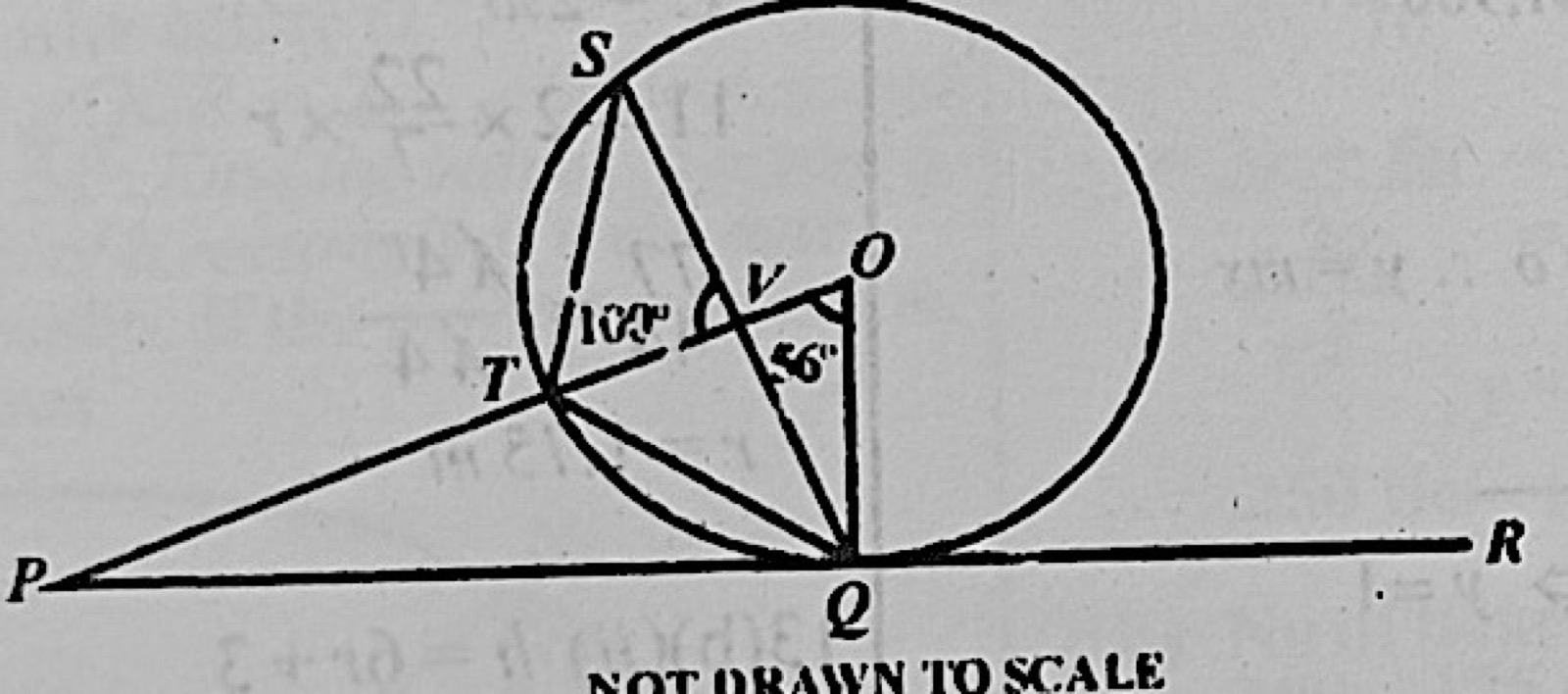
(a) In the diagram PR is a tangent to the circle centre O at Q. ∠POQ = 56° and PO intersects SQ at V such that ∠SVP = 109°. Calculate: (i) ∠TQP; (ii) ∠QTS.
(b) Simplify: (2n2 − 3n − 2)/(2n2 + 3n + 1) × (n2 − 1)/(n2 − 4)

Diagram for this question
Show the model answer
Model answer

(a)(i) OT = OQ, so ∠OQT = ∠OTQ = (180° − 56°)/2 = 62°; ∠OQP = 90° (tangent ⊥ radius) ⇒ ∠TQP = 90° − 62° = 28°
(ii) ∠QVO = ∠SVP = 109° (vertically opposite); in triangle QVO, ∠VQO = 180° − 109° − 56° = 15°, so ∠SQP = 90° − 15° = 75°
T lies on the arc on the same side of SQ as P, so ∠QTS = 180° − 75° = 105° (alternate segment theorem)
(b) = (2n + 1)(n − 2)/[(2n + 1)(n + 1)] × (n − 1)(n + 1)/[(n − 2)(n + 2)] = (n − 1)/(n + 2)

Explanation

Factorise every quadratic before cancelling.

Open this question

Theory question 113

Circle Theorems

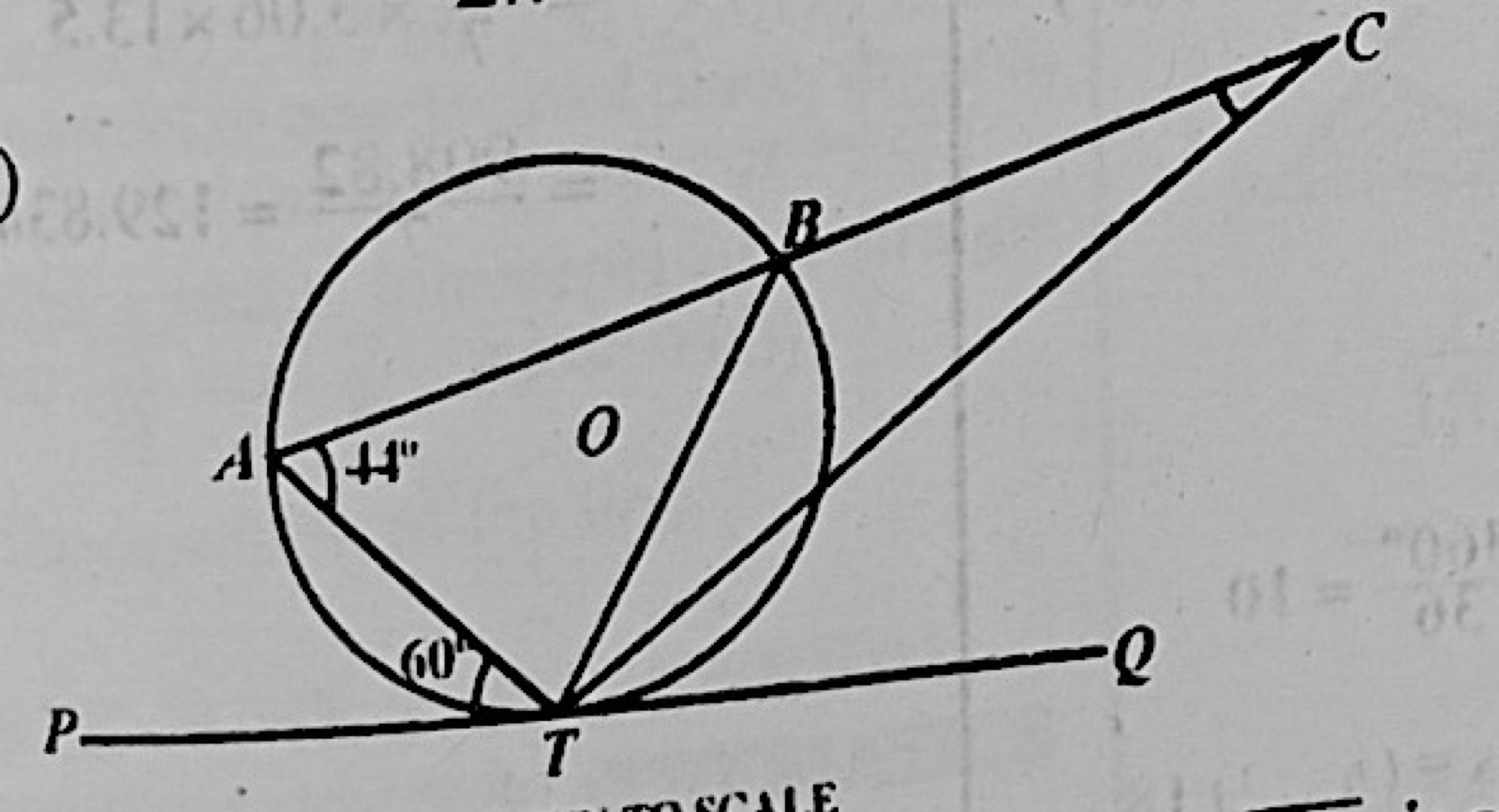
(a) In the diagram ABT is a circle centre O. PQ is a tangent to the circle at T and ABC is a straight line. TC bisects ∠BTQ. ∠BAT = 44° and ∠PTA = 60°. Find ∠ACT.
(b) The circumference of the base of a cyclindrical tank is 11 m. The height of the tank is 3 m more than 6 times the base radius. Calculate the: (i) radius; (ii) height; (iii) volume of the tank. [Take π = 22/7]

Diagram for this question
Show the model answer
Model answer

(a) ∠BTQ = ∠BAT = 44° (alternate segment) ⇒ ∠BTC = 22°
∠ABT = ∠PTA = 60° (alternate segment); ∠ABT is an exterior angle of triangle BTC ⇒ ∠ACT = 60° − 22° = 38°
(b)(i) 2 × 22/7 × r = 11 ⇒ r = 1.75 m
(ii) h = 6 × 1.75 + 3 = 13.5 m
(iii) V = 22/7 × 1.75² × 13.5 ≈ 129.9 m³

Explanation

Use the alternate segment theorem twice.

Open this question