WAEC Mathematics 2005 past questions and answers

61 questions. Try each one, then open the answer to check yourself and read the explanation.

Question 1

Fractions, Decimals and Approximation

Correct 0.04945 to two significant figures.

  1. A.0.040
  2. B.0.049
  3. C.0.050
  4. D.0.49
Show the answer and explanation

Answer: B (0.049)

Explanation

The first two significant figures are 4 and 9; the next digit is 4, so round down: 0.049.

Open this question

Question 2

Surds

Simplify: 5/√3 − 3/√2

  1. A.1/6 (5√3 − 3√2)
  2. B.1/6 (15√3 − 6√2)
  3. C.1/6 (3√2 − √3)
  4. D.1/6 (10√3 − 9√2)
Show the answer and explanation

Answer: D (1/6 (10√3 − 9√2))

Explanation

5/√3 = 5√3/3 = 10√3/6 and 3/√2 = 3√2/2 = 9√2/6, so the difference is (10√3 − 9√2)/6.

Open this question

Question 3

Fractions, Decimals and Approximation

Evaluate, correct to the nearest whole number: 7 1/2 − (2 1/2 + 3) ÷ 33/2

  1. A.33
  2. B.8
  3. C.7
  4. D.0
Show the answer and explanation

Answer: C (7)

Explanation

Brackets: 5 1/2. Division: 11/2 ÷ 33/2 = 1/3. Then 7 1/2 − 1/3 = 7 1/6 ≈ 7.

Open this question

Question 4

Logarithms

Simplify the expression log1018 − log102.88 + log1016.

  1. A.31.12
  2. B.3.112
  3. C.2
  4. D.1
Show the answer and explanation

Answer: C (2)

Explanation

log(18 × 16 ÷ 2.88) = log 100 = 2.

Open this question

Question 5

Quadratic Equations

Find the equation whose roots are 2 and −3 1/2.

  1. A.2x2 + 3x + 14 = 0
  2. B.2x2 + 5x + 7 = 0
  3. C.2x2 + 5x − 7 = 0
  4. D.2x2 + 3x − 14 = 0
Show the answer and explanation

Answer: D (2x2 + 3x − 14 = 0)

Explanation

(x − 2)(2x + 7) = 2x2 + 3x − 14 = 0.

Open this question

Question 6

Commercial Arithmetic

A man bought 220 mangoes at N5x. He sold each for 3x kobo and made a gain of N8. Find the value of x.

  1. A.2
  2. B.5
  3. C.6
  4. D.10
Show the answer and explanation

Answer: B (5)

Explanation

He sold them for 220 × 3x kobo = N6.60x. Gain = 6.6x − 5x = 1.6x = 8, so x = 5.

Open this question

Question 7

Bearings

From a point P, R is 5 km due west and 12 km due south. Find the distance between P and R.

  1. A.5 km
  2. B.12 km
  3. C.13 km
  4. D.17 km
Show the answer and explanation

Answer: C (13 km)

Explanation

The two movements are at right angles: √(52 + 122) = √169 = 13 km.

Open this question

Question 8

Probability

A fair die is tossed once, what is the probability of obtaining neither 5 nor 2?

  1. A.5/6
  2. B.2/3
  3. C.1/2
  4. D.1/6
Show the answer and explanation

Answer: B (2/3)

Explanation

Four of the six faces (1, 3, 4, 6) are neither 5 nor 2: 4/6 = 2/3.

Open this question

Question 9

Angles and Polygons

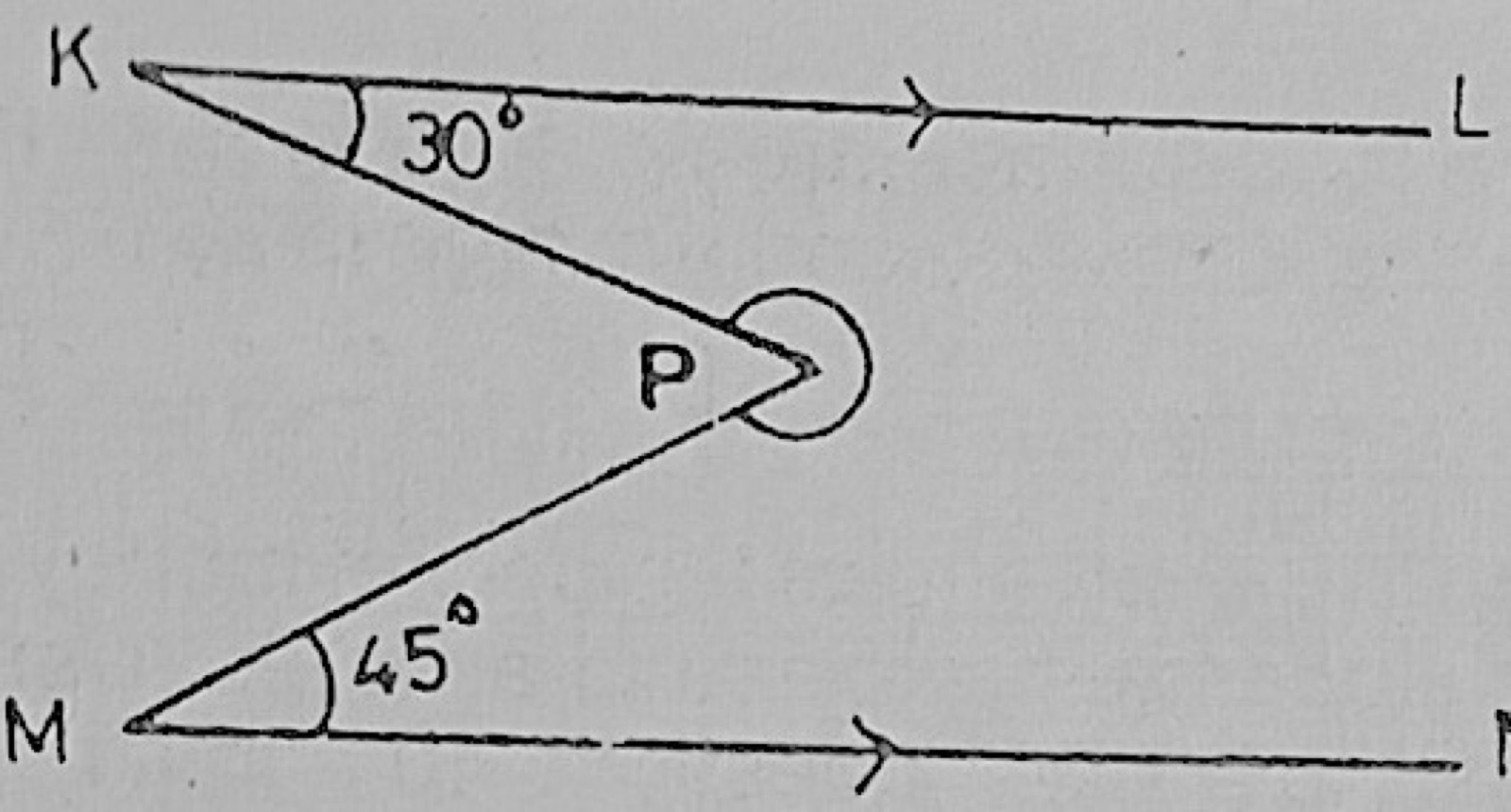
In the diagram, KL//MN, ∠LKP = 30° and ∠NMP = 45°. Find the size of the reflex ∠KPM.

Diagram for this question
  1. A.285°
  2. B.255°
  3. C.225°
  4. D.210°
Show the answer and explanation

Answer: A (285°)

Explanation

The non-reflex angle KPM = 30° + 45° = 75° (alternate angles with a line through P parallel to KL), so the reflex angle = 360 − 75 = 285°.

Open this question

Question 10

Circle Theorems

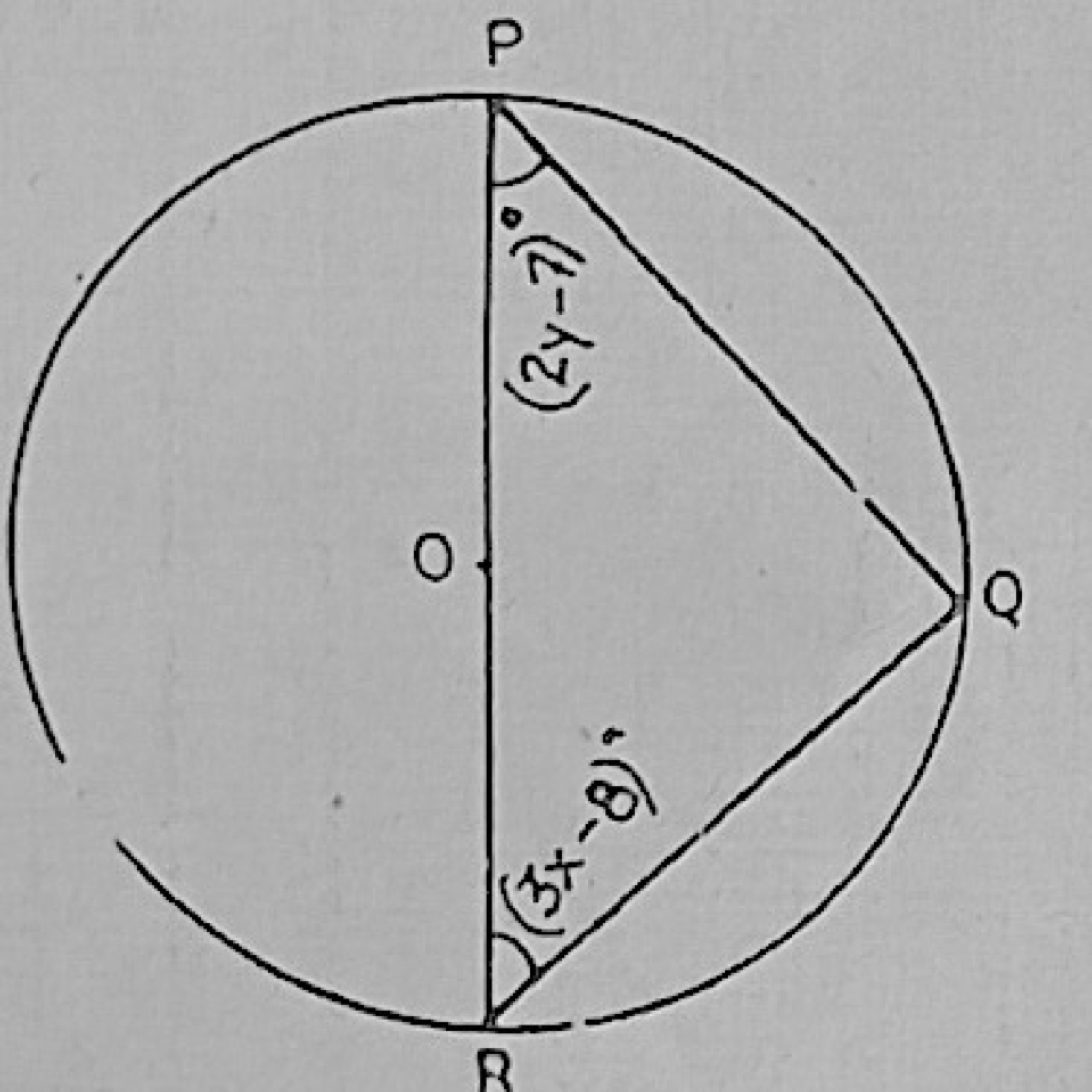
In the diagram, PR is a diameter, ∠PRQ = (3x − 8)° and ∠RPQ = (2y − 7)°. Express x in terms of y.

Diagram for this question
  1. A.x = (75 − 2y)/3
  2. B.x = (105 − 3y)/2
  3. C.x = (105 − 2y)/3
  4. D.x = (75 − 3y)/2
Show the answer and explanation

Answer: C (x = (105 − 2y)/3)

Explanation

∠PQR = 90° (angle in a semicircle), so (3x − 8) + (2y − 7) = 90, giving 3x = 105 − 2y and x = (105 − 2y)/3.

Open this question

Question 11

Number Bases

Convert 101101two to a number in base ten.

  1. A.61
  2. B.46
  3. C.45
  4. D.44
Show the answer and explanation

Answer: C (45)

Explanation

32 + 8 + 4 + 1 = 45.

Open this question

Question 12

Indices

Solve the equation 27 = 85−x.

  1. A.5/8
  2. B.8/3
  3. C.3/2
  4. D.15/4
Show the answer and explanation

Answer: B (8/3)

Explanation

85−x = 215−3x, so 7 = 15 − 3x and x = 8/3.

Open this question

Question 13

Algebraic Expressions

Expand (2x − 3y)(x − 5y)

  1. A.2x2 + 13xy − 15y2
  2. B.2x2 − 13xy − 15y2
  3. C.2x2 + 13xy + 15y2
  4. D.2x2 − 13xy + 15y2
Show the answer and explanation

Answer: D (2x2 − 13xy + 15y2)

Explanation

2x2 − 10xy − 3xy + 15y2 = 2x2 − 13xy + 15y2.

Open this question

Question 14

Algebraic Expressions

Make f the subject of the relation v = u + ft.

  1. A.(v − u)/t
  2. B.(u − v)/t
  3. C.t(v + u)
  4. D.v/u − t
Show the answer and explanation

Answer: A ((v − u)/t)

Explanation

ft = v − u, so f = (v − u)/t.

Open this question

Question 16

Angles and Polygons

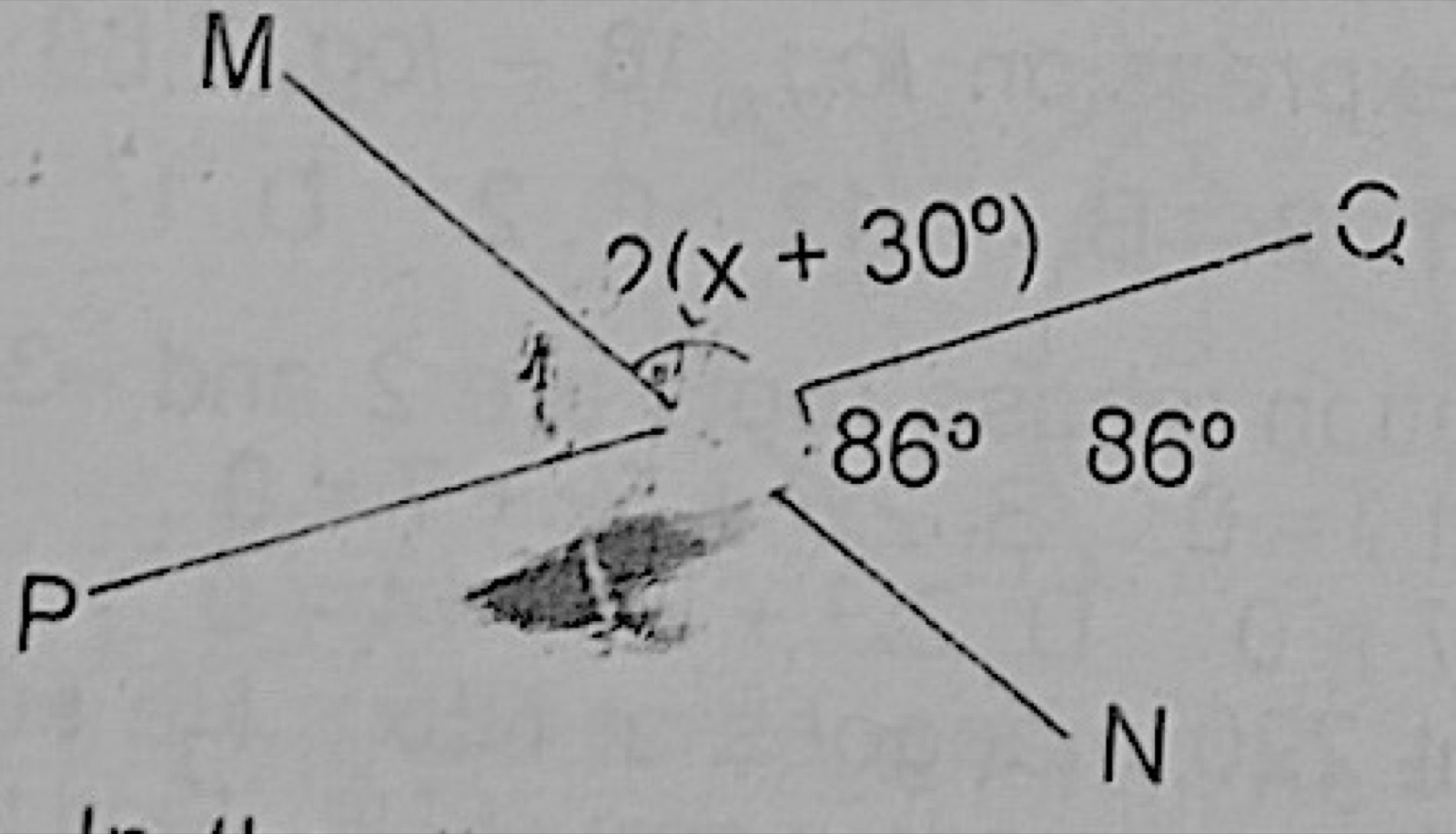
In the diagram, PQ and MN are straight lines. Find the value of x.

Diagram for this question
  1. A.13°
  2. B.17°
  3. C.28°
  4. D.30°
Show the answer and explanation

Answer: B (17°)

Explanation

Angles on the straight line MN add to 180°: 2(x + 30) + 86 = 180, so 2x = 34 and x = 17°.

Open this question

Question 17

Angles and Polygons

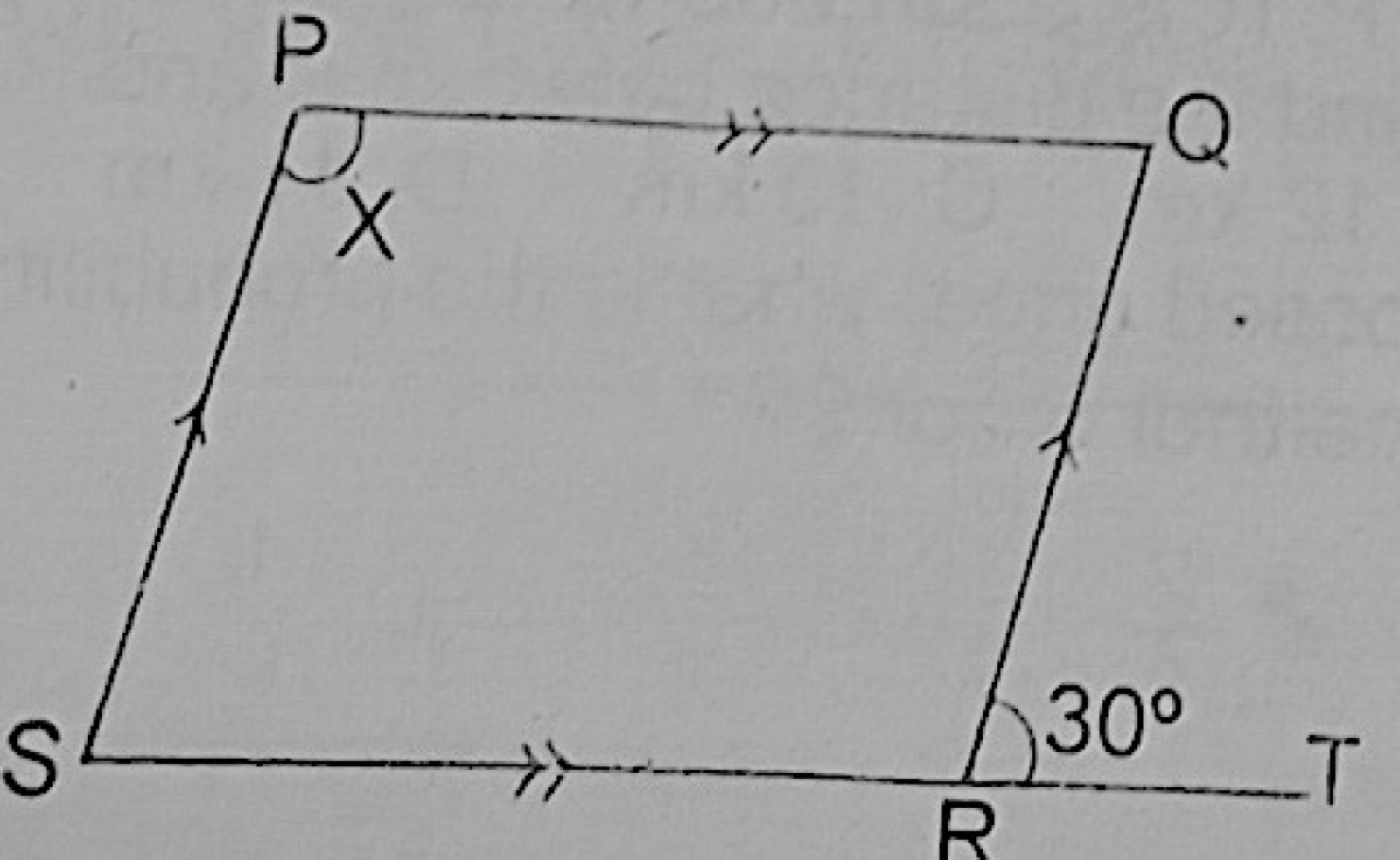
In the diagram, PQRS is a parallelogram and ∠QRT = 30°. Find x.

Diagram for this question
  1. A.95°
  2. B.100°
  3. C.120°
  4. D.150°
Show the answer and explanation

Answer: D (150°)

Explanation

SRT is a straight line, so ∠QRS = 180 − 30 = 150°. Opposite angles of a parallelogram are equal, so x = ∠SPQ = 150°.

Open this question

Question 18

Bearings

From a point R, 300 m north of P, man walks eastwards to a place Q which is 600 m from P. Find the bearing of P from Q, correct to the nearest degree.

  1. A.026°
  2. B.045°
  3. C.210°
  4. D.240°
Show the answer and explanation

Answer: D (240°)

Explanation

cos ∠RPQ = 300/600, so ∠RPQ = 60° and the bearing of Q from P is 060°. The bearing of P from Q is 060° + 180° = 240°.

Open this question

Question 19

Quadratic Equations

The lengths of the adjacent sides of a right-angled triangle are x cm, (x − 1) cm. If the length of the hypotenuse is √13 cm, find the value of x.

  1. A.2
  2. B.3
  3. C.4
  4. D.5
Show the answer and explanation

Answer: B (3)

Explanation

x2 + (x − 1)2 = 13 gives x2 − x − 6 = 0, (x − 3)(x + 2) = 0, so x = 3.

Open this question

Question 20

Mensuration of Plane Shapes

What is the diameter of a circle of area 77cm2? (Take π = 22/7)

  1. A.√2/7 cm
  2. B.3 1/2 cm
  3. C.7cm
  4. D.7√2 cm
Show the answer and explanation

Answer: D (7√2 cm)

Explanation

r2 = 77 × 7/22 = 49/2, so r = 7/√2 and the diameter = 14/√2 = 7√2 cm.

Open this question

Question 21

Linear and Simultaneous Equations

Solve for y in the equations: 2x − 3y = 22; 3x + 2y = 7

  1. A.−5
  2. B.−4
  3. C.4
  4. D.5
Show the answer and explanation

Answer: B (−4)

Explanation

Eliminate y: 4x − 6y = 44 and 9x + 6y = 21 add to 13x = 65, x = 5. Then 15 + 2y = 7, y = −4.

Open this question

Question 22

Linear and Simultaneous Equations

Solve the equation (2y − 1)/3 − (3y − 1)/4 = 1

  1. A.−8
  2. B.−13
  3. C.13
  4. D.19
Show the answer and explanation

Answer: B (−13)

Explanation

Multiply by 12: 8y − 4 − 9y + 3 = 12, so −y = 13 and y = −13.

Open this question

Question 24

Logarithms

If log9x = 1.5, find x.

  1. A.36
  2. B.27
  3. C.24.5
  4. D.13.5
Show the answer and explanation

Answer: B (27)

Explanation

x = 91.5 = (√9)3 = 27.

Open this question

Question 25

Progressions

A sequence is given by 2 1/2, 5, 7 1/2, ....... If the nth term is 25, find n.

  1. A.9
  2. B.10
  3. C.12
  4. D.15
Show the answer and explanation

Answer: B (10)

Explanation

a = 2½ and d = 2½, so Tn = 2½n = 25 gives n = 10.

Open this question

Question 26

Quadratic Equations

Given that one of the roots of the equation 2x2 + (k + 2)x + k = 0 is 2, find the value of k.

  1. A.−4
  2. B.−2
  3. C.−1
  4. D.−1/4
Show the answer and explanation

Answer: A (−4)

Explanation

Substitute x = 2: 8 + 2(k + 2) + k = 0, so 3k = −12 and k = −4.

Open this question

Question 27

Angles and Polygons

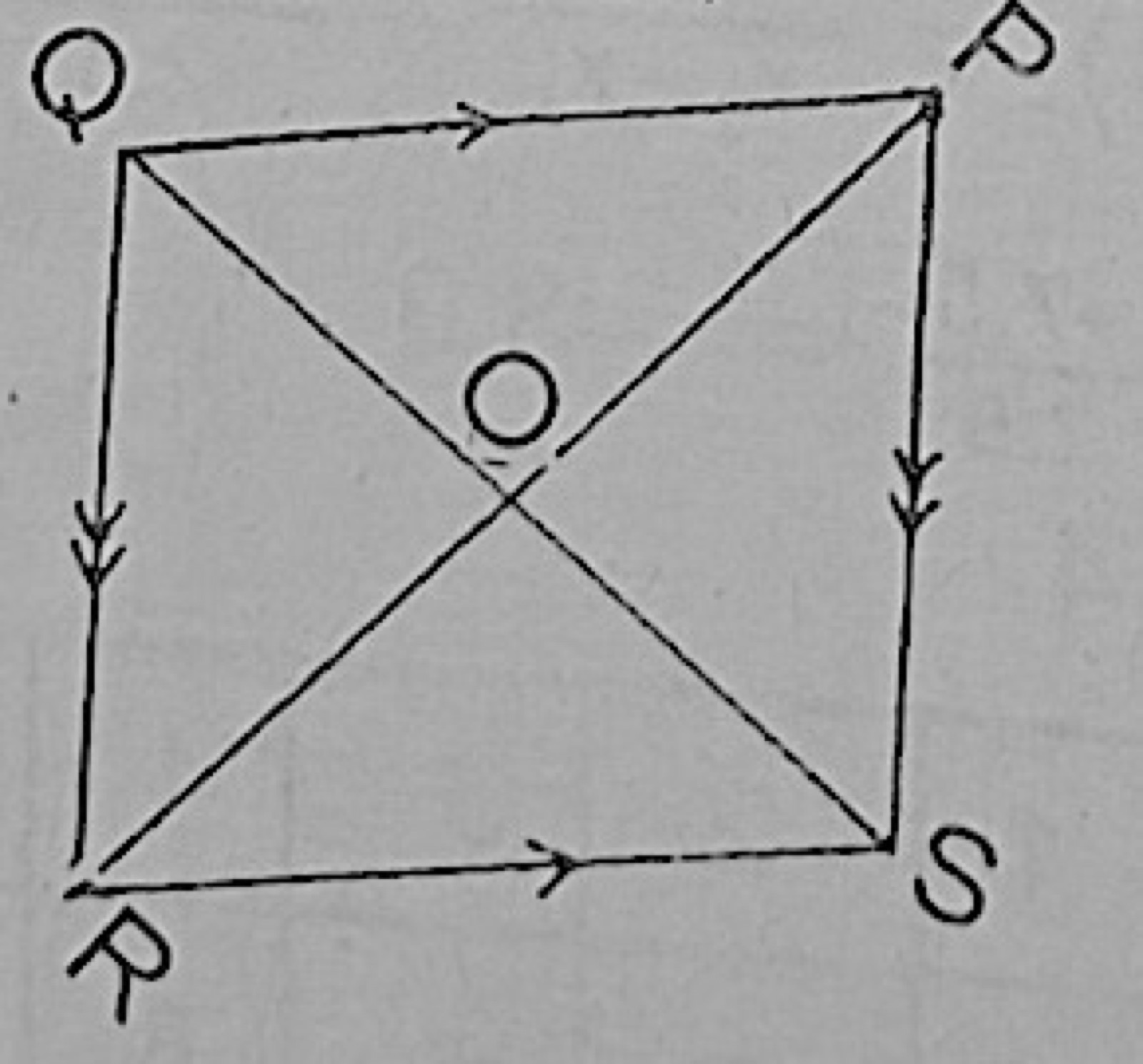
The figure shows a quadrilateral PQRS having equal sides and opposite sides parallel. The diagonals PR and QS intersect perpendicularly at O, which of the following statements cannot be correct?

Diagram for this question
  1. A.|PO| = |RO|
  2. B.PQR is an equilateral triangle
  3. C.PQRS is a parallelogram
  4. D.There are two lines of symmetry.
Show the answer and explanation

Answer: B (PQR is an equilateral triangle)

Explanation

PQRS is a rhombus: its diagonals bisect each other, it is a parallelogram, and it has two lines of symmetry. Triangle PQR is isosceles but not, in general, equilateral.

Open this question

Question 28

Measures of Central Tendency

Find the mean of the numbers 1, 3, 4, 8, 8, 4 and 7.

  1. A.4
  2. B.5
  3. C.6
  4. D.7
Show the answer and explanation

Answer: B (5)

Explanation

Sum = 35 and there are 7 numbers: 35 ÷ 7 = 5.

Open this question

Question 29

Mensuration of Solids

What is the total surface area of a closed cylinder of height 10 cm and diameter 7 cm? (Take π = 22/7)

  1. A.77 cm2
  2. B.227 cm2
  3. C.297 cm2
  4. D.374 cm2
Show the answer and explanation

Answer: C (297 cm2)

Explanation

2πr(r + h) = 2 × 22/7 × 3.5 × 13.5 = 297 cm2.

Open this question

Question 30

Mensuration of Plane Shapes

An arc of a circle of radius 14 cm subtends angle 300° at the centre. Find the perimeter of the sector formed by the arc. (Take π = 22/7)

  1. A.14.67 cm
  2. B.42.67 cm
  3. C.101.33 cm
  4. D.513.33 cm
Show the answer and explanation

Answer: C (101.33 cm)

Explanation

Arc = 300/360 × 2 × 22/7 × 14 = 73.33 cm. Perimeter = 73.33 + 14 + 14 = 101.33 cm.

Open this question

Question 31

Graphs of Functions

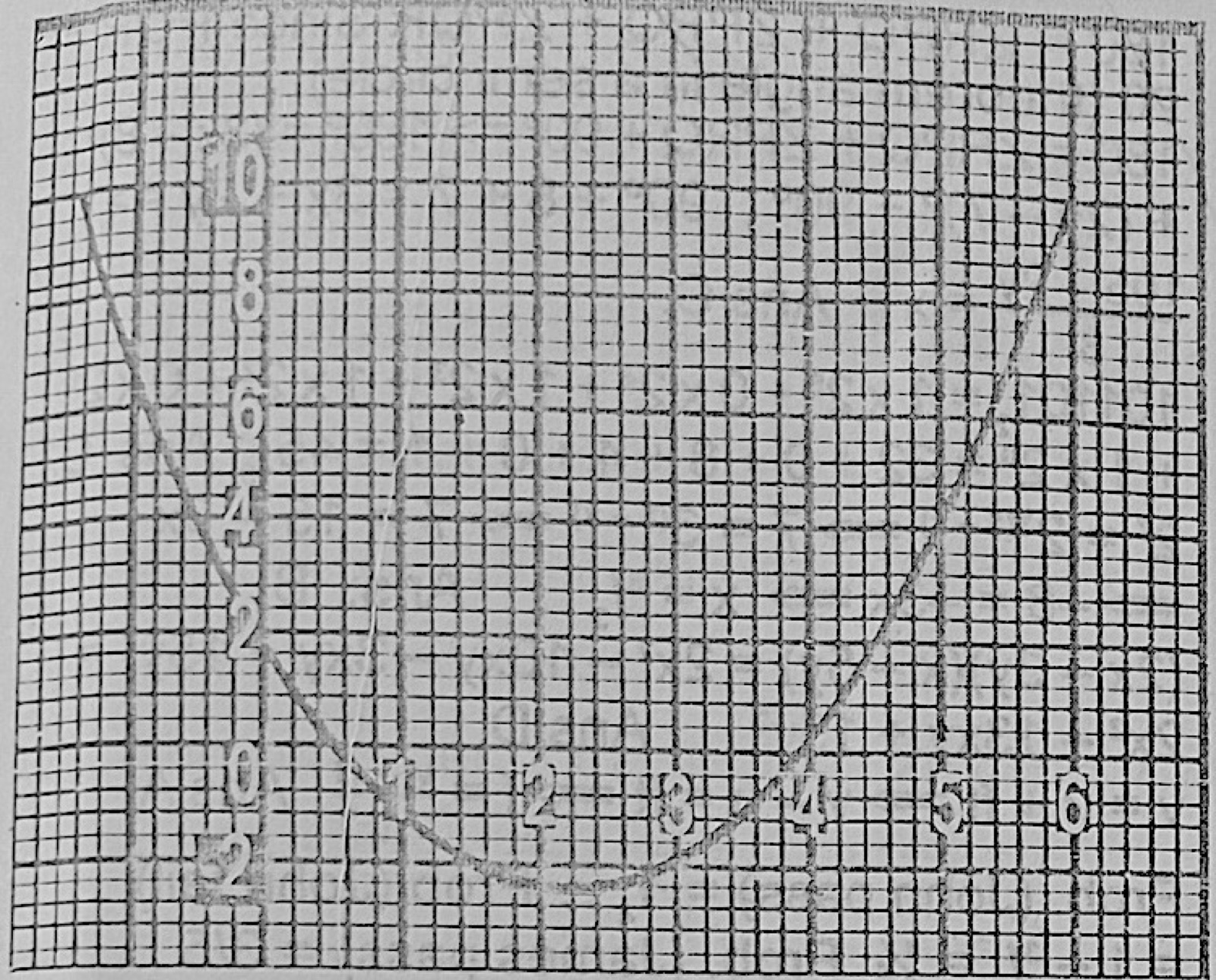
The figure is the graph of a quadratic equation. What are the roots of the equation?

Diagram for this question
  1. A.−1 and 1
  2. B.4 and −1
  3. C.1 and 4
  4. D.4 and 4
Show the answer and explanation

Answer: C (1 and 4)

Explanation

The curve crosses the x-axis at x = 1 and x = 4.

Open this question

Question 32

Graphs of Functions

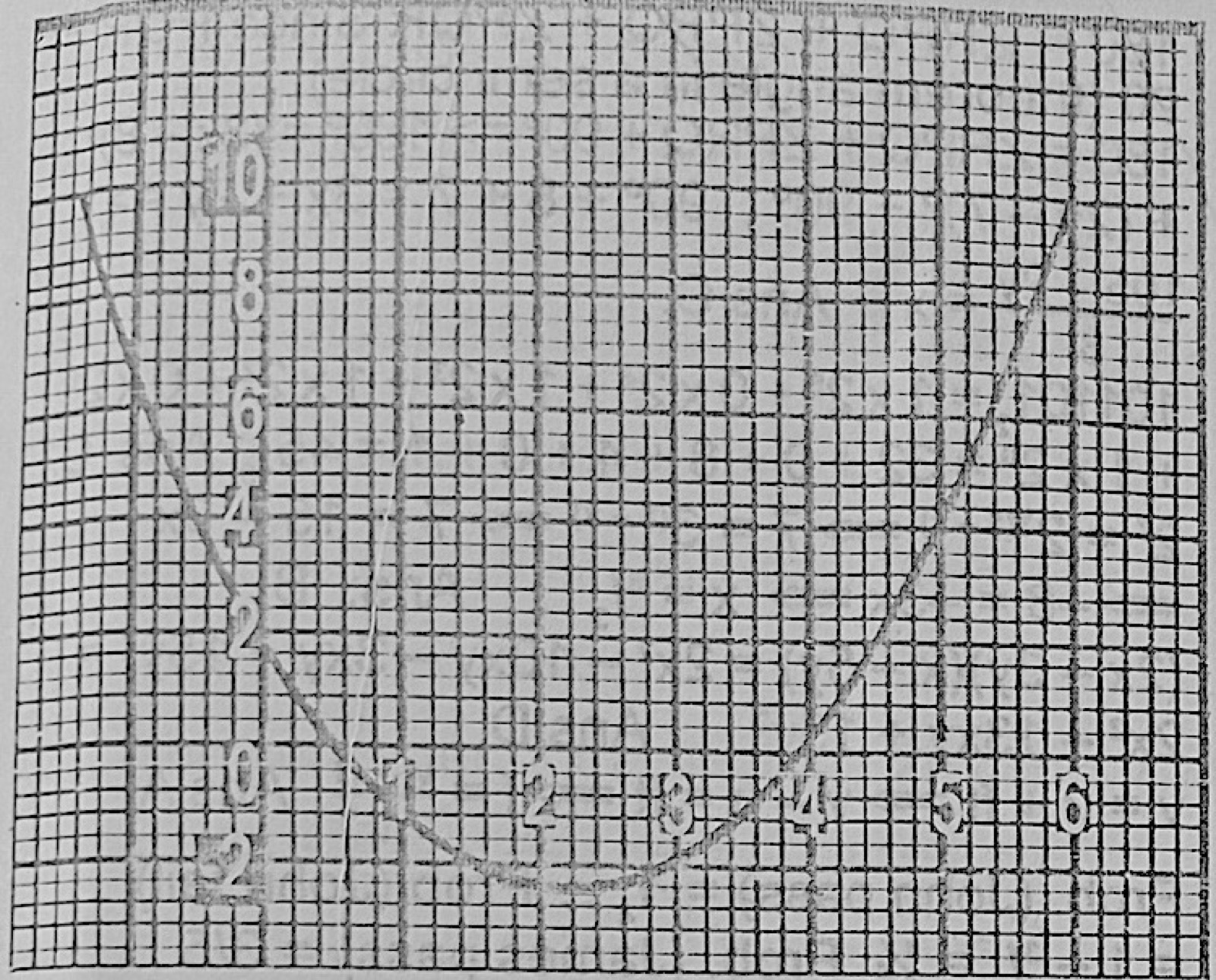
The figure is the graph of a quadratic equation. What is the equation of the curve?

Diagram for this question
  1. A.y = x2 + 6x + 4
  2. B.y = x2 − 5x − 4
  3. C.y = x2 − 5x + 4
  4. D.y = x2 + 5x − 4
Show the answer and explanation

Answer: C (y = x2 − 5x + 4)

Explanation

Roots 1 and 4 give y = (x − 1)(x − 4) = x2 − 5x + 4 (it also passes through (0, 4)).

Open this question

Question 33

Loci

Which of the following statements describes the locus of a point R which moves in a plane such that it is equidistant from two intersecting lines?

  1. A.The bisector of the angles formed by the lines
  2. B.The point of intersection of the two lines
  3. C.A cone, with the two intersecting lines as slant heights.
  4. D.A circle, with the point of intersection of the two lines as the centre.
Show the answer and explanation

Answer: A (The bisector of the angles formed by the lines)

Explanation

Points the same distance from two intersecting lines lie on the bisectors of the angles between them.

Open this question

Question 34

Sets

P = {3, 9, 11, 13} and Q = {3, 7, 9, 15} are subsets of the universal set ε = {1, 3, 7, 9, 11, 13, 15}. Find P'∩Q'.

  1. A.{3, 9}
  2. B.{5, 7, 15}
  3. C.{1}
  4. D.{1, 11}
Show the answer and explanation

Answer: C ({1})

Explanation

P' = {1, 7, 15} and Q' = {1, 11, 13}; only 1 is in both.

Open this question

Question 35

Ratio, Percentages and Rates

A train moving at a uniform speed, covers 36 km in 21 minutes. How long does it take to cover 60 km?

  1. A.35 minutes
  2. B.40 minutes
  3. C.45 minutes
  4. D.90 minutes
Show the answer and explanation

Answer: A (35 minutes)

Explanation

Time is proportional to distance: 21 × 60/36 = 35 minutes.

Open this question

Question 36

Commercial Arithmetic

The salary of a man was increased in the ratio 40:47. Calculate the percentage increase in the salary.

  1. A.85.1%
  2. B.58.5%
  3. C.17.5%
  4. D.14.9%
Show the answer and explanation

Answer: C (17.5%)

Explanation

The increase is 7 parts on 40: 7/40 × 100% = 17.5%.

Open this question

Question 37

Angles and Polygons

A regular polygon has 9 sides. What is the size of one of its exterior angles?

  1. A.20°
  2. B.40°
  3. C.90°
  4. D.140°
Show the answer and explanation

Answer: B (40°)

Explanation

Exterior angle = 360° ÷ 9 = 40°.

Open this question

Question 38

Algebraic Expressions

Simplify: 2/(3xy) − 3/(4yz)

  1. A.(2 − x)/(12xyz)
  2. B.(2z − 3x)/(12xyz)
  3. C.(4z − 3x)/(12xyz)
  4. D.(8z − 9x)/(12xyz)
Show the answer and explanation

Answer: D ((8z − 9x)/(12xyz))

Explanation

Over 12xyz: 2 × 4z − 3 × 3x = 8z − 9x.

Open this question

Question 39

Mensuration of Solids

The total surface area of the walls of a room 7 m long, 5 m wide and x m high is 96 m2. Find the value of x.

  1. A.2/3
  2. B.2
  3. C.4
  4. D.8
Show the answer and explanation

Answer: C (4)

Explanation

The four walls have area 2(7x) + 2(5x) = 24x = 96, so x = 4.

Open this question

Question 40

Data Presentation

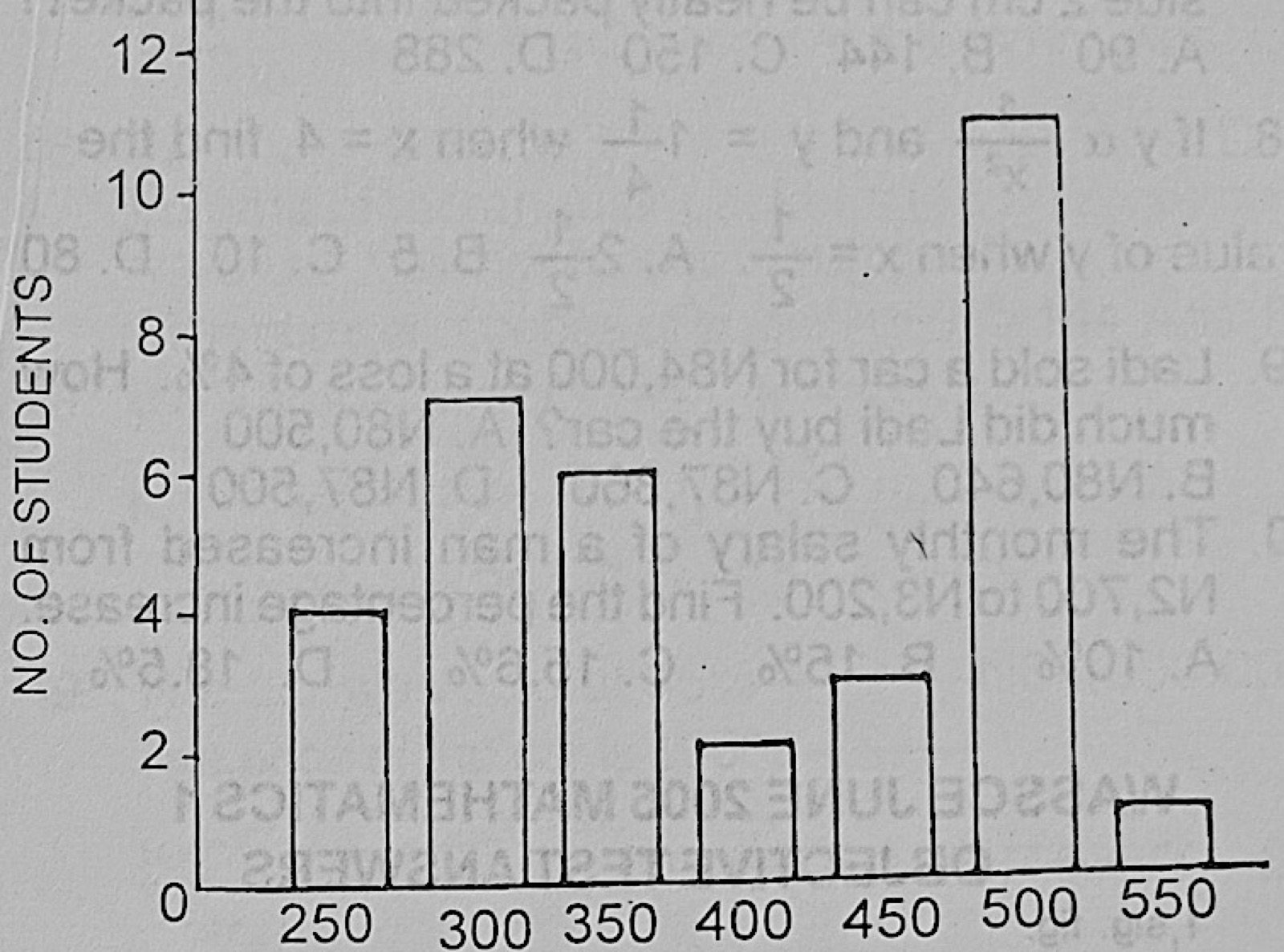
The bar chart shows the pocket money received by students in a class in a week. Find the total number of students in the class.

Diagram for this question
  1. A.27
  2. B.31
  3. C.33
  4. D.34
Show the answer and explanation

Answer: D (34)

Explanation

Add the bars: 4 + 7 + 6 + 2 + 3 + 11 + 1 = 34.

Open this question

Question 41

Data Presentation

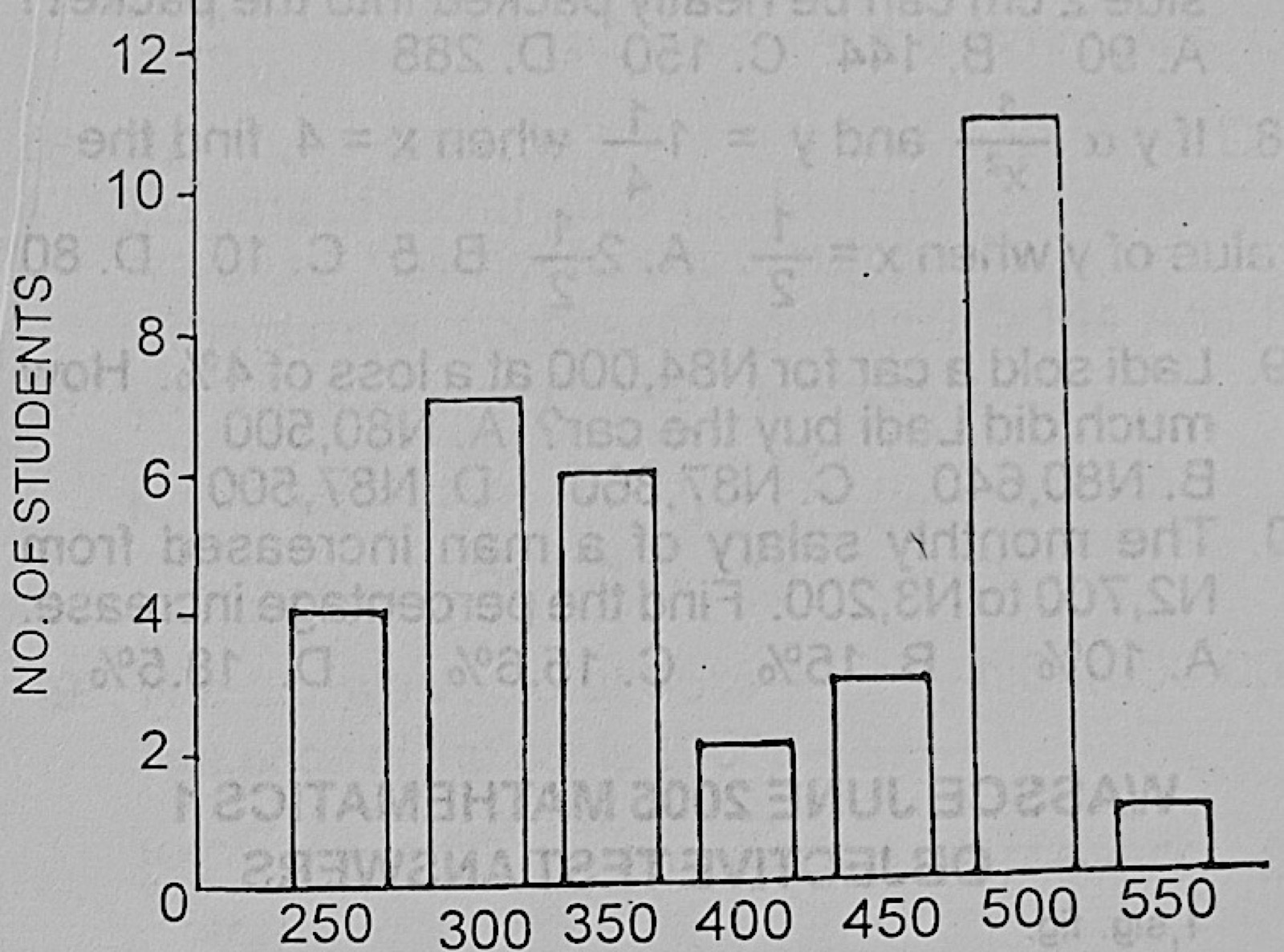
The bar chart shows the pocket money received by students in a class in a week. How many students received N300 or N500 for a week?

Diagram for this question
  1. A.7
  2. B.11
  3. C.18
  4. D.19
Show the answer and explanation

Answer: C (18)

Explanation

7 students received N300 and 11 received N500: 7 + 11 = 18.

Open this question

Question 42

Circle Theorems

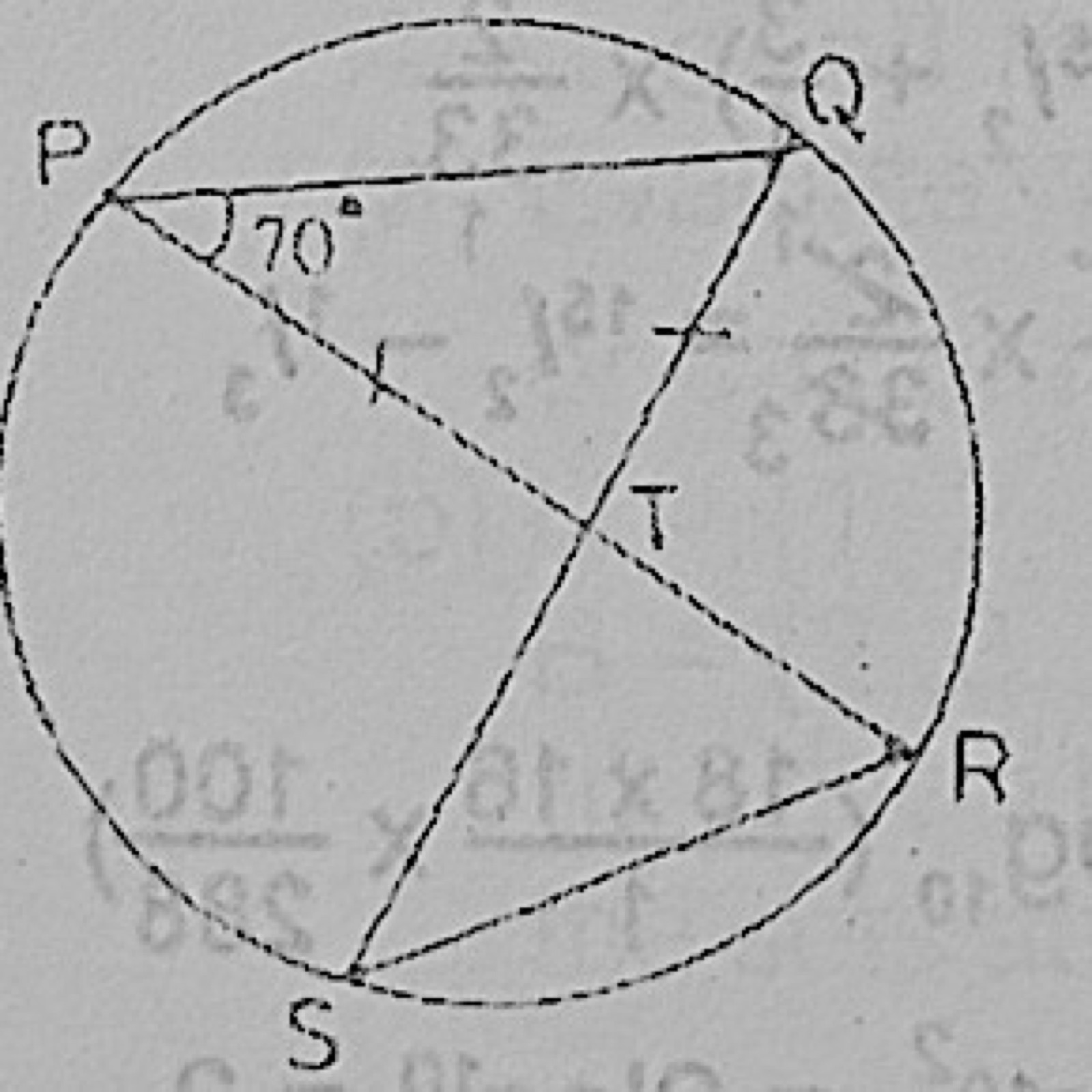
In the diagram PQRS is a circle, |PT| = |QT| and ∠QPT = 70°. What is the size of ∠PRS?

Diagram for this question
  1. A.40°
  2. B.70°
  3. C.80°
  4. D.140°
Show the answer and explanation

Answer: B (70°)

Explanation

PT = QT, so ∠PQT = ∠QPT = 70°, i.e. ∠PQS = 70°. ∠PRS = ∠PQS (angles on the same arc PS) = 70°.

Open this question

Question 43

Trigonometry

The angle of elevation of the top of a cliff 15 meters high from a landmark is 60°. How far is the landmark from the foot of the cliff? Leave your answer in surd form.

  1. A.15√3 m
  2. B.15√2 m
  3. C.10√3m
  4. D.5√3m
Show the answer and explanation

Answer: D (5√3m)

Explanation

Distance = 15/tan 60° = 15/√3 = 5√3 m.

Open this question

Question 44

Algebraic Expressions

For what values of y is the expression (6y − 1)/(y2 − y − 6) not defined?

  1. A.1/6, 1/4
  2. B.3, −2
  3. C.−3, 2
  4. D.0, 1
Show the answer and explanation

Answer: B (3, −2)

Explanation

The denominator y2 − y − 6 = (y − 3)(y + 2) is zero when y = 3 or −2.

Open this question

Question 45

Mensuration of Plane Shapes

XOY is a sector of a circle centre O of radius 3.5 cm which subtends an angle of 144° at the centre. Calculate, in terms of π, the area of the sector.

  1. A.1.4π cm2
  2. B.2.8π cm2
  3. C.4.9π cm2
  4. D.9.8π cm2
Show the answer and explanation

Answer: C (4.9π cm2)

Explanation

Area = 144/360 × π × 3.52 = 0.4 × 12.25π = 4.9π cm2.

Open this question

Question 46

Inequalities

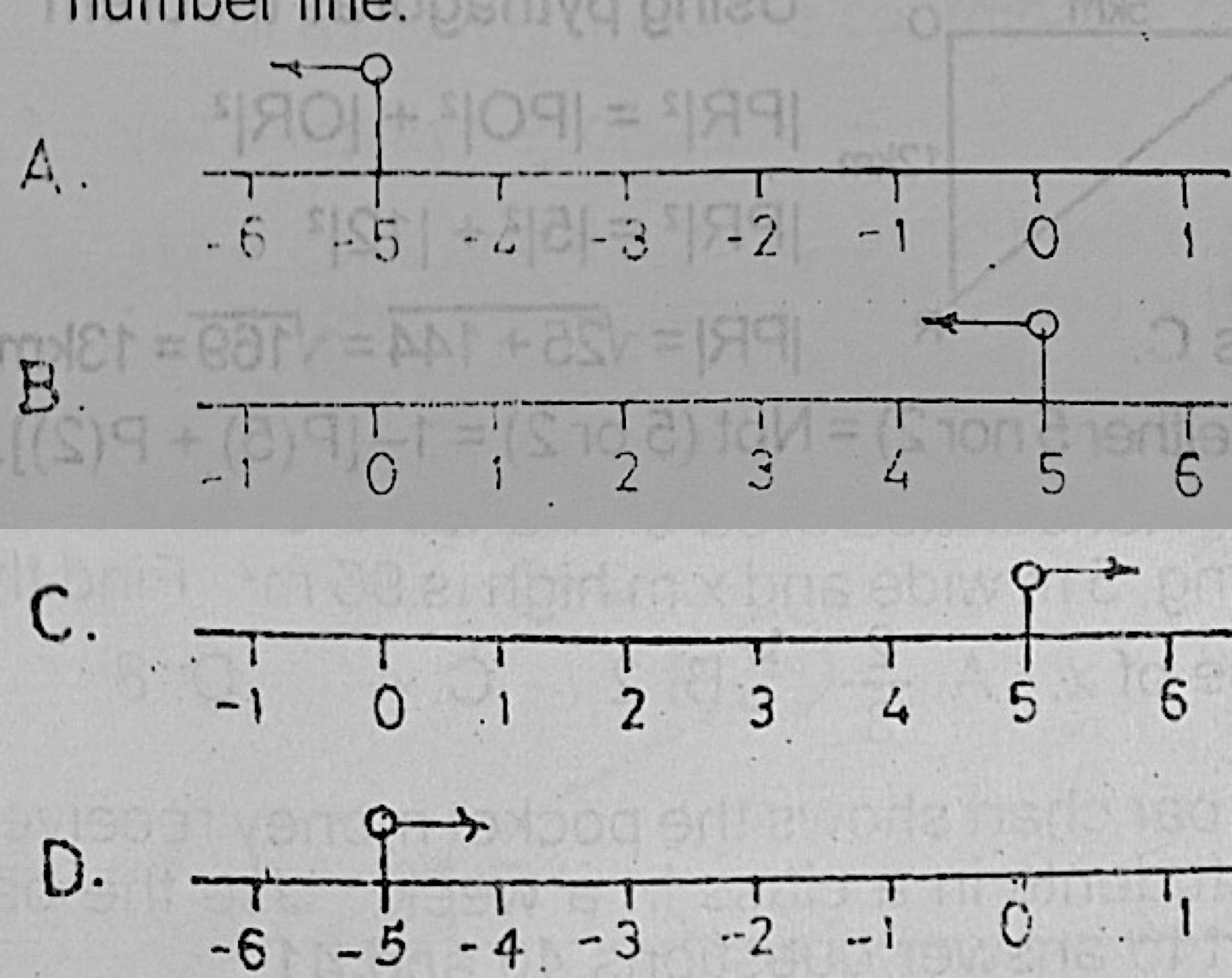
Represent the solution of 3x + 15 > 0 on a number line.

Diagram for this question
  1. A.Number line A
  2. B.Number line B
  3. C.Number line C
  4. D.Number line D
Show the answer and explanation

Answer: D (Number line D)

Explanation

3x > −15, so x > −5. Line D has an open circle at −5 with the arrow pointing right.

Open this question

Question 47

Mensuration of Solids

A rectangular packet has inner dimension 16 cm by 12 cm by 6 cm. How many cubes of sugar of side 2 cm can be neatly packed into the packet?

  1. A.90
  2. B.144
  3. C.150
  4. D.288
Show the answer and explanation

Answer: B (144)

Explanation

8 × 6 × 3 = 144 cubes fit along the three edges.

Open this question

Question 48

Variation

If y ∝ 1/x2 and y = 1 1/4 when x = 4, find the value of y when x = 1/2.

  1. A.2 1/2
  2. B.5
  3. C.10
  4. D.80
Show the answer and explanation

Answer: D (80)

Explanation

k = yx2 = 5/4 × 16 = 20. When x = 1/2, y = 20 ÷ 1/4 = 80.

Open this question

Question 49

Commercial Arithmetic

Ladi sold a car for N84,000 at a loss of 4%. How much did Ladi buy the car?

  1. A.N80,500
  2. B.N80,640
  3. C.N87,360
  4. D.N87,500
Show the answer and explanation

Answer: D (N87,500)

Explanation

N84,000 is 96% of the cost price: 84,000 ÷ 0.96 = N87,500.

Open this question

Question 50

Commercial Arithmetic

The monthly salary of a man increased from N2,700 to N3,200. Find the percentage increase.

  1. A.10%
  2. B.15%
  3. C.15.6%
  4. D.18.5%
Show the answer and explanation

Answer: D (18.5%)

Explanation

Increase = N500; 500/2700 × 100% ≈ 18.5%.

Open this question

Theory question 101

Logarithms

(a) Evaluate without using the mathematical table or calculator. log10√30 − log10√6 + log10√2.
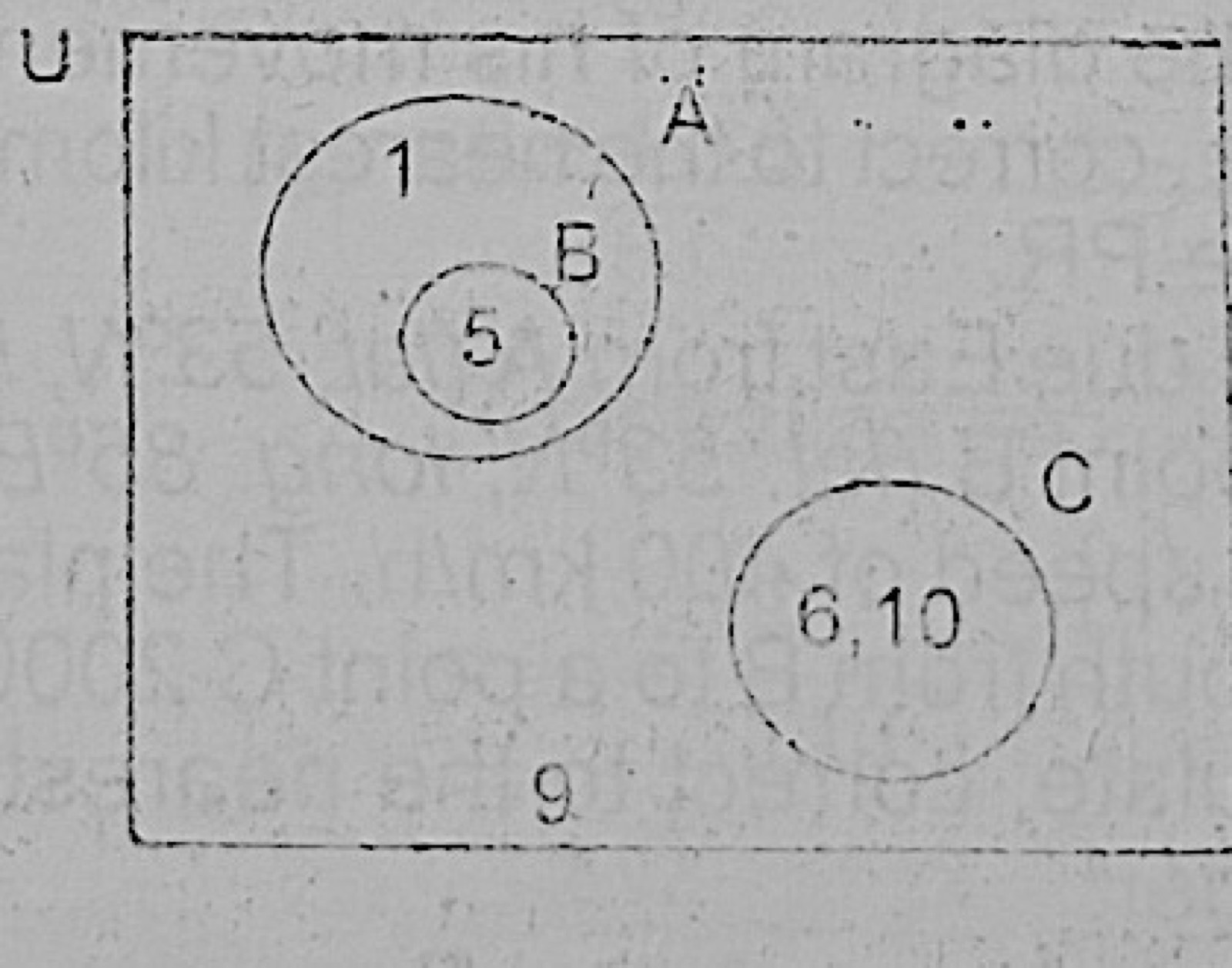
(b) U = {1, 2, 3, ........... 10}, A = {1, 2, 3, 4, 5}, B = {2, 3, 5} and C = {6, 8, 10}. (i) Given that the Venn diagram represents the sets above, copy and fill in the elements. (ii) Find A∩C. (iii) Find A∩B'.

Diagram for this question
Show the model answer
Model answer

(a) log √(30 × 2/6) = log √10 = ½ log 10 = ½.
(b)(i) B inside A: put 2, 3, 5 in B; 1 and 4 in A outside B; 6, 8, 10 in C (separate from A); 7 and 9 outside all sets.
(ii) A∩C = ∅ (no common elements).
(iii) A∩B' = {1, 4}.

Explanation

Combine the logs first, then use log √10 = ½.

Open this question

Theory question 102

Coordinate Geometry

(a) Evaluate: 2 ÷ (64/125)−2/3
(b) The lines y = 3x + 5 and y = −4x − 1 intersect at a point k. Find the coordinates of k.

Show the model answer
Model answer

(a) Dividing by a negative power is multiplying by the positive power: 2 × (64/125)2/3 = 2 × (4/5)2 = 2 × 16/25 = 32/25 = 1 7/25.
(b) 3x + 5 = −4x − 1, so 7x = −6 and x = −6/7.
y = 3(−6/7) + 5 = 17/7 = 2 3/7. K = (−6/7, 2 3/7).

Explanation

(64/125)^(1/3) = 4/5; then square it.

Open this question

Theory question 103

Fractions, Decimals and Approximation

(a) Simplify 5/8 of 2 1/2 − 3/4 ÷ 3/5
(b) A cone and a right pyramid have equal heights and volumes. If the area of the base of the pyramid is 154 cm2, find the base radius of the cone (Take π = 22/7)

Show the model answer
Model answer

(a) 5/8 × 5/2 = 25/16 and 3/4 ÷ 3/5 = 5/4 = 20/16. 25/16 − 20/16 = 5/16.
(b) ⅓πr2h = ⅓ × 154 × h, so πr2 = 154.
r2 = 154 × 7/22 = 49, r = 7 cm.

Explanation

Equal heights and volumes mean the base areas are equal.

Open this question

Theory question 104

Probability

(a) Two fair dice are thrown once. Find the probability of getting: (i) the same digit (ii) a total score greater than 5.
(b) Given that x = cos 30° and y = sin 30°, evaluate without using a mathematical table or calculator: (x2 + y2)/(y2 − x2).

Show the model answer
Model answer

(a)(i) Doubles (1,1)…(6,6): 6/36 = 1/6.
(ii) Totals of 5 or less: 1 + 2 + 3 + 4 = 10 outcomes, so P(total > 5) = 1 − 10/36 = 26/36 = 13/18.
(b) x2 + y2 = 3/4 + 1/4 = 1; y2 − x2 = 1/4 − 3/4 = −1/2. Value = 1 ÷ (−1/2) = −2.

Explanation

Count the outcomes that are not wanted when that is easier, then subtract from 1.

Open this question

Theory question 105

Circle Theorems

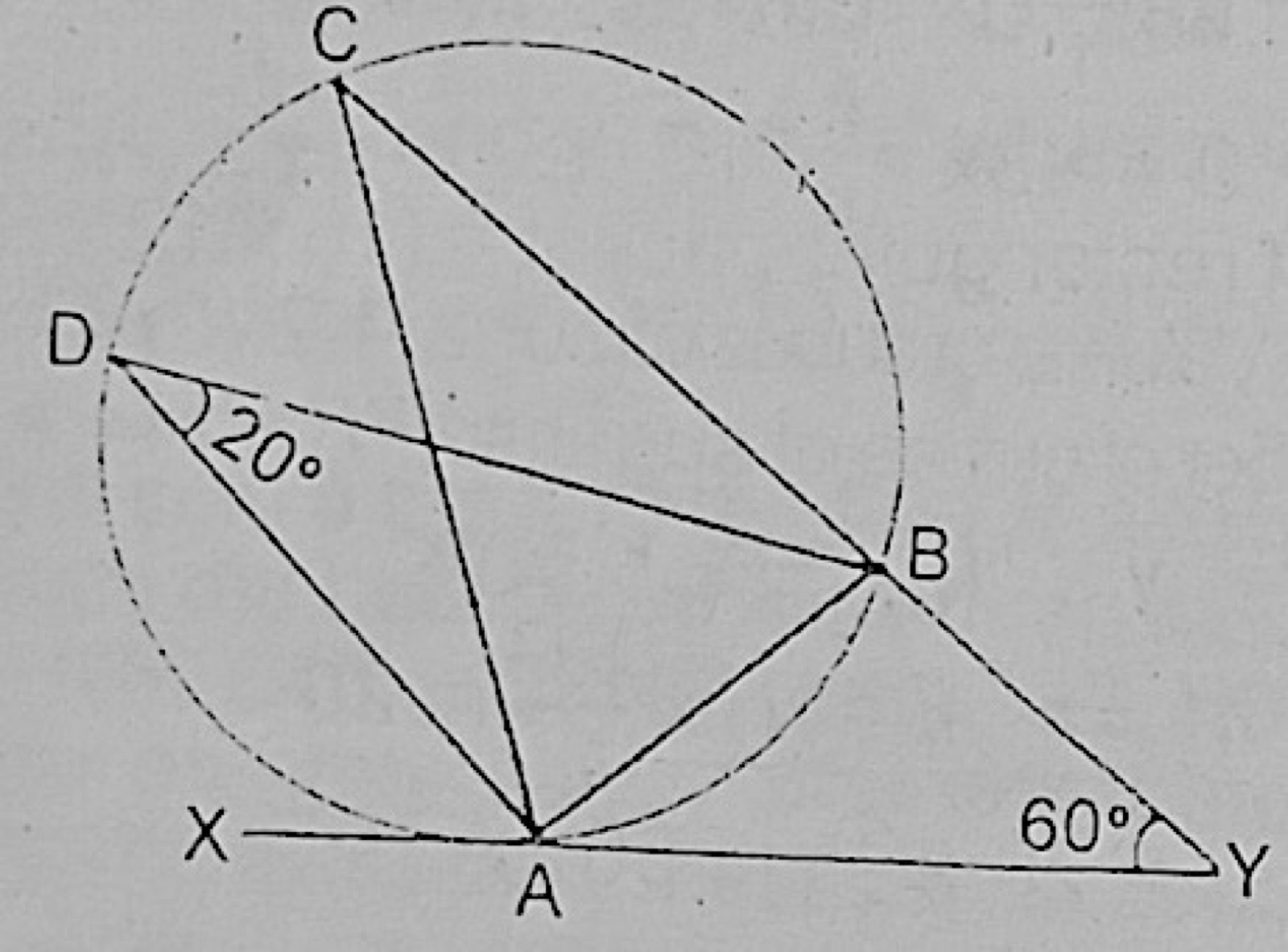
(a) In the diagram, A, B, C and D are points on the circumference of a circle. XY is a tangent at A. Find: (i) ∠CAX; (ii) ∠ABY
(b) If (m + 1) and (m − 3) are factors of m2 − km + c, find the values of k and c.

Diagram for this question
Show the model answer
Model answer

(a)(i) ∠ACB = ∠ADB = 20° (same segment). C, B and Y are in a straight line, so in triangle ACY the exterior angle ∠CAX = ∠ACY + ∠AYC = 20° + 60° = 80°.
(ii) ∠BAY = ∠ADB = 20° (angle between tangent and chord equals the angle in the alternate segment). In triangle ABY, ∠ABY = 180 − 60 − 20 = 100°.
(b) (m + 1)(m − 3) = m2 − 2m − 3, so k = 2 and c = −3.

Explanation

Use the tangent–chord angle and the exterior angle of a triangle.

Open this question

Theory question 106

Fractions, Decimals and Approximation

(a) Without using mathematical table or calculator, evaluate: √((0.18 × 12.5)/(0.05 × 0.2)).
(b) Simplify: (8 − 4√18)/√50 leaving your answer in the a + b√n where a and b are rational numbers and n is an integer.
(c) x, y and z are related such that x varies directly as the cube of y and inversely as the square of z. If x = 108 when y = 3 and z = 4, find z when x = 4000 and y = 10.

Show the model answer
Model answer

(a) 0.18 × 12.5 = 2.25 and 0.05 × 0.2 = 0.01, so √225 = 15.
(b) √18 = 3√2 and √50 = 5√2: (8 − 12√2)/(5√2). Multiply by √2/√2: (8√2 − 24)/10 = −12/5 + (4/5)√2.
(c) x = ky3/z2: 108 = 27k/16, so k = 64.
4000 = 64 × 1000/z2, so z2 = 16 and z = 4.

Explanation

Rationalise the denominator by multiplying by √2/√2.

Open this question

Theory question 107

Angles and Polygons

(a) A regular polygon of n sides is such that each interior angle is 120° greater than the exterior angle. Find: (i) the value of n; (ii) the sum of all the interior angles.
(b) A boy walks 6 km from a point P to a point Q on a bearing of 065°. He then walks to a point R, a distance of 13 km, on a bearing of 146°. (i) Sketch the diagram of his movement. (ii) Calculate, correct to the nearest kilometer, the distance PR.

Show the model answer
Model answer

(a) I − E = 120 and I + E = 180, so E = 30° and I = 150°.
(i) n = 360 ÷ 30 = 12.
(ii) Sum = (12 − 2) × 180° = 1800°.
(b)(i) Sketch north lines at P and Q, PQ at 065° and QR at 146°.
(ii) The bearing of P from Q is 245°, so ∠PQR = 245 − 146 = 99°.
PR2 = 62 + 132 − 2(6)(13) cos 99° = 205 + 24.4 = 229.4, PR ≈ 15.1 ≈ 15 km.

Explanation

Find the angle at Q from the back bearing, then use the cosine rule.

Open this question

Theory question 108

Latitude and Longitude

A plane flies due East from A (lat. 53°N, long. 25°E) to a point B (lat. 53°N, long. 85°E) at an average speed of 400 km/h. The plane then flies South from B to a point C 2000 km away. Calculate, correct to the nearest whole number: (a) the distance between A and B; (b) the time the plane takes to reach point B; (c) the latitude of C. [Take the radius of the earth to be 6400 km and π = 22/7].

Show the model answer
Model answer

(a) Difference in longitude = 85 − 25 = 60°. AB = 60/360 × 2 × 22/7 × 6400 × cos 53° = 6704.8 × 0.6018 ≈ 4035 km.
(b) Time = 4035 ÷ 400 ≈ 10.09 h ≈ 10 hours.
(c) 2000 = θ/360 × 2 × 22/7 × 6400, so θ ≈ 17.9°. Latitude of C = 53 − 17.9 = 35.1 ≈ 35°N.

Explanation

Along a latitude use R cos(latitude); along a meridian use R.

Open this question

Theory question 109

Inequalities

(a) Find the smallest integer that satisfies the inequality x + 8 < 4x − 15.
(b) A sales girl is paid a monthly salary of N2,500.00 in addition to a commission of 5 kobo in the naira on all sales made by her during the month. If her sales for a month amounts to N200,000.00, calculate her income for that month.
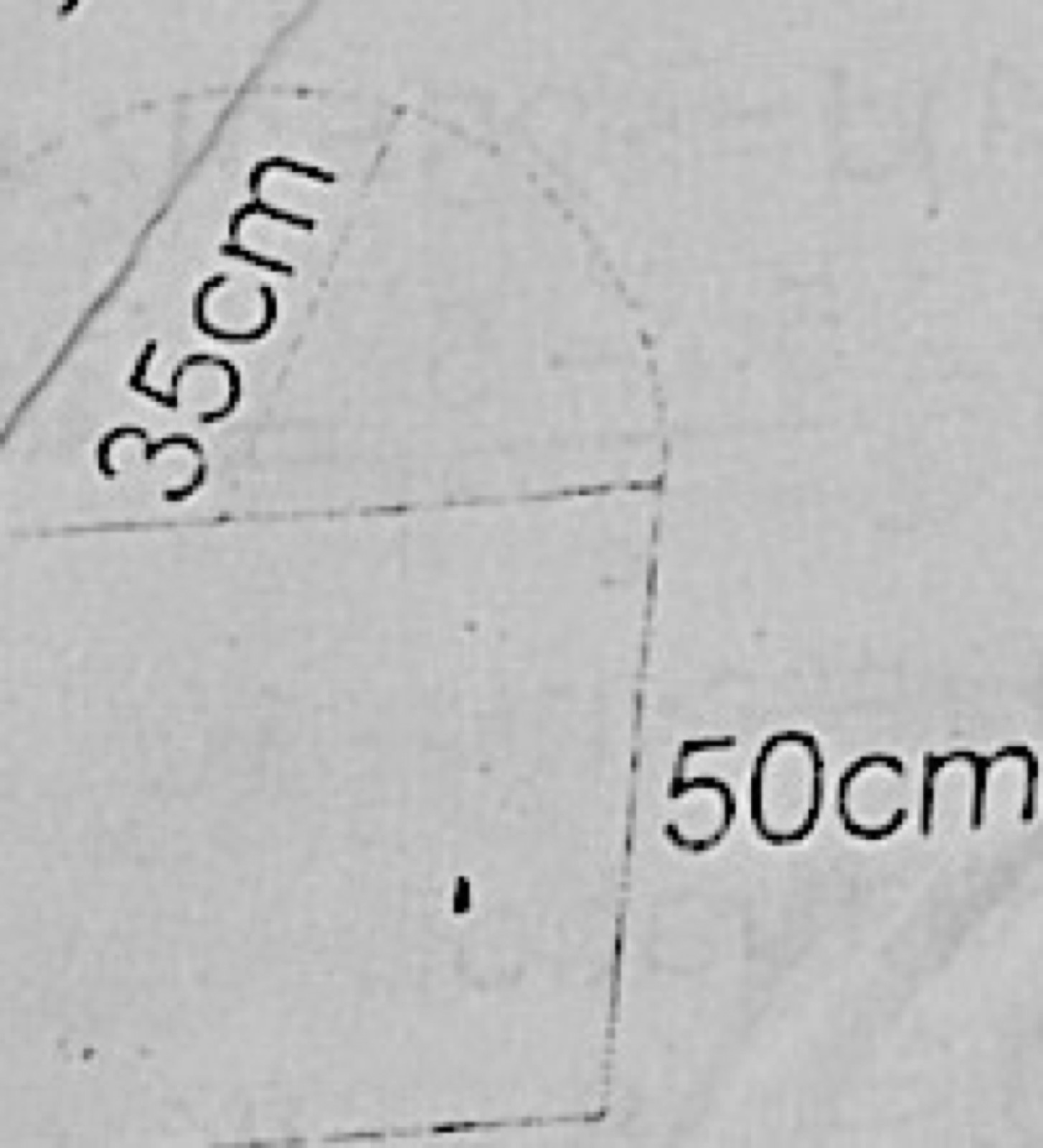
(c) The diagram shows a window consisting of a rectangular and a semi-circular parts. The radius of the semi-circular part is 35 cm and the height of the rectangular part is 50cm. Find the area of the window. (Take π = 22/7)

Diagram for this question
Show the model answer
Model answer

(a) 23 < 3x, so x > 7⅔; the smallest integer is 8.
(b) Commission = 5% of 200,000 = N10,000. Income = 2,500 + 10,000 = N12,500.00.
(c) The rectangle is 70 cm wide (the diameter) and 50 cm high: 3500 cm2.
Semicircle = ½ × 22/7 × 352 = 1925 cm2. Window = 3500 + 1925 = 5425 cm2.

Explanation

5 kobo in the naira is 5%.

Open this question

Theory question 110

Constructions

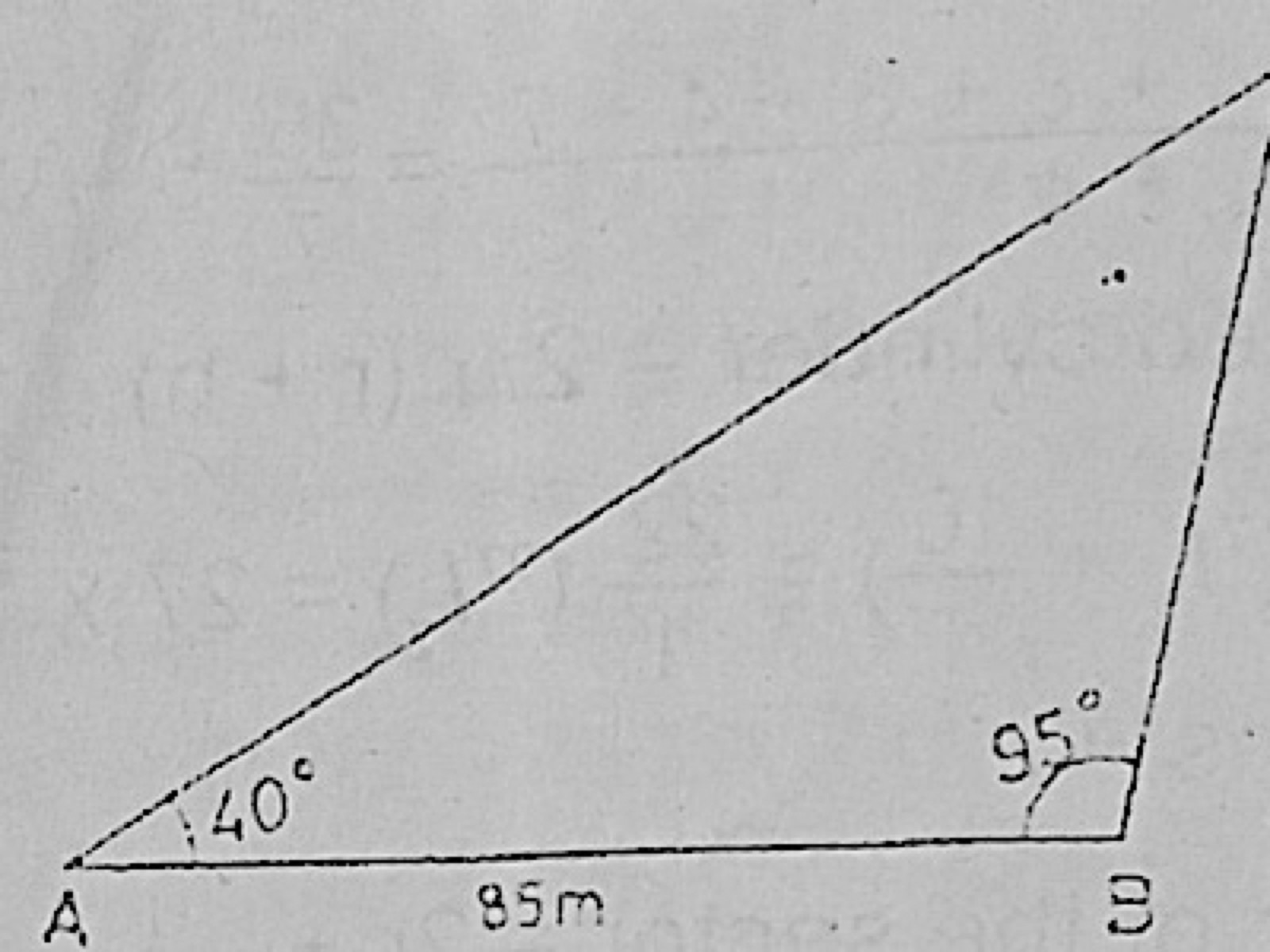
The sketch shows a plot of land (|AB| = 85 m, ∠CAB = 40°, ∠ABC = 95°). (a) Using a scale of 1 cm to 10 m draw an accurate diagram of the plot. (b) Construct: (i) the locus l1 of points equidistant from AC and BC (ii) the locus l2 of points 60 m from A. (c) A tree T inside the plot, is on both l1 and l2. Locate T and find |TC| in metres. (d) A flag pole, P is to be placed such that it is nearer AC than BC and more than 60 m from A. Shade the region where P can be located.

Diagram for this question
Show the model answer
Model answer

(a) Draw AB = 8.5 cm, angle 40° at A and 95° at B; the arms meet at C (AC ≈ 12.0 cm, BC ≈ 7.7 cm, ∠C = 45°).
(b)(i) l1: bisector of ∠ACB.
(ii) l2: arc of a circle centre A, radius 6 cm.
(c) T is where the bisector meets the arc inside the plot; TC ≈ 7.2 cm on the drawing, i.e. about 72 m.
(d) Shade the part of the plot on the AC side of the bisector of ∠C and outside the arc of radius 6 cm about A.

Explanation

Equidistant from two lines: angle bisector. A fixed distance from a point: circle.

Open this question

Theory question 111

Measures of Central Tendency

The table shows the age distributions of the members of a club.
Age (years): 10-14, 15-19, 20-24, 25-29, 30-34, 35-39
Frequency: 7, 18, 25, 17, 9, 4
(a) Calculate, correct to one decimal place, the mean age. (b)(i) Draw a histogram to illustrate the information (ii) Use the histogram to estimate the modal age. (c) If a member is selected at random, what is the probability that he/she is in the modal class?

Show the model answer
Model answer

(a) Class marks 12, 17, 22, 27, 32, 37; Σf = 80; Σfx = 84 + 306 + 550 + 459 + 288 + 148 = 1835. Mean = 1835/80 ≈ 22.9 years.
(b)(i) Bars on boundaries 9.5, 14.5, …, 39.5 with heights 7, 18, 25, 17, 9, 4.
(ii) In the tallest bar join its top corners to the neighbouring bars' tops; they cross at about 19.5 + 7/15 × 5 ≈ 21.8 years.
(c) Modal class 20–24 has 25 members: P = 25/80 = 5/16.

Explanation

Use the class mid-points for x when finding the mean.

Open this question

Theory question 112

Trigonometry

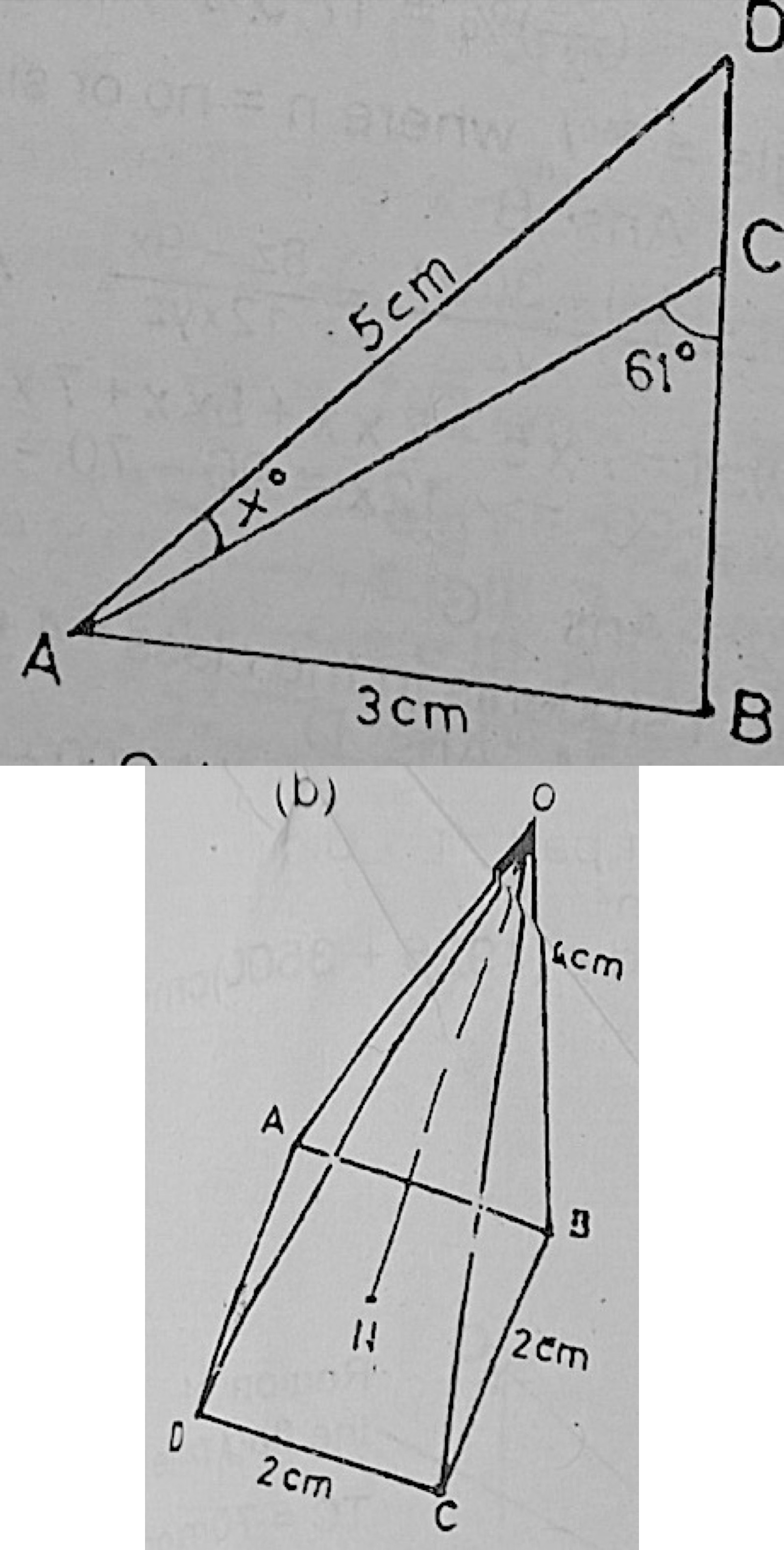
(a) In a diagram, ΔABD is right-angled at B. |AB| = 3 cm, |AD| = 5cm, ∠ACB = 61° and ∠DAC = x°. Calculate, correct to one decimal place, the value of x.
(b) In the diagram, OABCD is a pyramid with a square base of side 2 cm and a slant height of 4cm. Calculate, correct to three significant figures: (i) the vertical height of the pyramid; (ii) the volume of the pyramid.

Diagram for this question
Show the model answer
Model answer

(a) tan ∠DAB = BD/AB = 4/3, so ∠DAB = 53.13°. In right-angled triangle ABC, ∠CAB = 90 − 61 = 29°.
x = 53.13 − 29 = 24.1°.
(b) The diagram marks the slant edge as 4 cm. Half the base diagonal = √2 cm.
(i) Height = √(42 − 2) = √14 ≈ 3.74 cm.
(ii) Volume = ⅓ × 22 × 3.742 ≈ 4.99 cm3.
(If 4 cm is taken as the height of a triangular face instead, h = √15 ≈ 3.87 cm and V ≈ 5.16 cm3.)

Explanation

First find BD = 4 cm with Pythagoras (3-4-5 triangle).

Open this question

Theory question 113

Graphs of Functions

(a) Copy and complete the table. y = x2 − 2x − 2 for −4 ≤ x ≤ 4.
x: −4, −3, −2, −1, 0, 1, 2, 3, 4
y: 22, , , , −2, , , 1, 6
(b) Using a scale of 2 cm to 1 unit on the x-axis and 2 cm to 5 units on the y-axis, draw the graph of y = x2 − 2x − 2.
(c) Use your graph to find: (i) the roots of the equation x2 − 2x − 2 = 0; (ii) the values of x for which x2 − 2x − 4½ = 0 (iii) the equation of the line of symmetry of the curve.

Show the model answer
Model answer

(a) x = −3: 13; −2: 6; −1: 1; 1: −3; 2: −2.
(b) Plot and join with a smooth U-shaped curve (lowest point (1, −3)).
(c)(i) The curve crosses y = 0 at x ≈ −0.7 and x ≈ 2.7.
(ii) x2 − 2x − 4½ = 0 means x2 − 2x − 2 = 2½; draw y = 2.5: x ≈ −1.3 and x ≈ 3.3.
(iii) x = 1.

Explanation

The line of symmetry passes through the lowest point of the curve.
Open this question