The angle of elevation of the top of a tower from a point on the ground which is 36m away from the foot of the tower is 30°. Calculate the height of the tower.
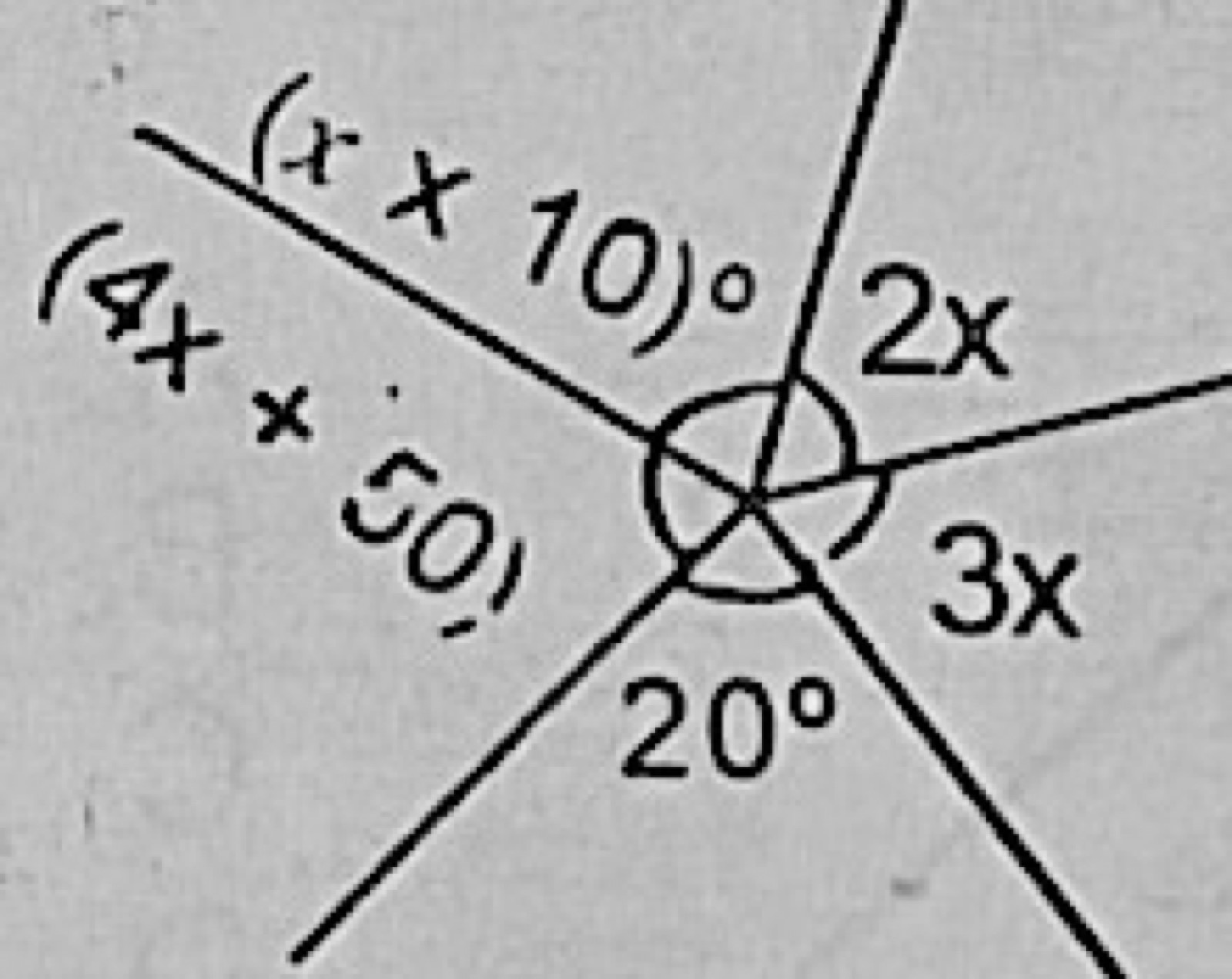
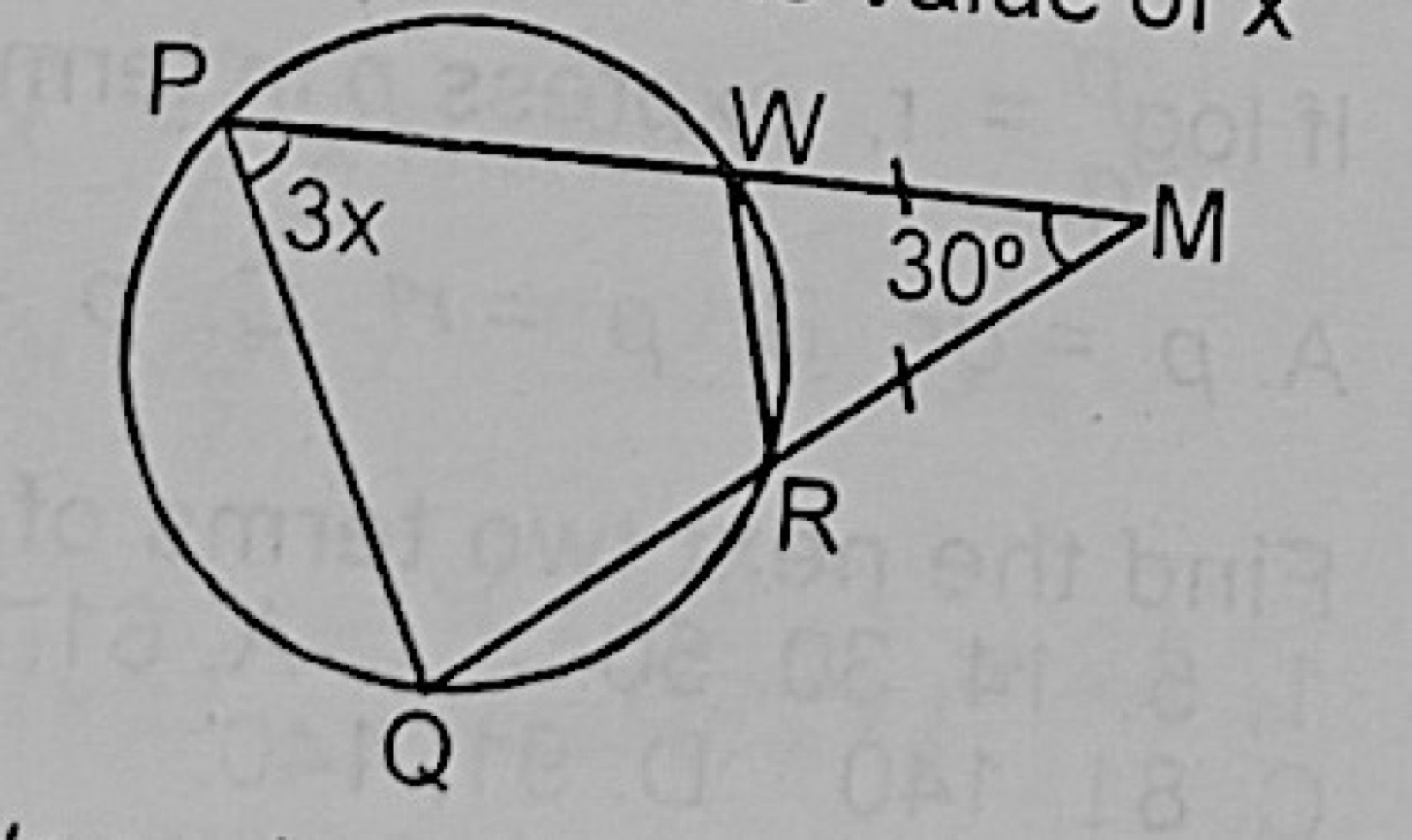
In the diagram, PQRW is a circle. Line PW and QR are produced to meet at M, where ∠WMR = 30° and |WM| = |MR|. Find the value of x
A.10°
B.25°
C.35°
D.60°
Show the answer and explanation
Answer: B (25°)
Explanation
WM = MR, so ∠MRW = (180 − 30)/2 = 75°. The exterior angle of cyclic quadrilateral PQRW at R equals the opposite interior angle at P: 3x = 75°, x = 25°.
The table below gives the marks scored by a group of students in a test. Mark: 0, 1, 2, 3, 4, 5 Frequency: 1, 2, 7, 5, 4, 3 What is the probability of selecting a student from the group that scored 2 or 3?
A.1/11
B.5/22
C.7/22
D.6/11
Show the answer and explanation
Answer: D (6/11)
Explanation
12 of the 22 students scored 2 or 3: 12/22 = 6/11.
Which of the following is/are true? In a plane, the locus of points I. Equidistant from a straight line is a circle radius d where d is the distance between the point and the straight line. II Equidistant from two given points P and Q is a circle of radius |PQ|. III Equidistant from two points is the perpendicular bisector of the line joining the two points.
A.I only
B.II only
C.III only
D.I, II and III
Show the answer and explanation
Answer: C (III only)
Explanation
Points a fixed distance from a line form two parallel lines, not a circle, and statement II is false; only III is true.
A Cooperative Society charges an interest of 5½% per annum on any amount borrowed by its members. If a member borrows N125,000, how much does he pay back after one year?
A.N136,875
B.N131,875
C.N128,750
D.N126,250
Show the answer and explanation
Answer: B (N131,875)
Explanation
Interest = 5.5% of 125,000 = N6,875, so he pays back 125,000 + 6,875 = N131,875.
A bag contains 3 red and 2 white identical balls. If 2 balls are picked at random from the bag, one after the other and with replacement, find the probability that they are of different colours
A.36/625
B.16/625
C.12/25
D.13/25
Show the answer and explanation
Answer: C (12/25)
Explanation
P(red then white) + P(white then red) = 3/5 × 2/5 + 2/5 × 3/5 = 12/25.
A point on the ground is 5m away from the foot of a vertical wall 7 m high, Calculate, correct to the nearest degree, the angle of depression of the point from the top of the wall
A.36°
B.44°
C.46°
D.54°
Show the answer and explanation
Answer: D (54°)
Explanation
The angle of depression equals the angle of elevation from the point: tan θ = 7/5 = 1.4, so θ ≈ 54°.
(a) Solve 1/81(x−2) = 27(1−x) (b) Simplify 5/(√7 − √3) + 1/(√7 − √3) leaving your answer in surd form
Show the model answer
Model answer
(a) 3−4(x−2) = 33(1−x), so −4x + 8 = 3 − 3x and x = 5. (b) Both fractions have the same denominator: 6/(√7 − √3). Multiply top and bottom by √7 + √3: 6(√7 + √3)/(7 − 3) = 3(√7 + √3)/2.
Explanation
Rationalise by multiplying by the conjugate √7 + √3.
(a) In the simultaneous equations: px + qy = 5; qx + py = −10; p and q are constants. If x = 1 and y = 2 is solution of the equation, find p and q (b) Solve (4r − 3)/(6r + 1) = (2r − 1)/(3r + 4)
Show the model answer
Model answer
(a) p + 2q = 5 and q + 2p = −10. From the first, p = 5 − 2q; substitute: q + 10 − 4q = −10, so q = 20/3 and p = 5 − 40/3 = −25/3. (b) (4r − 3)(3r + 4) = (2r − 1)(6r + 1): 12r2 + 7r − 12 = 12r2 − 4r − 1, so 11r = 11 and r = 1.
Explanation
Substitute the given x and y to get two equations in p and q.
(a) AB is a chord of a circle centre O. If |AB| = 24.2cm and the perimeter of ΔAOB is 52.2cm, calculate ∠AOB correct to the nearest degree. (b) A rectangular tank 60cm by 80 cm by 100 cm is half filled with water. How many litres of water is it holding?
Show the model answer
Model answer
(a) OA = OB = r: 2r + 24.2 = 52.2, so r = 14 cm. The perpendicular from O bisects AB: sin(½∠AOB) = 12.1/14 = 0.8643, so ½∠AOB ≈ 59.8° and ∠AOB ≈ 120°. (b) Volume of water = ½ × 60 × 80 × 100 = 240,000 cm3 = 240 litres.
(a) The sides of an isosceles triangle are in the ratio 7:5:7. Calculate correct to the nearest degree, the angle included between the equal sides (b) The sum of the interior angles of a regular polygon is 1440° calculate: (i) the number of sides (ii) the size of one exterior angle of the polygon.
Show the model answer
Model answer
(a) Take sides 7, 7 and 5. The line from the apex to the middle of the base splits it into right-angled triangles: sin(½θ) = 2.5/7 = 0.3571, ½θ ≈ 20.9°, θ ≈ 42°. (b)(i) (n − 2) × 180 = 1440, so n − 2 = 8 and n = 10. (ii) Exterior angle = 360 ÷ 10 = 36°.
Explanation
The equal sides meet at the apex; the side in the ratio that differs is the base.
The table shows the marks scored by a group of students in a class test. Mark: 0, 1, 2, 3, 4, 5 Frequency: 1, 4, 9, 8, 5, 3 (a)(i) Calculate the mean mark (ii) Find the median (b) If the information were to be represented in a pie chart, what would be the sectorial angle for the mark 2?
Show the model answer
Model answer
Total = 30 students. (a)(i) Σfx = 0 + 4 + 18 + 24 + 20 + 15 = 81; mean = 81/30 = 2.7. (ii) The 15th and 16th marks: cumulative 1, 5, 14, 22, so both are 3; median = 3. (b) Angle = 9/30 × 360° = 108°.
(a) Simplify (x2/2 − x + 1/2)(1/(x − 1)) (b) A point P is 40 km from Q on a bearing 061°. Calculate, correct to one decimal place, the distance of P to (i) north of Q; (ii) east of Q. (c) A man left N5,720 to be shared among his son and three daughters. Each daughter's share was ¾ of the son's share. How much did the son receive?
Show the model answer
Model answer
(a) x2/2 − x + 1/2 = (x2 − 2x + 1)/2 = (x − 1)2/2. Multiply by 1/(x − 1): (x − 1)/2. (b)(i) North: 40 cos 61° = 40 × 0.4848 ≈ 19.4 km. (ii) East: 40 sin 61° = 40 × 0.8746 ≈ 35.0 km. (c) Son s, each daughter ¾s: s + 3 × ¾s = 13s/4 = 5720, so s = N1,760.
Explanation
The bearing is measured from north, so north uses cosine and east uses sine.
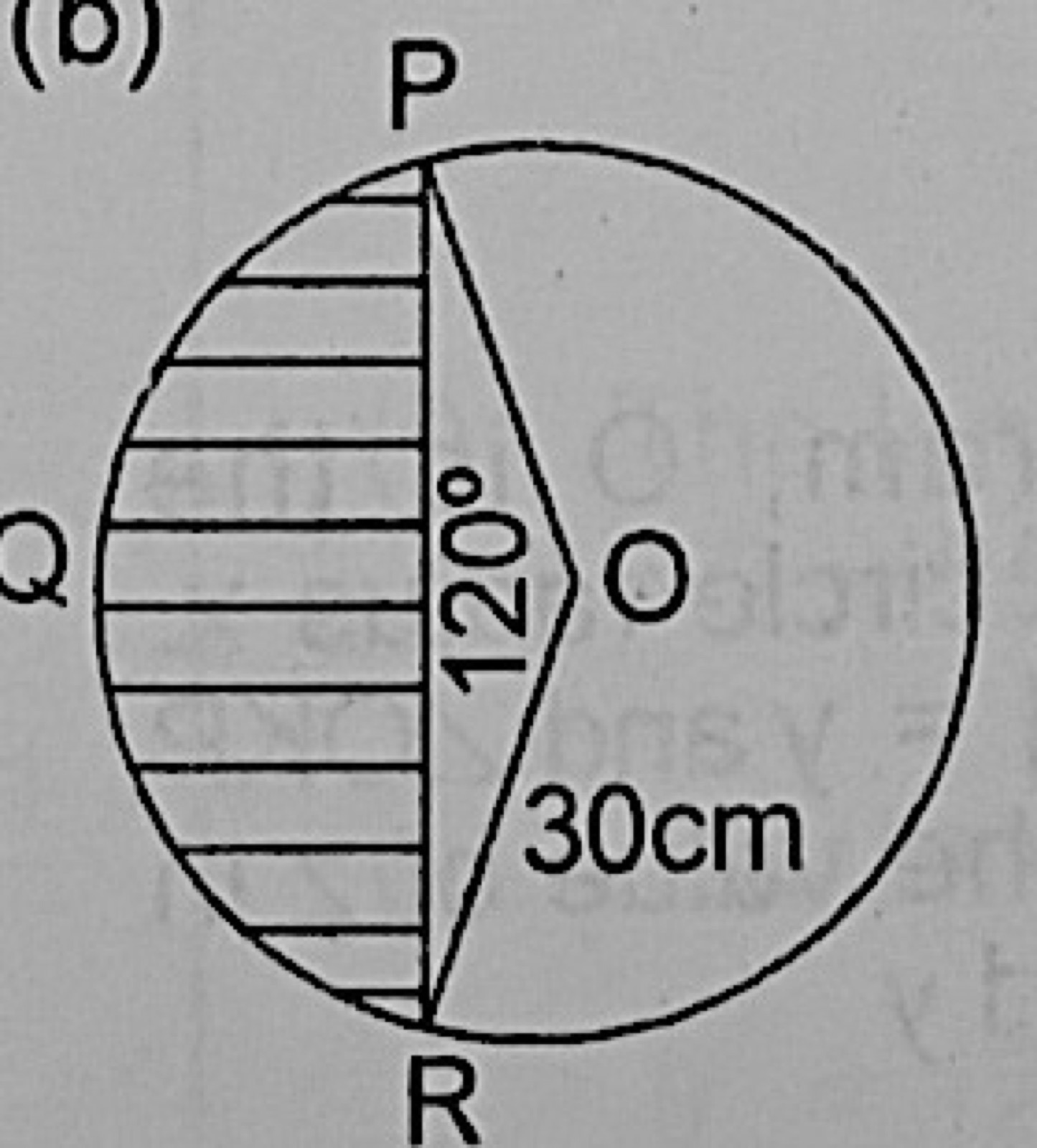
(a) The angles of depression of the top and bottom of a building are 51° and 62° respectively from the top of a tower 72m high. The base of the building is on the same horizontal level as the foot of the tower. Calculate the height of the building, correct to two significant figures. (b) In the diagram, PR is a chord of the circle centre O and radius 30 cm. ∠POR = 120°. Calculate, correct to three significant figures. (i) the length of chord PR; (ii) the length of arc PQR; (iii) the perimenter of the shaded portion. (Take π = 3.142)
Show the model answer
Model answer
(a) Horizontal distance d = 72/tan 62° = 72/1.8807 = 38.28 m. Drop from the tower top to the building top = 38.28 × tan 51° = 38.28 × 1.2349 = 47.27 m. Height of building = 72 − 47.27 = 24.7 ≈ 25 m. (b)(i) PR = 2 × 30 sin 60° = 51.96 ≈ 52.0 cm. (ii) Arc PQR (the 120° arc) = 120/360 × 2 × 3.142 × 30 = 62.84 ≈ 62.8 cm. (iii) Perimeter of the shaded segment = 51.96 + 62.84 = 114.8 ≈ 115 cm.
Explanation
Both angles of depression share the same horizontal distance between the tower and the building.
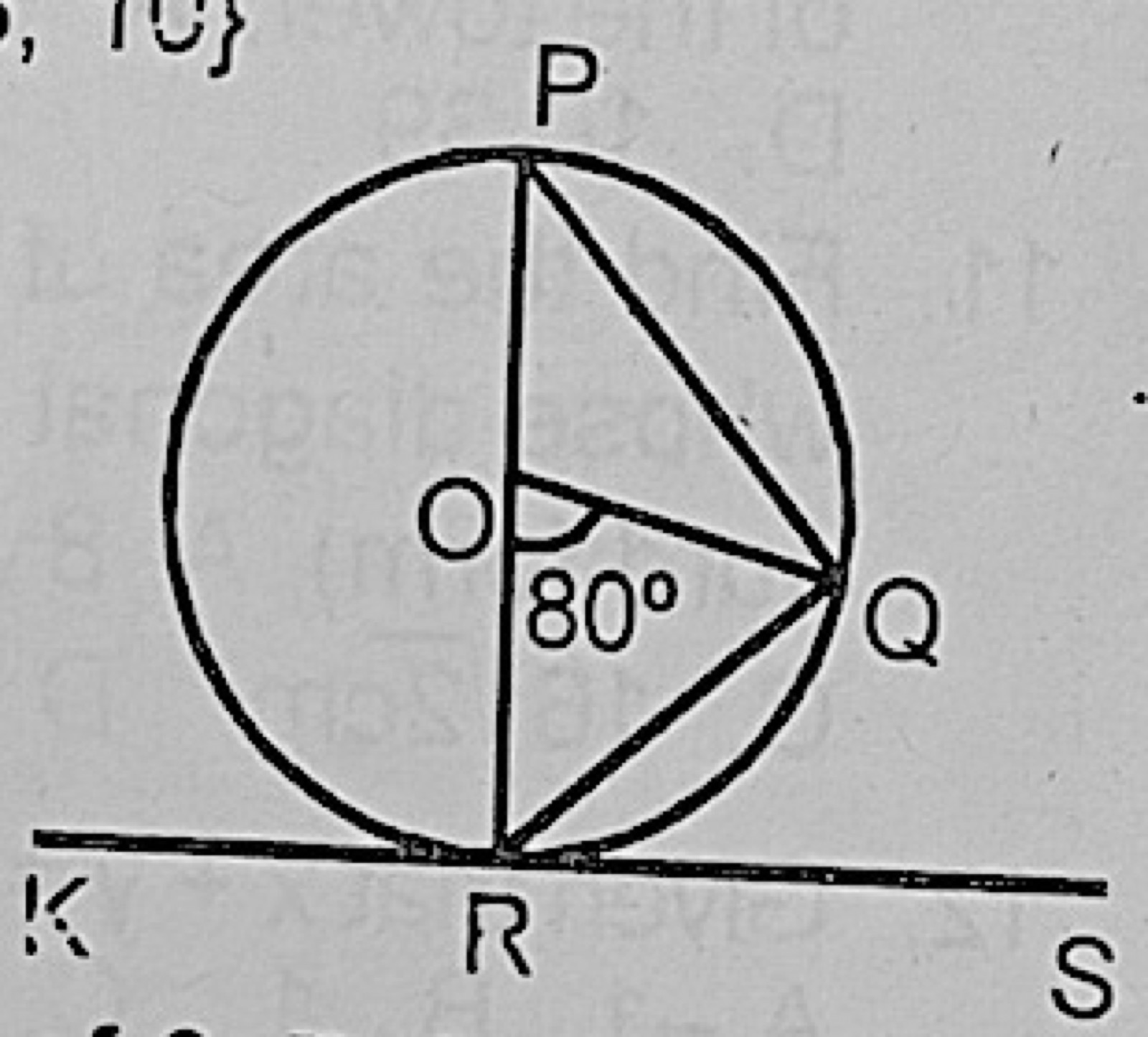
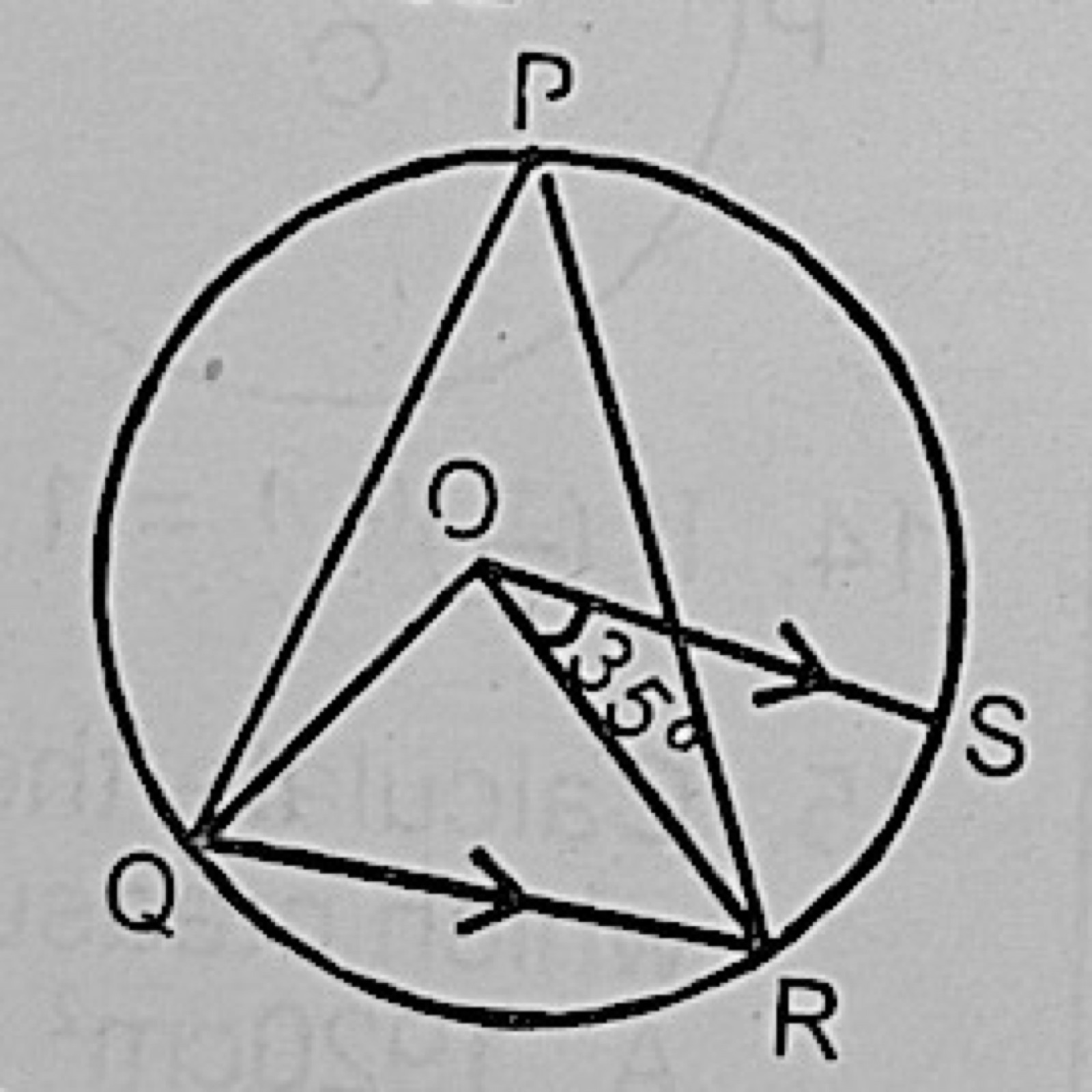
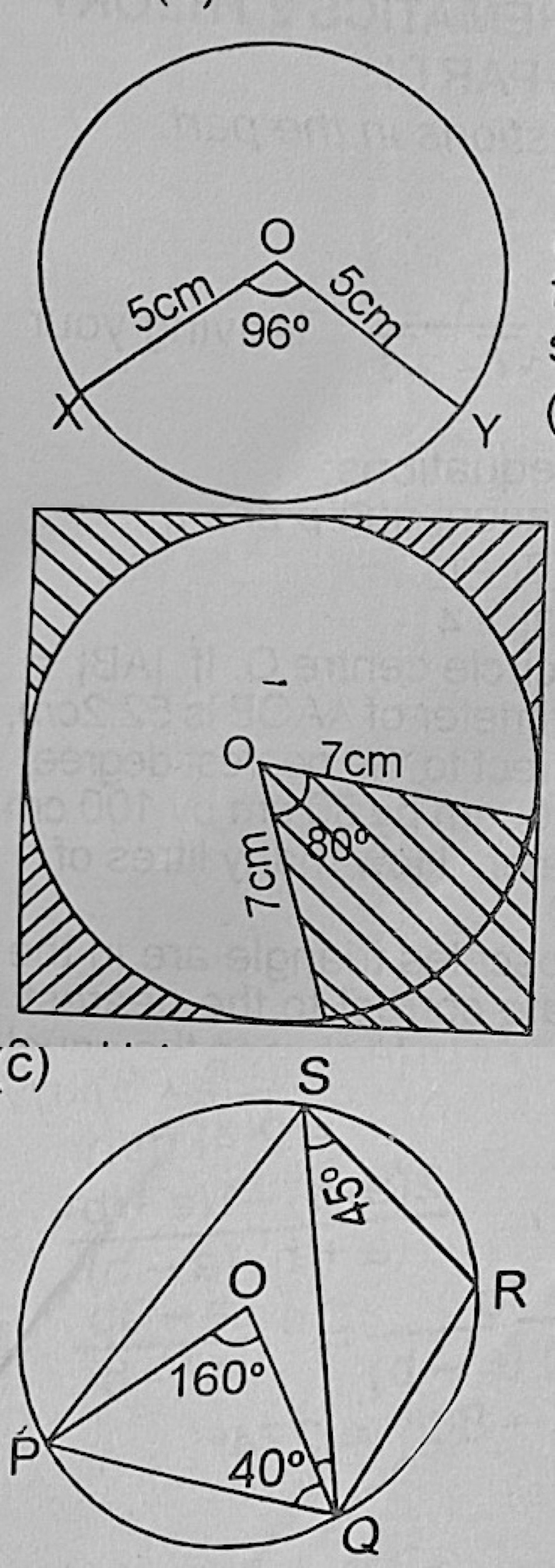
(a) In the diagram, XY is a chord of a circle of a radius 5 cm. The chord subtends an angle 96° at the centre. Calculate, correct to three significant figures, the area of the minor segment cut-off by XY, (Take π = 22/7) (b) The figure shows a circle of radius 7 cm inscribed in a square. If a portion of the circle is shaded with some portions of the square, calculate the total area of the shaded portions. (Take π = 22/7) (c) In the diagram P, Q, R and S are points on the circumference of the circle centre O. ∠POQ = 160°, ∠QSR = 45° and ∠PQS = 40°. Calculate (i) ∠QPS, (ii) ∠RQS
Using a ruler and a pair of compasses only. (a) Construct: (i) ΔPQR such that |PQ| = 8cm, |PR| = 7cm and ∠QPR = 105°, (ii) locus l1 of points equidistant from P and Q. (iii) locus l2 of points equidistant from Q and R (b) (i) Label the point T and where l1 and l2 intersect. (ii) With centre T and radius |TQ|, construct a circle l3. (iii) Complete quadrilateral PQSR such that |RS| = |QS| and |TQ| = |TS|.
Show the model answer
Model answer
(a)(i) Draw PQ = 8 cm. Construct 105° at P (90° plus half of the 30° between 90° and 120°). Mark R on this arm with PR = 7 cm; join QR (QR ≈ 11.9 cm). (ii) l1: perpendicular bisector of PQ. (iii) l2: perpendicular bisector of QR. (b)(i) T is where l1 and l2 meet (the circumcentre). (ii) The circle centre T radius TQ (≈ 6.2 cm) passes through P, Q and R. (iii) S is where l2 meets the circle on the side of QR away from P; join QS and RS.
Explanation
TS = TQ puts S on the circle, and RS = QS puts S on the perpendicular bisector of QR.
(a) K (lat. 60°N, long, 50°W) is a point on the earth's surface. L is another point due east of K and the third point N is due south of K. The distance KL 3520 km and KN is 10951 km. Calculate (i) the longitude of L (ii) the latitude of N. (Take π = 22/7 and the radius of the earth = 6400 km) (b) A man was allowed 20% of his income as tax free. He then paid 25 kobo in the naira on the remainder. If he paid N1,200.00 as tax, calculate his total income.
Show the model answer
Model answer
(a)(i) Along latitude 60°: 3520 = θ/360 × 2 × 22/7 × 6400 cos 60°, so θ = 3520 × 360/20114 ≈ 63°. Moving east 63° from 50°W: longitude of L = 63 − 50 = 13°E. (ii) Along the meridian: 10951 = α/360 × 2 × 22/7 × 6400, so α ≈ 98°. Moving south 98° from 60°N: 60 − 98 = −38, so N is at latitude 38°S. (b) Taxable income = 80% of I; tax = 0.25 × 0.8I = 0.2I = 1200, so I = N6,000.
Explanation
Crossing the Greenwich meridian or the equator switches W to E or N to S.
The frequency distribution shows the marks of 100 students in a Mathematics test. Marks: 1-10, 11-20, 21-30, 31-40, 41-50, 51-60, 61-70, 71-80, 81-90, 91-100 No. of Students: 2, 4, 9, 13, 18, 32, 13, 5, 3, 1 (a) Draw a cumulative frequency curve for the distribution (b) Use your curve to estimate; (i) the median; (ii) the lower quartile; (iii) the 60th percentile
Show the model answer
Model answer
(a) Upper boundaries 10.5, 20.5, …, 100.5 with cumulative frequencies 2, 6, 15, 28, 46, 78, 91, 96, 99, 100; plot (0.5, 0) and these points and draw a smooth curve. (b)(i) Median at 50: about 50.5 + 4/32 × 10 ≈ 51.8. (ii) Lower quartile at 25: about 30.5 + 10/13 × 10 ≈ 38.2. (iii) 60th percentile at 60: about 50.5 + 14/32 × 10 ≈ 54.9. (Accept values read from the graph within about ±1.)
Explanation
For 100 students, read across at 25, 50 and 60 on the cumulative frequency axis.
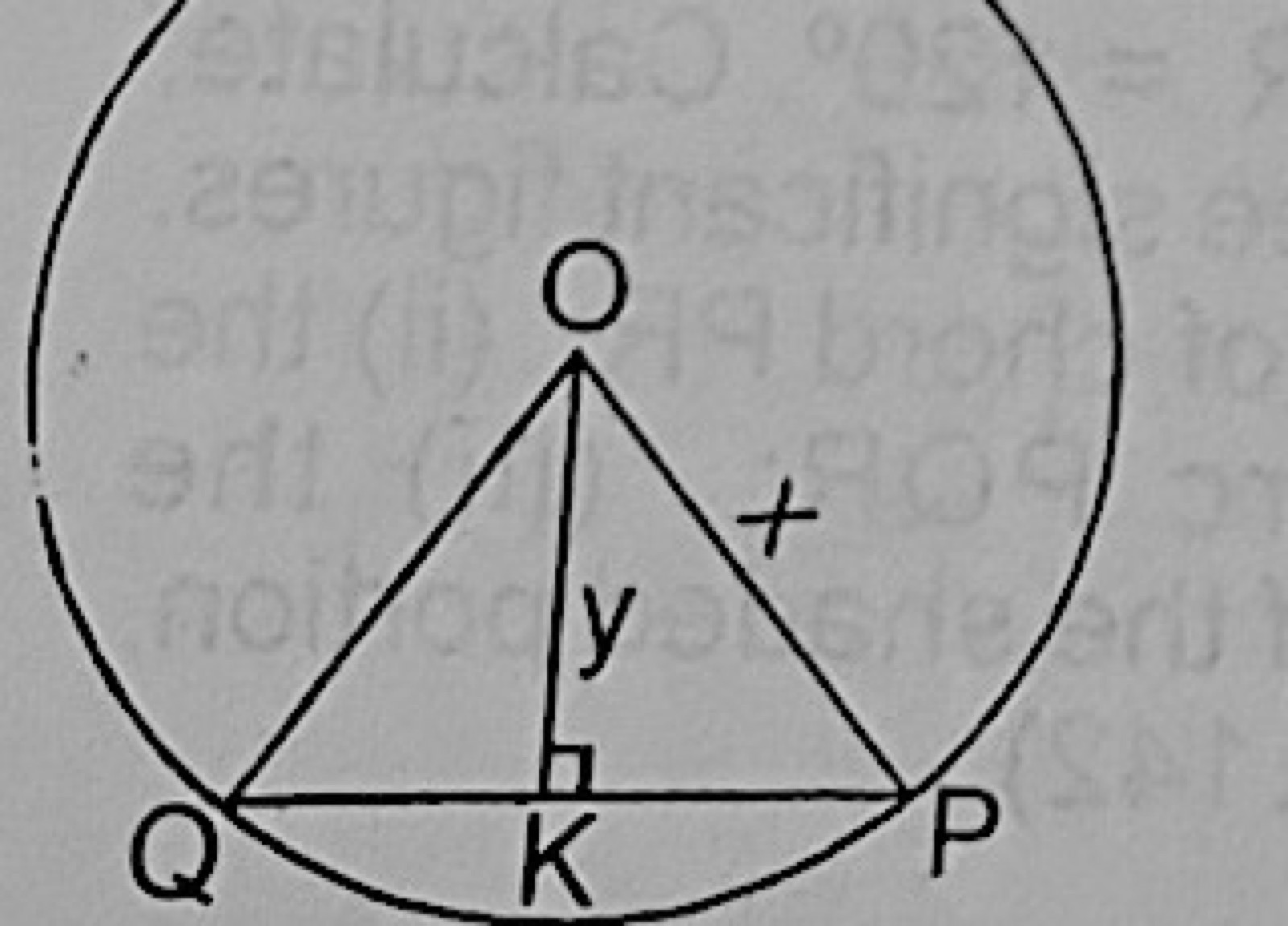
(a) Simplify √1001two, leaving your answer in base two. (b) In the diagram, O is the centre of the circle radius x. |PQ| = z |OK| = y and ∠OKP = 90°. Find the value of z in terms of x and y
Show the model answer
Model answer
(a) 1001two = 8 + 1 = 9, and √9 = 3 = 11two. (b) OK ⟂ PQ, so K is the midpoint of PQ and KP = z/2. In right-angled triangle OKP: (z/2)2 + y2 = x2, so z = 2√(x2 − y2).
Explanation
A perpendicular from the centre bisects the chord.
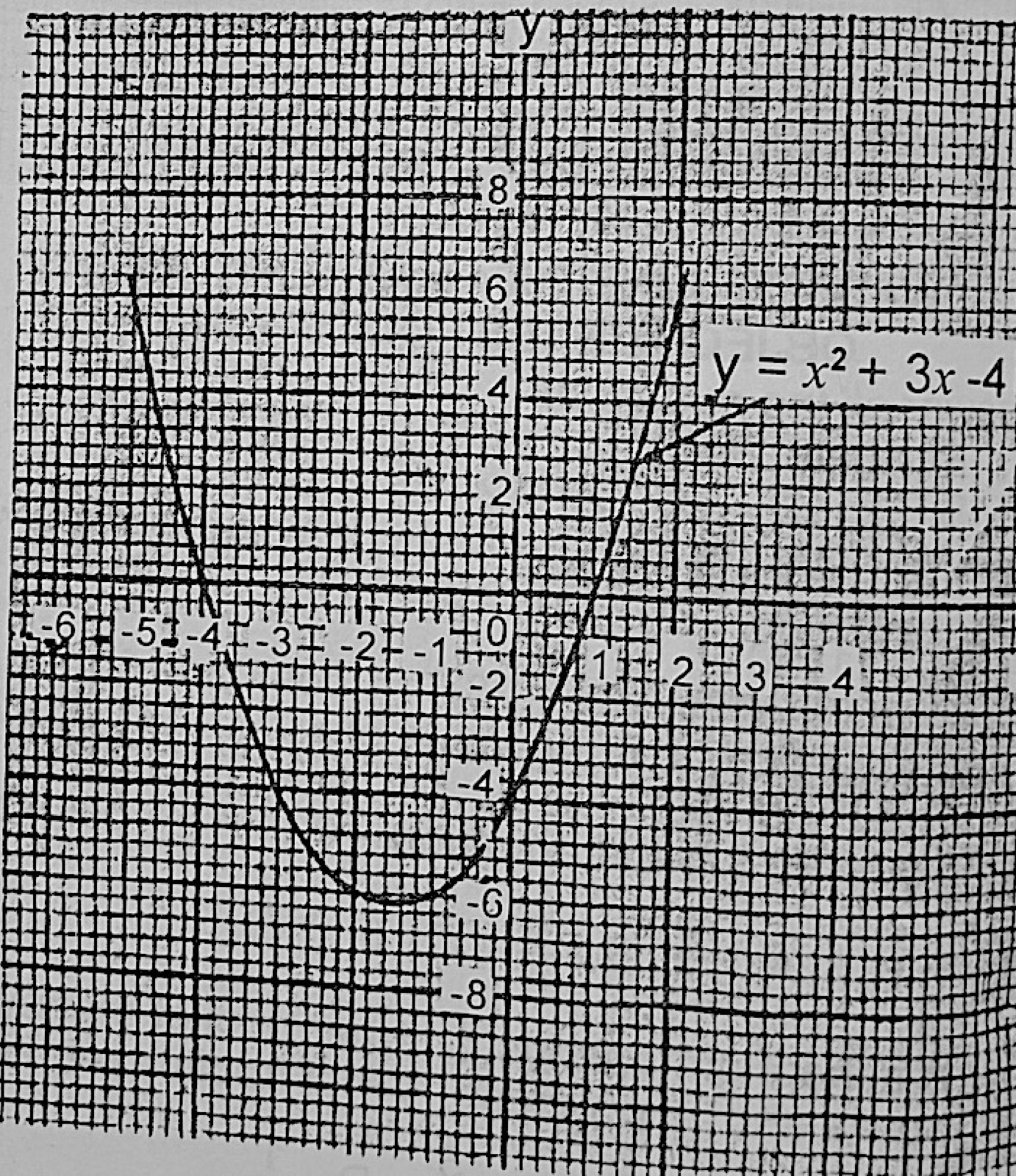
(a) Copy and complete the following table of values for the relation y = 2x2 − 7x − 3 x: −2, −1, 0, 1, 2, 3, 4, 5 y: 19, , −3, , −9, , , (b) Using 2cm to 1 unit on the x-axis and 2cm to 5 units on the y-axis, draw the graph of y = 2x2 − 7x − 3 for −2 ≤ x ≤ 5 (c) From your graph, find the: (i) minimum value of y; (ii) gradient of the curve at x = 1 (d) By drawing a suitable straight line, find the values of x for which 2x2 − 7x − 5 = x + 4.
Show the model answer
Model answer
(a) x = −1: 6; x = 1: −8; x = 3: −6; x = 4: 1; x = 5: 12. (b) Plot and join with a smooth U-shaped curve. (c)(i) Minimum y ≈ −9.1 (at x ≈ 1.75). (ii) Tangent at (1, −8): gradient ≈ −3. (d) 2x2 − 7x − 5 = x + 4 is the same as 2x2 − 7x − 3 = x + 6. Draw y = x + 6; it meets the curve at x ≈ −0.9 and x ≈ 4.9.
Explanation
Rearrange so one side is exactly the drawn curve; the other side is the line to draw.