Question 1
SetsIf S⊂R, then
- A.S∩R = R
- B.S∩R = S
- C.S∪R = S
- D.S∩R = S'
- E.S∩R = R'
Show the answer and explanation
Answer: B (S∩R = S)
Explanation
If S is a subset of R, every element of S is already in R, so the common part of S and R is S itself.
48 questions. Try each one, then open the answer to check yourself and read the explanation.
If S⊂R, then
Answer: B (S∩R = S)
If S is a subset of R, every element of S is already in R, so the common part of S and R is S itself.
Convert 35 to a number in base two.
Answer: C (100011two)
35 = 32 + 2 + 1 = 1×25 + 0 + 0 + 0 + 1×2 + 1, so 35 = 100011two.
The nth term of a sequence is represented by 3 × 2(2−n). Write down the first three terms of the sequence
Answer: B (6, 3, 3/2)
n = 1: 3 × 21 = 6; n = 2: 3 × 20 = 3; n = 3: 3 × 2−1 = 3/2.
A piece of cloth was measured as 6.10m. If the actual length of the cloth is 6.35m, find the percentage error, correct to 2 decimal places.
Answer: B (3.94%)
Error = 6.35 − 6.10 = 0.25 m. Percentage error = 0.25/6.35 × 100% ≈ 3.94%.
Simplify: (82/3 × 27−1/3)/641/3
Answer: C (1/3)
82/3 = 4, 27−1/3 = 1/3 and 641/3 = 4, so the value is 4 × 1/3 ÷ 4 = 1/3.
Solve the equation 5x2 − 4x − 1 = 0
Answer: D (1, −1/5)
5x2 − 4x − 1 = (5x + 1)(x − 1) = 0, so x = 1 or x = −1/5.
p and q are two positive numbers such that p > 2q. Which one of the following statements is not true?
Answer: B (−p > −2q)
Multiplying p > 2q by −1 reverses the sign: −p < −2q, so −p > −2q is false.
For what values of x is the expression (x − 5)/(x2 − 2x − 3) not defined?
Answer: C (−1, 3)
A fraction is undefined when its denominator is 0: x2 − 2x − 3 = (x − 3)(x + 1) = 0 gives x = 3 or −1.
Make S the subject of the formula: V = K/√(T − S)
Answer: A (S = T − K2/V2)
√(T − S) = K/V, so T − S = K2/V2 and S = T − K2/V2.
Find (x − y) if 4x − 3y = 7 and 3x − 2y = 5.
Answer: C (2)
Solving gives x = 1 and y = −1 (check: 4 + 3 = 7, 3 + 2 = 5), so x − y = 2.
If h(m + n) = m(h + r) find h in terms of m, n and r
Answer: E (h = mr/n)
Expand: hm + hn = hm + mr. The hm terms cancel, leaving hn = mr, so h = mr/n.
Given that (6x − y)/(x + 2y) = 2, find the value of x/y
Answer: D (5/4)
6x − y = 2x + 4y, so 4x = 5y and x/y = 5/4.
The radius of a geographical globe is 60cm. Find the length of the parallel of Latitude 60°N.
Answer: B (60πcm)
Radius of the parallel = 60 cos 60° = 30 cm, so its length = 2π × 30 = 60π cm.
In the diagram below, O is the centre of the two concentric circles of radii 13cm and 10cm respectively. Find the area of the shaded portion in the sector with an angle of 120° at the centre.

Answer: D (23πcm2)
Shaded area = 120/360 × π(132 − 102) = 1/3 × 69π = 23π cm2.
Express as a single fraction: x/(x − 2) − (x + 2)/(x + 3)
Answer: D ((3x + 4)/((x − 2)(x + 3)))
Numerator = x(x + 3) − (x + 2)(x − 2) = x2 + 3x − x2 + 4 = 3x + 4.
The following numbers represent a set of scores for a class of 32 students, where the maximum score possible was 12, 6, 5, 9, 4, 4, 8, 7, 5, 6, 3, 2, 5, 4, 6, 9, 10, 4, 3, 2, 3, 4, 6, 8, 7, 4, 2, 1, 8, 7, 7, 6, 11. What percentage of the class, correct to the nearest whole number, scored above 6?
Answer: A (34%)
The first 12 is the maximum possible score; the 32 scores after it include 11 above 6 (9, 8, 7, 9, 10, 8, 7, 8, 7, 7, 11). 11/32 × 100% ≈ 34%.
A die with faces numbered 1 to 6 is rolled once. What is the probability of obtaining 3 or 4?
Answer: C (1/3)
Two of the six faces are wanted: 2/6 = 1/3.
Use the graph to answer this question. The graph is that of the quadratic expression
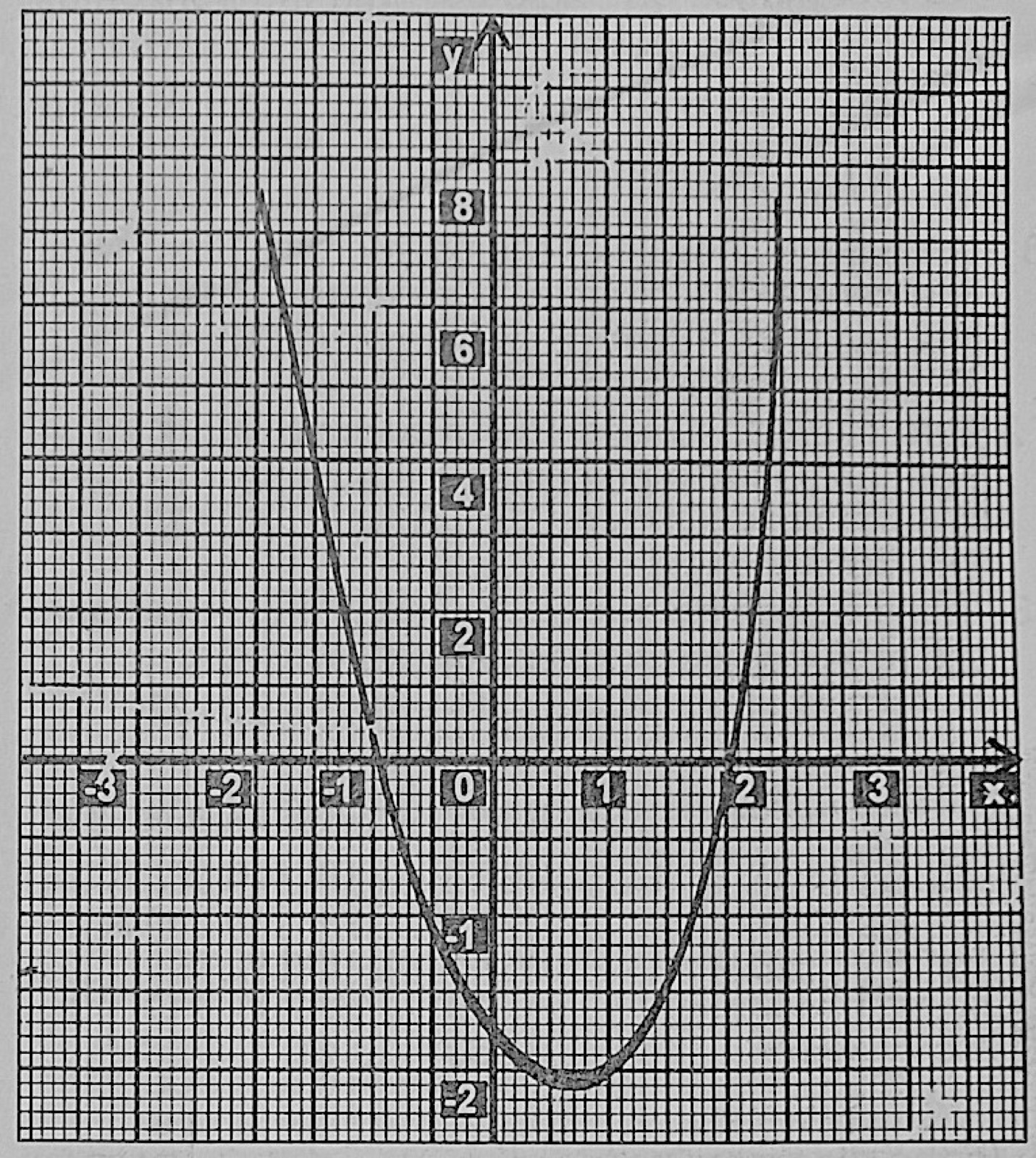
Answer: C (y = x2 − x − 2)
The curve crosses the x-axis at −1 and 2, so y = (x + 1)(x − 2) = x2 − x − 2 (it also passes through (0, −2)).
Use the graph to answer this question. The values of x when y = −1 are approximately

Answer: D (−0.6 and 1.6)
Draw the line y = −1 across the graph; it meets the curve at about x = −0.6 and x = 1.6 (x2 − x − 1 = 0).
In ΔPQR, ∠PQR is a right angle. |QR| = 2cm and ∠PRQ = 60°. Find |PR|.
Answer: B (4cm)
QR is adjacent to the 60° angle: cos 60° = QR/PR, so PR = 2 ÷ ½ = 4 cm.
In sin (X + 30)° = Cos 40°, find X.
Answer: B (20°)
sin A = cos B when A + B = 90°, so X + 30 + 40 = 90 and X = 20°.
A ladder 5cm long rests against a wall such that its foot makes an angle 30° with the horizontal. How far is the foot of the ladder from the wall?
Answer: C (5√3/2 m)
The ladder is the hypotenuse. Distance from wall = 5 × cos 30° = 5 × √3/2 = 5√3/2 m.
A chord of a circle of radius 26cm is 10cm from the centre of the circle. Calculate the length of the chord
Answer: D (48cm)
Half the chord = √(262 − 102) = √576 = 24 cm, so the chord is 48 cm.
Two chords PQ and RS of a circle intersect at right angles at a point inside the circle. If ∠QPR = 35°, find ∠PQS
Answer: C (55°)
In the triangle formed by P, R and the crossing point, the angles are 35° and 90°, so ∠PRS = 55°. ∠PQS = ∠PRS (angles on the same arc PS) = 55°.
In the diagram, O is the centre of the circle and the reflex angle ROS is 264°. Find ∠RTS.
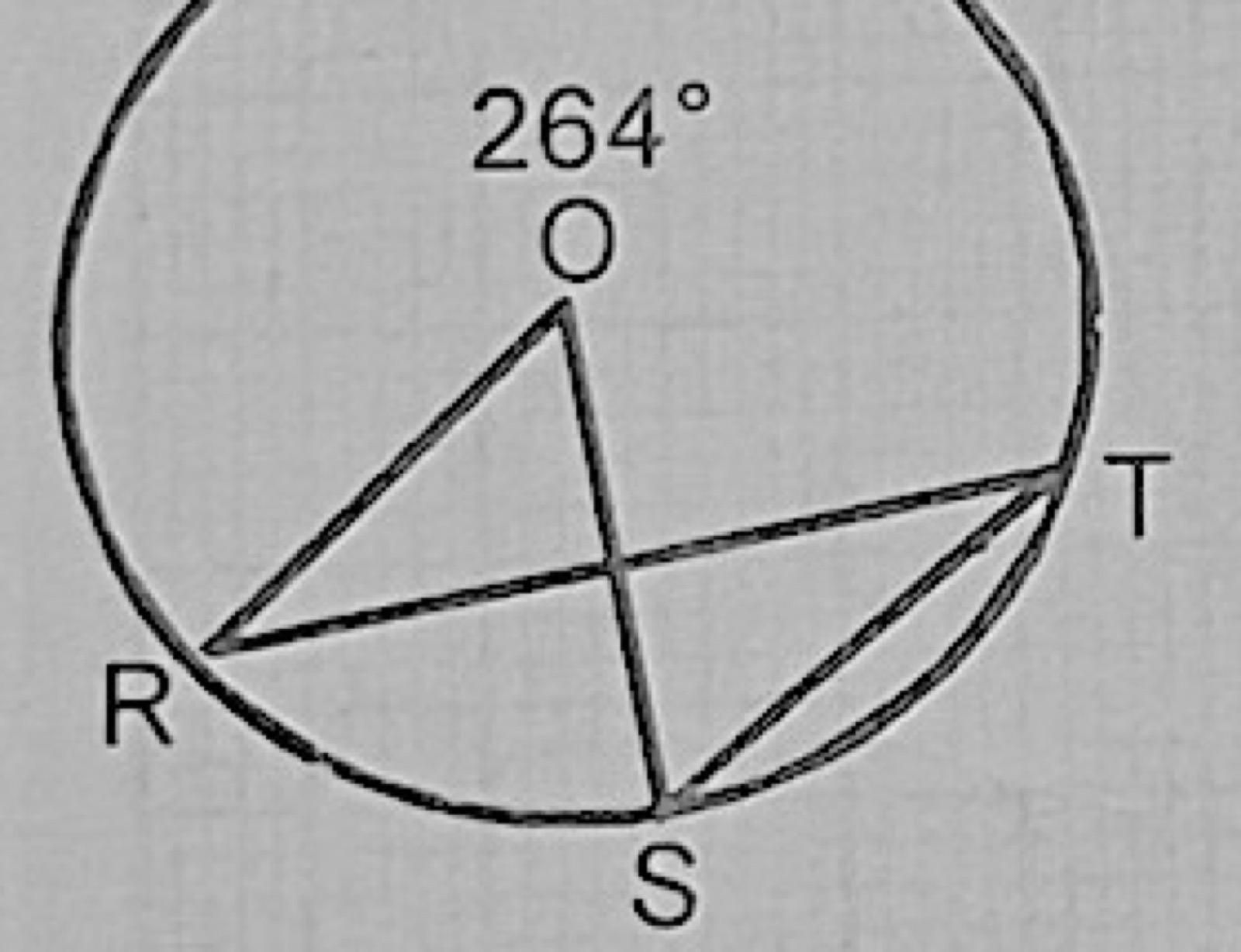
Answer: A (48°)
The non-reflex angle ROS = 360 − 264 = 96°. The angle at the circumference is half the angle at the centre: 48°.
If the exterior angles of a quadrilateral are y°, (y + 5)°, (y + 10)° and (y + 25)°, find y.
Answer: E (80°.)
Exterior angles of any polygon add to 360°: 4y + 40 = 360, so y = 80°.
In the diagram PQ is a diameter of circle PMQN centre O. If ∠PQM = 63°, find ∠MNQ.
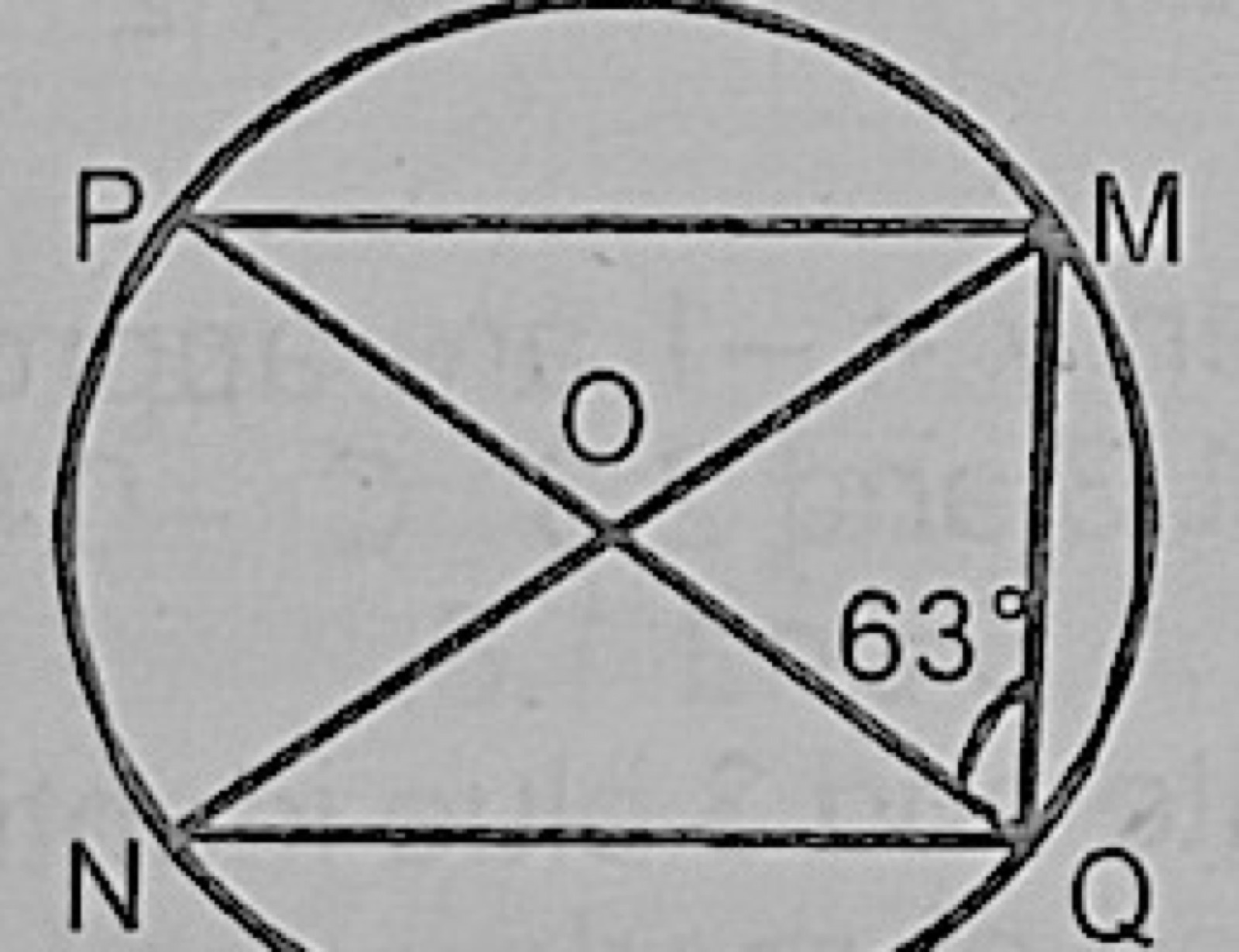
Answer: E (27°.)
∠PMQ = 90° (angle in a semicircle), so ∠MPQ = 27°. ∠MNQ = ∠MPQ (same arc MQ) = 27°.
In the diagram, O is the centre of circle PRQ. The radius is 3.5cm and ∠POQ = 50°. (Take π = 3.142) Calculate, correct to one decimal place, the length of arc PQ.
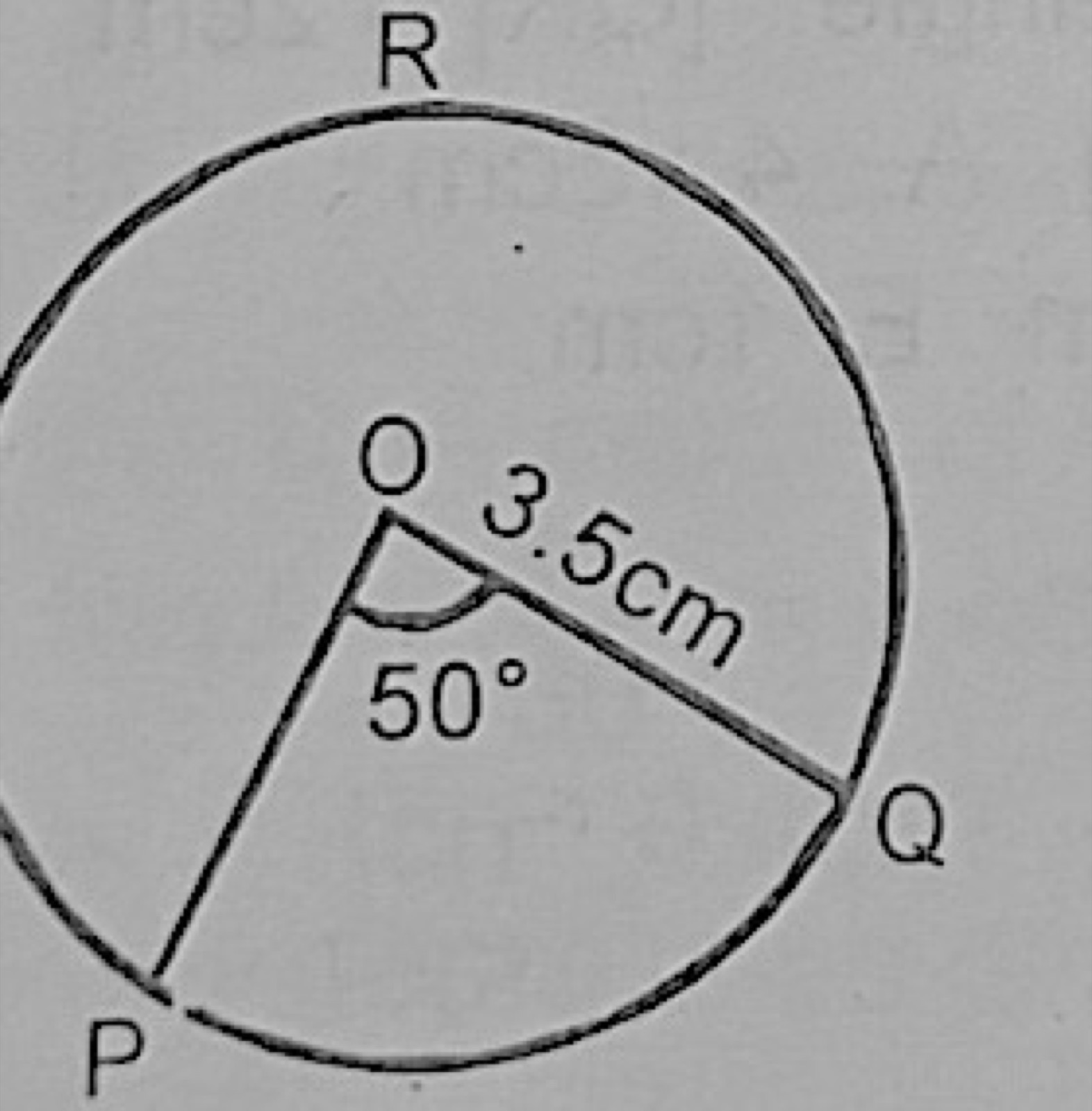
Answer: E (3.1cm.)
Arc PQ = 50/360 × 2 × 3.142 × 3.5 ≈ 3.05, which is 3.1 cm to one decimal place.
In the diagram, O is the centre of circle PRQ. The radius is 3.5cm and ∠POQ = 50°. (Take π = 3.142) Calculate, correct to three significant figures, the area of sector OPQ.
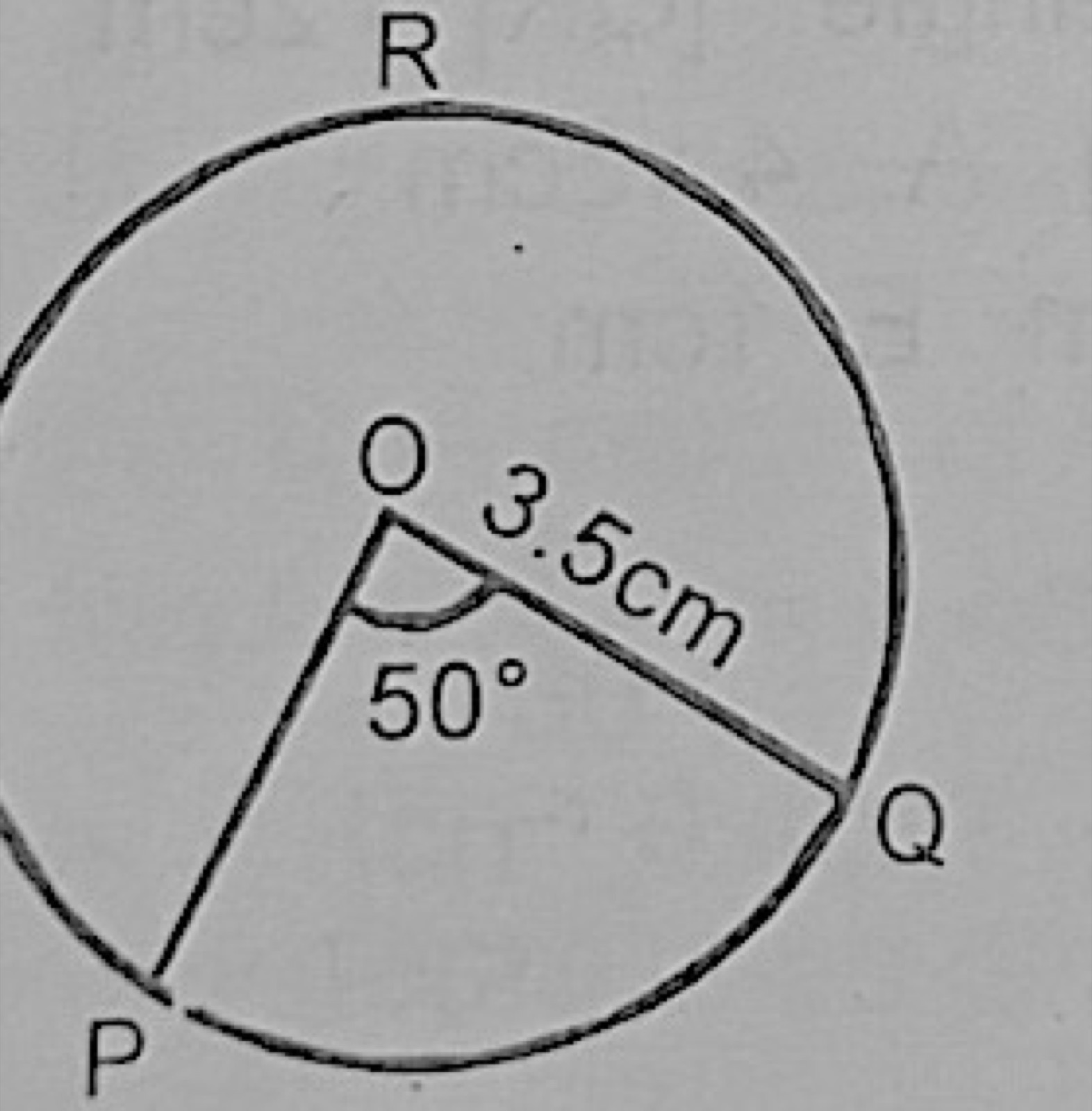
Answer: B (5.350cm2)
Area = 50/360 × 3.142 × 3.52 ≈ 5.35 cm2.
The pie chart below shows the distribution of how students travelled to a certain school on a particular day. What percentage, to the nearest whole number, of the students travelled to school on foot?
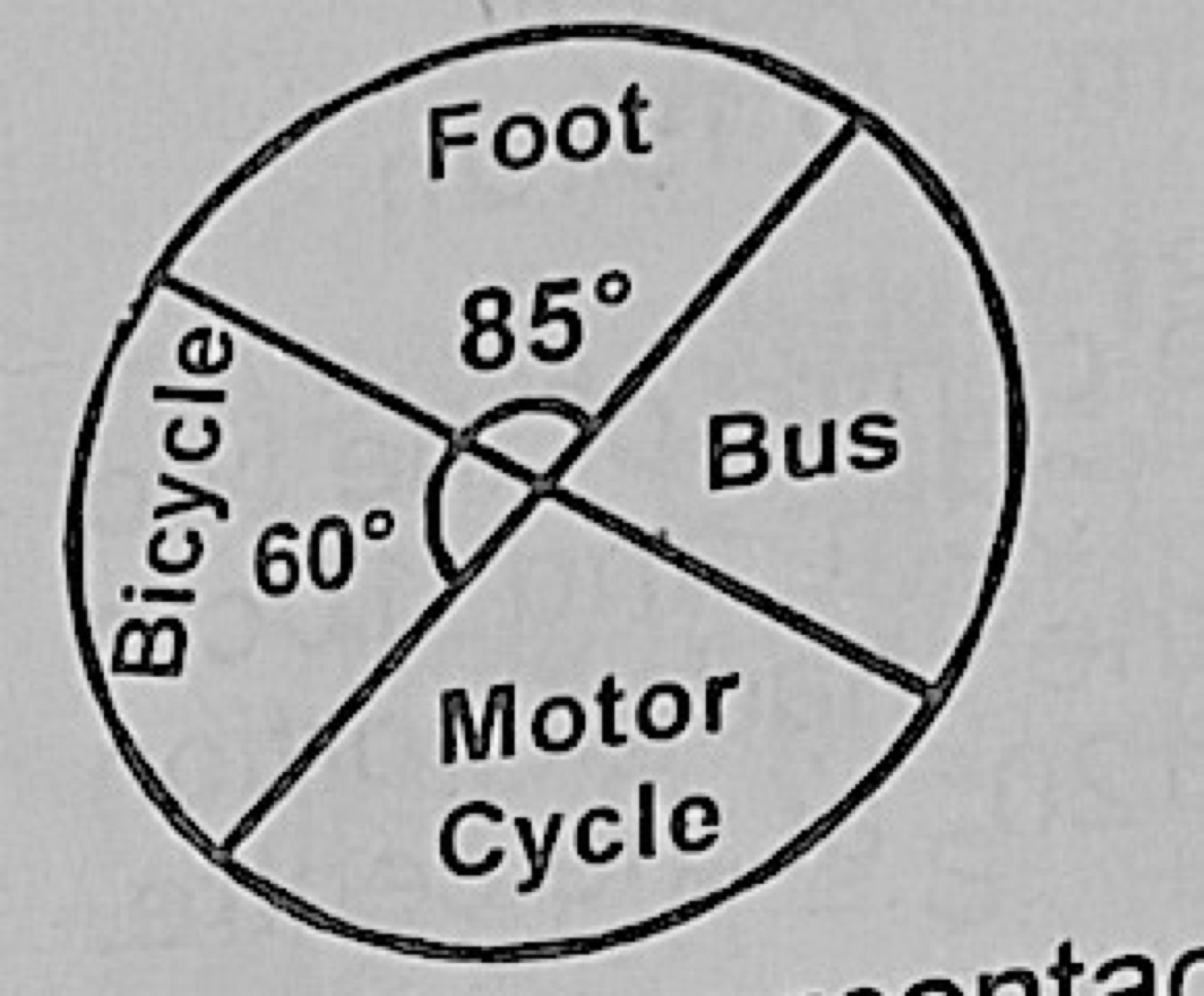
Answer: A (24%)
The foot sector is 85°: 85/360 × 100% ≈ 23.6%, which is 24% to the nearest whole number.
The diagram below is a rectangle. If the perimeter is 36m, find the area of the rectangle.

Answer: B (65m2)
2[(2x + 5) + (x + 1)] = 36 gives 3x + 6 = 18, x = 4. The sides are 13 m and 5 m, so the area is 65 m2.
In Δ PQR, T is a point on QR such that ∠QPT = 39° and ∠PTR = 83°. Calculate ∠PQT.
Answer: B (44°)
∠PTR is an exterior angle of triangle PQT, so it equals ∠QPT + ∠PQT: ∠PQT = 83 − 39 = 44°.
Find the curved surface area of a cone of radius 3cm and slant height 7 cm. (Take π = 22/7)
Answer: C (66cm2)
Curved surface = πrl = 22/7 × 3 × 7 = 66 cm2.
In the diagram below, |PQ| = |PR| = |RS| and ∠RSP = 35°. Find ∠QPR.

Answer: D (40°)
PR = RS, so ∠RPS = ∠RSP = 35° and the exterior angle ∠PRQ = 70°. PQ = PR, so ∠PQR = 70° too, and ∠QPR = 180 − 140 = 40°.
P varies inversely as Q. The table below shows the value of Q for some selected values of P.
P: 6, 8, 9, 12
Q: 24, 18, ?, 12
What is the missing value of Q in the table?
Answer: D (16)
For inverse variation PQ is constant: 6 × 24 = 144. So Q = 144 ÷ 9 = 16.
Three of the angles of a hexagon are each x°. The others are each 3x°. Find x.
Answer: C (60°)
Hexagon angles add to 720°: 3x + 9x = 720, so x = 60°.
A, B and C are subsets of the universal set U such that:
U = {0, 1, 2, 3, ……, 12}
A = {x: 0 ≤ x ≤ 7}
B = {4, 6, 8, 10, 12}
C = {1 < y < 8}, where y is a prime number
(a) Draw a Venn diagram to illustrate the information given above.
(b) Find: (i) (B∪C)' (ii) A'∩B∩C
A = {0, 1, 2, 3, 4, 5, 6, 7}, B = {4, 6, 8, 10, 12}, C = {2, 3, 5, 7}.
(a) C lies inside A; A and B overlap in {4, 6}; B and C do not overlap. Place 0, 1 in A only; 2, 3, 5, 7 in C (inside A); 4, 6 in A∩B; 8, 10, 12 in B only; 9, 11 outside all three.
(b)(i) B∪C = {2, 3, 4, 5, 6, 7, 8, 10, 12}, so (B∪C)' = {0, 1, 9, 11}.
(ii) B∩C = ∅ (no even number in C is prime except 2, which is not in B), so A'∩B∩C = ∅ = { }.
List each set in full before drawing the Venn diagram.
(a) Given that log102 = 0.3010, log107 = 0.8451 and log105 = 0.6990, evaluate without using logarithm tables. (i) log1035; (ii) log102.8
(b) Given that N0.8942 = 2.8, use your result in (a)(ii) to find the value of N.
(a)(i) log 35 = log 7 + log 5 = 0.8451 + 0.6990 = 1.5441.
(ii) log 2.8 = log (7 × 4/10) = log 7 + 2 log 2 − log 10 = 0.8451 + 0.6020 − 1 = 0.4471.
(b) 0.8942 log N = log 2.8 = 0.4471, so log N = 0.5.
N = 100.5 = √10 ≈ 3.162.
Break each number into factors whose logs you are given.
(a) The value of the expression 2Ax − Kx2 is 7 when x = 1 and 4 when x = 2. Find the values of the constants A and K.
(b) Solve the equation x2 − 3x − 1 = 0, giving your answers correct to 1 decimal place.
(a) x = 1: 2A − K = 7. x = 2: 4A − 4K = 4, i.e. A − K = 1.
Subtract: A = 6, then K = 5.
(b) x = [3 ± √(9 + 4)]/2 = (3 ± √13)/2 = (3 ± 3.606)/2.
x ≈ 3.3 or x ≈ −0.3.
Substitute each given x value to get two simultaneous equations.
The area of a rectangular floor is 13.5m2. One side is 1.5m longer than the other.
(a) Calculate the dimensions of the floor
(b) If it costs N250.00 per square metre to carpet the floor and only N2,200.00 is available, what area of the floor can be covered with carpet?
(a) Let the shorter side be x m: x(x + 1.5) = 13.5, so 2x2 + 3x − 27 = 0, (2x + 9)(x − 3) = 0.
x = 3 (a length cannot be negative). The floor is 3 m by 4.5 m.
(b) Area covered = 2200 ÷ 250 = 8.8 m2.
Form a quadratic from length × width = area and reject the negative root.
(a) A number is selected at random from each of the sets {2,3,4} and {1,3,5}. What is the probability that the sum of the two numbers will be less than 7 but greater than 3?
(b) In the diagram above, ABCD is a circle. DAE, CBE, ABF and DCF are straight lines. If y + m = 90°, find the value of x.
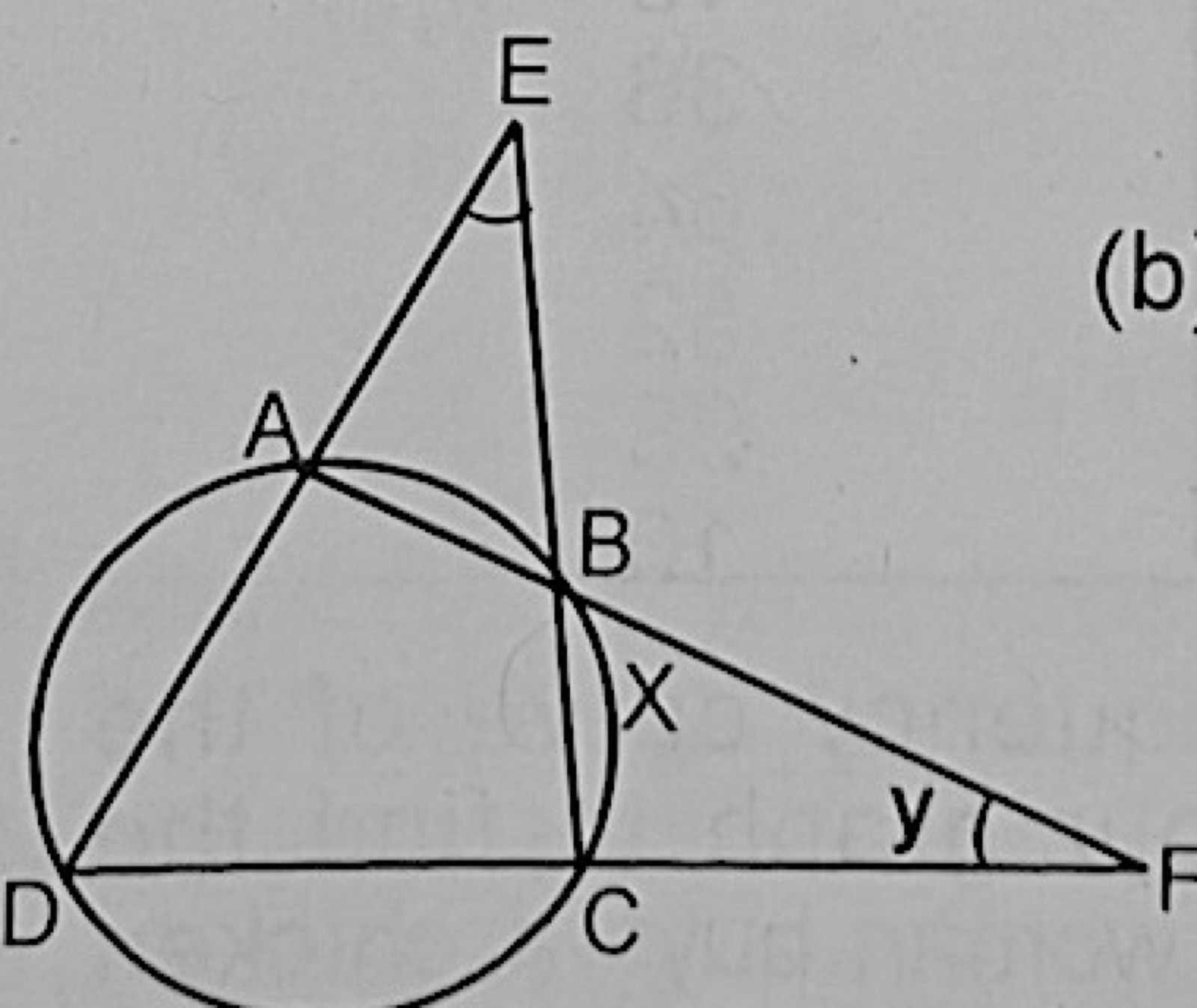
(a) The 9 equally likely sums are 3, 5, 7, 4, 6, 8, 5, 7, 9. Those greater than 3 and less than 7 are 5, 4, 6, 5: probability = 4/9.
(b) Let m = ∠AEB and x = ∠ABE = ∠CBF (vertically opposite).
Exterior angle of triangle ABE: ∠DAB = x + m. Exterior angle of triangle BCF: ∠DCB = x + y.
ABCD is cyclic, so (x + m) + (x + y) = 180°: 2x + 90° = 180°, x = 45°.
Use exterior angles of the two small triangles, then opposite angles of the cyclic quadrilateral.
The third term of a Geometric Progression (G.P) is 360 and the sixth term is 1215. Find the first four terms.
ar2 = 360 and ar5 = 1215. Divide: r3 = 1215/360 = 27/8, so r = 3/2.
a = 360 ÷ (3/2)2 = 360 × 4/9 = 160.
First four terms: 160, 240, 360, 540.
Dividing the two term equations removes a and leaves r³.
(a) A radio which a dealer bought for N6,000.00 and marked to give a profit of 30% was reduced in a sale by 10%. Find (i) the final sale price (ii) the percentage profit.
(b) Solve the equation 2(2x+1) − 9(2x) + 4 = 0
(a)(i) Marked price = 130% of N6,000 = N7,800. Sale price = 90% of N7,800 = N7,020.
(ii) Profit = 7,020 − 6,000 = N1,020; percentage profit = 1020/6000 × 100% = 17%.
(b) 22x+1 = 2(2x)2. Let y = 2x: 2y2 − 9y + 4 = 0, (2y − 1)(y − 4) = 0.
y = ½ or 4, so 2x = 2−1 or 22: x = −1 or x = 2.
Percentage profit is always worked out on the cost price.
(a) Copy and complete the table of values for the relation y = 5 − 7x − 6x2 for −3 ≤ x ≤ 2.
x: −3, −2, −1, −0.5, 0, 1, 2
y: −28, , 6, , 5, ,
(b) Using a scale of 2cm to 1 unit on the x-axis and 2cm to 5 units on the y-axis, draw the: (i) graph of y = 5 − 7x − 6x2 (ii) line y = 3 on the same axes.
(c) Use your graph to find the; (i) Roots of the equation 2 − 7x − 6x2 = 0 (ii) Maximum value of y = 5 − 7x − 6x2
(a) x = −2: y = −5; x = −0.5: y = 7; x = 1: y = −8; x = 2: y = −33 (with −28, 6 and 5 given).
(b) Plot the points, join with a smooth upside-down parabola, and draw the horizontal line y = 3.
(c)(i) 2 − 7x − 6x2 = 0 is the same as 5 − 7x − 6x2 = 3, so read x where the curve meets y = 3: x ≈ −1.4 and x ≈ 0.2 (exact: −1.40 and 0.24).
(ii) Maximum value ≈ 7.0 (at x ≈ −0.6).
Rewrite the new equation so one side matches the drawn curve; the other side is the line to draw.
Using a ruler and a pair of compasses only, construct (a) triangle QRT with |QR| = 8cm, |RT| = 5cm and |QT| = 4.5cm (b) a quadrilateral QRSP which has a common base QR with ΔQRT such that QTP is a straight line, PQ||SR, |QP| = 9cm and |RS| = 4.5cm (i) Measure |PS| (ii) Find the perpendicular distance between RS and PQ. (iii) What is QRSP?
(a) Draw QR = 8 cm. With centre Q radius 4.5 cm and centre R radius 5 cm draw arcs meeting at T; join QT and RT.
(b) Produce QT to P with QP = 9 cm. At R construct a line parallel to QP (copy ∠RQP at R on the same side) and mark S on it with RS = 4.5 cm. Join PS.
(i) |PS| ≈ 5.0 cm (TPSR is a parallelogram, so PS = TR = 5 cm).
(ii) Drop a perpendicular from R to QP: about 4.5 cm (calculated 4.55 cm).
(iii) QRSP is a trapezium (one pair of parallel sides, PQ ∥ SR).
Notice TP = 9 − 4.5 = 4.5 cm = RS, which makes TPSR a parallelogram — a useful check on the measurement.
A surveyor standing at a point X sights a pole Y due east of him and a tower Z of a building on a bearing of 046°. After walking to a point, W, a distance of 180m in the south-east direction, he observes the bearing of Z and Y to be 337° and 050° respectively. (a) Calculate, correct to the nearest metre (i) |XY| (ii) |ZW|. (b) If N is on XY such that XZ = ZN, find the bearing of Z from N.
(a)(i) In triangle XWY: ∠YXW = 45° (east to south-east), ∠XWY = (360 − 315) + 50 = 95° (X is on bearing 315° from W), so ∠XYW = 180 − 45 − 95 = 40°.
Sine rule: XY/sin 95° = 180/sin 40°, XY = 180 × 0.9962/0.6428 ≈ 279 m.
(ii) In triangle XWZ: ∠ZXW = 135 − 46 = 89°, ∠XWZ = 337 − 315 = 22°, so ∠XZW = 69°.
ZW/sin 89° = 180/sin 69°, ZW = 180 × 0.9998/0.9336 ≈ 193 m.
(b) ∠ZXN = 90 − 46 = 44°. XZ = ZN, so ∠ZNX = 44° too. From N, X is due west (270°), so the bearing of Z from N is 270° + 44° = 314°.
Draw a clear sketch with north lines at X and W before finding any angles.
In the diagram, ASRTB represents a piece of string passing over a pulley of radius 10cm in a vertical plane. O is the centre of the pulley and AMB is a horizontal straight line touching the pulley at M. Angle SAB = 90° and angle TBA = 60°.
(a) Calculate (i) the obtuse angle SOT, (ii) arc SRT (iii) |BT|.
(b) Find, correct to the nearest cm, the length of the string. [Take π = 22/7].
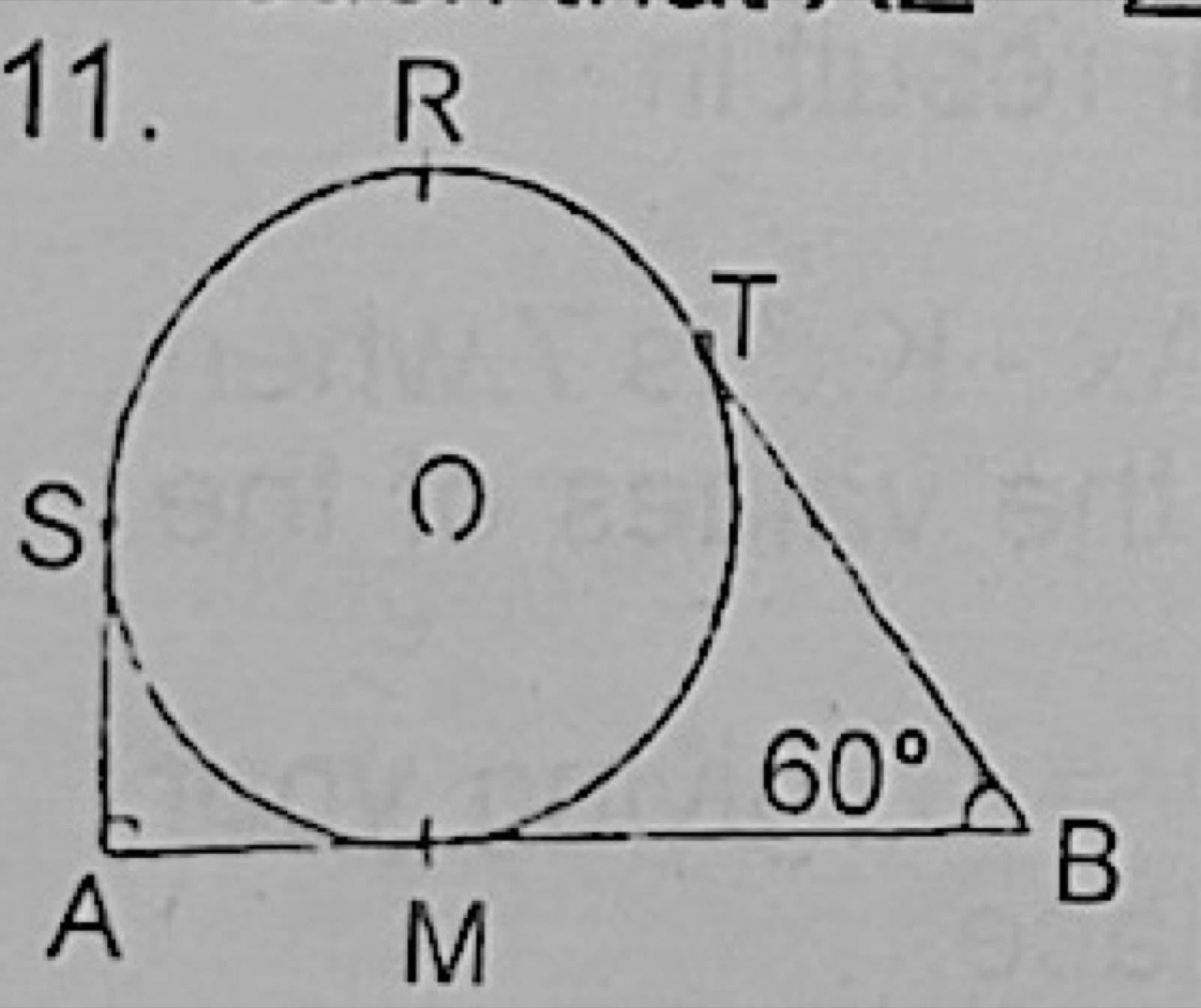
(a)(i) ASOM is a square (radii meet tangents at 90°), so ∠SOM = 90°. In OMBT, ∠MOT = 360 − 90 − 90 − 60 = 120°. Obtuse ∠SOT = 360 − 90 − 120 = 150°.
(ii) Arc SRT = 150/360 × 2 × 22/7 × 10 ≈ 26.19 cm.
(iii) OB bisects ∠TBM, so ∠OBT = 30° and BT = 10/tan 30° = 10√3 ≈ 17.32 cm.
(b) String = AS + arc SRT + TB = 10 + 26.19 + 17.32 = 53.51 ≈ 54 cm.
Tangents from a point are equal, and a radius meets a tangent at 90°.
The table below shows the number of eggs laid by chicken in a man's farm in a year.
No. of Eggs Per Year: 45–49, 50–54, 55–59, 60–64, 65–69, 70–74
No. of Chicken: 10, 36, 64, 52, 28, 10
(a) Draw a cumulative frequency curve of the distribution. (b) Use your graph to find the interquartile range. (c) If a woman buys a chicken from the farm, what is the probability that the chicken lays at least 60 eggs in a year?
(a) Upper class boundaries 49.5, 54.5, 59.5, 64.5, 69.5, 74.5 with cumulative frequencies 10, 46, 110, 162, 190, 200; plot (44.5, 0) and these points and draw a smooth curve.
(b) Q1 at 50th chicken ≈ 54.5 + 4/64 × 5 ≈ 54.8; Q3 at 150th ≈ 59.5 + 40/52 × 5 ≈ 63.3. Interquartile range ≈ 63.3 − 54.8 ≈ 8.5 (accept values read from the graph).
(c) Chickens laying 60 or more eggs = 52 + 28 + 10 = 90, so P = 90/200 = 9/20 = 0.45.
For quartiles of 200 items, read across at 50 and 150 on the cumulative frequency axis.