WAEC Mathematics 1992 past questions and answers

58 questions. Try each one, then open the answer to check yourself and read the explanation.

Question 1

Sets

Let U = {1, 2, 3, 4}, P = {2, 3} and Q = {2, 4}. What is (P∩Q)'?

  1. A.{1, 2, 3}
  2. B.{1, 3, 4}
  3. C.{2, 3}
  4. D.{1, 3}
  5. E.{1, 4}
Show the answer and explanation

Answer: B ({1, 3, 4})

Explanation

P∩Q = {2}. Its complement is every element of U except 2, which is {1, 3, 4}.

Open this question

Question 2

Fractions, Decimals and Approximation

Simplify (3/4 + 1/3) × 4⅓ ÷ 3¼

  1. A.1/3
  2. B.13/12
  3. C.10/9
  4. D.17/12
  5. E.13/9
Show the answer and explanation

Answer: E (13/9)

Explanation

3/4 + 1/3 = 13/12. Then 13/12 × 13/3 = 169/36, and 169/36 ÷ 13/4 = 169/36 × 4/13 = 13/9.

Open this question

Question 3

Inequalities

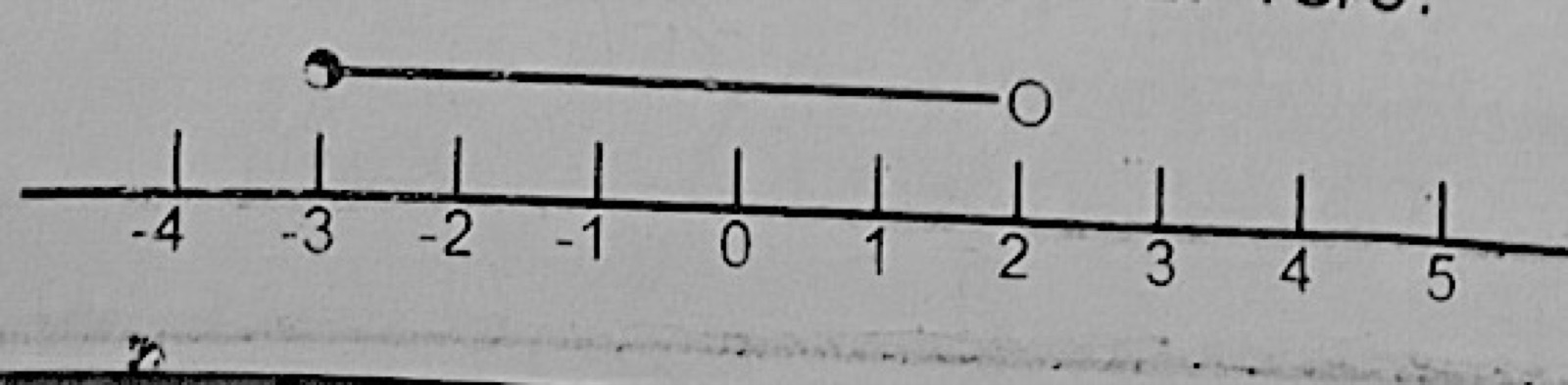
If x varies over the set of real numbers, which of the following is illustrated in the diagram above?

Diagram for this question
  1. A.−3 < x ≤ 2
  2. B.−3 ≤ x < 2
  3. C.−3 < x < 2
  4. D.−3 ≤ x ≤ 2
  5. E.x ≥ 2
Show the answer and explanation

Answer: B (−3 ≤ x < 2)

Explanation

The shaded (filled) dot at −3 means −3 is included; the open circle at 2 means 2 is not included. So −3 ≤ x < 2.

Open this question

Question 4

Number Bases

Convert 77 to a number in base two

  1. A.1001101
  2. B.111001
  3. C.100110
  4. D.10101
  5. E.10011
Show the answer and explanation

Answer: A (1001101)

Explanation

77 = 64 + 8 + 4 + 1 = 26 + 23 + 22 + 20, which is 1001101 in base two.

Open this question

Question 5

Ratio, Percentages and Rates

A bricklayer measured the length of a wall and obtained 4.10m. If the actual length of the wall is 4.25m, find his percentage error.

  1. A.3 9/17%
  2. B.3 27/41%
  3. C.15%
  4. D.35 5/17%
  5. E.36 24/41%
Show the answer and explanation

Answer: A (3 9/17%)

Explanation

Error = 4.25 − 4.10 = 0.15m. Percentage error = 0.15/4.25 × 100 = 300/85 = 3 9/17%.

Open this question

Question 6

Progressions

The nth term of a sequence is given by 3.2n−2. Write down the first three terms of the sequence.

  1. A.2/3, 0, 6
  2. B.3/2, 3, 6
  3. C.2/3, 3, 8/3
  4. D.2/3, 3/4, 6
  5. E.2/3, 3, 1/3
Show the answer and explanation

Answer: B (3/2, 3, 6)

Explanation

The nth term is 3 × 2n−2. n = 1 gives 3 × 2−1 = 3/2; n = 2 gives 3 × 1 = 3; n = 3 gives 3 × 2 = 6.

Open this question

Question 8

Logarithms

Evaluate log1025 + log1032 − log108

  1. A.0.2
  2. B.2
  3. C.100
  4. D.409
  5. E.490
Show the answer and explanation

Answer: B (2)

Explanation

Combine the logs: log10(25 × 32 ÷ 8) = log10100 = 2.

Open this question

Question 9

Algebraic Expressions

Factorize the expression 2y2 + xy − 3x2

  1. A.2y(y + x) − 3x2
  2. B.(2y − x)(2y + x)
  3. C.(3x − 2y)(x − y)
  4. D.(2y + 3x)(y − x)
  5. E.(x − y)(2y + 3x)
Show the answer and explanation

Answer: D ((2y + 3x)(y − x))

Explanation

Split xy as 3xy − 2xy: 2y2 − 2xy + 3xy − 3x2 = 2y(y − x) + 3x(y − x) = (2y + 3x)(y − x).

Open this question

Question 10

Quadratic Equations

Construct a quadratic equation whose roots are −½ and 2.

  1. A.3x2 − 3x + 2 = 0
  2. B.3x2 + 3x − 2 = 0
  3. C.2x2 + 3x − 2 = 0
  4. D.2x2 − 3x + 2 = 0
  5. E.2x2 − 3x − 2 = 0
Show the answer and explanation

Answer: E (2x2 − 3x − 2 = 0)

Explanation

(x + ½)(x − 2) = 0, or (2x + 1)(x − 2) = 0, which expands to 2x2 − 3x − 2 = 0.

Open this question

Question 12

Quadratic Equations

What must be added to the expression x2 − 18x to make it a perfect square?

  1. A.3
  2. B.9
  3. C.36
  4. D.72
  5. E.81
Show the answer and explanation

Answer: E (81)

Explanation

Add the square of half the coefficient of x: (18/2)2 = 81, giving (x − 9)2.

Open this question

Question 13

Linear and Simultaneous Equations

Solve the equation m/3 + 1/2 = 3/4 + m/4

  1. A.−3
  2. B.−2
  3. C.2
  4. D.3
  5. E.4
Show the answer and explanation

Answer: D (3)

Explanation

Multiply through by 12: 4m + 6 = 9 + 3m, so m = 3.

Open this question

Question 14

Mensuration of Solids

The angle of a sector of a circle of radius 8cm is 240°. This sector is bent to form a cone. Find the radius of the base of the cone.

  1. A.16/3cm
  2. B.15/3cm
  3. C.16/5cm
  4. D.8/3cm
  5. E.16/10cm
Show the answer and explanation

Answer: A (16/3cm)

Explanation

The arc becomes the base circumference: (240/360) × 2π × 8 = 2πr, so r = (2/3) × 8 = 16/3 cm.

Open this question

Question 15

Mensuration of Solids

The curved surface area of a cylinderical tin is 704cm2. Calculate the height when the radius is 8cm. (Take π = 22/7)

  1. A.3.5cm
  2. B.7cm
  3. C.14cm
  4. D.28cm
  5. E.32cm
Show the answer and explanation

Answer: C (14cm)

Explanation

Curved surface area = 2πrh, so 2 × 22/7 × 8 × h = 704, giving h = 704 × 7 ÷ 352 = 14 cm.

Open this question

Question 16

Mensuration of Solids

The volume of a cone of height 9cm is 1848cm3. Find its radius. (Take π = 22/7).

  1. A.7cm
  2. B.14cm
  3. C.28cm
  4. D.98cm
  5. E.196cm
Show the answer and explanation

Answer: B (14cm)

Explanation

V = ⅓πr2h: ⅓ × 22/7 × r2 × 9 = 1848, so r2 = 1848 × 7 ÷ 66 = 196 and r = 14 cm.

Open this question

Question 17

Mensuration of Plane Shapes

The area of a parallelogram is 513cm2 and the height is 19cm. Calculate the base.

  1. A.13.5cm
  2. B.25cm
  3. C.27cm
  4. D.54cm
  5. E.108cm
Show the answer and explanation

Answer: C (27cm)

Explanation

Area = base × height, so base = 513 ÷ 19 = 27 cm.

Open this question

Question 18

Mensuration of Plane Shapes

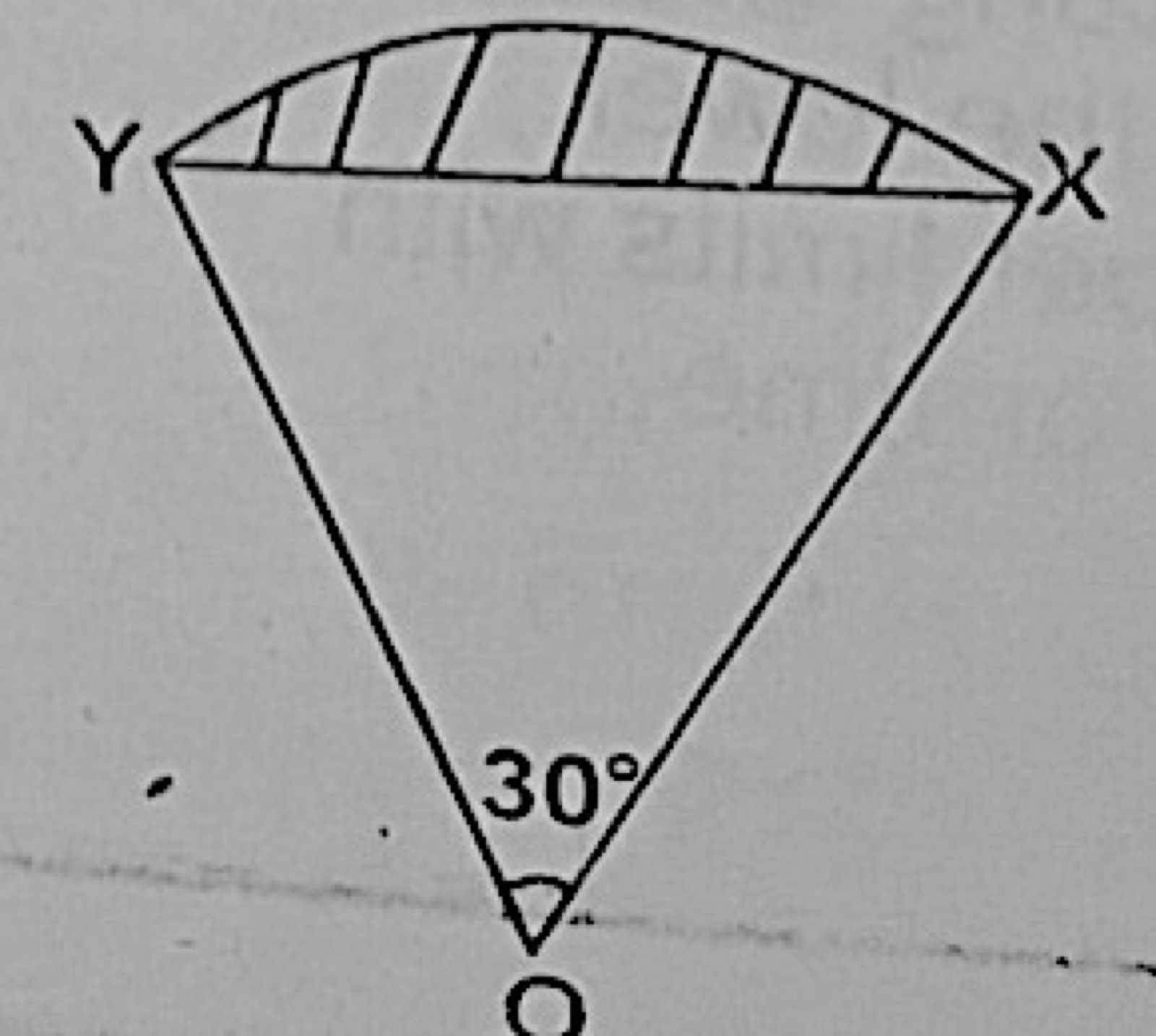
The diagram below shows the shaded segment of a circle of radius 7cm. If the area of the triangle OXY is 12¼cm2, calculate the area of the segment. (Take π = 22/7)

Diagram for this question
  1. A.5/12cm2
  2. B.7/12cm2
  3. C.11/6cm2
  4. D.2 1/3cm2
  5. E.6 1/6cm2
Show the answer and explanation

Answer: B (7/12cm2)

Explanation

Sector area = (30/360) × 22/7 × 7 × 7 = 77/6 = 12 5/6 cm2. Segment = sector − triangle = 12 5/6 − 12¼ = 7/12 cm2.

Open this question

Question 19

Circle Theorems

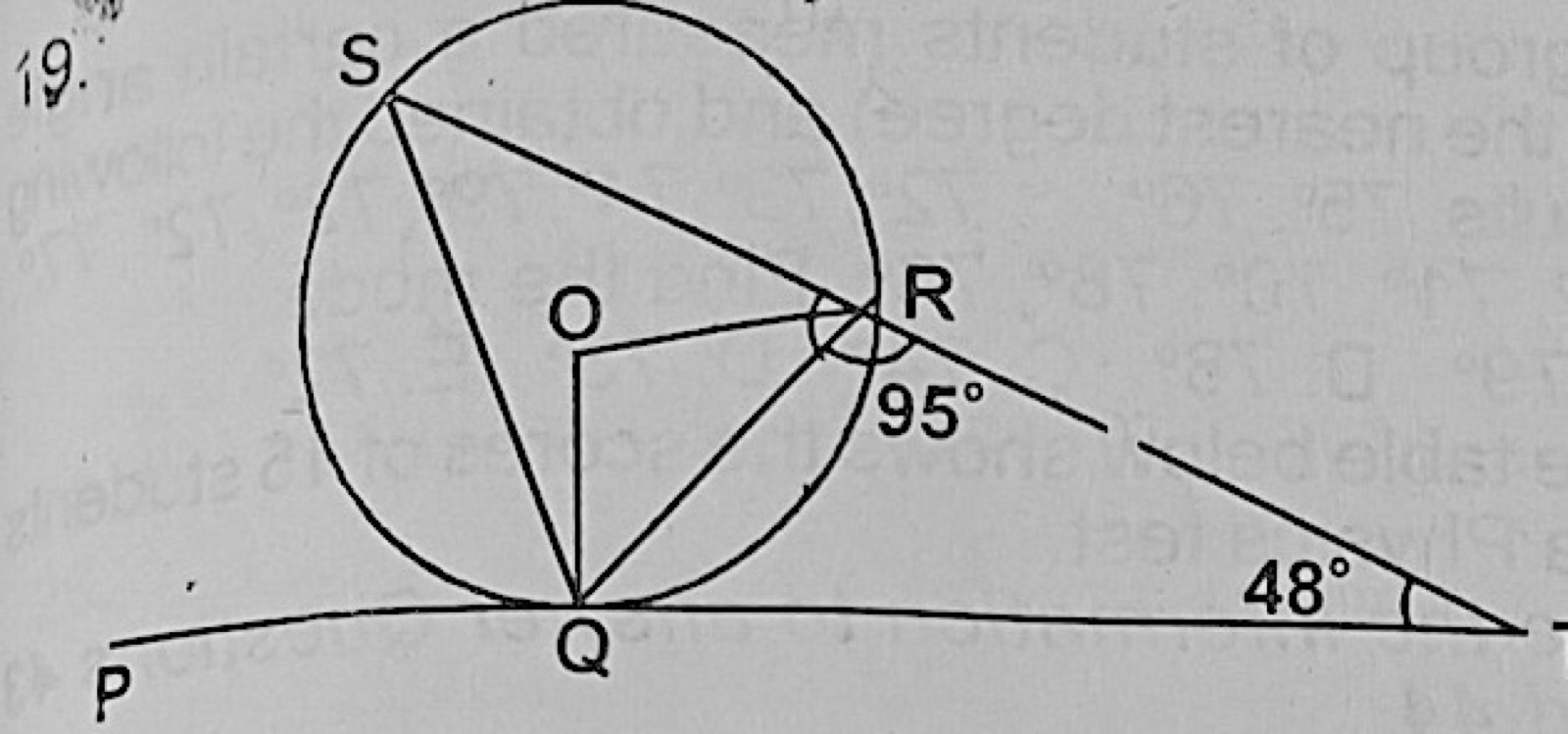
In the diagram above PQT is a tangent to the circle QRS at Q. Angle QTR = 48° and ∠QRT = 95°. Find ∠QSR

Diagram for this question
  1. A.48°
  2. B.45°
  3. C.37°
  4. D.32°
  5. E.30°
Show the answer and explanation

Answer: C (37°)

Explanation

In triangle QRT, ∠RQT = 180° − 48° − 95° = 37°. By the alternate segment theorem, ∠QSR = ∠RQT = 37°.

Open this question

Question 20

Circle Theorems

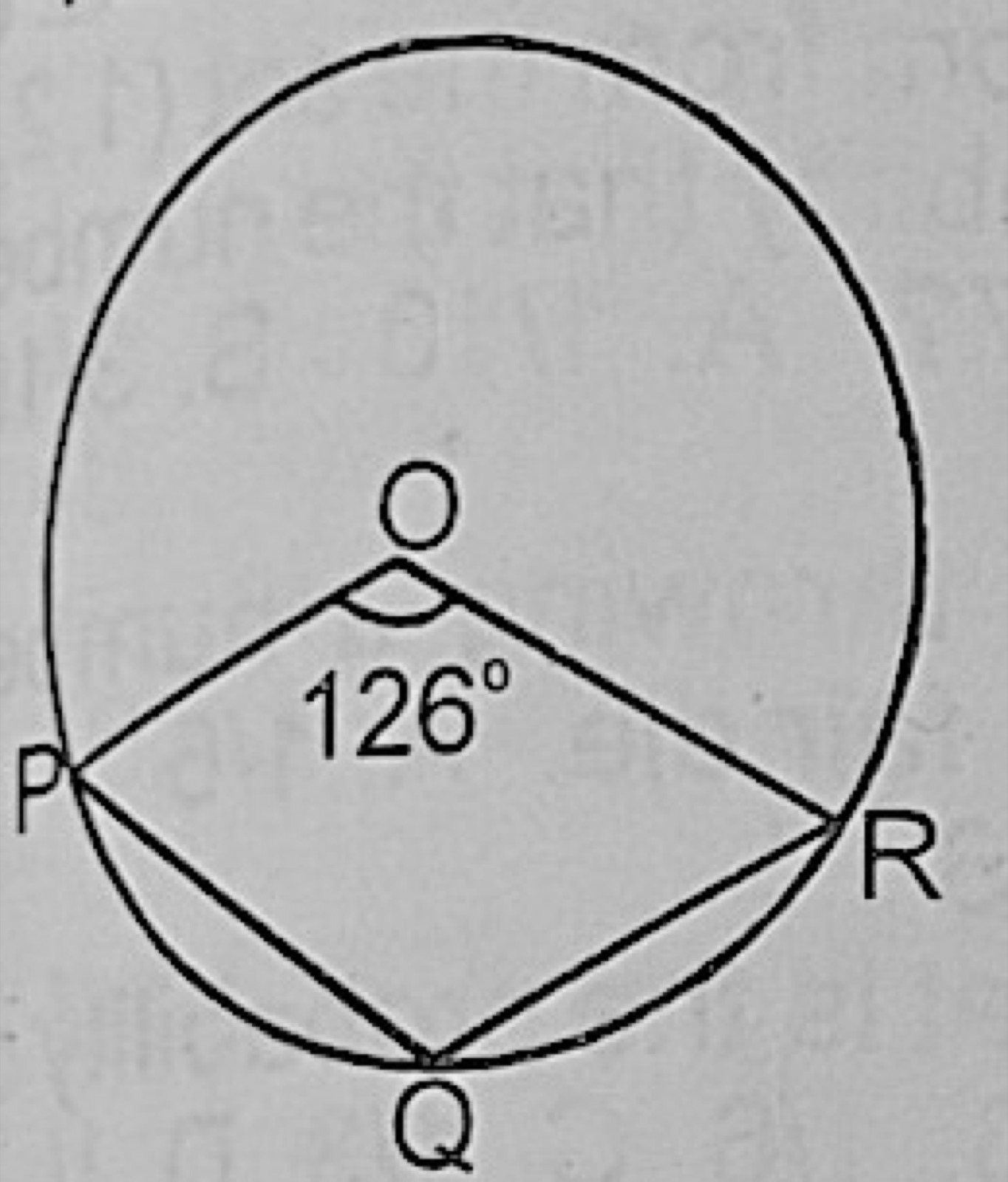
In the diagram below, O is the centre of the circle and ∠POR = 126°. Find ∠PQR.

Diagram for this question
  1. A.234°
  2. B.117°
  3. C.72°
  4. D.63°
  5. E.54°
Show the answer and explanation

Answer: B (117°)

Explanation

The 126° angle faces Q, so the arc PR not containing Q has central angle 360° − 126° = 234°. ∠PQR is half of that: 117°.

Open this question

Question 21

Triangles and Quadrilaterals

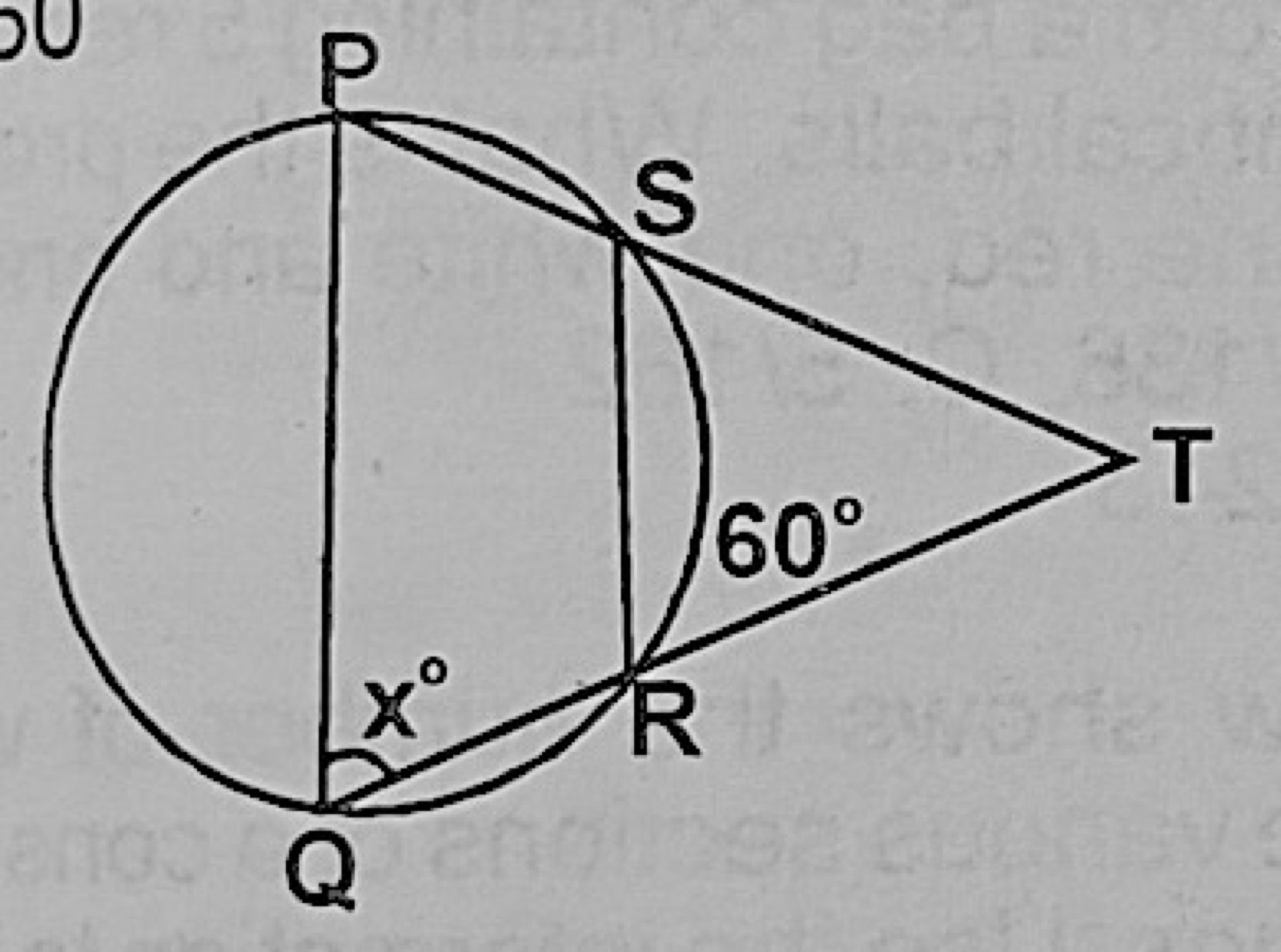
In the diagram below, TR = TS and ∠TRS = 60°. Find the value of x.

Diagram for this question
  1. A.30
  2. B.45
  3. C.60
  4. D.120
  5. E.150
Show the answer and explanation

Answer: C (60)

Explanation

TR = TS with ∠TRS = 60° makes triangle RST equilateral, so ∠RST = 60° and ∠PSR = 180° − 60° = 120°. PSRQ is cyclic, so x = 180° − 120° = 60°.

Open this question

Question 22

Circle Theorems

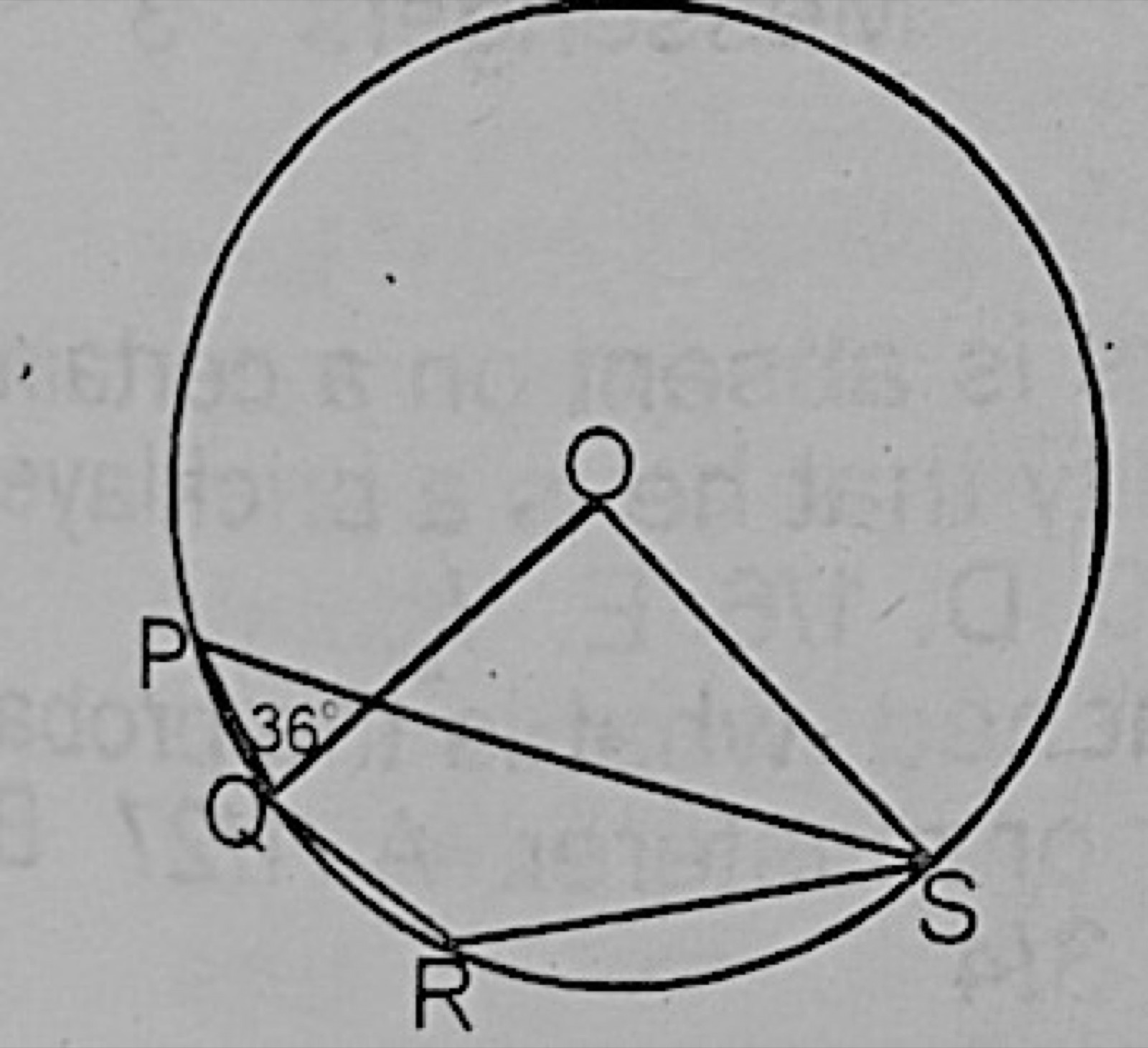
In the diagram below, O is the centre of the circle PQRS and ∠QPS = 36°. Find ∠QOS

Diagram for this question
  1. A.36°
  2. B.72°
  3. C.108°
  4. D.144°
  5. E.288°
Show the answer and explanation

Answer: B (72°)

Explanation

The angle at the centre is twice the angle at the circumference on the same arc: ∠QOS = 2 × 36° = 72°.

Open this question

Question 23

Circle Theorems

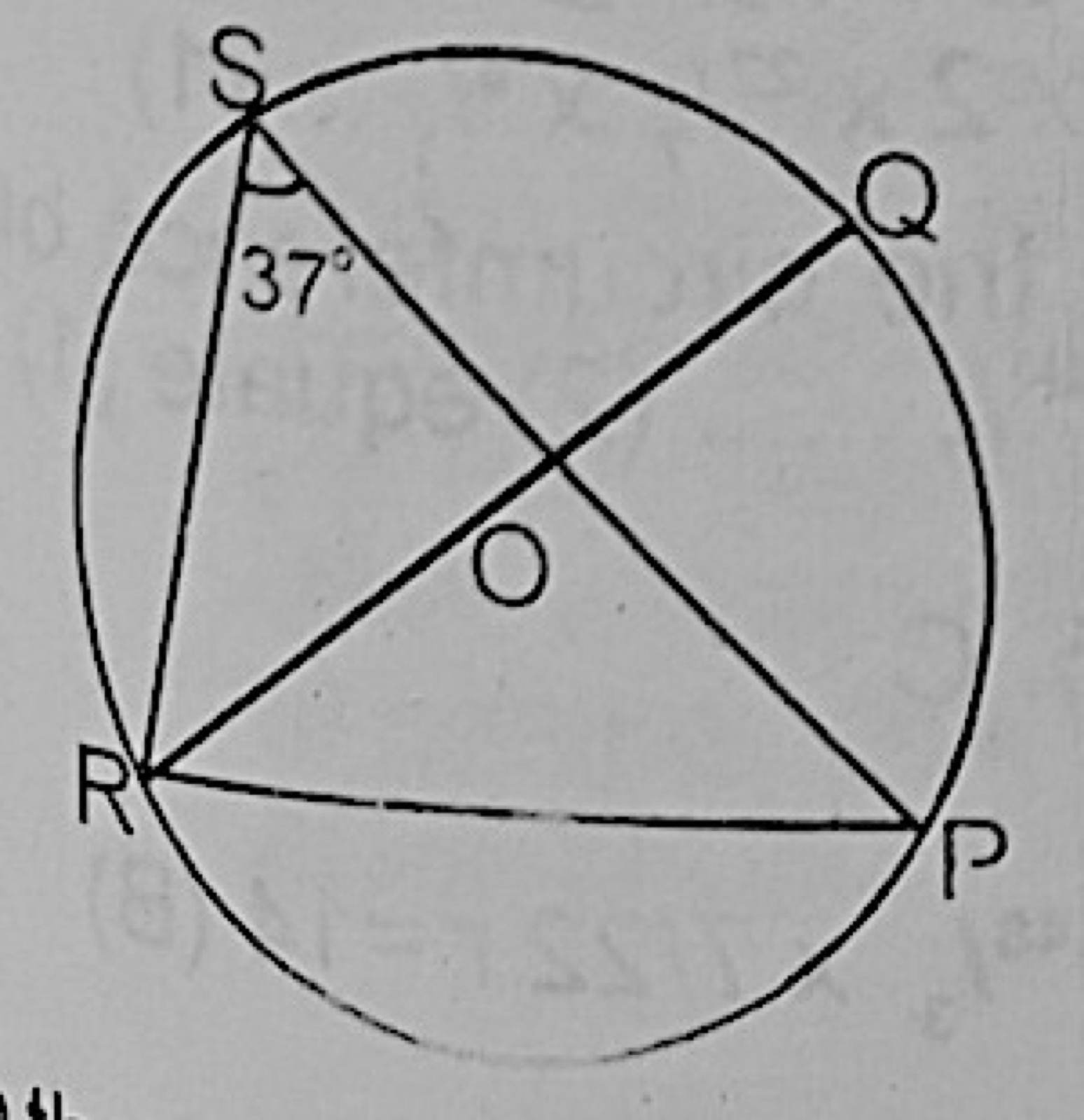
In the diagram below, O is the centre of the circle. QOR is a diameter and ∠PSR is 37°. Find ∠PRQ.

Diagram for this question
  1. A.37°
  2. B.53°
  3. C.65°
  4. D.127°
  5. E.147°
Show the answer and explanation

Answer: B (53°)

Explanation

∠PQR = ∠PSR = 37° (angles in the same segment) and ∠QPR = 90° (angle in a semicircle). So ∠PRQ = 180° − 90° − 37° = 53°.

Open this question

Question 24

Angles and Polygons

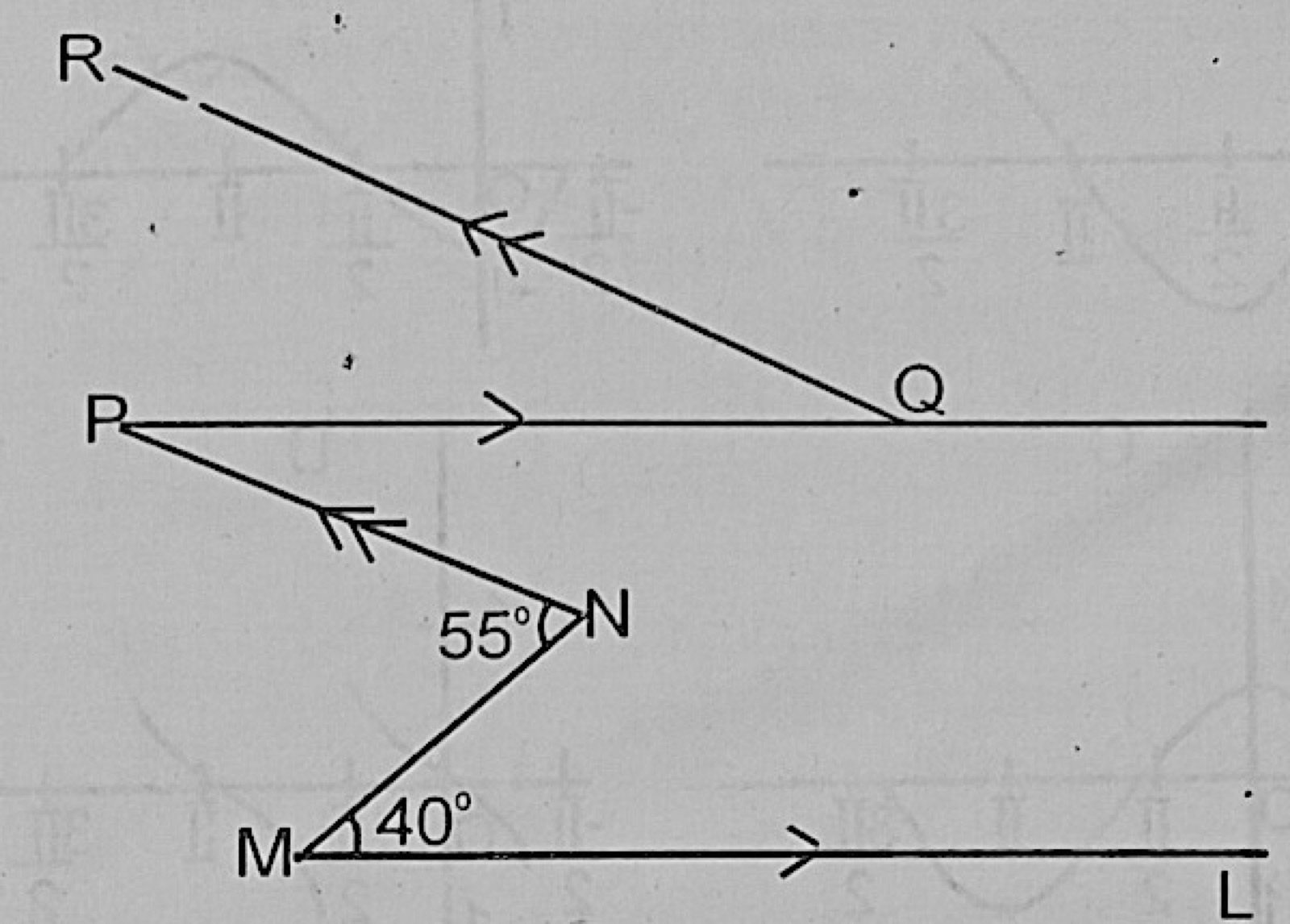
In the diagram below, ML//PQ and NP//QR. If ∠LMN = 40° and ∠MNP = 55°. Find ∠QPR

Diagram for this question
  1. A.15°
  2. B.25°
  3. C.35°
  4. D.40°
  5. E.55°
Show the answer and explanation

Answer: A (15°)

Explanation

Draw a line through N parallel to ML and PQ: it splits the 55° angle into 40° (alternate to ∠LMN) and 15°, so NP makes 15° with PQ. Since QR is parallel to NP, the angle between QR and PQ is also 15°.

Open this question

Question 25

Triangles and Quadrilaterals

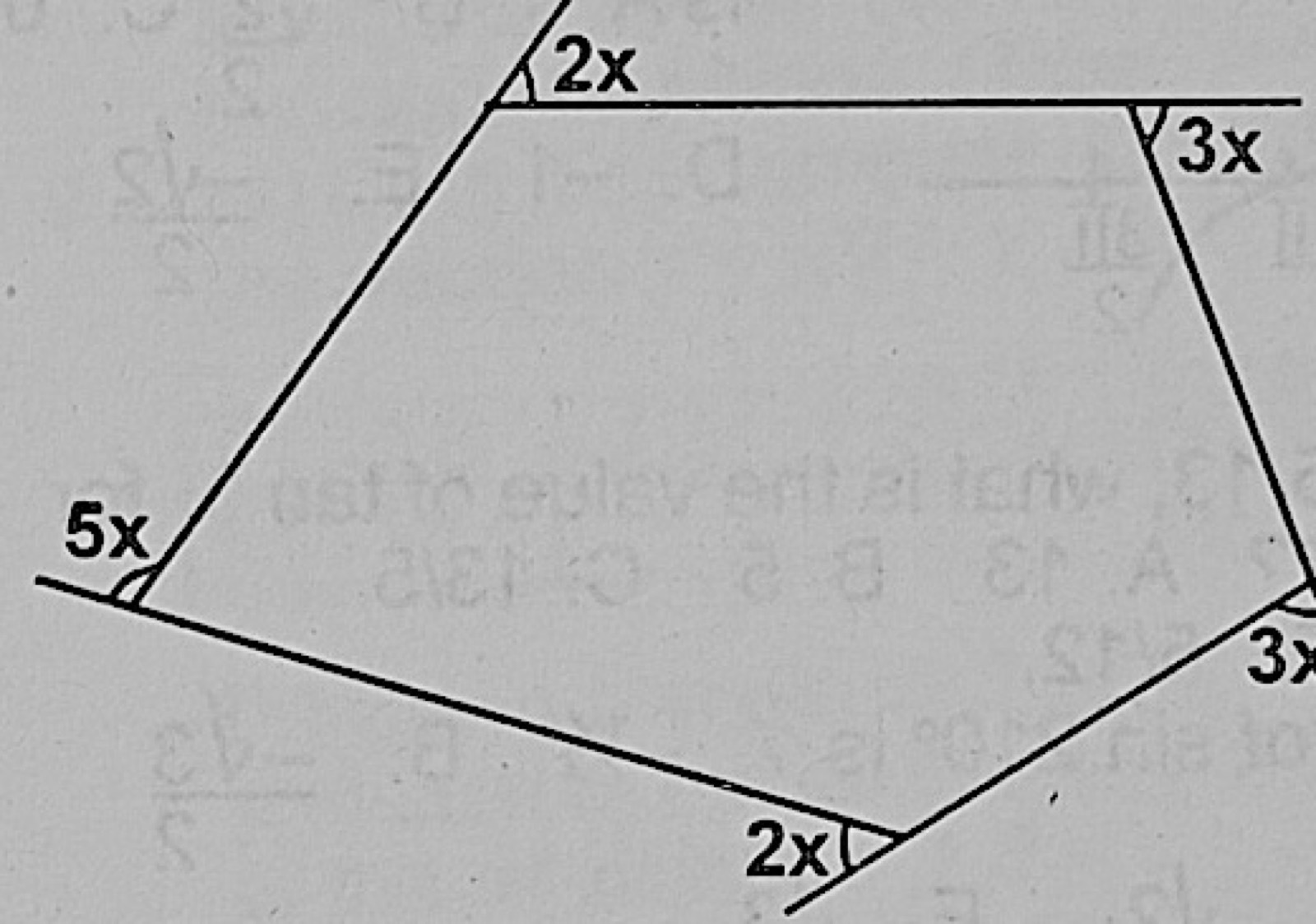
The angles marked in the diagram below are measured in degrees. Find x

Diagram for this question
  1. A.15°
  2. B.24°
  3. C.30°
  4. D.36°
  5. E.48°
Show the answer and explanation

Answer: B (24°)

Explanation

The marked angles are the exterior angles of the pentagon, which add up to 360°: 2x + 3x + 5x + 3x + 2x = 15x = 360°, so x = 24°.

Open this question

Question 26

Triangles and Quadrilaterals

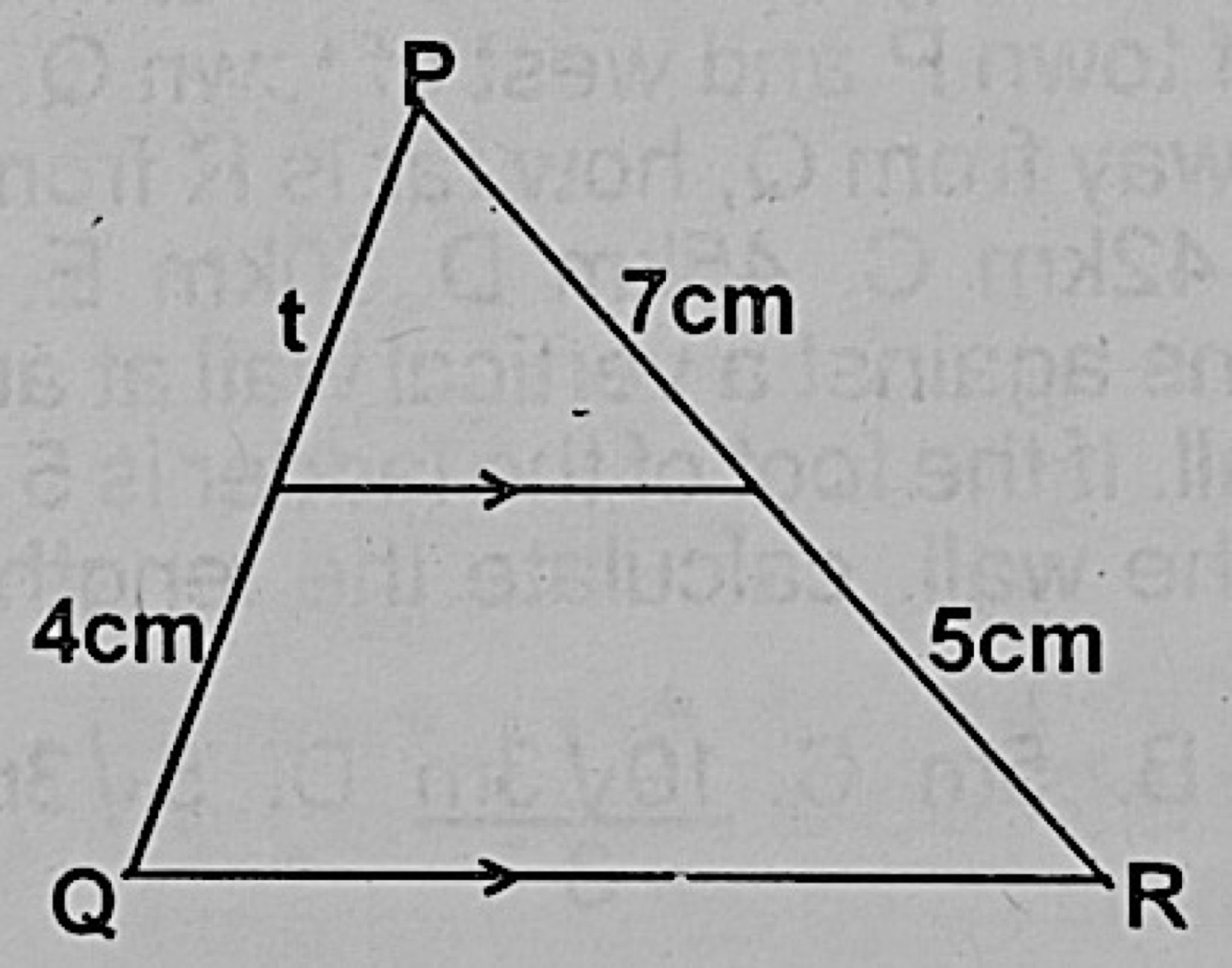
Find the value of t in the diagram below.

Diagram for this question
  1. A.5.6cm
  2. B.6.5cm
  3. C.6.6cm
  4. D.6.8cm
  5. E.7.0cm
Show the answer and explanation

Answer: A (5.6cm)

Explanation

The line parallel to QR divides the two sides in the same ratio: t/4 = 7/5, so t = 28/5 = 5.6 cm.

Open this question

Question 27

Angles and Polygons

A regular polygon has each of its exterior angles as 18°. How many sides has the polygon?

  1. A.10
  2. B.11
  3. C.12
  4. D.20
  5. E.24
Show the answer and explanation

Answer: D (20)

Explanation

Exterior angles of a polygon add up to 360°, so the number of sides = 360° ÷ 18° = 20.

Open this question

Question 28

Angles and Polygons

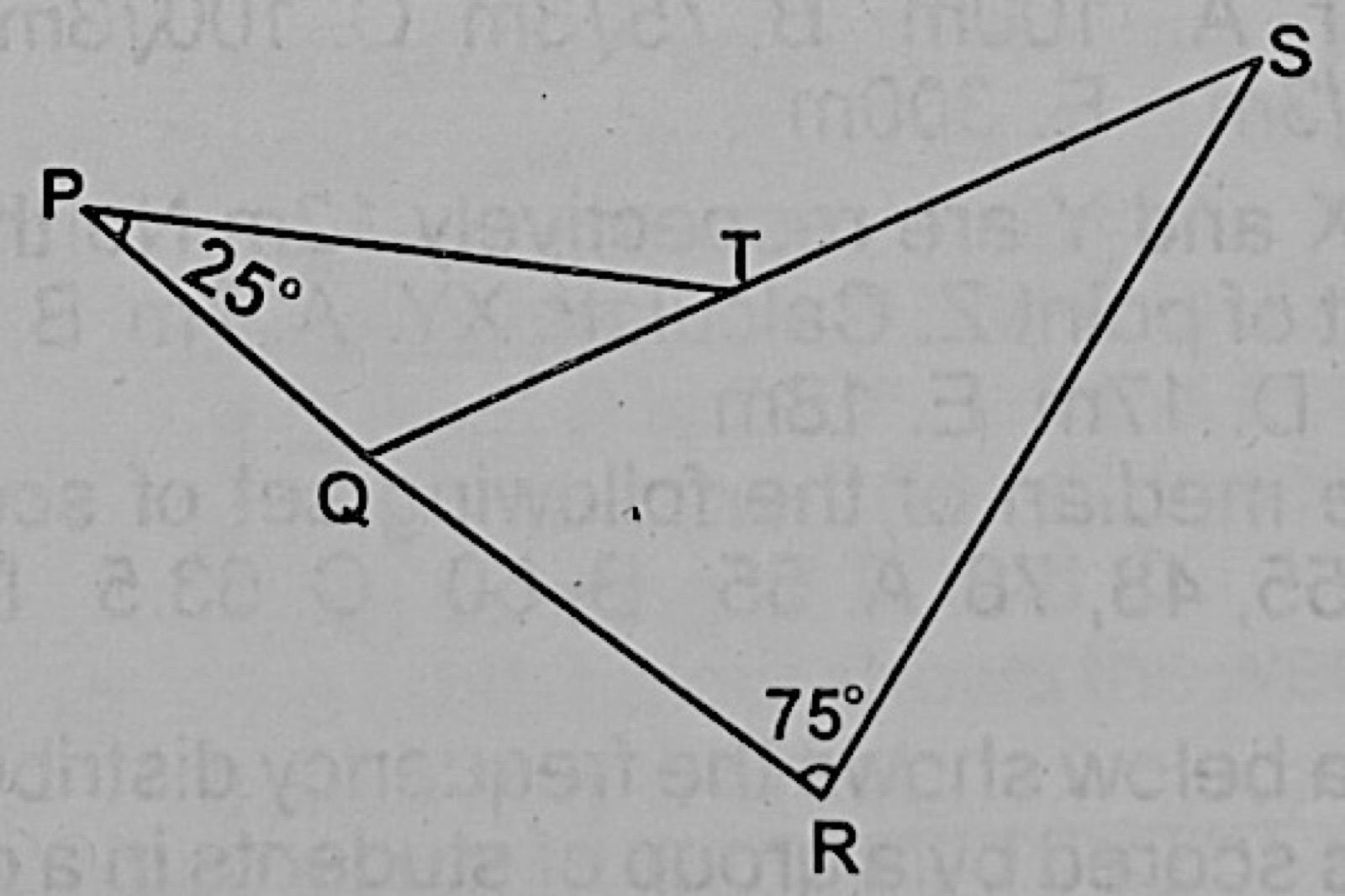
In the diagram above, PQT is an isosceles triangle. |PQ| = |QT|, ∠SRQ = 75°, ∠QPT = 25° and PQR is a straight line. Find ∠RST.

Diagram for this question
  1. A.20°
  2. B.50°
  3. C.55°
  4. D.70°
  5. E.75°
Show the answer and explanation

Answer: C (55°)

Explanation

PQ = QT, so ∠QTP = 25° and the exterior angle ∠TQR = 25° + 25° = 50°. In triangle QRS, ∠RST = 180° − 50° − 75° = 55°.

Open this question

Question 29

Trigonometry

Sin 60° has the same value as I. sin 120° II. cos 240° III. −sin 150° IV. cos 210° V. sin 240°

  1. A.I only
  2. B.II only
  3. C.IV only
  4. D.III only
  5. E.IV and V only
Show the answer and explanation

Answer: A (I only)

Explanation

sin 60° = √3/2. sin 120° = sin 60° = √3/2; cos 240° = −½, −sin 150° = −½, cos 210° = −√3/2 and sin 240° = −√3/2. Only I matches.

Open this question

Question 30

Trigonometry

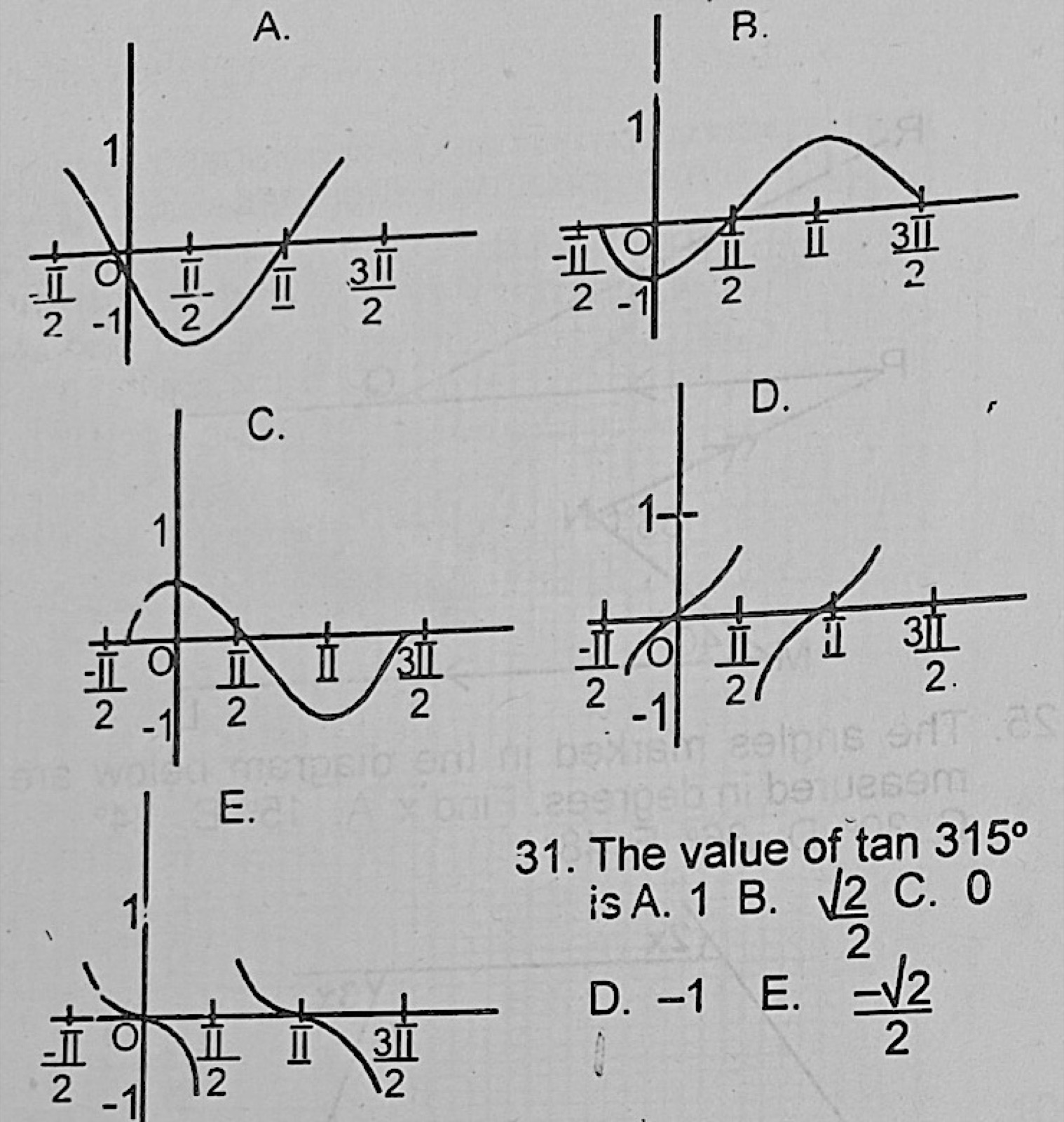
Which of the following is the graph of cos θ?

Diagram for this question
  1. A.Graph A
  2. B.Graph B
  3. C.Graph C
  4. D.Graph D
  5. E.Graph E
Show the answer and explanation

Answer: C (Graph C)

Explanation

cos θ equals 1 at θ = 0, 0 at π/2, −1 at π and 0 again at 3π/2. Graph C is the only one with this shape.

Open this question

Question 31

Trigonometry

The value of tan 315° is

  1. A.1
  2. B.√2/2
  3. C.0
  4. D.−1
  5. E.−√2/2
Show the answer and explanation

Answer: D (−1)

Explanation

315° is in the fourth quadrant where tangent is negative, and its reference angle is 45°, so tan 315° = −tan 45° = −1.

Open this question

Question 32

Trigonometry

If cos θ = 5/13, what is the value of tan θ for 0 < θ < 90°?

  1. A.13
  2. B.5
  3. C.13/5
  4. D.12/5
  5. E.5/12
Show the answer and explanation

Answer: D (12/5)

Explanation

With adjacent side 5 and hypotenuse 13, the opposite side is √(169 − 25) = 12, so tan θ = 12/5.

Open this question

Question 33

Trigonometry

The value of sin 210° is

  1. A.−½
  2. B.−√3/2
  3. C.½
  4. D.√2/2
  5. E.√3/2
Show the answer and explanation

Answer: A (−½)

Explanation

210° is in the third quadrant where sine is negative, with reference angle 30°: sin 210° = −sin 30° = −½.

Open this question

Question 34

Bearings

Town P is on bearing 315° from town Q while town R is south of town P and west of town Q. If town R is 60km away from Q, how far is R from P?

  1. A.30km
  2. B.42km
  3. C.45km
  4. D.60km
  5. E.120km
Show the answer and explanation

Answer: D (60km)

Explanation

R, P and Q form a right angle at R, and the bearing 315° (north-west) makes the angle at Q 45°. The triangle is isosceles, so RP = RQ = 60 km.

Open this question

Question 35

Trigonometry

A ladder leans against a vertical wall at an angle 60° to the wall. If the foot of the ladder is 5 metres away from the wall, calculate the length of the ladder.

  1. A.5√3/3 m
  2. B.5m
  3. C.10√3/3 m
  4. D.5√3m
  5. E.10m
Show the answer and explanation

Answer: C (10√3/3 m)

Explanation

The 5 m distance is opposite the 60° angle at the wall: sin 60° = 5/L, so L = 5 ÷ (√3/2) = 10/√3 = 10√3/3 m.

Open this question

Question 37

Bearings

Points X and Y are respectively 12m North and 5m East of point Z. Calculate XY.

  1. A.7m
  2. B.12m
  3. C.13m
  4. D.17m
  5. E.18m
Show the answer and explanation

Answer: C (13m)

Explanation

The angle at Z is 90°, so XY = √(122 + 52) = √169 = 13 m.

Open this question

Question 38

Measures of Central Tendency

Find the median of the following set of scores: 65, 72, 55, 48, 78

  1. A.55
  2. B.60
  3. C.63.5
  4. D.65
  5. E.72
Show the answer and explanation

Answer: D (65)

Explanation

In order: 48, 55, 65, 72, 78. The middle score is 65.

Open this question

Question 39

Measures of Central Tendency

The data below shows the frequency distribution of marks scored by a group of students in a class test.
Marks: 2, 3, 4, 5, 6
Frequency: 2, 4, 5, 3, 1
How many students took the test?

  1. A.13
  2. B.14
  3. C.15
  4. D.18
  5. E.20
Show the answer and explanation

Answer: C (15)

Explanation

Add the frequencies: 2 + 4 + 5 + 3 + 1 = 15.

Open this question

Question 40

Measures of Central Tendency

The data below shows the frequency distribution of marks scored by a group of students in a class test.
Marks: 2, 3, 4, 5, 6
Frequency: 2, 4, 5, 3, 1
What is the modal score.

  1. A.2
  2. B.3
  3. C.4
  4. D.5
  5. E.6
Show the answer and explanation

Answer: C (4)

Explanation

The mode is the score with the highest frequency: 4 (frequency 5).

Open this question

Question 41

Measures of Central Tendency

The data below shows the frequency distribution of marks scored by a group of students in a class test.
Marks: 2, 3, 4, 5, 6
Frequency: 2, 4, 5, 3, 1
Find the mean mark.

  1. A.1
  2. B.1.3
  3. C.2
  4. D.3
  5. E.3.8
Show the answer and explanation

Answer: E (3.8)

Explanation

Σfx = 4 + 12 + 20 + 15 + 6 = 57 and Σf = 15, so the mean = 57 ÷ 15 = 3.8.

Open this question

Question 42

Measures of Central Tendency

A group of students measured a certain angle (to the nearest degree) and obtained the following results: 75°, 76°, 72°, 73°, 74°, 79°, 72°, 72°, 77°, 72°, 71°, 70°, 78°, 73°. Find the mode

  1. A.79°
  2. B.78°
  3. C.74°
  4. D.73°
  5. E.72°
Show the answer and explanation

Answer: E (72°)

Explanation

72° occurs four times, more than any other value, so it is the mode.

Open this question

Question 43

Measures of Central Tendency

The table below shows the scores of 15 students in a Physics test.
Marks: 1, 2, 3, 4, 5, 6, 7, 8, 9, 10
No. of Students: 1, 3, 2, 0, 1, 6, 1, 0, 1, 0
How many students scored at least 5?

  1. A.1
  2. B.6
  3. C.8
  4. D.9
  5. E.14
Show the answer and explanation

Answer: D (9)

Explanation

Add the students scoring 5 or more: 1 + 6 + 1 + 0 + 1 + 0 = 9.

Open this question

Question 44

Measures of Central Tendency

The table below shows the scores of 15 students in a Physics test.
Marks: 1, 2, 3, 4, 5, 6, 7, 8, 9, 10
No. of Students: 1, 3, 2, 0, 1, 6, 1, 0, 1, 0
Find the median score

  1. A.1
  2. B.5
  3. C.6
  4. D.7
  5. E.8
Show the answer and explanation

Answer: C (6)

Explanation

The median is the 8th of the 15 scores. Cumulative totals: 1, 4, 6, 6, 7, 13…, so the 8th score falls in mark 6.

Open this question

Question 45

Probability

A number is chosen at random from the set {1, 2, 3, ….., 9, 10}. What is the probability that the number is greater than or equal to 7?

  1. A.1/10
  2. B.3/10
  3. C.2/5
  4. D.3/5
  5. E.7/10
Show the answer and explanation

Answer: C (2/5)

Explanation

The numbers 7, 8, 9 and 10 qualify: 4 out of 10, which is 2/5.

Open this question

Question 46

Probability

What is the probability of throwing a number greater than 2 with a single fair die.

  1. A.1/6
  2. B.1/3
  3. C.1/2
  4. D.2/3
  5. E.5/6
Show the answer and explanation

Answer: D (2/3)

Explanation

3, 4, 5 and 6 are greater than 2: 4 out of 6 = 2/3.

Open this question

Question 47

Probability

A fair die is rolled once. What is the probability of obtaining 4 or 6?

  1. A.1/12
  2. B.1/6
  3. C.1/3
  4. D.1/2
  5. E.2/3
Show the answer and explanation

Answer: C (1/3)

Explanation

Two favourable outcomes out of six: 2/6 = 1/3.

Open this question

Question 48

Probability

Three balls are drawn one after the other with replacement, from a bag containing 5 red, 9 white and 4 blue identical balls. What is the probability that they are one red, one white and one blue?

  1. A.5/102
  2. B.5/136
  3. C.5/162
  4. D.5/204
  5. E.5/243
Show the answer and explanation

Answer: C (5/162)

Explanation

There are 18 balls. Taking the draws in the order red, white, blue: 5/18 × 9/18 × 4/18 = 180/5832 = 5/162.

Open this question

Question 49

Probability

The data below shows the number of workers employed in the various sections of a construction company in Lagos.
Carpenters 24, Plumbers 12, Painters 9, Bricklayers 18, Labourers 27, Plasterers 15, Messengers 3
If one of the workers is absent on a certain day, what is the probability that he is a bricklayer?

  1. A.1/12
  2. B.1/9
  3. C.2/9
  4. D.1/6
  5. E.1/4
Show the answer and explanation

Answer: D (1/6)

Explanation

Total workers = 24 + 12 + 9 + 18 + 27 + 15 + 3 = 108. P(bricklayer) = 18/108 = 1/6.

Open this question

Question 50

Probability

The data below shows the number of workers employed in the various sections of a construction company in Lagos.
Carpenters 24, Plumbers 12, Painters 9, Bricklayers 18, Labourers 27, Plasterers 15, Messengers 3
If a worker is retrenched, what is the probability that he is a plumber or plasterer.

  1. A.1/27
  2. B.1/9
  3. C.5/36
  4. D.1/4
  5. E.3/4
Show the answer and explanation

Answer: D (1/4)

Explanation

Plumbers + plasterers = 12 + 15 = 27 out of 108 workers, so the probability is 27/108 = 1/4.

Open this question

Theory question 101

Indices

(a) If 92x+1 = 81x−2/3x, find x.
(b) Without using Mathematical Tables, evaluate √((0.81 × 10⁻⁵)/(2.25 × 107))

Show the model answer
Model answer

(a) Write everything as powers of 3: 32(2x+1) = 34(x−2) ÷ 3x
So 4x + 2 = 4x − 8 − x = 3x − 8
x = −10
(b) (0.81 × 10⁻⁵)/(2.25 × 107) = (81/225) × 10−12 = 0.36 × 10⁻¹²
Square root: 0.6 × 10−6 = 6 × 10⁻⁷

Explanation

Turn both sides into the same base before comparing indices.

Open this question

Theory question 102

Linear and Simultaneous Equations

(a) Solve the following pair of simultaneous equations
2x + 5y = 6½
5x − 2y = 9
(b) If log10(2x + 1) − log10(3x − 2) = 1, find x

Show the model answer
Model answer

(a) Double the first equation: 4x + 10y = 13. Multiply the second by 5: 25x − 10y = 45
Add: 29x = 58, so x = 2
Substitute: 4 + 5y = 6½, so y = ½
(b) log10[(2x + 1)/(3x − 2)] = 1 = log1010
(2x + 1)/(3x − 2) = 10, so 2x + 1 = 30x − 20
28x = 21, x = ¾ (check: 3x − 2 = ¼ > 0, so the log exists)

Explanation

Use the subtraction law of logarithms to combine the left-hand side into one log.

Open this question

Theory question 103

Mensuration of Plane Shapes

(a) The angle of a sector of a circle radius 7cm is 108°. Calculate the perimeter of the sector (Take π = 22/7).
(b) A boat is on the same horizontal level as the foot of a cliff, and the angle of depression of the boat from the top of the cliff is 30°. If the boat is 120m away from the foot of the cliff, find the height of the cliff correct to three significant figures.

Show the model answer
Model answer

(a) Arc length = (108/360) × 2 × 22/7 × 7 = 0.3 × 44 = 13.2 cm
Perimeter = arc + two radii = 13.2 + 7 + 7 = 27.2 cm
(b) Angle of elevation of the top from the boat = angle of depression = 30°
tan 30° = h/120, so h = 120 × tan 30° = 120 × 0.5774 = 69.28
Height ≈ 69.3 m (3 s.f.)

Explanation

The perimeter of a sector includes the two radii as well as the arc.

Open this question

Theory question 104

Angles and Polygons

(a) The sides PQ and PR of ΔPQR are produced to T and S respectively, such that ∠TQR = 131° and ∠QRS = 98°. Find ∠QPR.
(b) The circumference of a circular track is 400m. Find its radius, correct to the nearest metre (Take π = 22/7).

Show the model answer
Model answer

(a) ∠PQR = 180° − 131° = 49° (angles on a straight line)
∠PRQ = 180° − 98° = 82° (angles on a straight line)
∠QPR = 180° − (49° + 82°) = 49° (angles in a triangle)
(b) 2πr = 400, so r = 400 × 7 ÷ (2 × 22) = 63.6
r ≈ 64 m (nearest metre)

Explanation

Each exterior angle and its interior angle add up to 180°.

Open this question

Theory question 105

Probability

(a) In a game, a fair die is rolled once and two unbiased coins are tossed once. What is the probability of obtaining 3 and a tail?
(b) A box contains 10 marbles, 7 of which are black and 3 are red. Two marbles are drawn one after the other without replacement. Find the probability of getting: (i) a red, then a black marble; (ii) two black marbles.

Show the model answer
Model answer

(a) P(3 on the die) = 1/6
Two coins: HH, HT, TH, TT; exactly one tail in 2 of the 4 outcomes, so P(a tail) = 1/2
P(3 and a tail) = 1/6 × 1/2 = 1/12
(If 'a tail' is read as at least one tail, P = 3/4 and the answer is 1/6 × 3/4 = 1/8.)
(b)(i) P(red then black) = 3/10 × 7/9 = 21/90 = 7/30
(ii) P(two black) = 7/10 × 6/9 = 42/90 = 7/15

Explanation

Without replacement, the second fraction uses one fewer marble in total.

Open this question

Theory question 106

Fractions, Decimals and Approximation

(a) If 17x = 3752 − 3562, find the exact value of x.
(b) If 4x = 21/2 × 8, find x.
(c) The sum of the first 9 terms of an A.P. is 72 and the sum of the next 4 terms is 71. Find the A.P.

Show the model answer
Model answer

(a) Difference of two squares: 3752 − 3562 = (375 − 356)(375 + 356) = 19 × 731 = 13889
x = 13889 ÷ 17 = 817
(b) 22x = 21/2 × 23 = 27/2, so 2x = 7/2 and x = 7/4
(c) S9 = 9/2(2a + 8d) = 72, so a + 4d = 8
S13 = 72 + 71 = 143 = 13/2(2a + 12d), so a + 6d = 11
Subtract: 2d = 3, d = 3/2; then a = 8 − 6 = 2
The A.P. is 2, 3½, 5, 6½, 8, …

Explanation

The first 13 terms add up to 72 + 71 = 143; use the sum formula twice.

Open this question

Theory question 108

Mensuration of Plane Shapes

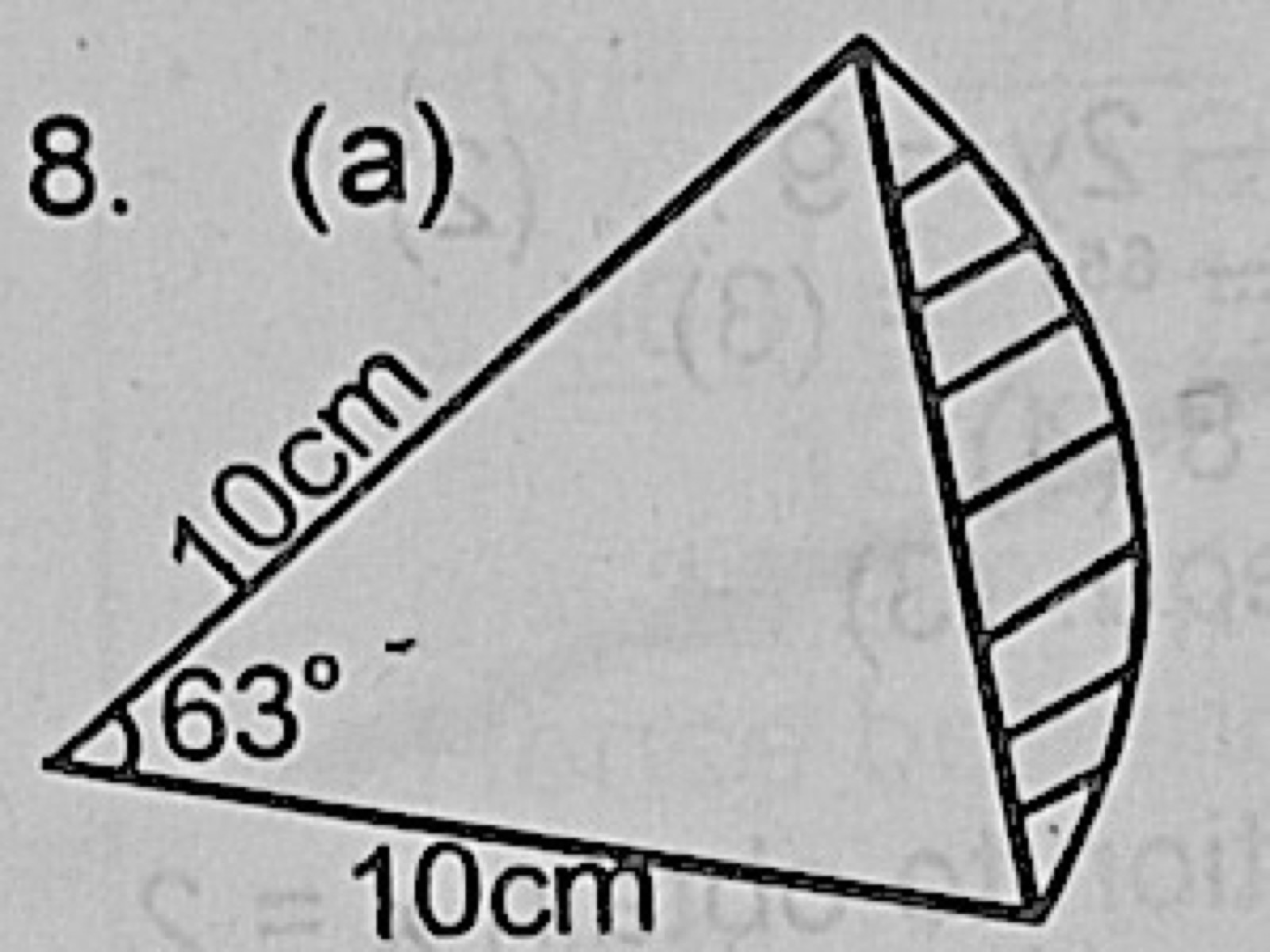
(a) Calculate the area of the shaded segment of the circle shown in the diagram. (Take π = 22/7).
(b) A tin has radius 3cm and height 6cm. Find the: (i) total surface area of tin; (ii) volume in litres of liquid that will fill the tin to capacity, correct to two decimal places. (Take π = 22/7).

Diagram for this question
Show the model answer
Model answer

(a) Sector area = (63/360) × 22/7 × 102 = 55 cm2
Triangle area = ½ × 10 × 10 × sin 63° = 50 × 0.8910 = 44.55 cm2
Segment area = 55 − 44.55 = 10.45 cm2
(b)(i) Closed tin: total surface area = 2πr2 + 2πrh = 2πr(r + h) = 2 × 22/7 × 3 × 9 = 169.71 cm2
(ii) Volume = πr2h = 22/7 × 9 × 6 = 169.71 cm3
1 litre = 1000 cm3, so volume ≈ 0.17 litres

Explanation

Segment = sector minus the triangle formed by the two radii and the chord.

Open this question

Theory question 109

Graphs of Functions

(a) Copy and complete the following table for the relation y = 5/2 + x − 4x2
x: −2.0, −1.5, −1.0, −0.5, 0, 0.5, 1, 1.5, 2
y: −15.5, , , 1, 2.5, , , ,
(b) Using a scale of 2cm to 1 unit on the x axis and 2cm to 5 units on the y axis, draw the graph of the relation for −2.0 ≤ x ≤ 2.0
(c) What is the maximum value of y?
(d) From your graph obtain the roots of the equation 8x2 − 2x − 5 = 0.

Show the model answer
Model answer

(a) y values: x = −2.0 → −15.5; −1.5 → −8; −1.0 → −2.5; −0.5 → 1; 0 → 2.5; 0.5 → 2; 1 → −0.5; 1.5 → −5; 2 → −11.5
(b) Plot the points with the given scales and join them with a smooth n-shaped curve.
(c) Maximum y ≈ 2.6 (exact value 2.5625 at x = 0.125)
(d) 8x2 − 2x − 5 = 0 is −2 times (5/2 + x − 4x2) = 0, i.e. y = 0
Read where the curve cuts the x-axis: x ≈ −0.7 and x ≈ 0.9 (exact −0.68 and 0.93)

Explanation

Dividing 8x² − 2x − 5 = 0 by −2 gives exactly the plotted relation set to zero.

Open this question

Theory question 110

Data Presentation

(a) The distribution of junior workers in an illustration is as follows:
Clerks − 78
Drivers − 36
Typists − 44
Messengers − 52
Others − 30
Represent the above information by a pie chart.
(b) The table below shows the frequency distribution of marks scored by 30 candidates in an aptitude test.
Marks: 4, 5, 6, 7, 8, 9
No. of Students: 5, 8, 5, 6, 4, 2
Find the mean score to the nearest whole number.

Show the model answer
Model answer

(a) Total = 78 + 36 + 44 + 52 + 30 = 240 workers, so each worker is 360°/240 = 1.5°
Clerks 117°, Drivers 54°, Typists 66°, Messengers 78°, Others 45° (total 360°)
Draw the circle, measure the sectors with a protractor and label each one.
(b) Σfx = 20 + 40 + 30 + 42 + 32 + 18 = 182; Σf = 30
Mean = 182 ÷ 30 = 6.07 ≈ 6

Explanation

Sector angle = (number in group ÷ total) × 360°.

Open this question

Theory question 111

Bearings

Three towns P, Q and R are such that the distance between P and Q is 50km and the distance between P and R is 90km. If the bearing of Q from P is 075° and the bearing of R from P is 310°, find the: (a) distance between Q and R; (b) bearing of R and Q.

Show the model answer
Model answer

(a) ∠QPR = 75° + (360° − 310°) = 125°
Cosine rule: QR2 = 502 + 902 − 2 × 50 × 90 × cos 125° = 10600 + 5162 = 15762
QR ≈ 125.5 km
(b) Sine rule: sin ∠PQR = 90 × sin 125° ÷ 125.5 = 0.5873, so ∠PQR ≈ 36.0°
Bearing of P from Q = 075° + 180° = 255°
Bearing of R from Q = 255° + 36° = 291°

Explanation

Find the angle between the two bearings first, then use the cosine rule.

Open this question

Theory question 112

Measures of Dispersion

The table below shows the weekly profit in naira from a Mini-market.
Weekly profit (N): 1-10, 11-20, 21-30, 31-40, 40-50, 51-60
Frequency: 6, 6, 12, 11, 10, 5
(a) Draw the cumulative frequency graph of the data.
(b) From your graph, estimate the: (i) median; (ii) 80th percentile
(c) What is the modal weekly profit?

Show the model answer
Model answer

(a) Upper class boundaries 10.5, 20.5, 30.5, 40.5, 50.5, 60.5 with cumulative frequencies 6, 12, 24, 35, 45, 50. Plot these (start at (0.5, 0)) and draw a smooth ogive.
(b)(i) Median at the 25th value: about N31 (calculation: 30.5 + (1/11) × 10 = 31.4)
(ii) 80th percentile at the 40th value: about N45.5 (40.5 + (5/10) × 10)
(c) The modal class is N21–N30 (frequency 12); estimated mode = 20.5 + 6/(6 + 1) × 10 ≈ N29

Explanation

Plot cumulative frequency against the upper class boundary, not the class mark.
Open this question