WAEC Literature in English 2002 past questions and answers

68 questions. Try each one, then open the answer to check yourself and read the explanation.

Question 1

Poetry: General

A couplet is

  1. A.a pastoral poem
  2. B.two successive rhyming lines
  3. C.a love poem
  4. D.two successive unrhyming lines.
Show the answer and explanation

Answer: B (two successive rhyming lines)

Explanation

A couplet is two lines in a row that rhyme.

Open this question

Question 2

Poetry: General

The first eight lines of a sonnet is a/an

  1. A.tercet
  2. B.sestet
  3. C.octave
  4. D.quatrain
Show the answer and explanation

Answer: C (octave)

Explanation

The first eight lines of a (Petrarchan) sonnet form the octave.

Open this question

Question 3

Poetry: General

An ode is a

  1. A.poem about love
  2. B.poem of mourning
  3. C.praise poem
  4. D.narrative poem
Show the answer and explanation

Answer: C (praise poem)

Explanation

An ode praises or celebrates its subject, e.g. Keats's 'Ode on a Grecian Urn'.

Open this question

Question 4

Figures of Speech

The expression of unpleasant experiences in a mild way is

  1. A.hyperbole
  2. B.metaphor
  3. C.euphemism
  4. D.paradox
Show the answer and explanation

Answer: C (euphemism)

Explanation

Euphemism softens something unpleasant, e.g. 'passed away' for 'died'.

Open this question

Question 5

Poetry: General

A poem which tells a story in the form of a song is a/an

  1. A.epic
  2. B.ballad
  3. C.pastoral
  4. D.eulogy
Show the answer and explanation

Answer: B (ballad)

Explanation

A ballad is a song-like poem that tells a story.

Open this question

Question 6

Poetry: General

The paragraph in prose can be compared to ________ in poetry

  1. A.couplet
  2. B.line
  3. C.stanza
  4. D.verse
Show the answer and explanation

Answer: C (stanza)

Explanation

A stanza groups lines in a poem as a paragraph groups sentences in prose.

Open this question

Question 8

Poetry: General

Poetry is defined by

  1. A.words written in sequence
  2. B.condensed use of language
  3. C.evocation of feelings
  4. D.legends and myths
Show the answer and explanation

Answer: C (evocation of feelings)

Explanation

Poetry is marked by language that stirs up (evokes) feelings in the reader.

Open this question

Question 9

Figures of Speech

The juxtaposition of two seemingly contradictory words is

  1. A.contrast
  2. B.anti-climax
  3. C.oxymoron
  4. D.anti-thesis
Show the answer and explanation

Answer: C (oxymoron)

Explanation

Putting two contradictory words together (e.g. 'bitter sweet') is an oxymoron.

Open this question

Question 10

African Poetry

Salute to the Elephant is an example of ________ poetry

  1. A.traditional
  2. B.dramatic
  3. C.epic
  4. D.narrative
Show the answer and explanation

Answer: A (traditional)

Explanation

It is a traditional (oral) praise poem.

Open this question

Question 11

Literary Appreciation: Poetry
Lines for question 11
The passage, as printed

The extract illustrates a

  1. A.quatrain
  2. B.hexameter
  3. C.couplet
  4. D.sestet
Show the answer and explanation

Answer: C (couplet)

Explanation

A pair of successive rhyming lines forms a couplet.

Open this question

Question 12

Literary Appreciation: Poetry

The dominant literary device used in the extract is

  1. A.alliteration
  2. B.assonance
  3. C.onomatopoeia
  4. D.repetition
Show the answer and explanation

Answer: D (repetition)

Explanation

'Grace', 'uncle' and 'grace' are repeated again and again: repetition.

Open this question

Question 13

Figures of Speech

You are the salt of my life illustrates a

  1. A.metaphor
  2. B.simile
  3. C.irony
  4. D.personification
Show the answer and explanation

Answer: A (metaphor)

Explanation

The person is called 'salt' directly, without 'like' or 'as': a metaphor.

Open this question

Question 14

Poetry: General

The sequence of beats in a poem is its

  1. A.rhythm
  2. B.rhyme
  3. C.metre
  4. D.stanza
Show the answer and explanation

Answer: A (rhythm)

Explanation

The flow of beats (stressed and unstressed syllables) is rhythm.

Open this question

Question 15

Figures of Speech

Charm strikes the sight, but merit wins the soul is an example of

  1. A.oxymoron
  2. B.epigram
  3. C.epithet
  4. D.bathos
Show the answer and explanation

Answer: B (epigram)

Explanation

This neat, memorable saying with a witty contrast is an epigram.

Open this question

Question 16

Literary Terms and Devices

A literary device that creates a mental picture of a situation is

  1. A.imagery
  2. B.symbolism
  3. C.flashback
  4. D.epilogue
Show the answer and explanation

Answer: A (imagery)

Explanation

Imagery creates pictures in the reader's mind.

Open this question

Question 17

Literary Terms and Devices

A short witty statement is an

  1. A.epistle
  2. B.eulogy
  3. C.epigram
  4. D.anecdote
Show the answer and explanation

Answer: C (epigram)

Explanation

An epigram is a short, clever, witty saying.

Open this question

Question 18

Figures of Speech

The whole town was present at the wedding ceremony is an example of

  1. A.oxymoron
  2. B.hyperbole
  3. C.onomatopoeia
  4. D.repetition
Show the answer and explanation

Answer: B (hyperbole)

Explanation

Not literally everyone in the town attended: it is an exaggeration (hyperbole).

Open this question

Question 19

Drama: General

In a literary work, a clown normally

  1. A.directs the action
  2. B.creates comic relief
  3. C.supports the protagonist
  4. D.creates the atmosphere
Show the answer and explanation

Answer: B (creates comic relief)

Explanation

A clown's jokes give the audience relief from tension.

Open this question

Question 20

Figures of Speech

Hear thou, great Anna! Whom three realms obey,
Dost sometimes counsel take - and sometimes tea

depicts the use of

  1. A.paradox
  2. B.imagery
  3. C.pathos
  4. D.bathos
Show the answer and explanation

Answer: D (bathos)

Explanation

The sudden drop from serious state business to drinking tea is bathos (anticlimax).

Open this question

Question 21

Literary Appreciation: Prose and Drama
WAEC 2002 Unseen prose: the July downpour
The month of July crept in. The sky, like a hooded monk wore black, as in mourning, ready to shed its load. The sun was mystified while heaps of sand and dust spiralled high up in the sky, sending high and low alike scurrying into hiding. The town had never known such a downpour, it was forty-eight hours of weeping by both the heavens and the inhabitants of Olusi who lost most of their life's savings in this destructive blessing.

The subject of the passage is

  1. A.cloud
  2. B.climate
  3. C.rainfall
  4. D.flood
Show the answer and explanation

Answer: C (rainfall)

Explanation

The passage describes a forty-eight-hour downpour: rainfall.

Open this question

Question 22

Literary Appreciation: Prose and Drama

The month of July crept in is an example of

  1. A.metaphor
  2. B.synecdoche
  3. C.imagery
  4. D.apostrophe
Show the answer and explanation

Answer: A (metaphor)

Explanation

July is described as if it could creep, an implied comparison: metaphor.

Open this question

Question 23

Literary Appreciation: Prose and Drama

The expression the sky, like a hooded monk wore black, illustrates

  1. A.symbolism
  2. B.paradox
  3. C.personification
  4. D.metaphor
Show the answer and explanation

Answer: C (personification)

Explanation

The sky is given a human action, wearing black like a monk: personification.

Open this question

Question 24

Literary Appreciation: Prose and Drama

........high and low alike refers to the

  1. A.rulers of the village
  2. B.women and their children
  3. C.chiefs and their subjects
  4. D.rich and the poor
Show the answer and explanation

Answer: D (rich and the poor)

Explanation

'High and low' means people of every class: the rich and the poor.

Open this question

Question 25

Literary Appreciation: Prose and Drama

......... destructive blessing shows the use of

  1. A.antithesis
  2. B.oxymoron
  3. C.apostrophe
  4. D.parallelism
Show the answer and explanation

Answer: B (oxymoron)

Explanation

'Destructive' and 'blessing' are contradictory words placed together: oxymoron.

Open this question

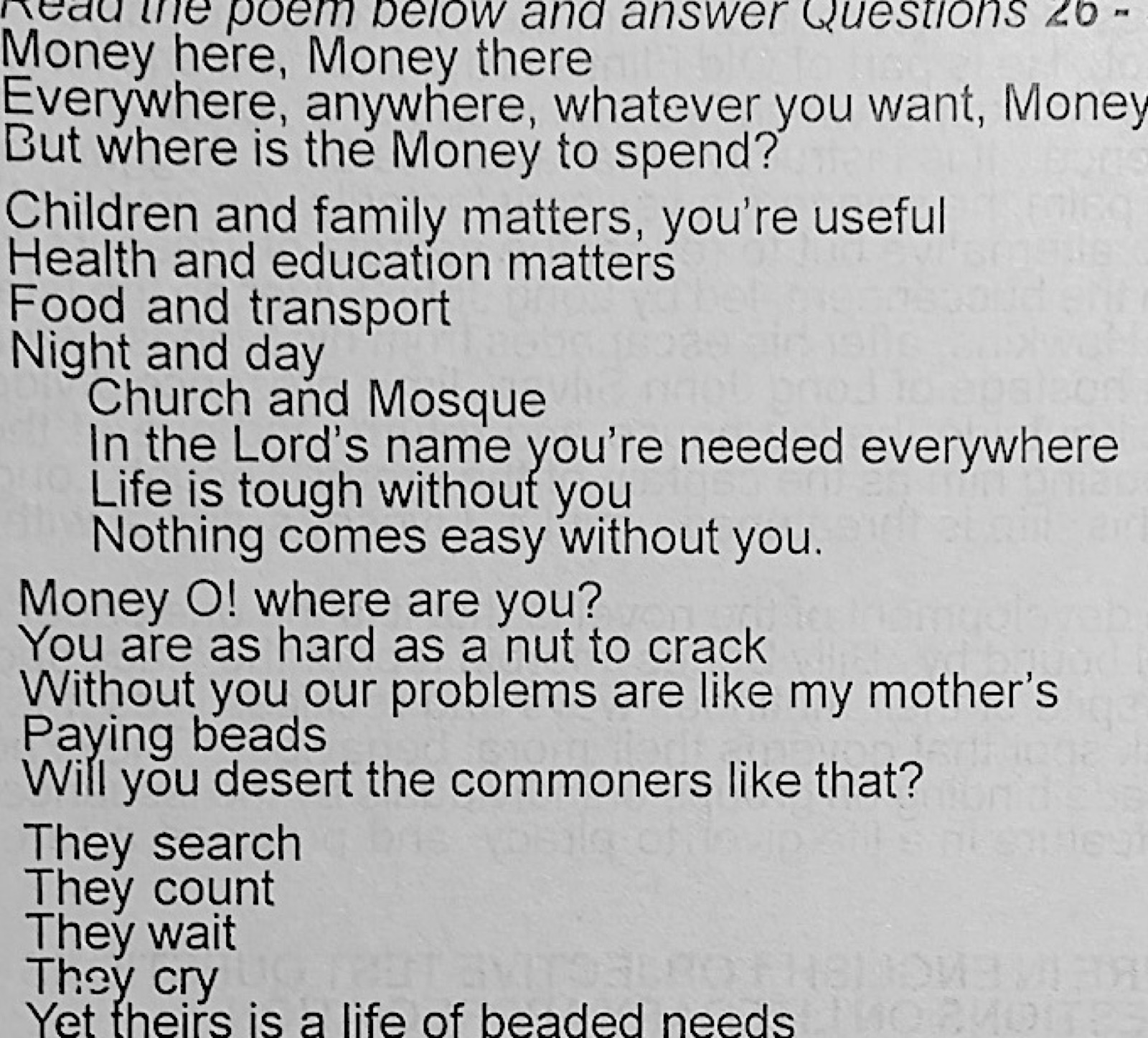
Question 26

Literary Appreciation: Poetry
Unseen poem: questions 26–30
The passage, as printed

The theme of the poem is

  1. A.religion
  2. B.enlightenment
  3. C.struggle
  4. D.hardship
Show the answer and explanation

Answer: D (hardship)

Explanation

The poem laments the lack of money and the hardship ordinary people face.

Open this question

Question 27

Literary Appreciation: Poetry

The dominant poetic devices used are

  1. A.onomatopoeia and refrain
  2. B.metaphor and simile
  3. C.repetition and personification
  4. D.pun and hyperbole
Show the answer and explanation

Answer: C (repetition and personification)

Explanation

'Money' is repeated throughout and is addressed as a person who may 'desert' the commoners.

Open this question

Question 28

Literary Appreciation: Poetry

The tone of the poem is one of

  1. A.sadness and lamentation
  2. B.happiness and excitement
  3. C.apathy and non-challance
  4. D.resignation and joy.
Show the answer and explanation

Answer: A (sadness and lamentation)

Explanation

The speaker mourns the suffering caused by lack of money.

Open this question

Question 29

Literary Appreciation: Poetry

The use of rhetorical questions ——— the poet's message

  1. A.emphasizes
  2. B.repeats
  3. C.recasts
  4. D.dramatizes
Show the answer and explanation

Answer: A (emphasizes)

Explanation

Questions like 'Money O! where are you?' stress the poet's point.

Open this question

Question 30

Literary Appreciation: Poetry

Lines 13 - 15 illustrate the use of

  1. A.metaphor
  2. B.alliteration
  3. C.simile
  4. D.pun
Show the answer and explanation

Answer: C (simile)

Explanation

The comparisons use 'as' and 'like': similes.

Open this question

Question 31

Set Text: The Merchant of Venice

The Merchant of Venice (William Shakespeare). The speaker is

  1. A.Portia
  2. B.Solanio
  3. C.Gratiano
  4. D.Bassanio
Show the answer and explanation

Answer: B (Solanio)

Explanation

In the opening scene Solanio teases Antonio about his sadness.

Open this question

Question 32

Set Text: The Merchant of Venice

The Merchant of Venice (William Shakespeare). The person addressed is

  1. A.Antonio
  2. B.Nerissa
  3. C.Lorenzo
  4. D.Salarino
Show the answer and explanation

Answer: A (Antonio)

Explanation

Antonio cannot explain why he is sad.

Open this question

Question 33

Set Text: The Merchant of Venice

The Merchant of Venice (William Shakespeare). The dominant literary device used in the extract is

  1. A.personification
  2. B.contrast
  3. C.metonymy
  4. D.pun
Show the answer and explanation

Answer: B (contrast)

Explanation

Sad and merry, laughing and not sad are set against each other: contrast.

Open this question

Question 34

Set Text: The Merchant of Venice

The Merchant of Venice (William Shakespeare). The speaker is addressing the addressee's

  1. A.elopement
  2. B.merchandise
  3. C.engagement
  4. D.melancholy
Show the answer and explanation

Answer: D (melancholy)

Explanation

Solanio is talking about Antonio's unexplained sadness (melancholy).

Open this question

Question 35

Set Text: The Merchant of Venice

The Merchant of Venice (William Shakespeare). The underlined expression illustrates

  1. A.assonance
  2. B.synecdoche
  3. C.alliteration
  4. D.irony
Show the answer and explanation

Answer: C (alliteration)

Explanation

'Laugh and leap' repeat the 'l' sound: alliteration.

Open this question

Question 36

Set Text: The Merchant of Venice

The Merchant of Venice (William Shakespeare). The speaker is

  1. A.Jessica
  2. B.Servingman
  3. C.Nerissa
  4. D.Portia
Show the answer and explanation

Answer: A (Jessica)

Explanation

Jessica, Shylock's daughter, says goodbye to Launcelot.

Open this question

Question 37

Set Text: The Merchant of Venice

The Merchant of Venice (William Shakespeare). Thou in the extract refers to

  1. A.Gobbo
  2. B.Launcelot
  3. C.Salerio
  4. D.Leonardo
Show the answer and explanation

Answer: B (Launcelot)

Explanation

Launcelot Gobbo is leaving Shylock's service.

Open this question

Question 38

Set Text: The Merchant of Venice

The Merchant of Venice (William Shakespeare). During this speech, the speaker

  1. A.betrays his conscience
  2. B.chooses the right partner
  3. C.gives the addressee a letter
  4. D.changes the course of action
Show the answer and explanation

Answer: C (gives the addressee a letter)

Explanation

Jessica gives Launcelot a ducat and a letter for Lorenzo.

Open this question

Question 39

Set Text: The Merchant of Venice

The Merchant of Venice (William Shakespeare). Merry devil illustrates

  1. A.oxymoron
  2. B.simile
  3. C.paradox
  4. D.personification
Show the answer and explanation

Answer: A (oxymoron)

Explanation

'Merry' and 'devil' seem contradictory side by side: oxymoron.

Open this question

Question 40

Set Text: The Merchant of Venice

The Merchant of Venice (William Shakespeare). The speaker is contemplating on

  1. A.marriage
  2. B.love
  3. C.elopement
  4. D.disguise
Show the answer and explanation

Answer: C (elopement)

Explanation

Jessica is planning to run away with Lorenzo.

Open this question

Question 41

Set Text: The Merchant of Venice

The Merchant of Venice (William Shakespeare). The speaker is

  1. A.Portia
  2. B.Launcelot
  3. C.Jessica
  4. D.Antonio
Show the answer and explanation

Answer: A (Portia)

Explanation

Portia mocks her suitors, here the Duke of Saxony's nephew.

Open this question

Question 42

Set Text: The Merchant of Venice

The Merchant of Venice (William Shakespeare). The person addressed is

  1. A.Gobbo
  2. B.Nerissa
  3. C.Bassanio
  4. D.Lorenzo
Show the answer and explanation

Answer: B (Nerissa)

Explanation

Portia is talking with her waiting-woman Nerissa.

Open this question

Question 43

Set Text: The Merchant of Venice

The Merchant of Venice (William Shakespeare). The subject of discussion is the

  1. A.Prince of Morocco
  2. B.young Baron of England
  3. C.Prince of Arragon
  4. D.Duke of Saxony's nephew.
Show the answer and explanation

Answer: D (Duke of Saxony's nephew.)

Explanation

The drunken suitor described is the Duke of Saxony's nephew.

Open this question

Question 44

Set Text: The Merchant of Venice

The Merchant of Venice (William Shakespeare). The speaker is contemplating on the

  1. A.choice of caskets
  2. B.loss of his fortune
  3. C.most eligible suitor
  4. D.outcome of the trial
Show the answer and explanation

Answer: C (most eligible suitor)

Explanation

Portia and Nerissa review the suitors, weighing who would be acceptable.

Open this question

Question 45

Set Text: The Merchant of Venice

The Merchant of Venice (William Shakespeare). The dominant literary device used in the extract is

  1. A.simile
  2. B.paradox
  3. C.repetition
  4. D.oxymoron
Show the answer and explanation

Answer: C (repetition)

Explanation

'Very vilely ... most vilely', 'when he is best ... when he is worst': repeated words and patterns.

Open this question

Question 46

Set Text: The Merchant of Venice

The Merchant of Venice (William Shakespeare). The speaker is

  1. A.Gratiano
  2. B.Shylock
  3. C.Lorenzo
  4. D.Solanio
Show the answer and explanation

Answer: B (Shylock)

Explanation

Shylock orders Jessica to lock up the house against the Christian masque.

Open this question

Question 47

Set Text: The Merchant of Venice

The Merchant of Venice (William Shakespeare). The dominant literary device used in the extract is

  1. A.allusion
  2. B.irony
  3. C.symbolism
  4. D.metonymy
Show the answer and explanation

Answer: B (irony)

Explanation

The audience knows Jessica plans to run away with Lorenzo that night, while Shylock, warning her to lock up the house, does not. This gap between what he believes and what will happen is dramatic irony.

Open this question

Question 48

Set Text: The Merchant of Venice

The Merchant of Venice (William Shakespeare). The person addressed is

  1. A.Bassanio
  2. B.Antonio
  3. C.Launcelot
  4. D.Jessica
Show the answer and explanation

Answer: D (Jessica)

Explanation

Shylock gives these orders to his daughter Jessica.

Open this question

Question 49

Set Text: The Merchant of Venice

The Merchant of Venice (William Shakespeare). After this scene the person addressed

  1. A.portrays love for his suitor
  2. B.informs of the loss at sea
  3. C.elopes with her lover
  4. D.delivers letter to a suitor
Show the answer and explanation

Answer: C (elopes with her lover)

Explanation

That night Jessica elopes with Lorenzo.

Open this question

Theory question 101

Other Set Texts: African Drama

Literature 2, Section A: African Drama. James Ngugi: The Black Hermit
Compare and contrast the character and role of Jane and Thoni in the play

Show the model answer
Model answer

Thoni: Remi's widow by custom (wife of his dead brother, inherited); traditional, patient, loyal, loving; suffers neglect; dies when Remi rejects her.
Jane: Remi's girlfriend in the city; modern, educated, independent; represents the city and Western values.
Both love Remi and are hurt by him.
Contrast: village versus city, tradition versus modernity.
Roles: Thoni shows the cost of Remi's flight from tribe; Jane shows his alienation; together they show his divided self.

Explanation

Compare and contrast traits and roles.

Open this question

Theory question 102

Other Set Texts: African Drama

Literature 2, Section A. James Ngugi: The Black Hermit
How does Ngugi present religion in the play?

Show the model answer
Model answer

Christianity through the Pastor: tries to win Remi back for the church; mixes religion with politics.
Traditional religion through the elders and the medicine man; charms to bring Remi home.
Mother's faith; prayer.
Ngugi shows both as used for selfish ends and as sources of division.
Conflict of religion with politics and tribalism.

Explanation

Show how each form of religion appears and the writer's attitude.

Open this question

Theory question 103

Set Text: The Lion and the Jewel

Literature 2, Section A. Wole Soyinka: The Lion and the Jewel
Discuss the character and role of Sadiku in the play.

Show the model answer
Model answer

Baroka's senior wife; loyal, talkative, superstitious, proud of her position.
Acts as go-between: carries Baroka's proposal to Sidi.
Believes Baroka is impotent and celebrates the 'women's victory' with a dance.
Her gossip lures Sidi to Baroka's house, where he seduces her.
Role: comic figure; instrument of Baroka's trick; represents tradition.

Explanation

Traits with evidence and role in the plot.

Open this question

Theory question 104

Set Text: The Lion and the Jewel

Literature 2, Section A. Wole Soyinka: The Lion and the Jewel
Discuss the conflict between modernism and traditionalism in the play.

Show the model answer
Model answer

Lakunle (modern teacher) versus Baroka (traditional chief).
Bride price: Lakunle rejects it, Sidi insists.
Baroka blocks the railway; prefers village ways but uses a stamp machine.
Sidi's photographs in the magazine; vanity from modern media.
Sidi chooses Baroka: tradition wins, but Baroka adapts.
Soyinka satirises shallow modernism and shows tradition can be cunning.

Explanation

Show both sides and the outcome.

Open this question

Theory question 105

Other Set Texts: Non-African Drama

Literature 2, Section B: Non-African Drama. Richard B. Sheridan: The Rivals
Discuss the use of dramatic irony in the play

Show the model answer
Model answer

Audience knows 'Ensign Beverley' is Captain Jack Absolute; Lydia, Mrs Malaprop and Sir Anthony don't.
Jack woos Lydia in two roles; scenes with Mrs Malaprop reading his insulting letter.
Sir Anthony urges Jack to marry the very girl he loves.
Acres challenges 'Beverley' using Jack as messenger.
Effect: comedy, suspense, exposure of characters' follies.

Explanation

Give examples and explain the effect.

Open this question

Theory question 106

Other Set Texts: Non-African Drama

Literature 2, Section B. Richard B. Sheridan: The Rivals
How does the playwright's characterization contribute to the development of the play?

Show the model answer
Model answer

Lydia's romantic notions drive Jack's disguise.
Mrs Malaprop's misused words and vanity create comedy; Lucius O'Trigger's letters.
Sir Anthony's temper and authority push the arranged match.
Faulkland's jealousy creates the sub-plot with Julia.
Acres's cowardice and the duel; servants carry messages.
Characters' traits create complications and resolution.

Explanation

Link traits to plot events.

Open this question

Theory question 107

Other Set Texts: Non-African Drama

Literature 2, Section B. T.S. Eliot: Murder in the Cathedral
Comment on the role of the Chorus in the play

Show the model answer
Model answer

The women of Canterbury, ordinary people.
Express fear and foreboding at Becket's return.
Comment on events and link audience to action, as in Greek drama.
Their growth from passive fear to acceptance of martyrdom.
Provide poetic atmosphere and religious meaning.

Explanation

Explain the chorus's functions with examples.

Open this question

Theory question 108

Other Set Texts: Non-African Drama

Literature 2, Section B. T.S. Eliot: Murder in the Cathedral
Discuss the dramatic significance of Tempters in the play

Show the model answer
Model answer

Four tempters visit Becket in Part I.
First: pleasures of youth; second: worldly power as Chancellor; third: alliance with barons against the king.
Fourth: spiritual pride, seeking martyrdom for glory.
Show Becket's inner conflict; the fourth is the most dangerous.
Becket overcomes them: 'to do the right deed for the wrong reason'.
Prepare for his true martyrdom; dramatise the theme of will.

Explanation

Describe each tempter and their dramatic purpose.

Open this question

Theory question 109

African Poetry

Literature 2, Section C: African Poetry
How successful is the use of imagery in We have come home?

Show the model answer
Model answer

Lenrie Peters's poem on soldiers returning from war.
Images of death, blood and destruction left by war.
Images of loss of identity and spirit.
Images of hope and peace sought.
Successful: vivid, emotional, shows futility of war.

Explanation

Give images and assess their effect.

Open this question

Theory question 110

African Poetry

Literature 2, Section C
Comment on the style and theme of Abiku

Show the model answer
Model answer

Theme: the abiku (born-to-die child) and parents' attempts to keep it; mystery of infant death.
J.P. Clark/Soyinka: voice of the child (Soyinka) or parents' plea (Clark).
Style: first-person voice, repetition, imagery of charms, bangles, cycles; tone mocking or pleading.
Traditional belief presented poetically.

Explanation

Discuss theme then style with examples.

Open this question

Theory question 111

Non-African Poetry

Literature 2, Section D: Non-African Poetry
Comment on the theme and style of Is my team ploughing?

Show the model answer
Model answer

A.E. Housman; dialogue between a dead young man and his living friend.
Theme: life goes on after death; transience and indifference; betrayal (friend now with his sweetheart).
Style: question-and-answer stanzas; simple diction; regular quatrains with rhyme; irony in the last stanza.
Tone: wistful, ironic.

Explanation

Theme with evidence, then style features.

Open this question

Theory question 112

Non-African Poetry

Literature 2, Section D
How is atmosphere conveyed in Elegy written in a country churchyard?

Show the model answer
Model answer

Thomas Gray: evening scene in a churchyard.
Images of fading day: curfew, lowing herd, ploughman going home.
Stillness and darkness; owl's complaint; graves.
Diction and slow rhythm create solemn, melancholy mood.
Reflection on death of the poor ('paths of glory lead but to the grave').

Explanation

Show how imagery, sound and diction build the atmosphere.

Open this question

Theory question 201

Other Set Texts: African Prose

Literature 3, Section A: African Prose. Chinua Achebe: Anthills of the Savannah
What view of contemporary African Society is treated in the novel?

Show the model answer
Model answer

Military dictatorship in Kangan; His Excellency (Sam) becomes power-hungry.
Corruption, sycophancy of cabinet; abuse of power, State Research Council.
Suppression of press freedom (Ikem's sacking and murder).
Neglect of the people (Abazon drought delegation).
Hope through women (Beatrice) and new generation (naming ceremony).

Explanation

Show the picture of society with incidents.

Open this question

Theory question 202

Other Set Texts: African Prose

Literature 3. Chinua Achebe: Anthills of the Savannah
Comment on the narrative technique used in the novel.

Show the model answer
Model answer

Multiple narrators: Chris, Ikem, Beatrice in first person, plus third-person narrator.
Different viewpoints on the same events.
Use of stories, myths, proverbs and Ikem's prose poem.
Effect: rounded picture, immediacy, irony.

Explanation

Describe techniques and their effects.

Open this question

Theory question 203

Other Set Texts: African Prose

Literature 3. Ayi Kwei Armah: The Beautyful Ones Are Not Yet Born
Comment on the style of the novel.

Show the model answer
Model answer

Symbolism: banister, bus, latrine, Koomson's sweets.
Vivid, often disgusting imagery of filth and decay representing corruption.
Unnamed protagonist ('the man'): everyman.
Third-person narrative with flashbacks; slow plot.
Pessimistic tone; satire.

Explanation

Identify features with examples and effects.

Open this question

Theory question 204

Other Set Texts: African Prose

Literature 3. Ayi Kwei Armah: The Beautyful Ones Are Not Yet Born
Discuss the character of Maana and the teacher, bringing out their contributions to the development of the plot.

Show the model answer
Model answer

Teacher: the man's friend; disillusioned, withdrawn, lives alone; voice of reflection; tells of Maanan and Kofi Billy.
Maanan: beautiful woman, friend of Teacher's group; ruined by wee (Indian hemp) and disillusionment; ends mad.
Contributions: through them we see the failure of independence hopes, flashbacks to the past.
Show despair and decay in society.

Explanation

Describe both and show their part in the story.

Open this question

Theory question 205

Other Set Texts: Non-African Prose

Literature 3, Section B: Non-African Prose. Thomas Hardy: Tess of the d'Urbervilles
Comment on the view that Tess is a victim of society.

Show the model answer
Model answer

Poverty pushes her family to send her to the d'Urbervilles.
Seduced/raped by Alec, then judged by society's double standards.
Angel rejects her after the wedding night confession though he had sinned too.
Hard labour at Flintcomb-Ash; forced back to Alec to support her family.
Executed for killing Alec.
Also fate and chance; but society's morality crushes her.

Explanation

Assess with evidence.

Open this question

Theory question 206

Other Set Texts: Non-African Prose

Literature 3. Thomas Hardy: Tess of the d'Urbervilles
Comment on the author's use of symbolism in the novel.

Show the model answer
Model answer

Colour red: blood, roses, Prince's death, Tess's ribbons; foreshadows violence.
Stonehenge: pagan sacrifice; Tess as victim.
The death of Prince the horse.
Seasons and landscapes (Talbothays fertility versus Flintcomb-Ash barrenness).
The threshing machine; the d'Urberville portraits.

Explanation

Name symbols and explain them.

Open this question

Theory question 207

Other Set Texts: Non-African Prose

Literature 3. Daniel Defoe: Robinson Crusoe
Discuss Crusoe's relationship with Xury and Man Friday in Robinson Crusoe.

Show the model answer
Model answer

Xury: boy he escapes with from slavery in Sallee; loyal, helpful; Crusoe later sells him to the Portuguese captain.
Friday: rescued from cannibals; becomes servant and companion; taught English and Christianity.
Relationship is master-servant, affectionate but unequal.
Shows Crusoe's attitudes to race and colonial ideas.

Explanation

Describe both relationships and comment.

Open this question

Theory question 208

Other Set Texts: Non-African Prose

Literature 3. Daniel Defoe: Robinson Crusoe
Comment on the treatment of religion in the novel.

Show the model answer
Model answer

Crusoe's disobedience to his father seen as original sin.
Illness and dream lead to conversion; reads the Bible.
Sees Providence in his survival and supplies.
Teaches Friday Christianity.
Religion gives him hope and meaning; Puritan view.

Explanation

Show his spiritual journey with incidents.

Open this question