A stone was dropped from the top of a building 40m high. Find, correct to one decimal place, the time it took the stone to reach the ground. [Take g = 9.8ms−2]
A.2.9 seconds
B.2.8 seconds
C.2.6 seconds
D.1.4 seconds
Show the answer and explanation
Answer: A (2.9 seconds)
Explanation
40 = ½ × 9.8 × t², so t² = 8.16 and t ≈ 2.86 ≈ 2.9 s.
In which of the following series can be the formula S = a/(1 − r) where a is the first term and r is the common ratio, be used to find the sum of all the terms?
A.4 + 8 + 16 + 32 + …
B.½ + 2½ + 12½ + 62½ + …
C.4/81 + 2/27 + 1/9 + 1/6 + …
D.128 + 64 + 32 + 16 + …
Show the answer and explanation
Answer: D (128 + 64 + 32 + 16 + …)
Explanation
The sum to infinity exists only when −1 < r < 1. Only D has such a ratio (r = ½); the others have r = 2, 5 and 3/2.
A bag contains 5 red and 5 blue identical balls. Three balls are selected at random without replacement. Determine the probability of selecting balls alternating in color.
A.7/18
B.5/18
C.5/36
D.1/36
Show the answer and explanation
Answer: B (5/18)
Explanation
RBR: (5/10)(5/9)(4/8) = 100/720; BRB is the same. Total 200/720 = 5/18.
The distance(s) in metres covered by a particle in motion at any time, t seconds, is given by S = 120t − 16t2. Find in metres, the distance covered by the body before coming to rest.
A.220
B.222
C.223
D.225
Show the answer and explanation
Answer: D (225)
Explanation
v = 120 − 32t = 0 at t = 3.75 s. S = 450 − 225 = 225 m.
A binary operation * is defined on the set of real numbers, R, by p * q = p + q − pq/2, where p, q ∈ R. Find the: (a) inverse of −1 under * given that the identity element is zero. (b) truth set of m * 7 = m * 5.
Show the model answer
Model answer
(a) p * p⁻¹ = 0: p + p⁻¹ − pp⁻¹/2 = 0, so p⁻¹(1 − p/2) = −p and p⁻¹ = −2p/(2 − p). For p = −1: p⁻¹ = 2/3 (check: −1 + 2/3 + 1/3 = 0). (b) m + 7 − 7m/2 = m + 5 − 5m/2, so 2 = m. Truth set {2}.
(a) Two functions p and q are defined on the set of real numbers, R, by p: y → 2y + 3 and q: y → y2 − 2. Find q o p (b) How many four digits odd numbers greater than 4000 can be formed from 1, 7, 3, 8, 2 if repetition is allowed?
Show the model answer
Model answer
(a) q o p(y) = q(2y + 3) = (2y + 3)² − 2 = 4y² + 12y + 7. (b) First digit 7 or 8 (2 ways, to exceed 4000); second and third digits any of 5; last digit 1, 7 or 3 (3 ways). 2 × 5 × 5 × 3 = 150.
Explanation
Fill the restricted places (first and last) first.
The table shows the distribution of marks scored by 64 students in a test. Marks: 10−19, 20−29, 30−39, 40−49, 50−59, 60−69, 70−79, 80−89, 90−99 Frequency: 2, 2, 2, 8, 13, 11, 12, 10, 4 (a) Draw a histogram for the distribution. (b) Use the histogram to estimate the modal score.
Show the model answer
Model answer
(a) Class boundaries 9.5, 19.5, …, 99.5 (equal widths of 10); bar heights are the frequencies. Label axes and give a scale. (b) Tallest bar 49.5–59.5 (13). Join its top corners to the tops of the neighbouring bars (8 and 11) and read where the lines cross: mode ≈ 49.5 + 10 × 5/(5 + 2) ≈ 56.6, about 57.
Explanation
The crossing lines on the tallest bar locate the mode.
(a) A bag contains 10 red and 8 green identical balls. Two balls are drawn at random from the bag, one after the other, without replacement. Find the probablity that one is red and the other is green. (b) There are 20% defective bulbs in a large box. If 12 bulbs are selected randomly from the box, calculate the probablity that between two and five are defective.
Show the model answer
Model answer
(a) RG or GR: 2 × (10/18)(8/17) = 160/306 = 80/153. (b) Binomial n = 12, p = 0.2. 'Between two and five' (3 or 4): ¹²C₃(0.2)³(0.8)⁹ + ¹²C₄(0.2)⁴(0.8)⁸ = 0.2362 + 0.1329 ≈ 0.3691. (If 2 and 5 are included: P(2) + … + P(5) ≈ 0.7057.)
(a) Find the derivative of y = x2(1 + x)3/2 with respect to x. (b) The centre of a circle lies on the line 2y − x = 3. If the circle passes through P(2, 3) and Q(6, 7), find its equation.
Show the model answer
Model answer
(a) Product rule: dy/dx = 2x(1 + x)^(3/2) + (3/2)x²(1 + x)^(1/2) = ½x(1 + x)^(1/2)(4 + 7x). (b) The centre is on the perpendicular bisector of PQ: midpoint (4, 5), gradient −1, so x + y = 9. With 2y − x = 3: y = 4, x = 5. Centre (5, 4); r² = (5 − 2)² + (4 − 3)² = 10. (x − 5)² + (y − 4)² = 10, i.e. x² + y² − 10x − 8y + 31 = 0.
Explanation
The centre is the same distance from P and Q, so it lies on their perpendicular bisector.
(a) Simplify: (log2 8 + log2 16 − 4 log2 2)/log4 16 (b) The first, third and seventh terms of an Arithmetic Progression (A.P) from three consecutive terms of a Geometric Progression (G.P). If the sum of the first two terms of the A.P is 6, find its: (i) first term; (ii) common difference.
Show the model answer
Model answer
(a) (3 + 4 − 4)/2 = 3/2. (b) (a + 2d)² = a(a + 6d) gives 4d² = 2ad, so a = 2d (d ≠ 0). a + (a + d) = 6 gives 5d = 6. (i) a = 12/5; (ii) d = 6/5. (Check: 12/5, 24/5, 48/5 form a G.P. with ratio 2.)
(a) An association is made up of 6 farmers and 8 traders. If an executive body of 4 members is to be formed, find the probability that it will consist of at least two farmers. (b) The probability of an accident occuring in a given month in factories X, Y, and Z are 1/5, 1/12 and 1/6 respectively. Find the probablity that the accident will occur in: (i) none of the factories; (ii) all the factories; (iii) at least one factory.
The essays of 10 candidates were ranked by three examiners as shown in the table. Candidate: A, B, C, D, E, F, G, H, I, J Examiner I: 1st, 3rd, 6th, 2nd, 10th, 9th, 7th, 4th, 8th, 5th Examiner II: 2nd, 1st, 3rd, 9th, 7th, 4th, 8th, 10th, 5th, 6th Examiner III: 3rd, 2nd, 1st, 6th, 9th, 8th, 7th, 5th, 4th, 10th (a) Calculate the Spearman's rank correlation coefficient of the ranks assigned by: (i) Examiners I and II; (ii) Examiners I and III (iii) Examiners II and III. (b) Using the results in 13(a), state which two examiners agree most.
Show the model answer
Model answer
ρ = 1 − 6Σd²/(n(n² − 1)), n = 10, so n(n² − 1) = 990. (a)(i) I and II: Σd² = 144, ρ = 1 − 864/990 ≈ 0.13. (ii) I and III: Σd² = 90, ρ = 1 − 540/990 ≈ 0.45. (iii) II and III: Σd² = 78, ρ = 1 − 468/990 ≈ 0.53. (b) Examiners II and III agree most (largest coefficient).
Explanation
The bigger the coefficient, the closer the agreement.
(a) A car is moving with a velocity of 10ms−1. It then accelerates at 0.2ms−2 for 100m. Find, correct to two decimal places the time taken by the car to cover the distance. (b) A particle moves along a straight line such that its distance S metres from a fixed point O is given by S = t2 − 5t + 6, where t is the time in seconds. Find its: (i) initial velocity; (ii) distance when it is momentarily at rest
Show the model answer
Model answer
(a) 100 = 10t + 0.1t², so t² + 100t − 1000 = 0 and t = (−100 + √14 000)/2 ≈ 9.16 s. (b)(i) v = 2t − 5; at t = 0, v = −5 ms⁻¹ (5 ms⁻¹ towards O). (ii) v = 0 at t = 2.5 s: S = 6.25 − 12.5 + 6 = −0.25, i.e. 0.25 m from O on the other side.
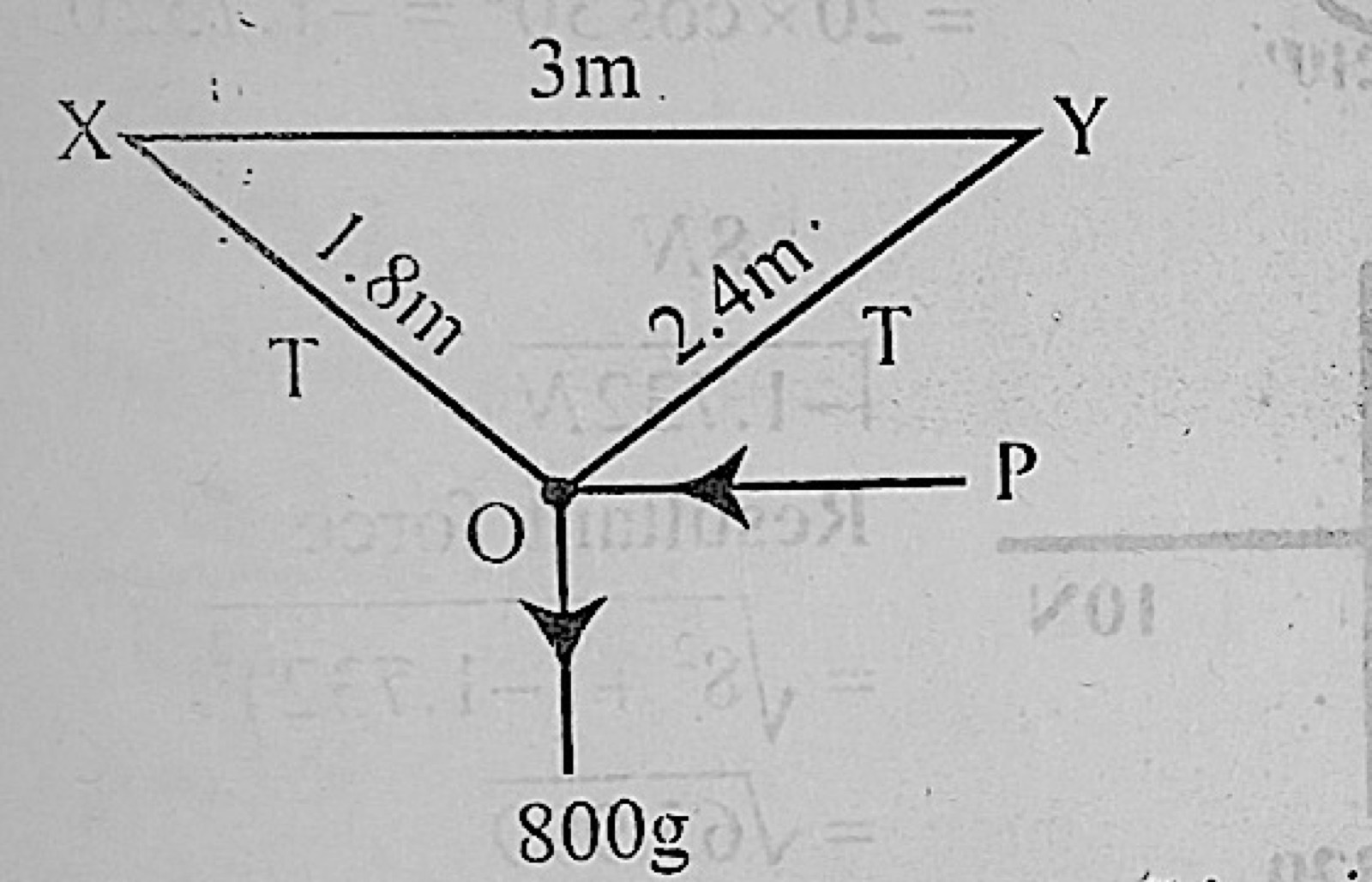
The diagram is that of a light inextensible string of length 4.2m, whose ends are attached to two fixed points X and Y, 3m apart, and on the same horizontal level. A body of mass 800g is hung on the string at a point O, 2.4m from Y. If the system is kept in equilibrium by a horizontal force P acting on the body and the tensions are equal, calculate: (a) ∠XOY; (b) the magnitude of the force P; (c) the tension T in the string.
Show the model answer
Model answer
OX = 1.8 m, OY = 2.4 m, XY = 3 m. (a) 1.8² + 2.4² = 9 = 3², so ∠XOY = 90°. OX makes 53.1° with the horizontal (cos = 0.6) and OY makes 36.9° (cos = 0.8). Weight = 0.8 × 10 = 8 N. (c) Vertically: T sin 53.1° + T sin 36.9° = 8, so 1.4T = 8 and T ≈ 5.71 N. (b) Horizontally: P = T cos 36.9° − T cos 53.1° = 0.2T ≈ 1.14 N.
Explanation
Resolve the forces at O horizontally and vertically; take g = 10 ms⁻².