A box contains 4 red and 3 blue identical balls. If two balls are picked at random, one after the other without replacement, find the probability that one is red and the other is blue.
A.4/7
B.2/7
C.1/7
D.1/12
Show the answer and explanation
Answer: A (4/7)
Explanation
P(red then blue) + P(blue then red) = (4/7)(3/6) + (3/7)(4/6) = 2/7 + 2/7 = 4/7.
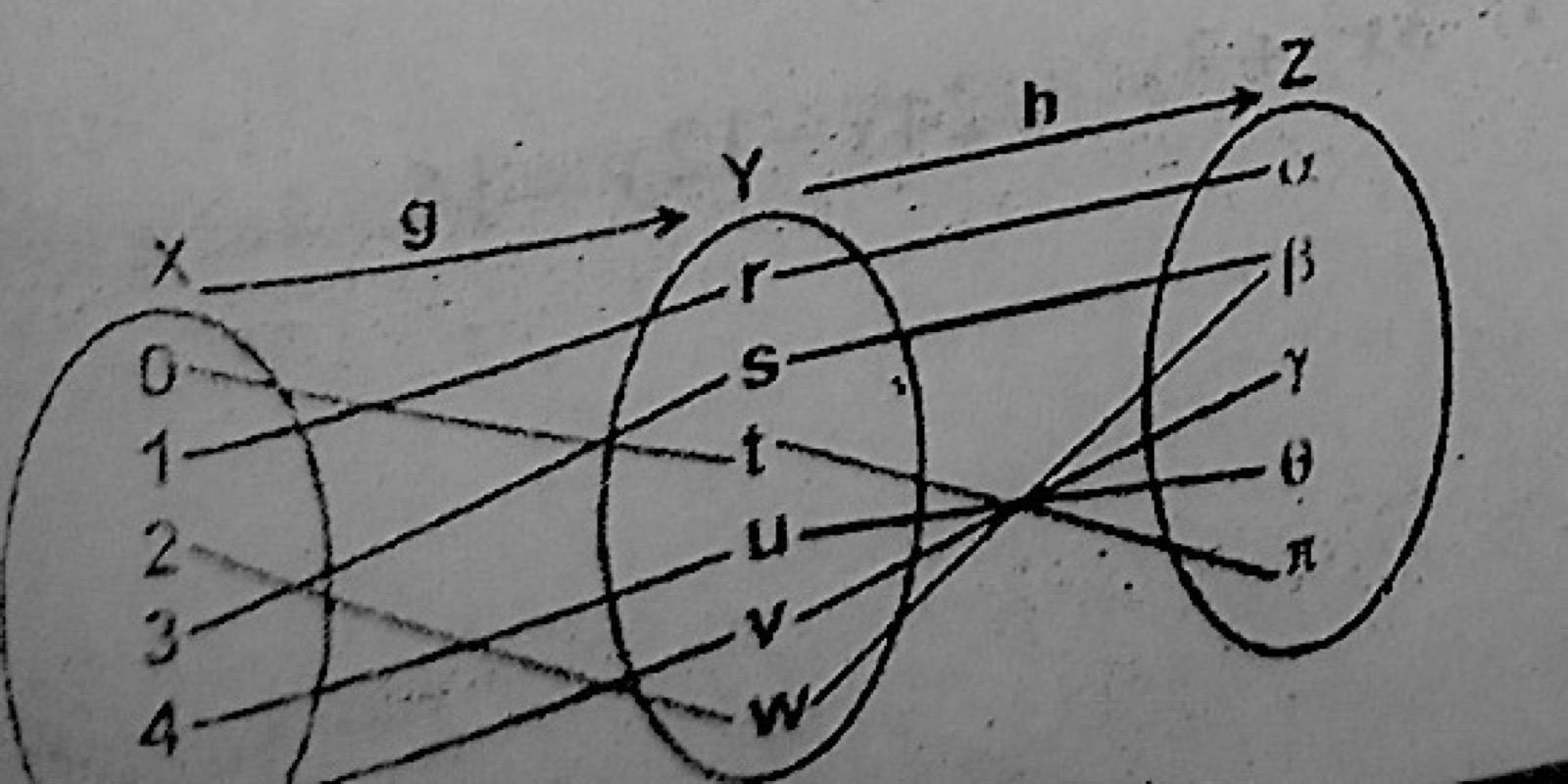
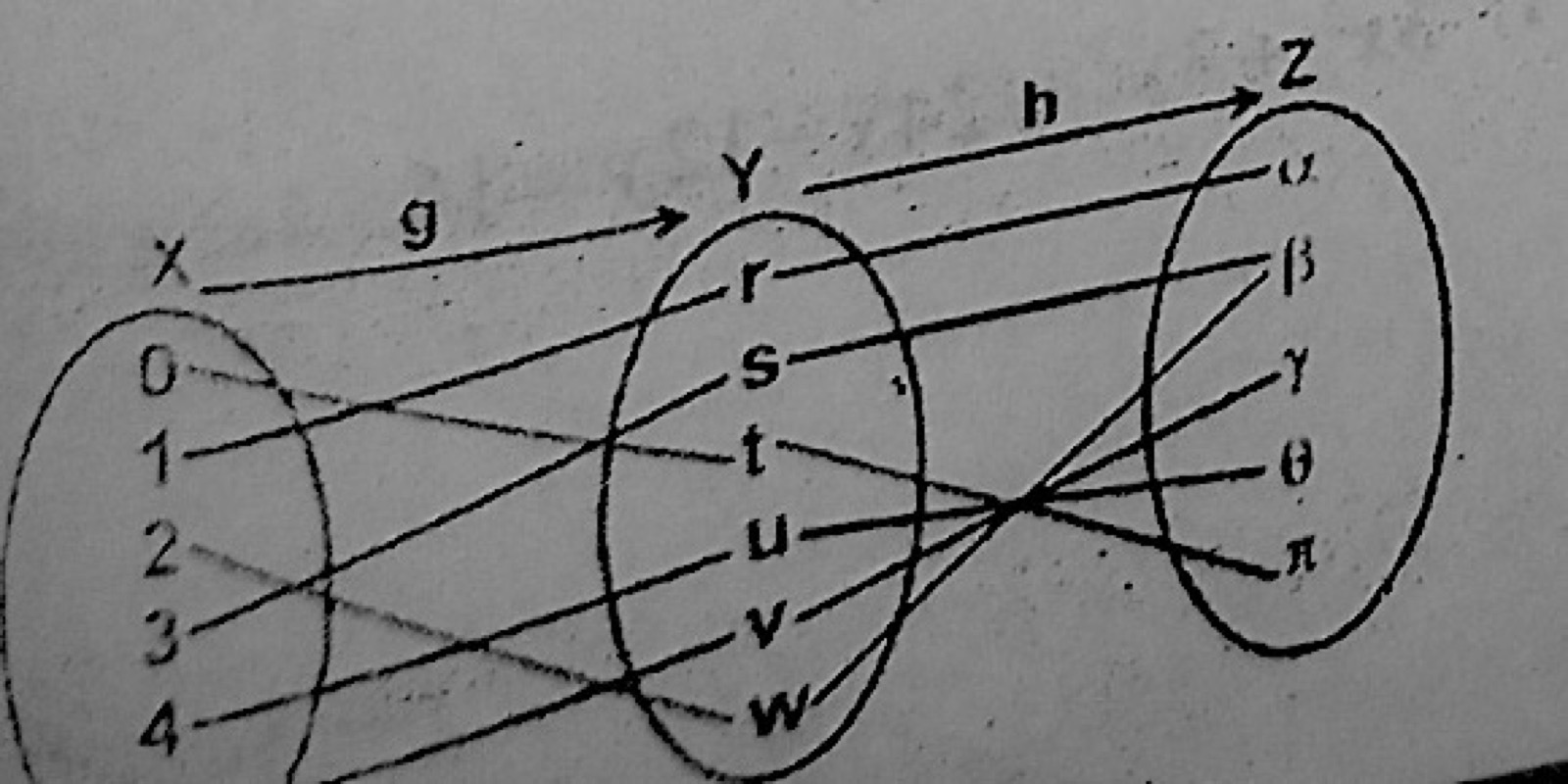
Two functions g and h are defined on the set R of real numbers by g : x → x2 − 2 and h : x → 1/(x + 2), x ≠ −2. Find: (a) h−1, the inverse of h; (b) g∘h when x = −½
Show the model answer
Model answer
(a) Let y = 1/(x + 2); then x + 2 = 1/y, x = 1/y − 2 h−1(x) = 1/x − 2 = (1 − 2x)/x, x ≠ 0 (b) h(−½) = 1/(3/2) = 2/3 g(2/3) = 4/9 − 2 = −14/9
Express 3x2 − 6x + 10 in the form a(x − b)2 + c where a, b and c are integers. Hence state the minimum value of 3x2 − 6x + 10 and the value of x for which it occurs.
Show the model answer
Model answer
3x2 − 6x + 10 = 3(x2 − 2x) + 10 = 3(x − 1)2 − 3 + 10 = 3(x − 1)2 + 7, so a = 3, b = 1, c = 7 Since 3(x − 1)2 ≥ 0, the minimum value is 7, when x = 1
Explanation
Complete the square after taking out the factor 3.
The twenty-first term of an Arithmetic progression (AP) is 5½ and the sum of the first twenty-one terms is 94½. Find the: (a) first term; (b) common difference; (c) sum of the first thirty terms.
Show the model answer
Model answer
a + 20d = 5.5 S21 = (21/2)(2a + 20d) = 94.5, so a + 10d = 4.5 Subtract: 10d = 1 (a) a = 3.5 (b) d = 0.1 (c) S30 = 15(2 × 3.5 + 29 × 0.1) = 15 × 9.9 = 148.5
Write down the first three terms of the binomial expansion (1 + ax)n in ascending powers of x. If the coefficients of x and x2 are 2 and 3/2 respectively, find the various values of a and n.
Show the model answer
Model answer
(1 + ax)n = 1 + nax + [n(n − 1)/2]a2x2 + ... na = 2 and n(n − 1)a2/2 = 3/2, i.e. n(n − 1)a2 = 3 a = 2/n: n(n − 1)(4/n2) = 3, so 4(n − 1) = 3n n = 4, a = ½
Three forces −63j, (32.14i + 38.3j) and (14i − 24.25j) act on a body of mass 5kg. Find, correct to one decimal place, the: (a) magnitude of the resultant force; (b) acceleration of the body.
the marks scored by 35 students in a test are given in the table below: Marks: 1−5, 6−10, 11−20, 21−30, 31−35, 36−40 No. of students: 2, 7, 12, 8, 5, 1 Draw a histogram for the distribution
Show the model answer
Model answer
Class boundaries 0.5, 5.5, 10.5, 20.5, 30.5, 35.5, 40.5; the class widths are unequal (5, 5, 10, 10, 5, 5) Bar heights must be frequency densities, e.g. per 5 marks: 2, 7, 6, 4, 5, 1 (or frequency ÷ width: 0.4, 1.4, 1.2, 0.8, 1.0, 0.2) Draw touching bars over the boundaries with these heights, with a stated scale
Explanation
With unequal class widths the area, not the height, of each bar shows the frequency.
(a) The polynomial f(x) = x3 + px2 − 10x + q is exactly divisible by (x2 + x − 6). Find the: (i) values of p and q; (ii) third factor. (b) The volume of a cube is increasing at the rate of 2½cm3s−1. Find the rate of change of the side of the base when its length is 2cm.
(a) Write down the matrix A of the linear transformation A(x, y) → (2x − y, −5x + 3y). (b) If B = (3 1 / 5 2), find (i) A2 − B2; (ii) matrix C = B2A (iii) the point M(x, y) whose image under the linear transformation C is M(10, 18). (c) What is the relationship between matrix A and matrix C? (Matrices are written row by row.)
Show the model answer
Model answer
(a) A = (2 −1 / −5 3) (b)(i) A2 = (9 −5 / −25 14), B2 = (14 5 / 25 9) A2 − B2 = (−5 −10 / −50 5) (ii) C = B2A = (14 5 / 25 9)(2 −1 / −5 3) = (3 1 / 5 2) (iii) 3x + y = 10 and 5x + 2y = 18 give x = 2, y = 4; M(2, 4) (c) AC = (2 −1 / −5 3)(3 1 / 5 2) = (1 0 / 0 1) = I, so C is the inverse of A (C = A−1, which here equals B)
Explanation
Multiply row by column carefully; check (c) by working out AC.
(a) Evaluate ∫12 x(3x − 2)/(2√x) dx (b) The equation of a circle is given by 2x2 + 2y2 − 8x + 5y − 10 = 0. Find the: (i) coordinates of the centre; (ii) radius of the circle; (iii) coordinates of P and Q, if the circle cuts the x-axis at the points P and Q.
(a) (i) Find the sum of the series A(1 + r) + A(1 + r)2 + ... + A(1 + r)n. (ii) Given that r = 8% and A = GH¢40.00, find the sum of the 6th to 10th terms of the series in 12a(i). (b) Find the equation of the tangent to the curve y = 1/x at the point on the curve, when x = 2.
Show the model answer
Model answer
(a)(i) G.P. with first term A(1 + r) and common ratio (1 + r) Sn = A(1 + r)[(1 + r)n − 1]/r (ii) Sum of T6 to T10 = S10 − S5 = 40(1.08)[(1.08)10 − (1.08)5]/0.08 = 540(2.15892 − 1.46933) ≈ GH¢372.38 (b) y = 1/2 at x = 2; dy/dx = −1/x2 = −1/4 y − ½ = −¼(x − 2) x + 4y − 4 = 0
Explanation
The common ratio is 1 + r, so the sum formula divides by (1 + r) − 1 = r.
(a) A fair die with six faces is thrown six times. Calculate, correct to three decimal places, the probability of obtaining (i) exactly three sixes; (ii) at most three sixes. (b) Eight percent of screw produced by a machine are defective. From a random sample of 10 screws produced by the machine, find the probability that: (i) exactly two will be defective; (ii) not more than two will be defective.
Show the model answer
Model answer
(a) Binomial n = 6, p = 1/6 (i) 6C3(1/6)3(5/6)3 = 2500/46656 ≈ 0.054 (ii) 1 − [P(4) + P(5) + P(6)] = 1 − (375 + 30 + 1)/46656 = 46250/46656 ≈ 0.991 (b) Binomial n = 10, p = 0.08 (i) 10C2(0.08)2(0.92)8 ≈ 0.148 (ii) P(0) + P(1) + P(2) = 0.4344 + 0.3777 + 0.1478 ≈ 0.960
Explanation
For 'at most three' it is quicker to subtract P(4), P(5) and P(6) from 1.
The table gives the distribution of heights in metres of 100 students. Height: 1.40 − 1.42, 1.43 − 1.45, 1.46 − 1.48, 1.49 − 1.51, 1.52 − 1.54, 1.55 − 1.57, 1.58 − 1.60, 1.61 − 1.63 Freq.: 2, 4, 19, 30, 24, 14, 6, 1 (a) Calculate the (i) mean height (ii) mean deviation of the distribution (b) What is the probability that the height of a student selected at random is greater than the mean height of the distribution?
Show the model answer
Model answer
Class marks 1.41, 1.44, 1.47, 1.50, 1.53, 1.56, 1.59, 1.62 (a)(i) Σfx = 151.23, mean = 151.23/100 ≈ 1.51 m (1.5123) (ii) Σf|x − x̄| ≈ 3.333, mean deviation ≈ 3.333/100 ≈ 0.033 m (b) The classes above the mean are 1.52 − 1.54 upwards: 24 + 14 + 6 + 1 = 45 students Probability = 45/100 = 0.45
Explanation
Use the class mark (middle value) of each class for x.
(a) Two items are selected at random from four items labeled (p, q, r, s) (i) list the sample space if sampling is done (α) with replacement; (β) without replacement. (ii) Find the probability that r is at least one of the two objects selected: (α) in a(i) (b) How many whole numbers from 100 to 999 are divisible by: (i) 4; (ii) both 3 and 4
Show the model answer
Model answer
(a)(i)(α) With replacement, 16 ordered pairs: pp, pq, pr, ps, qp, qq, qr, qs, rp, rq, rr, rs, sp, sq, sr, ss (β) Without replacement, 12 ordered pairs: pq, pr, ps, qp, qr, qs, rp, rq, rs, sp, sq, sr (ii) With replacement: pairs containing r are pr, qr, rp, rq, rr, rs, sr = 7, probability 7/16 Without replacement: pr, qr, rp, rq, rs, sr = 6 of 12, probability ½ (b)(i) 100, 104, ..., 996: 100 + 4(n − 1) = 996, n = 225 (ii) Divisible by both 3 and 4 means divisible by 12: 108, 120, ..., 996; 108 + 12(n − 1) = 996, n = 75
Explanation
Divisible by both 3 and 4 is the same as divisible by 12.
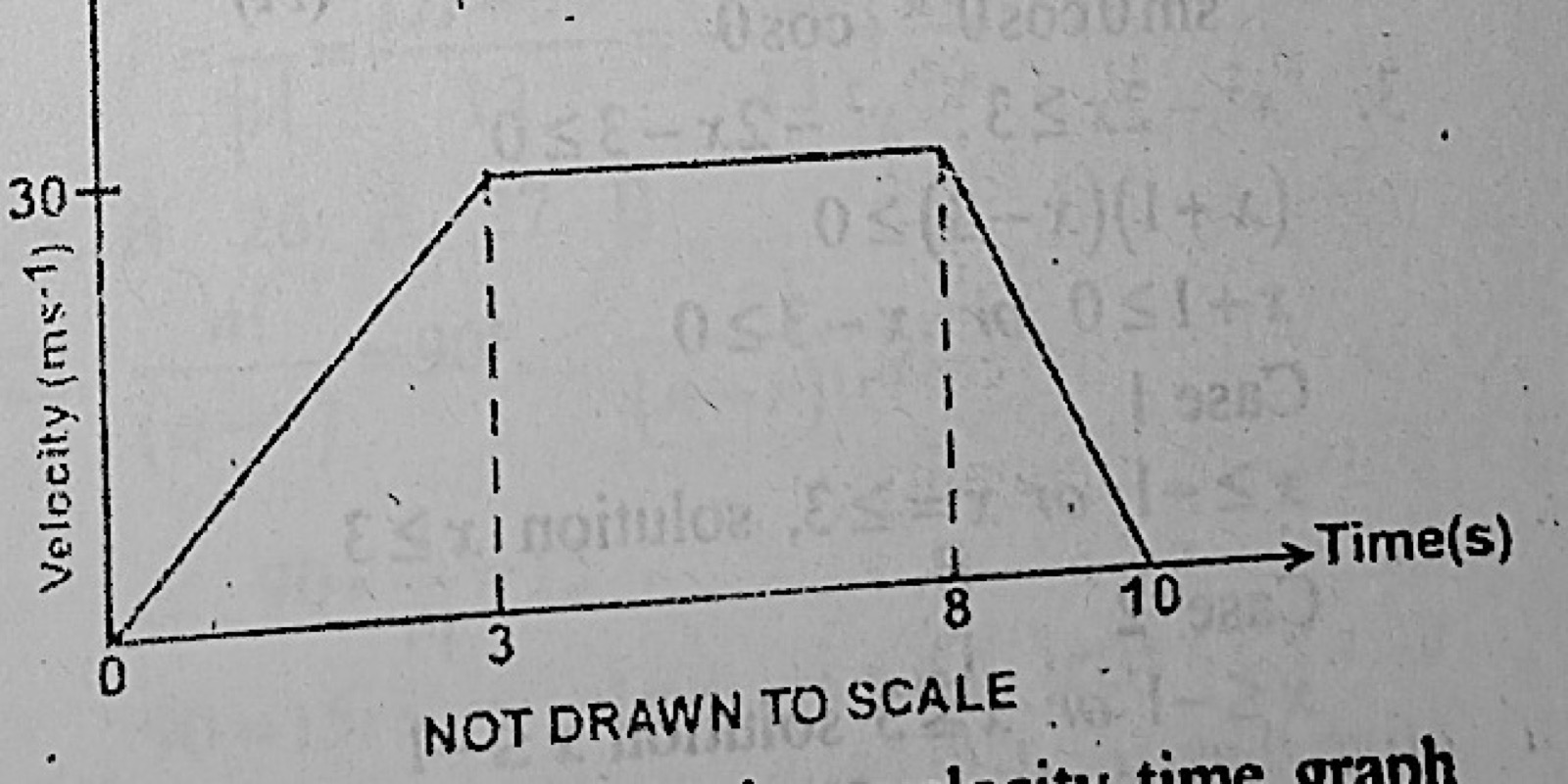
(a) A body P of mass 5kg is suspended by two light inextensible strings AP and BP attached to a ceiling. If the strings are inclined at angles 40° and 30° respectively to the downward vertical, find the tension in each of the strings. [Take g = 10ms−1] (b) A constant force F acts on the toy car of mass 5kg and increases its velocity from 5ms−1 to 9ms−1 in 2 seconds. Calculate the: (i) magnitude of the force; (ii) velocity of the toy car 3 seconds after attaining a velocity of 9ms−1.
Show the model answer
Model answer
(a) W = 50 N; the angle between the strings is 70° Horizontal: TAP sin 40° = TBP sin 30°; vertical: TAP cos 40° + TBP cos 30° = 50 (Lami) TAP = 50 sin 30°/sin 70° ≈ 26.6 N TBP = 50 sin 40°/sin 70° ≈ 34.2 N (b)(i) a = (9 − 5)/2 = 2 ms−2, F = ma = 5 × 2 = 10 N (ii) v = 9 + 2 × 3 = 15 ms−1
Explanation
The string nearer the vertical carries the larger tension.
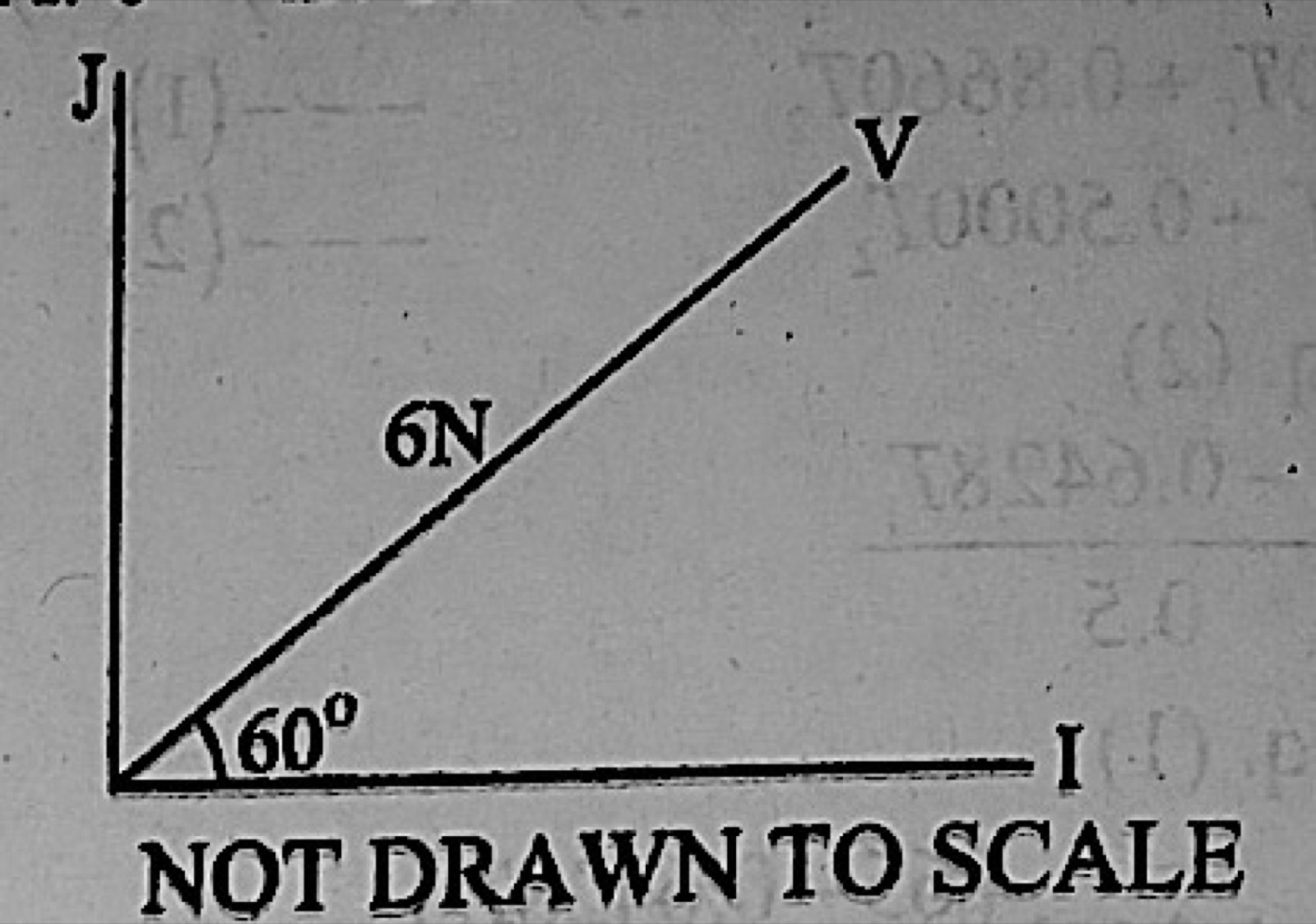
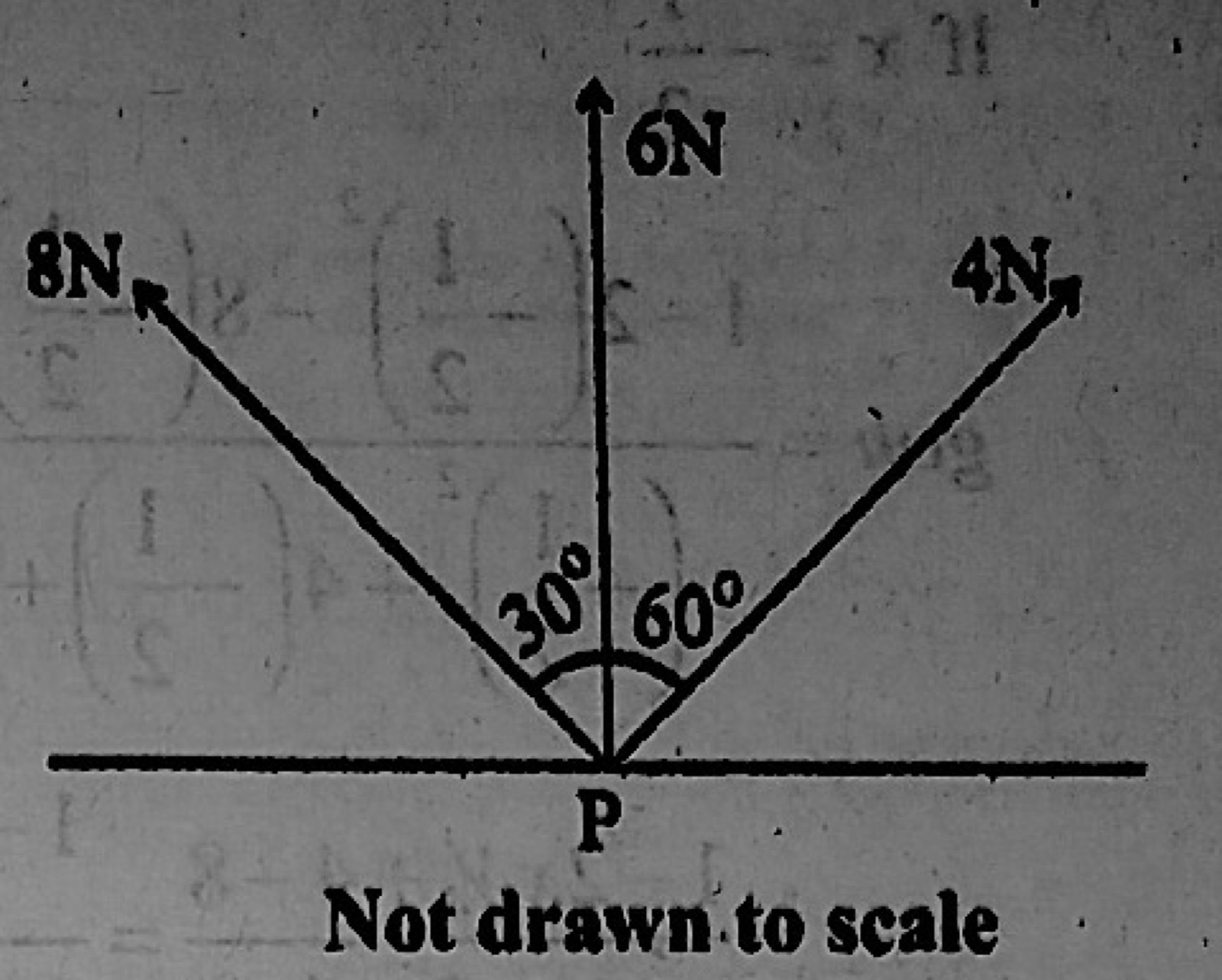
(a) given that P = (4i − 3j) and q = (−i + 5j), find r such that |r| = 15 and is in the direction of (2p + 3q) (b) Forces of magnitude 8N, 6N and 4N act at the point P, as shown in the diagram. Find the: (i) magnitude; (ii) direction of the resultant force.
Show the model answer
Model answer
(a) 2p + 3q = (8i − 6j) + (−3i + 15j) = 5i + 9j, |5i + 9j| = √106 r = 15(5i + 9j)/√106 ≈ 7.28i + 13.11j (b) Take i to the right and j along the 6N force; 8N is 30° left of it and 4N is 60° right of it Σx = −8 sin 30° + 4 sin 60° = −4 + 2√3 ≈ −0.536 Σy = 6 + 8 cos 30° + 4 cos 60° = 8 + 4√3 ≈ 14.928 (i) R = √(0.5362 + 14.9282) ≈ 14.9 N (ii) tan α = 0.536/14.928, α ≈ 2.1° to the left of the 6N force (about 92.1° to the horizontal line through P, measured from the right)
Explanation
Resolve each force along and across the 6N direction.
(a) Find the angle between the vectors a = (−3 / 4) and b = (−8 / −15). (Column vectors written top / bottom.) (b) Given that a = (4N, 060°) and b = (3N, 120°), Find in component form, the unit vector along a − b.
Show the model answer
Model answer
(a) a · b = 24 − 60 = −36; |a| = 5, |b| = 17 cos θ = −36/85 ≈ −0.4235, θ ≈ 115.1° (b) Using bearings, (F, θ) = F sin θ i + F cos θ j a = 2√3i + 2j, b = (3√3/2)i − (3/2)j a − b = (√3/2)i + (7/2)j, |a − b| = √(3/4 + 49/4) = √13 Unit vector = (√3i + 7j)/(2√13) ≈ 0.240i + 0.971j
Explanation
Find a − b first, then divide it by its own length.