Question 1
SurdsSimplify (√3 + √48)/√6
- A.3√2
- B.5√2
- C.5√2/2
- D.3√2/2
Show the answer and explanation
Answer: C (5√2/2)
Explanation
√48 = 4√3, so the top is 5√3. Then 5√3/√6 = 5/√2 = 5√2/2.
57 questions. Try each one, then open the answer to check yourself and read the explanation.
Simplify (√3 + √48)/√6
Answer: C (5√2/2)
√48 = 4√3, so the top is 5√3. Then 5√3/√6 = 5/√2 = 5√2/2.
Find the range of values of x for which 2x2 + 7x − 15 > 0
Answer: B (x < −5 or x > 3/2)
Factorise: (2x − 3)(x + 5) > 0. The product is positive outside the roots −5 and 3/2, so x < −5 or x > 3/2.
A function f is defined on R, the set of real numbers, by f : x → (x + 3)/(x − 1), x ≠ 2. Find f−1
Answer: B (f−1 : x → (x + 3)/(x − 1), x ≠ −2)
Let y = (x + 3)/(x − 1). Then yx − y = x + 3, so x(y − 1) = y + 3 and x = (y + 3)/(y − 1). The inverse has the same rule as f.
The sum of the first n terms of a linear sequence is Sn = n2 + 2n. Find the common difference of the sequence.
Answer: D (2)
T1 = S1 = 3 and S2 = 8, so T2 = 5. The common difference is 5 − 3 = 2.
The sum of the first n terms of a linear sequence is Sn = n2 + 2n. Determine the general term of the sequence.
Answer: B (2n + 1)
First term 3, common difference 2, so Tn = 3 + (n − 1)2 = 2n + 1.
If f(x) = 2x2 − 3x − 1 find the value of x for which f(x) is minimum.
Answer: C (3/4)
f′(x) = 4x − 3 = 0 gives x = 3/4, and f″(x) = 4 > 0 so it is a minimum.
The polynomial 2x3 + x2 − 3x + p has a remainder 20 when divided by (x − 2). Find the value of constant p.
Answer: B (6)
By the remainder theorem f(2) = 16 + 4 − 6 + p = 14 + p = 20, so p = 6.
If 2log42 = x + 1, find the value of x.
Answer: C (0)
log42 = 1/2 because 41/2 = 2. So 2 × 1/2 = 1 = x + 1, giving x = 0.
Which of the following quadratic curves will not intersect with the x-axis?
Answer: D (y = 3x2 − 2x + 4)
A curve misses the x-axis when b2 − 4ac < 0. For 3x2 − 2x + 4: 4 − 48 = −44 < 0; the others have positive discriminants.
What is the coordinates of the centre of the circle 5x2 + 5y2 − 15x + 25y − 3 = 0?
Answer: B ((3/2, −5/2))
Divide by 5: x2 + y2 − 3x + 5y − 3/5 = 0. The centre is (−g, −f) = (3/2, −5/2).
Evaluate ∫12(2 + 2x − 3x2)dx
Answer: A (−2)
The antiderivative is 2x + x2 − x3. At 2 it is 0 and at 1 it is 2, so the answer is 0 − 2 = −2.
A rectangle has a perimeter of 24m, if its area is to be a maximum, find its dimension.
Answer: B (6, 6)
L + B = 12, so A = L(12 − L). dA/dL = 12 − 2L = 0 gives L = 6 and B = 6.
Express 7π/6 radians in degrees.
Answer: B (210°)
π radians = 180°, so 7π/6 = 7 × 180°/6 = 210°.
If P = (1 −2; 3 4) and Q = (−2 3; 1 0), find PQ.
Answer: D ((−4 3; −2 9))
Row 1: (1)(−2) + (−2)(1) = −4 and (1)(3) + (−2)(0) = 3. Row 2: (3)(−2) + (4)(1) = −2 and (3)(3) + 0 = 9.
Two statements are represented by p and q as follows: p: He is brilliant. q: He is regular in class. Which of the following symbols represents the statement "he is regular in class but dull"?
Answer: B (q ∧ ~p)
'Regular in class' is q, 'dull' is not brilliant (~p), and 'but' means 'and' (∧): q ∧ ~p.
A binary operation *, is defined on the set R, of real numbers by a * b = a2 + b + ab. Find the value of x for which 5 * x = 37.
Answer: B (2)
5 * x = 25 + x + 5x = 25 + 6x. Setting 25 + 6x = 37 gives x = 2.
Find the derivative of 3x2 + 1/x2
Answer: C (6x − 2/x3)
Write 1/x2 as x−2; its derivative is −2x−3. So the answer is 6x − 2/x3.
The coefficient of the 5th term in the binomial expansion of (1 + kx)8, in ascending powers of x is 35/8. Find the value of constant k.
Answer: B (1/2)
The 5th term is 8C4(kx)4 = 70k4x4. So 70k4 = 35/8, k4 = 1/16 and k = 1/2 (k = −1/2 also fits).
Given that f′(x) = 3x2 − 6x + 1 and f(3) = 5, find f(x).
Answer: C (f(x) = x3 − 3x2 + x + 2)
Integrate: f(x) = x3 − 3x2 + x + c. f(3) = 27 − 27 + 3 + c = 5, so c = 2.
Express 1/(1 − sin 45°) in surd form
Answer: A (2 + √2)
sin 45° = 1/√2, so the expression is √2/(√2 − 1). Multiply top and bottom by (√2 + 1): √2(√2 + 1)/1 = 2 + √2.
If |4 x; 5 3| = 32, find the value of x
Answer: D (−4)
The determinant is 4 × 3 − 5x = 12 − 5x. 12 − 5x = 32 gives x = −4.
If events A and B are independent and P(A) = 7/12 and P(A∩B) = 1/2, find P(B)
Answer: D (6/7)
For independent events P(A∩B) = P(A) × P(B), so P(B) = (1/2) ÷ (7/12) = 6/7.
Given that AB = 5i + 3j and AC = 2i + 5j, find BC.
Answer: B (−3i + 2j)
BC = AC − AB = (2i + 5j) − (5i + 3j) = −3i + 2j.
The probability of Jide, Atu and Obu solving a given problem are 1/12, 1/6 and 1/8 respectively. Calculate the probability that only one of them solves the problem.
Answer: D (167/576)
Add the three cases where exactly one solves it: (1/12)(5/6)(7/8) + (11/12)(1/6)(7/8) + (11/12)(5/6)(1/8) = (35 + 77 + 55)/576 = 167/576.
Two forces F1 = (10N, 020°) and F2 = (7N, 200°) act on a particle. Find the resultant force.
Answer: A ((3N, 020°))
020° and 200° differ by 180°, so the forces act in opposite directions. The resultant is 10 − 7 = 3N in the direction of the larger force, 020°.
The table shows the distribution of marks by some candidates in a test.
Marks: 2, 3, 4, 5, 6, 7, 8
No of students: 5, 7, 9, 6, 3, 6, 4
What is the median score?
Answer: B (4.0)
There are 40 students, so the median is between the 20th and 21st scores. Cumulative frequencies are 5, 12, 21, so both are 4.
The table shows the distribution of marks by some candidates in a test.
Marks: 2, 3, 4, 5, 6, 7, 8
No of students: 5, 7, 9, 6, 3, 6, 4
Find, correct to one decimal place, the mean of the distribution.
Answer: D (4.7)
Σfx = 10 + 21 + 36 + 30 + 18 + 42 + 32 = 189 and Σf = 40, so the mean is 189/40 = 4.725 ≈ 4.7.
The table shows the distribution of marks by some candidates in a test.
Marks: 2, 3, 4, 5, 6, 7, 8
No of students: 5, 7, 9, 6, 3, 6, 4
If a student is selected at random, what is the probability that she scored at least 6 marks?
Answer: C (13/40)
Students scoring 6, 7 or 8: 3 + 6 + 4 = 13 out of 40, so the probability is 13/40.
Express r = (12, 210°) in the form ai + bj
Answer: B (6(−i − √3j))
Read 210° as a bearing (clockwise from north): a = 12 sin 210° = −6 and b = 12 cos 210° = −6√3, so r = −6i − 6√3j = 6(−i − √3j).
A test consists of 12 questions out of which candidates are to answer 10. If the first 6 questions are compulsory, in how many ways can each candidate select her questions?
Answer: C (15)
After the 6 compulsory questions she chooses 4 more from the remaining 6: 6C4 = 15.
A body starts from rest and moves in a straight line with a uniform acceleration of 5ms−2. How far, in m, does it go in 10 seconds?
Answer: B (250)
s = ut + ½at2 = 0 + ½ × 5 × 100 = 250 m.
If n items are arranged two at a time, the number obtained is 20. Find the value of n.
Answer: A (5)
nP2 = n(n − 1) = 20, so n2 − n − 20 = 0, (n − 5)(n + 4) = 0 and n = 5.
If p = (2, −2) and q = (3, 4), find |q − ½p|
Answer: D (√29)
q − ½p = (3 − 1, 4 + 1) = (2, 5). Its magnitude is √(4 + 25) = √29.
Find the value of constant k for which a = 4i − kj and b = 3i + 8j are perpendicular.
Answer: B (3/2)
Perpendicular vectors have a zero dot product: 12 − 8k = 0, so k = 3/2.
A pack of cards has 6 of them with a ⊗ written on them, 5 with ⊕ and 9 with ∅. What is probability that single card drawn at random is not a ⊕?
Answer: D (3/4)
There are 20 cards and 5 have ⊕, so 15 do not. The probability is 15/20 = 3/4.
The initial and final velocities of an object of mass 5kg are u = (1, 3) and v = (4, 7) respectively. Find the magnitude of its change in momentum.
Answer: A (25)
Change in velocity = (3, 4), so change in momentum = 5(3, 4) = (15, 20). Its magnitude is √(225 + 400) = 25.
If y = x2 − 6x + 11 is written in the form y = a(x − h)2 + k, find the value of (a + h + k)
Answer: D (6)
Completing the square: y = (x − 3)2 + 2, so a = 1, h = 3, k = 2 and a + h + k = 6.
The distance between P(x, 7) and Q(6, 19) is 13 units. Find the values of x
Answer: C (1 or 11)
(6 − x)2 + 122 = 169, so (6 − x)2 = 25 and 6 − x = ±5. Hence x = 1 or 11.
In the diagram below, forces P, Q and 50N are acting on a body at M. If the system is in equilibrium, calculate, in terms of θ, the magnitude of P.
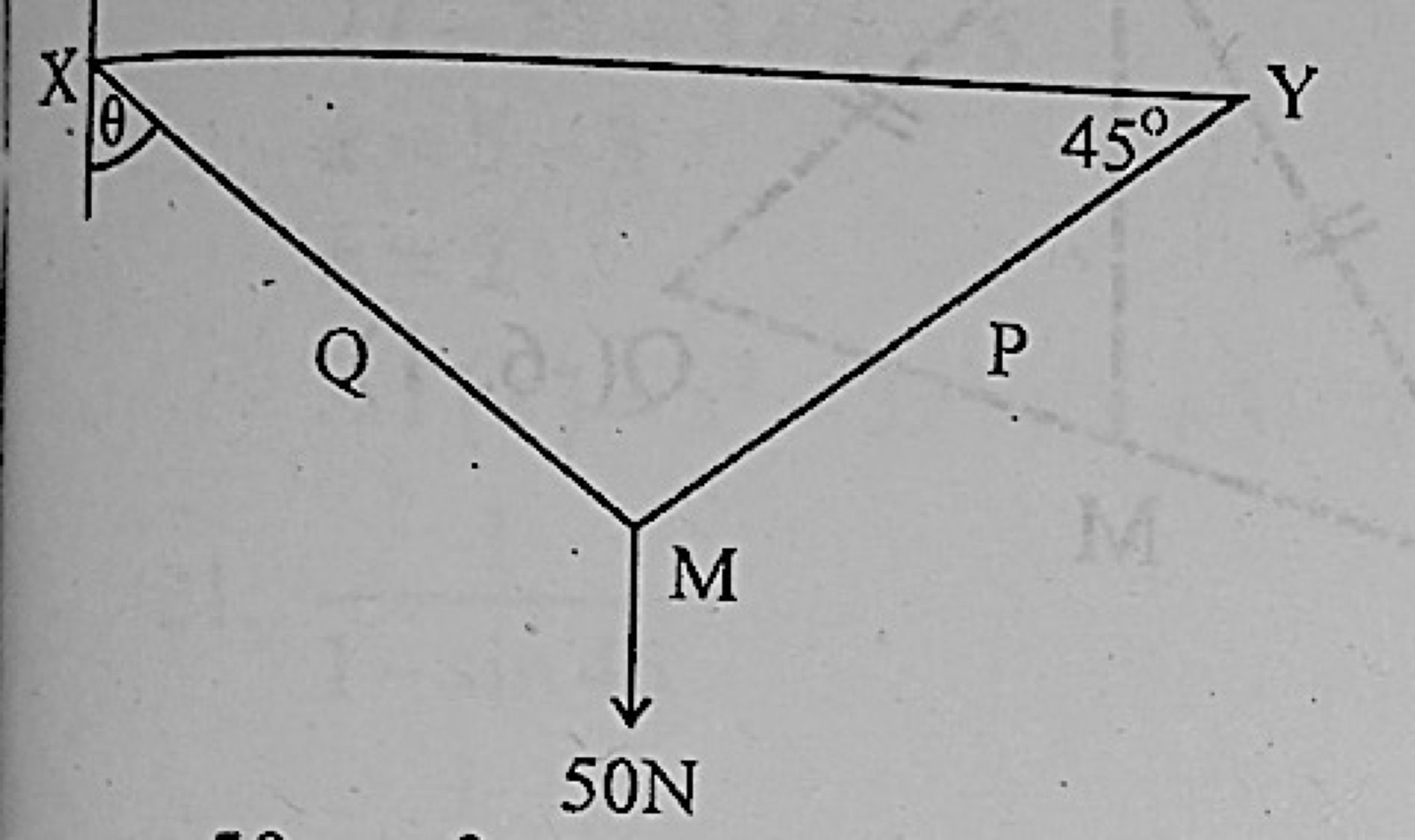
Answer: D (50sinθ/sin(θ + 45)°)
By Lami's theorem P/sin(angle between Q and 50N) = 50/sin(angle between P and Q). The angle between Q and the weight is 180° − θ and between P and Q is θ + 45°, so P = 50 sinθ/sin(θ + 45°).
A function f is defined on the set R, of real numbers by f : x → px2 + qx + 2, where p and q are constants. If f(−2) = 0 and f(1) = 3, find f(−4)
f(−2) = 4p − 2q + 2 = 0, so 2p − q = −1
f(1) = p + q + 2 = 3, so p + q = 1
Adding: 3p = 0, so p = 0 and q = 1
f(x) = x + 2, so f(−4) = −2
Form two equations from the given values, solve for p and q, then substitute x = −4.
If sin A = 3/5 and cos B = 15/17, where A is obtuse and B is acute, find the value of cos(A + B).
A is obtuse, so cos A = −4/5
B is acute, so sin B = 8/17
cos(A + B) = cos A cos B − sin A sin B
= (−4/5)(15/17) − (3/5)(8/17) = −60/85 − 24/85
= −84/85
Use right-angled triangles (3, 4, 5 and 8, 15, 17) and remember cosine is negative for an obtuse angle.
Differentiate, with respect to x, x3 − 2x from the first principle
y = x3 − 2x; y + δy = (x + δx)3 − 2(x + δx)
δy = 3x2δx + 3x(δx)2 + (δx)3 − 2δx
δy/δx = 3x2 + 3xδx + (δx)2 − 2
As δx → 0: dy/dx = 3x2 − 2
Give x a small increase δx, find δy, divide by δx and let δx tend to 0.
A straight line passes through the point P(−1, 3). Another line which passes through Q(−4, 4) intersects the first line at a point R(k, 5), where k is constant. If ∠PRQ = 90° find the values of K.
Gradient of PR = (5 − 3)/(k + 1) = 2/(k + 1)
Gradient of QR = (5 − 4)/(k + 4) = 1/(k + 4)
Perpendicular: product = −1, so 2 = −(k + 1)(k + 4)
k2 + 5k + 6 = 0, (k + 2)(k + 3) = 0
k = −2 or k = −3
Lines at right angles have gradients whose product is −1.
In a hotel the breakfast menu is a choice between yam (Y) or plantain (P) or both. The Venn diagram shows the choices made by 25 guests of the Hotel. (a) Find the value of x. (b) What is the probability that a guest chosen at random chose only one of the two?
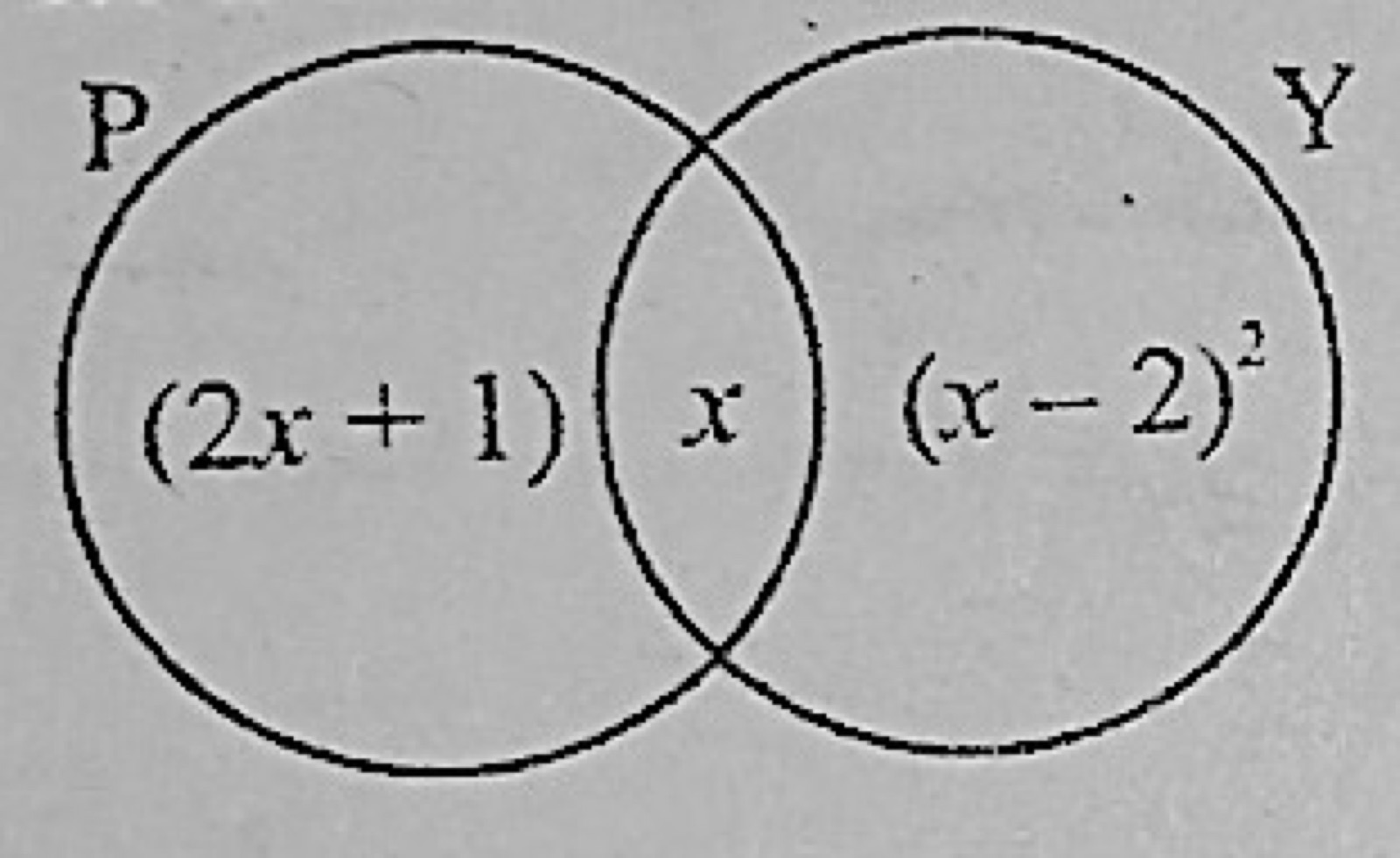
(a) (2x + 1) + x + (x − 2)2 = 25
x2 − x − 20 = 0, (x − 5)(x + 4) = 0
x = 5 (x cannot be negative)
(b) P only = 11, Y only = 9, so 20 guests chose only one
Probability = 20/25 = 4/5
The three regions of the Venn diagram add up to the 25 guests.
The table shows the distribution of marks obtained by some candidates in a test
Marks: 10 − 14, 15 − 24, 25 − 29, 30 − 39, 40 − 44, 45 − 49
No. of candidates: 14, 30, 22, 18, 12, 4
Draw a histogram for the distribution.
Class boundaries: 9.5–14.5, 14.5–24.5, 24.5–29.5, 29.5–39.5, 39.5–44.5, 44.5–49.5
Class widths 5, 10, 5, 10, 5, 5 are unequal, so bar heights must be frequency densities
Heights per 5 marks: 14, 15, 22, 9, 12, 4 (frequency ÷ width × 5)
Bars drawn touching on the class boundaries, with a stated scale and labelled axes
The classes have different widths, so the area (not the height) of each bar must show the frequency.
A car travelling at a velocity of 50 km h−1, covers a distance of 20km. If it was accelerating at 6km h−2, calculate, correct to one decimal place, the time the car took to cover the distance.
s = ut + ½at2: 20 = 50t + 3t2
3t2 + 50t − 20 = 0
t = (−50 + √2740)/6 ≈ 0.39
t ≈ 0.4 hours (about 23 minutes)
(Taking 50 km h−1 as the final speed instead also gives 0.4 h.)
Use s = ut + ½at² and solve the quadratic in t, keeping the positive root.
The magnitude of a force xi + 15j is 17N. Find the: (a) possible value of x; (b) directions of the forces, correct to the nearest degree.
(a) x2 + 152 = 172, x2 = 64, x = ±8
(b) 8i + 15j: tan θ = 15/8, θ = 62° to the positive x-axis (bearing 028°)
−8i + 15j: 180° − 62° = 118° to the positive x-axis (bearing 332°)
The magnitude of ai + bj is √(a² + b²); there are two forces, one for each value of x.
(a) The sum of the first n terms of a sequence is given by Sn = 5n2/2 + 5n/2. Write down the first four terms of the sequence and find an expression for the nth term.
(b) The equation of a circle is given by x2 + y2 − 10x − 8y + 25 = 0. (i) Show that the circle touches the X-axis. (ii) Find the coordinates of the point of contact.
(a) S1 = 5, S2 = 15, S3 = 30, S4 = 50
Terms: 5, 10, 15, 20
Tn = Sn − Sn−1 = 5n
(b)(i) Centre (5, 4), radius √(25 + 16 − 25) = 4; distance from centre to the x-axis = 4 = radius, so the circle touches it (or: y = 0 gives (x − 5)2 = 0, equal roots)
(ii) Point of contact (5, 0)
Each term is the difference of two consecutive sums; a circle touches a line when the line is exactly one radius from the centre.
(a) If α and β are the roots of the equation 2x2 + 5x − 6 = 0, find the equation whose roots are (α − 2) and (β − 2).
(b) Given that ∫0k(x2 − 2x)dx = 4/3, find the values of k.
(a) α + β = −5/2, αβ = −3
Sum of new roots = α + β − 4 = −13/2
Product = αβ − 2(α + β) + 4 = −3 + 5 + 4 = 6
x2 + (13/2)x + 6 = 0, i.e. 2x2 + 13x + 12 = 0
(b) [x3/3 − x2] from 0 to k = k3/3 − k2 = 4/3
k3 − 3k2 − 4 = 0
This cubic has only one real root: k ≈ 3.36 (by trial or iteration)
Find the sum and product of the new roots from those of the old ones; for (b) integrate, substitute the limits and solve for k.
(a) Express (2x2 − 5x + 1)/(x3 − 4x2 + 3x) in partial fractions.
(b) If |x − 3 −4 3|
|5 2 2|
|2 −4 6 − x| = −24, find the value of x.
(a) x3 − 4x2 + 3x = x(x − 1)(x − 3)
A/x + B/(x − 1) + C/(x − 3): A = 1/3, B = 1, C = 2/3
= 1/(3x) + 1/(x − 1) + 2/(3(x − 3))
(b) Expanding along the first row: (x − 3)(20 − 2x) + 4(26 − 5x) + 3(−24) = −2x2 + 6x − 28
−2x2 + 6x − 28 = −24, x2 − 3x + 2 = 0
x = 1 or x = 2
Factorise the denominator fully before splitting; expand the determinant along the first row.
(a) The point P(3, −5) is rotated through an angle 60° anticlockwise about the origin. (i) Obtain the matrix for the rotation. (ii) Find the image P′ of point P under the rotation.
(b) A linear transformation is given by N: (x, y) → (2x + 3y, 3x − y). (i) Write down the matrix N of the transformation. (ii) If N2 + aN + bI = O, where a, b ∈ R, I is the 2 × 2 unit matrix and O is the 2 × 2 null matrix, find the values of a and b.
(a)(i) (cos 60° −sin 60°; sin 60° cos 60°) = (1/2 −√3/2; √3/2 1/2)
(ii) x′ = 3/2 + 5√3/2 = (3 + 5√3)/2, y′ = 3√3/2 − 5/2 = (3√3 − 5)/2
P′((3 + 5√3)/2, (3√3 − 5)/2) ≈ (5.83, 0.10)
(b)(i) N = (2 3; 3 −1)
(ii) N2 = (13 3; 3 10)
13 + 2a + b = 0 and 3 + 3a = 0
a = −1, b = −11 (check: 10 − a·1 + b = 10 + 1 − 11 = 0)
Matrices are written (row 1; row 2). Compare corresponding entries of N² + aN + bI with zero.
A survey indicated that 65% of the families in an area have cars. Find, correct to three decimal places, the probability that among 7 families selected at random in the area (a) exactly 5; (b) 3 or 4; (c) at most 2 of them have cars.
Binomial with n = 7, p = 0.65, q = 0.35
(a) 7C5(0.65)5(0.35)2 = 0.298
(b) P(3) + P(4) = 0.1442 + 0.2679 = 0.412
(c) P(0) + P(1) + P(2) = 0.0006 + 0.0084 + 0.0466 = 0.056
Use P(r) = ⁿCᵣ pʳ qⁿ⁻ʳ and add the cases needed.
The following table shows the distribution of marks obtained by some students in an examination.
Marks: 0 − 9, 10 − 19, 20 − 29, 30 − 39, 40 − 49, 50 − 59, 60 − 69, 70 − 79, 80 − 89, 90 − 99
No. of students: 50, 50, 40, 60, 100, 100, 50, 25, 15, 10
(a) Construct a cumulative frequency table for the distribution. (b) Draw an ogive for the distribution. (c) Use your graph in (b) to determine the (i) semi-interquartile range; (ii) number of students who failed, if the pass mark for the examination is 37; (iii) probability that a student selected at random scored between 20% and 60%.
(a) Cumulative frequencies: 50, 100, 140, 200, 300, 400, 450, 475, 490, 500
(b) Plot cumulative frequency against upper class boundaries 9.5, 19.5, …, 99.5 and join with a smooth curve
(c)(i) Q1 (125th) ≈ 25.8, Q3 (375th) ≈ 57; semi-interquartile range ≈ (57 − 25.8)/2 ≈ 15.6 (about 15–16 from the graph)
(ii) Reading at 36.5: about 182 students failed (about 180)
(iii) (400 − 100)/500 = 3/5
Read quartiles at the 125th and 375th positions of 500 on the ogive.
(a) Five (5) female and seven (7) male teachers applied for 4 vacancies in a Junior High School. The teachers are equally qualified. Find the number of ways of employing the 4 teachers. If (i) there is no restriction; (ii) at least 2 of them are females.
(b) The table shows the positions awarded to 7 contestants by Judges x and y in a competition.
Contestant: P, Q, R, S, T, U, V
Judges X: 2, 7, 1, 3, 6, 5, 4
Judges Y: 4, 6, 2, 3, 7, 1, 5
(i) Calculate, correct to one decimal place, the Spearman's rank correlation coefficient. (ii) interprete your answer in (b)(i) above.
(a)(i) 12C4 = 495
(ii) 5C2×7C2 + 5C3×7C1 + 5C4 = 210 + 70 + 5 = 285
(b)(i) d = −2, 1, −1, 0, −1, 4, −1; Σd2 = 24
ρ = 1 − 6(24)/(7(49 − 1)) = 1 − 144/336 = 0.57 ≈ 0.6
(ii) There is a moderate positive agreement between the two judges' rankings
'At least 2 females' means 2, 3 or 4 females; add the three cases.
The position vectors of points P, Q and R with respect to the origin are (4i − 5j), (i + 3j) and (−5i + 2j) respectively. If PQRM is a parallelogram, find: (a) the position vector of M; (b) |PM| and |PQ|; (c) the acute angle between PM and PQ, correct to one decimal place; (d) the area of PQRM.
(a) OM = OP + OR − OQ = −2i − 6j
(b) PM = −6i − j, |PM| = √37; PQ = −3i + 8j, |PQ| = √73
(c) PM·PQ = 18 − 8 = 10; cos θ = 10/(√37 √73) = 0.1924; θ = 78.9°
(d) Area = |PM||PQ| sin θ = √37 × √73 × sin 78.9° = 51 square units
In parallelogram PQRM, PM = QR, so M = P + R − Q.
(a) Forces F1 = (−5, 4)N, F2 = (2, 5)N, F3 = (2, −1)N, F4 = (3, −5)N, act on a body, Find the: (i) resultant of these forces; (ii) fifth force that will keep the system in equilibrium.
(b) A body, moving at 20ms−1 accelerates uniformly at 2.5ms−2 for 4 seconds. It continues the journey at this speed for 8 seconds, before coming to rest t seconds with a uniform retardation. If the ratio of acceleration to retardation is 3:4 (i) sketch the velocity - time graph of the journey; (ii) find t, (iii) find the total distance of the journey.
(a)(i) R = (−5 + 2 + 2 + 3, 4 + 5 − 1 − 5) = (2, 3)N (magnitude √13 N)
(ii) Fifth force = −R = (−2, −3)N
(b)(i) Graph: line from 20 to 30 ms−1 over 0–4 s, horizontal at 30 ms−1 from 4 to 12 s, then down to 0
Speed after 4 s: 20 + 2.5 × 4 = 30 ms−1
(ii) Retardation = 2.5 × 4/3 = 10/3 ms−2; t = 30 ÷ 10/3 = 9 s
(iii) Distance = area: ½(20 + 30)(4) + 30 × 8 + ½(30)(9) = 100 + 240 + 135 = 475 m
The equilibrant is equal and opposite to the resultant; distance is the area under the velocity–time graph.
(a) An object is thrown up a smooth plane inclined at an angle of 30° to the horizontal. If the plane is 15m long and the object comes to rest at the top, find the (i) initial speed of the object (ii) time taken to reach the top.
(b) Force of magnitudes 5N, 5√3 N, 10N, 5√3 and 5N act on a body P, of mass 5kg as shown in the diagram. Find the (i) magnitude of the resultant force; (ii) acceleration of the body.
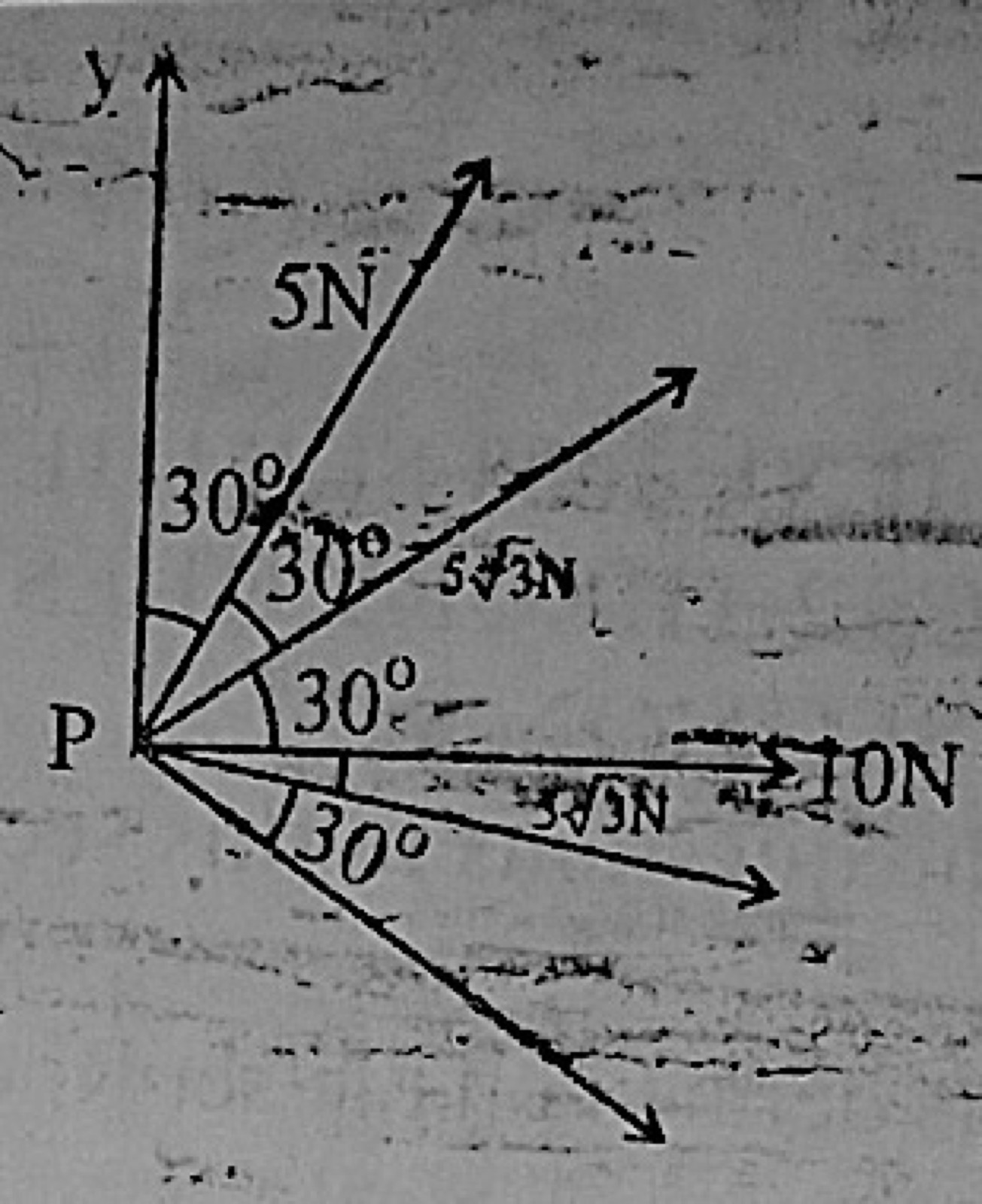
(a) Retardation = g sin 30° = 10 × ½ = 5 ms−2 (taking g = 10)
(i) 0 = u2 − 2(5)(15), u = √150 ≈ 12.2 ms−1
(ii) t = u/5 = 2.45 s
(b) Forces at 60°, 30°, 0°, −30°, −60° to the 10N direction: components across cancel
Along: 10 + 2(5√3 cos 30°) + 2(5 cos 60°) = 10 + 15 + 5 = 30 N
(i) Resultant = 30 N along the 10N force
(ii) a = F/m = 30/5 = 6 ms−2
On a smooth slope the only retarding force is the weight component mg sin θ.