Use the following information: 10,000 ordinary shares of ₦1 each: ₦10,000 5,000 5% preference shares of ₦1 each: ₦5,000 Profit and Loss Account: ₦8,000 8% debenture: ₦10,000 Creditors: ₦3,000 Bank overdraft: ₦2,000 Plants and machinery: ₦10,000 Furniture and fittings: ₦3,000 Stock: ₦8,000 Debtors: ₦5,000
Use the following information: 10,000 ordinary shares of ₦1 each: ₦10,000 5,000 5% preference shares of ₦1 each: ₦5,000 Profit and Loss Account: ₦8,000 8% debenture: ₦10,000 Creditors: ₦3,000 Bank overdraft: ₦2,000 Plants and machinery: ₦10,000 Furniture and fittings: ₦3,000 Stock: ₦8,000 Debtors: ₦5,000
What is the value of shareholders' equity?
A.₦25,000
B.₦23,000
C.₦18,000
D.₦15,000
E.₦10,000.
Show the answer and explanation
Answer: B (₦23,000)
Explanation
Share capital 15,000 + profit and loss 8,000 = ₦23,000.
Use the following information: 10,000 ordinary shares of ₦1 each: ₦10,000 5,000 5% preference shares of ₦1 each: ₦5,000 Profit and Loss Account: ₦8,000 8% debenture: ₦10,000 Creditors: ₦3,000 Bank overdraft: ₦2,000 Plants and machinery: ₦10,000 Furniture and fittings: ₦3,000 Stock: ₦8,000 Debtors: ₦5,000
What is the total value of long term liability?
A.₦33,000
B.₦25,000
C.₦25,000
D.₦15,000
E.₦10,000.
Show the answer and explanation
Answer: E (₦10,000.)
Explanation
The only long-term liability is the 8% debenture, ₦10,000.
Use the following information: 10,000 ordinary shares of ₦1 each: ₦10,000 5,000 5% preference shares of ₦1 each: ₦5,000 Profit and Loss Account: ₦8,000 8% debenture: ₦10,000 Creditors: ₦3,000 Bank overdraft: ₦2,000 Plants and machinery: ₦10,000 Furniture and fittings: ₦3,000 Stock: ₦8,000 Debtors: ₦5,000
Use the following information: 10,000 ordinary shares of ₦1 each: ₦10,000 5,000 5% preference shares of ₦1 each: ₦5,000 Profit and Loss Account: ₦8,000 8% debenture: ₦10,000 Creditors: ₦3,000 Bank overdraft: ₦2,000 Plants and machinery: ₦10,000 Furniture and fittings: ₦3,000 Stock: ₦8,000 Debtors: ₦5,000
Use the following information: 10,000 ordinary shares of ₦1 each: ₦10,000 5,000 5% preference shares of ₦1 each: ₦5,000 Profit and Loss Account: ₦8,000 8% debenture: ₦10,000 Creditors: ₦3,000 Bank overdraft: ₦2,000 Plants and machinery: ₦10,000 Furniture and fittings: ₦3,000 Stock: ₦8,000 Debtors: ₦5,000
John and Johnson are in partnership, sharing profit and losses in the ratio 3:2. Other information are as follows: Capital: John ₦20,000; Johnson ₦10,000 Drawings: John ₦2,000; Johnson ₦3,000 Interest on capital: 5% Interest on drawings: 10% Profit: ₦6,000
John and Johnson are in partnership, sharing profit and losses in the ratio 3:2. Other information are as follows: Capital: John ₦20,000; Johnson ₦10,000 Drawings: John ₦2,000; Johnson ₦3,000 Interest on capital: 5% Interest on drawings: 10% Profit: ₦6,000
John and Johnson are in partnership, sharing profit and losses in the ratio 3:2. Other information are as follows: Capital: John ₦20,000; Johnson ₦10,000 Drawings: John ₦2,000; Johnson ₦3,000 Interest on capital: 5% Interest on drawings: 10% Profit: ₦6,000
What is John's share of the profit?
A.₦5,000
B.₦3,600
C.₦3,000
D.₦2,400
E.₦2,000
Show the answer and explanation
Answer: C (₦3,000)
Explanation
6,000 + interest on drawings 500 − interest on capital 1,500 = 5,000; John gets 3/5 = ₦3,000.
John and Johnson are in partnership, sharing profit and losses in the ratio 3:2. Other information are as follows: Capital: John ₦20,000; Johnson ₦10,000 Drawings: John ₦2,000; Johnson ₦3,000 Interest on capital: 5% Interest on drawings: 10% Profit: ₦6,000
John and Johnson are in partnership, sharing profit and losses in the ratio 3:2. Other information are as follows: Capital: John ₦20,000; Johnson ₦10,000 Drawings: John ₦2,000; Johnson ₦3,000 Interest on capital: 5% Interest on drawings: 10% Profit: ₦6,000
John and Johnson are in partnership, sharing profit and losses in the ratio 3:2. Other information are as follows: Capital: John ₦20,000; Johnson ₦10,000 Drawings: John ₦2,000; Johnson ₦3,000 Interest on capital: 5% Interest on drawings: 10% Profit: ₦6,000
The balance on Johnson's current account is
A.₦3,300 CR
B.₦2,200 CR
C.₦1,300 CR
D.₦800 DR
E.₦500 DR.
Show the answer and explanation
Answer: D (₦800 DR)
Explanation
Interest 500 + share 2,000 − drawings 3,000 − interest on drawings 300 = −800, a debit of ₦800.
John and Johnson are in partnership, sharing profit and losses in the ratio 3:2. Other information are as follows: Capital: John ₦20,000; Johnson ₦10,000 Drawings: John ₦2,000; Johnson ₦3,000 Interest on capital: 5% Interest on drawings: 10% Profit: ₦6,000
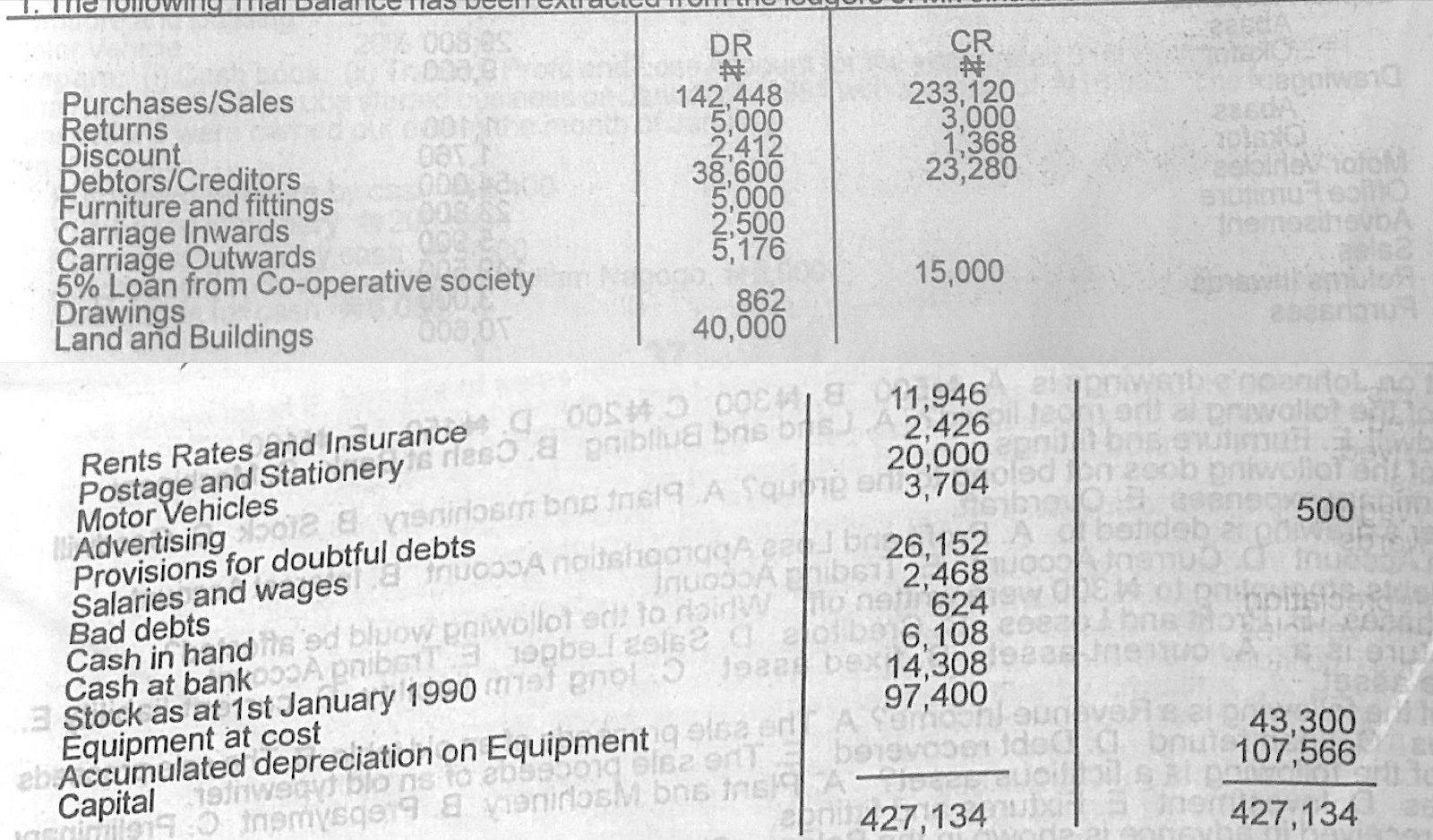
Section A (compulsory) The following Trial Balance has been extracted from the ledgers of Mr. Jinadu as at 31st December 1990 (shown in the figure). Additional Information: (a) Stock at close ₦16,442 (b) Outstanding expenses: Advertising ₦354; Salaries and wages ₦848; Interest on loan ₦750 (c) Rent, Rates and Insurance paid in advance ₦426 (d) Depreciation: Equipment 10% on cost; Furniture & Fittings 5%; Land and Building 10%; Motor Vehicles 25% (e) Salaries and wages includes ₦3,600 paid to Mr. Jinadu (f) Records of typewriter bought on Credit on 31st December 1990 for ₦10,000 have not been made in books. (g) Mr. Jinadu decided on 31st December 1990 to write off a further amount of ₦2,000 as bad debt (h) Mr. Jinadu's children consumed goods worth ₦5,500 during the year. (i) Provisions: doubtful debts 5% discount allowance 10%. Prepare: (i) Trading, Profit and Loss Account for the year ended 31st December 1990; and (ii) A Balance Sheet as at that date.
Show the model answer
Model answer
(i) Trading, Profit and Loss Account for the year ended 31 December 1990 Sales 233,120 − returns inwards 5,000 = 228,120 Purchases 142,448 + carriage inwards 2,500 − returns outwards 3,000 − goods taken for own use 5,500 = 136,448; + opening stock 14,308 − closing stock 16,442 = cost of sales 134,314 Gross profit ₦93,806; add discount received 1,368 = 95,174 Expenses: discount allowed 2,412; carriage outwards 5,176; rent, rates and insurance (11,946 − 426) 11,520; postage and stationery 2,426; advertising (3,704 + 354) 4,058; salaries and wages (26,152 − 3,600 + 848) 23,400; bad debts (2,468 + 2,000) 4,468; loan interest 750; increase in provision for doubtful debts (5% × 36,600 = 1,830 − 500) 1,330; provision for discounts (10% × 34,770) 3,477; depreciation: equipment 10% × 107,400 = 10,740, furniture 5% × 5,000 = 250, land and buildings 10% × 40,000 = 4,000, motor vehicles 25% × 20,000 = 5,000; total 79,007 Net profit ₦16,167 (ii) Balance Sheet as at 31 December 1990 Fixed assets (NBV): land and buildings 36,000; equipment 107,400 − 54,040 = 53,360; motor vehicles 15,000; furniture 4,750; total 109,110 Current assets: stock 16,442; debtors 36,600 − 1,830 − 3,477 = 31,293; prepayments 426; bank 6,108; cash 624; total 54,893 Current liabilities: creditors 23,280; typewriter creditor 10,000; accrued advertising 354, salaries 848, loan interest 750; total 35,232; working capital 19,661 Less 5% loan 15,000; net assets ₦113,771 Capital 107,566 + net profit 16,167 − drawings (862 + 3,600 + 5,500) 9,962 = ₦113,771
Explanation
Salary paid to the owner and goods his family used are drawings, not business expenses.
Section B On January 1, 1991 the Sales Ledger balance of Ola was ₦2,400 debit while the bought Ledger balance was ₦970 credit. The following transactions took place in the month of January 1991 Credit Sales ₦35,180 Bad debt ₦845 Dishonoured cheque ₦1,250 Credit Purchases ₦18,060 Returns Inwards ₦1,570 Bills receivable ₦4,500 Cash received from debtors ₦15,600 Cash paid to creditors ₦11,400 Discount allowed ₦450 Discount received ₦945 Cheques from debtors ₦7,500 Bills Payable ₦2,150 Debit Balance in Bought Ledger transferred to Sales Ledger ₦260 Discount allowed but subsequently disallowed ₦150 Discount received but subsequently withdrawn ₦145 Prepare: (a) Total Debtors Account (b) Total Creditors Account
Show the model answer
Model answer
(a) Total Debtors Account: Dr balance b/d 2,400; credit sales 35,180; dishonoured cheque 1,250; discount disallowed 150; total 38,980 / Cr bad debts 845; returns inwards 1,570; bills receivable 4,500; cash 15,600; discount allowed 450; cheques 7,500; transfer to bought ledger (contra) 260; balance c/d 8,255; total 38,980 (b) Total Creditors Account: Dr cash 11,400; discount received 945; bills payable 2,150; transfer (contra) 260; balance c/d 4,420; total 19,175 / Cr balance b/d 970; credit purchases 18,060; discount withdrawn 145; total 19,175
Explanation
A discount disallowed puts the debt back: debit debtors (and credit creditors for a discount withdrawn).
Abass and Okafor are in partnership sharing profits and losses in the ratio 2 : 3 respectively. The following balances were extracted from the partnership books on 31st December, 1991. Capital Accounts: Abass ₦15,500; Okafor ₦18,070 Current Accounts: Abass ₦29,800; Okafor ₦9,500 Drawings: Abass ₦1,100; Okafor ₦1,760 Motor Vehicles ₦54,000 Office Furniture ₦23,800 Advertisement ₦5,900 Sales ₦149,500 Returns Inwards ₦3,000 Purchases ₦70,600 Returns Outwards ₦5,500 Opening Stock ₦24,600 Carriage Inwards ₦3,300 Discount Allowed ₦3,400 Discount Received ₦2,300 Rent and Rates ₦3,950 Salaries and Wages ₦16,000 Carriage Outwards ₦5,600 Electricity ₦2,300 Provision for depreciation: Motor Vehicles ₦13,500; Office Furniture ₦7,140 Bills Payable ₦7,500 Creditors ₦28,000 Bills Receivable ₦6,600 Debtors ₦48,000 Cash ₦12,400
Additional Information: (a) Closing stock ₦18,000 (b) Salaries and Wages accrued ₦60 (c) Interest on Capital is ₦2,425 for Abass and ₦1,475 for Okafor. (d) The partners maintain fixed capital accounts (e) Salaries payable to partner: Abass ₦1,400; Okafor ₦1,600 (f) Provision for depreciation: Motor Vehicles 25% on cost; Office Furniture 15% on cost. Prepare: (i) The Trading, Profit and Loss Appropriation Account for the year ended 31st December 1991, and (ii) A Balance Sheet as at that date.
Show the model answer
Model answer
(i) Trading, Profit and Loss and Appropriation Account for the year ended 31 December 1991 Sales 149,500 − returns 3,000 = 146,500 Opening stock 24,600 + purchases 70,600 + carriage inwards 3,300 − returns outwards 5,500 − closing stock 18,000 = cost of sales 75,000 Gross profit ₦71,500; add discount received 2,300 = 73,800 Expenses: advertisement 5,900; discount allowed 3,400; rent and rates 3,950; salaries and wages (16,000 + 60) 16,060; carriage outwards 5,600; electricity 2,300; depreciation motor vehicles 13,500, office furniture 3,570; total 54,280 Net profit ₦19,520 Appropriation: interest on capital Abass 2,425, Okafor 1,475; salaries Abass 1,400, Okafor 1,600; residue 12,620 shared 2:3: Abass 5,048, Okafor 7,572 Current accounts: Abass 29,800 + 2,425 + 1,400 + 5,048 − 1,100 = 37,573; Okafor 9,500 + 1,475 + 1,600 + 7,572 − 1,760 = 18,387 (ii) Balance Sheet as at 31 December 1991 Fixed assets: motor vehicles 54,000 − 27,000 = 27,000; office furniture 23,800 − 10,710 = 13,090; total 40,090 Current assets: stock 18,000; debtors 48,000; bills receivable 6,600; cash 12,400; total 85,000 Current liabilities: creditors 28,000; bills payable 7,500; accrued wages 60; total 35,560; working capital 49,440 Net assets ₦89,530 = capitals (15,500 + 18,070) 33,570 + current accounts (37,573 + 18,387) 55,960
Explanation
With fixed capitals, interest, salaries, profit shares and drawings all go through the partners' current accounts.
Amanabo could not keep proper books of his business transactions during the year 1991. The following were extracted from his books: Purchases - Cash ₦15,000; Credit ₦25,000 Cash received from debtors ₦65,000 Purchase of furniture ₦2,400 Cash Sales ₦25,000 Expenses paid: Salaries of Office Assistants ₦7,200; Electricity ₦1,200; Rent ₦2,400; Insurance ₦4,000; Rate ₦600; Advertisement ₦1,200 Additional Information: (a) (1st January, 1991 | 31st December, 1991): Stock ₦5,000 | ₦7,000; Electricity ₦80 | ₦120; Rent owing ₦200 | ₦180; Insurance prepaid ₦180 | ₦200; Debtors ₦2,500 | ₦3,200; Creditors ₦1,500 | ₦2,220; Rates paid in advance ₦150 | ₦120 (b) Fixed Assets on 1st January 1991 are: Furniture ₦3,600; Motor Vehicles ₦25,000; Buildings ₦35,000 (c) Cash at Bank on 1st January 1991 was ₦10,000 (d) Fixed Assets should be depreciated as follows: Furniture and Building 5%; Motor Vehicle 20% Prepare: (i) Cash book: (ii) Trading, Profit and Loss Account for the year ended 31st December, 1991.
Alhaji Mohammed Garuba started business on January 1, 1991 with a capital of ₦16,000. The following transactions were carried out during the month of January: Jan. 1. Purchased furniture by cash ₦2,400 2. Purchased stationery ₦200 cash 3. Purchased goods by cash ₦3,500 4. Purchased goods on credit from Mallam Nagogo ₦5,000 15. Sold goods for cash ₦6,000 18. Sold goods to Charlotte Umedo on credit ₦2,400 20. Paid advertisement expenses ₦200 cash 25. Paid Mallam Nagogo ₦3,500 cash being part of settlement of goods purchased 28. Paid rent in cash ₦300 31. Paid salaries and wages ₦600 cash. You are required to write up Ledger Accounts recording the above transactions and extract a Trial Balance
Show the model answer
Model answer
Cash Account: Dr capital 16,000; sales 6,000; total 22,000 / Cr furniture 2,400; stationery 200; purchases 3,500; advertising 200; Mallam Nagogo 3,500; rent 300; salaries and wages 600; balance c/d 11,300 Capital Cr 16,000; Furniture Dr 2,400; Stationery Dr 200; Purchases Dr 3,500 + 5,000 = 8,500; Mallam Nagogo: Cr 5,000, Dr 3,500, balance 1,500 Cr; Sales Cr 6,000 + 2,400 = 8,400; Charlotte Umedo Dr 2,400; Advertising Dr 200; Rent Dr 300; Salaries and wages Dr 600 Trial Balance as at 31 January 1991: Dr furniture 2,400, stationery 200, purchases 8,500, Charlotte Umedo 2,400, advertising 200, rent 300, salaries and wages 600, cash 11,300 = ₦25,900; Cr capital 16,000, Mallam Nagogo 1,500, sales 8,400 = ₦25,900
Explanation
Every cash payment, including the furniture on 1 January, must appear in the cash account.
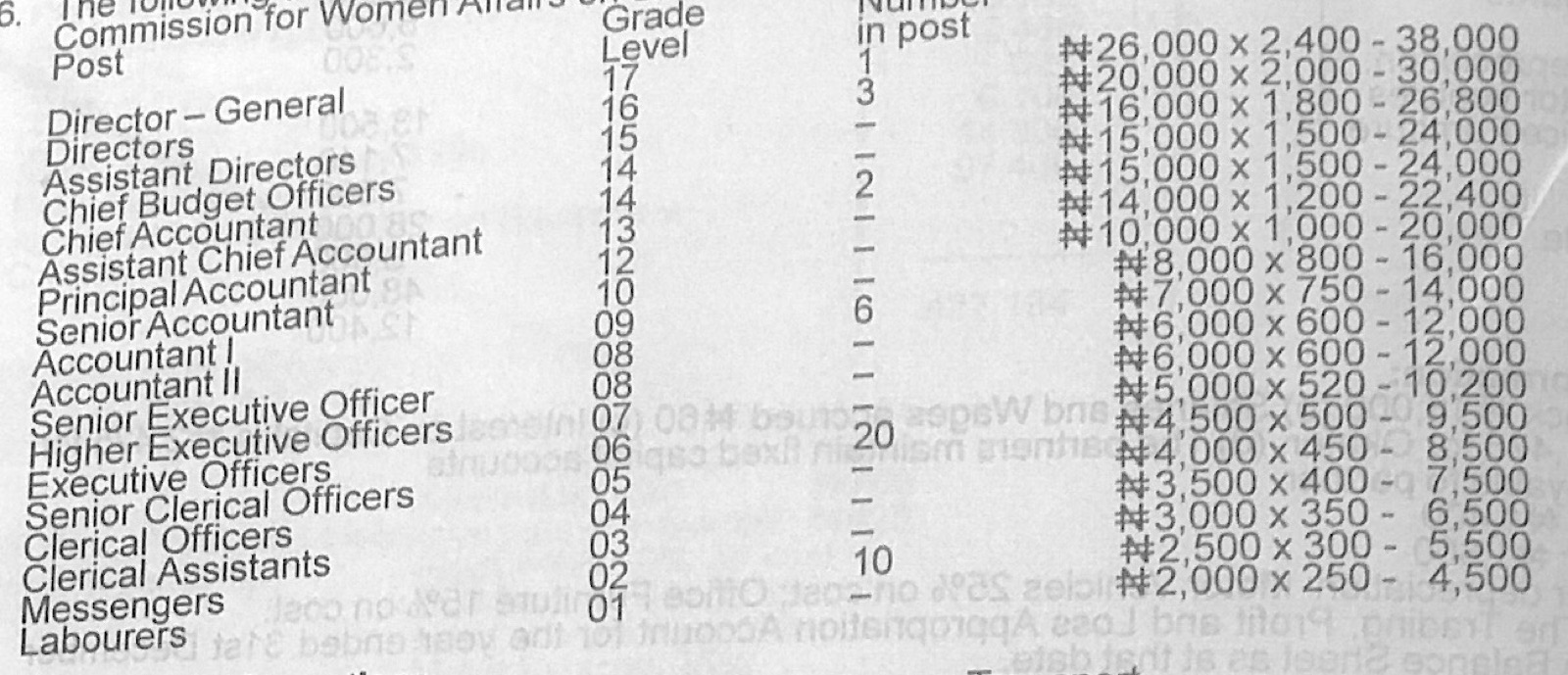
The following information was extracted from the Staff Establishment Department of the Logo State Commission for Women Affairs on 30th September, 1990 (post, grade level, number in post and salary scale shown in the figure). Additional Information: Housing and Transport allowances by Grade Level: 12 and above: Housing ₦2,400 p.a, Transport ₦1,800 p.a; 07 - 11: ₦1,800 p.a, ₦1,200 p.a.; 05 – 06: ₦1,200 p.a., ₦600 p.a.; Others: ₦600 p.a., ₦400 p.a. (b) All the employees are on first step of their salary. You are required to prepare the personnel cost budget for the commission for 1991.
Show the model answer
Model answer
Personnel Cost Budget for 1991 (number × first-step salary + housing + transport) Director-General (GL17): 1 × 26,000 = 26,000; housing 2,400; transport 1,800; total 30,200 Directors (GL16): 3 × 20,000 = 60,000; housing 7,200; transport 5,400; total 72,600 Chief Accountant (GL14): 2 × 15,000 = 30,000; housing 4,800; transport 3,600; total 38,400 Accountant I (GL09): 6 × 7,000 = 42,000; housing 10,800; transport 7,200; total 60,000 Executive Officers (GL06): 20 × 4,500 = 90,000; housing 24,000; transport 12,000; total 126,000 Messengers (GL02): 10 × 2,500 = 25,000; housing 6,000; transport 4,000; total 35,000 Totals: 42 staff; salaries 273,000; housing 55,200; transport 34,000; personnel cost budget ₦362,200
Explanation
Only posts with staff in them cost money; use the first figure of each salary scale.