Theory question 102
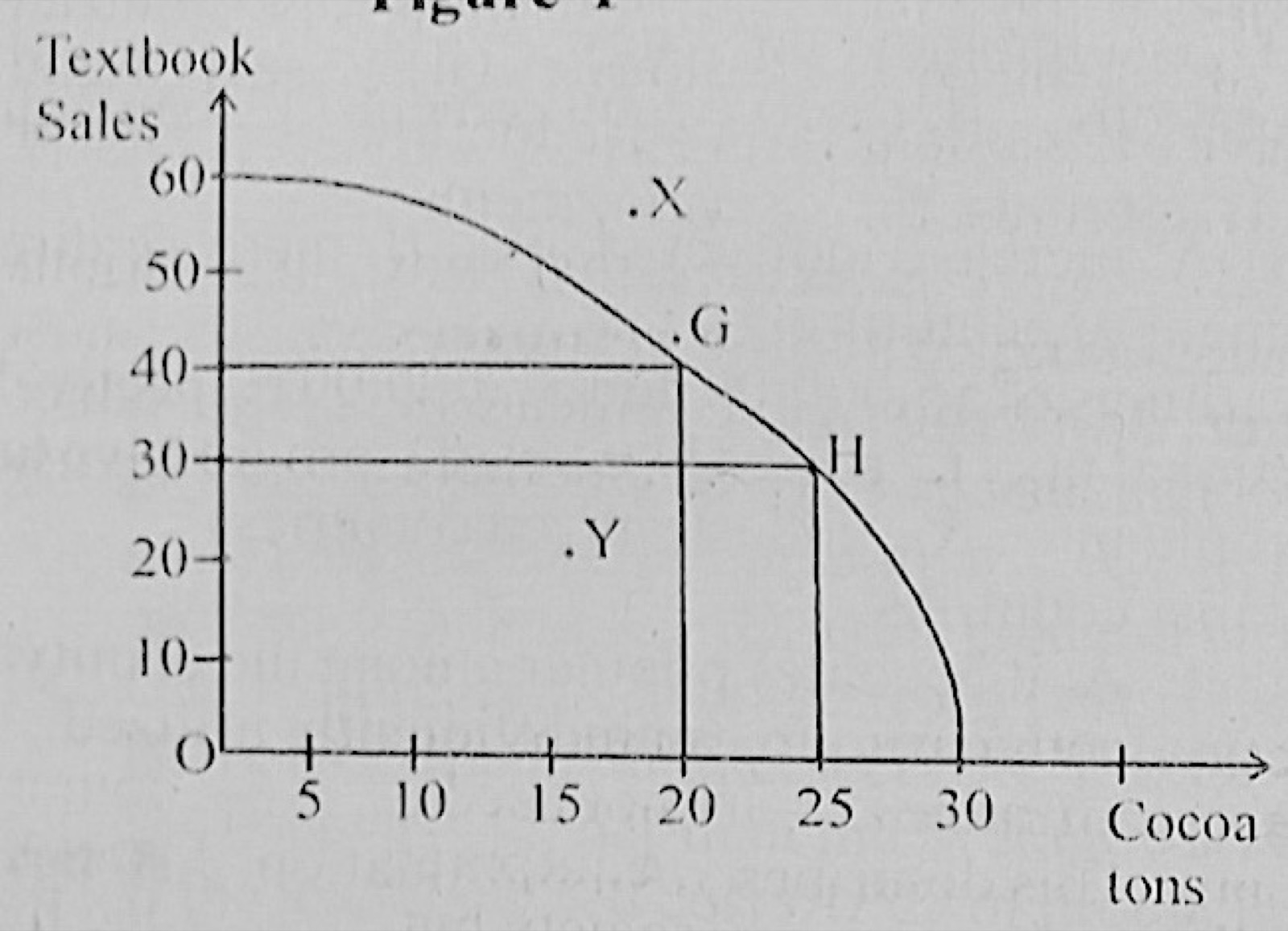
Basic ConceptsFigure 1 below represents the production possibility curve of a nation. Use it to answer the questions that follow.
(a) What is the opportunity cost of: (i) producing 30 units of cocoa; (ii) increasing textile production from 30 to 40 bales?
(b) Interpret the following points as found in the graph: (i) point Y; (ii) point G; (iii) point X.
(c) List three conditions that can enable the nation to produce at point X.
(d) State two basic economic concepts illustrated in the diagram above.
(e)(i) Define production possibility curve. (ii) What does the slope of the production possibility curve indicate?
Show the model answer
(a)(i) Producing 30 tons of cocoa means producing none of the other good: the opportunity cost is 60 units (all the textiles/textbooks that could have been produced).
(ii) Moving from H (25 cocoa, 30 bales) to G (20 cocoa, 40 bales): 5 tons of cocoa are given up.
(b)(i) Y (inside the curve): resources are unemployed or used inefficiently.
(ii) G (on the curve): resources are fully and efficiently used; an attainable best combination.
(iii) X (outside the curve): unattainable with present resources and technology.
(c) Any three: improved technology; discovery of more resources; increase in labour or capital; better education and skills; foreign aid or investment.
(d) Any two: scarcity; choice; opportunity cost; efficiency.
(e)(i) A curve showing the combinations of two goods an economy can produce when all its resources are fully and efficiently employed with given technology.
(ii) The opportunity cost of producing more of one good in terms of the other given up (the rate of transformation).
Read the opportunity cost as the amount of one good given up for the other.