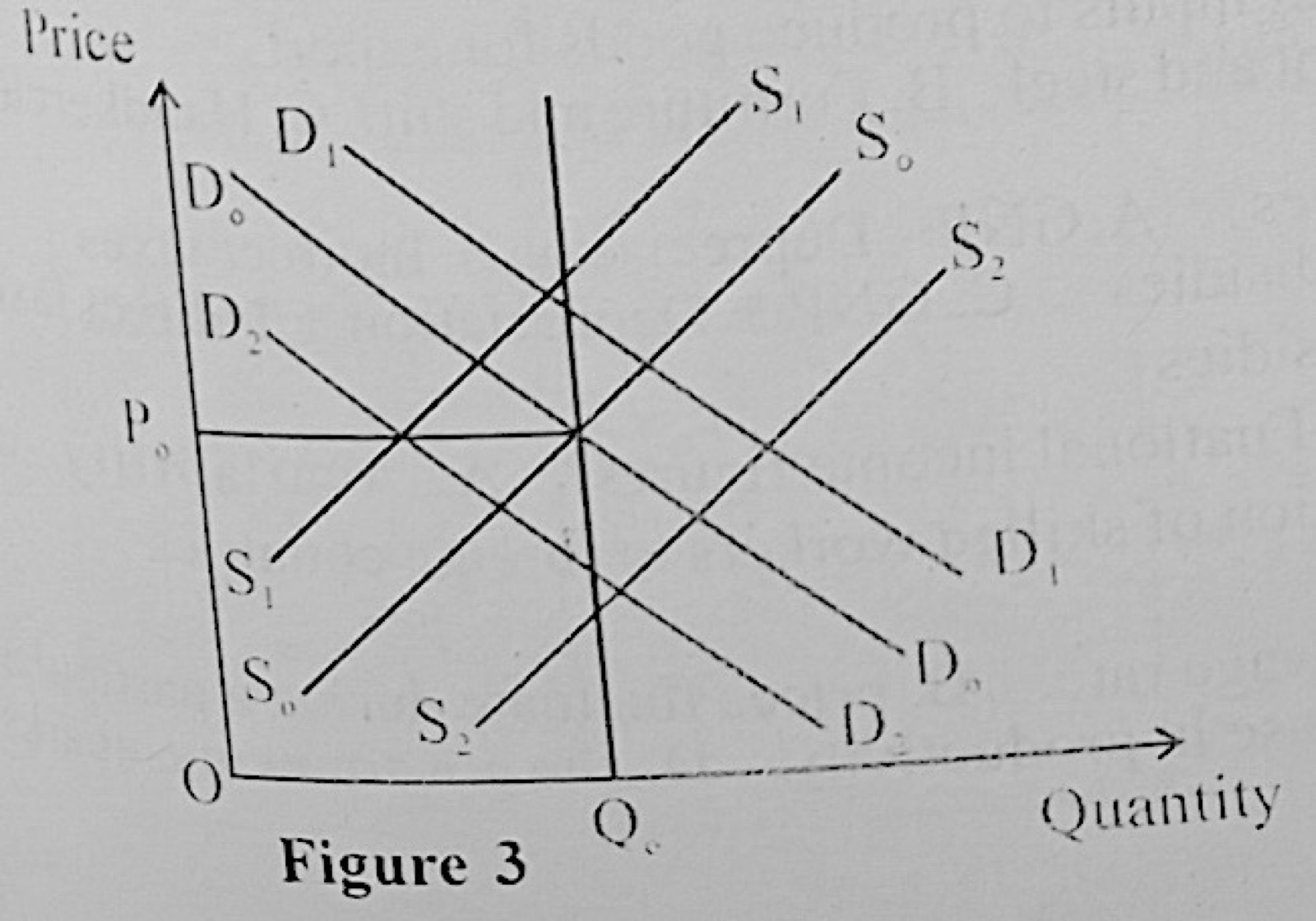
Use Figure 3 to answer the question. The curves D0D0 and S0S0 are the initial demand and supply curves respectively. What happens when government provides subsidy to producers?
A.The supply curve will shift from S0S0 to S2S2
B.The supply curve will shift from S0S0 to S1S1
C.The demand curve will shift from D0D0 to D1D1
D.The supply curve will shift from S1S1 to S0S0
Show the answer and explanation
Answer: A (The supply curve will shift from S0S0 to S2S2)
Explanation
A subsidy lowers producers' costs, so supply increases: the curve moves right from S0S0 to S2S2.
A seller increased the quantity he offered for sale from 200 units to 250 units when price of his product increased by 12.5%. What is the price elasticity of supply of his product?
A.2.00
B.1.50
C.1.00
D.0.50
Show the answer and explanation
Answer: A (2.00)
Explanation
% change in quantity = 50/200 × 100 = 25%; Es = 25 ÷ 12.5 = 2.
Use the table below (Table 1, the total revenue schedule of a firm) to answer the question. Output (units) | 50 | 60 | 70 | 80 | 90 Total revenue (TR) $ | 85 | 102 | 119 | 136 | 153 What is the unit price of the firm's output?
Use the table below (Table 1, the total revenue schedule of a firm) to answer the question. Output (units) | 50 | 60 | 70 | 80 | 90 Total revenue (TR) $ | 85 | 102 | 119 | 136 | 153 What is the firm's marginal revenue?
Table 1 below shows the number of workers engaged by an agricultural firm over a period of time. Study it and answer the questions that follow. Number of workers | Total product | Marginal product | Average Product 0 | 0 | 0 | 0 1 | 20 | 20 | 20 2 | 50 | 30 | Z 3 | 70 | 20 | 23.3 4 | 80 | Y | 20 5 | 80 | 0 | 16 6 | X | −9.8 | 11.7 (a) Calculate the values of X, Y and Z. (b) At what level of employment of labour does the firm experience: (i) increasing returns; (ii) decreasing returns; (iii) negative returns? (c) State the law of diminishing returns. (d)(i) On a graph sheet, draw the total product and marginal product curves. (ii) State any two relationship between the two curves in (d)(i) above.
Show the model answer
Model answer
(a) X = TP5 + MP6 = 80 − 9.8 = 70.2 (or AP × 6 = 11.7 × 6 = 70.2); Y = 80 − 70 = 10; Z = 50 ÷ 2 = 25 (b)(i) Increasing returns: from the 1st to the 2nd worker (MP rises from 20 to 30). (ii) Decreasing returns: 3rd and 4th workers (MP falls from 30 to 20 to 10 but is positive). (iii) Negative returns: the 6th worker (MP = −9.8). (c) If more and more units of a variable factor are added to a fixed factor, the marginal product will at first rise but will eventually fall (and may become negative). (d)(i) Workers on the horizontal axis, product on the vertical axis; plot TP (0, 20, 50, 70, 80, 80, 70.2) and MP (20, 30, 20, 10, 0, −9.8); label both curves. (ii) Any two: when MP is rising, TP rises at an increasing rate; when MP is falling but positive, TP rises at a decreasing rate; when MP is zero, TP is at its maximum; when MP is negative, TP falls.
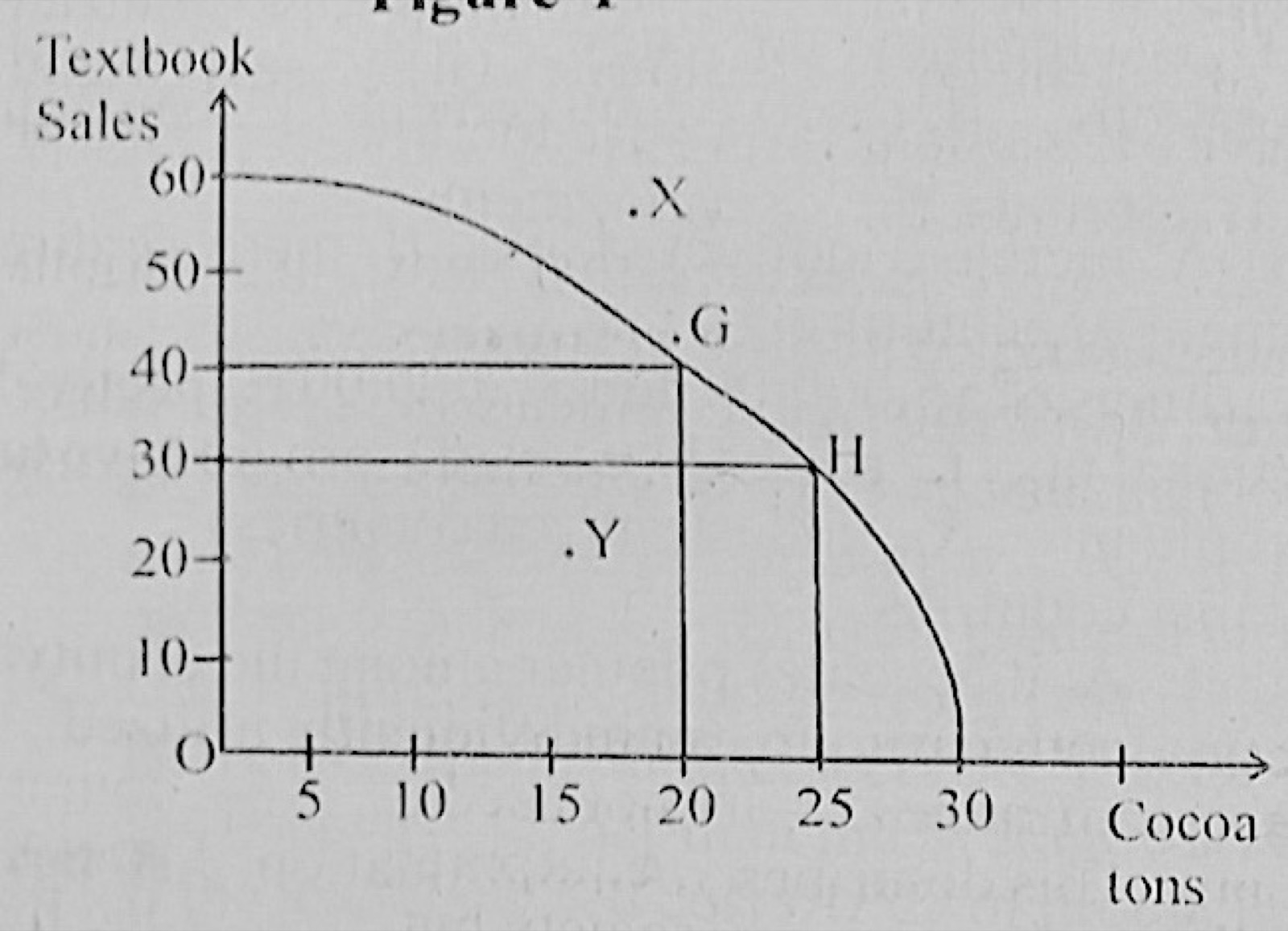
Figure 1 below represents the production possibility curve of a nation. Use it to answer the questions that follow. (a) What is the opportunity cost of: (i) producing 30 units of cocoa; (ii) increasing textile production from 30 to 40 bales? (b) Interpret the following points as found in the graph: (i) point Y; (ii) point G; (iii) point X. (c) List three conditions that can enable the nation to produce at point X. (d) State two basic economic concepts illustrated in the diagram above. (e)(i) Define production possibility curve. (ii) What does the slope of the production possibility curve indicate?
Show the model answer
Model answer
(a)(i) Producing 30 tons of cocoa means producing none of the other good: the opportunity cost is 60 units (all the textiles/textbooks that could have been produced). (ii) Moving from H (25 cocoa, 30 bales) to G (20 cocoa, 40 bales): 5 tons of cocoa are given up. (b)(i) Y (inside the curve): resources are unemployed or used inefficiently. (ii) G (on the curve): resources are fully and efficiently used; an attainable best combination. (iii) X (outside the curve): unattainable with present resources and technology. (c) Any three: improved technology; discovery of more resources; increase in labour or capital; better education and skills; foreign aid or investment. (d) Any two: scarcity; choice; opportunity cost; efficiency. (e)(i) A curve showing the combinations of two goods an economy can produce when all its resources are fully and efficiently employed with given technology. (ii) The opportunity cost of producing more of one good in terms of the other given up (the rate of transformation).
Explanation
Read the opportunity cost as the amount of one good given up for the other.
(a) Define consumer goods. (b) Explain the following forms of capital with an example each: (i) fixed capital; (ii) social capital; (iii) circulating capital. (c) Outline three reasons for the low level of savings in a country.
Show the model answer
Model answer
(a) Consumer goods are goods bought by households for direct satisfaction of their wants, e.g. food, clothes, furniture. (b)(i) Fixed capital: durable producer goods used many times in production, e.g. machines, buildings, tractors. (ii) Social capital: capital owned by the community/government for public use, e.g. roads, schools, hospitals, bridges. (iii) Circulating (working) capital: goods used up in one round of production or held as stock, e.g. raw materials, fuel, cash for wages. (c) Any three: low incomes; high dependency ratio/large families; inflation; poor banking habits and few banks in rural areas; low interest rates on savings; high cost of living; conspicuous consumption and social obligations; lack of confidence in banks.
Explanation
Fixed capital is used again and again; circulating capital is used up.
(a) Distinguish between the following pairs of terms: (i) capital expenditure and recurrent expenditure; (ii) fiscal policy and monetary policy. (b) Explain four reasons why the government of a country imposes taxes.
Show the model answer
Model answer
(a)(i) Capital expenditure is government spending on long-lasting assets that add to productive capacity, e.g. roads, schools, dams. Recurrent expenditure is regular spending on running government, e.g. salaries, maintenance, interest. (ii) Fiscal policy is the use of government taxation and spending to influence the economy; monetary policy is the use of money supply, interest rates and credit by the central bank to influence the economy. (b) Any four: to raise revenue; to redistribute income; to discourage consumption of harmful goods; to protect infant industries (import duties); to control inflation; to correct balance of payments deficits; to influence location of industries; to control monopolies.
Explanation
Taxes raise revenue and are also tools of economic policy.
(a) Define tariff. (b) State the following laws: (i) The law of absolute cost advantage; (ii) The law of comparative cost advantage. (c) Outline any four assumptions behind the law of comparative cost advantage.
Show the model answer
Model answer
(a) A tariff is a tax imposed on imported (or exported) goods. (b)(i) Absolute advantage: a country should specialise in producing goods it can produce more efficiently (at lower absolute cost) than other countries, and trade for others. (ii) Comparative advantage: even if a country is more efficient in all goods, both countries gain if each specialises in the good in which it has the greater relative advantage (lowest opportunity cost). (c) Any four: two countries and two goods; no transport costs; free trade (no barriers); perfect mobility of factors within a country but immobility between countries; constant costs/returns; full employment; perfect competition; labour is the only factor (labour theory of value).
Explanation
Comparative advantage is based on opportunity cost.
(a) What is money? (b) Explain the following concepts: (i) value of money; (ii) demand for money. (c) Identify any four determinants of transactions demand for money.
Show the model answer
Model answer
(a) Money is anything generally acceptable as a medium of exchange and in settlement of debts. (b)(i) Value of money: its purchasing power, the quantity of goods and services a unit of money can buy; it moves opposite to the general price level. (ii) Demand for money: the desire to hold money in cash (liquidity preference) rather than other assets, for transactions, precautionary and speculative motives. (c) Any four: level of income; frequency/interval of income payments; general price level; habits and spending patterns; size of family; availability of credit; level of economic activity.
Explanation
Transactions demand depends mostly on income and how often it is paid.
(a) Distinguish between competitive demand and joint demand. (b) Using diagrams, explain how the following factors will affect the equilibrium price and quantity of commodity R in the market: (i) an increase in the price of the complement of commodity R; (ii) an increase in the price of a substitute of commodity R; (iii) imposition of an indirect tax on commodity R.
Show the model answer
Model answer
(a) Competitive demand is demand for goods that are substitutes (e.g. tea and coffee): a rise in the price of one raises demand for the other. Joint demand is demand for goods used together (e.g. car and petrol): a rise in the price of one reduces demand for both. (b)(i) Dearer complement: demand for R falls; D shifts left; equilibrium price and quantity of R both fall. (ii) Dearer substitute: demand for R rises; D shifts right; equilibrium price and quantity of R both rise. (iii) Indirect tax: supply of R falls; S shifts left (upwards by the tax); equilibrium price rises and quantity falls. Each diagram shows the original and new curves with the old and new equilibrium price and quantity.
Explanation
Ask whether the factor shifts demand or supply, and in which direction.
(a) Differentiate between subsistence farming and commercial farming. (b) State four features of subsistence farming. (c) Outline two positive and two negative effects of mining on the economy of West Africa countries.
Show the model answer
Model answer
(a) Subsistence farming is small-scale farming mainly to feed the farmer's family, with simple tools; commercial farming is large-scale farming mainly for sale and profit, using machines, hired labour and much capital. (b) Any four: small farm size; simple tools (hoe, cutlass); family labour; low output; little capital; mixed cropping; little use of fertiliser/improved seeds; production mainly for family consumption. (c) Positive (any two): foreign exchange earnings; government revenue (royalties, taxes); employment; infrastructure development in mining areas; raw materials for industry. Negative (any two): land degradation and destruction of farmland; water and air pollution; displacement of communities; neglect of agriculture; conflicts over resource control; health hazards.
Explanation
Subsistence farming feeds the family; commercial farming feeds the market.