Theory question 101
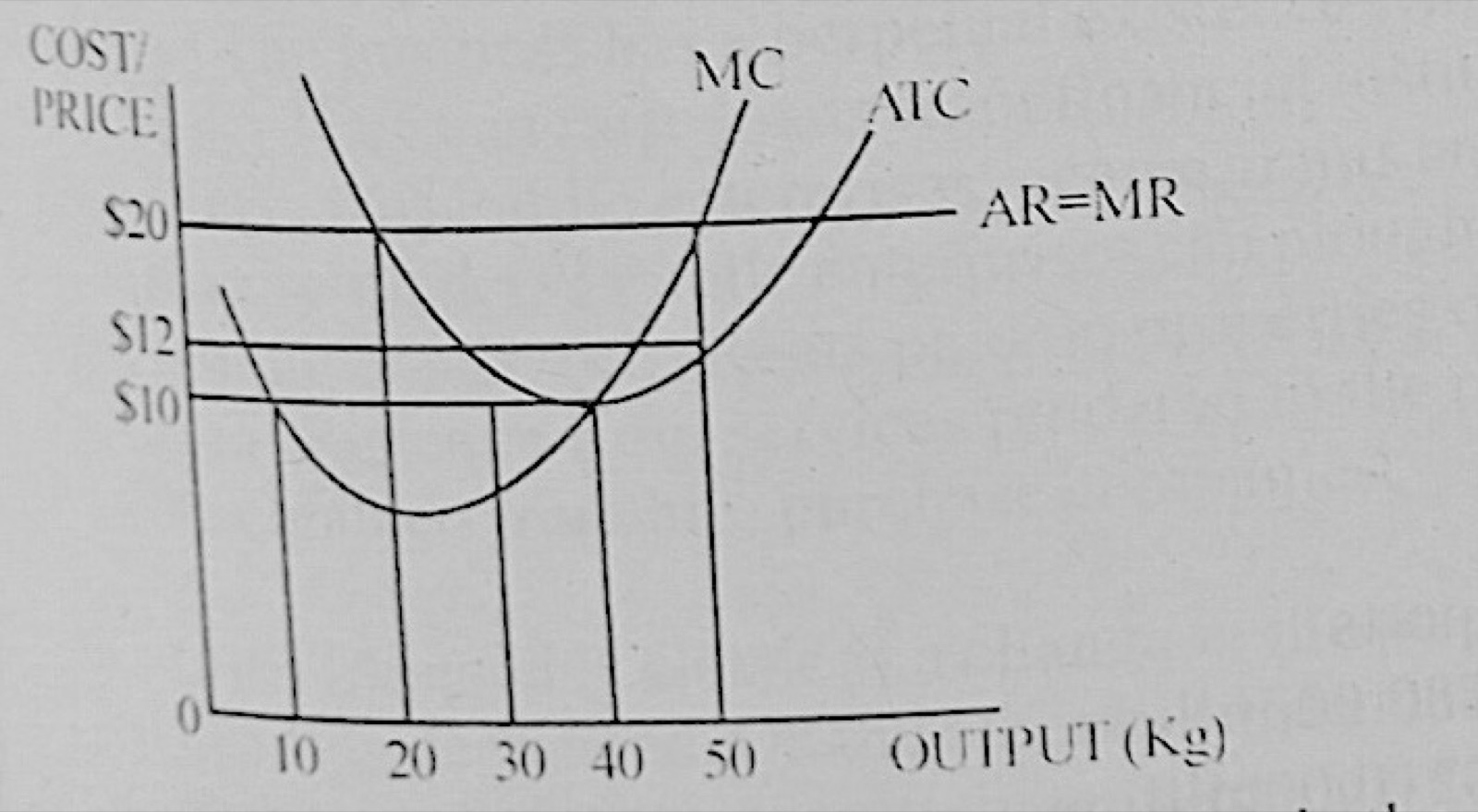
Market StructuresThe diagram below represents the equilibrium position of a firm in a perfectly competitive industry. Study it carefully answer the questions that follow.
(a)(i) At what level of output and price is the firm in equilibrium? (ii) Calculate the firm's profit in equilibrium. (iii) What type of profit is it? Explain your answer.
(b) Why is the average revenue (AR) function horizontal?
(c) State any two ways in which marginal cost (MC) and average total cost (ATC) are related.
Show the model answer
(a)(i) Output 50 kg at a price of $20, where MC = MR with MC rising.
(ii) TR = 20 × 50 = $1,000; ATC at 50 kg = $12, so TC = 12 × 50 = $600; profit = 1,000 − 600 = $400 (or (20 − 12) × 50).
(iii) Supernormal (abnormal) profit, because price (AR) is greater than average total cost at the equilibrium output.
(b) The firm is a price taker: it can sell any quantity at the market price, so AR (= price = MR) is constant and the AR line is horizontal.
(c) Any two: when MC is below ATC, ATC is falling; when MC is above ATC, ATC is rising; MC cuts ATC at the lowest point of ATC (MC = ATC at minimum ATC); both are U-shaped.
Equilibrium is where MC = MR; profit is (AR − ATC) × output.