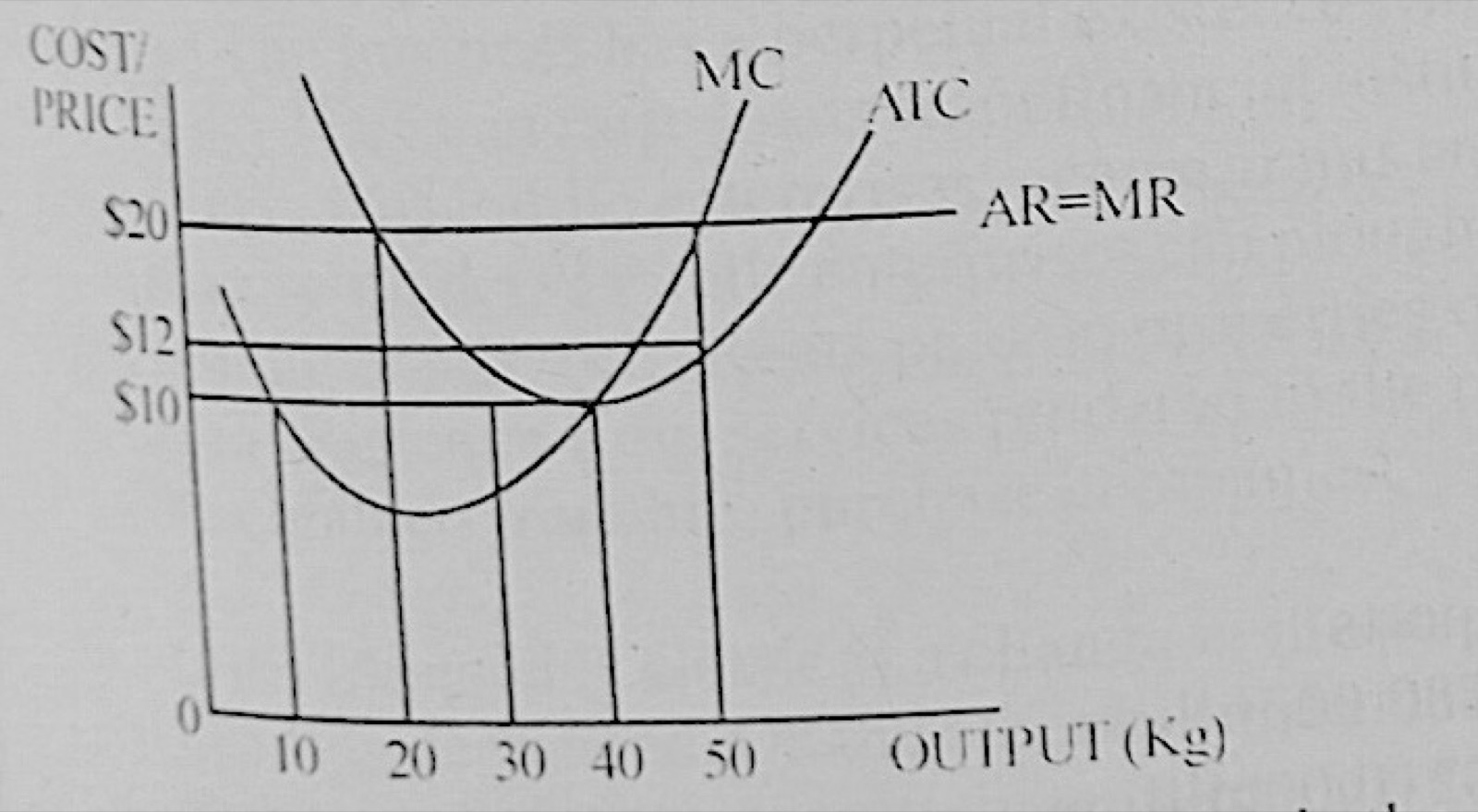
The diagram below represents the equilibrium position of a firm in a perfectly competitive industry. Study it carefully answer the questions that follow. (a)(i) At what level of output and price is the firm in equilibrium? (ii) Calculate the firm's profit in equilibrium. (iii) What type of profit is it? Explain your answer. (b) Why is the average revenue (AR) function horizontal? (c) State any two ways in which marginal cost (MC) and average total cost (ATC) are related.
Show the model answer
Model answer
(a)(i) Output 50 kg at a price of $20, where MC = MR with MC rising. (ii) TR = 20 × 50 = $1,000; ATC at 50 kg = $12, so TC = 12 × 50 = $600; profit = 1,000 − 600 = $400 (or (20 − 12) × 50). (iii) Supernormal (abnormal) profit, because price (AR) is greater than average total cost at the equilibrium output. (b) The firm is a price taker: it can sell any quantity at the market price, so AR (= price = MR) is constant and the AR line is horizontal. (c) Any two: when MC is below ATC, ATC is falling; when MC is above ATC, ATC is rising; MC cuts ATC at the lowest point of ATC (MC = ATC at minimum ATC); both are U-shaped.
Explanation
Equilibrium is where MC = MR; profit is (AR − ATC) × output.
(a)(i) Define distribution of goods. (ii) Illustrate the normal chain of distribution of goods. (b) Describe a consumer's cooperative society. (c) Outline any four roles performed by a consumers' cooperative society.
Show the model answer
Model answer
(a)(i) Distribution is the process of moving goods from producers to final consumers, including wholesaling, retailing, transport, storage and advertising. (ii) Producer/manufacturer → wholesaler → retailer → consumer. (b) A consumers' co-operative society is an association of consumers who contribute capital to buy goods in bulk directly from producers or wholesalers and sell them to members (and others) at fair prices; profits are shared as dividends according to members' purchases; it is run democratically (one member, one vote). (c) Any four: buys in bulk and sells to members at low prices; eliminates middlemen; protects members from exploitation and hoarding; provides genuine/quality goods; pays dividends to members; educates members on thrift and consumer matters; stabilises prices.
Explanation
Consumers' co-operatives cut out middlemen to lower prices for members.
(a) What is an industry? (b) Explain the following: (i) division of labour (ii) economies of scale. (c) Outline any four internal economies of scale.
Show the model answer
Model answer
(a) An industry is a group of firms producing the same or similar products. (b)(i) Division of labour: breaking a production process into separate tasks, each done by a different worker who specialises in it. (ii) Economies of scale: the cost advantages (fall in average cost) a firm or industry enjoys as its scale of production increases. (c) Any four: technical; managerial; financial; marketing (bulk buying and selling); risk-bearing; research and development; welfare economies.
Explanation
Internal economies arise from the firm's own growth.
(a) Define a joint venture. (b) Identify any three merits of a private company over a partnership. (c) State any three sources of finance to a public enterprise.
Show the model answer
Model answer
(a) A joint venture is a business owned and managed jointly by two or more parties (e.g. government and foreign or local private firms), who share the capital, risks and profits. (b) Any three: limited liability of shareholders; separate legal entity and continuity (not ended by death of a member); can have more members (up to 50) and raise more capital; shares can be transferred with consent; professional management; easier access to bank loans. (c) Any three: government grants and subsidies; government loans; loans from banks and international institutions; revenue from sales of its goods and services; issue of bonds/stocks; foreign aid; retained profits.
Explanation
A private company has limited liability while most partners do not.
(a) Distinguish between the following pairs of concepts: (i) elastic demand and inelastic demand; (ii) income elasticity of demand and cross elasticity of demand. (b) Using diagrams, explain how an increase in price will affect the total revenue of a producer if demand for his product is: (i) price elastic; (ii) price inelastic.
Show the model answer
Model answer
(a)(i) Elastic demand: a change in price causes a more than proportionate change in quantity demanded (coefficient > 1). Inelastic demand: a change in price causes a less than proportionate change in quantity demanded (coefficient < 1). (ii) Income elasticity: responsiveness of quantity demanded to a change in consumers' income (% change in Qd ÷ % change in income). Cross elasticity: responsiveness of quantity demanded of one good to a change in the price of another good (% change in Qd of X ÷ % change in price of Y). (b)(i) Elastic demand (flat curve): a price rise causes a larger proportionate fall in quantity, so total revenue falls; show the revenue rectangles before and after. (ii) Inelastic demand (steep curve): a price rise causes a smaller proportionate fall in quantity, so total revenue rises; show the rectangles.
Explanation
Total revenue = price × quantity; compare the two rectangles.
(a) Distinguish between: (i) a growing population and a declining population; (ii) overpopulation and under population. (b) Explain any four disadvantages of a rapidly growing population in an economy.
Show the model answer
Model answer
(a)(i) A growing population is one whose size increases over time because births (and immigration) exceed deaths (and emigration); a declining population is one whose size falls because deaths and emigration exceed births and immigration. (ii) Overpopulation: the population is too large for the available resources, so income per head is below the maximum possible. Under-population: the population is too small to make full use of the resources, so income per head is also below the maximum. (b) Any four: high dependency ratio; unemployment; pressure on social amenities (schools, hospitals, housing); low savings and investment; food shortages; low per capita income; environmental damage; congestion and slums; rural-urban migration and crime.
Explanation
Over- and under-population are measured against the optimum.
(a) What is public debt? (b) Outline any three reasons why countries borrow. (c) Highlight any three effects of a huge national debt on the economy of a country.
Show the model answer
Model answer
(a) Public debt is the total amount of money owed by a government to lenders within the country (internal debt) and outside (external debt). (b) Any three: to finance a budget deficit; to finance development projects/infrastructure; to correct balance of payments deficit; to meet emergencies (war, disasters); to control inflation (borrowing from the public); to bridge foreign exchange gaps; to repay old debts. (c) Any three: heavy debt-servicing burden reduces money for development; higher taxes; capital flight and lower investment; loss of sovereignty to creditors' conditions; inflation if financed by money creation; worsens balance of payments; burden passed to future generations.
Explanation
Debt helps development if used well, but servicing can crowd out other spending.