Use the table below to answer the question. EXPECTED REVENUE Items | Amount ($ m) Rents and royalties | 75.00 Company income tax | 150.00 Customs and excise duties | 300.20 Personal income tax | 80.00 Fees and fines | 60.80 Value added tax | 100.00 What is the total revenue from indirect taxes?
A.$686.00 m
B.$400.20 m
C.$135.80 m
D.$100.00 m.
Show the answer and explanation
Answer: B ($400.20 m)
Explanation
Indirect taxes = customs and excise 300.20 + VAT 100.00 = $400.20 m.
Use the table below to answer the question. EXPECTED REVENUE Items | Amount ($ m) Rents and royalties | 75.00 Company income tax | 150.00 Customs and excise duties | 300.20 Personal income tax | 80.00 Fees and fines | 60.80 Value added tax | 100.00 What is the total revenue from non-tax sources?
A.$400.20 m
B.$375.20 m
C.$135.80 m
D.$75.00 m
Show the answer and explanation
Answer: C ($135.80 m)
Explanation
Non-tax revenue = rents and royalties 75.00 + fees and fines 60.80 = $135.80 m.
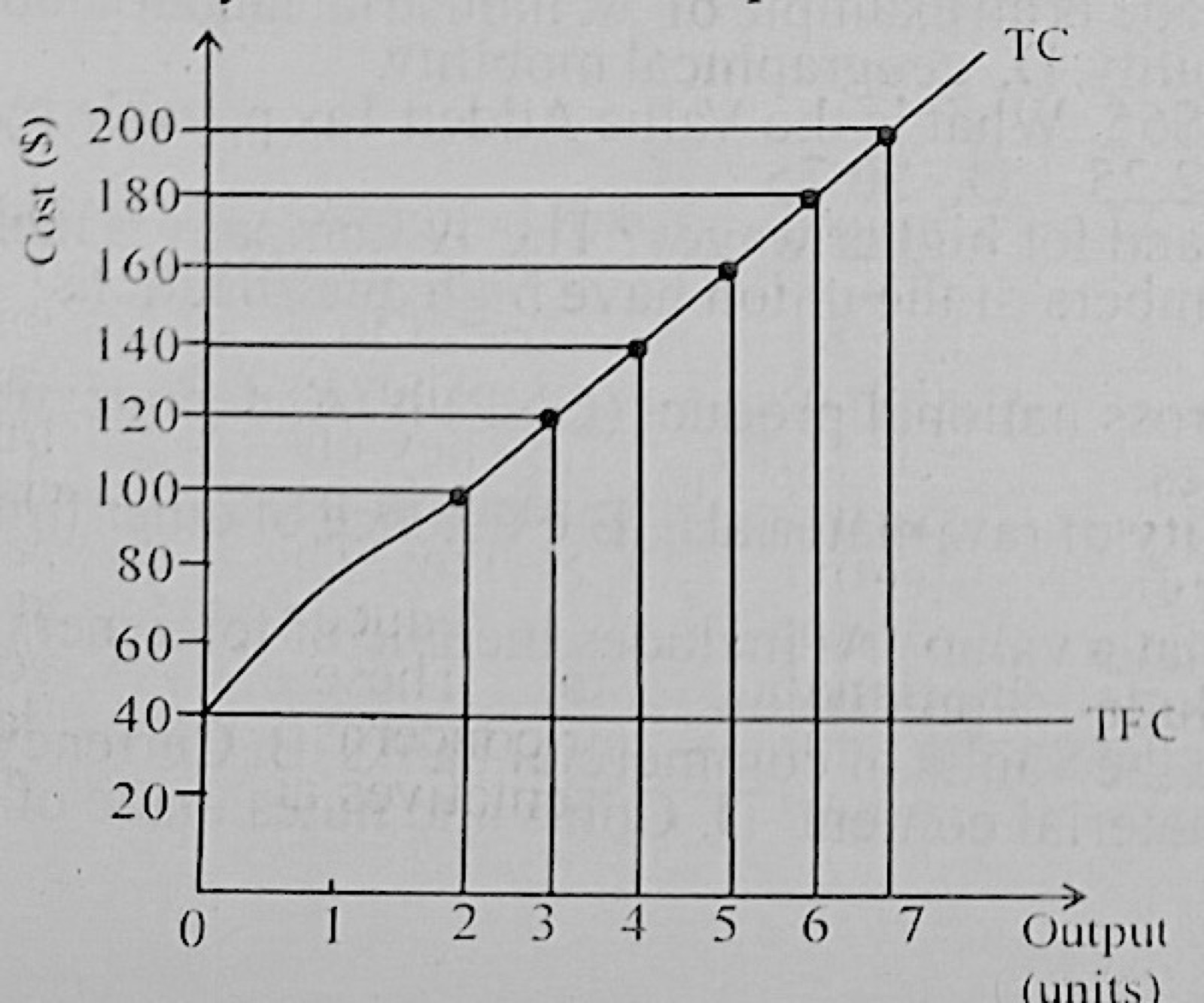
The total fixed cost (TFC) and total cost (TC) functions of a hypothetical firm are shown in the graph below. Study it and answer the questions that follow (a) Determine the firm's (i) variable cost at output levels 2, 4 and 6; (ii) average total cost at output levels 2 and 3; (iii) marginal cost at output levels 4 and 6. (b) If the price of the firm's product is $40, calculate the firm's profit or loss when the following units are sold: (i) 2 units; (ii) 4 units.
Show the model answer
Model answer
From the graph: TFC = $40; TC = $100, 120, 140, 160, 180, 200 at outputs 2, 3, 4, 5, 6, 7. (a)(i) VC = TC − TFC: at 2, 100 − 40 = $60; at 4, 140 − 40 = $100; at 6, 180 − 40 = $140 (ii) ATC = TC/Q: at 2, 100/2 = $50; at 3, 120/3 = $40 (iii) MC = TCn − TCn−1: at 4, 140 − 120 = $20; at 6, 180 − 160 = $20 (b)(i) TR = 40 × 2 = $80; profit = 80 − 100 = −$20 (a loss of $20) (ii) TR = 40 × 4 = $160; profit = 160 − 140 = $20
Explanation
Fixed cost is where TC starts at zero output; VC = TC − TFC.
The table below shows the incomes and rates of income tax levied on four professionals in an economy. Profession | Income per month ($) | Tax rate (%) | Disposable income ($) Doctor | 8,000 | 10 | Engineer | 7,000 | 12 | Civil Servant | 5,000 | 18 | Nurse | 6,000 | 15 | Use the above data to answer the questions that follows (a) Calculate the disposable incomes of the four individuals. (b) What system of taxation was employed? (c) Give reasons for your answer in 2(b). (d) With the aid of a diagram, explain the system of taxation employed in 2(b).
Show the model answer
Model answer
(a) Doctor: 8,000 − 800 = $7,200; Engineer: 7,000 − 840 = $6,160; Civil Servant: 5,000 − 900 = $4,100; Nurse: 6,000 − 900 = $5,100 (b) Regressive taxation. (c) The tax rate falls as income rises: the highest earner (doctor, $8,000) pays 10% while the lowest earner (civil servant, $5,000) pays 18%. (d) A regressive tax takes a smaller percentage of income as income rises. Diagram: tax rate on the vertical axis, income on the horizontal axis; a downward-sloping line/curve showing the rate falling as income increases.
(a) What is a trade union? (b) Describe any four functions of trade unions. (c) Outline any two weapons used by trade unions to achieve their objectives.
Show the model answer
Model answer
(a) A trade union is an association of workers formed to protect and improve the wages, working conditions and welfare of its members. (b) Any four: bargaining for higher wages; improving working conditions and hours; job security and protection against unfair dismissal; welfare services for members (loans, insurance); education and training of members; representing members in disputes; influencing government labour policy. (c) Any two: collective bargaining; strike; work-to-rule/go-slow; picketing and demonstrations; boycott (overtime ban); lobbying and use of the media.
Explanation
Weapons are the actions unions take to press their demands.
(a) Outline any four objectives of a price control policy. (b) Highlight any four effects of a maximum price control policy.
Show the model answer
Model answer
(a) Any four: to protect consumers from exploitation; to make essential goods affordable to low-income earners; to control inflation; to protect producers' income (minimum price); to ensure fair distribution of scarce goods; to stabilise prices. (b) Any four: shortages (excess demand); long queues; black markets; hoarding; rationing becomes necessary; reduced supply as producers are discouraged; corruption and favouritism in distribution; poor quality goods.
Explanation
A maximum price is fixed below equilibrium, so shortages follow.
(a) What are infant industries? (b) State any four reasons for protecting infant industries. (c) Outline any three ways by which industries can be financed in West Africa.
Show the model answer
Model answer
(a) Infant industries are newly established industries that are still small, with high costs, and cannot yet compete with older, larger foreign firms. (b) Any four: to allow them to grow and reach economies of scale; to create employment; to save foreign exchange; to diversify the economy; to prevent dumping; to develop local skills and technology; for self-reliance and national security. (c) Any three: personal savings/owners' capital; sale of shares and debentures (stock exchange); bank loans and overdrafts; development bank loans; government grants and subsidies; foreign investment/joint ventures; ploughed-back profits; trade credit; leasing.
Explanation
Infant industries need time behind protection to become competitive.
(a) What is balance of payment disequilibrium? (b) Explain the two types of balance of payment disequilibrium. (c) Highlight any four reasons most West African countries are experiencing balance of payment problem.
Show the model answer
Model answer
(a) Balance of payments disequilibrium is a situation in which a country's total receipts from abroad are not equal to its total payments abroad, i.e. a deficit or surplus. (b) Deficit: total payments for imports of goods, services and capital exceed total receipts from exports. Surplus: total receipts exceed total payments. (Other classifications accepted: cyclical, structural, short-run/temporary and fundamental disequilibrium.) (c) Any four: dependence on a few primary exports with falling or unstable prices; high demand for imported manufactured goods; worsening terms of trade; heavy debt servicing; capital flight and profit repatriation by foreign firms; low productivity and weak industry; overvalued currencies; smuggling; political instability.
(a) What is deflation? (b) Outline any three positive effects of deflation. (c) Explain the ways by which inflation affects any three functions of money.
Show the model answer
Model answer
(a) Deflation is a persistent fall in the general price level (a rise in the value of money). (b) Any three: value of money rises; people on fixed incomes and creditors gain; savings increase in value, encouraging saving; exports become cheaper and more competitive; imports fall, improving the balance of payments; cost of living falls. (c) Any three: medium of exchange – people lose confidence in money and may return to barter; store of value – money loses purchasing power, so people hold real assets instead; unit of account – prices keep changing, making money a poor measure of value; standard of deferred payment – creditors are repaid with money worth less, so lending is discouraged.
Explanation
Inflation weakens money's functions because its value keeps falling.
(a) What is protective tariff? (b) Outline any four reasons in favour of protective tariff. (c) State any two reasons against protective tariff.
Show the model answer
Model answer
(a) A protective tariff is a tax on imported goods meant to make them dearer so that local industries producing similar goods are protected from foreign competition. (b) Any four: protects infant industries; reduces imports and corrects balance of payments deficit; prevents dumping; creates employment; encourages self-reliance and diversification; protects strategic industries; raises revenue. (c) Any two: higher prices for consumers; local firms may stay inefficient; retaliation by other countries; reduces consumer choice; encourages smuggling; reduces gains from specialisation.
Explanation
Protection helps local producers but costs consumers.