Which of the following determines the size of a country's population? (I) Birth rate (II) Death rate (III) Migration rate (IV) Importation rate (V) Unemployment rate
A.(I), (II) and (V)
B.(II) and (IV)
C.(I), (II) and (III)
D.(I) and (V)
Show the answer and explanation
Answer: C ((I), (II) and (III))
Explanation
Population changes only through births, deaths and migration.
Mr. Bala's income is $800.00 per month while that of Mr. Jatau is $1,200.00. If Messrs. Bala and Jatau pay $80.00 and $120.00 respectively as taxes, the tax system is
A.progressive
B.regressive
C.proportional
D.ad-valorem.
Show the answer and explanation
Answer: C (proportional)
Explanation
80/800 = 10% and 120/1,200 = 10%: the same rate for both, so the tax is proportional.
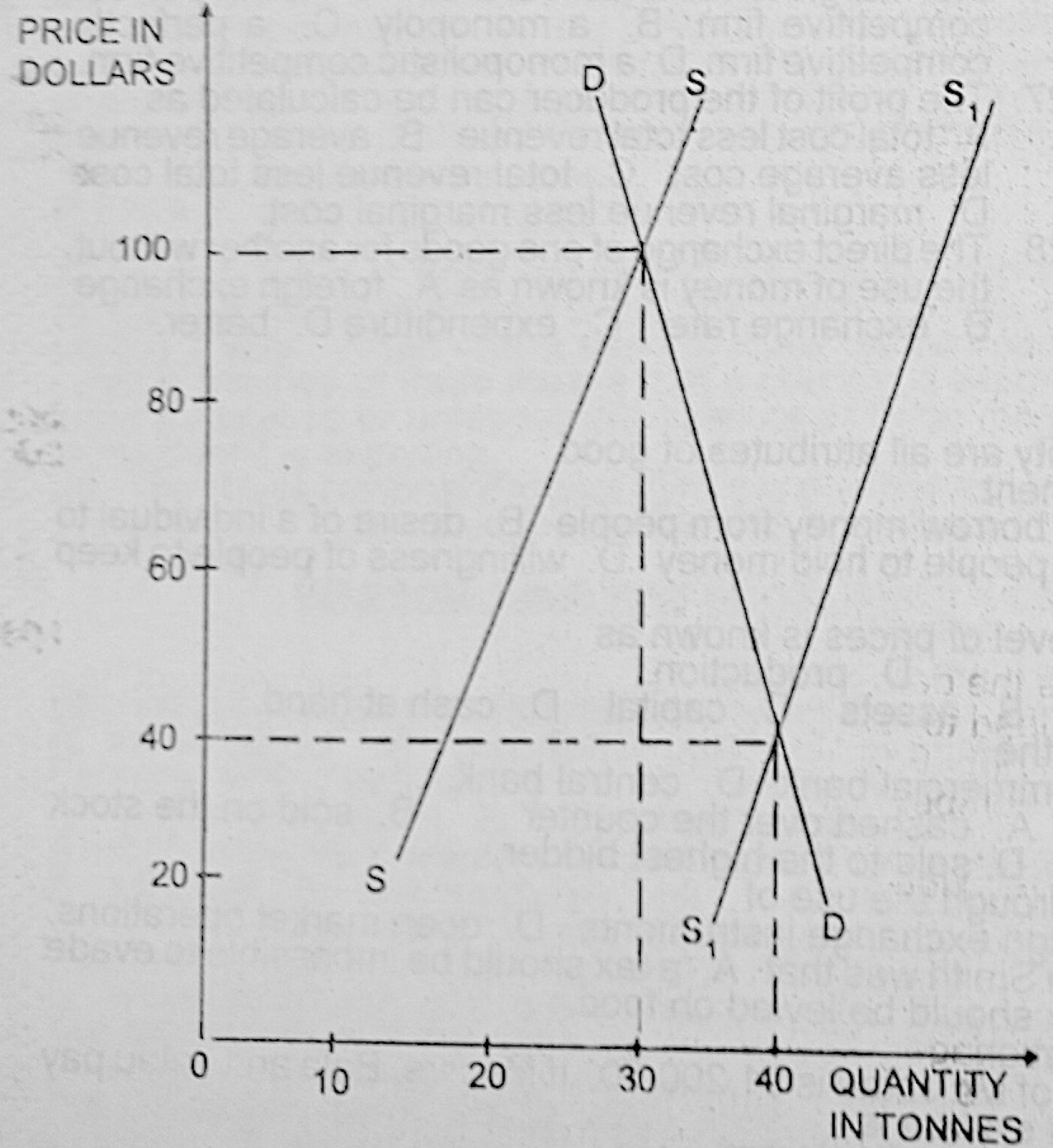
Section A (answer one question only from this section) The diagram below illustrates the demand for and supply of maize. Use the information in the diagram to answer the questions that follow. (a)(i) What is the total revenue of the farmer at the initial equilibrium? (ii) Calculate the total revenue of the farmer if the supply curve shifts to S1S1. (b) What change occurs in the total revenue of the farmer when the price falls from 100 Dollars to 40 Dollars per tonne? (c)(i) Use the figures in the diagram to determine the price elasticity of demand for maize. (ii) Interprete your answer. (d) Give two reasons for the shift of the supply curve from SS to S1S1.
Show the model answer
Model answer
(a)(i) Initial equilibrium (DD and SS): price $100, quantity 30 tonnes; TR = 100 × 30 = $3,000. (ii) New equilibrium (DD and S1S1): price $40, quantity 40 tonnes; TR = 40 × 40 = $1,600. (b) Total revenue falls by 3,000 − 1,600 = $1,400. (c)(i) % change in quantity = 10/30 × 100 = 33.3%; % change in price = 60/100 × 100 = 60%; PED = 33.3 ÷ 60 ≈ 0.56. (ii) PED is less than 1, so demand for maize is inelastic: the price fall raises quantity demanded proportionately less, which is why total revenue falls. (d) Any two: good weather/bumper harvest; improved technology or high-yield seeds; fall in the cost of inputs (fertiliser, labour); government subsidies; more farmers entering maize production; fall in prices of other crops the farmer could grow.
Explanation
Read both equilibrium points off the diagram; a supply increase shifts the curve to the right.
Section A (answer one question only from this section) The Table below relates to the supply of labour in response to the given wage rates. Use the information in the Table to answer the questions that follow. Wage rate ($ per hour) | Hours worked (per day) | Income per day ($) 10 | — | 10 20 | — | 60 30 | — | 150 40 | 6 | — 50 | 4 | — 60 | 2 | — (a) Determine the number of hours of work per day if the wage rate is (i) $10 per day; (ii) $20 per day; (iii) $30 per day. (b) Calculate the income per day when the wage rate is (i) $40 (ii) $50 (iii) $60. (c)(i) Which wage rate per hour attracts the highest earnings? (ii) Name the type of supply curve that can be associated with the data in the table (iii) Explain the nature of the supply curve named in 2(c)(ii).
Show the model answer
Model answer
(a) Hours = income ÷ wage rate: (i) 10 ÷ 10 = 1 hour; (ii) 60 ÷ 20 = 3 hours; (iii) 150 ÷ 30 = 5 hours. (b) Income = wage rate × hours: (i) 40 × 6 = $240; (ii) 50 × 4 = $200; (iii) 60 × 2 = $120. (c)(i) $40 per hour (income $240 a day). (ii) A backward-bending supply curve of labour. (iii) From $10 to $40 an hour, hours worked rise (1 → 6) because the worker gives up leisure for the higher pay (substitution effect). Above $40, hours fall (6 → 2) because the worker can keep a high income with fewer hours and prefers more leisure (income effect). So the curve slopes upward at first and then bends back towards the wage (vertical) axis.
Explanation
The table's 'per day' in (a) means the hourly wage rate.
Section B (answer four questions only from this section) (a) What are capital goods? (b) Explain the problems associated with the distribution of goods in your country.
Show the model answer
Model answer
(a) Capital goods are man-made goods used to produce other goods and services rather than for direct consumption, e.g. machines, tools, factory buildings, vehicles. (b) Poor roads and transport facilities. Inadequate storage and warehousing facilities, leading to losses of perishables. Too many middlemen, raising prices. Hoarding and artificial scarcity. Inadequate finance/credit for traders. Poor communication and market information. Insecurity (armed robbery) on the roads. Multiple levies and checkpoints. Poor packaging and preservation facilities.
Section B (answer four questions only from this section) (a) Explain the term net migration. (b) Describe any four economic effects of rural to urban migration in your country.
Show the model answer
Model answer
(a) Net migration is the difference between the number of people coming into a country (immigrants) and the number leaving it (emigrants) in a given period; it is positive if immigrants exceed emigrants. (b) Any four: fall in agricultural output and food shortage in rural areas; overcrowding and slums in towns; pressure on urban amenities (water, housing, transport, schools); urban unemployment; rise in crime and social vices; higher urban cost of living; rural areas left with ageing people; supply of labour to urban industries.
Section B (answer four questions only from this section) (a) Outline any two differences between monopoly and perfect competition. (b) State any four entry barriers that can prevent the emergence of competitive firms.
Show the model answer
Model answer
(a) Any two: a monopoly has one seller while perfect competition has many; monopoly has barriers to entry while perfect competition has free entry; the monopolist is a price maker while a competitive firm is a price taker; monopoly product has no close substitutes while competitive products are identical; monopolist can earn abnormal profit in the long run while a competitive firm earns only normal profit; monopolist's demand curve slopes downward while a competitive firm's is horizontal. (b) Any four: patents and copyrights; government licences/legal monopoly; control of essential raw materials; very large capital requirement (economies of scale); exclusive franchise; heavy advertising/brand loyalty; price-cutting by existing firms; tariffs and trade restrictions.
Section B (answer four questions only from this section) (a) Distinguish between a public company and a public corporation. (b) What are the problems of public corporations in your country?
Show the model answer
Model answer
(a) A public (limited) company is privately owned by shareholders, formed under the Companies Act, sells shares to the public on the stock exchange, has a minimum of seven members and aims at profit. A public corporation is owned and financed by government, set up by an Act or decree, has no private shareholders, is run by a board appointed by government and aims mainly at providing essential services. (b) Inadequate funding by government; political interference; poor management and inefficiency; corruption and embezzlement; over-staffing; frequent changes of board members; bureaucracy and slow decisions; lack of profit motive; poor maintenance of equipment; continued dependence on subsidies.
Explanation
Compare ownership, formation, finance, control and aims in (a).
Section B (answer four questions only from this section) (a) What is trade by barter? (b) Highlight the problems posed by trade by barter.
Show the model answer
Model answer
(a) Trade by barter is the direct exchange of goods and services for other goods and services without the use of money. (b) Double coincidence of wants is needed. No common measure of value to fix exchange rates between goods. Indivisibility of some goods. Difficulty of storing wealth (perishability). Difficulty of deferred payments. Bulky goods are hard to carry (non-portability). It discourages specialisation and large-scale production. Time and effort wasted in finding trading partners.
Section B (answer four questions only from this section) Outline the role of development banks in the economic development of West African countries.
Show the model answer
Model answer
They give medium- and long-term loans for industrial, agricultural and infrastructural projects. They help implement government development policies. They provide technical and managerial advice to entrepreneurs. They carry out feasibility studies and supervise projects they finance. They take equity shares in new enterprises. They finance manpower training. They encourage indigenous entrepreneurs and small and medium enterprises. They attract foreign capital and guarantee loans.
Section B (answer four questions only from this section) Describe any four ways by which industrial development can promote agricultural productivity in your country.
Show the model answer
Model answer
Any four: industries produce machines and tools that mechanise farming; supply of fertilisers, pesticides and improved inputs; industries provide a ready market for agricultural raw materials; agro-processing and storage reduce waste; higher incomes from industry increase demand for food; industry absorbs surplus labour, reducing pressure on land; research by industries provides better seeds; industrial development brings infrastructure (roads, power) that benefits farmers.
Section B (answer four questions only from this section) (a) Define the term taxation. (b) In which four ways can the government of your country use taxation to improve the economy?
Show the model answer
Model answer
(a) Taxation is the compulsory levy imposed by government on individuals, firms and goods and services to raise revenue, without a direct benefit to the taxpayer in return. (b) Any four: raise revenue to provide social services and infrastructure; redistribute income through progressive taxes; discourage consumption of harmful goods; protect infant industries with import duties; control inflation by raising taxes; correct balance of payments deficits by taxing imports; encourage investment with tax holidays and reliefs; influence location of industries with tax incentives.
Section B (answer four questions only from this section) (a) Distinguish between personal income and national income. (b) Describe any four uses of national income data.
Show the model answer
Model answer
(a) Personal income is the total income actually received by individuals/households from all sources, including transfer payments, before personal taxes. National income is the total money value of all goods and services produced in a country in a year (plus net income from abroad), less depreciation. (b) Any four: measuring standard of living (per capita income); comparing living standards between countries; measuring economic growth over time; economic planning and policy making; showing the contribution of each sector; guiding income distribution and tax policy; helping international organisations fix contributions and aid; guiding investors.
Section B (answer four questions only from this section) (a) Explain the term balance of payments deficit. (b) What four measures can be taken to reduce the balance of payments deficit of a country?
Show the model answer
Model answer
(a) A balance of payments deficit occurs when a country's total payments to the rest of the world (imports, services, capital outflows) exceed its total receipts from the rest of the world in a given period. (b) Any four: export promotion; import restriction through tariffs, quotas or bans; devaluation of the currency; exchange control; deflationary fiscal and monetary policies to cut demand for imports; import substitution industrialisation; attracting foreign investment; reducing government spending abroad.