35 questions. Try each one, then open the answer to check yourself and read the explanation.
Question 1
Basic Concepts
The definition of Economics as 'the science which studies human behaviour as a relationship between ends and scarce means which have alternative uses' was given by
A.Adam Smith
B.David Ricardo
C.Lionel Robbins
D.Thomas R. Malthus
E.Robert Giffen
Show the answer and explanation
Answer: C (Lionel Robbins)
Explanation
Lionel Robbins gave this scarcity definition of Economics in 1932.
To the economist, a stock of goods existing at a particular time and conforming to certain requirements such as having utility, money value and being limited in supply, is known as
A.consumer goods
B.products
C.wealth
D.commercial goods
E.durable goods
Show the answer and explanation
Answer: C (wealth)
Explanation
In Economics, wealth is a stock of goods that have utility, money value and are scarce.
Mr. Idowu needs a television and a refrigerator. Each cost N500.00, the exact amount he has. If Mr. Idowu buys the television, the refrigerator would be regarded as the
A.marginal cost
B.inferior item
C.opportunity cost
D.supplementary item
E.prime cost
Show the answer and explanation
Answer: C (opportunity cost)
Explanation
The refrigerator is the alternative given up to buy the television, so it is the opportunity cost.
Fixed unit of land (hectares): 5, 5, 5, 5, 5, 5 Variable unit of labour: 1, 2, 3, 4, 5, 6 Total output (TO): 10, 25, X, 60, 73, 82 Marginal product (MP): 10, 15, 21, 14, 13, Y Which of the following pairs gives the values of X and Y in the table above?
A.X = 20, Y = 6
B.X = 10, Y = 10
C.X = 38, Y = 9
D.X = 46, Y = 9
E.X = 46, Y = 14
Show the answer and explanation
Answer: D (X = 46, Y = 9)
Explanation
X = 25 + 21 = 46 (TO rises by the MP); Y = 82 − 73 = 9.
Section A: answer one question only from this section. (a) What is meant by price elasticity of demand? (b) The following figures are extracted from a schedule of demand and supply. Price: N9.00, N10.00, N11.00 Quantity demanded: 1,050, 1,000, 950 Quantity supplied: 850, 1,000, 1,150 (i) Calculate the elasticity of demand when price rises from N10.00 to N11.00 (ii) State whether the demand in (i) above is elastic or inelastic (iii) Calculate the elasticity of supply when price falls from N10.00 to N9.00 (iv) State whether the supply in (iii) above is elastic or inelastic.
Show the model answer
Model answer
(a) Price elasticity of demand is the degree of responsiveness of quantity demanded to a change in the price of the commodity It is measured as percentage change in quantity demanded ÷ percentage change in price (b)(i) % change in Qd = (950 − 1,000)/1,000 × 100 = −5%; % change in P = (11 − 10)/10 × 100 = 10% Ed = 5% ÷ 10% = 0.5 (ignoring the minus sign) (ii) Ed is less than 1, so demand is inelastic (iii) % change in Qs = (850 − 1,000)/1,000 × 100 = −15%; % change in P = (9 − 10)/10 × 100 = −10% Es = 15% ÷ 10% = 1.5 (iv) Es is greater than 1, so supply is elastic
Explanation
Always divide the percentage change in quantity by the percentage change in price, using the starting values as the base.
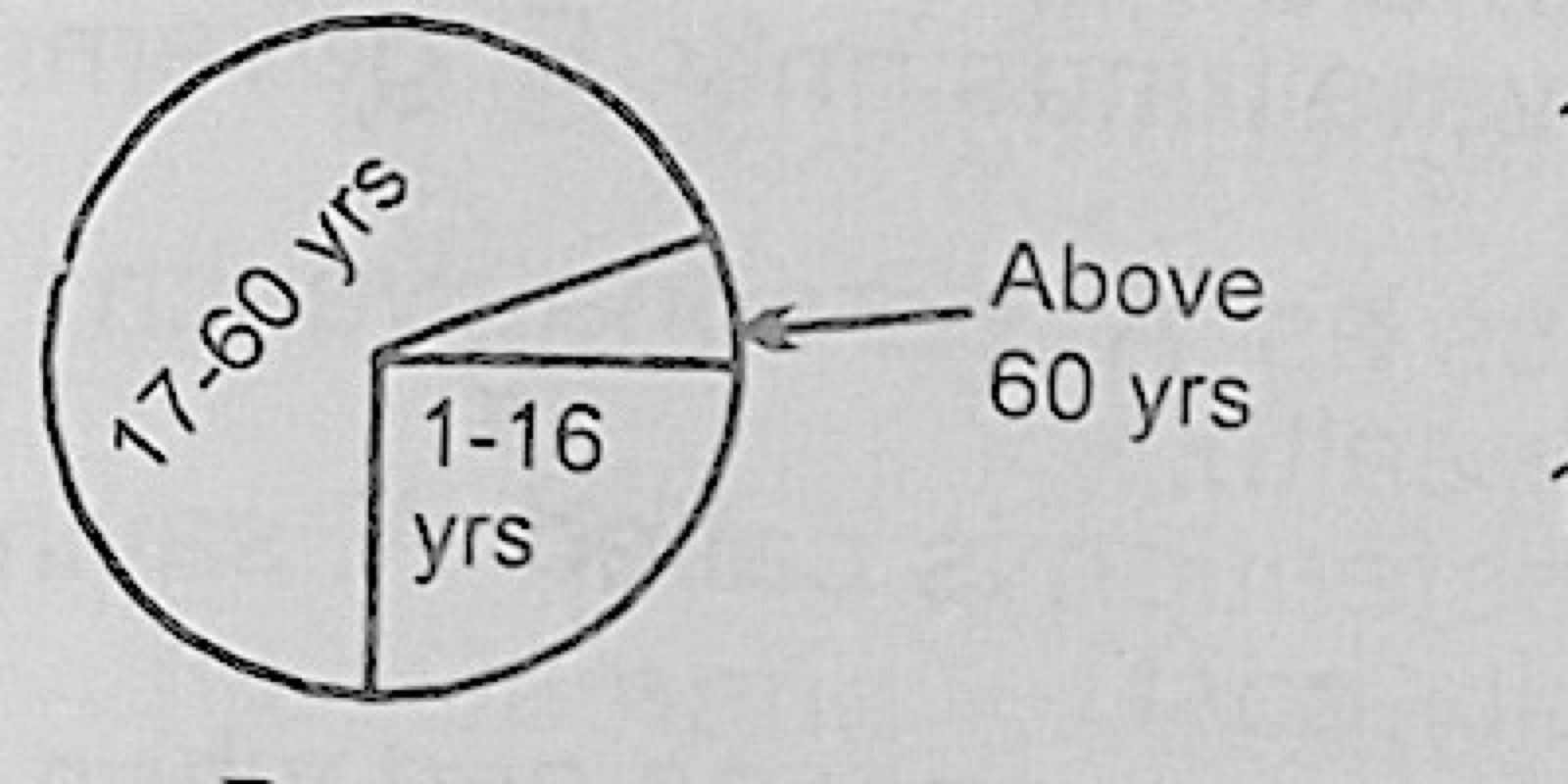
Section A: answer one question only from this section. Use the data in the table below to answer the questions that follow: No of persons in thousands Age group 0 – 16: 1955: 150; 1960: 143 Age group 17 – 45: 1955: 51; 1960: 107 Age group 46 – 60: 1955: 29; 1960: 33 Age group above 60: 1955: 15; 1960: 17 (a) What is the percentage increase in the working population between 1955 and 1960? (b) Calculate the ratio of dependent population to the working population in 1955 (c) Calculate the ratio of dependent population to the working population in 1960 (d) Has the dependency ratio increased or decreased between 1955 and 1960?
Show the model answer
Model answer
Working population = ages 17–60; dependants = ages 0–16 and above 60 (a) Working population 1955 = 51 + 29 = 80 thousand; 1960 = 107 + 33 = 140 thousand Increase = 60 thousand; percentage increase = 60/80 × 100 = 75% (b) Dependants 1955 = 150 + 15 = 165 thousand; ratio = 165 : 80 = 33 : 16 (about 2.06 : 1) (c) Dependants 1960 = 143 + 17 = 160 thousand; ratio = 160 : 140 = 8 : 7 (about 1.14 : 1) (d) The dependency ratio decreased (from about 2.06 to about 1.14)
Explanation
First separate the age groups into the working population (17–60) and the dependants (under 17 and over 60).
Section B: answer three questions only from this section. 'Price tends towards the level which equates supply with demand'. Explain this statement.
Show the model answer
Model answer
In a free market, price is determined by the forces of demand and supply Demand falls as price rises; supply rises as price rises Equilibrium price is the price at which quantity demanded equals quantity supplied (where the curves intersect) Above equilibrium there is excess supply (surplus): sellers cut prices to clear stocks, so price falls Below equilibrium there is excess demand (shortage): buyers compete and bid prices up, so price rises These movements continue until the market clears at equilibrium, so price 'tends towards' that level A diagram showing D and S curves, equilibrium price and quantity, surplus and shortage earns marks A change in demand or supply sets a new equilibrium price
Explanation
Explain the surplus and shortage on either side of equilibrium and how they push price back.
Section B: answer three questions only from this section. Highlight the economic problems associated with the dependence of West African countries on primary production.
Show the model answer
Model answer
Unstable export earnings: prices of primary products fluctuate widely on world markets Worsening terms of trade: prices of primary exports tend to fall relative to manufactured imports Low and inelastic world demand for many primary products Dependence on weather, pests and diseases makes output uncertain Low income and low standard of living for producers; low value added Little industrialisation: raw materials are exported unprocessed, so jobs and skills are created abroad Balance of payments problems and dependence on foreign aid and loans Mono-product economies are very vulnerable when that product's price falls Difficulty in planning because government revenue is unpredictable Exhaustion of non-renewable resources such as minerals
Explanation
Give at least five problems, each with a short explanation.
Section B: answer three questions only from this section. (a) Explain the term national debt (b) State any four instruments of government borrowing in Nigeria.
Show the model answer
Model answer
(a) National (public) debt is the total amount a government owes to lenders at home and abroad It arises when government borrows to finance a budget deficit or development projects Internal debt is owed to citizens and institutions in the country; external debt is owed to foreign governments, institutions or lenders (b) Any four instruments: Treasury bills Treasury certificates Development stocks / government bonds Ways and means advances from the Central Bank Loans from foreign governments and international institutions (e.g. World Bank, IMF) Savings certificates / premium bonds
Explanation
Define national debt clearly, then list four named instruments.
Section B: answer three questions only from this section. Compare and contrast the private limited company with the public limited company.
Show the model answer
Model answer
Similarities: both are joint-stock companies registered under the Companies Act Both have limited liability and a separate legal entity; both have continuity of existence Both are managed by a board of directors and must file accounts Differences: a private company has 2 to 50 members; a public company has a minimum of 7 (now 2) and no maximum A private company cannot invite the public to buy its shares; a public company can sell shares to the public and be quoted on the Stock Exchange Shares of a private company are not freely transferable; those of a public company are freely transferable A private company usually has smaller capital; a public company can raise very large capital A private company need not publish its accounts to the public; a public company must publish audited accounts A private company uses 'Ltd' after its name; a public company uses 'Plc'
Explanation
Give both similarities and differences; a table of differences is acceptable.
Section B: answer three questions only from this section. (a) Outline the main features of the Malthusian theory on population (b) Explain the developments that render the theory irrelevant to the present day situation.
Show the model answer
Model answer
(a) Population tends to grow in geometric progression (1, 2, 4, 8 …) Food supply grows only in arithmetic progression (1, 2, 3, 4 …) because of diminishing returns on land Population would therefore outgrow food supply, doubling about every 25 years Positive checks (famine, disease, war) would reduce population He recommended preventive checks: late marriage and moral restraint (b) Improved agricultural technology (fertilisers, mechanisation, improved seeds) has raised food output faster than population Birth control and family planning have slowed population growth International trade lets countries import food Medical advances and urbanisation changed population patterns; developed countries' population growth has slowed Malthus ignored technology and the fact that more people also produce more
Explanation
State Malthus's ratios clearly, then give reasons the predictions did not come true.
Section B: answer three questions only from this section. What is money? Explain its characteristics.
Show the model answer
Model answer
Money is anything generally acceptable as a medium of exchange and in settlement of debts Characteristics: general acceptability Portability (easy to carry) Durability (does not wear out quickly) Divisibility into smaller units without loss of value Homogeneity / uniformity (units of the same value are identical) Scarcity / limited supply, so it keeps its value Stability of value Recognisability and difficulty to forge Each characteristic should be explained briefly
Explanation
Define money, then explain at least five characteristics.
Section B: answer three questions only from this section. (a) Explain the term capital market (b) How is the capital market different from the stock exchange? (c) What are the advantages of the capital market?
Show the model answer
Model answer
(a) The capital market is the market for medium- and long-term funds Institutions include development banks, insurance companies, mortgage banks, issuing houses and the Stock Exchange (b) The capital market is the whole system for raising long-term funds; the stock exchange is one institution within it The stock exchange deals mainly in buying and selling existing (second-hand) securities; the capital market also covers new issues and long-term loans (c) Provides long-term funds for industry and government Mobilises savings and encourages investment Gives investors a way to earn income (dividends, interest) Helps government finance development projects Promotes economic growth and industrialisation Helps indigenisation and wide ownership of companies
Section B: answer three questions only from this section. Describe the functions of the International Monetary Fund (IMF).
Show the model answer
Model answer
Gives short-term loans to members with temporary balance of payments deficits Promotes international monetary co-operation Promotes exchange rate stability and orderly exchange arrangements Helps remove exchange controls and encourages convertibility of currencies Promotes the growth of international trade Gives technical assistance and advice on economic policy to members Provides a forum for consultation on international monetary problems Manages Special Drawing Rights (SDRs) to increase international liquidity