WAEC Economics 1993 past questions and answers

48 questions. Try each one, then open the answer to check yourself and read the explanation.

Question 1

Basic Concepts

Economics is the study of how to

  1. A.choose between alternatives, given limited resources
  2. B.regulate the money that is in circulation in a country
  3. C.be prudent in the use of available resources
  4. D.improve the standard of living of the society at large
  5. E.arrange our needs in order of usefulness before satisfying them.
Show the answer and explanation

Answer: A (choose between alternatives, given limited resources)

Explanation

Economics studies how people choose among alternative uses of limited resources.

Open this question

Question 2

Basic Concepts

Scarcity in Economics arises because

  1. A.the resources available are adequate
  2. B.individuals have limited time
  3. C.resources are limited in supply
  4. D.human beings have limited wants
  5. E.individual wants are equal to the resources available.
Show the answer and explanation

Answer: C (resources are limited in supply)

Explanation

Scarcity exists because resources are limited compared with unlimited wants.

Open this question

Question 3

Basic Concepts

The real cost of a commodity is

  1. A.the cost of the alternative that has to be sacrificed for it
  2. B.the alternative that has to be forgone in order to purchase it
  3. C.its market price
  4. D.the alternative cost involved when the opportunity of buying the commodity is missed
  5. E.the sacrifice that is made after buying the commodity.
Show the answer and explanation

Answer: B (the alternative that has to be forgone in order to purchase it)

Explanation

Real (opportunity) cost is the next best alternative given up to obtain the commodity.

Open this question

Question 4

Business Organisations

Public corporations in West Africa are set up to

  1. A.make maximum profit
  2. B.provide jobs for the people
  3. C.provide welfare services for the people
  4. D.show that the government can do business
  5. E.compete with private enterprises.
Show the answer and explanation

Answer: C (provide welfare services for the people)

Explanation

Public corporations aim mainly to provide essential services (power, water, transport) for public welfare, not to maximise profit.

Open this question

Question 6

Theory of Demand

An inferior good is one

  1. A.that is too bad for consumption
  2. B.whose price is lower than the prices of other goods
  3. C.that is easily perishable
  4. D.whose demand falls when the income of its consumers increases
  5. E.that is not durable.
Show the answer and explanation

Answer: D (whose demand falls when the income of its consumers increases)

Explanation

For an inferior good, people buy less as their income rises (they switch to better goods).

Open this question

Question 7

Elasticity

Price elasticity of demand is defined as the

  1. A.responsiveness of demand to changes in price
  2. B.responsiveness of price to changes in demand
  3. C.increase in demand resulting from a rise in price
  4. D.unit decrease in price resulting from a fall in demand
  5. E.unit increase in quantity demanded when price rises.
Show the answer and explanation

Answer: A (responsiveness of demand to changes in price)

Explanation

Price elasticity of demand measures how much quantity demanded responds to a change in price.

Open this question

Question 8

Industrialisation

The rural areas of West African countries lack industries because

  1. A.rural people are not meant to work in industries
  2. B.rural people are uneducated
  3. C.of inadequate infrastructure
  4. D.of low population density
  5. E.they are not suitable for industries.
Show the answer and explanation

Answer: C (of inadequate infrastructure)

Explanation

Rural areas lack roads, electricity, water and other infrastructure that industries need.

Open this question

Question 9

Industrialisation

An entrepreneur will locate his industry in a place

  1. A.nearest to his home town
  2. B.where the cost of production will be minimized
  3. C.nearest to his wife's hometown
  4. D.where the government directs him to locate it
  5. E.where there is no other industry.
Show the answer and explanation

Answer: B (where the cost of production will be minimized)

Explanation

A rational entrepreneur chooses the location where his costs of production (and distribution) are lowest.

Open this question

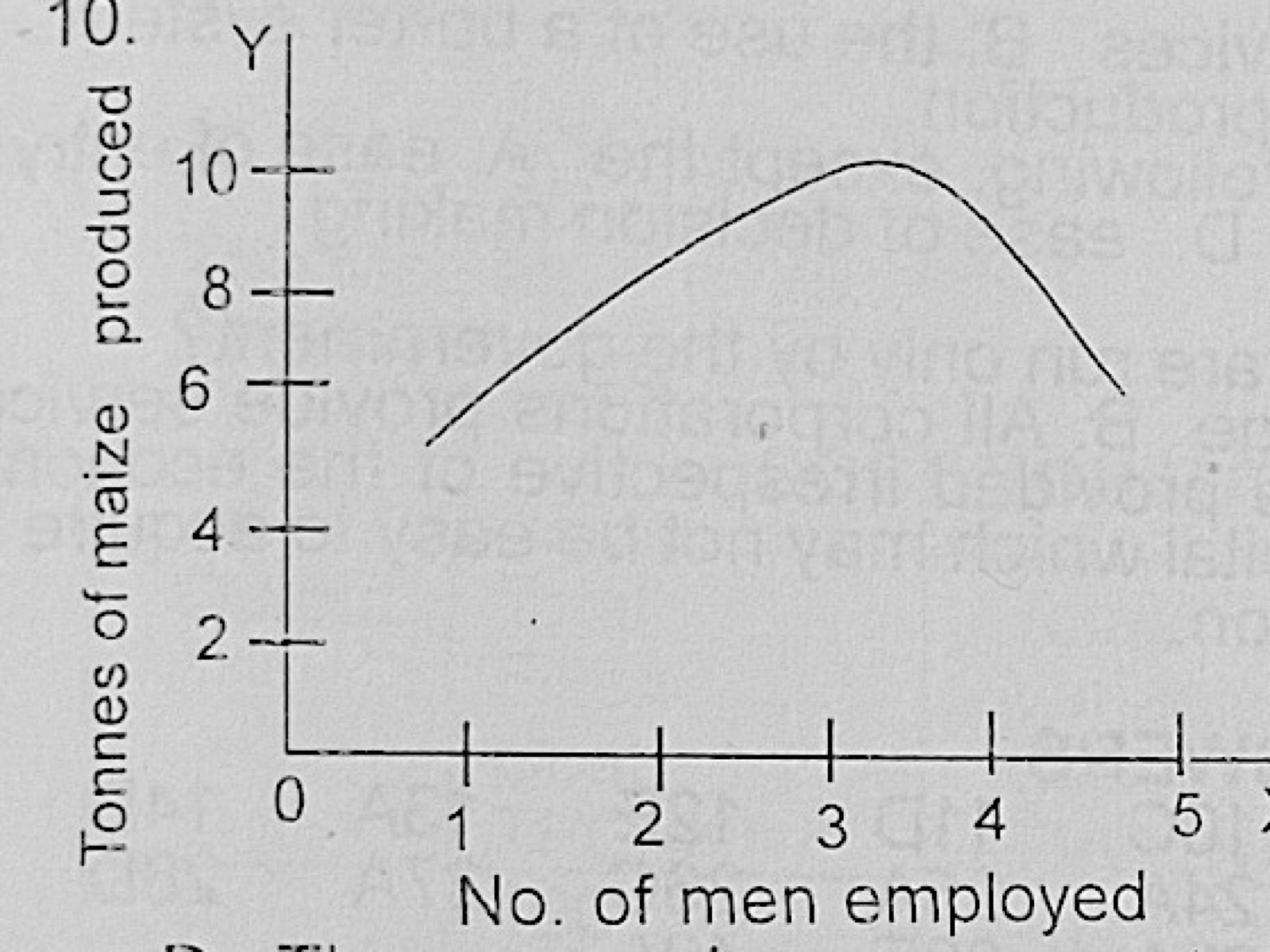
Question 10

Theory of Production

Which important economic principle is illustrated by the graph above?

Diagram for this question
  1. A.Law of Comparative Cost
  2. B.Law of Diminishing Marginal Utility
  3. C.Law of Diminishing Returns
  4. D.Malthusian Law of Population
  5. E.Law of Supply.
Show the answer and explanation

Answer: C (Law of Diminishing Returns)

Explanation

Output of maize rises as more men are employed, peaks and then falls: adding a variable factor to fixed land eventually gives diminishing returns.

Open this question

Question 11

Distributive Trade

Which of the following reasons is mainly responsible for the inefficient distribution of goods in West African countries? The

  1. A.large number of distribution companies
  2. B.import and export restrictions by the government
  3. C.narrow market for commodities produced
  4. D.poor transport and communication systems
  5. E.large influence of foreign traders.
Show the answer and explanation

Answer: D (poor transport and communication systems)

Explanation

Bad roads and poor communication make it slow and costly to move goods to buyers.

Open this question

Question 12

Business Organisations

Which of the following does not apply to private companies?

  1. A.The number of shareholders is limited
  2. B.The liability of shareholders is limited
  3. C.Accounts have to be publicized
  4. D.The companies are separate legal entities
  5. E.Shares are not easily transferable.
Show the answer and explanation

Answer: C (Accounts have to be publicized)

Explanation

A private company has limited members, limited liability, separate legal identity and restricted share transfer, but it does not publish its accounts to the public.

Open this question

Question 13

Labour Market

In Economics, the reward for labour is in the form of

  1. A.wages
  2. B.profit
  3. C.rent
  4. D.dividends
  5. E.interest.
Show the answer and explanation

Answer: A (wages)

Explanation

Labour earns wages; land earns rent, capital interest and entrepreneurs profit.

Open this question

Question 14

Population

A nation with a working population that is insufficient to exploit its resources is said to be

  1. A.over-populated
  2. B.under-populated
  3. C.experiencing decreasing population
  4. D.experiencing increasing population
  5. E.having optimum population.
Show the answer and explanation

Answer: B (under-populated)

Explanation

Under-population means there are too few people to make full use of the available resources.

Open this question

Question 15

Theory of Production

Which of the following may not be included in explaining the term production?

  1. A.Provision of services
  2. B.manufacture of goods
  3. C.Changing raw materials to finished goods
  4. D.Use of consumer goods
  5. E.Making goods available where and when they are needed.
Show the answer and explanation

Answer: D (Use of consumer goods)

Explanation

Using up goods is consumption, not production.

Open this question

Question 16

Business Organisations

Which of the following business establishments are not motivated mainly by profit?

  1. A.Public Limited Companies
  2. B.Private Limited Companies
  3. C.Holding Companies
  4. D.Partnerships
  5. E.Co-operatives.
Show the answer and explanation

Answer: E (Co-operatives.)

Explanation

Co-operatives exist mainly to serve their members' welfare, not to make profit.

Open this question

Question 17

Theory of Production

Production is not complete until the

  1. A.goods get to the wholesalers
  2. B.goods reach the final consumer
  3. C.factors of production are combined
  4. D.goods are ready for transportation
  5. E.wholesalers ask the firms to produce.
Show the answer and explanation

Answer: B (goods reach the final consumer)

Explanation

Production ends only when goods reach the final consumer.

Open this question

Question 18

Theory of Costs and Revenue

Which of the following is the correct way to calculated total cost?

  1. A.Addition of fixed cost to variable cost
  2. B.Division of total cost by total output
  3. C.Multiplication of fixed cost by variable cost
  4. D.Subtraction of ficed cost from total cost
  5. E.Addition of marginal cost to average cost.
Show the answer and explanation

Answer: A (Addition of fixed cost to variable cost)

Explanation

Total cost = total fixed cost + total variable cost.

Open this question

Question 19

Population

Robert T. Malthus postulated in his population theory that

  1. A.the death rate may become so high that people may not survive
  2. B.people will eventually stop having children
  3. C.people will migrate from one place to another in search of food
  4. D.positive efforts should be made to increase population
  5. E.population growth rate may out-grow the means of subsistence.
Show the answer and explanation

Answer: E (population growth rate may out-grow the means of subsistence.)

Explanation

Malthus held that population tends to grow faster than food supply (the means of subsistence).

Open this question

Question 20

Theory of Production

Division of labour may be restricted when

  1. A.an ailing economy has improved
  2. B.producers live in villages
  3. C.market is small
  4. D.there is full employment
  5. E.there is inflation.
Show the answer and explanation

Answer: C (market is small)

Explanation

Division of labour is limited by the size of the market: a small market cannot absorb large output.

Open this question

Question 21

Theory of Production

Land is often distinguished as a factor of production because it

  1. A.is a free gift of nature
  2. B.constitutes one-third of the entire world
  3. C.is unlimited in supply
  4. D.is owned by individuals
  5. E.is owned by government.
Show the answer and explanation

Answer: A (is a free gift of nature)

Explanation

Land is a free gift of nature, not made by man.

Open this question

Question 22

Theory of Production

Which of the following is not an advantage of division of labour? It

  1. A.saves time
  2. B.makes possible the use of machines
  3. C.is monotonous
  4. D.leads to specialization
  5. E.aids the development of skills.
Show the answer and explanation

Answer: C (is monotonous)

Explanation

Monotony (boredom from repeating one task) is a disadvantage of division of labour.

Open this question

Question 23

Industrialisation

The location of timber and plywood industries in West Africa is mainly influenced by the

  1. A.availability of transport
  2. B.good climate
  3. C.availability of power supply
  4. D.adequate labour supply
  5. E.presence of a luxuriant forest.
Show the answer and explanation

Answer: E (presence of a luxuriant forest.)

Explanation

Timber is bulky, so these industries locate near their raw material – the forest.

Open this question

Question 24

Population

The occupational distribution of population in most West African countries shows the highest concentration in

  1. A.agriculture and allied industries
  2. B.mining and manufacturing
  3. C.the distributive trade
  4. D.commerce and industry
  5. E.mining and services.
Show the answer and explanation

Answer: A (agriculture and allied industries)

Explanation

Most West Africans work in farming, fishing and related activities.

Open this question

Question 25

Population

The growth rate of population is the

  1. A.annual increase in population
  2. B.total population of a country at a given time
  3. C.addition to the total population over a given period
  4. D.increase in the working population over a given period
  5. E.percentage increase in population in a given year.
Show the answer and explanation

Answer: E (percentage increase in population in a given year.)

Explanation

The growth rate of population is the increase in population in a year expressed as a percentage of the population at the start of the year.

Open this question

Question 26

Theory of Demand

A situation in which an increase in the demand for certain goods leads to a fall in the demand for other goods is known as

  1. A.joint supply
  2. B.derived demand
  3. C.competitive demand
  4. D.competitive supply
  5. E.composite demand.
Show the answer and explanation

Answer: C (competitive demand)

Explanation

Substitutes are in competitive demand: buying more of one means buying less of the other.

Open this question

Question 27

Price Determination

A market equilibrium exists when

  1. A.demand and supply are equal
  2. B.the market is large
  3. C.the price is fluctuating
  4. D.no buyer goes home empty-handed
  5. E.no seller has an unsold stock.
Show the answer and explanation

Answer: A (demand and supply are equal)

Explanation

Equilibrium is where quantity demanded equals quantity supplied.

Open this question

Question 28

Economic Systems

The price system is

  1. A.the market price of commodities
  2. B.a market where a single price rules
  3. C.a system of price allocation to the products of the same firm
  4. D.a system of resource allocation through supply and demand interactions
  5. E.a system which the market price is determined only through haggling.
Show the answer and explanation

Answer: D (a system of resource allocation through supply and demand interactions)

Explanation

The price system allocates resources through the free interplay of demand and supply.

Open this question

Question 29

Market Structures

The main objective of production by an entrepreneur is to

  1. A.equate marginal revenue with marginal cost
  2. B.provide employment opportunities
  3. C.equate total revenue with total cost
  4. D.equate average revenue with average cost
  5. E.accumulate wealth for the nation.
Show the answer and explanation

Answer: A (equate marginal revenue with marginal cost)

Explanation

An entrepreneur aims to maximise profit, which happens where marginal revenue equals marginal cost.

Open this question

Question 30

Price Determination

If price falls below the equilibrium

  1. A.demand will equal supply
  2. B.demand will be greater than supply
  3. C.supply will be greater than demand
  4. D.price will become indeterminate
  5. E.quantity supplied will be zero.
Show the answer and explanation

Answer: B (demand will be greater than supply)

Explanation

Below equilibrium, more is demanded and less supplied, so demand exceeds supply (a shortage).

Open this question

Question 31

Business Organisations

Which of the following is not a source of finance for a one-man business?

  1. A.Money lenders
  2. B.Inheritance
  3. C.Loans from insurance companies
  4. D.Loans from banks
  5. E.Sale of shares.
Show the answer and explanation

Answer: E (Sale of shares.)

Explanation

A sole trader cannot sell shares; only companies can.

Open this question

Question 32

Theory of Production

Land is a most significant factor in terms of contribution to the economy because

  1. A.it enables us to build industries
  2. B.we build houses on it
  3. C.all our highways are constructed on it
  4. D.we get a lot of fishes from it
  5. E.vital resources from it enrich the economy.
Show the answer and explanation

Answer: E (vital resources from it enrich the economy.)

Explanation

Land includes all natural resources – minerals, soil, forests, water – which supply the economy's raw materials.

Open this question

Question 33

Theory of Production

Capital as a factor of production is important because

  1. A.it enables us to carry out tasks which cannot be done by human effort only
  2. B.most tasks can be done with bare hands
  3. C.people can work without capital
  4. D.without capital, all other factors are useless
  5. E.it provides money which is essential for the growth of business.
Show the answer and explanation

Answer: A (it enables us to carry out tasks which cannot be done by human effort only)

Explanation

Capital goods (machines, tools, buildings) multiply what labour can do and make possible tasks that hands alone cannot perform.

Open this question

Question 34

Theory of Costs and Revenue

A firm's compulsory cost whether it is in production or not, is referred to as its

  1. A.prime cost
  2. B.variable cost
  3. C.marginal cost
  4. D.fixed cost
  5. E.average cost.
Show the answer and explanation

Answer: D (fixed cost)

Explanation

Fixed costs (rent, insurance) must be paid even when the firm produces nothing.

Open this question

Question 35

Basic Concepts

A scale of preference is a list

  1. A.of consumer's wants arranged in order of importance
  2. B.that helps the individual to make a rational choice
  3. C.that enables the consumer to make a wise decision about his choice
  4. D.that is necessary because human beings are faced with competing wants
  5. E.of all satisfied wants arranged in order of magnitude.
Show the answer and explanation

Answer: A (of consumer's wants arranged in order of importance)

Explanation

A scale of preference ranks a person's wants in order of importance.

Open this question

Question 36

Economic Systems

An economic system in which the state owns and controls the means of production is known as

  1. A.free enterprise
  2. B.socialist economy
  3. C.mixed economy
  4. D.capitalist economy
  5. E.welfare economy.
Show the answer and explanation

Answer: B (socialist economy)

Explanation

State ownership and control of the means of production is the main feature of socialism.

Open this question

Question 37

Distributive Trade

Which of the following is not a middleman in the distribution channel? The

  1. A.wholesaler
  2. B.distributor
  3. C.agent
  4. D.consumer
  5. E.retailer.
Show the answer and explanation

Answer: D (consumer)

Explanation

The consumer is the end of the channel, not a middleman between producer and consumer.

Open this question

Question 38

Theory of Production

Division of labour gives rise to

  1. A.the exchange of goods and services
  2. B.the use of a barter system
  3. C.the production of limited goods
  4. D.unemployment
  5. E.delay in production.
Show the answer and explanation

Answer: A (the exchange of goods and services)

Explanation

When people specialise they produce more of one thing and must exchange to get other goods.

Open this question

Question 39

Business Organisations

One-man business are popular in West Africa because of all the following, except the

  1. A.ease of entry
  2. B.small capital required
  3. C.limited entrepreneurial skill needed
  4. D.ease of decision making
  5. E.tendency to become joint-stock companies.
Show the answer and explanation

Answer: E (tendency to become joint-stock companies.)

Explanation

Sole proprietorships rarely grow into companies; their popularity comes from easy entry, small capital and simple decision making.

Open this question

Theory question 101

Tools of Economic Analysis

Section A (answer one question only from this section)
(a) Explain each of the following measures of central tendency: (i) mean; (ii) median; (iii) mode
(b) Calculate the mean, median and mode of the following set of numbers: 21, 22, 23, 24, 25, 26, 27, 23, 28, 29, 30, 24, 31, 34, 23.

Show the model answer
Model answer

(a)(i) Mean (arithmetic mean): sum of all values divided by the number of values, x̄ = Σx/n.
(ii) Median: the middle value when the data are arranged in order of size.
(iii) Mode: the value that occurs most frequently.
(b) n = 15; Σx = 390; mean = 390 ÷ 15 = 26
Ordered: 21, 22, 23, 23, 23, 24, 24, 25, 26, 27, 28, 29, 30, 31, 34
Median = 8th value = 25
Mode = 23 (occurs three times)

Explanation

Arrange the numbers in order before finding the median.

Open this question

Theory question 102

Theory of Costs and Revenue

Section A (answer one question only from this section)
Cost schedule of a Firm
Output | TFC (N) | TVC (N) | TC (N) | AVC (N) | ATC (N) | MC (N)
0 | 100 | 0 | 100 | 0 | 100 | —
1 | 100 | 40 | 140 | ? | ? | ?
2 | 100 | 64 | 164 | ? | ? | ?
3 | 100 | 80 | 180 | ? | ? | ?
4 | 100 | 88 | 188 | ? | ? | ?
5 | 100 | 96 | 196 | ? | ? | ?
From the cost schedule above, calculate the Average Variable Cost (AVC), Average Total Cost (ATC) and Marginal Cost (MC) of the firm. Show your workings clearly.

Show the model answer
Model answer

AVC = TVC ÷ output; ATC = TC ÷ output; MC = change in TC
Output 1: AVC = 40/1 = N40; ATC = 140/1 = N140; MC = 140 − 100 = N40
Output 2: AVC = 64/2 = N32; ATC = 164/2 = N82; MC = 164 − 140 = N24
Output 3: AVC = 80/3 = N26.67; ATC = 180/3 = N60; MC = 180 − 164 = N16
Output 4: AVC = 88/4 = N22; ATC = 188/4 = N47; MC = 188 − 180 = N8
Output 5: AVC = 96/5 = N19.20; ATC = 196/5 = N39.20; MC = 196 − 188 = N8

Explanation

Show each formula, then each division.

Open this question

Theory question 103

Elasticity

Section B (answer three questions only from this section)
What are the factors that determine the price elasticity of demand for a commodity?

Show the model answer
Model answer

Factors:
1. Availability of close substitutes – more substitutes, more elastic.
2. Nature of the commodity – necessities inelastic, luxuries elastic.
3. Proportion of income spent on it – small share (salt, matches) inelastic.
4. Number of uses – many uses, more elastic.
5. Habit/addiction – habit-forming goods (cigarettes) inelastic.
6. Time period – demand more elastic in the long run.
7. Durability – durable goods' purchase can be postponed (elastic).
8. Complementary goods / joint demand – goods used with others often inelastic.
9. Level of income of consumers.

Explanation

Explain how each factor affects elasticity.

Open this question

Theory question 104

Industrialisation

Section B
What are the likely reasons for government participation in the location of industries in Nigeria?

Show the model answer
Model answer

Reasons:
1. To ensure even/balanced development among regions.
2. To reduce rural-urban migration by taking industries to rural areas.
3. To create employment across the country.
4. To prevent over-concentration and congestion in a few cities.
5. For strategic and security reasons (defence industries).
6. To make use of local raw materials where they are found.
7. To protect the environment and public health (keep polluting industries away from residential areas).
8. For political reasons – to give each state a share of industries.
9. To develop backward areas and provide infrastructure there.

Explanation

Explain each reason.

Open this question

Theory question 105

Business Organisations

Section B
Outline the merits of a Joint Stock Company.

Show the model answer
Model answer

Merits:
1. Limited liability of shareholders.
2. Large capital can be raised by selling shares (and debentures).
3. Continuity – separate legal entity, not affected by death of members.
4. Shares (of public companies) are easily transferable.
5. Expert management by a board of directors and professional managers.
6. Enjoys economies of scale.
7. Can borrow easily because of its size and credibility.
8. Risk is spread among many shareholders.
9. Research and development possible.

Explanation

Brief points.

Open this question

Theory question 106

Distributive Trade

Section B
What functions do wholesalers perform for manufacturers?

Show the model answer
Model answer

Functions:
1. Buy in bulk, so manufacturers can produce on a large scale.
2. Provide storage (warehousing), relieving manufacturers of storage costs.
3. Pay promptly or in advance, financing production.
4. Bear risks of price changes, damage and theft.
5. Distribute goods to retailers over a wide area.
6. Give manufacturers market information on consumer tastes.
7. Advertise and promote products.
8. Grade, sort, pack and brand goods.
9. Help even out supply and stabilise prices.

Explanation

Focus on the manufacturer, not the retailer.

Open this question

Theory question 107

Public Finance

Section B
Explain each of the following types of taxes:
(a) Proportional tax (b) Progressive tax (c) Regressive tax.

Show the model answer
Model answer

(a) Proportional tax: the same percentage rate is charged whatever the income; tax paid rises in proportion to income (e.g. 10% on N10,000 = N1,000 and on N100,000 = N10,000).
(b) Progressive tax: the rate rises as income rises; higher earners pay a larger percentage (e.g. 5% on low income, 20% on high income). Equitable; used for personal income tax.
(c) Regressive tax: the rate falls as income rises, or the tax takes a larger share of low incomes than of high incomes (e.g. flat poll tax, taxes on essential goods). Burden is heavier on the poor.
Diagrams or numerical examples earn credit.

Explanation

A numerical example for each makes the difference clear.

Open this question

Theory question 108

Population

Section B
Highlight the economic effects of high population density in Nigeria.

Show the model answer
Model answer

Effects:
1. Pressure on land – fragmentation of farms, land scarcity.
2. Unemployment and underemployment.
3. Pressure on social amenities (housing, water, schools, hospitals), congestion and slums.
4. Large market for goods – encourages production and investment.
5. Plentiful (cheap) labour supply.
6. Food shortages and high food prices.
7. Environmental problems: pollution, erosion, deforestation.
8. Higher crime rate and social problems.
9. Easier and cheaper provision of infrastructure per head in dense areas.
10. Low savings and low standard of living if output does not keep pace.

Explanation

Include both positive and negative effects.

Open this question

Theory question 109

Financial Institutions

Section B
How does the central bank exercise control over commercial banks?

Show the model answer
Model answer

Methods:
1. Bank rate/monetary policy rate – raising it makes borrowing dearer and reduces lending.
2. Open market operations – selling securities reduces banks' cash; buying increases it.
3. Cash reserve ratio – raising it reduces banks' ability to create credit.
4. Liquidity ratio requirements.
5. Special deposits called from commercial banks.
6. Selective credit control – directing loans to priority sectors.
7. Credit ceilings.
8. Moral suasion – persuading banks to follow policy.
9. Licensing, supervision and bank examination; prudential guidelines.

Explanation

Explain how each tool affects banks' lending.

Open this question

Theory question 110

Agriculture

Section B
Describe the problems facing agriculture in Nigeria.

Show the model answer
Model answer

Problems:
1. Use of crude tools and little mechanisation.
2. Land tenure system and land fragmentation.
3. Inadequate credit facilities for farmers.
4. Poor storage, processing and transport – post-harvest losses.
5. Pests, diseases and poor seeds.
6. Dependence on rainfall; drought and floods; soil erosion.
7. Rural-urban migration – ageing, illiterate farming population.
8. Low and unstable prices; poor marketing.
9. Inadequate extension services and research.
10. Neglect of agriculture since the oil boom; insecurity in farming areas.
Explanation

Describe at least five problems.

Open this question