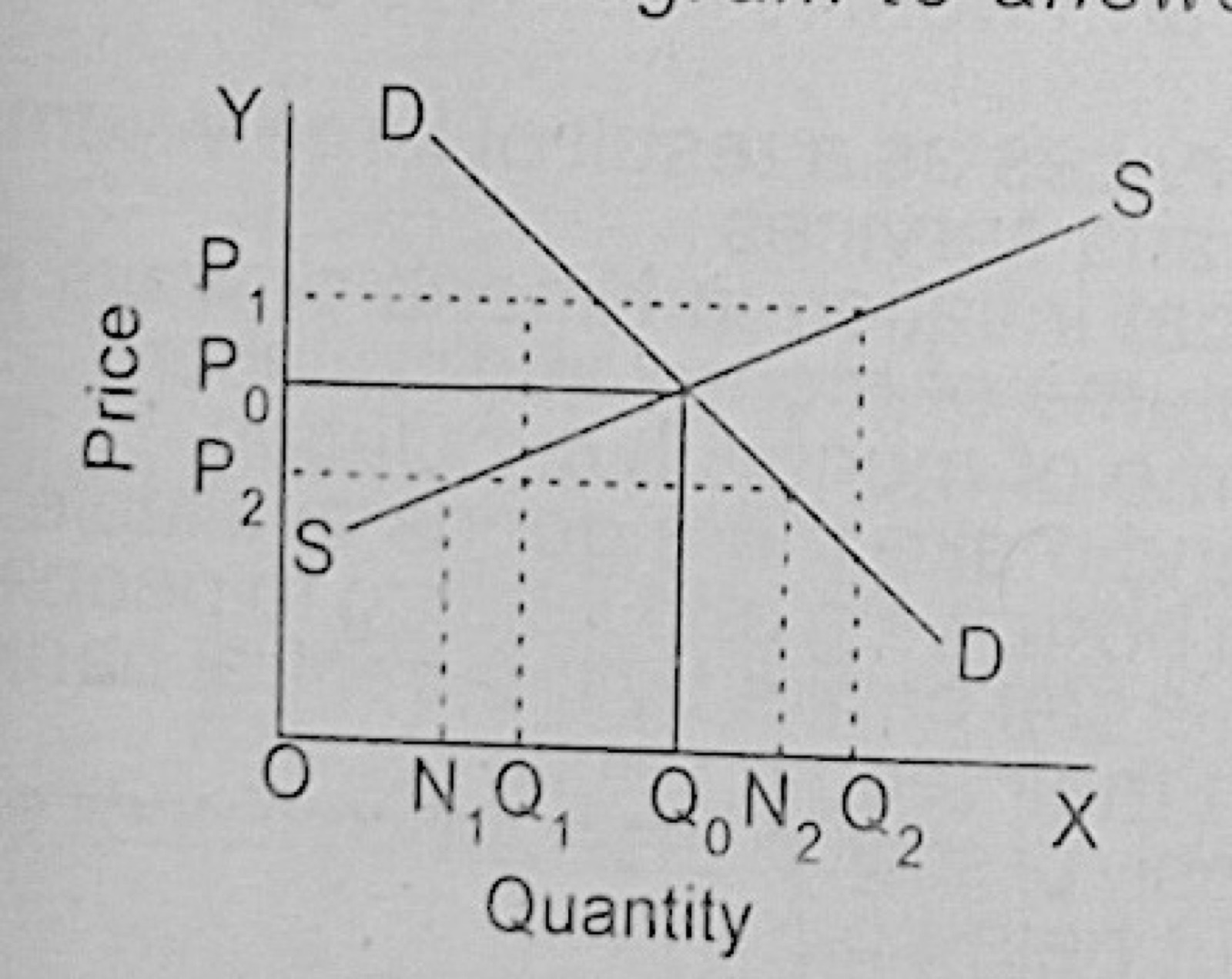
Use the following market schedule for semovita to answer the question. Price for 5 kg bag | Quantity demanded in bags | Quantity supplied in bags N3.00 | 15,000 | 1,500 N4.00 | 13,000 | 3,000 N5.00 | 10,000 | 6,000 N6.00 | 7,000 | 7,000 N7.00 | 5,000 | 9,000 N8.00 | 4,000 | 12,000 N9.00 | 2,000 | 14,000 What is the equilibrium price?
A.N5.00
B.N6.00
C.N7.00
D.N8.00
E.N9.00
Show the answer and explanation
Answer: B (N6.00)
Explanation
At N6.00 quantity demanded (7,000) equals quantity supplied (7,000).
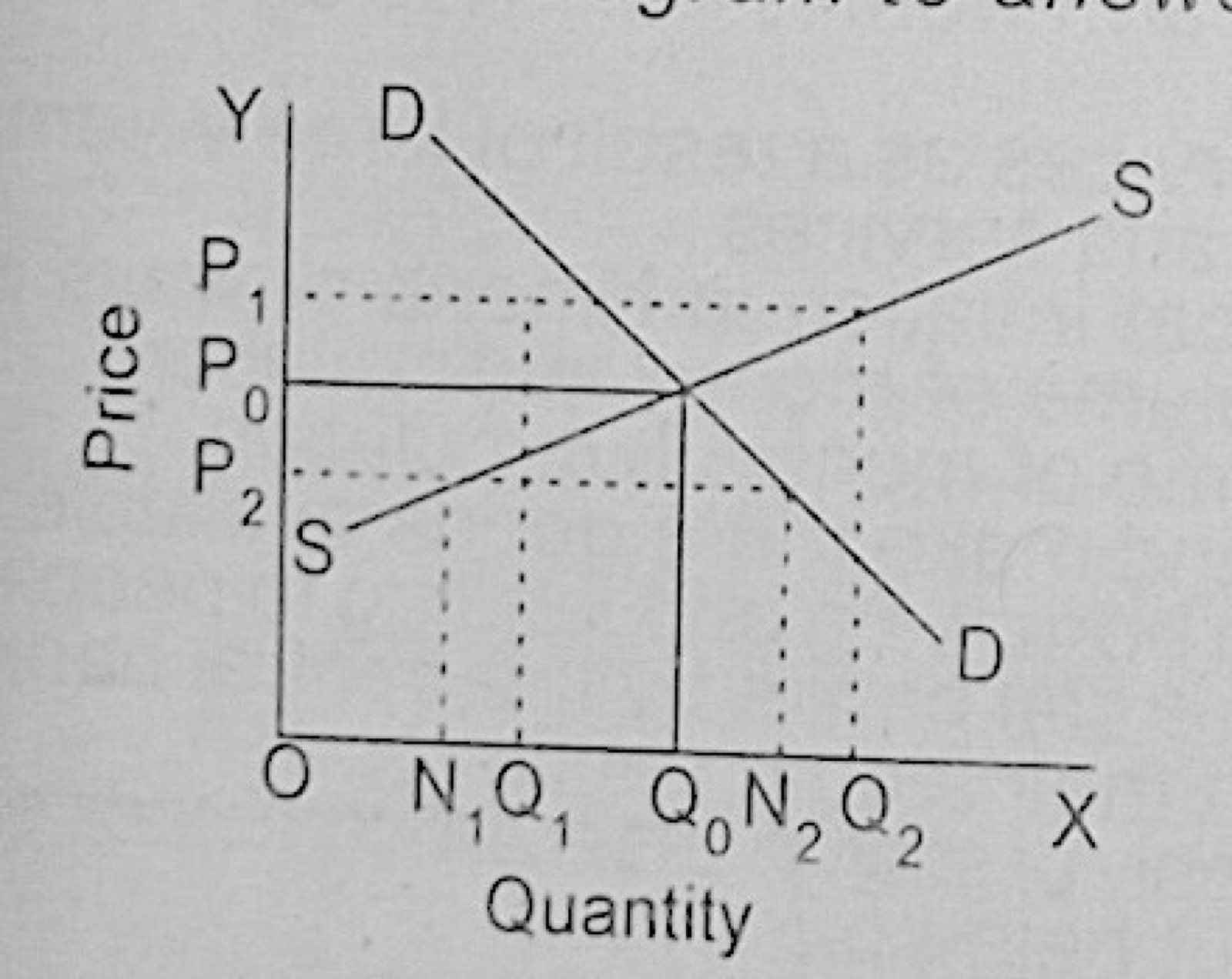
Use the following market schedule for semovita to answer the question. Price for 5 kg bag | Quantity demanded in bags | Quantity supplied in bags N3.00 | 15,000 | 1,500 N4.00 | 13,000 | 3,000 N5.00 | 10,000 | 6,000 N6.00 | 7,000 | 7,000 N7.00 | 5,000 | 9,000 N8.00 | 4,000 | 12,000 N9.00 | 2,000 | 14,000 If the equilibrium price falls by N2.00, what will be the change in quantity demanded and supplied?
A.7,000 and 6,000 bags respectively
B.6,000 and 4,000 bags respectively
C.5,000 and 4,500 bags respectively
D.3,000 and 3,000 bags respectively
E.2,000 and 2,000 bags respectively.
Show the answer and explanation
Answer: B (6,000 and 4,000 bags respectively)
Explanation
Price falls from N6 to N4: demand rises from 7,000 to 13,000 (a change of 6,000) and supply falls from 7,000 to 3,000 (a change of 4,000).
The productivity of labour does not depend only on its own effort and efficiency, but also on I. the level of technical knowledge II. the quality of other factors III. racial qualities which allow persons from certain races to have good physique and be very active. Which of the above statements is/are correct?
A.I only
B.I and II only
C.I and III only
D.II and III only
E.III only.
Show the answer and explanation
Answer: B (I and II only)
Explanation
Labour productivity rises with better technology and better capital and land to work with; race has nothing to do with it.
Section A (answer one question only from this section) A pie-chart shows the age distribution of a population: 0-17 years 162°; 18-54 yrs 90°; 55+ years 108°. The total population is 120 million. The official school-leaving age is 18 years while the official retiring age is 55 years. (a) From the above information, calculate the: (i) population of children between 0 and 17 years (ii) population of old people (55 + years); (iii) working population (18 - 54 years) (b) What is the economic implication of the above population structure?
Show the model answer
Model answer
(a)(i) 162/360 × 120m = 54 million (ii) 108/360 × 120m = 36 million (iii) 90/360 × 120m = 30 million (b) Dependants = 54m + 36m = 90m (75%), workers only 30m (25%): a very high dependency ratio (3 : 1). Implications: - Heavy burden on the working population; high taxes. - Low savings and low investment, so slow growth. - High government spending on education, health and pensions. - High demand for goods may cause inflation and more imports, worsening the balance of payments. - Low standard of living; pressure on social amenities. - Small labour force limits output.
Section A (answer one question only from this section) Complete the following cost schedules and answer the questions that follow: Output | Total cost TC | Average cost AC | Marginal cost MC 1 | 8 | 8 | – 2 | 14 | ? | ? 3 | ? | 6 | ? 4 | 20 | ? | ? 5 | ? | 6 | ? 6 | 48 | ? | ? (a) At what output is AC at the minimum? (b) At which output is MC at the minimum (c) At what output does AC start increasing? (d) At what output does MC start to be greater than AC? (e) What is the maximum output?
Show the model answer
Model answer
Completed schedule (TC = AC × output; AC = TC ÷ output; MC = change in TC): Output 1: TC 8, AC 8, MC – Output 2: TC 14, AC 7, MC 6 Output 3: TC 18, AC 6, MC 4 Output 4: TC 20, AC 5, MC 2 Output 5: TC 30, AC 6, MC 10 Output 6: TC 48, AC 8, MC 18 (a) AC is lowest (5) at 4 units. (b) MC is lowest (2) at 4 units. (c) AC starts rising at 5 units. (d) MC (10) first exceeds AC (6) at 5 units. (e) The largest output in the schedule is 6 units (the least-cost or optimum output is 4 units).
Explanation
Fill in TC first for outputs 3 and 5 using TC = AC × Q.
Section B (answer three questions only from this section) With the aid of diagrams, explain what is meant by a change in: (a) the quantity demanded; (b) demand
Show the model answer
Model answer
(a) Change in quantity demanded: caused only by a change in the commodity's own price, other things being equal. Shown as a movement along the same demand curve – down the curve (extension) when price falls, up the curve (contraction) when price rises. Diagram: one demand curve with two points, e.g. price P1 to P2 and quantity Q1 to Q2. (b) Change in demand: caused by factors other than the good's own price – income, tastes, prices of related goods, population, expectations, taxes. Shown as a shift of the whole curve: to the right (increase, more bought at every price) or to the left (decrease). Diagram: D0 shifting to D1 (right) or D2 (left) at the same price. Diagrams must have labelled axes (price, quantity) and curves.
Section B What is the median? State its merits and demerits.
Show the model answer
Model answer
Median: the middle value when the data are arranged in order of size. For n items it is the ((n + 1)/2)th item; with an even number of items it is the average of the two middle values. E.g. 3, 5, 7, 9, 11 → median 7. Merits: easy to understand and calculate; not affected by extreme values; can be found graphically (ogive); useful for qualitative data that can be ranked; can be found even when end classes are open. Demerits: data must first be arranged in order, tedious for large data; ignores the actual values of other items; not suitable for further algebraic treatment; may not be an actual value in the data (even number of items); less reliable with small or irregular data.
Section B Discuss five contributions made by agriculture to the industrial development of Nigeria.
Show the model answer
Model answer
Any five, explained: 1. Supplies raw materials to industries (cocoa, cotton, rubber, palm oil, groundnuts, hides). 2. Provides food for the industrial workforce. 3. Provides a market for industrial products (fertilisers, tools, machines, chemicals). 4. Earns foreign exchange used to import machinery for industries. 5. Provides capital/savings and government revenue used to set up industries. 6. Releases labour to industry as farming becomes more efficient.
Section B (a) Explain the term mobility of labour (b) Why may labour as a mobile factor of production be unwilling to move?
Show the model answer
Model answer
(a) Mobility of labour is the ease with which labour moves from one place to another (geographical mobility) or from one job/occupation to another (occupational mobility), including from one grade to another (vertical mobility). (b) Reasons for unwillingness to move: 1. Family and social ties. 2. Cost of moving and of housing in the new place. 3. Language, cultural and religious differences. 4. Lack of information about jobs elsewhere. 5. Long period and cost of training for a new occupation. 6. Age – older workers are less willing. 7. Insecurity, political instability, discrimination. 8. Climate and unfamiliar environment. 9. Love of present job, seniority and pension rights. 10. Trade union and professional restrictions.
Section B Explain the factors that affect the supply of labour in Nigeria.
Show the model answer
Model answer
Factors: 1. Size of the population. 2. Age structure – proportion of working-age people. 3. School-leaving age and length of education. 4. Retirement age. 5. Number of women in the labour force (social and religious attitudes). 6. Wage rate – higher wages attract more workers. 7. Hours of work and working conditions. 8. Health of the population. 9. Migration (immigration and emigration). 10. Attitude to work, leisure and unemployment benefits. 11. Number of disabled/invalid people.
Section B (a) Define a market (b) Explain four characteristics of a perfect market.
Show the model answer
Model answer
(a) A market is any arrangement by which buyers and sellers are brought into contact to exchange goods and services at a price; it need not be a particular place. (b) Any four: 1. Many buyers and sellers – no one can influence price. 2. Homogeneous (identical) products. 3. Perfect knowledge of market conditions by buyers and sellers. 4. Free entry and exit of firms. 5. One uniform price throughout the market. 6. Perfect mobility of factors of production. 7. No transport costs and no government interference. 8. No preferential treatment or advertising.
Section B Describe the factors that can affect the size of a country's population.
Show the model answer
Model answer
Factors: 1. Birth rate – affected by early marriage, polygamy, culture and religion, desire for large families, illiteracy, little use of family planning. 2. Death rate – affected by medical facilities, sanitation, nutrition, epidemics, wars and disasters. 3. Migration – immigration increases population, emigration reduces it. 4. Government policy – population control, incentives. 5. Standard of living and level of education. 6. Infant and maternal mortality. 7. Natural disasters, famine and war.
Section B What efforts has the government of Nigeria made to combat inflation?
Show the model answer
Model answer
Efforts: 1. Tight monetary policy: higher bank rate/MPR, open market sales, higher reserve and liquidity ratios, credit ceilings. 2. Fiscal measures: cutting government spending, raising taxes, reducing deficits. 3. Price control and anti-hoarding laws. 4. Wage control / incomes policy. 5. Increasing local production of food and goods (Operation Feed the Nation, Green Revolution, agricultural loans). 6. Liberal import of essential goods and reduction of duties. 7. Improving transport and distribution. 8. Encouraging savings.
Explanation
Group measures into monetary, fiscal and direct controls.