A written instruction by a current account holder to his bank to debit his account at regular intervals with a specified amount for a given period is known as
A.standing order.
B.money order.
C.bank draft.
D.overdraft.
Show the answer and explanation
Answer: A (standing order.)
Explanation
A standing order instructs the bank to make regular fixed payments.
Mr. Lou who assured his life with XYZ Assurance Company, was involved in an accident and had a broken leg; the sum of ₦80,000 was paid to Mr. Lou for his broken leg. The money received is known as
A.compensation.
B.commission.
C.premium.
D.indemnity.
Show the answer and explanation
Answer: A (compensation.)
Explanation
Indemnity means restoring the exact money loss, which applies to property insurance. A payment for an injury under personal accident or life cover is a fixed sum paid as compensation.
The document in which the full details of goods and the ship carrying the goods are contained is known as
A.bill of exchange.
B.bill of sight.
C.certificate of origin.
D.shipping advice note.
Show the answer and explanation
Answer: D (shipping advice note.)
Explanation
A shipping advice note tells the buyer that the goods have been shipped, giving details of the goods and the ship; a certificate of origin shows only where goods were made.
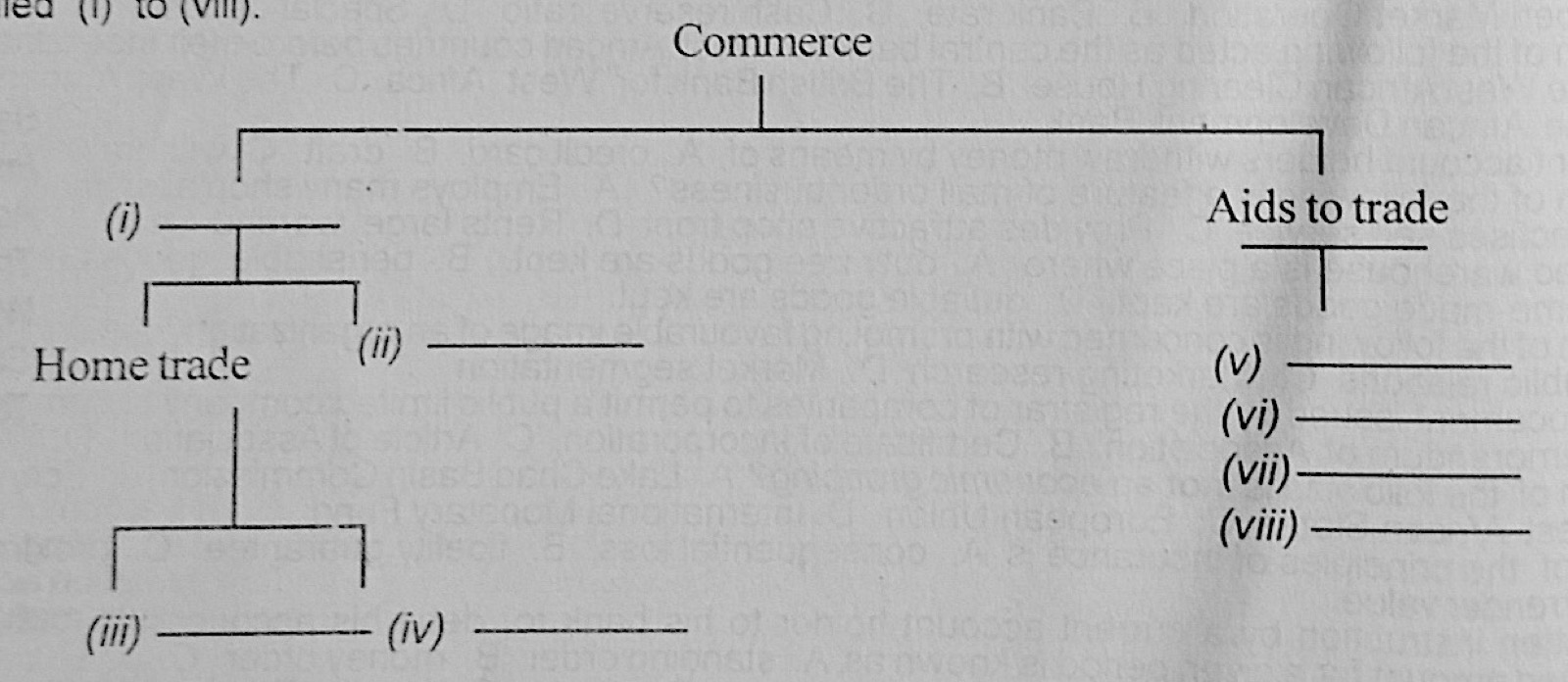
Commerce 2 (essay) (a) The chart below gives the main divisions of Commerce, complete the chart by filling in the blank spaces labelled (i) to (viii). (b) Explain the following, give one example of each: (i) Primary production; (ii) Secondary production; (iii) Tertiary production.
Show the model answer
Model answer
(a) (i) Trade; (ii) Foreign trade; (iii) Retail trade; (iv) Wholesale trade (iii and iv in either order); (v)–(viii) any four aids to trade: banking, insurance, transport, advertising, warehousing, communication, tourism. (b)(i) Primary production – extracting raw materials from land, sea or air, e.g. farming, fishing, mining. (ii) Secondary production – turning raw materials into finished goods or structures (manufacturing and construction), e.g. textile making, building. (iii) Tertiary production – providing commercial and personal services, e.g. banking, teaching, nursing.
Explanation
Commerce divides into trade (home and foreign) and aids to trade.
Commerce 2 (essay) (a) Explain the following: (i) limited liability; (ii) separate legal entity; (iii) certificate of incorporation; (iv) participating preference shares; (v) ordinary shares. (b) State five advantages of public corporation.
Show the model answer
Model answer
(a)(i) Limited liability – members can lose only the amount they invested (unpaid on shares); their private property is safe. (ii) Separate legal entity – the company exists in law apart from its owners; it can own property, sue and be sued in its own name. (iii) Certificate of incorporation – document issued by the Registrar (CAC) showing the company is registered and legally exists. (iv) Participating preference shares – preference shares that receive a fixed dividend first and also share in remaining profits after ordinary shareholders are paid. (v) Ordinary shares (equities) – shares whose holders own the company, vote, and receive variable dividends after preference shareholders; they bear the greatest risk. (b) Any five: provide essential services at low cost; create jobs; prevent private monopoly exploitation; undertake projects too big for private investors; promote even development; government revenue; protect strategic industries; improve standard of living.
Commerce 2 (essay) (a) What is channel of distribution? (b) With the aid of diagrams, show four examples of channel of distribution. (c) Explain five advantages of home trade over foreign trade.
Show the model answer
Model answer
(a) The channel of distribution is the route by which goods pass from the producer to the final consumer. (b) Any four, as arrow diagrams: Producer → Wholesaler → Retailer → Consumer; Producer → Retailer → Consumer; Producer → Consumer; Producer → Agent → Wholesaler → Retailer → Consumer; Producer → Wholesaler → Consumer. (c) Any five, explained: same currency – no foreign exchange problems; same language and culture; fewer documents and simpler procedures; shorter distances, quicker delivery and lower transport costs; no customs duties/restrictions; less risk; easier to know customers and settle disputes under the same law.
Explanation
Draw each channel with arrows from producer to consumer.
Commerce 2 (essay) (a) What is credit? (b) List and explain six principles of insurance.
Show the model answer
Model answer
(a) Credit is the receipt of goods, services or money now, with a promise to pay at a future date (usually with interest). (b) Six principles, explained: utmost good faith – disclose all material facts; insurable interest – must suffer loss if the event happens; indemnity – restored to position before the loss, no profit; contribution – insurers of the same risk share the loss; subrogation – insurer takes over the insured's rights after paying; proximate cause – the main cause of loss must be an insured risk.
Commerce 2 (essay) (a) Explain five factors affecting the choice of transport of frozen products. (b) State five disadvantages of air transport.
Show the model answer
Model answer
(a) Any five, explained: perishability – need fast transport; availability of refrigerated (cold) vehicles or containers; speed of the means; cost of transport compared with value of goods; distance; safety/reliability; quantity of goods; urgency of delivery; availability of storage at destination. (b) Any five: very expensive; unsuitable for bulky, heavy goods; limited carrying capacity; affected by bad weather; needs airports, so no door-to-door service; risk of crashes with total loss; high cost of building airports; noise/pollution.
Commerce 2 (essay) (a) Define the term market segmentation. (b) List six factors that influence market segmentation. (c) State five advantages of advertising.
Show the model answer
Model answer
(a) Market segmentation is dividing a market into groups of consumers with similar characteristics or needs, so each group can be targeted. (b) Any six: age; sex; income; geographical location; occupation; education; religion/culture; lifestyle; family size; social class. (c) Any five: creates awareness of products; increases sales; informs/educates consumers; introduces new products; helps meet competition; supports mass production and lower costs; creates jobs; builds brand loyalty.
Explanation
(b) asks for the bases on which markets are divided.
Commerce 2 (essay) (a) What is a contract? (b) List five elements of a valid contract (c) Explain four ways by which a contract may be discharged.
Show the model answer
Model answer
(a) A contract is a legally binding agreement between two or more parties. (b) Any five: offer; acceptance; consideration; capacity of the parties; intention to create legal relations; legality of object; genuine consent; certainty of terms; proper form where required. (c) Any four, explained: performance; agreement; breach; frustration; operation of law (death, bankruptcy); lapse of time.
Explanation
Name each way of discharge and explain it briefly.
Commerce 2 (essay) Explain the following documents used in international trade: (a) Indent; (b) Bill of lading; (c) Consular invoice; (d) Certificate of origin; (e) Bill of exchange.
Show the model answer
Model answer
(a) Indent – an order sent by an importer to a foreign supplier or indent agent; it may be open (agent chooses supplier) or closed (supplier named). (b) Bill of lading – issued by the shipowner; a receipt for goods shipped, evidence of the contract of carriage and a document of title. (c) Consular invoice – invoice certified by the importing country's consul in the exporting country, confirming the value of goods for customs duty. (d) Certificate of origin – document stating the country where the goods were produced, used to fix duty/preferential tariffs. (e) Bill of exchange – an unconditional written order by one person (drawer) to another (drawee) to pay a sum to a named person at a fixed or future date; used to settle foreign trade debts.
Commerce 2 (essay) (a) Differentiate between Nationalization and Indigenization. (b) State six reasons why a country would indigenize some industries.
Show the model answer
Model answer
(a) Nationalisation is government taking over ownership and control of privately owned businesses; indigenisation is transferring ownership and control of businesses from foreigners to citizens (private or public). (b) Any six: to give citizens control of the economy; to reduce foreign domination; to stop profits being sent abroad (capital flight); to create jobs and train local managers; to encourage local entrepreneurs; to promote economic independence; to raise citizens' income; to develop local technology.
Explanation
The key difference: nationalisation – to government; indigenisation – to citizens.
Commerce 2 (essay) Ade Company Limited has an authorized capital of 80,000 shares of ₦20 each, out of which 30,000 shares have been fully subscribed by the public and allotted as at 31st March 2006. Other assets and liabilities were (₦): Creditors – 35,000 Motor van – 90,000 Buildings – 65,000 Stock – 60,000 Debtors – 15,000 Cash – 5,000 You are required to calculate: (a) Issued capital; (b) Unissued capital; (c) Total Assets; (d) Working capital.
Show the model answer
Model answer
(a) Issued capital = 30,000 × ₦20 = ₦600,000. (b) Authorised capital = 80,000 × ₦20 = ₦1,600,000; unissued capital = 1,600,000 − 600,000 = ₦1,000,000 (50,000 shares × ₦20). (c) Total assets = motor van 90,000 + buildings 65,000 + stock 60,000 + debtors 15,000 + cash 5,000 = ₦235,000. (d) Current assets = 60,000 + 15,000 + 5,000 = ₦80,000; working capital = 80,000 − creditors 35,000 = ₦45,000.
Explanation
Creditors are a liability, so leave them out of total assets.