Use the following information: The following information relates to Mallam Amidu Kachella for the year ended 31/12/2005 (₦): Opening stock 4,000; Purchases 16,000; Sales 30,000; Debtors 6,500; Creditors 4,200; Cash in hand 800; Closing stock 5,600; Bank overdraft 3,000. The average stock is
Use the following information: The following information relates to Mallam Amidu Kachella for the year ended 31/12/2005 (₦): Opening stock 4,000; Purchases 16,000; Sales 30,000; Debtors 6,500; Creditors 4,200; Cash in hand 800; Closing stock 5,600; Bank overdraft 3,000. The current liability is
A.₦1,200
B.₦3,000
C.₦4,200
D.₦7,200
Show the answer and explanation
Answer: D (₦7,200)
Explanation
Current liabilities = creditors 4,200 + bank overdraft 3,000 = ₦7,200.
Use the following information: The following information relates to Mallam Amidu Kachella for the year ended 31/12/2005 (₦): Opening stock 4,000; Purchases 16,000; Sales 30,000; Debtors 6,500; Creditors 4,200; Cash in hand 800; Closing stock 5,600; Bank overdraft 3,000. The cost of goods sold is
A.₦10,000
B.₦14,400
C.₦15,600
D.₦20,200
Show the answer and explanation
Answer: B (₦14,400)
Explanation
Cost of goods sold = 4,000 + 16,000 − 5,600 = ₦14,400.
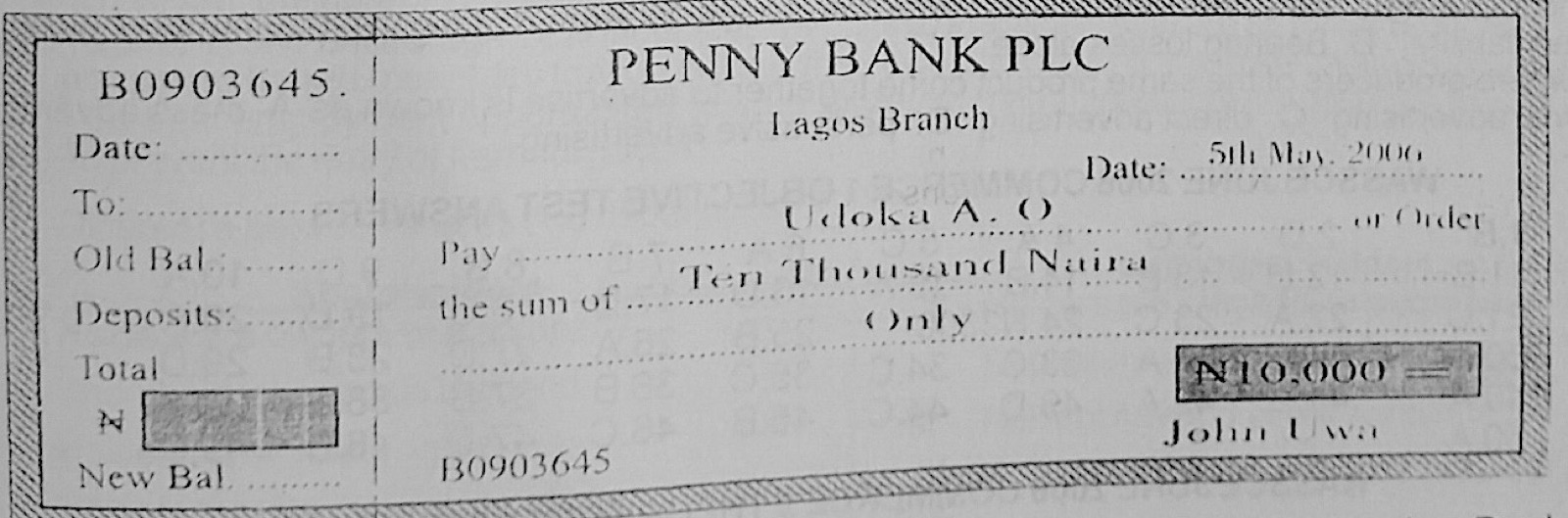
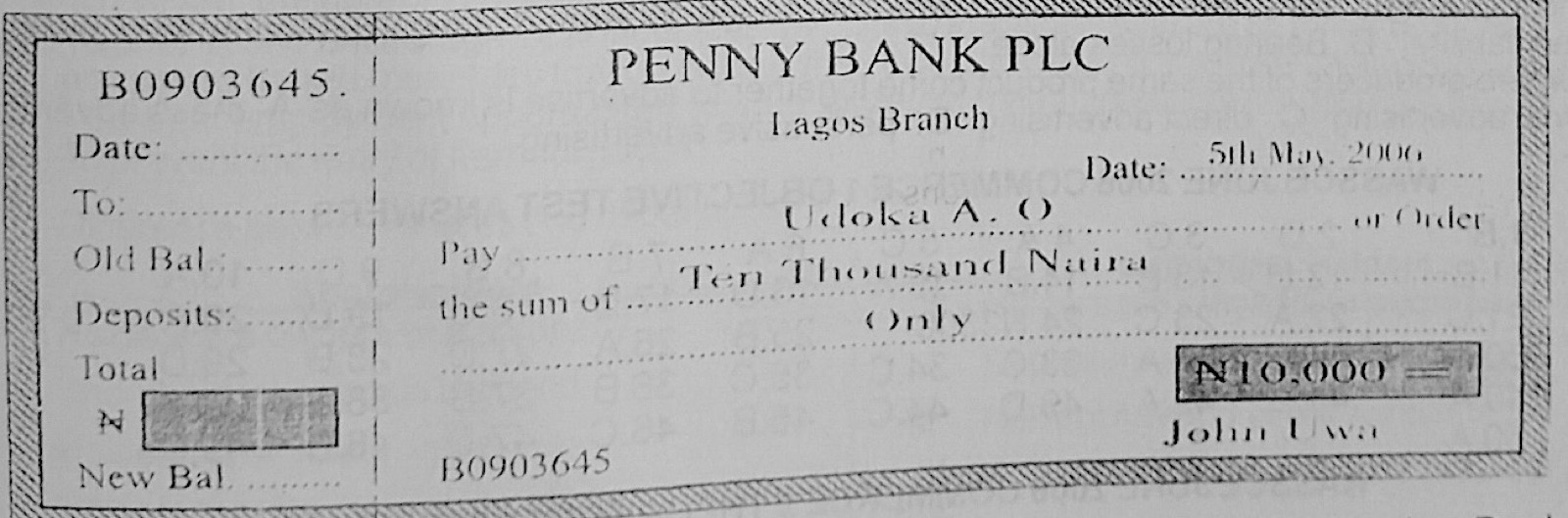
Use the diagram (a Penny Bank PLC, Lagos Branch cheque dated 5th May 2006: 'Pay Udoka A. O. or Order the sum of Ten Thousand Naira Only', ₦10,000, signed John Uwa) to answer the question. The above document is
A.foreign bill of exchange
B.promissory note
C.money order
D.cheque
Show the answer and explanation
Answer: D (cheque)
Explanation
It is a written order on a bank to pay a named person: a cheque.
Use the diagram (a Penny Bank PLC, Lagos Branch cheque dated 5th May 2006: 'Pay Udoka A. O. or Order the sum of Ten Thousand Naira Only', ₦10,000, signed John Uwa) to answer the question. Penny Bank Plc is the
A.drawee
B.payee
C.drawer
D.endorser
Show the answer and explanation
Answer: A (drawee)
Explanation
The bank on which the cheque is drawn is the drawee.
Commerce 2 (essay) (a) What is foreign trade? (b) Explain four ways by which foreign trade is different from home trade. (c) State five reasons why countries restrict foreign trade.
Show the model answer
Model answer
(a) Foreign trade is the buying and selling of goods and services between countries. (b) Any four, explained: different currencies are used; language differences; more complex documents; different laws, customs and weights and measures; higher transport costs and greater distance; goods face customs duties and restrictions; greater risks in transit. (c) Any five: protect infant industries; prevent dumping; raise revenue; correct balance of payments deficits; conserve foreign exchange; prevent importation of harmful goods; create jobs at home; retaliation; political/strategic reasons.
Commerce 2 (essay) (a) State three differences between: (i) Shareholders and debenture holders. (ii) Ordinary shares and Preference shares. (b) Explain four reasons for winding up a public limited company.
Show the model answer
Model answer
(a)(i) Any three: shareholders are owners, debenture holders are creditors; shareholders get dividends, debenture holders get fixed interest; shareholders vote, debenture holders do not; debenture interest is paid before dividends and whether or not there is profit; debentures are usually secured and repaid on winding up before shareholders. (ii) Any three: ordinary shares earn variable dividends, preference shares a fixed rate; preference shares are paid dividends (and capital on winding up) first; ordinary shareholders vote, preference shareholders usually do not; ordinary shares carry the greatest risk; preference shares may be cumulative or redeemable. (b) Any four, explained: members pass a special resolution to wind up; insolvency – inability to pay debts; court order on a creditor's petition; objects achieved or becomes illegal; fraud or illegal operations; members fall below the legal minimum; failure to start business within a year of incorporation; continued losses.
Explanation
Owners versus creditors is the key difference in (a)(i).
Commerce 2 (essay) (a) What is non-indemnity insurance? (b) List and explain three types of life assurance policies. (c) Explain the term surrender value.
Show the model answer
Model answer
(a) Non-indemnity insurance is insurance where the loss cannot be measured in money, such as life or personal accident, so an agreed sum is paid rather than restoring an actual loss. (b) Any three, explained: whole life assurance – pays the sum assured only on death, whenever it occurs; endowment policy – pays on a fixed date or on earlier death; term assurance – pays only if death occurs within a stated period; group life – covers a group of employees under one policy. (c) Surrender value is the amount the insurer pays the assured if he discontinues (cashes in) a life policy before it matures.
Explanation
Life assurance is the main example of non-indemnity insurance.
Commerce 2 (essay) (a) Who is a common carrier? (b) State three functions of each of the following communication agents: (i) Post Office; (ii) Telecommunication; (iii) Courier companies
Show the model answer
Model answer
(a) A common carrier is a person or firm that carries goods or passengers for anyone who pays the fee, e.g. transport companies and railways. (b)(i) Post Office (any three): carries letters and parcels; registered and recorded delivery; sells stamps, postal and money orders; post office boxes; poste restante; express mail. (ii) Telecommunication (any three): telephone and mobile services; internet and e-mail; SMS/text messaging; fax/telex; video conferencing; mobile money. (iii) Courier companies (any three): fast door-to-door delivery; collection of parcels and documents; tracking of items; local and international delivery; proof of delivery.
Commerce 2 (essay) (a) Explain seven functions of a commercial bank. (b) Explain three types of accounts that are operated in a commercial bank.
Show the model answer
Model answer
(a) Any seven, explained: accepts deposits; grants loans and overdrafts; provides means of payment (cheques, transfers, cards); safe custody of valuables; foreign exchange services; discounting bills; financial advice; agency services (paying bills, buying shares); executor/trustee services; electronic banking; issues bank drafts and letters of credit. (b) Current account – for businesses; cheques used; no or little interest; overdraft possible. Savings account – for small savers; earns interest; withdrawals by withdrawal slip/ATM. Fixed (time) deposit account – money kept for a fixed period; higher interest; notice needed for early withdrawal.
Commerce 2 (essay) (a) Define marketing mix. (b) Explain the term Marketing Concept. (c) List and describe the four elements of marketing mix.
Show the model answer
Model answer
(a) The marketing mix is the combination of product, price, place and promotion decisions a firm uses to satisfy its target market. (b) The marketing concept is the idea that a firm should first find out what customers want and then produce and deliver it to satisfy them better than competitors, at a profit; the customer is king. (c) Product – the good or service, its quality, design, brand and packaging; Price – the amount charged, discounts and terms; Place – distribution channels and locations through which goods reach customers; Promotion – advertising, personal selling, sales promotion and publicity used to inform and persuade customers.
Commerce 2 (essay) (a) List four types each of: (i) small scale retailers; (ii) large scale retailers; (b) Explain four reasons why small scale retailers survive despite the dominance of large scale retail outlets.
Show the model answer
Model answer
(a)(i) Any four: hawkers/itinerant traders; market traders/stall holders; kiosks; mobile shops; roadside traders; tied shops; unit shops. (ii) Any four: department stores; supermarkets/hypermarkets; chain (multiple) stores; mail order firms; co-operative retail societies; discount stores. (b) Any four, explained: personal attention to customers; sell on credit to known customers; sell in very small quantities; convenient location close to homes; long, flexible opening hours; low capital needed and low costs; customers can bargain; deliver to customers' homes.
Explanation
Survival reasons are mainly about personal service and convenience.
Commerce 2 (essay) (a) State five functions of a chamber of commerce. (b) Explain five functions of a trade association.
Show the model answer
Model answer
(a) Any five: promotes trade and industry in its area; organises trade fairs and exhibitions; gives business information to members; represents members' views to government; settles disputes among members; issues certificates of origin; promotes international trade links; publishes journals. (b) Any five, explained: protects members' interests; fixes standards and quality of products; researches and shares technical information; trains members; represents the trade before government; settles disputes; may fix common prices/discourage unfair competition; advertises the industry's products collectively.
Explanation
A chamber covers many trades in an area; a trade association covers one trade.
Commerce 2 (essay) (a) State one use of each of the following: (i) letter of enquiry; (ii) invoice; (iii) advice note; (iv) credit note; (v) statement of account; (vi) debit note. (b) Identify two advantages and two disadvantages of automatic vending.
Show the model answer
Model answer
(a)(i) Letter of enquiry – sent by a buyer to ask about prices, terms and availability of goods. (ii) Invoice – the seller's bill telling the buyer the goods supplied and the amount owed. (iii) Advice note – tells the buyer that goods have been despatched. (iv) Credit note – reduces the amount the buyer owes, e.g. for returned goods or overcharge. (v) Statement of account – summary of transactions for a period showing the balance the buyer owes. (vi) Debit note – increases the amount owed when the buyer was undercharged. (b) Advantages (any two): sells 24 hours; saves labour cost; convenient and quick; no shoplifting by assistants. Disadvantages (any two): limited range of goods; machines break down/need power; vandalism and theft; costly to buy and maintain; no personal service.