Question 1
National ValuesA prerequisite for orderliness is
- A.humility
- B.morality
- C.hardwork
- D.politeness
Show the answer and explanation
Answer: B (morality)
Explanation
Orderly behaviour comes from a sense of right and wrong, that is, morality.
57 questions. Try each one, then open the answer to check yourself and read the explanation.
A prerequisite for orderliness is
Answer: B (morality)
Orderly behaviour comes from a sense of right and wrong, that is, morality.
National symbols are also referred to as symbols of national
Answer: B (identity)
National symbols (flag, anthem, coat of arms) identify the nation.
Law of libel and defamation of character violates right to freedom of
Answer: C (expression)
Libel laws limit what a person may say or publish about others, a limit on freedom of expression.
Who among the following is not a foremost Nigerian nationalist?
Answer: C (General Yakubu Gowon)
Gowon was a military head of state (1966-75), not one of the nationalists who fought for independence.
The major reason for the enactment of traffic regulations is to
Answer: C (ensure safety and allow easy flow of traffic)
Traffic rules exist mainly to keep road users safe and traffic moving smoothly.
The basic responsibility of parents is
Answer: A (providing necessities of life for the children)
Parents must first provide food, shelter, clothing, health care and education.
The attitude that prevents peaceful resolution of inter-communal conflict is
Answer: B (resentment)
Resentment (bitterness) keeps conflict alive; the others are ways of resolving it.
The zeal shown by the youths of Upe village is a manifestation of
Answer: A (community service)
They give their time freely to build projects for their community: community service.
The youths who took part in the various building projects in Upe village are said to be
Answer: D (selfless)
They worked for the good of the whole village without pay: selflessness.
Which of the following sets of agencies are responsible for checking road worthiness of vehicles?
Answer: A (The Federal Road Safety Corps and Vehicle Inspection Office)
The FRSC and the VIO check vehicles for roadworthiness.
Which of the following may not be vested with a constituted authority?
Answer: B (A mob)
A mob has no lawful authority.
An individual who finds it difficult to do without in-take of prohibited substances is
Answer: C (a drug addict)
Dependence on prohibited drugs is drug addiction.
Which of the following is not a method of recruiting victims for human trafficking?
Answer: C (Application)
Traffickers use deceit, threats and abduction, not formal applications.
The law protecting certain individuals from being prosecuted is called
Answer: C (immunity clause)
Section 308 of the 1999 Constitution (the immunity clause) shields the President, Vice-President, Governors and Deputy Governors from prosecution while in office.
We can conclude that the mother of the boy putting on a face cap in the cartoon in Fig. 1 is a
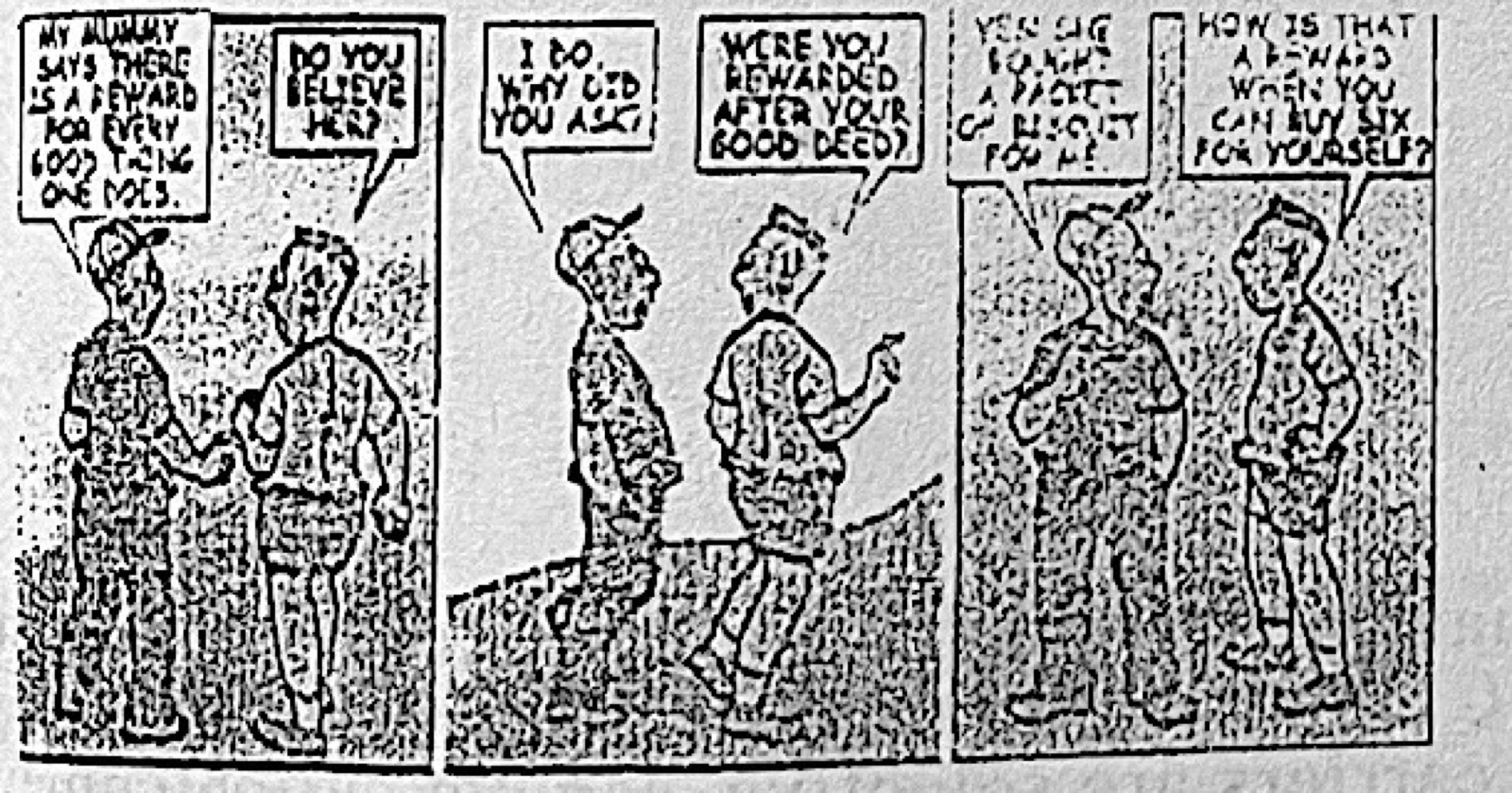
Answer: B (responsible parent)
She teaches her son that good deeds are rewarded, showing responsible parenting.
The effect of the interaction as captured in the cartoon in Fig 1 in relation to Civic Education is
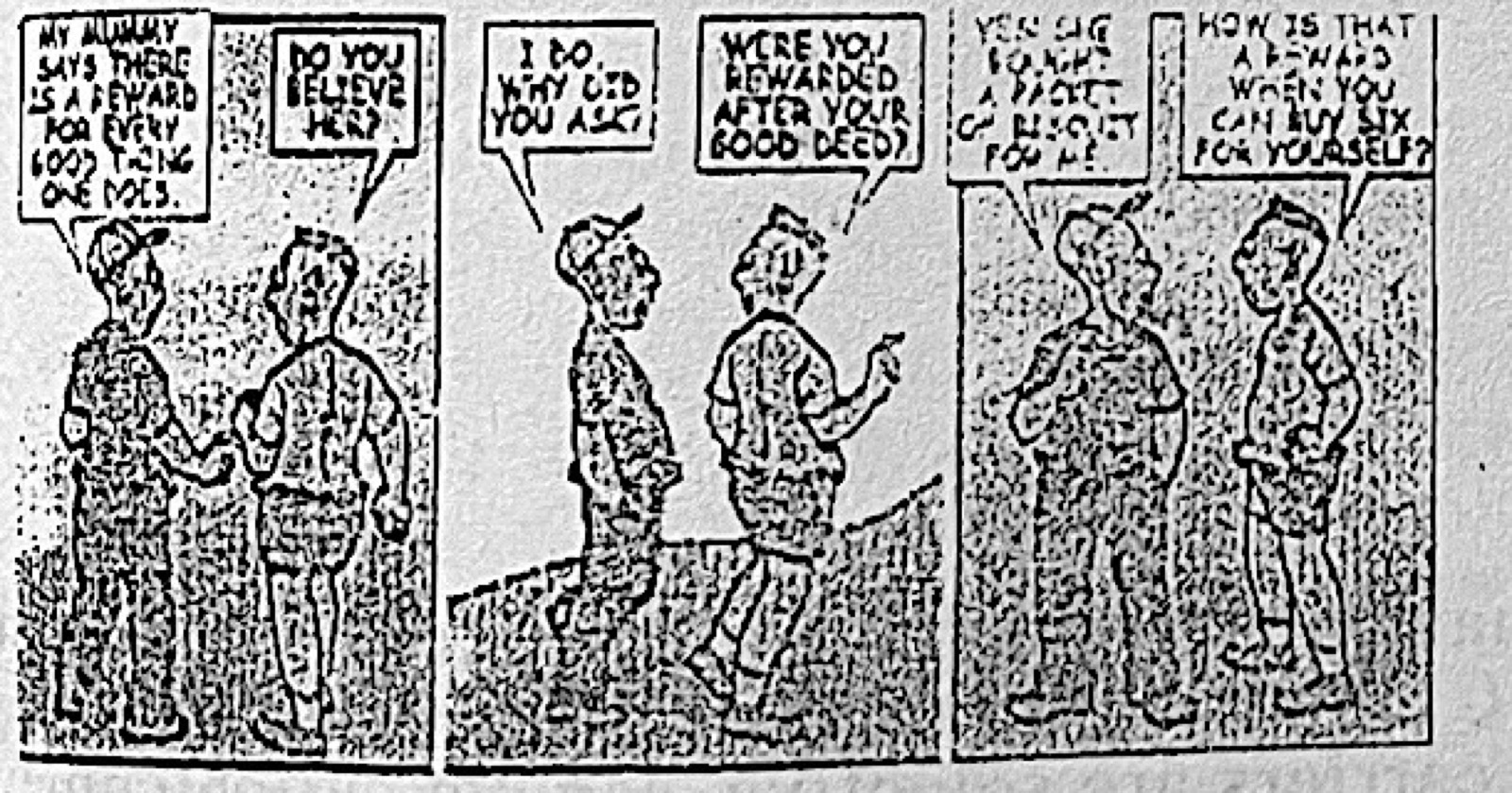
Answer: C (Peer pressure)
The other boy mocks the good deed and tries to change his friend's attitude: peer pressure.
We can make inference from the response of the boy wearing short pants in the cartoon in Fig. 1 that he
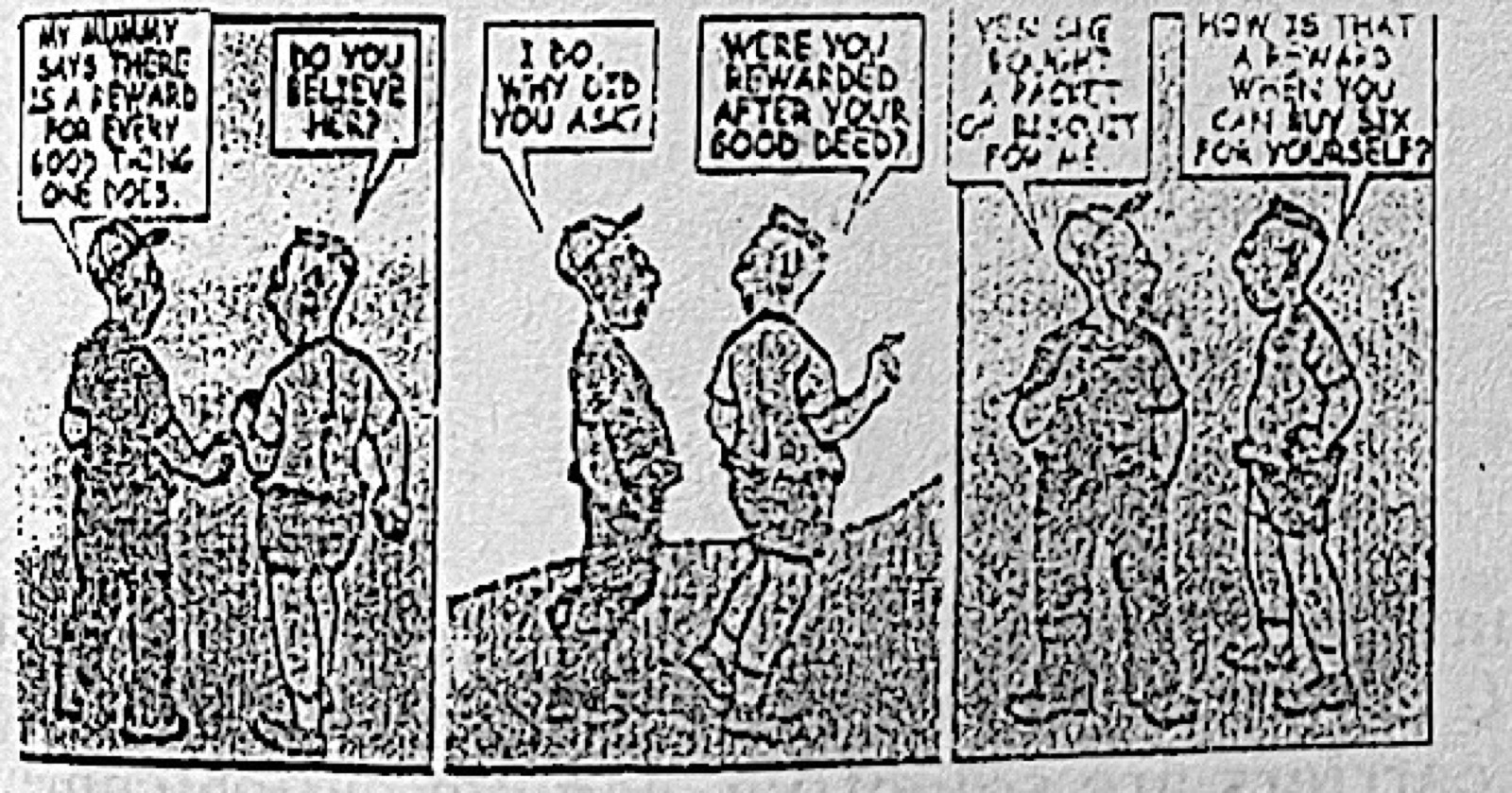
Answer: D (lacks moral care of a responsible parent)
He sees no value in doing good unless the reward is large, which suggests he has not been given moral guidance at home.
Which of the following is not an advisable way through which the orientation of the boy wearing short pants in the cartoon in Fig. 1 can be corrected?
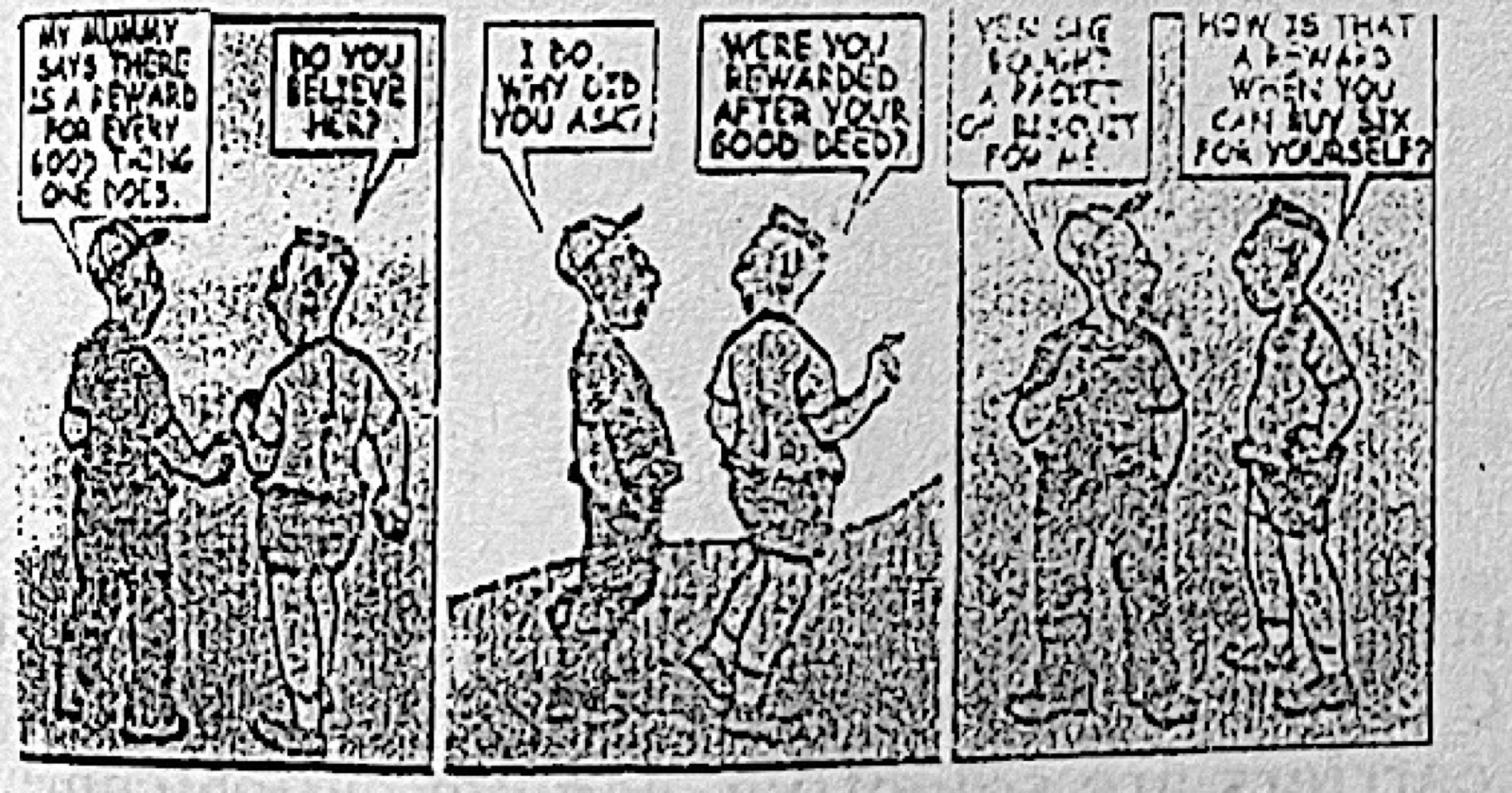
Answer: A (Subjecting him to harsh punitive measures)
Wrong attitudes are corrected by education, good parenting and counselling, not harsh punishment.
Limitation to the right to life can be found in the case of
Answer: C (a condemned person)
Section 33 of the 1999 Constitution allows life to be taken in execution of a lawful death sentence.
Interest and willingness to participate in the affairs of a nation are forms of
Answer: A (popular participation)
Taking an active part in national affairs is popular participation.
The societal norms that represents the overall attitude of the people in a society is called
Answer: B (general values)
Values shared by society as a whole are general (societal) values.
Read the quotation: "My stiffest earthly assignment is ended and major life's work is done. My country is now free..." (Dr Nnamdi Azikiwe)
The speaker quoted above must have fought hard for national
Answer: D (independence)
'My country is now free' refers to independence.
Irresponsible parenting has the tendency of
Answer: A (encouraging egoistic tendencies)
Children who lack guidance tend to become selfish.
Which of the following is a cause of political apathy in Nigeria?
Answer: C (Biased electoral umpires)
When electoral officials are biased, people feel their votes do not count.
Representation of Nigerians in the senate is
Answer: C (equal)
Each state has three senators regardless of population (the FCT has one).
Identify the odd one from the list below in relation to citizenship obligations.
Answer: B (Right to personal liberty)
Personal liberty is a right, not an obligation.
According to the 1999 constitution as amended, sovereignty belongs to the
Answer: B (people from whom government derives its power and authority)
Section 14(2)(a): sovereignty belongs to the people of Nigeria.
Article 1 of the Universal Declaration of Human Rights (UDHR) states that all human beings
Answer: B (are born free and equal)
Article 1: 'All human beings are born free and equal in dignity and rights.'
Read the quotation: "If you cannot beat them, join them".
The statement is an indication of a society that is
Answer: B (morally degenerated)
Joining wrongdoers because one cannot stop them shows values have collapsed: moral degeneration.
Read the quotation: "If you cannot beat them, join them".
Through which of the following means can the effect of the above quotation on the society be rectified?
Answer: C (Reorientation of values)
Moral decay is corrected by reorienting people's values.
Interpersonal relationship is promoted through the following ways except
Answer: A (confrontation)
Confrontation breeds conflict, not good relationships.
An activity meant to promote and protect the interest of a country is
Answer: D (nationalism)
Nationalism is devotion to the interests of one's nation.
Democracy is important because it
Answer: A (accommodates popular participation)
Democracy allows citizens to take part in government.
Which of the following criminal act is most commonly perpetrated by cult members?
Answer: D (Violence)
Cultism is marked above all by violence.
From the above dialogue, noticeable symptoms Tim must have observed about Jim include the following except
Answer: C (increase in appetite)
HIV/AIDS causes loss of appetite and weight, not an increase.
Individuals like Jim in the story above who believe HIV carriers are selective, can get enlightenment through
Answer: C (sex and civic education)
Sex and civic education teaches how HIV is spread and that anyone can be infected.
Which of the following is not a function of the judicial arm of government?
Answer: D (Initiation of bills)
Bills are initiated by the executive and legislature.
The officials of the administrative agency of the state that are most active in governance belongs to the
Answer: C (executive organ)
Administrative agencies and their officials are part of the executive.
One major reason some Nigerian youths join cult groups is
Answer: C (inadequate support from guardians and parents)
Youths without parental care and guidance seek belonging and protection in cults.
All the following are aims of youths empowerment scheme except
Answer: C (maximization of profit)
Youth empowerment aims at self-reliance and reducing delinquency, not profit maximisation.
A situation where only 35% of over 80 million registered voters participated in a general election, is an indication of political
Answer: C (apathy)
Low turnout shows political apathy.
The organizations working against dictatorship and mounting of campaigns for effective civil rule are called
Answer: D (civil societies)
Civil society groups such as NADECO and the Campaign for Democracy fought military dictatorship.
In a democratic government structure, the portion marked x in the diagram in Fig. 2 is occupied by the
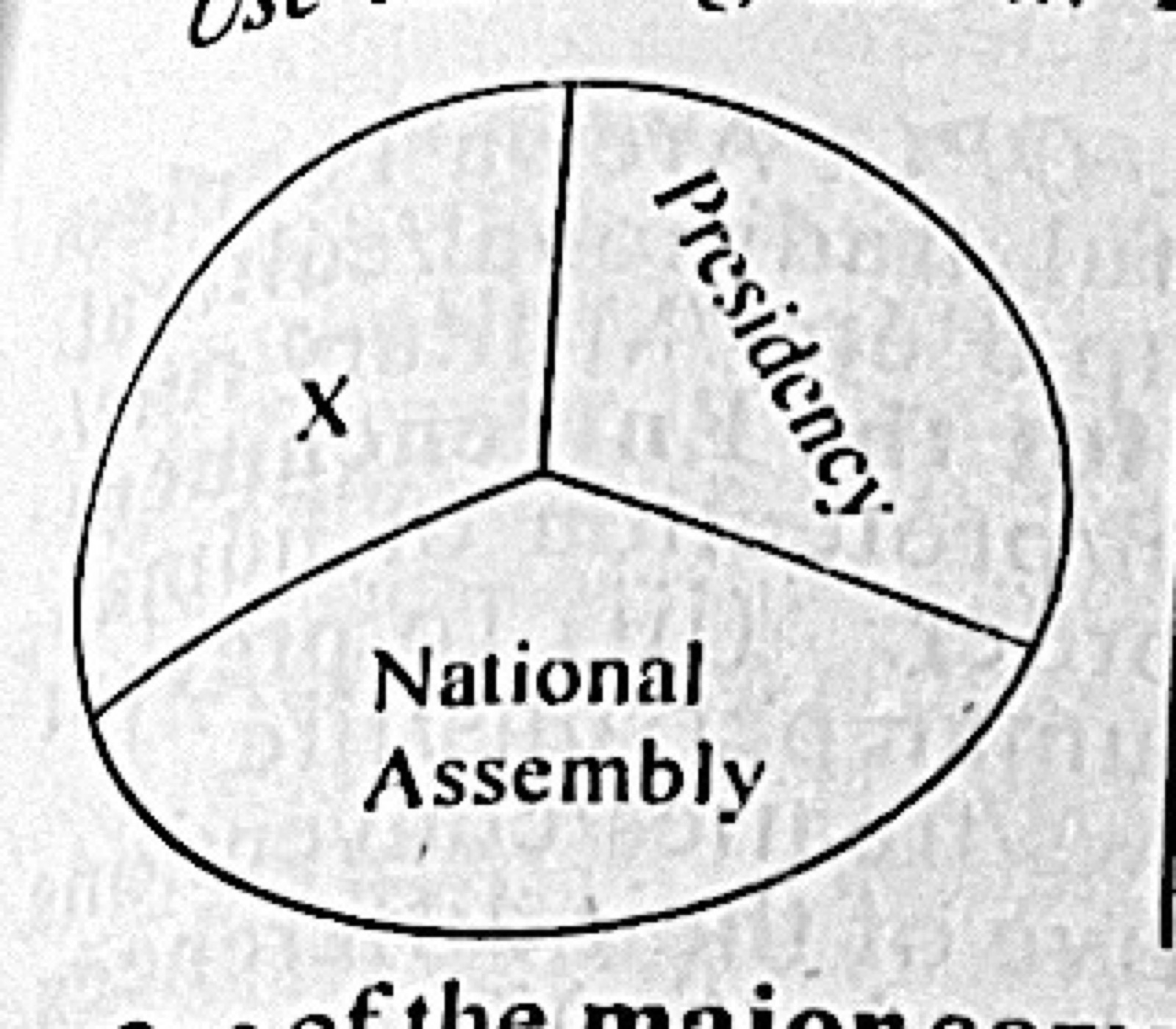
Answer: B (judiciary)
The three arms are the presidency (executive), National Assembly (legislature) and the judiciary.
The major function of the activity of the occupiers of the portion marked x in the diagram Fig. 2 is to
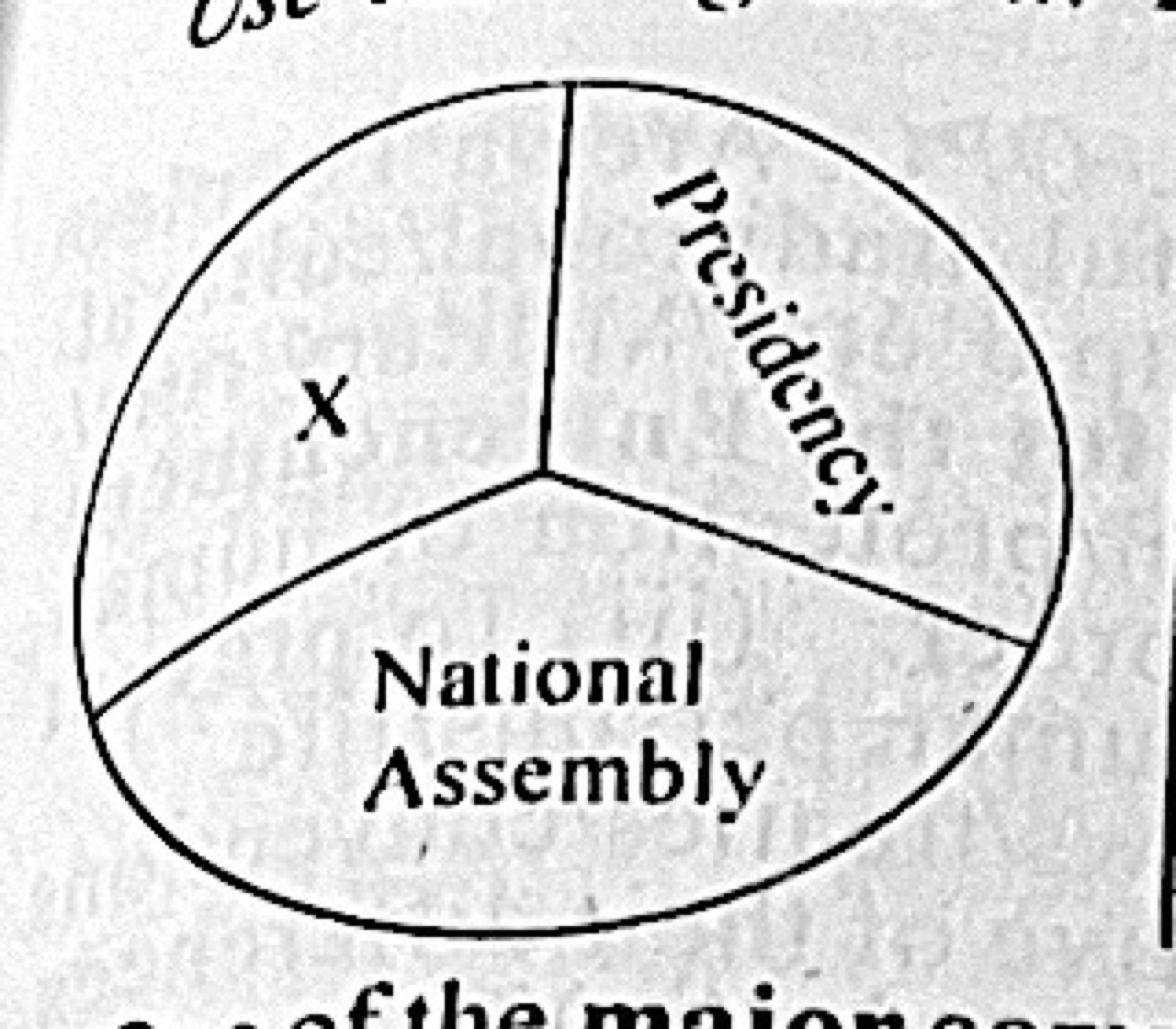
Answer: A (interpret laws)
The judiciary interprets laws.
Which of the following is not a problem of civil society?
Answer: C (Planning to capture political power)
Civil society groups do not seek to capture power (that is what parties do); the others are real problems they face.
From which of the following sources are constitutional provisions not derived?
Answer: D (Story books)
Constitutions draw on statutes, customs and judicial decisions, not story books.
The head of the judicial arm of government in Nigeria is the
Answer: A (Chief Justice)
The Chief Justice of Nigeria heads the judiciary.
The composition of National Assembly of the Federal Republic of Nigeria could be termed
Answer: C (bicameral)
It has two chambers: Senate and House of Representatives.
Section A: National Ethics, Discipline, Rights and Obligations
(a) Define human rights.
(b) Suggest four conditions under which human rights can be violated in Nigeria.
(c) Explain three reasons for which it is necessary to entrench citizens' rights in the Nigerian constitution.
(a) Human rights are the basic rights and freedoms every person is entitled to simply because he or she is a human being, e.g. right to life, dignity, fair hearing; in Nigeria they are entrenched in Chapter IV of the 1999 Constitution.
(b) Any four: declaration of a state of emergency; war; military rule; imposition of curfew; conviction by a court (imprisonment, death sentence); outbreak of contagious disease (quarantine); compulsory acquisition of land for public use; abuse by security agents; a weak or compromised judiciary.
(c) Any three, explained:
Makes the rights supreme and difficult to remove (rigid amendment process).
Gives citizens a legal basis to go to court to enforce them.
Limits government power and prevents tyranny.
Gives citizens confidence and promotes democracy.
Meets international standards (UDHR, African Charter).
Three parts; marks split.
Section A: National Ethics, Discipline, Rights and Obligations
(a) Identify five qualities an individual must possess to be qualified as a responsible parent.
(b) In what five ways do the roles of responsible parenting contribute to the upbringing of good citizens in the society?
(a) Any five: love and care; self-discipline and good character (role model); patience and tolerance; a steady source of income/hard work; good communication; fairness; sense of responsibility; knowledge/education.
(b) Any five:
Teaching moral and religious values.
Giving children education.
Instilling discipline and respect for authority.
Teaching them their rights and duties.
Guiding them against bad company and vices.
Training them to be hardworking and self-reliant.
Setting good examples.
Qualities in (a); contributions in (b).
Section A: National Ethics, Discipline, Rights and Obligations
(a) Identify five reasons for which it has become increasingly difficult to maintin low rate of accidents on Nigerian roads.
(b) Highlight five measures adopted by the Nigerian government to reduce the rate of accidents on Nigeria roads.
(a) Any five: bad roads/potholes; poorly maintained, old vehicles; reckless driving and speeding; drunk driving and drug use; disobedience to traffic rules; corruption of traffic officials; unqualified drivers with fake licences; overloading; lack of road signs and lights; poor enforcement.
(b) Any five: establishment of FRSC (1988) and VIO; speed limiters in commercial vehicles; driver's licence tests and new number plates; road safety campaigns; road construction and repair; penalties for traffic offences; mandatory seat belts and crash helmets; emergency rescue services.
Five reasons, five government measures.
Section B: Emerging Issues in the Society
(a) Outline five negative consequences of cultism on its members in the society.
(b) In what five ways can responsible parenting assist in reducing high rate of cultism in the society?
(a) Any five: untimely death; injury and disability; expulsion or rustication; imprisonment; stigmatisation; poor academic performance; psychological trauma and fear; bad family image.
(b) Any five: good moral and religious upbringing; monitoring children's friends and activities; providing their needs so they are not lured; open communication; warning them of the dangers of cultism; being good role models; co-operating with schools.
Consequences for members in (a).
Section B: Emerging Issues in the Society
(a) Outline five reasons for which those who tested positive to HIV/AIDS are being discriminated against in the society.
(b) In what five ways does the contraction of HIV/AIDS impact on the socio-economic life of the victim?
(a) Any five: ignorance about how HIV spreads; fear of infection; belief it is a punishment for immorality; belief it is incurable/a death sentence; religious and cultural beliefs; misinformation; association with prostitution and drug abuse.
(b) Any five: loss of job and income; high medical costs and poverty; stigma and isolation; reduced productivity; school drop-out; family breakdown; depression; early death leaving dependants.
Reasons for stigma in (a); effects on the victim in (b).
Section B: Emerging Issues in the Society
(a) Highlight five major empowerment skills that youths require for self-reliance in Nigerian society?
(b) State five reasons for the establishment of the National Youth Service Corps (NYSC) in Nigeria.
(a) Any five: ICT/computer skills; tailoring; agriculture; carpentry; welding; hairdressing/barbing; catering; auto repairs; electrical installation; entrepreneurship and business management.
(b) NYSC (1973), any five: promote national unity and integration after the civil war; encourage inter-ethnic understanding; develop patriotism and service; expose graduates to other parts of the country; provide manpower for rural and national development; encourage self-reliance and skills (SAED); remove ethnic and religious prejudice.
Skills in (a); NYSC objectives in (b).
Section C: Governmental System and Processes
(a) Define political party as a pillar of democracy.
(b) Highlight six ways of enhancing the credibility of democratic elections in Nigeria.
(a) A political party is an organised group of people with similar ideas who seek to win elections and control government in order to carry out their programmes; parties give voters choices and provide government and opposition, so democracy rests on them.
(b) Any six: independent, well-funded INEC; electronic accreditation and result transmission (e.g. BVAS/IReV, used from 2021-22); security for voters and materials; punishing electoral offenders; voter education; internal democracy in parties; neutral security agents; independent judiciary for election petitions; accurate voters' register; election monitoring by observers.
Define with link to democracy; six ways.
Section C: Governmental System and Processes
Explain any five of the following forms of civic society: (a) Pro-democracy groups; (b) Labour groups; (c) Professional groups; (d) Religious groups; (e) Student groups; (f) Gender based groups; (g) Human rights groups.
Any five explained:
(a) Pro-democracy groups: fight for democratic rule and credible elections, e.g. Campaign for Democracy, NADECO, Transition Monitoring Group.
(b) Labour groups: trade unions that protect workers' welfare, e.g. NLC, TUC.
(c) Professional groups: associations of members of a profession that set standards and protect members, e.g. NBA, NMA.
(d) Religious groups: faith bodies that promote moral values and speak on public issues, e.g. CAN, JNI.
(e) Student groups: unions that protect students' interests, e.g. NANS.
(f) Gender based groups: promote the rights and participation of women, e.g. NCWS, WIN.
(g) Human rights groups: defend and monitor human rights, e.g. CLO, Amnesty International.
Define each with an example.
Section C: Governmental System and Processes
Enumerate five reasons for which the public service sector in Nigeria has not been proficient.
Any five:
Corruption.
Political interference.
Recruitment and promotion by nepotism, not merit.
Poor pay and welfare.
Inadequate training.
Poor working tools and infrastructure.
Red tape and bureaucracy.
Overstaffing and lack of discipline.
Five reasons.