50 questions. Try each one, then open the answer to check yourself and read the explanation.
Question 1
Animal Kingdom
Which of the following groups of animals do not possess a nervous system?
A.Porifera
B.Cnidaria
C.Platyhelminthes
D.Nematoda
Show the answer and explanation
Answer: A (Porifera)
Explanation
Sponges (Porifera) are the simplest animals: their cells are loosely organised and they have no nerve cells. Cnidarians have a nerve net, and flatworms and roundworms have nerve cords.
The structural similarities in Paramecium and Euglena are in the
A.shape of locomotory organs.
B.blunt anterior and pointed posterior.
C.presence of micro and mega nuclei in both.
D.presence of anterior and posterior contractile vacuoles.
Show the answer and explanation
Answer: B (blunt anterior and pointed posterior.)
Explanation
Both organisms have a rounded (blunt) front end and a narrower, pointed back end. Paramecium moves with cilia but Euglena with a flagellum, and only Paramecium has two kinds of nuclei.
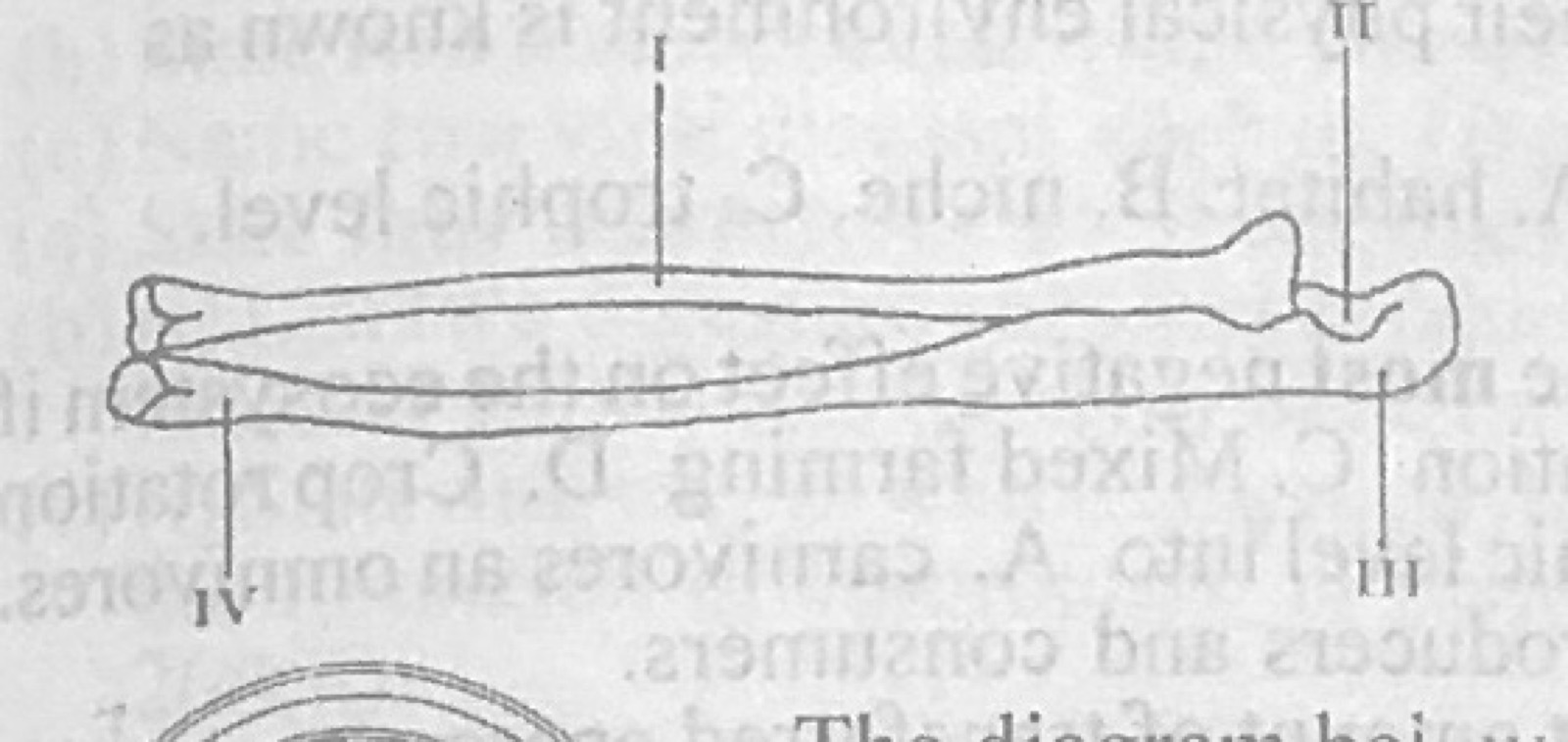
The diagram below illustrates a part of the human skeleton. Which of the labelled parts articulates with the head of the trochlea to form a hinge joint?
A.I
B.II
C.III
D.IV
Show the answer and explanation
Answer: B (II)
Explanation
The notch at the elbow end of the ulna (part II) fits round the trochlea of the humerus, forming the hinge joint of the elbow.
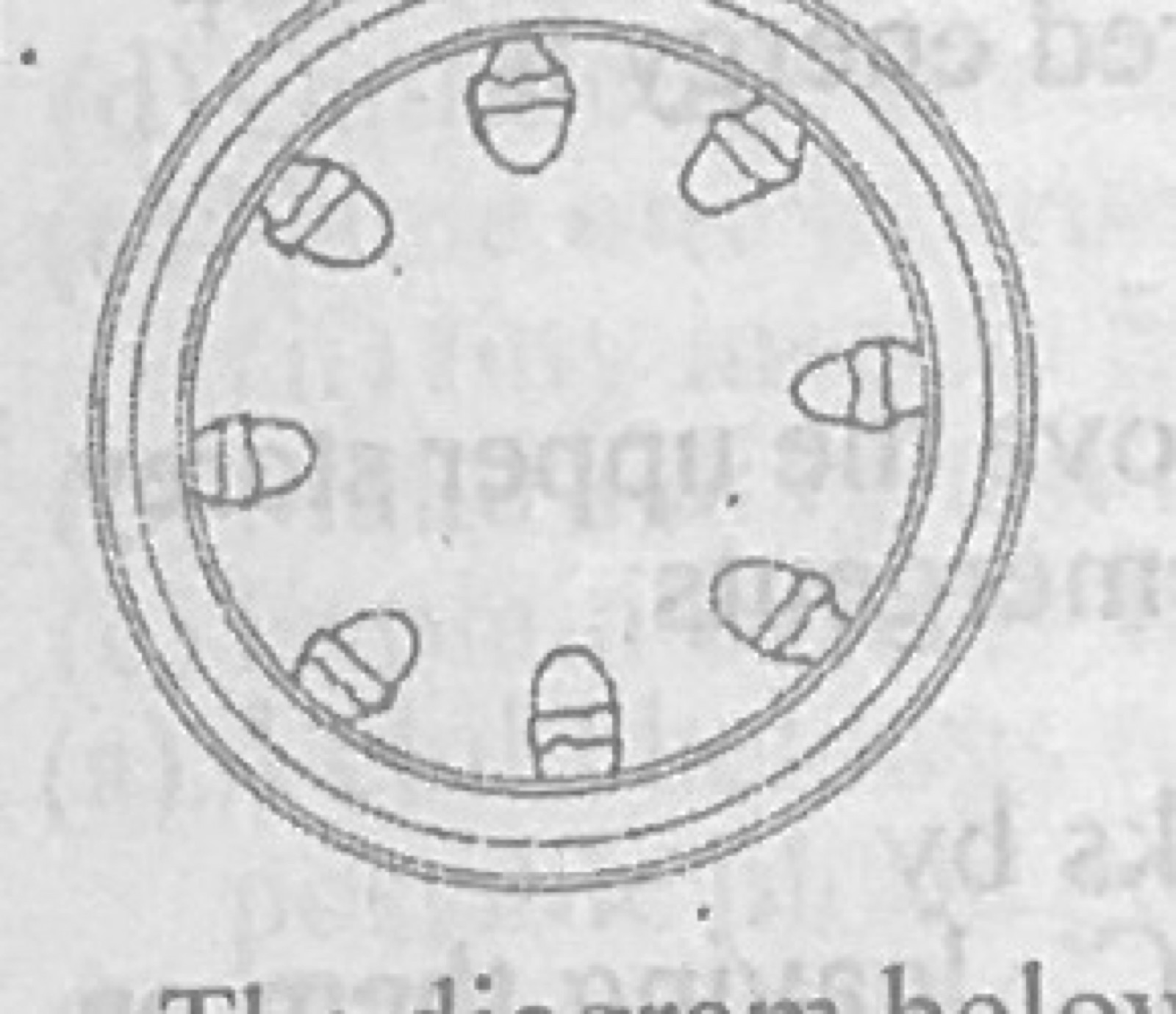
The diagram below illustrates the transverse section of a
A.dicotyledonous root.
B.monocotyledonous root.
C.dicotyledonous stem.
D.monocotyledonous stem.
Show the answer and explanation
Answer: C (dicotyledonous stem.)
Explanation
The vascular bundles are arranged in a single ring near the edge, which is the pattern in a dicot stem. Monocot stems have scattered bundles and roots have xylem in the centre.
Which of the following actions does not occur during exhalation in man?
A.Thoracic cavity decreases in volume
B.Diaphragm flattens
C.Ribs move down and in
D.Air pressure increases in the thoracic cavity
Show the answer and explanation
Answer: B (Diaphragm flattens)
Explanation
When we breathe out, the diaphragm relaxes and curves upwards, the ribs move down and in, the chest volume falls and the pressure inside rises, pushing air out. The diaphragm flattens only when we breathe in.
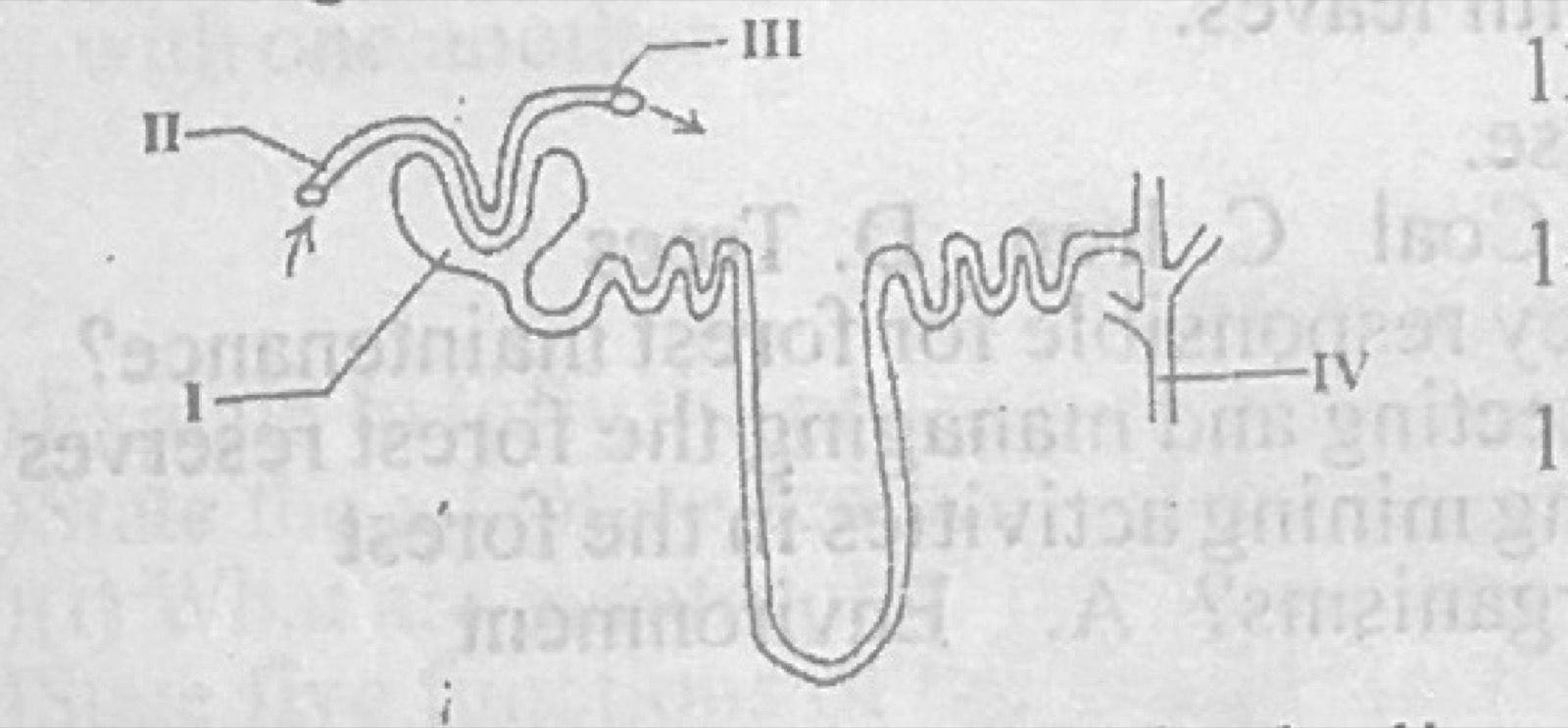
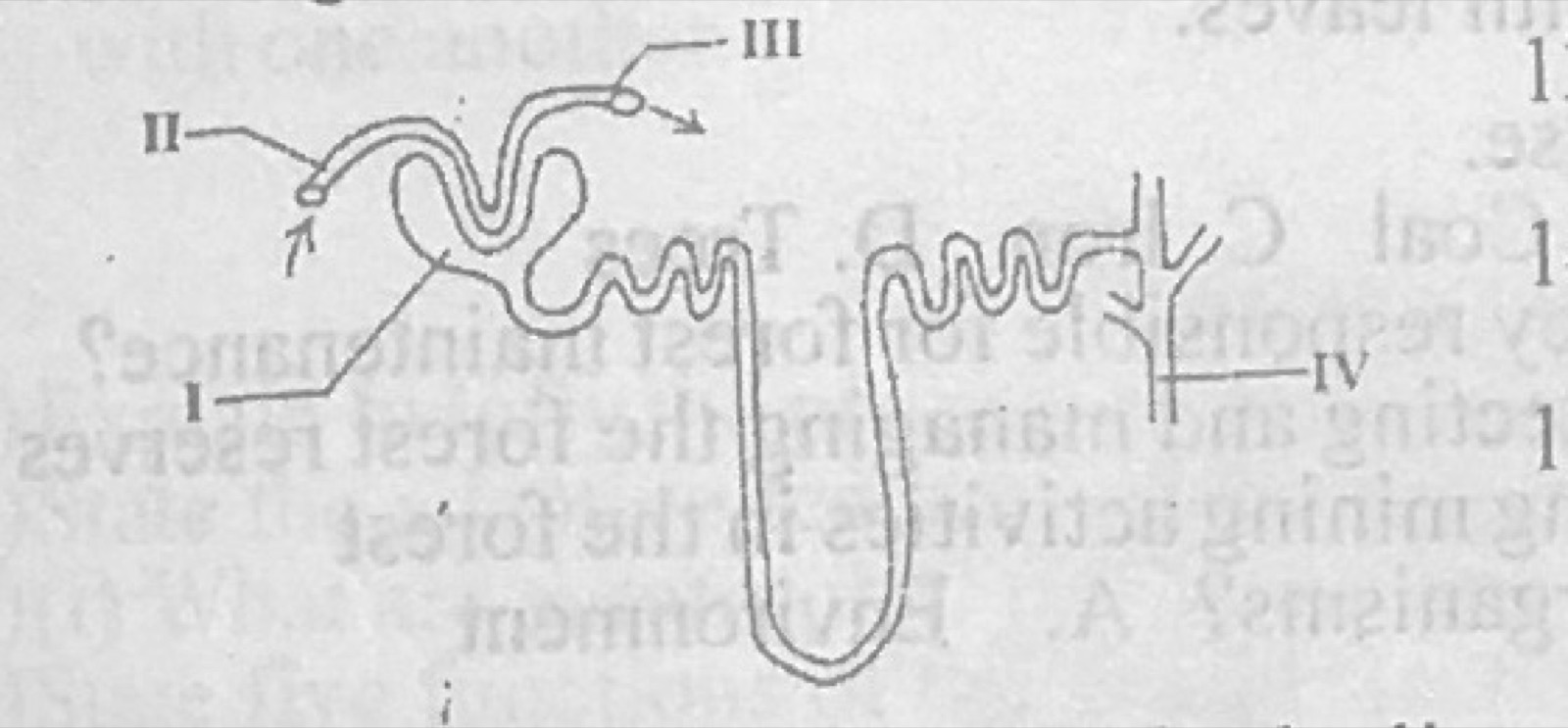
The diagram below is an illustration of the urinary tubule in a mammal. Which of the following substances is found in the part labelled II only?
A.Lipid
B.Protein
C.Salts
D.Water
Show the answer and explanation
Answer: B (Protein)
Explanation
Part II is the blood vessel bringing blood to the glomerulus. Plasma proteins are too large to be filtered, so they stay in the blood and are not found in the tubule.
The diagram below is an illustration of the urinary tubule in a mammal. Which of the following substances is greater in concentration in the part labelled IV when compared to that of the part labelled I?
A.Lipid
B.Glucose
C.Urea
D.Uric acid
Show the answer and explanation
Answer: C (Urea)
Explanation
As the filtrate passes along the tubule, water is reabsorbed but urea is not, so urea is much more concentrated in the collecting duct (IV) than at the start of the tubule (I).
When viewing an object that is close to the human eye, the
A.eye lens becomes thin.
B.cilliary muscles relax.
C.suspensory ligaments become taut.
D.eye lens become fat.
Show the answer and explanation
Answer: D (eye lens become fat.)
Explanation
To focus a near object the ciliary muscles contract, the suspensory ligaments slacken and the elastic lens becomes thicker (fatter), bending light more.
Which of the following types of placentation is not common amongst syncarpous pistils?
A.Marginal
B.Axile
C.Parietal
D.Free central
Show the answer and explanation
Answer: A (Marginal)
Explanation
Marginal placentation occurs in an ovary made of one carpel, such as the bean pod. Axile, parietal and free central placentation occur where several carpels are fused (syncarpous).
Which of the following processes are associated with photosynthesis? I. Energy from sunlight is absorbed II. Carbon dioxide is evolved III. Oxygen is given off IV. Glucose is synthesized
A.I and II only
B.I, II and IV only
C.I, III and IV only
D.I, II, III and IV
Show the answer and explanation
Answer: C (I, III and IV only)
Explanation
In photosynthesis light energy is absorbed, oxygen is given off and glucose is made. Carbon dioxide is used up, not given off.
Secondary succession happens where a community was destroyed but soil remains, such as burnt forest land. Bare rock and new sand dunes start primary succession.
Which of the following pyramids gives the most accurate picture of the relationships between the organisms at the various trophic levels in a food chain? A pyramid of
A.numbers.
B.energy.
C.biomass.
D.size.
Show the answer and explanation
Answer: B (energy.)
Explanation
A pyramid of energy shows how much energy actually flows from one trophic level to the next. It is never upside down, unlike pyramids of numbers and biomass.
Which of the following practices is not used in conserving water?
A.Afforestation
B.Damming
C.Deforestation
D.Reforestation
Show the answer and explanation
Answer: C (Deforestation)
Explanation
Cutting down forests leaves soil bare, so rain runs off instead of soaking in, and streams dry up. Planting trees and building dams help conserve water.
Which of the following resources cannot be renewed?
A.Air
B.Petroleum
C.Food crop
D.Soil
Show the answer and explanation
Answer: B (Petroleum)
Explanation
Petroleum formed from buried organisms over millions of years; once used, it cannot be replaced in a human lifetime. Air, food crops and soil can be renewed.
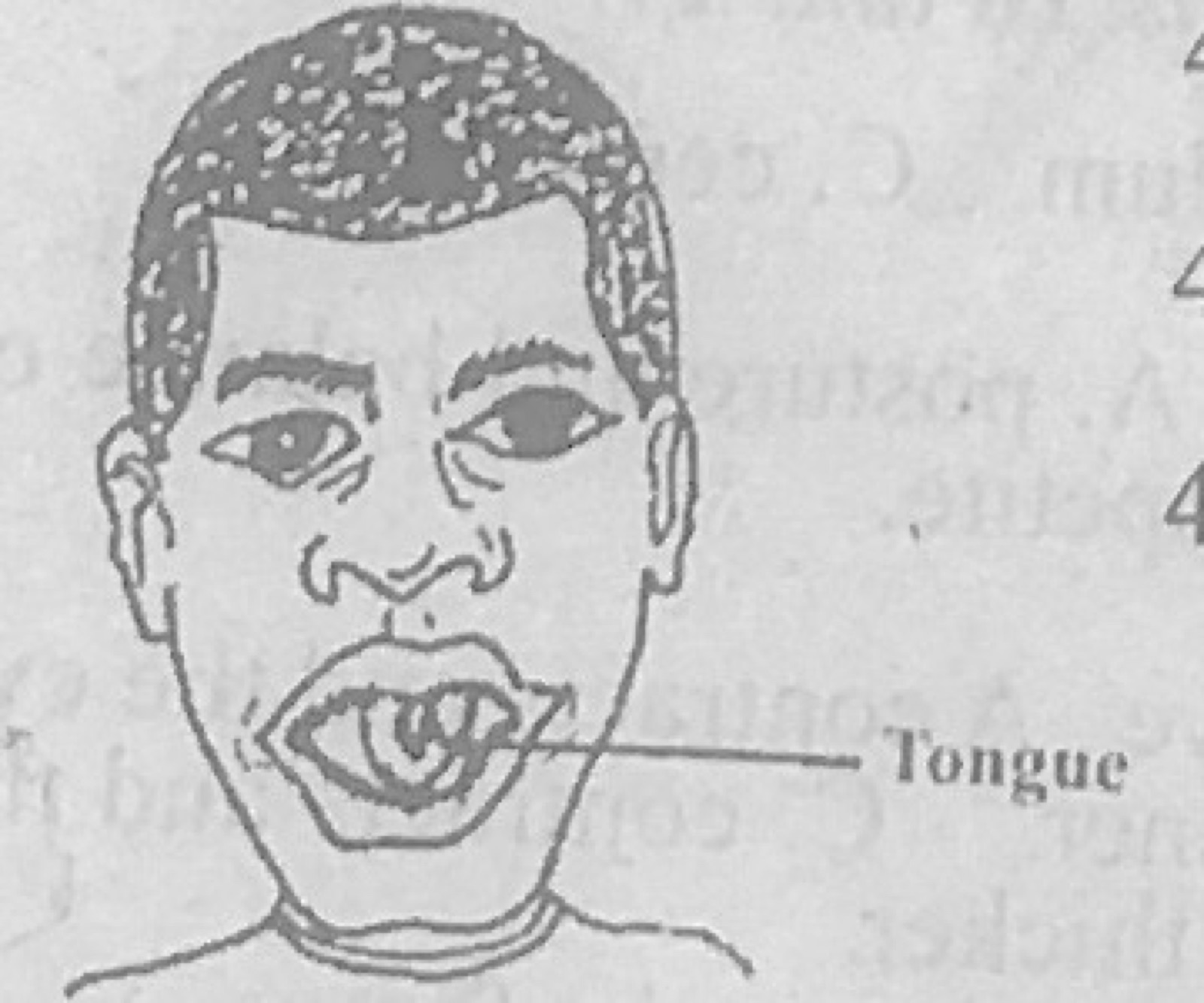
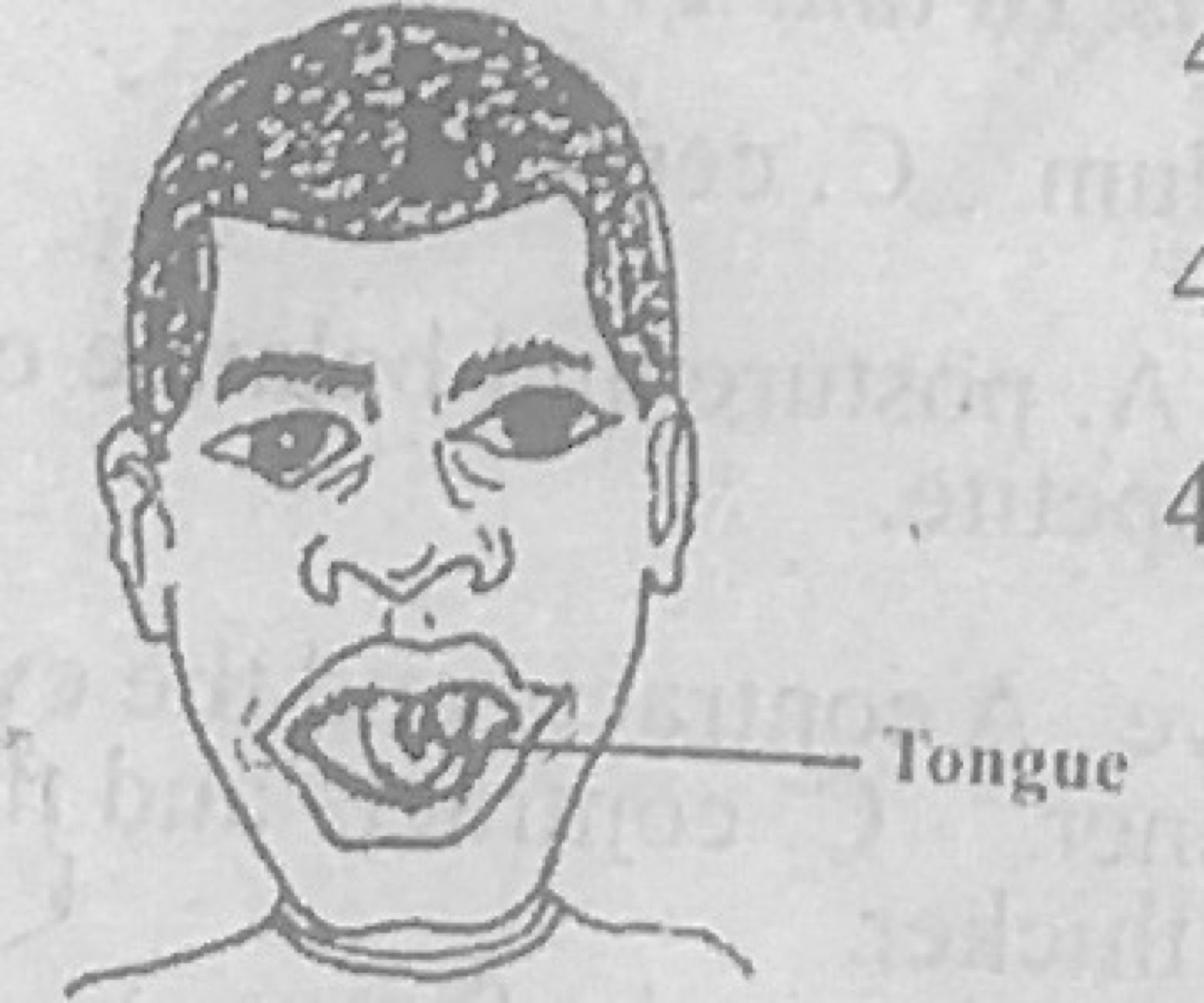
Use the diagram below. Which of the following characters is not a morphological variation?
A.Shape of the nose
B.Colour of skin
C.Colour of hair
D.Tongue rolling
Show the answer and explanation
Answer: D (Tongue rolling)
Explanation
Morphological variations are differences in visible structure, such as nose shape, skin colour and hair colour. Tongue rolling is an ability, so it is a physiological variation.
An apple plant can produce sexually and asexually and it has 40 chromosomes in its leaf cells. How many chromosomes would be in each gamete and somatic cell?
A.20 chromosomes in the gametes and 10 in the somatic cells
B.40 chromosomes in the gametes and 20 in the somatic cells
C.20 chromosomes in the gametes and 40 in the somatic cells
D.40 chromosomes in the gametes and 40 in the somatic cells
Show the answer and explanation
Answer: C (20 chromosomes in the gametes and 40 in the somatic cells)
Explanation
Leaf cells are body (somatic) cells, so somatic cells have 40 chromosomes. Gametes are made by meiosis, which halves the number to 20.
Which of the following statements is true about mutation?
A.Phenotype is not involved
B.Genotype is not involved
C.Artificial induction is not possible
D.Genotype is involved
Show the answer and explanation
Answer: D (Genotype is involved)
Explanation
A mutation is a change in the genes or chromosomes, so the genotype is always involved. Mutations can also change the phenotype and can be caused artificially (e.g. by radiation).
One of the structural adaptations of mammals for movement on land is the development of the
A.hollow bones.
B.pentadactyl limb.
C.fused thoracic bones.
D.streamlined body.
Show the answer and explanation
Answer: B (pentadactyl limb.)
Explanation
Mammals have pentadactyl (five-digit) limbs, which support the body and are adapted for walking, running and climbing on land. Hollow bones and fused bones are bird features for flight.
Which of the following traits is not characteristic of social insects?
A.All members are identical
B.There is division of labour
C.The members dwell in the same habitat
D.Some members protect the queen
Show the answer and explanation
Answer: A (All members are identical)
Explanation
Social insects such as termites and bees are divided into castes (queen, workers, soldiers, drones) that differ in shape and job. So the members are not identical.
Characteristics and Classification of Living Things
(a)(i) What is classification of living things? (ii) Name the scientist that developed the Binomial system of classification. (iii) State three reasons why it is necessary to classify living things. (iv) List seven major groups into which Taxonomists classify living things in order of hierarchy. (b) State two features each which viruses have in common with: (i) living things; (ii) non-living things. (c) Name two viral diseases each of: (i) plants; (ii) humans.
Show the model answer
Model answer
(a)(i) Classification is the arranging of living things into groups based on the features they share. (ii) Carolus (Carl) Linnaeus. (iii) Any three: makes study and identification easier; brings order to the huge number of organisms; shows relationships between groups; shows evolutionary trends; gives each organism a unique name understood everywhere; aids reference and research. (iv) Kingdom → Phylum (Division) → Class → Order → Family → Genus → Species. (b)(i) Any two: contain nucleic acid (DNA or RNA) as genetic material; reproduce (inside host cells); can mutate; show heredity. (ii) Any two: can be crystallised; have no cell structure, cytoplasm or organelles; do not feed, respire or excrete; inactive outside a living cell. (c)(i) Any two: cassava mosaic; maize streak; tobacco mosaic; groundnut rosette; cocoa swollen shoot. (ii) Any two: HIV/AIDS; measles; polio; smallpox; influenza; yellow fever; hepatitis; chickenpox; mumps; COVID-19; Ebola.
Explanation
Learn the seven ranks in order: Kingdom, Phylum, Class, Order, Family, Genus, Species.
(a) State four characteristics of enzymes. (b)(i) List two digestive enzymes produced in the duodenum of humans. (ii) Name the substrate that each enzyme listed in 2(b)(i) acts on. (iii) State the products of each enzyme activity in 2(b)(ii). (c)(i) State one way in which chlorophyll is important in plants. (ii) Name two macroelements that are required for the formation of chlorophyll in plants. (iii) State one deficiency symptom of each macroelement named in 2(c)(ii). (d) Outline the procedure used for testing for starch in a leaf.
Show the model answer
Model answer
(a) Any four: they are proteins; they are specific (each acts on one substrate); they speed up reactions (biological catalysts) and are not used up; they work best at an optimum temperature and are destroyed (denatured) by high heat; they work best at an optimum pH; many reactions are reversible; needed in small amounts; slowed by inhibitors. (b) Enzymes in the duodenum (from pancreatic juice), any two, with substrate and products: amylase – starch → maltose; trypsin – proteins → peptides (polypeptides); lipase – fats and oils → fatty acids and glycerol. (c)(i) Chlorophyll traps (absorbs) light energy for photosynthesis. (ii) Magnesium and nitrogen. (iii) Magnesium deficiency: yellowing between the veins of older leaves (chlorosis). Nitrogen deficiency: general yellowing of leaves and stunted growth. (d) Pick a leaf that has been in sunlight; boil it in water for about a minute to kill it and break the cell membranes; put it in alcohol (ethanol) in a test tube heated in a water bath to remove the chlorophyll; dip it in warm water to soften it; spread it on a white tile and add iodine solution; a blue-black colour shows starch is present.
Explanation
For the starch test, keep the steps in order and say why each step is done.
(a) Name one instrument used for collecting: (i) soil organisms from a soil sample; (ii) tiny insects from a leaf or a stem. (b) Make a diagram 6cm — 8cm long of the instrument named in 3(a)(ii) and label fully. (c) Explain briefly the relationship between three examples of symbiotic organisms.
Show the model answer
Model answer
(a)(i) Tullgren funnel (or Baermann funnel for soil nematodes). (ii) Pooter (aspirator). (b) Diagram of a pooter, 6–8 cm long, with title and labels: specimen tube/bottle, rubber bung (cork), inlet tube (short tube put near the insect), mouthpiece tube (sucking tube), gauze/muslin covering the inner end of the mouthpiece tube. (c) Any three pairs, each with how both benefit: Rhizobium bacteria and legumes – bacteria fix nitrogen for the plant, plant gives food and shelter in root nodules; lichen (alga and fungus) – alga makes food, fungus holds water and gives shelter; hermit crab and sea anemone – anemone protects the crab, crab carries the anemone to food; termites and cellulose-digesting protozoa in their gut – protozoa digest wood for the termite and get food and shelter; cattle and rumen bacteria – bacteria digest cellulose, get food and a warm home.
Explanation
For symbiosis, say what each partner gains in every example.
(a) A child belongs to blood group O and the mother belongs to group B. With the aid of a genetic cross, state the possible blood groups of the father. (b)(i) Name two forms of adaptive communication in animals. (ii) State two reasons why organisms communicate with one another.
Show the model answer
Model answer
(a) The child is OO, so the mother must be BO and the father must give an O allele. The father can be AO, BO or OO. Crosses: BO × AO → AB, BO, AO, OO; BO × BO → BB, BO, BO, OO; BO × OO → BO, BO, OO, OO. Each cross can give an OO child. So the father's blood group could be A (AO), B (BO) or O (OO), but not AB. Diagram must show parents, gametes, offspring. (b)(i) Any two: sound (calls, songs, chirping); visual signals (colour, display, dances, body posture); chemical signals (pheromones, scent marking); touch (tactile). (ii) Any two: to attract a mate; to warn of danger; to mark territory; to show where food is; to keep a group together; to identify members of the same species or colony; to frighten enemies.
Explanation
The child's O allele must come from both parents, so the father cannot be AB.
(a) Explain briefly the process of perceiving smell in humans. (b) State the adaptive features of the egg of a domestic fowl. (c)(i) What are autotrophs? (ii) Name two unicellular organisms that are autotrophs. (d) State five functions of the World Health Organization. (e) Name two examples each of plants and animals that live in a freshwater pond. (i) Plants (ii) Animals (f) State five differences between the skin of a mammal and the epidermis of a leaf. (g) A farmer has two plots of land; plots A and B. On plot A, the farmer planted several seeds of maize. On plot B, the farmer planted several seeds of maize and pepper in a small area. What type of competition would be observed on: (i) plot A; (ii) plot B?
Show the model answer
Model answer
(a) Chemicals (odours) in the air enter the nasal cavity and dissolve in the moist mucus lining it; they stimulate the olfactory (smell) receptor cells; impulses pass along the olfactory nerve to the olfactory lobe/cerebrum of the brain, which interprets the smell. (b) Any: hard calcium carbonate shell protects the embryo; shell is porous for gaseous exchange; shell membranes keep out germs and reduce water loss; albumen (egg white) supplies water and protein and cushions the embryo; yolk is a store of food; chalazae hold the yolk in place so the embryo stays on top; air space provides oxygen at hatching. (c)(i) Autotrophs are organisms that make their own food from simple inorganic substances using energy from light (or chemical reactions). (ii) Any two: Chlamydomonas; Euglena; diatoms; Chlorella; photosynthetic bacteria. (d) Any five: fights the spread of diseases worldwide (e.g. immunisation campaigns); sets health standards; gives health advice and education; supports research into diseases and drugs; helps countries in health emergencies and epidemics; collects and shares health statistics; helps train health workers; improves nutrition, sanitation and water supply. (e)(i) Plants, any two: water lettuce (Pistia), water lily, Spirogyra, duckweed, water hyacinth, algae. (ii) Animals, any two: tilapia, tadpole/frog, water snail, mosquito larva, water boatman, Hydra. (f) Any five: skin is many cells thick / leaf epidermis is usually one cell thick; skin has hairs, sweat glands and sebaceous glands / epidermis has none (may have simple hairs); skin has sense receptors and nerves / epidermis has none; skin has blood vessels / epidermis has none; skin cells have no cell walls / epidermal cells have cellulose walls; skin has a dead keratinised outer layer / epidermis is covered by a waxy cuticle; epidermis has stomata with guard cells / skin has pores of sweat glands; skin helps control body temperature / epidermis does not; skin has pigment (melanin) / epidermis is mostly colourless. (g)(i) Plot A: intraspecific competition (between members of the same species, maize and maize). (ii) Plot B: interspecific competition (between different species, maize and pepper) as well as intraspecific.
Explanation
Section C (candidates in Nigeria only). Read each part carefully and give only the number of points asked.