WAEC Biology 2012 past questions and answers

64 questions. Try each one, then open the answer to check yourself and read the explanation.

Question 1

Characteristics and Classification of Living Things

The science of life is referred to as

  1. A.anatomy.
  2. B.biology.
  3. C.ecology.
  4. D.phylogeny.
Show the answer and explanation

Answer: B (biology.)

Explanation

Biology comes from 'bios' (life) and 'logos' (study): the study of living things.

Open this question

Question 2

Cell Structure and Organisation

The epidermis of a leaf is considered an example of a tissue because the cells

  1. A.allow sunlight to pass through.
  2. B.are covered by a waxy cuticle.
  3. C.all possess a similar structure and function.
  4. D.allow water to enter them by osmosis.
Show the answer and explanation

Answer: C (all possess a similar structure and function.)

Explanation

A tissue is a group of similar cells doing the same job, which is what the epidermal cells are.

Open this question

Question 3

Cell Structure and Organisation

The organism at the organ level of organisation of life is

  1. A.Euglena.
  2. B.Spirogyra.
  3. C.Ginger.
  4. D.Tapeworm.
Show the answer and explanation

Answer: C (Ginger.)

Explanation

Euglena and Spirogyra are at the cell level; a ginger rhizome is a storage organ, the usual example of the organ level.

Open this question

Question 4

Cell Structure and Organisation

The disadvantage of complexity of organisation in the higher organisms is that it leads to

  1. A.mutual interdependence between component cells.
  2. B.internal structural specialization.
  3. C.increased adaptation to environment.
  4. D.slower rate of diffusion of oxygen to individual cells.
Show the answer and explanation

Answer: D (slower rate of diffusion of oxygen to individual cells.)

Explanation

In a large, complex body most cells are far from the surface, so oxygen cannot reach them fast enough by diffusion alone; transport systems are needed.

Open this question

Question 5

Cell Structure and Organisation

In which of the following multicellular organisms is interdependence of cells maintained?

  1. A.Spirogyra
  2. B.Volvox
  3. C.Eudorina
  4. D.Pandorina
Show the answer and explanation

Answer: B (Volvox)

Explanation

In Volvox the cells are joined by protoplasmic strands and some are specialised for reproduction, so the cells depend on one another.

Open this question

Question 7

Respiration

The muscle cell fluid of an athlete was tested immediately after a 100 m race and was found to contain a high concentration of lactic acid. Explain what could have caused this. The

  1. A.athlete must have eaten food containing lactic acid just before the race.
  2. B.Athlete must have injected lactic acid into his blood just before the race
  3. C.athlete's muscle must have carried out anaerobic respiration during the race.
  4. D.athlete must have inhaled lactic acid from the environment during the race.
Show the answer and explanation

Answer: C (athlete's muscle must have carried out anaerobic respiration during the race.)

Explanation

In a sprint the muscles need energy faster than oxygen can arrive, so they respire anaerobically and lactic acid builds up.

Open this question

Question 8

Growth and Development

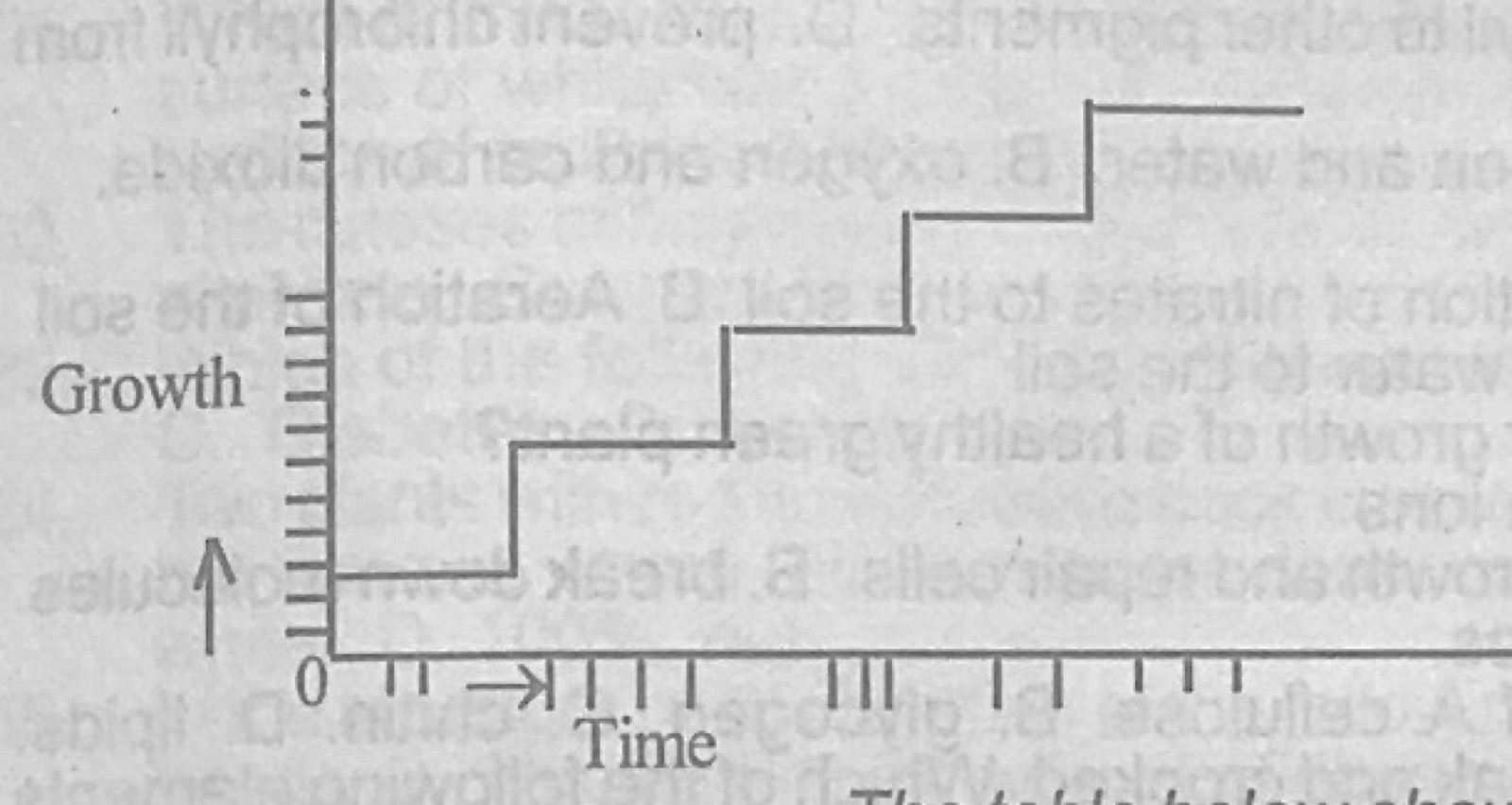
The graph represents the growth pattern of an animal. Which of the following groups of animals shows this pattern of growth?

Diagram for this question
  1. A.Cestoda
  2. B.Reptilia
  3. C.Amphibia
  4. D.Insecta
Show the answer and explanation

Answer: D (Insecta)

Explanation

The step-like graph shows growth only in bursts after each moult, because the hard exoskeleton stops growth in between; this is typical of insects.

Open this question

Question 9

Transport in Animals

The pulmonary circulation involves movement of the blood to and from the

  1. A.brain.
  2. B.kidneys.
  3. C.liver.
  4. D.lungs.
Show the answer and explanation

Answer: D (lungs.)

Explanation

'Pulmonary' refers to the lungs; this circuit takes blood from the heart to the lungs and back.

Open this question

Question 10

Transport in Animals

The table shows the blood composition of four individuals.
Individual I: plasma normal, red blood cells normal, white blood cells high, platelets normal.
Individual II: plasma normal, red blood cells normal, white blood cells normal, platelets normal.
Individual III: plasma normal, red blood cells normal, white blood cells low, platelets normal.
Individual IV: plasma normal, red blood cells normal, white blood cells normal, platelets low.
Which of the individuals is likely to be suffering from haemophilia?

  1. A.I
  2. B.II
  3. C.III
  4. D.IV
Show the answer and explanation

Answer: D (IV)

Explanation

Haemophilia is a failure of blood clotting; platelets help blood clot, and only individual IV has a low platelet count.

Open this question

Question 11

Microorganisms and Health

The table shows the blood composition of four individuals.
Individual I: plasma normal, red blood cells normal, white blood cells high, platelets normal.
Individual II: plasma normal, red blood cells normal, white blood cells normal, platelets normal.
Individual III: plasma normal, red blood cells normal, white blood cells low, platelets normal.
Individual IV: plasma normal, red blood cells normal, white blood cells normal, platelets low.
Which of the individuals is likely to have HIV?

  1. A.I
  2. B.II
  3. C.III
  4. D.IV
Show the answer and explanation

Answer: C (III)

Explanation

HIV destroys white blood cells (lymphocytes), so an infected person has a low white cell count, like individual III.

Open this question

Question 12

Transport in Animals

A student dissecting an animal specimen discovered that it had two auricles and one ventricle. The animal is likely to be a/an

  1. A.fish.
  2. B.reptile.
  3. C.amphibian.
  4. D.bird.
Show the answer and explanation

Answer: C (amphibian.)

Explanation

Amphibians have a three-chambered heart with two auricles and one ventricle; fish have two chambers and birds four.

Open this question

Question 13

Respiration

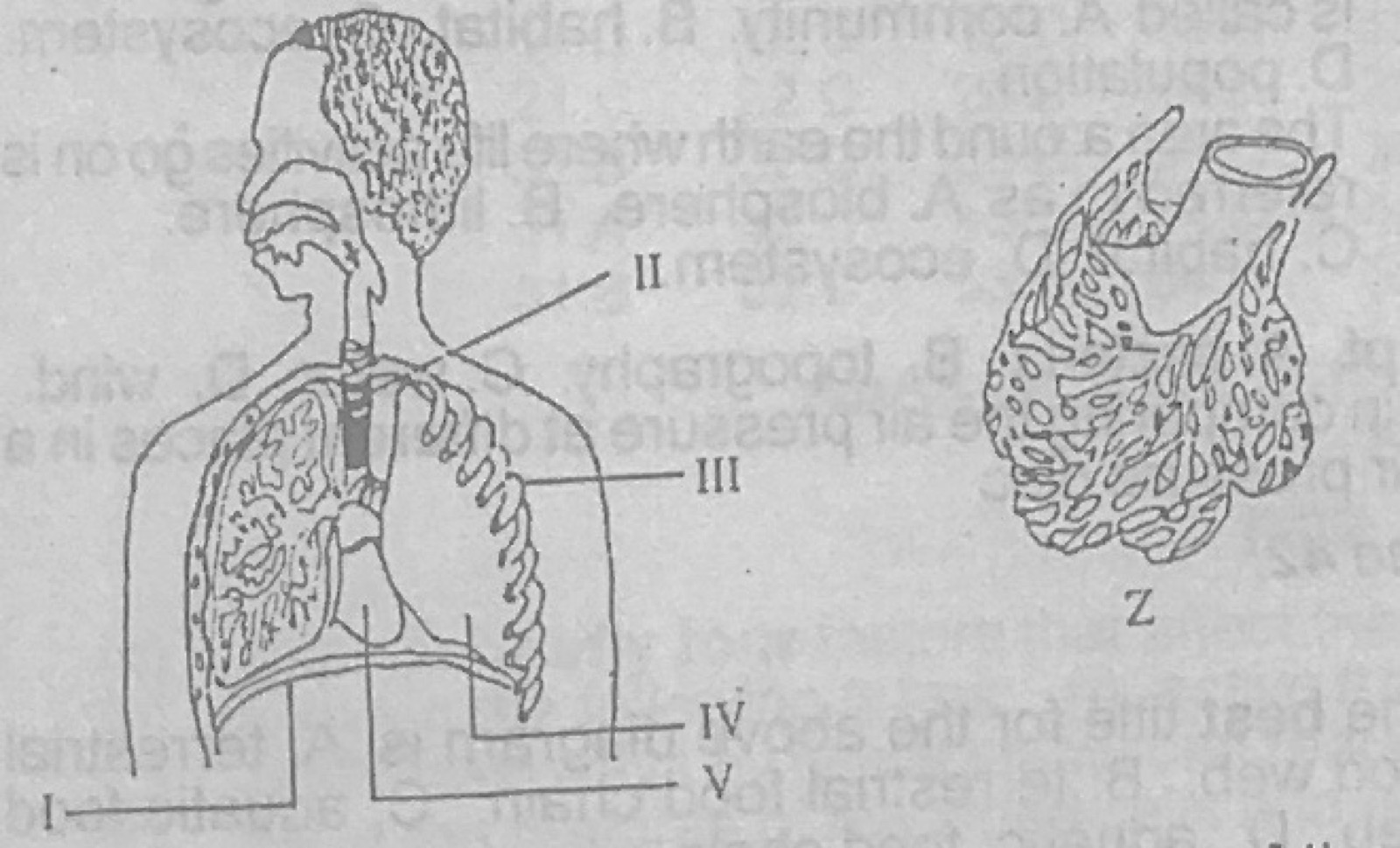
The diagrams are parts of a human lung. Which of the labelled parts is diagram Z taken from?

Diagram for this question
  1. A.II
  2. B.III
  3. C.IV
  4. D.V
Show the answer and explanation

Answer: C (IV)

Explanation

Z is a cluster of alveoli at the end of a bronchiole, which is found inside the lung tissue labelled IV.

Open this question

Question 15

Hormonal Coordination

Increasing adrenaline content of the blood would be expected to decrease the flow of blood to the

  1. A.liver.
  2. B.heart.
  3. C.lungs.
  4. D.brain.
Show the answer and explanation

Answer: A (liver.)

Explanation

Adrenaline prepares the body for action: it sends more blood to the heart, lungs and muscles and less to organs not needed at once, such as the gut and liver.

Open this question

Question 16

Nervous Coordination

The following are all examples of a simple reflex action, except

  1. A.swallowing
  2. B.sneezing.
  3. C.walking.
  4. D.blinking.
Show the answer and explanation

Answer: C (walking.)

Explanation

Walking is a voluntary (or learned) action controlled by the brain; swallowing, sneezing and blinking are automatic reflexes.

Open this question

Question 17

Nervous Coordination

Impulses are conducted towards the nerve cell through the

  1. A.myelin sheath.
  2. B.dendrons.
  3. C.axons.
  4. D.synaptic nodes.
Show the answer and explanation

Answer: B (dendrons.)

Explanation

Dendrons (dendrites) carry impulses towards the cell body; axons carry them away.

Open this question

Question 18

Sense Organs

The function of the convex lens in the correction of eye defects is to

  1. A.diverge light rays from far objects to focus image on the retina.
  2. B.converge light rays to focus image behind the retina.
  3. C.converge light rays to focus the image before the retina.
  4. D.converge light rays from far objects to focus their image on the retina.
Show the answer and explanation

Answer: D (converge light rays from far objects to focus their image on the retina.)

Explanation

A convex lens converges light rays so that the image falls exactly on the retina, correcting long sight.

Open this question

Question 19

Sense Organs

Which of the following parts of the eye contains light sensitive cells?

  1. A.Choroid
  2. B.Iris
  3. C.Retina
  4. D.Lens
Show the answer and explanation

Answer: C (Retina)

Explanation

The retina contains the rods and cones, which respond to light.

Open this question

Question 20

Homeostasis

The hair on the human skin will stand erect when the person is

  1. A.in an air-conditioned room.
  2. B.strolling in the sun.
  3. C.taking a hot drink.
  4. D.doing strenuous exercise.
Show the answer and explanation

Answer: A (in an air-conditioned room.)

Explanation

In the cold, erector muscles raise the hairs to trap a layer of air that reduces heat loss.

Open this question

Question 21

Reproduction in Animals

When fertilization occurs that leads to formation of a zygote, which of the following processes takes place?

  1. A.The tail of the sperm fuses with the egg cell
  2. B.Both tail and head of the sperm fuse with the egg cell
  3. C.The nucleus of the sperm fuses with the egg cell
  4. D.The egg cell develops on its own without the sperm
Show the answer and explanation

Answer: C (The nucleus of the sperm fuses with the egg cell)

Explanation

Fertilisation is the fusion of the sperm nucleus with the egg nucleus; the tail is left outside.

Open this question

Question 22

Reproduction in Plants

Which of the following structures in a flower develops into the seed?

  1. A.Testa
  2. B.Integument
  3. C.Ovule
  4. D.Ovary
Show the answer and explanation

Answer: C (Ovule)

Explanation

After fertilisation the ovule becomes the seed and the ovary becomes the fruit.

Open this question

Question 23

Reproduction in Animals

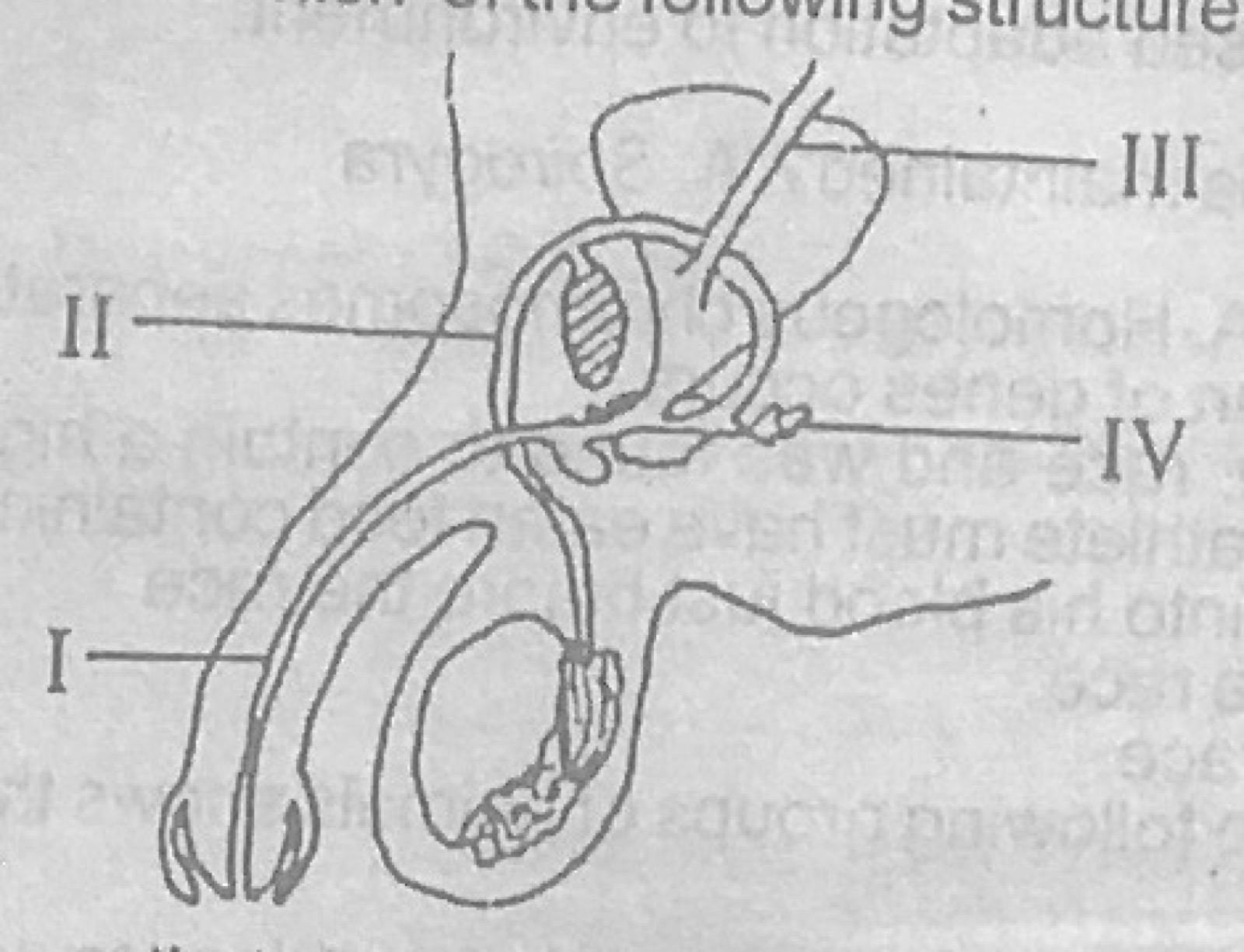
An illustration of a human male reproductive system is shown. Which of the labelled parts can be cut to ensure permanent sterility?

Diagram for this question
  1. A.I
  2. B.II
  3. C.III
  4. D.IV
Show the answer and explanation

Answer: B (II)

Explanation

II is the sperm duct (vas deferens); cutting and tying it (vasectomy) stops sperm leaving the testes.

Open this question

Question 24

Reproduction in Plants

The brightly coloured petals in some plants is an adaptive colouration for

  1. A.feeding.
  2. B.pollination.
  3. C.dispersal
  4. D.shedding.
Show the answer and explanation

Answer: B (pollination.)

Explanation

Bright petals attract insects, which carry pollen from flower to flower.

Open this question

Question 25

Ecological Associations

Squirrels easily kill some trees because

  1. A.they inject poisonous substances into the trees.
  2. B.most trees are susceptible to squirrel bites.
  3. C.they feed voraciously on the roots.
  4. D.they gnaw the bark and destroy the phloem.
Show the answer and explanation

Answer: D (they gnaw the bark and destroy the phloem.)

Explanation

Removing a ring of bark destroys the phloem, so food cannot reach the roots and the tree dies.

Open this question

Question 26

Photosynthesis and Plant Nutrition

The major role played by accessory pigments during photosynthesis is to

  1. A.add colour to plants but not to trap light energy.
  2. B.trap light energy that chlorophyll cannot absorb.
  3. C.transfer energy from chlorophyll to other pigments.
  4. D.prevent chlorophyll from absorbing unnecessary light.
Show the answer and explanation

Answer: B (trap light energy that chlorophyll cannot absorb.)

Explanation

Accessory pigments widen the range of light a plant can use: they absorb light chlorophyll misses and pass the energy to chlorophyll a.

Open this question

Question 27

Photosynthesis and Plant Nutrition

The main raw materials required for photosynthesis are

  1. A.oxygen and water.
  2. B.oxygen and carbon dioxide.
  3. C.oxygen and chlorophyll.
  4. D.carbon dioxide and water.
Show the answer and explanation

Answer: D (carbon dioxide and water.)

Explanation

Plants combine carbon dioxide and water, using light energy, to make glucose; oxygen is a product.

Open this question

Question 28

Nutrient Cycling

What is the benefit of thunder and lightning to farmers?

  1. A.Addition of nitrates to the soil
  2. B.Aeration of the soil
  3. C.Removal of harmful bacteria from the soil
  4. D.Addition of rain water to the soil
Show the answer and explanation

Answer: A (Addition of nitrates to the soil)

Explanation

Lightning makes nitrogen and oxygen combine; the oxides dissolve in rain and reach the soil as nitrates.

Open this question

Question 29

Photosynthesis and Plant Nutrition

Which of the following substances must be present in the soil for growth of a healthy green plant?

  1. A.Amino acids
  2. B.Carbon
  3. C.Glucose salts
  4. D.Magnesium ions
Show the answer and explanation

Answer: D (Magnesium ions)

Explanation

Magnesium is part of the chlorophyll molecule and must be absorbed from the soil; carbon comes from the air.

Open this question

Question 30

Food Substances and Enzymes

The purpose of proteins in the diet of a mammal is to

  1. A.promote growth and repair cells.
  2. B.break down molecules.
  3. C.regulate the flow of chyme.
  4. D.serve as co-factors for enzymes.
Show the answer and explanation

Answer: A (promote growth and repair cells.)

Explanation

Proteins are body-building foods used for growth and repair of tissues.

Open this question

Question 31

Food Substances and Enzymes

Excess carbohydrates can be stored in the muscles in the form of

  1. A.cellulose.
  2. B.glycogen.
  3. C.chitin.
  4. D.lipids.
Show the answer and explanation

Answer: B (glycogen.)

Explanation

Animals store carbohydrate as glycogen in the liver and muscles.

Open this question

Question 32

Food Substances and Enzymes

The bones of the legs of a six years old boy are observed to be weak and crooked. Which of the following elements were deficient in his mother's diet at pregnancy?

  1. A.Sodium and iron
  2. B.Iron and manganese
  3. C.Calcium and phosphorus
  4. D.Magnesium and sulphur
Show the answer and explanation

Answer: C (Calcium and phosphorus)

Explanation

Bones are hardened by calcium phosphate; lack of calcium and phosphorus causes soft, bent bones (rickets).

Open this question

Question 33

Respiration

The diagram is an illustration of an experimental set-up to test the action of yeast. What test would be used to confirm the nature of the gas given off at I?

Diagram for this question
  1. A.Insert a glowing splint
  2. B.Pass the gas through lime water
  3. C.Insert a piece of litmus paper
  4. D.Smell the gas
Show the answer and explanation

Answer: B (Pass the gas through lime water)

Explanation

Yeast fermenting sugar gives off carbon dioxide, which turns lime water milky.

Open this question

Question 34

Animal Nutrition

Which of the following digestive enzymes would be greatly affected if the liver fails to produce bile?

  1. A.Amylase
  2. B.Cellulase
  3. C.Lipase
  4. D.Protease
Show the answer and explanation

Answer: C (Lipase)

Explanation

Bile emulsifies fats into tiny droplets so lipase can work on them; without bile, fat digestion suffers.

Open this question

Question 35

Food Substances and Enzymes

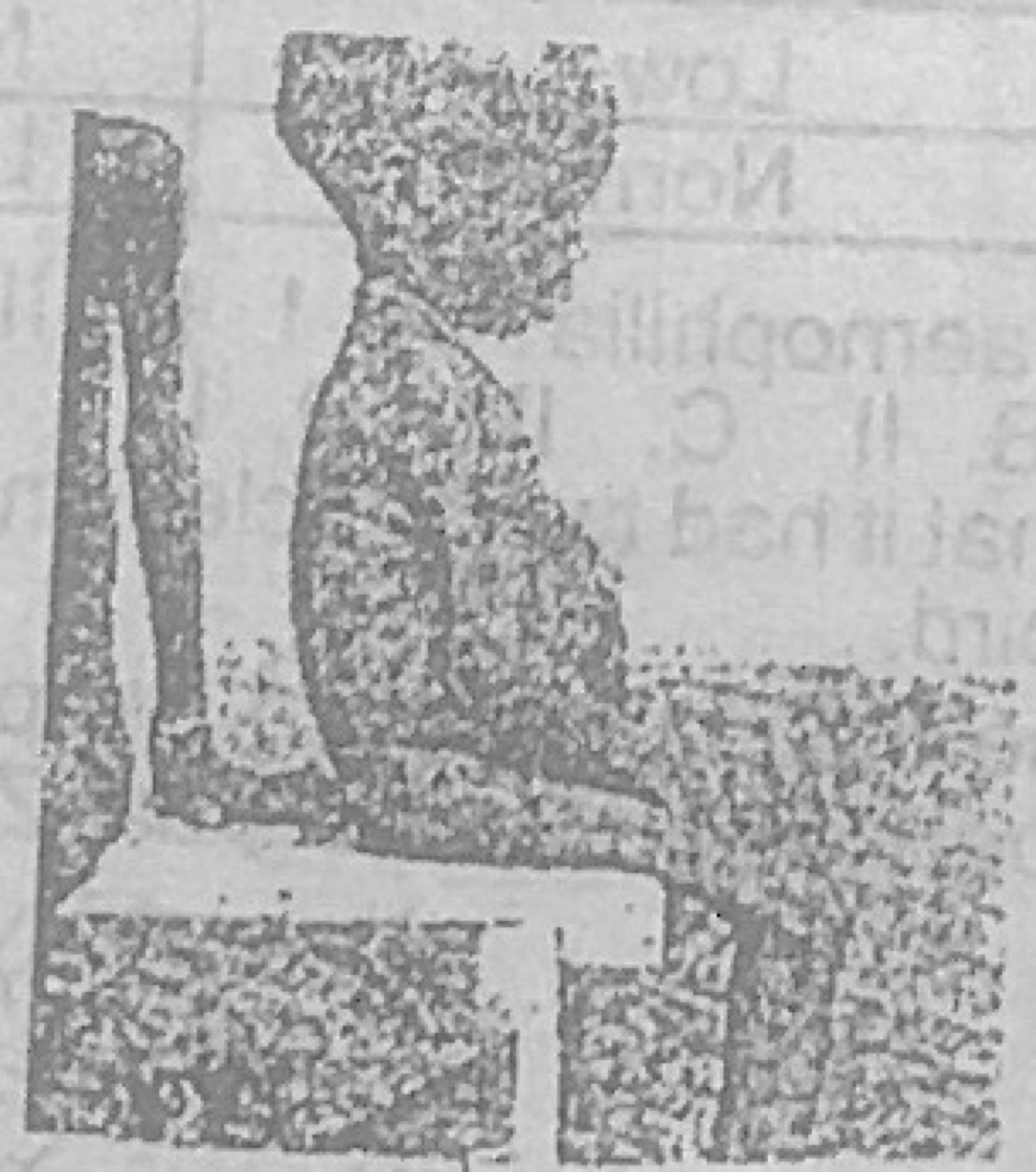
The appropriate food to be given to the child in the picture is

Diagram for this question
  1. A.beans.
  2. B.garri.
  3. C.bread.
  4. D.avocado pear.
Show the answer and explanation

Answer: A (beans.)

Explanation

The child shows signs of kwashiorkor (swollen belly), caused by lack of protein; beans are rich in protein.

Open this question

Question 36

Food Substances and Enzymes

Which of the following food substances will have little or no calorific value?

  1. A.Proteins
  2. B.Carbohydrates
  3. C.Lipids
  4. D.Water
Show the answer and explanation

Answer: D (Water)

Explanation

Water supplies no energy; proteins, carbohydrates and lipids all release energy when oxidised.

Open this question

Question 37

Ecosystem and Ecological Factors

A space containing a group of interactive organisms is called

  1. A.community.
  2. B.habitat.
  3. C.ecosystem.
  4. D.population.
Show the answer and explanation

Answer: A (community.)

Explanation

A community is all the populations of different species living and interacting in one area.

Open this question

Question 38

Ecosystem and Ecological Factors

The area around the earth where life activities go on is referred to as

  1. A.biosphere.
  2. B.lithosphere.
  3. C.habitat.
  4. D.ecosystem.
Show the answer and explanation

Answer: A (biosphere.)

Explanation

The biosphere is the part of the earth (land, water and air) where living things are found.

Open this question

Question 39

Ecosystem and Ecological Factors

The following are abiotic components of the ecosystem except

  1. A.bacteria.
  2. B.topography.
  3. C.water.
  4. D.wind.
Show the answer and explanation

Answer: A (bacteria.)

Explanation

Bacteria are living (biotic); topography, water and wind are non-living.

Open this question

Question 40

Ecosystem and Ecological Factors

Which of the following instruments would be most appropriate in comparing the air pressure at different places in a habitat?

  1. A.Hygrometer
  2. B.Barometer
  3. C.Photometer
  4. D.Air pressure disc
Show the answer and explanation

Answer: B (Barometer)

Explanation

A barometer measures atmospheric pressure; a hygrometer measures humidity and a photometer light.

Open this question

Question 41

Feeding Relationships and Energy Flow

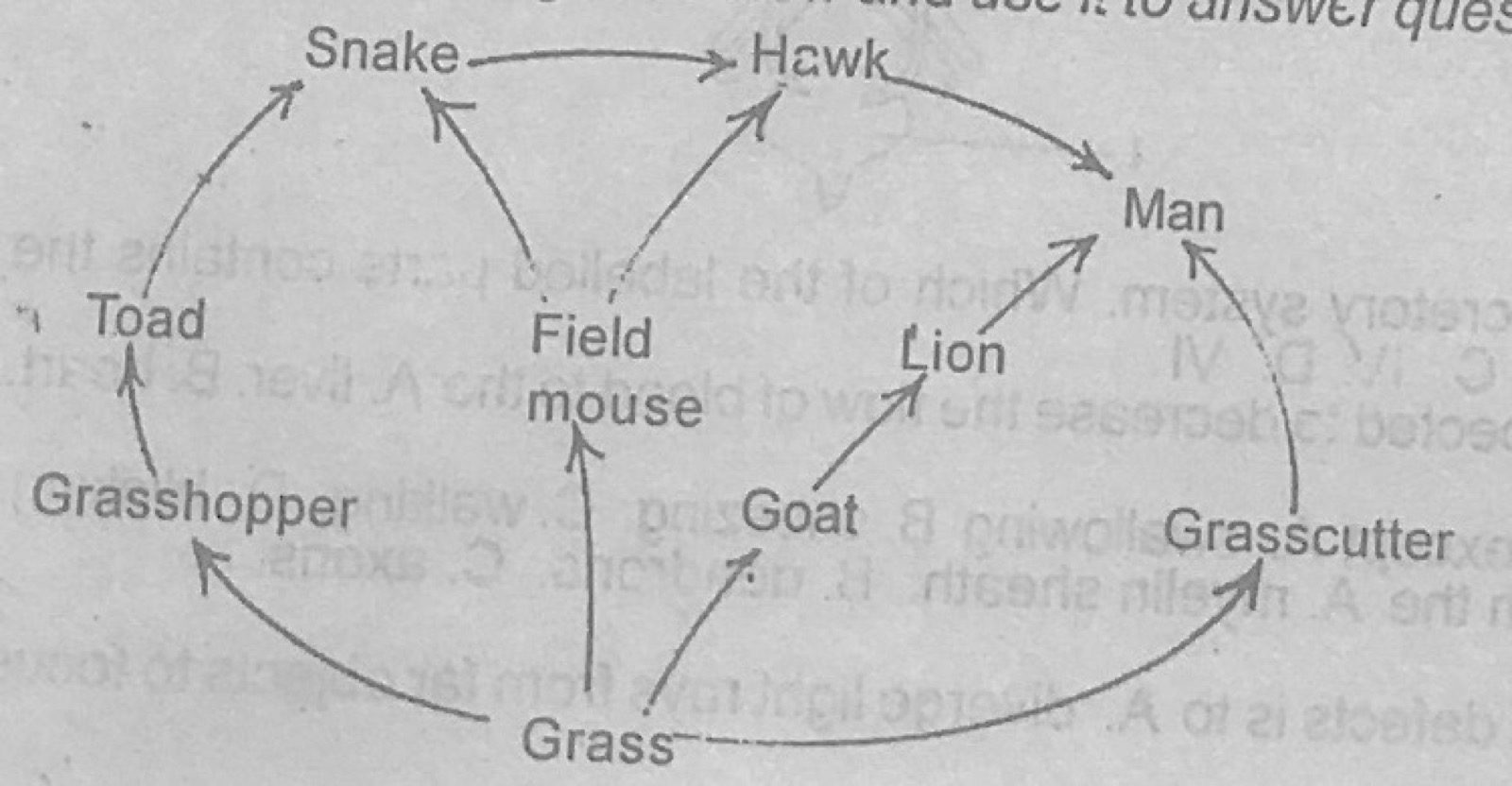
Study the feeding diagram.
The best title for the diagram is

Diagram for this question
  1. A.terrestrial food web.
  2. B.terrestrial food chain.
  3. C.aquatic food web.
  4. D.aquatic food chain.
Show the answer and explanation

Answer: A (terrestrial food web.)

Explanation

The organisms live on land and the feeding links are interconnected chains, which make a food web.

Open this question

Question 42

Feeding Relationships and Energy Flow

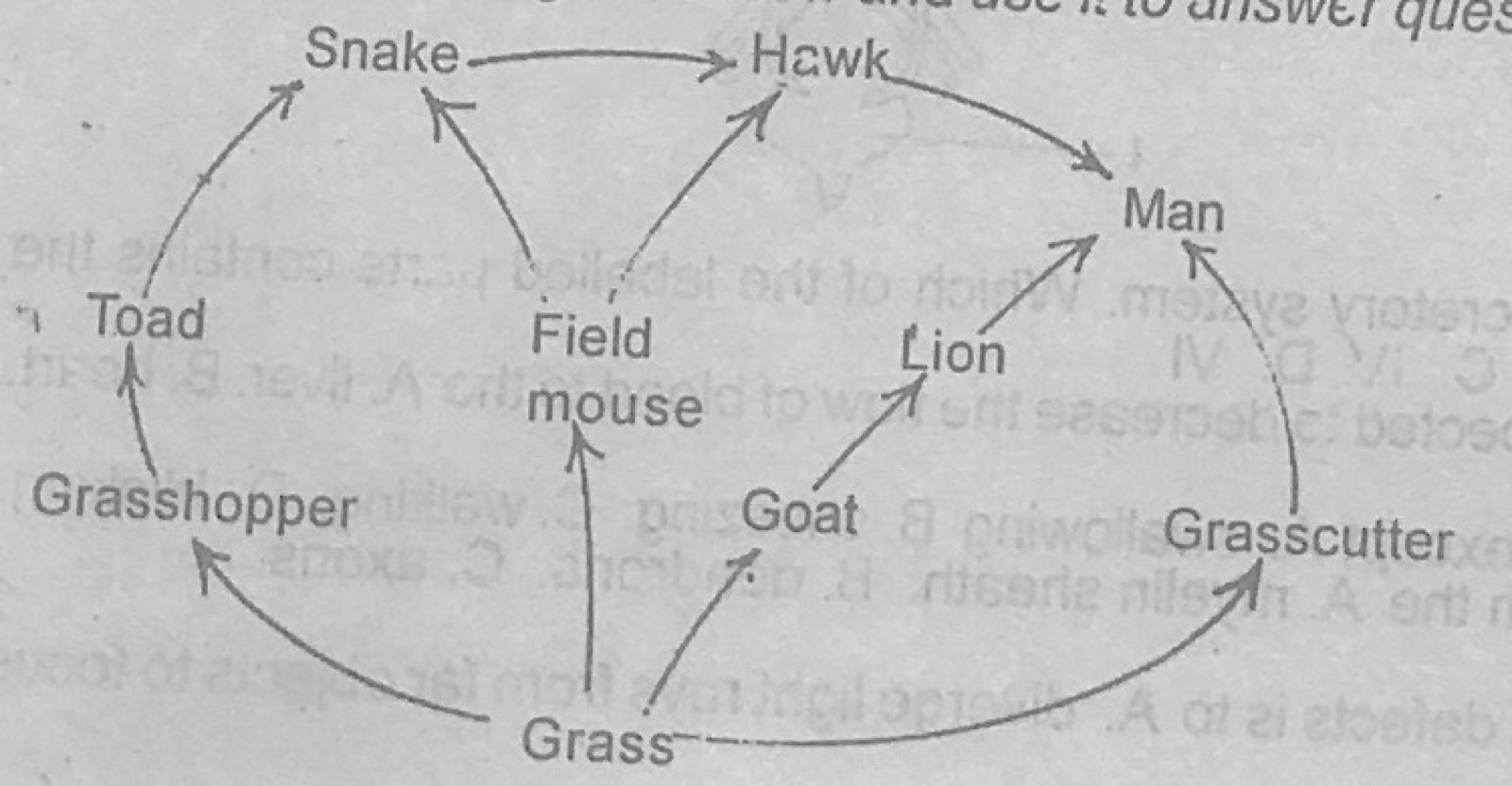
Study the feeding diagram.
How many food chains are in the diagram?

Diagram for this question
  1. A.Three
  2. B.Four
  3. C.Five
  4. D.Six
Show the answer and explanation

Answer: C (Five)

Explanation

Grass→grasshopper→toad→snake→hawk→man; grass→field mouse→snake→hawk→man; grass→field mouse→hawk→man; grass→goat→lion→man; grass→grasscutter→man: five chains.

Open this question

Question 43

Adaptation

Plants with breathing roots are characteristic features of vegetation in

  1. A.tropical grassland.
  2. B.temperate grassland.
  3. C.salt water swamp.
  4. D.tropical rain forest.
Show the answer and explanation

Answer: C (salt water swamp.)

Explanation

Mangroves in salt-water swamps grow in waterlogged mud with little oxygen, so they have breathing roots (pneumatophores).

Open this question

Question 44

Habitats and Biomes

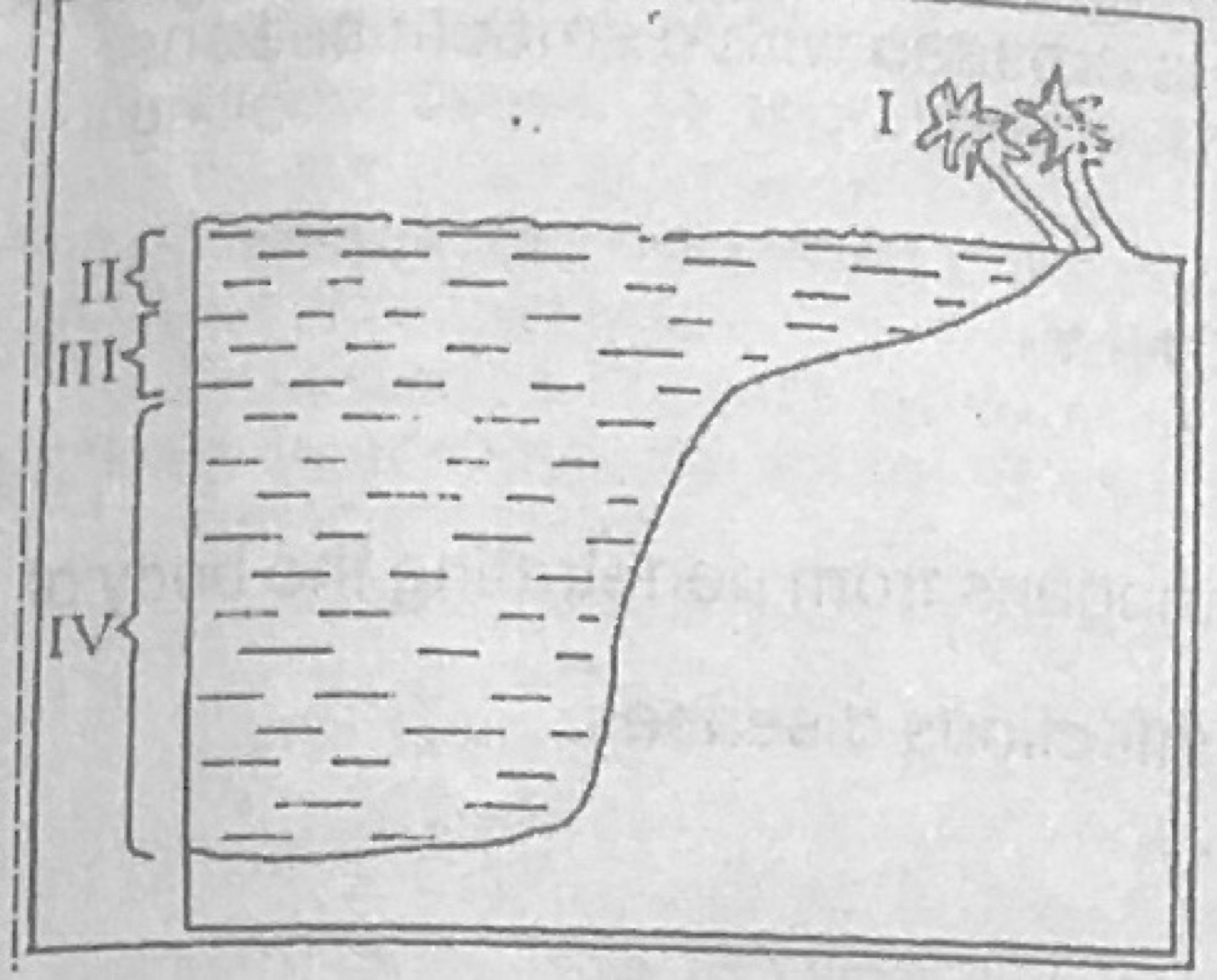
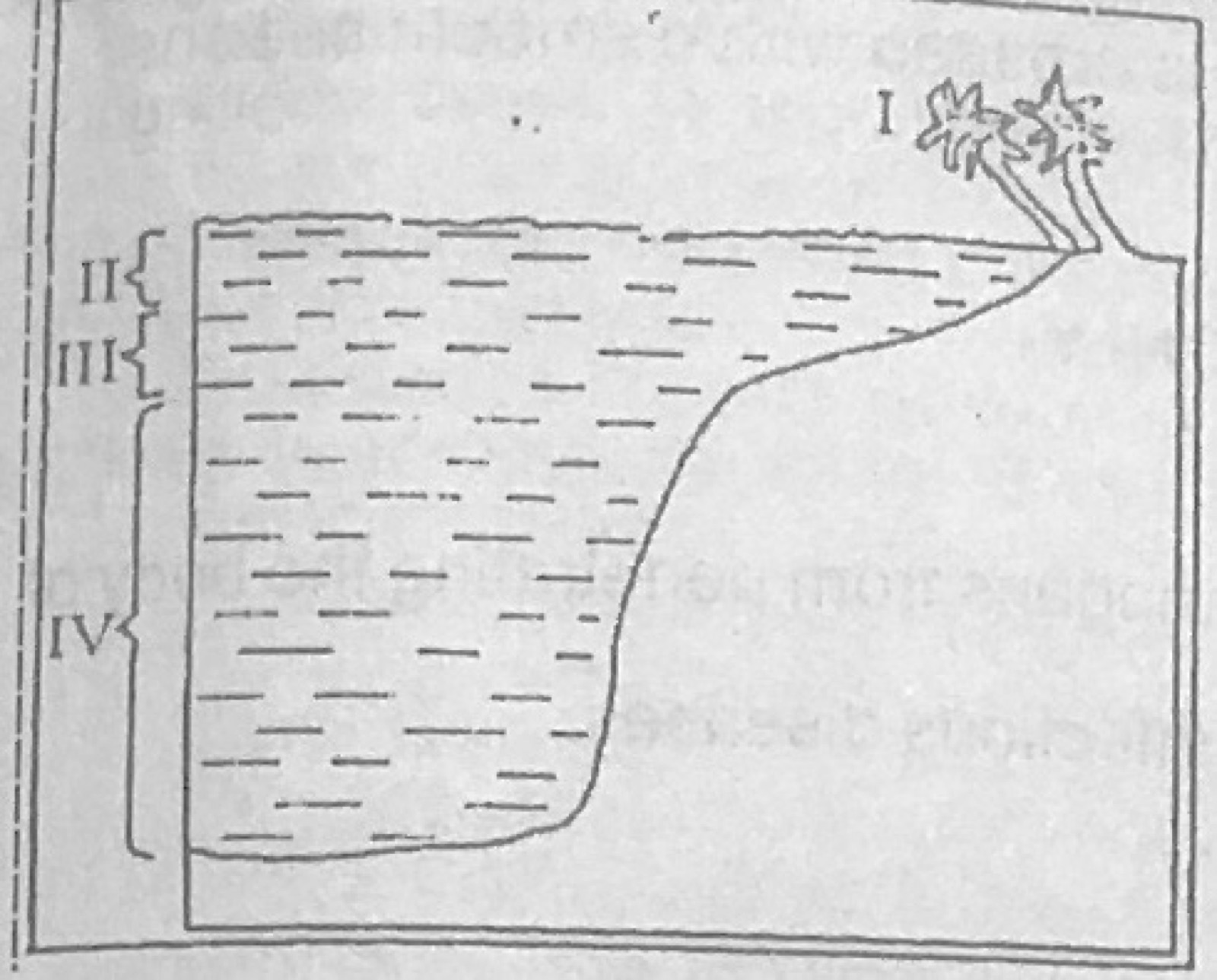
Study the diagram of the zones of a marine habitat.
In which of the zones can very few organisms be found?

Diagram for this question
  1. A.I
  2. B.II
  3. C.III
  4. D.IV
Show the answer and explanation

Answer: D (IV)

Explanation

Zone IV is the deep sea; there is no light for photosynthesis and it is cold, so very few organisms live there.

Open this question

Question 45

Habitats and Biomes

Study the diagram of the zones of a marine habitat.
Which of the following factors exerts a major effect on the distribution of living organisms in the habitat?

Diagram for this question
  1. A.Salt
  2. B.pH
  3. C.Light
  4. D.Rainfall
Show the answer and explanation

Answer: C (Light)

Explanation

Light decreases with depth; it controls where producers can photosynthesise and so where other organisms can live.

Open this question

Question 46

Microorganisms and Health

The use of water closet and septic tanks is preferred to the use of bucket and pit latrines because

  1. A.it is cost effective.
  2. B.contaminated faeces are completely kept away from flies.
  3. C.the water for flushing contains chlorine which kills the germs.
  4. D.it prevents flies from breeding.
Show the answer and explanation

Answer: B (contaminated faeces are completely kept away from flies.)

Explanation

Flushed faeces go straight into a closed tank, so flies cannot touch them and spread germs to food.

Open this question

Question 47

Microorganisms and Health

The detection of vibro cholerae in public drinking water is a sign of

  1. A.clean water.
  2. B.outbreak of disease.
  3. C.water pollution.
  4. D.decayed organisms in the water.
Show the answer and explanation

Answer: C (water pollution.)

Explanation

Vibrio cholerae comes from human faeces; finding it in drinking water shows the water is polluted with sewage.

Open this question

Question 48

Population Ecology

Which of the following factors would be least likely to act as a density dependent limiting factor in a population of mice?

  1. A.Build up of waste products
  2. B.Predation
  3. C.Parasitism
  4. D.Unfavourable climate
Show the answer and explanation

Answer: D (Unfavourable climate)

Explanation

Density-dependent factors grow stronger as a population gets crowded (waste, predators, parasites). Weather affects the population the same way however many mice there are, so it is density independent.

Open this question

Question 49

Conservation of Natural Resources

The primary cause of species endangerment is

  1. A.disappearing habitats.
  2. B.increase in temperatures.
  3. C.acid rain.
  4. D.exposure to hazardous wastes.
Show the answer and explanation

Answer: A (disappearing habitats.)

Explanation

Destruction of habitats by farming, logging and building is the biggest threat to most endangered species.

Open this question

Question 50

Variation

The following pairs of traits are examples of continuous and discontinuous variations respectively except

  1. A.eye colour and body weight.
  2. B.height and blood group.
  3. C.skin colour and fingerprints.
  4. D.body weight and tongue rolling.
Show the answer and explanation

Answer: A (eye colour and body weight.)

Explanation

Eye colour falls into distinct groups and body weight varies continuously, so this pair is in the wrong order.

Open this question

Question 51

Transport in Animals

Which of the following statements is true about the ABO blood group system?

  1. A.Antigens are located on the surface of white blood cells.
  2. B.Antibodies are located in the blood plasma.
  3. C.Antibodies are located on the surface of red blood cells.
  4. D.Antigens are located in the blood plasma.
Show the answer and explanation

Answer: B (Antibodies are located in the blood plasma.)

Explanation

In the ABO system the antigens are on red blood cells and the antibodies (anti-A, anti-B) are in the plasma.

Open this question

Question 52

Variation

The classes of fingerprints in man are

  1. A.whorl, alternate, opposite and compound.
  2. B.compound, loop, whorl and alternate.
  3. C.whorl, arch, compound and loop.
  4. D.arch, simple, compound and opposite.
Show the answer and explanation

Answer: C (whorl, arch, compound and loop.)

Explanation

Fingerprints are classed as arch, loop, whorl and compound (composite).

Open this question

Question 53

Mendelian Inheritance

Which of the following diseases is transmittable through genes?

  1. A.HIV / AIDS
  2. B.Sickle cell anaemia
  3. C.Diabetes
  4. D.Presbyopia.
Show the answer and explanation

Answer: B (Sickle cell anaemia)

Explanation

Sickle cell anaemia is caused by an inherited faulty gene for haemoglobin.

Open this question

Question 54

Mendelian Inheritance

Two plants with red flowers were back crossed, which of the following results indicate that the plants are heterozygous red flowers, where red flowers are dominant?

  1. A.75% red and 25% white
  2. B.50% red and 50% white
  3. C.100% white
  4. D.100% red
Show the answer and explanation

Answer: A (75% red and 25% white)

Explanation

Crossing two heterozygous red plants (Rr × Rr) gives 3 red : 1 white, i.e. 75% red and 25% white; white offspring prove both parents carry r.

Open this question

Question 55

Chromosomes, DNA and Sex Linkage

In the structure of DNA, which of the following statements is true?

  1. A.The double helix are held together by covalent bonds
  2. B.Nucleotide is made up of ribose, phosphate and an organic nitrogen compound
  3. C.Guanine is the opposite of cytosine
  4. D.Adenine is the opposite of cytosine
Show the answer and explanation

Answer: C (Guanine is the opposite of cytosine)

Explanation

The base pairs in DNA are A–T and G–C, held by hydrogen bonds; DNA sugar is deoxyribose, not ribose.

Open this question

Question 56

Mendelian Inheritance

In a case of complete dominance, what is the phenotypic ratio of the cross Bb X Bb; where B = black and b = white?

  1. A.1 black : 1 grey : 2 whites
  2. B.1 black : 3 whites
  3. C.1 black : 2 blues : 1 white
  4. D.3 blacks : 1 white
Show the answer and explanation

Answer: D (3 blacks : 1 white)

Explanation

Bb × Bb gives BB, Bb, Bb, bb; with complete dominance the first three are black, so 3 black : 1 white.

Open this question

Question 57

Mendelian Inheritance

Two yellow-flowered hybrid plants each carrying a recessive factor for flowers with green colour were crossed. Which of the following ratios shows the correct proportion of offspring that have green flowers?

  1. A.2 in 2
  2. B.1 in 3
  3. C.1 in 4
  4. D.1 in 5
Show the answer and explanation

Answer: C (1 in 4)

Explanation

Yy × Yy gives YY, Yy, Yy, yy; only yy (1 in 4) has green flowers.

Open this question

Question 58

Chromosomes, DNA and Sex Linkage

What name is given to a sudden change in a gene or chromosome?

  1. A.Allele
  2. B.Genotype
  3. C.Mutation
  4. D.Phenotype
Show the answer and explanation

Answer: C (Mutation)

Explanation

A mutation is a sudden, inheritable change in a gene or chromosome.

Open this question

Question 59

Animal Kingdom

Bees are of great importance to the farmer because they

  1. A.provide him with honey.
  2. B.pollinate flowers.
  3. C.sting crop pests to death.
  4. D.destroy flowers by sucking nectar from them.
Show the answer and explanation

Answer: B (pollinate flowers.)

Explanation

By pollinating crop flowers, bees allow fruits and seeds to form, which matters most for crop yield.

Open this question

Question 60

Evolution

Which of the following sequences is the correct evolutionary trend in plants?

  1. A.Algae → liverworts → mosses → ferns
  2. B.Liverworts → mosses → ferns → algae
  3. C.Mosses → algae → ferns → liverworts
  4. D.Ferns → liverworts → mosses → algae
Show the answer and explanation

Answer: A (Algae → liverworts → mosses → ferns)

Explanation

Plants evolved from simple water-living algae to liverworts and mosses, then to ferns with vascular tissue.

Open this question

Theory question 101

Cell and Its Environment

(a) Explain briefly four factors that affect the diffusion of substances.
(b) Explain the following terms: (i) active transport; (ii) transpiration.
(c) State four ways by which plants can reduce high rate of transpiration.
(d) State the features of red blood cells and how these features adapt the cell to perform its functions.

Show the model answer
Model answer

(a) Any four, each explained: concentration gradient — the steeper the gradient, the faster the diffusion; temperature — higher temperature makes molecules move faster; size of molecules — small molecules diffuse faster; surface area — a larger area allows more diffusion; distance/thickness of membrane — thinner surface, faster diffusion; medium — faster in gases than in liquids.
(b)(i) Active transport: movement of substances across a living membrane from a region of low concentration to high concentration (against the gradient), using energy (ATP) from respiration.
(ii) Transpiration: loss of water as vapour from the aerial parts of a plant, mainly through the stomata of leaves.
(c) Any four: thick waxy cuticle; sunken stomata; few or small stomata; leaves reduced to spines/needles or small leaves; hairy leaves; rolling of leaves; shedding of leaves in the dry season; closing stomata during the hottest part of the day.
(d) Biconcave disc shape — large surface area for absorbing oxygen; no nucleus — more room for haemoglobin; contains haemoglobin — combines with oxygen to carry it; thin membrane — short diffusion distance for gases; small and flexible — can squeeze through capillaries.

Explanation

In (d) pair each feature with how it helps the cell carry oxygen.

Open this question

Theory question 102

Animal Nutrition

(a) Describe briefly the role of the stomach in digestion.
(b)(i) Name three parts of plants in which food can be stored. (ii) Give one example in each case.
(c) Explain briefly how the level of sugar in the mammalian blood can be regulated.

Show the model answer
Model answer

(a) Stores food for a few hours; muscular walls contract to churn and mix food with gastric juice; gastric glands secrete hydrochloric acid, pepsinogen, rennin and mucus; HCl kills germs, stops salivary amylase and gives an acid pH; HCl activates pepsinogen to pepsin, which breaks proteins into polypeptides/peptides; rennin curdles milk protein (caseinogen) in young mammals; mucus protects the stomach wall from acid and enzymes; food leaves as chyme through the pyloric sphincter.
(b) Any three, each with an example: root — cassava/carrot/sweet potato; stem — yam/ginger/sugar cane/Irish potato; leaf — onion/cabbage; fruit — mango/orange; seed — maize/groundnut/beans.
(c) When blood sugar rises (after a meal), the pancreas secretes insulin, which makes the liver and muscles change glucose into glycogen and cells take up more glucose, so the level falls. When blood sugar falls, the pancreas secretes glucagon, which makes the liver change glycogen back into glucose, so the level rises. (Adrenaline also raises blood sugar in emergencies.)

Explanation

For (c) name both hormones and say what each makes the liver do.

Open this question

Theory question 103

Conservation of Natural Resources

(a) Explain briefly the following terms: (i) conservation; (ii) endangered species.
(b) State: (i) five reasons why conservation of forests is important; (ii) four ways by which forest reserves can be conserved.
(c)(i) What is the importance of decomposers in the ecosystem? (ii) Name one plant and one animal decomposer.

Show the model answer
Model answer

(a)(i) Conservation is the protection, preservation and wise, planned use of natural resources so that they are not wasted or destroyed and remain available for the future.
(ii) Endangered species are species whose numbers have fallen so low (through habitat loss, hunting, pollution etc.) that they are in danger of becoming extinct.
(b)(i) Any five: provide timber and fuel wood; provide food and medicine; habitat for wildlife; prevent soil erosion and protect water catchments; help regulate climate and rainfall; absorb carbon dioxide and release oxygen; source of income and tourism; act as windbreaks.
(ii) Any four: afforestation and reafforestation; laws against illegal felling; selective logging; forest reserves guarded by forest guards; prevention of bush burning; public education; use of alternative fuels.
(c)(i) Decomposers break down dead organisms and wastes; they release minerals back into the soil for plants (recycling of nutrients); they clean up the environment and form humus.
(ii) Plant decomposer: a fungus such as mushroom/Rhizopus/Mucor (or bacteria). Animal decomposer: earthworm/millipede/termite/maggot.

Explanation

Give a clear definition before listing reasons.

Open this question

Theory question 104

Mendelian Inheritance

(a)(i) What is a gene? (ii) Differentiate between the terms genotype and phenotype.
(b) Explain the following terms: (i) hybrid; (ii) pure breeding; (iii) nucleotide.
(c) In garden pea seeds, smooth seed coat is dominant over rough seed coat. With the aid of a genetic diagram, determine the result expected if a homozygous rough pea is crossed with a smooth seed coat plant whose parents were rough coated.

Show the model answer
Model answer

(a)(i) A gene is a unit of inheritance, a section of DNA on a chromosome that controls a particular characteristic.
(ii) Genotype is the genetic make-up (set of alleles) of an organism; phenotype is its observable features, produced by the genotype together with the environment.
(b)(i) Hybrid: offspring of a cross between two genetically different parents (e.g. heterozygous Tt).
(ii) Pure breeding: an organism that is homozygous for a trait and always produces offspring like itself when bred with a similar one.
(iii) Nucleotide: the unit of a nucleic acid, made of a pentose sugar, a phosphate group and a nitrogenous base.
(c) Let S = smooth, s = rough. The smooth plant had rough (ss) parents, so it must be Ss. Cross: ss × Ss; gametes s and S, s; offspring Ss and ss; result: 1 smooth : 1 rough (50% smooth, 50% rough).

Explanation

First work out the smooth parent's genotype from its rough parents.

Open this question

Theory question 107

Microorganisms and Health

(For candidates in Nigeria only)
(a) Explain the following terms: (i) disease; (ii) symptoms of diseases.
(b)(i) List two physical and two chemical barriers that prevent pathogens from penetrating the body of an organism.
(ii) Explain how vaccination protects the body from contracting infectious diseases.
(c) Distinguish between an antibody and an antigen.
(d) Name the causative agents of: (i) Malaria; (ii) Cholera; (iii) AIDS.

Show the model answer
Model answer

(a)(i) Disease: a condition in which the normal functioning of the body or part of it is disturbed, so the organism is unwell.
(ii) Symptoms: the signs or changes (e.g. fever, pain, rash, diarrhoea) felt or seen that show a person has a particular disease.
(b)(i) Physical: intact skin; mucus in the nose/airways; cilia; hairs in the nose; blood clotting; tears washing the eye. Chemical: hydrochloric acid in the stomach; lysozyme in tears and saliva; sebum/sweat; acidic vaginal secretions.
(ii) A vaccine contains dead or weakened germs or their toxoids; when introduced it stimulates the body to make antibodies and memory cells without causing the disease; if the real germ later enters, memory cells quickly produce large amounts of antibodies that destroy it before illness develops.
(c) An antigen is a foreign substance (usually protein on a germ's surface) that stimulates the body to make antibodies; an antibody is a protein made by white blood cells (lymphocytes) that combines with and neutralises a specific antigen.
(d)(i) Plasmodium (a protozoan, carried by female Anopheles mosquito); (ii) Vibrio cholerae (a bacterium); (iii) HIV (human immunodeficiency virus).

Explanation

Antigen = the trigger; antibody = the body's response.

Open this question

Theory question 108

Growth and Development

(For candidates in Nigeria only)
(a)(i) Describe epigeal germination of a seed.
(ii) In a tabular form, state three differences between epigeal germination and hypogeal germination.
(b)(i) What is seed dormancy? (ii) State three ways by which dormancy in seeds can be broken.
(c) State six advantages of using contraceptives in human populations.

Show the model answer
Model answer

(a)(i) The seed absorbs water through the micropyle and swells; enzymes become active and food in the cotyledons is broken down; the radicle emerges first and grows down to form the root; the hypocotyl grows rapidly, forming a hook that pulls the cotyledons above the soil; the hypocotyl straightens, the cotyledons open, turn green and photosynthesise for a while; the plumule grows up to form the first foliage leaves; e.g. bean.
(ii) Table — Epigeal: cotyledons brought above the soil / Hypogeal: cotyledons remain below the soil; Epigeal: hypocotyl elongates / Hypogeal: epicotyl elongates; Epigeal: cotyledons become green and photosynthesise / Hypogeal: cotyledons do not; e.g. bean / e.g. maize.
(b)(i) Seed dormancy is the state in which a viable seed does not germinate even when conditions (water, oxygen, warmth) are suitable.
(ii) Any three: scarification (scratching/cracking the testa); soaking in water to leach out inhibitors; treatment with gibberellin; exposure to light or to low temperature (stratification); heat/fire; passage through an animal's gut; ageing/after-ripening.
(c) Any six: prevents unwanted pregnancy; allows spacing of births; helps control population growth; improves health of mother and child; some (condoms) prevent sexually transmitted infections including HIV; allows parents to plan family size they can support; reduces unsafe abortions; lets women continue education/careers.
Explanation

Use a ruled table in (a)(ii).

Open this question